

Rattan bed frames keep showing up on every mood board for a reason—they soften a room without making it feel fussy, and they work in almost any climate or budget bracket. But “rattan bed frame” isn’t one look. A peacock-fan headboard reads completely differently from a caned panel frame or a branch-style canopy, and picking the wrong one for your space is an easy, expensive mistake.
This guide walks through ten distinct rattan bed frame directions—not as a gallery to admire, but as a decision tool. Each one solves a different problem, suits a different lifestyle, and comes with its own real-world trade-offs. By the end, you should know which style actually belongs in your bedroom.
Quick Overview
| Style | Boho & Coastal Rattan |
|---|---|
| Best For | Warm-climate homes, renters, boho/coastal lovers |
| Budget | Low–Medium (with premium options) |
| Difficulty | Easy to moderate DIY styling |
| Maintenance Level | Low–Medium |
1. The Peacock-Fan Headboard Built for a Terracotta Palette
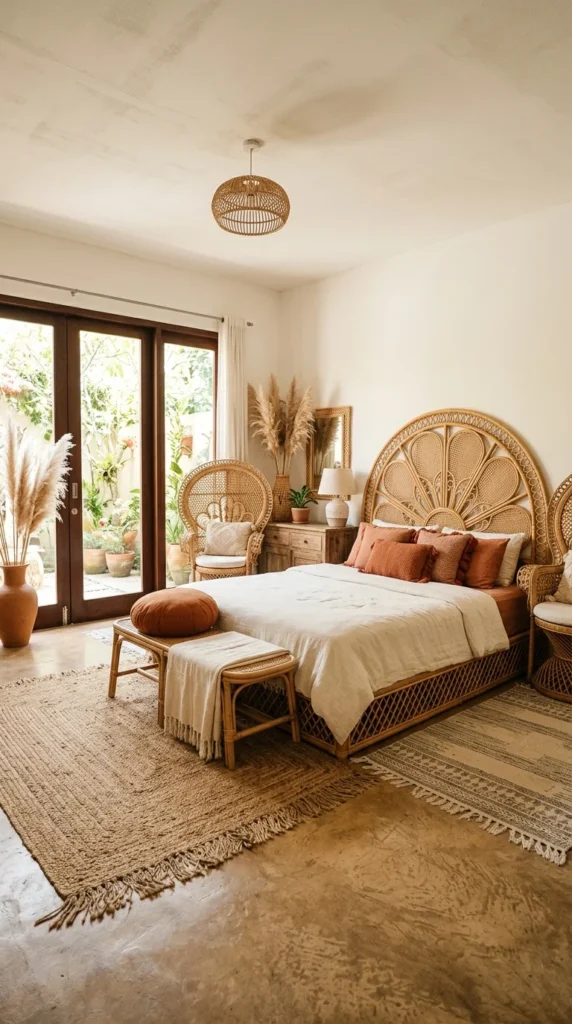
This bedroom leans on a full sunburst-fan rattan headboard as its structural anchor, then repeats that same fan shape in the pendant light and the peacock chairs flanking the French doors. It’s a good starting point precisely because it shows what a rattan bed frame looks like when it’s allowed to be the loudest thing in the room, rather than one accent among many.
Should you choose a fan-shaped headboard? Say yes if your room already has a strong natural-light source—this one backs onto garden-facing French doors—because the open weave needs light passing through it to read as detail rather than just a beige wall of texture. Say no if your bedroom is small or dim; a headboard this tall and open will visually shrink a cramped room instead of opening it up.
It suits homeowners who want a statement bed rather than a supporting one, and it pairs naturally with a terracotta and rust accent palette, jute layered rugs, and a large floor vase for dried pampas grass. The lifestyle fit is relaxed and slow—this isn’t a look for a minimalist who wants visual quiet at the end of the day.
The strongest advantage is scale: one headboard does the decorating work of an entire accent wall. The compromise is upkeep—the open cane pattern collects dust in every gap, and it needs a vacuum brush attachment weekly, not a wipe-down. To recreate it affordably, pair a budget rattan or faux-rattan headboard with a plain platform base and invest the saved money into one genuinely good rattan pendant instead of matching every piece.
A Fan That Repeats Itself on Purpose The headboard’s radiating fan shape isn’t isolated—it echoes in the pendant light above and the peacock chair in the corner. That kind of repetition is one reason a boho room like this reads as intentional rather than assembled piece by piece; swapping just one of those fan-shaped pieces for something angular would likely loosen that visual thread.
Recommended Materials: Natural rattan cane, jute rug, linen bedding, terracotta ceramics, wicker pendant shade
Main Colors: Warm Terracotta, Rust, Natural Rattan Tan, Off-White
Best Lighting: Lean on the garden-facing French doors for daytime light; add one warm-toned rattan pendant for evenings rather than harsh overhead lighting.
Keeping the Weave Actually Clean
- Skipping regular dusting until cane fibers start looking grey instead of golden
- Pushing the headboard flush against a damp exterior wall, which can warp the weave over time
- Mixing in cool-toned grey textiles that fight the warm terracotta palette
- Overcrowding the headboard with too many pillow layers so the fan shape disappears
2. A Caned Headboard Working Against Charcoal and Rust
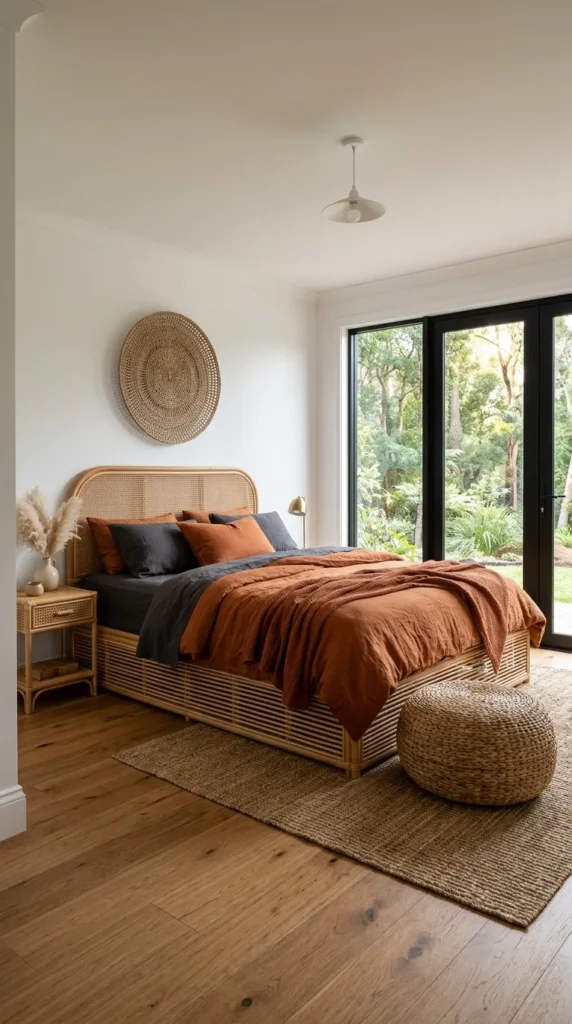
Where most rattan bedrooms lean soft and neutral, this one pushes the frame into darker territory—a rectangular caned headboard paired with charcoal bedding and a rust-orange throw. It’s proof that rattan bed frames aren’t locked into pastel boho; they can anchor a moodier, more graphic palette just as easily.
Should you go bold with your bedding instead of your bed frame? Yes, if you already like the honey tone of natural rattan and don’t want to paint or stain it—let the linens carry the drama instead. This matters most in a bedroom with strong natural light, like the black-framed garden doors here, because dark bedding against pale wood can look muddy without enough daylight to separate the tones.
This direction suits people who find fully neutral boho bedrooms a little flat and want more visual weight, especially in a primary bedroom that also functions as a retreat at the end of a long day. It supports a slightly more grown-up, less “beachy” version of boho.
The advantage here is contrast—the light cane against dark linens does most of the design work with almost no extra styling. The compromise is that charcoal bedding shows dust and pet hair faster than lighter tones, which matters if the room gets heavy daily use. To simplify this on a budget, keep the rattan pieces minimal (headboard and one nightstand) and spend the bulk of the budget on quality charcoal linen bedding, since that’s what’s actually carrying the look.
Scale Kept Deliberately Low The headboard sits close to the mattress height rather than towering above it, which keeps the room feeling grounded instead of top-heavy—a real risk with rattan headboards this wide. That restrained proportion is what lets the bold bedding colors take the lead without the frame competing for attention.
Recommended Materials: Woven cane, engineered oak flooring, linen bedding, woven jute pouf, rattan side table
Main Colors: Charcoal Grey, Rust Orange, Natural Cane, Warm Oak
Best Lighting: A single pendant over the nightstand works better here than a lamp, since dark bedding needs a focused warm light source rather than an ambient glow to avoid feeling flat
Where This Look Falls Apart
- Choosing cool-white bedding that clashes with the warm rattan undertone
- Skipping a rug, which leaves dark bedding floating awkwardly on light wood floors
- Using black hardware on the nightstand when the room’s warmth calls for brass or natural wood pulls
- Letting the charcoal duvet dominate without a warm accent (like the rust throw) to balance it
3. An Elegant Fan Headboard for Taller, Formal Rooms
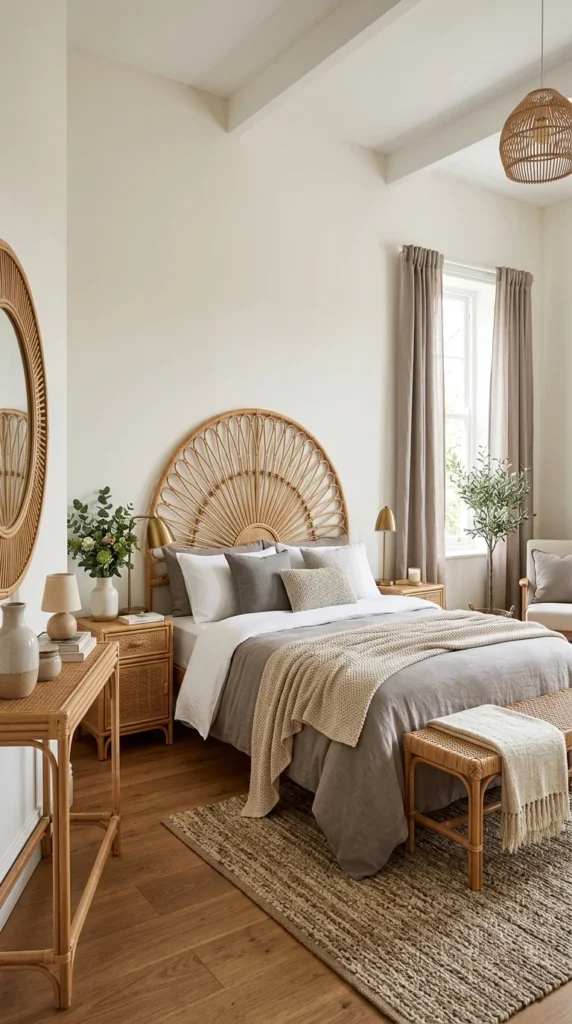
This bedroom takes the same peacock-fan silhouette as the terracotta room but shifts the entire palette into soft grey and taupe, paired with brass lamps, a round rattan mirror, and a rattan console. The result feels considerably more formal—closer to a boutique hotel than a beach cottage—which shows how much palette alone can change what a rattan frame communicates.
Should you pick this over the warmer terracotta version? Choose this direction if your room has genuine architectural height—exposed beams and tall walls, as seen here—because a fan headboard this large needs vertical space above it to avoid feeling cramped against the ceiling. In a standard 8-foot-ceiling room, this same headboard can look oversized rather than elegant.
It’s a strong fit for anyone who wants boho texture without boho color—a homeowner furnishing a primary suite that also needs to feel calm and resale-friendly, not overtly trend-driven. The muted grey-beige palette ages well and doesn’t date the way saturated boho colors sometimes can.
The advantage is versatility—this palette will outlast most color trends. The trade-off is cost: brass fixtures, a rattan console, and a round mirror this size add up quickly compared to the terracotta room’s more budget-driven styling. To simplify it, keep the rattan headboard and one brass lamp, and swap the console and matching mirror for simpler, less expensive pieces until a budget allows an upgrade.
Where the Eye Actually Lands First Because the walls, curtains, and bedding all sit in the same tonal family, the only real contrast in the room comes from the brass lamp bases and the headboard’s woven texture—which is exactly where your eye goes first when you walk in. That’s a deliberate sightline decision, not an accident of matching furniture.
Recommended Materials: Rattan cane, brass fixtures, linen curtains, wool-blend throw, oak flooring
Main Colors: Warm Taupe, Soft Grey, Brass Gold, Natural Rattan
Best Lighting: Twin brass table lamps at headboard height do more here than an overhead fixture—this room is built around pooled, low light rather than bright ambient light.
A Small-Scale Risk That Pays Off Here
- Placing this headboard style in a room with standard 8-foot ceilings, where it can look oversized
- Mixing warm brass with cool silver accents in the same sightline
- Choosing patterned bedding that competes with the headboard’s own woven pattern
- Skipping the console table, which is what balances the headboard’s visual weight on the opposite wall
4. A Fan Headboard Framed by Twin Rattan Pendants
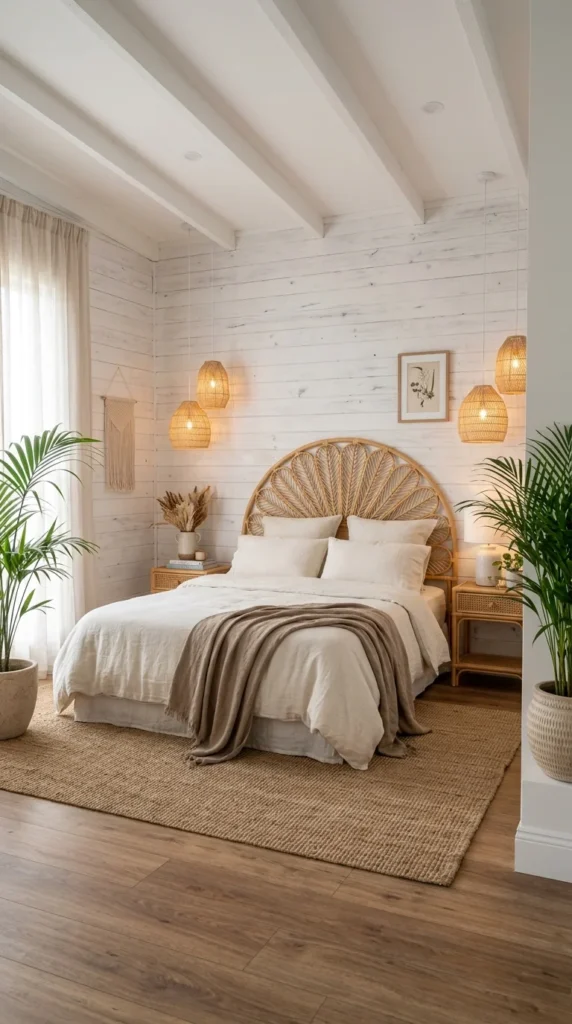
Here the rattan headboard is only half the story—it’s flanked symmetrically by two pairs of glowing rattan pendant lights against a whitewashed shiplap wall, turning the whole headboard wall into a single lit composition rather than a bed with a lamp on either side.
Should you build your lighting around the headboard or add it as an afterthought? Build it in from the start if you’re working with a shiplap or wood-plank accent wall like this one, because the warm pendant glow is what keeps all that pale wood from reading as cold or clinical. Skip this approach if your ceiling height or wiring won’t easily support four hanging fixtures—it’s a bigger commitment than a pair of table lamps.
This style suits renters and first-home buyers who want a coastal-boho bedroom that still feels considered, not thrown together, and who are willing to invest in lighting as the statement rather than furniture. It’s a strong fit for guest rooms and primary bedrooms alike, especially in beach or lake-adjacent homes.
The advantage is atmosphere—warm rattan pendant light against white shiplap creates a golden-hour glow any time of day. The compromise is installation: four hanging fixtures typically mean an electrician or a serious commitment to plug-in pendant kits, which is more effort than swapping a lamp. To simplify this, start with two pendants instead of four and add a simple ceramic table lamp as a stand-in until the second pair is installed. If you also like layered wall texture, our 10 slatted wood wall designs cover a related plank-wall approach worth comparing.
How the Cane Actually Behaves Under This Light: The rattan cane reads noticeably warmer under the pendant’s ambient glow than it does in flat daylight, and over months of evening use, the honey tones in the weave tend to deepen slightly rather than fade—the opposite of what direct sun does to it. That’s worth knowing before assuming rattan needs to sit near a window to look its best.
Recommended Materials: Rattan cane, whitewashed shiplap panels, linen bedding, jute rug, woven pendant shades
Main Colors: Whitewash, Natural Rattan Tan, Warm Amber Light, Soft Taupe
Best Lighting: The twin rattan pendants are the actual light source here—keep them on a dimmer so the room can shift from bright morning light to a low amber glow at night.
Easy Ways to Get This Wrong
- Hanging the pendants at mismatched heights, which breaks the symmetry that makes this wall work
- Using cool white bulbs instead of warm-temperature bulbs in the pendants
- Skipping the shiplap or plank wall, which is what gives the pendants somewhere to visually “land”
- Overloading the headboard wall with extra art that competes with the pendant symmetry
5. A Caned Panel Frame Set Against a Living Green Wall
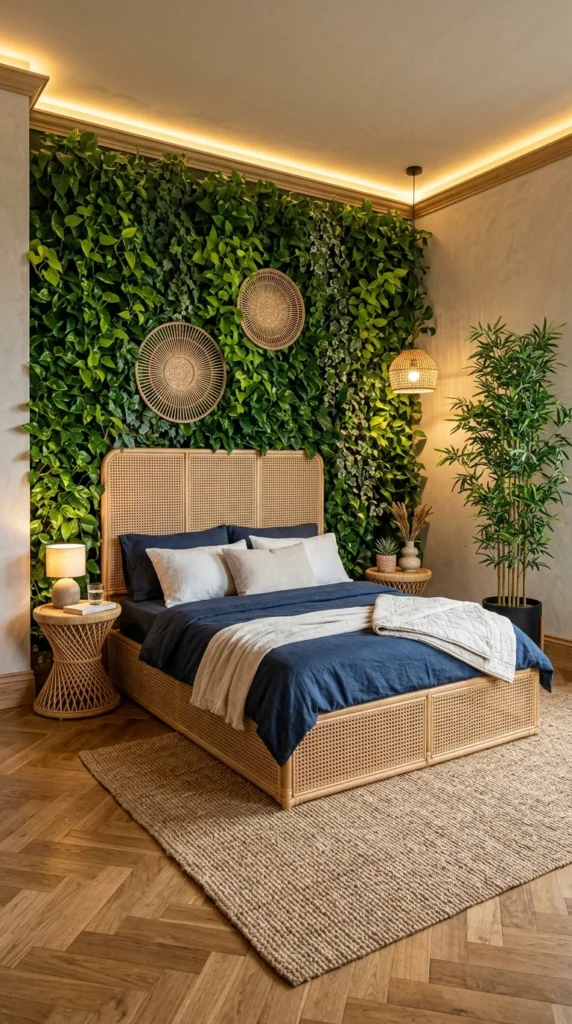
This is the most dramatic entry on this list—a caned three-panel rattan headboard set directly against a full living green wall, with navy bedding and warm cove lighting pulling the whole scene into jungle-retreat territory. It’s less about the bed frame itself and more about what happens when a rattan frame is used as the neutral anchor for a much bolder backdrop decision.
Should your bed frame or your wall be the star? Let the wall win here—the caned panels are intentionally simple and low-contrast so they don’t fight the green wall for attention. This only works if you’re genuinely committed to living-wall maintenance; if you’re not ready for that upkeep, this specific combination isn’t the one to copy.
It’s best suited to plant lovers with a warm-climate home or a well-humidified room and to anyone chasing a biophilic, jungle-adjacent aesthetic rather than a soft neutral boho look. The navy bedding signals this is meant to feel bold and enveloping at night, not airy and bright.
The advantage is atmosphere; no other style on this list can match—nothing reads as “escape” quite like a living wall. The compromise is real: living walls need irrigation, humidity control, and pruning, which is a genuinely different maintenance category than dusting a headboard. To simplify this without a full living wall, use large potted plants and one framed botanical print instead, keeping the caned rattan headboard and navy bedding as the core of the look.
Two Circular Forms Doing the Same Job Twice The round woven wall discs above the headboard and the hourglass-shaped rattan side tables both use circular, waist-narrowed silhouettes—a quiet repetition that keeps the room’s many textures (living wall, cane, wood) feeling like one coordinated idea rather than several competing ones.
Recommended Materials: Caned rattan panels, live plant wall, parquet wood flooring, jute rug, navy linen
Main Colors: Deep Navy, Living Green, Natural Rattan, Warm Amber
Best Lighting: Warm LED cove lighting along the ceiling edge does double duty—it flatters the plant wall’s texture and keeps the navy bedding from reading as too dark or heavy.
Maintenance Guide A living wall needs a scheduled watering system (drip irrigation is far more reliable than manual watering), consistent humidity, and monthly trimming to keep growth even. Budget realistically for this before committing—it’s the single highest-upkeep element in this entire guide.
What Trips People Up Recreating This
- Installing a living wall without adequate humidity control, causing patchy die-back
- Choosing a caned headboard with too much detail, which competes visually with the plant wall
- Skipping the cove lighting, which is what keeps the navy bedding from looking flat and dark
- Underestimating ongoing plant-wall maintenance costs before installation
6. A Slatted Rattan Headboard Anchoring a Macrame Gallery Wall
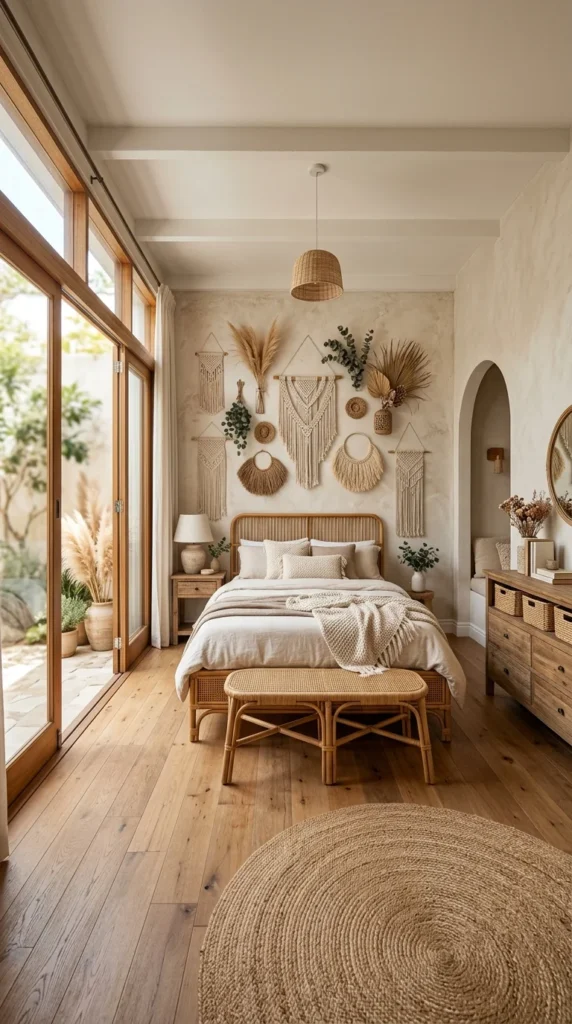
This narrow, light-filled bedroom pairs a vertical slatted rattan headboard with an entire gallery wall of macrame hangings, dried palm fronds, and eucalyptus—treating the headboard as one texture layer among several rather than the single hero piece. It’s the most “collected over time” bedroom on this list, and it shows how rattan bed frames can work as a supporting player instead of a centerpiece.
Should you build a full macrame gallery wall or keep the wall simple? Go for the gallery wall if your headboard is relatively understated—like this slatted design—because a busier headboard and a busy macrame wall together would create visual competition rather than harmony. If your bed frame is already a bold peacock-fan shape, skip the gallery wall and keep the surrounding walls calm instead.
This direction suits people who enjoy curating and swapping decor over time rather than committing to one fixed styling scheme, and it works especially well in narrow rooms where the eye needs somewhere interesting to travel since there’s limited floor space to decorate.
The advantage is flexibility—macrame pieces are inexpensive and easy to rearrange or add to over time, unlike a fixed headboard. The compromise is that a wall this layered takes real time to curate well; done in a rush, it can look cluttered rather than intentional. To simplify it on a budget, start with three macrame pieces in varying sizes rather than the full seven or eight shown here, and add more gradually.
A Wall That Pulls the Eye Vertically First In a narrow room like this one, the macrame gallery wall is what stops your eye from just following the length of the room toward the French doors—it gives you a vertical stopping point right at the headboard, which is a deliberate way to make a long room feel more like a destination than a hallway.
Recommended Materials: Slatted rattan/wood headboard, cotton macrame, dried pampas and palm, rattan dresser, jute round rug
Main Colors: Warm Plaster, Natural Rattan, Cream Cotton, Sage Green
Best Lighting: Rely on the floor-to-ceiling French doors for daytime light and add one warm rattan pendant for evening—avoid spotlighting the gallery wall directly, which can flatten the macrame’s texture.
Making This Bedroom Work at Bedtime
- Keep the headboard wall’s lighting warm and dimmable, since the macrame pieces read best in soft, low-contrast light
- Choose bedding in a single neutral tone so it doesn’t compete with the gallery wall’s texture
- Leave breathing room between hangings rather than packing the wall edge to edge
- Anchor the room with one larger rattan furniture piece (the dresser) so the space doesn’t feel like all small objects
Where This Look Falls Apart
- Hanging macrame pieces at random heights instead of a loosely intentional grid
- Choosing a busy patterned headboard that competes with the gallery wall above it
- Skipping the dried florals, which is what keeps the wall from feeling purely decorative rather than organic
- Overcrowding the narrow room with too much floor furniture, leaving no walking space
7. A Caned Frame Matched to Tropical Leaf Print Bedding
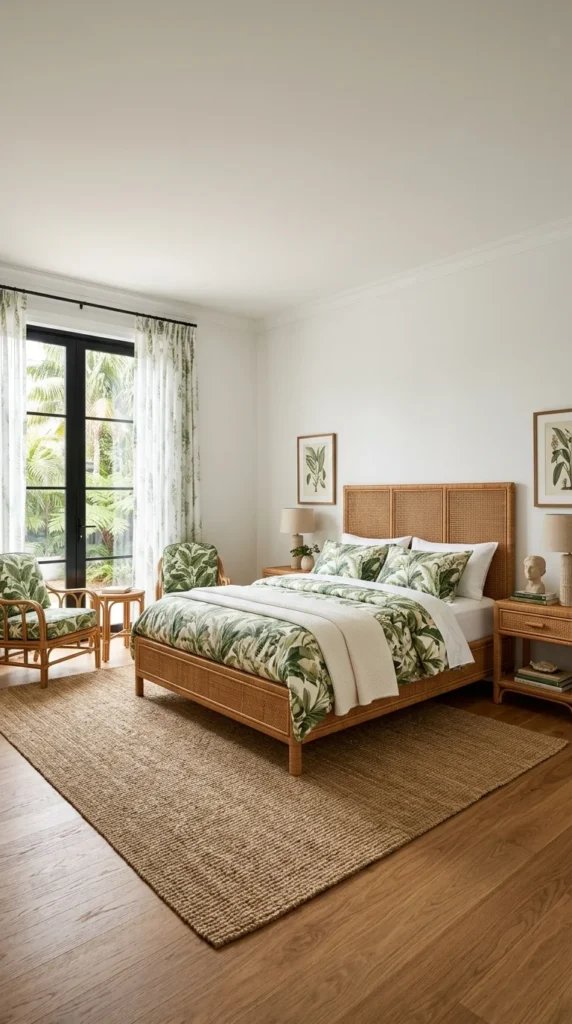
This bedroom commits fully to a tropical resort theme—a rectangular caned rattan headboard and matching wood-and-cane bed frame paired with palm-leaf print bedding, and the same print reupholstered onto the accent chair. It’s the most pattern-forward entry here, and it demonstrates how a rattan frame can act as a quiet, neutral base that lets a bold print carry the entire room.
Should your rattan frame match your bedding pattern or contrast it? Match them if you want a resort- or hospitality-style finished look—matching the chair fabric to the bedding, as done here, is what gives this room its coordinated feel. Contrast them instead if you’re worried about the room feeling themed rather than personal; a busy tropical print needs a genuinely simple, uncluttered rattan frame underneath it to avoid looking overdone.
This style suits homeowners in warm climates or anyone furnishing a vacation or guest bedroom where a strong, memorable theme is a feature, not a flaw. It’s less suited to a primary bedroom used daily long-term, since bold pattern-matching like this tends to feel more novel than restful over years of use.
The advantage is instant cohesion—matching the print across bedding and upholstery takes almost no additional styling decisions. The compromise is longevity: trend-driven prints like this can feel dated faster than a neutral rattan frame styled with solid linens. To simplify it, keep the caned frame and botanical art, but choose solid cream or white bedding instead of committing to the full leaf print—you can always add printed throw pillows later.
A Headboard Sized to Match Its Pattern’s Scale The headboard’s paneled width is wide enough to display the leaf print’s large-scale motif without cropping it awkwardly, which is a proportion decision that matters more than it looks—a narrower caned headboard would cut the leaves off mid-pattern and read as a mistake rather than a choice.
Recommended Materials: Caned rattan and wood frame, cotton-linen leaf print, oak flooring, jute rug, botanical framed prints
Main Colors: Forest Green, Cream, Natural Rattan, Warm Oak
Best Lighting: The palm-view window is doing the real work here—keep window treatments sheer rather than heavy so daylight stays strong enough to keep the green print from reading as dark or heavy.
Common Mistakes Recreating This Room
- Choosing a print scale too small for the headboard width, making the pattern look busy instead of bold
- Skipping the matching upholstered chair, which is what pulls the print into a full theme rather than a single accent
- Using heavy blackout drapes that block the daylight this palette depends on
- Adding too many additional patterns (rugs, throws) on top of the leaf print, which overwhelms the room
8. A Branch-Style Rattan Canopy Bed Set Against Dark Botanical Wallpaper
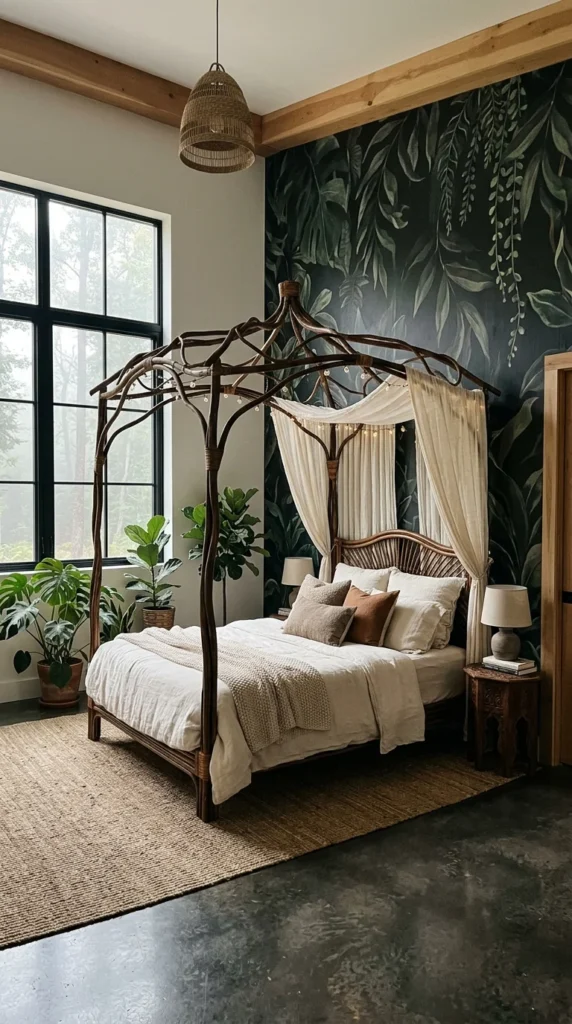
This is the most architecturally ambitious frame in the entire lineup—a four-poster canopy built from twisted branch-like rattan, draped in sheer curtains and fairy lights, and set against near-black botanical wallpaper. Unlike every other entry here, the “bed frame” isn’t a headboard at all; it’s a full standalone structure that changes the entire room around it.
Should you commit to a canopy frame, or is a headboard enough? Choose a canopy only if you have real ceiling height and want the bed to function as the room’s architecture, not just its furniture—this only works because the ceiling has enough clearance for the branch structure to feel intentional rather than cramped. If your room is low-ceilinged or already busy with furniture, a canopy this dramatic will overwhelm rather than elevate it.
It suits homeowners who want their bedroom to feel like a designed retreat or even a boutique-hotel suite and who don’t mind a bed frame that dominates the room’s visual identity. It’s a poor fit for anyone who prioritizes a calm, low-stimulation space for sleep, since the branch structure and dark wallpaper create real visual drama, not restfulness.
The advantage is that nothing else on this list creates the same sense of occasion—this bed frame alone makes the room feel finished with almost no other decor needed. The compromise is cost and commitment: a structural canopy like this is a genuine furniture investment, not something you casually swap out in a few years. To simplify it on a smaller budget, use a simpler four-post rattan frame without the twisted-branch detailing, and add sheer curtains and string lights as the more affordable version of the same drama.
Is a Branch Canopy Frame Actually Worth It? Honestly, this is the one piece on this list I’d think hardest about before buying. A structural canopy like this is a genuine investment—it’s harder to resell and harder to move and commits the whole room to one aesthetic. But if you have the ceiling height and you’re genuinely drawn to a dramatic, editorial bedroom rather than a calm one, few other single pieces of furniture do this much visual work on their own.
How the Branch Material Ages Twisted rattan and wood branch-style frames like this develop richer, darker tonal variation over years as the material is handled and exposed to ambient light—closer to how a wood banister patinas than how a painted headboard fades. That’s part of the appeal for buyers who want the piece to look more characterful over time, not less.
Recommended Materials: Twisted rattan/wood branch frame, dark botanical wallpaper, sheer linen curtains, string lights, jute rug
Main Colors: Near-Black Botanical Green, Natural Rattan, Warm Cream, Amber String Light
Best Lighting: String lights woven through the canopy structure are doing the ambient lighting here—pair with one warm table lamp rather than overhead lighting, which would flatten the dark wallpaper’s depth.
What Trips People Up Recreating This
- Choosing a canopy frame without confirming ceiling clearance first, resulting in a cramped feel
- Pairing dark wallpaper with cool-white string lights instead of warm amber tones
- Skipping the sheer curtains, which is what softens the branch structure’s otherwise heavy silhouette
- Overfilling the room with additional furniture that competes with the canopy’s scale
9. A Caned Panel Frame Built Around a Single Ocean-View Window
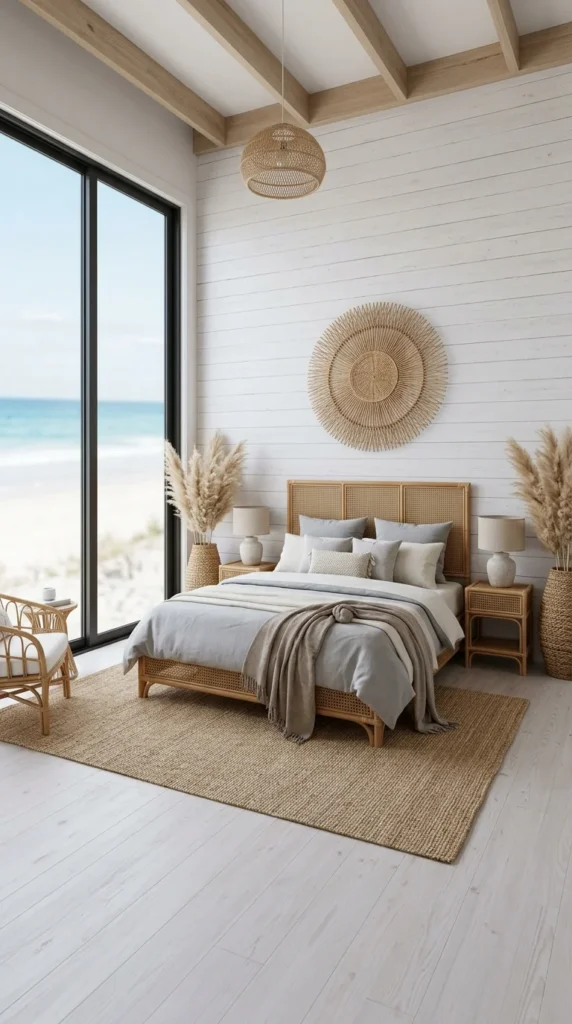
This coastal bedroom keeps everything quiet—whitewashed shiplap walls, a simple caned rattan headboard, and a soft grey-blue palette—so that the one wall of glass overlooking the beach can do all the visual work. It’s a useful contrast to the living-wall and canopy entries above, showing how restrained a rattan frame can be when the view itself is the room’s real feature.
Should you decorate around a view or keep the room independent of it? Decorate around it if you genuinely have a strong, unobstructed view like this—every color choice here, from the pale rattan to the grey-blue linens, is picked to echo the sand and water outside rather than compete with it. If your window view is unremarkable, this exact restrained approach will just look under-decorated; add more textural layers instead.
This style suits coastal and lake-house homeowners furnishing a primary bedroom meant to feel calm and uncomplicated, and it works especially well for owners who want a space that photographs well without needing constant restyling. It’s a poor fit for anyone who wants a cozier, more layered bedroom—this look depends on negative space to feel intentional rather than sparse.
The advantage is low-maintenance styling—a palette this restrained rarely looks “wrong” and needs very little seasonal refreshing. The compromise is that without the view, the room could read as underfurnished; this look genuinely depends on the window doing real visual work. To simplify it without an ocean view, add one more textural layer (a woven wall piece or extra throw) to compensate for the missing focal point.
One Radial Shape, Repeated at Two Scales The round rattan sunburst wall piece above the headboard echoes the woven texture of the caned headboard itself, just at a smaller, more graphic scale—a subtle repetition that ties the wall decor back to the bed frame without needing to match them exactly.
Recommended Materials: Caned rattan headboard, whitewashed wood paneling, linen bedding, jute rug, woven pampas baskets
Main Colors: Soft Grey-Blue, Whitewash, Natural Rattan, Sandy Beige
Best Lighting: The floor-to-ceiling ocean-facing window is the star here—keep artificial lighting minimal and warm (two simple table lamps) so it doesn’t compete with natural coastal light during the day.
Easy Ways to Get This Wrong
- Adding too much pattern or color, which fights the calm, view-led palette this room depends on
- Choosing cool-white bedding instead of a warm-adjacent grey, which can look sterile against natural light
- Blocking the window with heavy drapery instead of letting it stay fully open
- Skipping textural layers entirely, leaving the room feeling empty rather than restrained
10. A Peacock-Fan Frame With a Matching Footboard and Floral Print
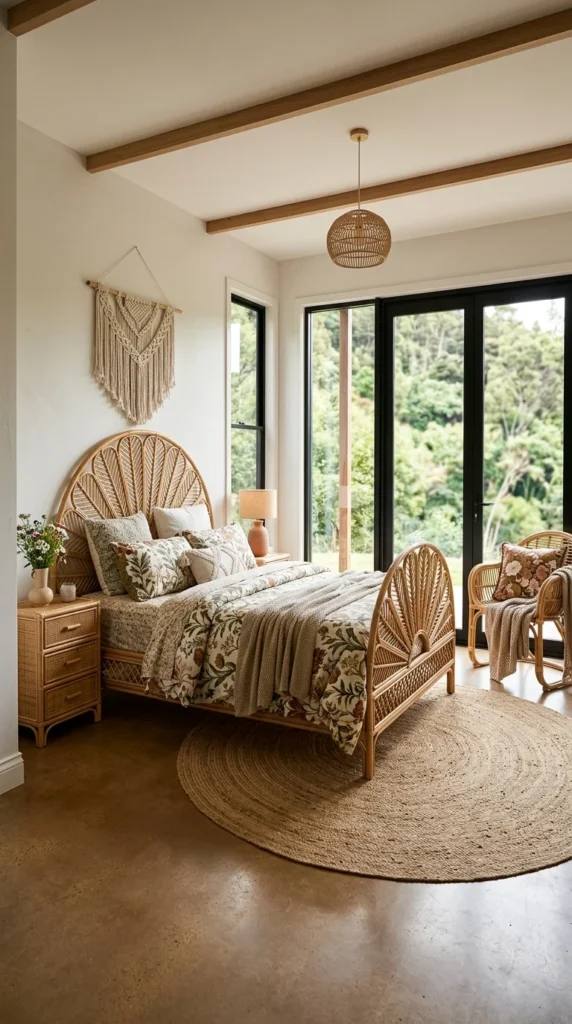
This is the only bed on the list with a matching rattan footboard as well as a headboard, both in the same peacock-fan silhouette, styled with a vintage-inspired floral print and a single macrame wall hanging. It reads more romantic and garden-cottage than any other entry here, and it shows how a fuller rattan frame changes a room’s mood even when the surrounding palette stays fairly neutral.
Should you invest in a matching footboard or stick with a headboard only? Choose the full frame if the bed is visible from multiple angles in the room—a footboard this decorative is wasted if it’s pushed against a wall where no one sees it. Skip it if your room is small, since a footboard adds real visual bulk and makes the bed harder to navigate around, especially with a round rug at its base like this one.
It suits homeowners who love a softer, more traditional cottage-boho look—floral prints, warm wood tones, curated nightstand styling—over the starker, more graphic rattan looks elsewhere on this list. It’s a strong fit for guest rooms and primary bedrooms in older or farmhouse-style homes where a fully modern look would feel out of place.
The advantage is that the matching footboard makes the bed itself feel like a complete, furniture-grade piece rather than a headboard with a mattress in front of it. The compromise is floor space—a footboard functionally extends the bed’s footprint, which matters in anything but a fairly generous bedroom. To simplify this on a budget, choose the headboard-only version of the same design and add a rattan bench at the foot of the bed instead, which gives a similar visual bookend without the added length.
Where the Fan Shape Draws the Eye Downward Most peacock-fan headboards keep your eye at pillow height, but repeating the fan shape at the footboard pulls attention down the full length of the bed instead—which is part of why this room reads as more furniture-forward and less purely “headboard as wall art” than the other fan-style rooms in this guide.
Recommended Materials: Rattan cane, floral cotton-linen bedding, macrame cotton, jute round rug, three-drawer rattan nightstand
Main Colors: Warm Cream, Sage Green, Dusty Rose, Natural Rattan
Best Lighting: A single warm ceramic table lamp at nightstand height suits this softer, cottage-style room better than a statement pendant, which would feel too modern against the floral print.
Sleep Comfort Tips
- Keep the footboard low enough that it doesn’t obstruct airflow or make the bed feel enclosed
- Choose breathable cotton-linen bedding over synthetic florals, which trap more heat overnight
- Leave clear walking space on at least one side of a footboard bed to avoid nighttime obstacles
- Balance a busy floral print with solid, higher-thread-count pillowcases closest to the skin for comfort
What Trips People Up Recreating This
- Choosing a footboard frame for a small room, where it restricts walking space more than expected
- Mismatching the headboard and footboard finish, which breaks the “complete frame” effect
- Overloading the bed with too many floral throw pillows, which can visually shrink the room
- Skipping the round rug, which is what keeps the footboard from looking like it’s floating on a bare floor
More Bedroom Directions Worth Comparing
Rattan pairs naturally with a handful of other bedroom styling choices covered elsewhere on the site:
Related Guides
- 10 Boho Bedroom Looks That Feel Curated, Not Cluttered—more ways to layer rattan, macrame, and pattern without overdoing it
- Rattan and Light: 10 Boho Sunroom Looks Worth Copying—see how rattan behaves in a brighter, plant-filled adjacent space
- Japandi Bedroom Design: 10 Ways to Create a Minimalist Cozy Retreat—a calmer, more pared-back alternative to full boho styling
- 10 Rug Styles That Make Any Bedroom Feel Cozier—helpful if you’re choosing the jute or wool rug to pair with your rattan frame
- 10 Ideas to Build the Bedroom Around a Black Bed Frame—a useful contrast if you’re weighing rattan against a darker, more modern frame
Budget Summary
| Budget | Expectation |
|---|---|
| Low | Faux-rattan or rattan-veneer headboard, budget jute rug, simple linen bedding |
| Medium | Solid rattan cane headboard, rattan nightstand, one statement pendant light |
| Premium | Full matching rattan bed frame with footboard, structural canopy piece, living wall, or brass fixtures |
Who Should Choose This Style?
- Best for warm-climate or coastal homeowners who want texture without heavy furniture
- Best for renters and first-home buyers, since many rattan pieces are lightweight and easy to move
- Best for anyone who wants a bedroom that feels layered and lived-in rather than showroom-perfect
- Not ideal for households with young pets that chew, since open cane weave is easy to damage
- Not ideal for anyone who wants a strictly minimalist, texture-free bedroom
FAQ
Is a rattan bed frame sturdy enough for daily use? Yes, when built on a solid wood or metal frame with rattan used for the headboard, footboard, or accent panels rather than the structural base. Always check the weight rating before buying, especially for larger bed sizes.
Does rattan work in a cold or dry climate? It can, but natural rattan can dry out and become brittle in very low humidity, so a light misting or humidifier nearby helps preserve the weave. Faux-rattan or rattan-look resin frames avoid this issue entirely if you live somewhere very dry.
How do you clean a rattan headboard? A soft brush attachment on a vacuum, followed by a slightly damp (not wet) cloth, handles most dust and buildup. Avoid soaking the cane, since trapped moisture can encourage mold in the weave over time.
Can rattan bed frames work in a small bedroom? Yes, if you choose an open-weave headboard-only design rather than a full canopy or footboard frame, since the visible weave keeps the piece from feeling visually heavy in a tight space.
Author Box
Written by the Aesthetic Lifes Editorial Team—home decor writers and stylists covering real, buildable bedroom and living space ideas, from budget-friendly swaps to full design overhauls.
Conclusion
Ten different rooms, one shared material—and ten genuinely different answers to what a rattan bed frame can be. Some of these lean warm and terracotta-soaked, some go moody and modern, and one commits fully to a structural branch canopy most bedrooms will never need. The point isn’t to copy one exactly; it’s to notice which room you kept picturing yourself waking up in and start there.
Explore More
You may also enjoy:
2 Responses