

There’s a reason Japandi keeps showing up in bedroom design searches long after most trends have faded. It isn’t loud. It doesn’t ask for attention. What it asks for, instead, is restraint—and that’s precisely why it works in real homes, not just styled photoshoots.
The style borrows from two design philosophies that, on paper, shouldn’t blend as easily as they do. Japanese minimalism brings a kind of quiet discipline: low furniture, natural materials, negative space treated as a feature rather than an oversight. Scandinavian design contributes the warmth—the wood tones, the soft textiles, the sense that a room should still feel lived-in even when it’s spare. Together, they cancel out each other’s extremes. Japanese minimalism alone can feel austere. Scandinavian design alone can drift into clutter. Japandi sits in the middle, and that middle ground is what makes it livable long-term rather than just photogenic for a season.
A Japandi bedroom isn’t defined by a shopping list. It’s defined by a handful of decisions, repeated with discipline: a limited palette, natural materials over synthetic ones, furniture kept low and unobtrusive, and enough empty space left alone that the room can breathe. Below are ten bedrooms that show what those decisions look like when they’re actually applied—not as abstract theory, but as rooms someone could realistically sleep in.
1. A Slatted Wood Wall That Makes the Whole Room Feel warmer.
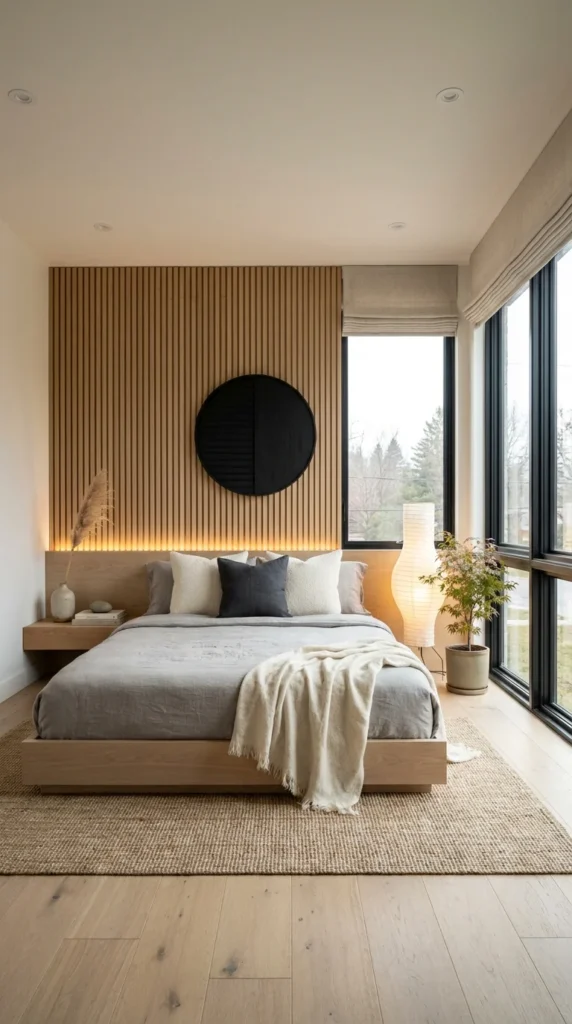
The vertical wood slats behind this bed are doing more work than they first appear to. Reeded paneling like this has become something of a Japandi signature, and here it stretches floor to ceiling in a soft, honey-toned wood—the kind of surface that catches light differently depending on where you’re standing in the room. Behind the headboard, a hidden LED strip washes the base of the slats in a warm glow, which is a small detail, but it’s the one that keeps this wall from reading as flat.
Against all that vertical rhythm, a round black mirror breaks the pattern deliberately. Circles rarely show up in rooms built on straight lines, so when one does, it earns its place – here it interrupts the slats just enough to give the eye somewhere to land before continuing upward.
The bed itself sits low, a platform frame in matching pale wood, dressed in muted grey linen with a cluster of pillows in cream, charcoal, and boucle texture. Nothing about the bedding is trying to impress. A chunky knit throw, tossed rather than styled, adds the one note of deliberate imperfection in an otherwise careful room.
What’s easy to miss: the floating wood nightstand, cantilevered off the wall with no visible legs. That detail alone shifts the whole room from “nicely decorated” to intentionally designed—floating furniture reads as considered in a way that floor-standing pieces rarely do.
A jute rug grounds the pale oak flooring, and a paper floor lamp glows beside the window, doing quiet, ambient work rather than serving as a design statement. Outside the black-framed windows, bare trees suggest late winter—appropriate, given how much this room seems built around the idea of holding warmth in.
2. An Ink-Wash Painting That Sets the Tone for the Whole Room
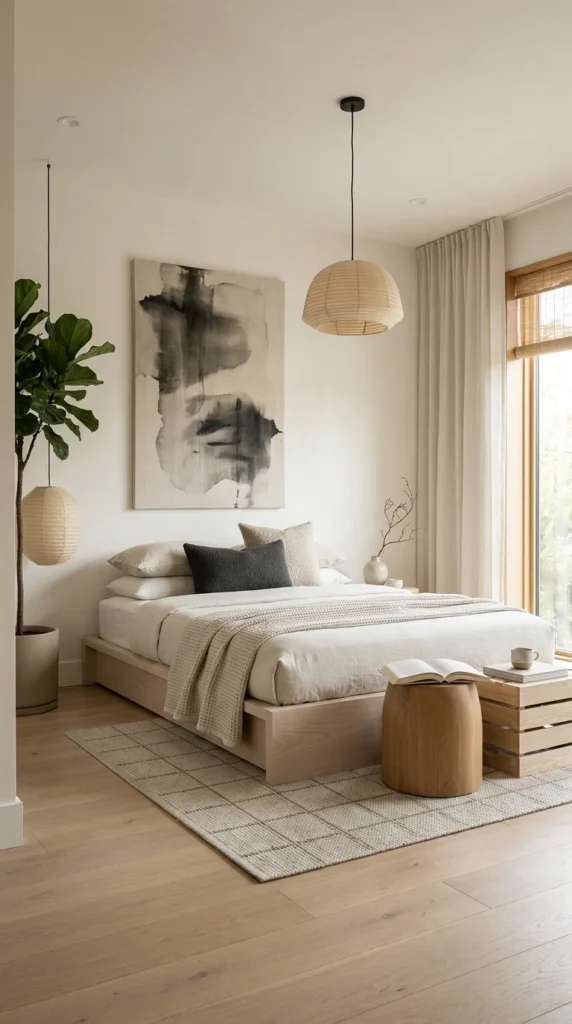
Above this bed hangs a large abstract piece done in loose, bleeding strokes of black on unbleached canvas—the kind of ink-wash painting that owes a clear debt to sumi-e technique. It’s the one object in the room allowed to be expressive. Everything else stays quiet by comparison, which is exactly the point: a Japandi room usually only has room for one loud gesture, and here, that gesture is on the wall rather than in the furniture.
A paper pendant lamp hangs just beside it, unlit but sculptural, its round rice-paper shade echoed by a second, smaller version near the fiddle-leaf fig in the corner. Repeating a single lighting fixture at two different scales is a subtle trick—it ties the far corner of the room back to the bed without anyone quite noticing why the space feels unified.
The bed itself is low and unfussy, a platform frame in pale, unstained wood, dressed almost entirely in warm neutrals: oatmeal linens, a charcoal boucle pillow for contrast, and a waffle-weave throw dropped rather than folded. Nothing here has been arranged with a ruler.
Beside the bed, function takes over from styling. A wooden stool holds an open book and a mug—the kind of detail that suggests someone actually reads in this room rather than staging it to look like they might. A slatted wood crate nightstand sits alongside it, doing the same job as a bedside table without pretending to be more furniture than it is.
Sheer linen curtains soften the tall window, and a woven bamboo blind adds texture without pattern. On the floor, a windowpane-check rug in muted grey is one of the only geometric elements in the room – a quiet nod to structure in a space that otherwise avoids straight lines wherever it can.
3.room—aed Alcove That Turns a Headboard Wall Into Architecture
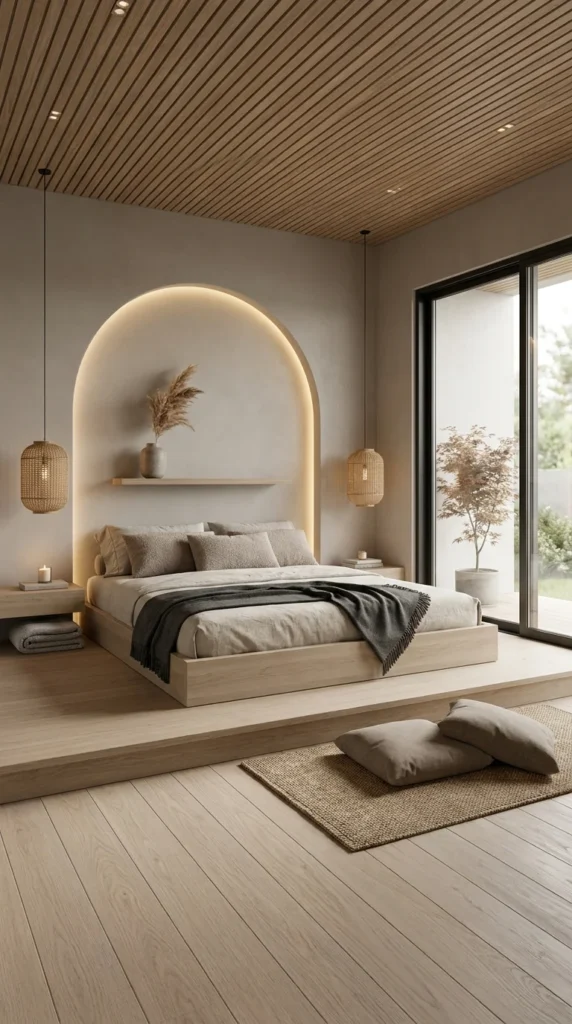
Most bedrooms treat the headboard wall as a flat background. This one doesn’t. A deep, rounded arch has been carved directly into the wall behind the bed, its inner curve lit from below by a soft ring of hidden LED – the kind of detail that reads as architectural rather than decorative, LEDs—thet was clearly planned before the drywall went up, not added afterward.
Inside the arch, restraint takes over again: a single wood shelf holds one ceramic vase with dried pampas grass, and nothing else. That emptiness is doing real work – fill that alcove with more objects and the arch itself stops being the focal point.
Overhead, a slatted wood ceiling repeatwork—fillcal rhythm of the arch’objects,ng, and two woven rattan pendant lights hang at slightly different heights on either side of the bed. Uneven pendant heights like this are usually a deliberate choice, not an oversight – it keeps the symmetry from feeling too exact.
The platform bed sits low on a raised wood dais that runs the width of the room, a level change that does more to define “boversight—it own zone than any wall could. Bedding stays in the expected register—oatmeal linen, a charcoal ribbed throw, a cluster of boucle pillows—but the real detail is at floor level: a woven jute mat below the platform holds two floor cushions, an unmistakable, quiet reference to floor-seating traditions in Japanese interiors.
Sliding glass doors along the side wall bring in a view of a small potted tree just outside, and the whole room is built almost entirely from a single material family—pale oak, warm plaster, and rattan—repeated at every scale from ceiling to floor.
4. A Floating Niche and a View of Bamboo That Does the Rest of the Work
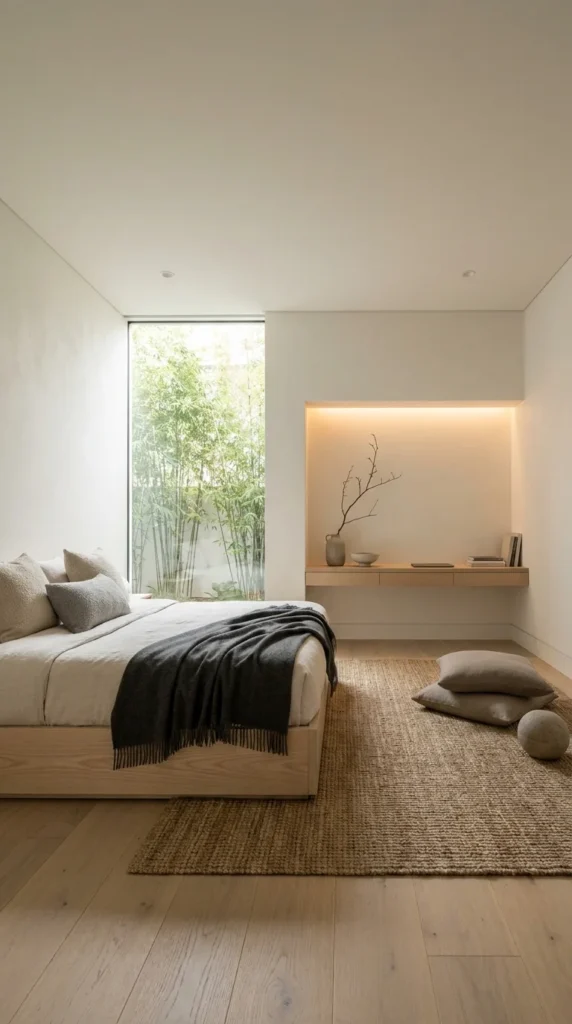
Some rooms lean on furniture to feel finished. This one leans on a window. A narrow, floor-to-ceiling slot of glass runs along the left wall, framing a stand of bamboo just outside like a piece of living artwork—no curtain, no treatment, nothing softening it. Why would you cover a view like that?
Inset into the opposite wall, a recessed niche glows from a hidden light channel above a floating wood shelf. It holds almost nothing: a single ceramic vase with one bare, gestural branch; a small bowl; and a stack of books. That’s it. The restraint here is doing something specific—a shelf this size could easily hold twice the objects, and the choice not to fill it is what keeps the niche looking like architecture rather than storage.
The bed sits low, built from pale, unfinished-looking oak, and is dressed simply: cream linen, a cluster of soft grey and boucle pillows, and a charcoal wool throw tossed on with visible texture rather than folded flat. Nothing about the bedding tries to coordinate with the wood tone exactly—it sits a shade cooler, which keeps the room from feeling monochromatic.
On the floor, a thick jute rug spreads wide beneath the bed, and just beyond its edge, two floor cushions and a single stone-like sculptural object sit with no clear function beyond occupying space thoughtfully. That’s arguably the most Japandi detail in the entire room: an object that exists purely to be looked at, not used.
What this image can’t tell you is how the room sounds – with this much bare plaster and hard flooring, acoustics are worth thinking about before committing to a layout this open.
5. A Cantilevered Bed and a Macrame Hanging That Softens Every Straight Line
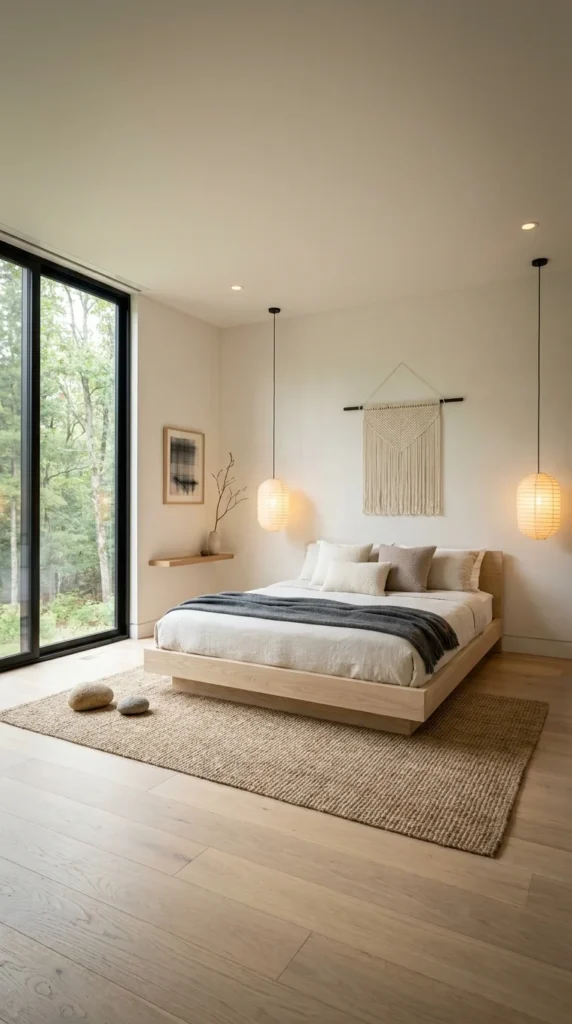
This bed doesn’t quite touch the floor the way most beds do. Its wood frame cantilevers slightly beyond the base, creating a thin shadow gap underneath that makes the whole piece look lighter than its actual mass—a trick more common in furniture design than most people notice, but one that changes how a room reads at floor level.
Above the headboard, a woven macrame wall hanging takes the place of the framed art or ceramic vase that shows up elsewhere in Japandi interiors. Its knotted cotton fringe is the softest object in the room, texturally speaking, and it does something the flat wall behind it couldn’t: it breaks a hard architectural edge with something fibrous and irregular.
Two paper pendant lights flank the bed at slightly uneven heights, glowing amber against the daylight still coming through the floor-to-ceiling window on the left. That window is arguably doing as much for the room as any furniture choice—a wall of trees just outside means the room never fully needs curtains, and the owners seem to know it.
Bedding stays close to the established formula: white linen base, a chunky navy-grey knit throw folded rather than draped, and a small cluster of pillows in cream and taupe. Nothing new here, which is fine—not every element in a room needs to reinvent itself.
What’s worth noticing instead is the floor. A jute rug anchors the bed, and just beside it, two smooth river stones sit with no clear purpose beyond existing quietly. Small, deliberately useless objects like this tend to be the last thing added to a room and the first thing a stylist would remove if the budget got tight—which says something about how considered this space actually is.
6. A Zen Garden Right Outside the Glass, and a Bonsai Standing In as the Only Decoration
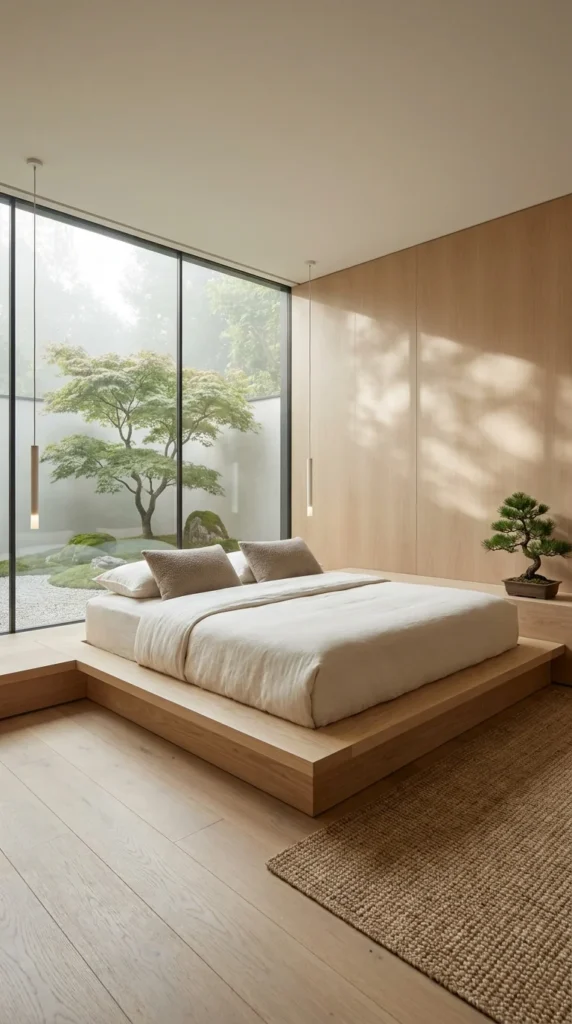
Some rooms borrow the feeling of a Japanese garden through texture and object choice. This one just puts the actual garden outside the window. Beyond the floor-to-ceiling glass, a raked gravel bed, moss-covered boulders, and a single sculpted maple sit inside a walled courtyard – landscaping that’s clearly been designed as carefully as the bedroom looking out onto it. Morning fog softens the scene further, whcourtyard—landscapingoment to have photographed or a very deliberate choice of timing.
Inside, the bed sits directly on a raised wood platform with no visible frame at all—the mattress base and the room’s flooring essentially become one continuous plane of pale oak. This is about as minimal as a bed can get while still being recognizable as one. There’s no headboard, no footboard, nothing to interrupt the platform’s edge.
A single bonsai pine sits on a small built-in ledge beside the bed, and it’s doing something worth noticing: it’s the only living, textured, imperfect object in an otherwise smooth, planar room. Everything else here is flat surface – wood paneling on the wall, a jute rug on the floor, linen on the bed. The bonsai’s twisted, asymmetrical form is the one thing allowed to look organic rather than milled.
Two slima flat surface—woodp from the ceiling on long cords, barely floor, andr than pencils, and they add almost no visual weight—which matters in a room this pared back, where a heavier fixture would have competed with the view.
Bedding stays in cream and taupe linen, with two boucle pillows providing the only texture contrast in the entire composition. What this photo can’t fully convey is scale – a platform this size, built this low, needs a room with genuine floor area to avoid feeling like it’s swallowing the spscale—ad it.
7. Tatami-Inspired Flooring and a Wall of Shoji Light
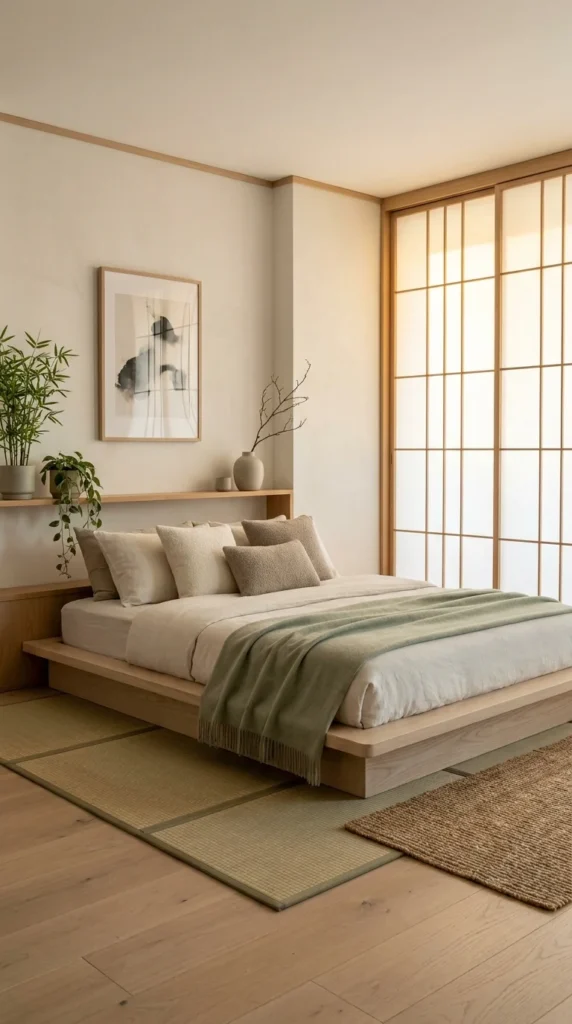
Sunlight pours through a full wall of shoji-style sliding panels here, their grid of wood muntins glowing amber in a way that no ordinary window treatment quite manages. Paper diffuses light differently than glass or fabric—it doesn’t let a room see out, but it lets the room glow, and that distinction is what makes shoji screens read as atmosphere rather than just a window covering.
Below the bed, woven straw-colored mats with a fine grid texture stand in for tatami flooring, laid directly over the pale oak boards rather than replacing them entirely. It’s a partial gesture rather than a full commitment to traditional Japanese flooring, and that restraint is arguably smarter than going all in—a whole room of tatami can feel like a theme; a section of it feels like a nod.
The bed itself sits low on a chunky, slab-like wood platform with almost no ornamentation—no headboard panel, no visible joinery, just mass and proportion doing the work. Bedding builds in layers: a cream linen base, a cluster of taupe and boucle pillows, and a sage-green waffle throw that’s the only real color note in a room otherwise built from neutrals and wood tones.
A built-in wood shelf runs above the headboard at just the right height to hold a framed ink-wash print, a ceramic vase with a bare branch, and a small potted bamboo trailing off one edge. Nothing on that shelf competes for attention—the branch is bare, the print is monochrome, and the plant is unfussy. It’s a study in matching energy levels rather than matching colors.
A jute rug sits at an angle near the foot of the bed, slightly overlapping the tatami mat rather than aligning with it—a small imperfection that keeps the room from feeling over-planned, in a space that could easily have tipped into looking like a showroom rather than somewhere anyone actually sleeps.
8. Shoji-Inspired Screens and a Bed That Goes Dark Instead of Light
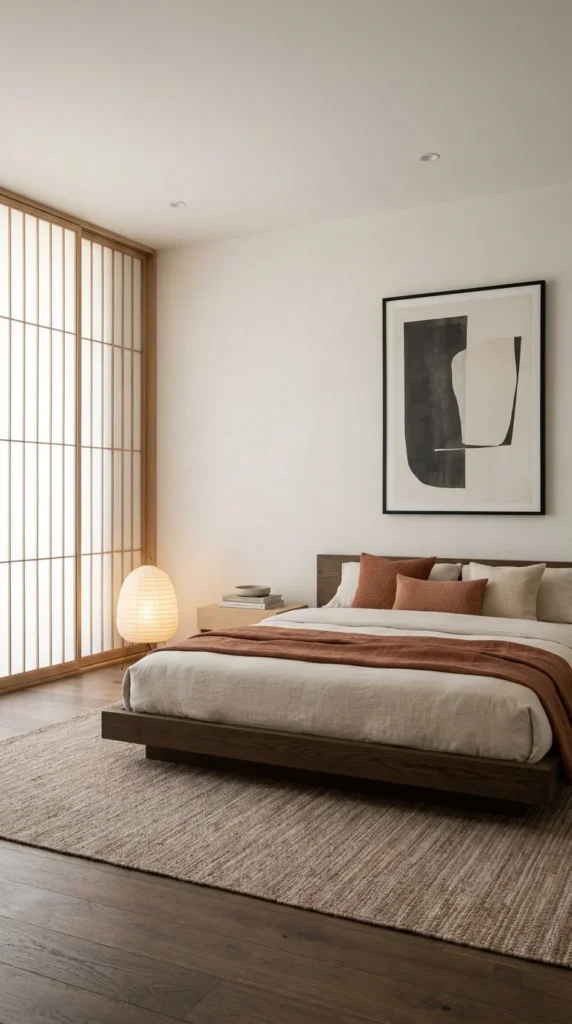
Most Japandi bedrooms lean pale. This one doesn’t, and that choice alone makes it worth including. The platform bed here is built from a deep, near-black stained wood—floating, low, and unapologetically heavy-looking against the lighter floor beneath it. It’s proof that Japandi isn’t a fixed palette so much as a set of proportions and materials; the tone can shift dramatically, and the style still holds together.
Along the far wall, a floor-to-ceiling shoji-style screen does the heaviest lifting in the room. Its grid of wood muntins and diffused paper panels is about as direct a nod to traditional Japanese architecture as this style tends to allow, used here at full scale rather than as a small accent—a braver move than it looks. Get the proportions wrong, and a screen like this can swallow a room. Here, it doesn’t.
A rounded paper floor lamp sits at its base, glowing amber, lighting the screen from below so the panels seem to hold light rather than simply filter it.
On the bed, rust-orange and terracotta pillows break from the neutral palette found almost everywhere else—a warm, earthy accent that ties back to the wood tones without repeating them exactly. A waffle-textured throw in the same rust shade drapes across the foot of the bed, paired with plain oatmeal linen underneath so the color reads as intentional rather than overwhelming.
Above the headboard, an abstract print in black, cream, and rust picks up every tone already present in the room—which suggests it was likely the last piece chosen, added once the bedding and rug had already been settled. A wide-weave rug in muted terracotta and taupe grounds the space, its horizontal stripe texture the closest thing to a pattern this room allows itself.
9. A Grid-Paneled Feature Wall That Frames the Art Instead of Competing With It
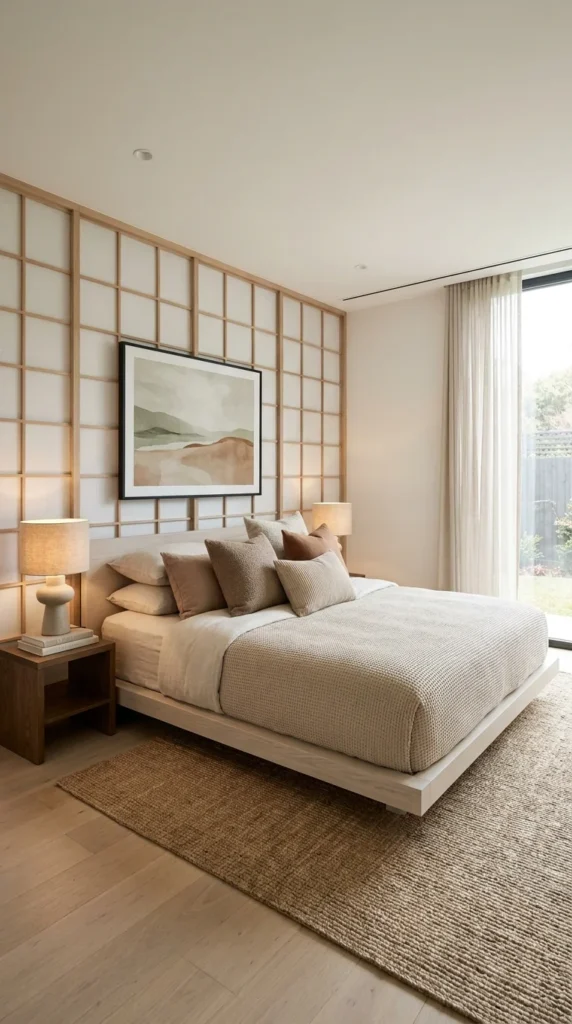
The wall behind this bed is built from a full grid of wood-framed panels running floor to ceiling, each square lit faintly from within—a stripped-down, oversized reinterpretation of shoji screen construction, but used as a wall rather than a door. It reads less like a traditional Japanese element and more like architecture borrowing its logic: repetition, a wood frame, and diffused light behind translucent panels.
A landscape print sits directly on top of that grid, framed in black. Hanging art over a paneled wall like this is a slightly unusual choice – most rooms would treat the panels as the finished statement -choice—moste print’s muted watercolor palette of sage, rustatement—butlls together every other color already in the room, so it earns its place rather than just adding clutter.
On either side of the bed, matching ceramic table lamps sit on nightstands of two entirely different materials—one pale wood, one dark stained wood with an open shelf. Mismatched nightstands show up more often in real bedrooms than styled ones, and here it works precisely because the lamps tie the two pieces together visually.
The bed itself carries a heavier textile mix than most in this style: a waffle-weave beige coverlet, a stack of pillows in taupe, rust, and warm brown, and almost no visible wood on the frame beneath all that layering. Sheer linen curtains hang beside a glass door on the right, letting in soft daylight and a glimpse of a fenced garden – proof that a Japandi bedroom doesn’t require total visual quiet on every wall, so long as one material logic holds the whole room together.
A wide jute rug anchors the floor, its coarse woven texture the same garden—proofwn up in nearly every other room in this style—reliable, unfussy, and apparently non-negotiable.
10. A Shoji-Paneled Headboard Wall With Its Own Built-In Display Niche
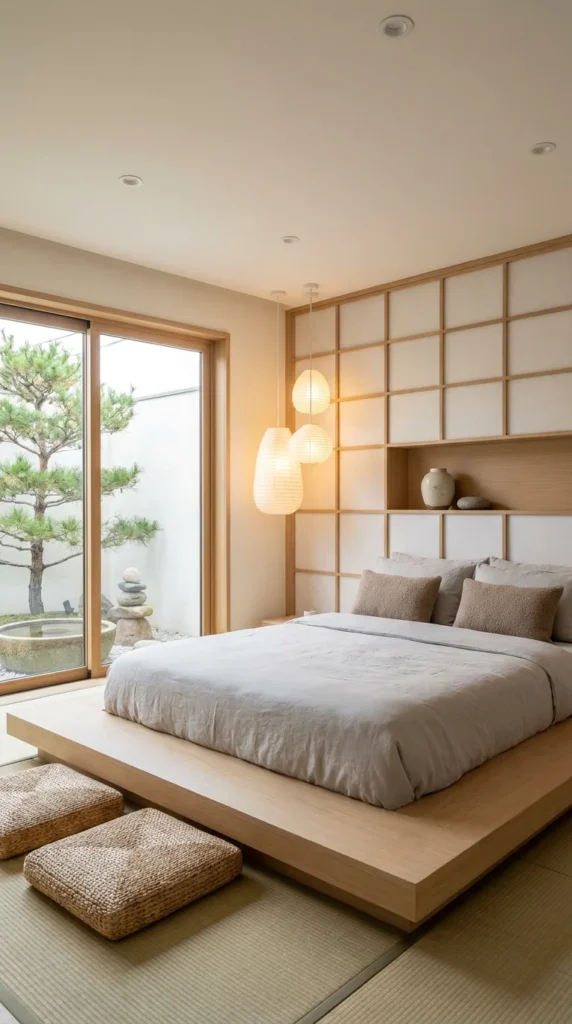
This one commits harder to Japanese architectural language than almost any other room in this list. The entire headboard wall is built from a grid of shoji-style wood mullions, filled with translucent white panels that carry all the way up to the ceiling – a full architectural feature rather than a decorative gesture. Cut into the lower half of ceiling—aa rectangular niche breaks the pattern to hold a single ceramic vase and two smooth river stones, lit softly from within.
Three paper pendant lights cluster together at slightly different heights and sizes just beside the bed—a deliberate irregularity, since matching them exactly would have made the grouping feel manufactured rather than gathered over time.
Outside the sliding glass door, an actual Japanese garden completes the reference: a sculpted pine tree, a stacked cairn of stones, and what looks like a stone water basin sitting in gravel. It’s rare for a bedroom’s interior language and its exterior view to align this precisely—usually one or the other is doing the work alone.
work – it The bed sits on a wide, low wood platform with no separation between mattress base and surrounding floor, dressed simply in cool gray linen with a small cluster of taupe and boucle pillows. Underneath, woven tatami-style floor mats replace conventional flooring entirely, edged in a thin green trim strip that’s easy to miss at first glance but is doing real work—it defines the mat’s border the way a wood threshold would in a traditional room.
Two woven floor cushions sit at the base of the platform, stacked rather than spread apart—a small detail suggesting they’re used often enough to end up piled instead of styled.
Final Thoughts
What ties these ten bedrooms together isn’t a single product or paint color—it’s a shared set of instincts: keep furniture low; let natural materials do most of the visual work; leave negative space alone instead of filling it; and pick one quiet element per room to carry the Japanese half of the equation, whether that’s a shoji screen, a bonsai, or a single ink-wash print. None of these rooms are trying to look busy, and none of them are empty either—the balance between the two is really the whole point of Japandi.
If there’s one takeaway worth carrying into an actual renovation or refresh, it’s this: restraint is a design decision, not the absence of one. A Japandi bedroom takes as much intention as a maximalist one—it just spends that intention on what to leave out.
Frequently Asked Questions
What is Japandi style, exactly?
Japandi is a design style that blends Japanese minimalism with Scandinavian functionality—combining natural materials, low furniture, and muted color palettes with a warm, liveable feel rather than a stark or clinical one.
What colors work best in a Japandi bedroom?
Muted, earthy neutrals dominate: oatmeal, taupe, warm grey, sage green, and charcoal, paired with natural wood tones like oak and walnut. Bold colour is used sparingly, if at all, usually as a single accent like a rust-toned throw or pillow.
Do I need a low platform bed for a Japcoloredroom?
Not strictly, but a low-profile platform bed is one of the most recognizable elements of the style. It echoes traditional Japanese futon-style sleeping and keeps the room’s visual weight close to the floor.
What materials are essential to Japandi design?
Natural, textural materials are key: oak and other light woods, linen, jute, rattan, boucle, and paper (in the form of pendant lighting or shoji-style screens). Synthetic or glossy finishes are generally avoided.
Can Japandi work in a small bedroom?
Yes, arguably it works even better in small spaces, since the style’s emphasis on minimal furniture and negative space naturally prevents a small room from feeling cluttered or visually heavy.
Is Japandi the same as minimalism?
No. Minimalism can feel cold or sparse on its own, while Japandi deliberately adds warmth through wood tones, soft textiles, and natural texttextures—it’simalism with comfort built back in.
3 Responses