
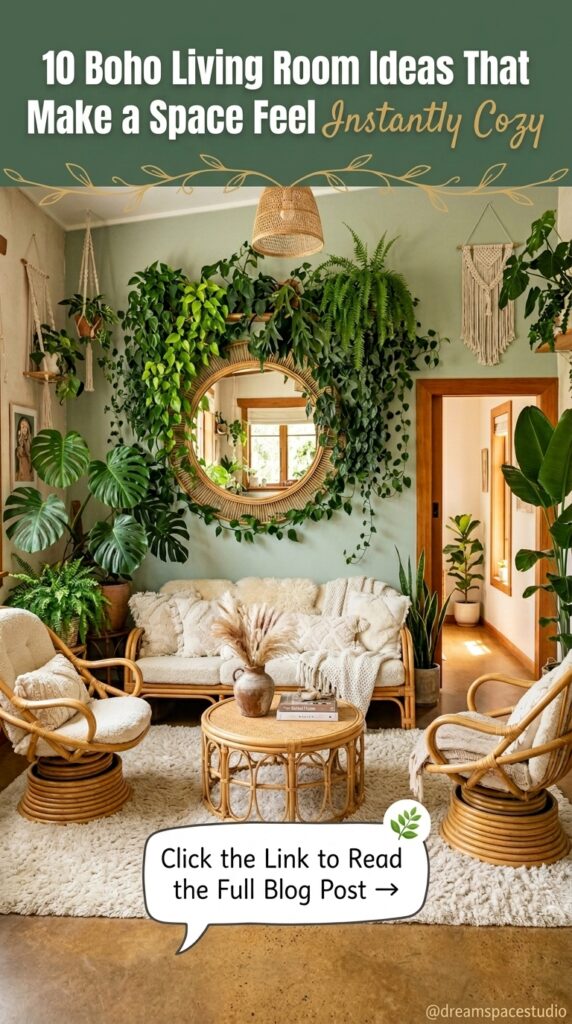
Boho living rooms get a bad reputation for looking chaotic—too many textures, too many patterns, and too much “collected over a lifetime” crammed into one wall. But the ten rooms below prove that’s a styling problem, not a style problem. Each one builds its warmth around one clear decision—a plant-covered mirror, a wall-hung rug, a single dark accent wall—and lets everything else support that choice instead of competing with it. By the end, you’ll know exactly which version of boho actually fits your space.
Quick Overview
| Style | Boho / Global-Eclectic |
|---|---|
| Best For | Living rooms wanting texture-rich, collected character |
| Budget | Low–High |
| Difficulty | Easy–Moderate |
| Maintenance Level | Low–Medium |
The Sculptural Sun Wall That Anchors a Calm Mediterranean Room
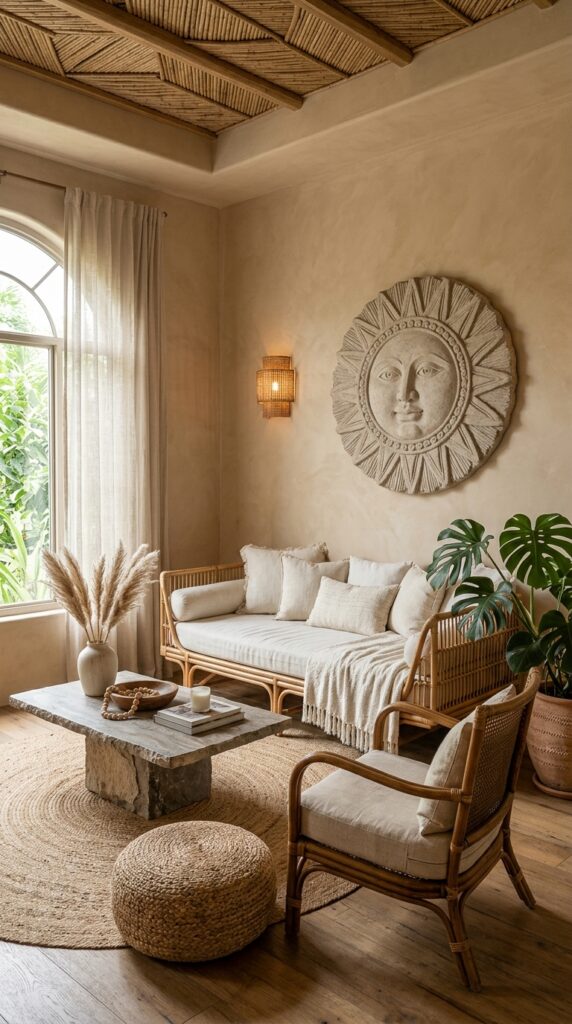
Not every boho room needs color and pattern to feel warm. This one leans almost entirely neutral—cream plaster walls, a rattan daybed-style sofa, and a jute round rug—and lets a single carved stone sun medallion do all the personality work above the sofa. The result reads closer to a Mediterranean villa than a typical maximalist boho space, proving restraint can be just as boho as abundance.
This idea suits anyone who loves the boho silhouette—rattan, jute, natural texture—but doesn’t want the visual noise that usually comes with it. It works especially well in rooms with an arched window or curved architectural detail, since the sun medallion’s circular shape echoes that curve rather than fighting it. The lifestyle it supports is slow and sun-drenched: this is a room built for morning light through sheer curtains, not evening entertaining.
The advantage is that a single oversized art piece like this ages far better than trend-driven decor—a carved stone relief doesn’t go out of style the way a printed textile might. The compromise is cost and weight: a piece this substantial usually needs professional mounting and a real budget line, unlike lighter macrame or textile wall art.
To simplify this for a smaller budget, look for a resin or lightweight plaster version of a sun medallion instead of solid stone, which cuts both cost and mounting complexity significantly. The most common mistake is pairing a piece this bold with an already busy wall—the sun medallion needs blank space around it to actually read as a focal point.
Would this work for you? If you want boho warmth without pattern overload, yes. If you’re drawn to a denser, more layered look, one of the gallery-wall rooms further down this list will suit you better.
Why the Empty Wall Space Matters as Much as the Art
The plaster wall around the sun medallion stays completely bare, and that emptiness is likely doing more for the piece than a busier backdrop would—one reason it reads as a genuine focal point rather than one more object in a crowded room is that nothing else on that wall competes for attention.
Materials in This Room: Carved stone (or resin) wall medallion, rattan sofa and armchair frames, reclaimed stone coffee table base, woven rattan wall sconce, jute rug, and pouf. Color Story: Warm Cream, Stone Grey, Natural Rattan, Soft Sage (from the monstera). Lighting: A woven rattan wall sconce for evening warmth, plus abundant natural light through the arched window and sheer linen curtains during the day.
Where This Calm Boho Look Goes Wrong
- Adding busy artwork or shelving around the sun medallion instead of leaving space
- Choosing cushions in more than two or three tones, which breaks the neutral calm
- Skipping the stone coffee table’s rough texture in favor of something too polished
- Overcrowding the plant corner so it competes with the wall art for attention
The Tribal Mask Wall That Sets the Room’s Entire Tone
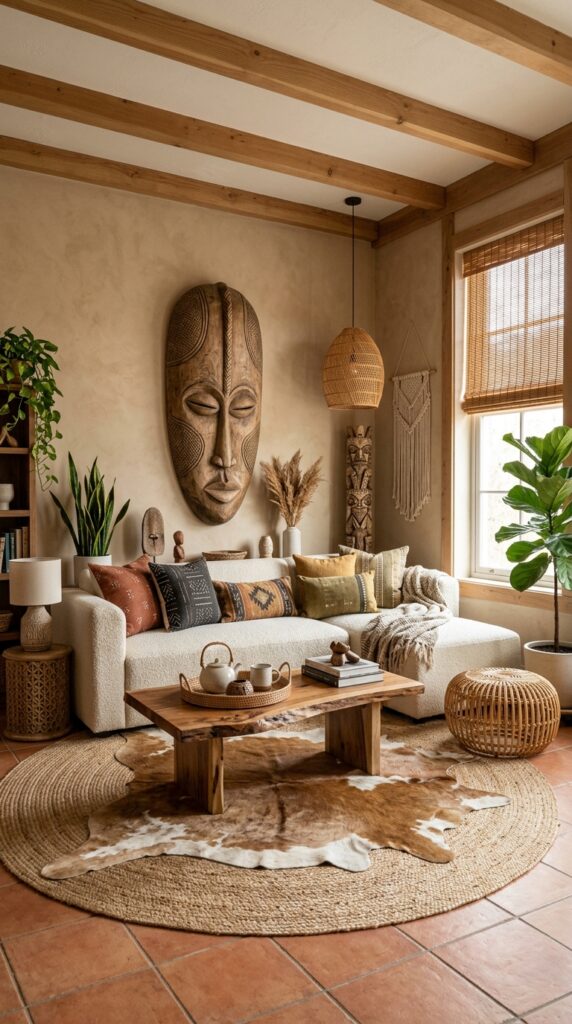
Where the previous room used restraint, this one leans into a single bold statement piece: an oversized carved wood tribal mask mounted above a boucle sectional. Terracotta tile floors, a live-edge wood coffee table, and a layered cowhide-over-jute rug all support the mask without trying to out-shout it, and mudcloth-print throw pillows echo its pattern language in a smaller, more wearable way.
This idea suits anyone drawn to global, handmade-feeling decor with real cultural weight behind it. It works particularly well in rooms with warm terracotta or wood tile flooring, since that grounding tone keeps the room from feeling like a themed showroom. The lifestyle it supports is collected and well-traveled—this is a room built around pieces with a story, not matching decor sets.
The advantage is authenticity—a single strong tribal art piece, sourced thoughtfully, gives a room more genuine character than a dozen smaller trend pieces combined. The compromise is that this look depends heavily on getting that one piece right; a mask that reads as decorative kitsch rather than considered can tip the whole room into costume territory instead of curated global style.
To simplify this for a smaller budget, source a single well-made carved piece from a fair-trade importer rather than filling the wall with several smaller mask pieces, and let one strong focal object do the work instead of many decorative ones. The most common mistake is layering too many patterned textiles on the sofa at once, which competes with the mask instead of supporting it.
Would this work for you? If you’re drawn to global, handmade art and want a genuine focal piece, yes. If you’d rather your wall art stay more abstract or neutral, this specific tribal-forward direction likely isn’t your fit.
The Proportion That Keeps the Mask From Overwhelming the Wall
The mask takes up a noticeably tall, narrow portion of the wall rather than a wide one, and that vertical proportion is likely what keeps it from visually flattening the room—a wider, shorter piece at the same scale would probably compete with the sofa’s own horizontal line instead of standing apart from it.
Materials in This Room: Carved wood tribal mask, boucle sectional upholstery, live-edge wood coffee table, cowhide and jute layered rugs, and terracotta floor tile. Color Story: Warm Terracotta, Charcoal, Mustard, Off-White Boucle. Lighting: A woven rattan pendant over the coffee table plus natural daylight through a bamboo Roman shade—the terracotta floor also reflects warm ambient tones back into the room.
How This Tribal-Forward Look Gets Botched
- Choosing a mask or carved piece without understanding or crediting its cultural origin
- Layering more than three patterned pillow styles at once, which competes with the art
- Pairing cowhide with another animal-print rug, which reads as too busy together
- Placing the coffee table too close to the sofa, crowding the live-edge wood’s natural shape
The Maximalist Gallery Wall Built on a Bold Terracotta Backdrop
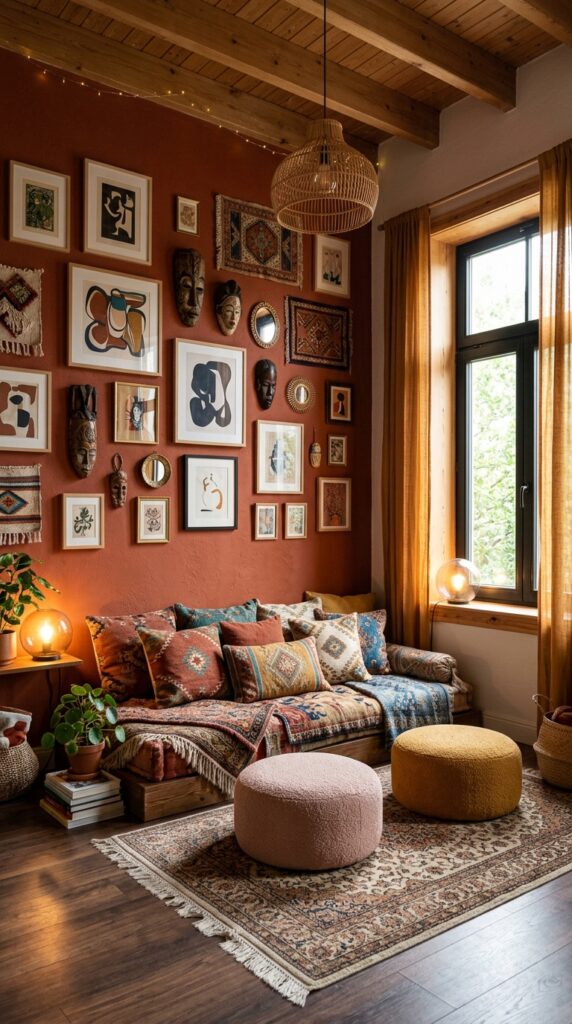
This is the most densely layered room in the list—a rust-terracotta accent wall covered edge to edge with framed prints, small mirrors, carved masks, and textile wall hangings, arranged salon-style with almost no visible gaps. Below it, a low bench-style sofa piled with kilim-patterned pillows and two boucle poufs in contrasting pink and mustard finishes the maximalist statement.
This idea suits people who genuinely love a “more is more” philosophy and want their living room to feel like a personal curation rather than a showroom. It works best in smaller, cozier rooms where a dense gallery wall can feel enveloping rather than overwhelming—in a very large room, the same density might read as busy rather than intimate. The lifestyle it supports is social and layered, a room built for long evenings with string lights on and conversation going.
The advantage is that this approach genuinely can’t be replicated by accident—it takes real curation, and the payoff is a wall that feels unmistakably personal. The compromise is maintenance and commitment: rearranging or dusting a gallery wall this dense is a bigger task than a simpler art arrangement, and the bold wall color itself is a real commitment if you ever want to sell or repaint.
To simplify this for a smaller budget, start with a bold peel-and-stick wall treatment instead of paint if you’re renting, and build the gallery wall gradually with thrifted frames rather than buying everything at once. The most common mistake is spacing the framed pieces too evenly, like a grid—the salon-wall effect depends on organic, slightly irregular spacing.
Would this work for you? If you love color and dense visual layering, yes. If you prefer a calmer, more editable wall, the sculptural single-piece rooms elsewhere in this list are a better starting point.
Where the Eye Lands First on a Wall This Dense
Even with dozens of objects on the wall, the eye is drawn first to the large abstract face-shaped print near the center rather than the smaller mirrors or masks around it—its size and higher contrast against the terracotta backdrop likely give it priority over the rest of the arrangement, functioning as an anchor the smaller pieces orbit around.
Materials in This Room: Painted plaster accent wall, mixed wood picture frames, small round mirrors, textile wall hangings, boucle poufs. Color Story: Rust Terracotta, Mustard Yellow, Dusty Pink, and Warm Blue (from the kilim pillows). Lighting: String lights along the ceiling beam plus a woven rattan pendant and a warm glass table lamp—the layered lighting is part of what keeps a wall this dense from feeling harsh after dark.
Easy Ways to Overdo a Maximalist Gallery Wall
- Spacing framed pieces in an even grid instead of an organic cluster
- Using more than one bold accent color on the wall itself alongside the gallery
- Choosing poufs or pillows in the exact same tone as the wall, which makes them disappear
- Leaving no breathing room at the wall’s edges, which makes the whole arrangement feel cramped
The Wood-Paneled Wall That Hangs a Rug as Art
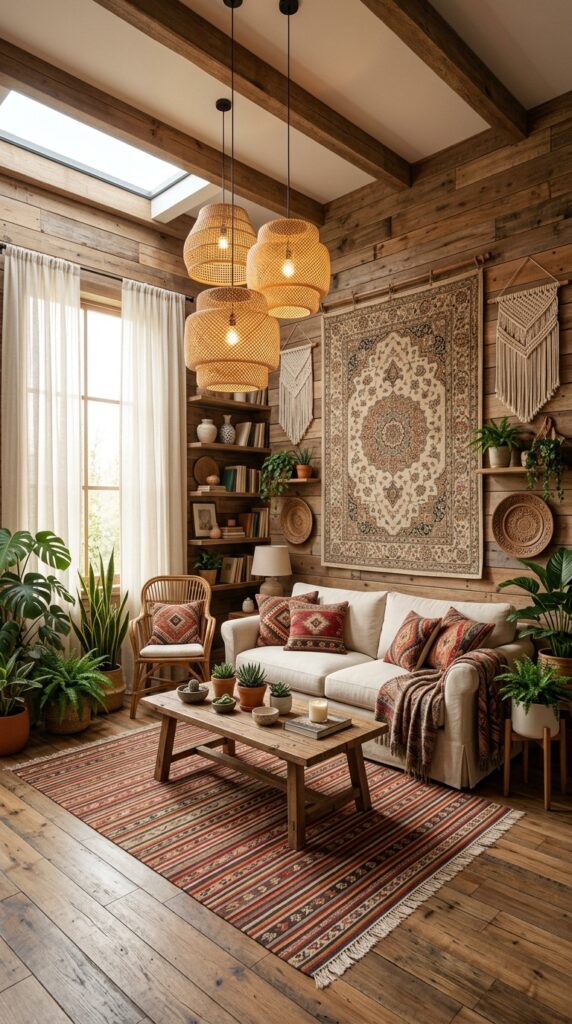
Reclaimed wood planks cover the entire back wall of this room, and instead of framed prints, the centerpiece is a vintage-style rug hung flat against the wood like a tapestry—flanked by macrame hangings and open wood shelving holding books and small plants. A cluster of three rattan pendant lights hangs low from a skylight above, adding warmth without needing floor lamps.
This idea suits cabin-style or rustic-leaning homes where a full wood-plank wall already makes sense architecturally. It’s a strong fit for rooms with a skylight or other strong natural light source, since the pendant cluster shown here relies on that overhead opening to avoid feeling dim. The lifestyle it supports is cozy and grounded—heavy on texture, plants, and reading nooks rather than sleek surfaces.
The advantage is that hanging a rug as wall art solves two problems at once: it adds pattern and softness to an otherwise hard wood wall, and it repurposes a beautiful textile that might otherwise sit underfoot and wear down. The compromise is that a full wood-plank wall is a genuine construction project, not a quick styling change, so this idea works best for a true renovation rather than a rental refresh.
To simplify this for a smaller budget, install wood plank panels only behind the rug rather than across the whole wall, and hang a single vintage-style rug using a wooden dowel rod instead of built-in mounting hardware. The most common mistake is hanging the rug too high or too low relative to the sofa, which throws off the whole wall’s visual balance.
Would this work for you? If your space already leans rustic or cabin-inspired, yes. If your living room has a more polished, contemporary shell, a full wood-plank wall like this would likely feel out of place.
How Wood Plank Walls Actually Behave Over Time
Reclaimed or unfinished wood planks like these will likely shift in tone slightly as they’re exposed to sunlight through the skylight above, generally deepening rather than fading—worth knowing if you’re hoping the wall stays exactly as evenly toned as it looks when freshly installed.
Materials in This Room: Reclaimed wood wall planks, vintage wool rug (used as a wall hanging), macrame cotton hangings, rattan pendant lights, and a striped kilim floor rug. Color Story: Warm Oak, Cream, Deep Red, Soft Blue (from the rug’s pattern). Lighting: A cluster of three rattan pendant lights hung at staggered heights, plus daylight from both the skylight above and a large window with sheer curtains.
Mistakes That Undercut a Wall-Hung Rug
- Hanging the rug off-center relative to the sofa below it
- Choosing a rug too small for the wall space, leaving awkward bare wood around it
- Skipping proper mounting hardware, which risks sagging over time
- Overcrowding the flanking shelves so they compete with the rug instead of framing it
Related Guides
- 10 Maximalist Living Room Ideas to Steal for a Room Full of Personality—more inspiration for a dense, layered living room
- Grey Couch, Endless Style: 10 Living Room Looks to Try—pairing a neutral sofa with a boho-leaning room
- Rattan and Light: 10 Boho Sunroom Looks Worth Copying—more rattan-forward styling ideas beyond the living room
- Biophilic Living Room Guide—for a deeper look at plant-heavy living spaces like Sections 5 and 8 below
- 10 Boho Bedroom Looks That Feel Curated, Not Cluttered—carrying the same aesthetic into the bedroom
The Urban Jungle Room Built Around a Tropical Tapestry
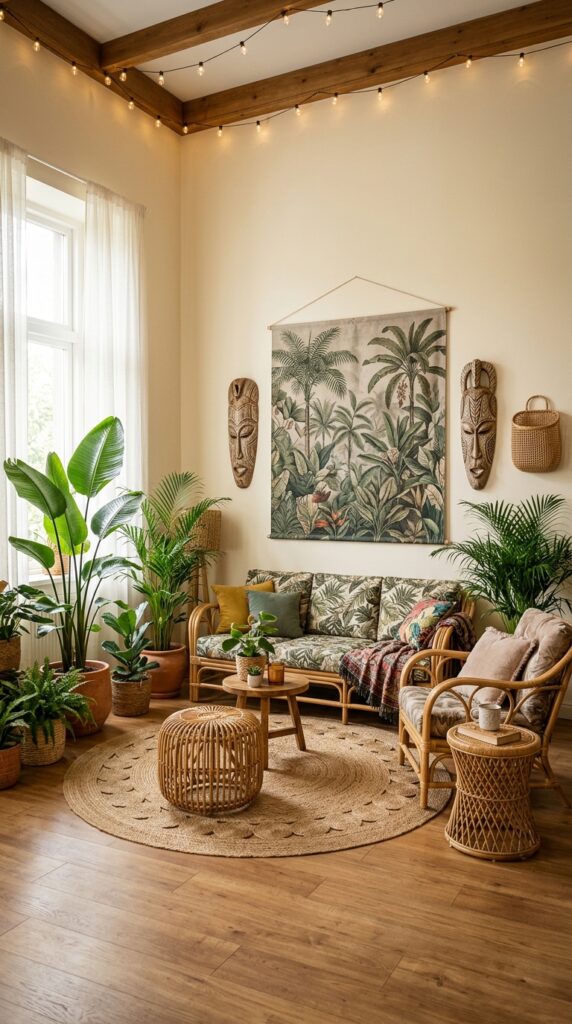
Plants aren’t an accessory in this room—they’re the entire point. A printed palm-leaf tapestry hangs above the sofa, flanked by two carved wood masks, but it’s nearly upstaged by the sheer volume of live tropical plants surrounding it: bird of paradise, palm, and trailing greenery packed into every corner. String lights along the ceiling beams add a soft glow without competing with all that green.
This idea suits genuine plant enthusiasts who want their living room to feel like a greenhouse as much as a sitting room. It works best in spaces with strong natural light—south or west-facing windows especially—since a plant collection this dense needs real sun to thrive rather than just look good on move-in day. The lifestyle it supports is nurturing and slow, with regular watering and care built into the weekly rhythm of the room.
The advantage is that a room this plant-dense feels genuinely alive in a way no textile or wall art can replicate—it changes subtly season to season as the plants grow. The compromise is real commitment: a collection this size means regular watering, pruning, and pest-checking, and even one under-lit or under-watered plant can visibly drag the whole look down.
To simplify this for a smaller budget, start with three or four larger statement plants rather than dozens of smaller ones, and mix in one or two high-quality faux plants near lower-light corners where real ones would struggle. The most common mistake is placing plants without matching their light needs to the room’s actual sun exposure, leading to leggy or dying greenery within a few months.
Would this work for you? If you already love caring for plants and have strong natural light, yes. If plant maintenance isn’t realistic for your schedule, a lighter plant touch—like the sculptural room above—will hold up better long-term.
One Tall Plant, Setting the Scale for Everything Around It
The bird of paradise on the left side of the room reaches nearly to the ceiling, and its height appears to set the scale that the rest of the plant collection is arranged around—smaller plants step down in height moving toward the seating area, which likely keeps a room this dense from feeling like an unplanned jungle rather than a considered layering.
Materials in This Room: Printed tropical tapestry, carved wood masks, rattan sofa frame, jute scalloped-pattern round rug, and terracotta plant pots. Color Story: Deep Green, Warm Cream, Rattan Tan, Soft Coral (from the cushion print). Lighting: String lights strung along the ceiling beams plus generous natural daylight through sheer curtains—this room genuinely depends on that daylight to keep the plant collection healthy. Upkeep: A plant collection this dense needs a regular watering schedule, occasional rotation toward the light source, and routine leaf dusting to keep the greenery looking as lush as it does here.
Common Slip-Ups With a Plant-Heavy Room
- Placing shade-loving and sun-loving plants in the same low-light corner
- Overwatering out of habit rather than checking each plant’s actual needs
- Letting trailing plants block walkways or seating access
- Skipping regular dusting, which dulls large leaves like the bird of paradise
The Dark Accent Wall That Makes Boho Feel Sophisticated
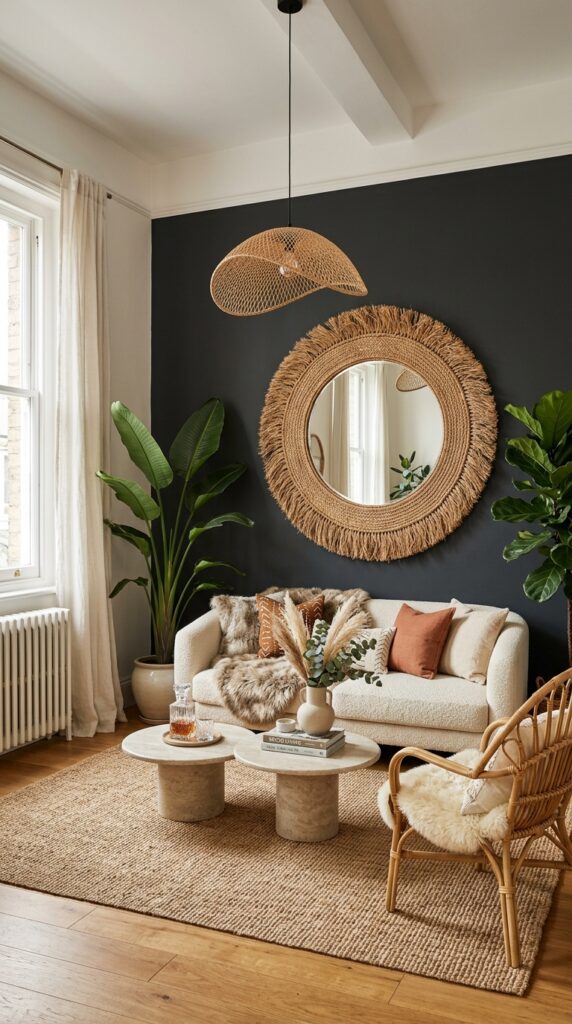
Most boho rooms lean warm and light. This one flips that expectation with a charcoal-black accent wall, against which a fringed jute mirror and a woven rattan pendant read as striking sculptural objects rather than the soft, blended-in accents they’d be against a pale backdrop. A boucle sofa, faux fur throw, and rust-toned pillows keep the room from tipping too cool or minimal.
This idea suits anyone who wants boho texture without the aesthetic feeling overly rustic or vacation-house casual. It works particularly well in rooms with good natural light from a large window, since a dark wall needs that daylight contrast to avoid feeling heavy rather than dramatic. The lifestyle it supports is a bit more polished and evening-oriented—this reads as a room for cocktails and conversation as much as lounging.
The advantage is real visual impact: a dark wall makes every light-toned or metallic object in front of it pop in a way a neutral wall simply can’t. The compromise is that dark paint absorbs light, so a room without strong natural light or a good lighting plan can feel smaller and dimmer than intended.
To simplify this for a smaller budget, paint just one wall rather than the whole room, and rely on paint alone rather than wallpaper or textured plaster, which keeps material costs low while still delivering the contrast effect. The most common mistake is pairing a dark wall with an equally dark or heavy furniture palette, which erases the contrast that makes this look work in the first place.
Would this work for you? If your room gets strong natural light and you want boho with an edge, yes. If your living room is naturally dim, a dark wall like this will likely work against you rather than for you.
The Ratio That Keeps Dark and Light Balanced Here
The dark wall covers roughly one full side of the room, while the remaining walls stay a soft off-white, and that ratio is likely doing a lot of the work—a fully dark room would probably feel closed-in, while this partial approach lets the charcoal read as a deliberate accent rather than an overwhelming choice.
Materials in This Room: Painted plaster accent wall, jute-fringed round mirror, woven rattan pendant, boucle sofa upholstery, travertine-style nesting coffee tables. Color Story: Charcoal Black, Warm Cream, Rust Orange, Natural Rattan. Lighting: A sculptural rattan pendant plus abundant daylight from a large window with sheer curtains—the dark wall makes both sources read more dramatically than they would against a pale backdrop.
Who Should Skip a Dark Accent Wall?
This particular direction genuinely isn’t for everyone, and it’s worth being honest about that before committing to a full repaint. A dark accent wall works best in rooms with strong, consistent natural light and at least one large window—without that, the same wall that looks moody and intentional here can just as easily read as cave-like. If your living room is on the smaller or dimmer side, a lighter neutral wall paired with the same rattan and boucle textures will likely serve the space better than chasing this exact look.
Where a Dark Boho Wall Falls Apart
- Painting the entire room dark instead of a single accent wall
- Pairing the dark wall with equally dark furniture, erasing the contrast
- Skipping a statement light fixture, which the dark backdrop is built to showcase
- Choosing cool-toned accessories instead of warm rattan and rust tones, which flattens the room
The Mixed-Media Gallery Wall That Pairs Baskets With Fine Art
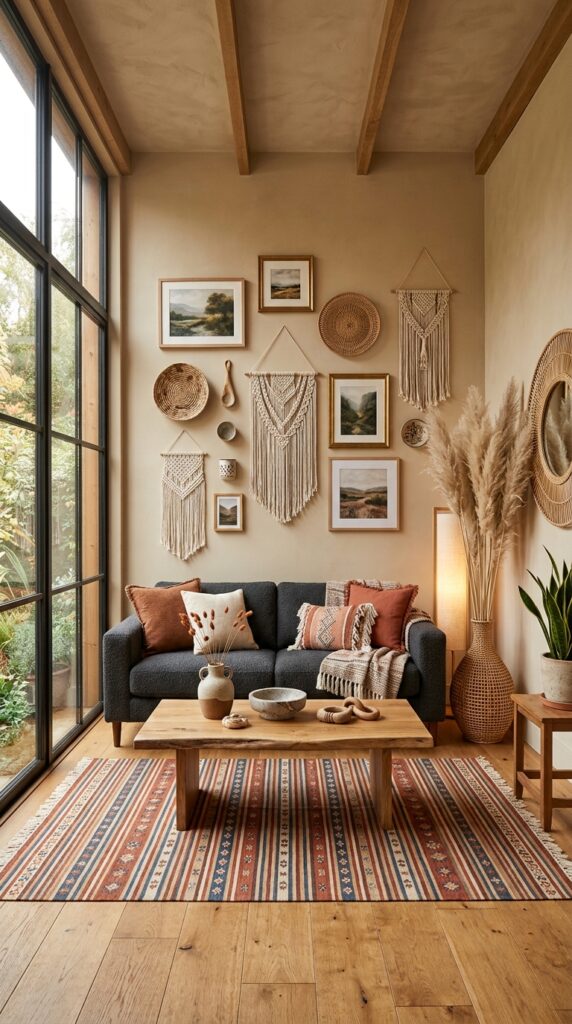
This room’s wall doesn’t choose between framed art and handmade texture—it uses both. Landscape prints in gold frames sit alongside woven baskets, macrame hangings, and small ceramic dishes, all arranged in a single considered cluster. Below it, a charcoal sofa stands in deliberate contrast to the warm terracotta pillows and honey-toned wall, proving a boho room doesn’t need every element to match the same warm palette.
This idea suits people who want the eclectic feeling of a gallery wall without it skewing purely into art or purely into craft objects—this is a hybrid that borrows credibility from both. It works well in rooms with floor-to-ceiling windows, since the wall of glass here balances the density of the gallery arrangement with an equally large area of visual quiet. The lifestyle it supports is genuinely collected—pieces that look gathered from different trips and different eras, not bought as a set.
The advantage is flexibility: because the wall mixes formats, it’s easy to keep adding to or editing over time without needing to match a strict theme. The compromise is that a mixed gallery like this takes a more practiced eye to arrange well—random framed art and random baskets thrown together without a common color thread can look messier than a single-format gallery wall would.
To simplify this for a smaller budget, start with the woven baskets and macrame pieces first, since they’re generally less expensive than framed art, then add one or two prints once you’ve found pieces you genuinely love. The most common mistake is choosing frames in too many different finishes, which makes the wall look accidental instead of curated.
Would this work for you? If you like both fine art and handmade texture and don’t want to choose, yes. If you’d rather keep your gallery wall to one format, the denser terracotta gallery wall earlier in this list is a more focused version of the idea.
What Makes the Dark Sofa the Room’s Real Anchor
With so much visual activity happening on the wall above it, the charcoal sofa’s solid, unpatterned surface is likely what keeps the whole room from feeling overloaded—its lack of decoration gives the eye a place to rest before moving back up to the gallery wall.
Materials in This Room: gold-framed prints, woven rattan baskets, macrame cotton hangings, a live-edge wood coffee table, and a striped kilim rug. Color Story: Warm Honey Wall, Charcoal Sofa, Rust Terracotta, Soft Cream. Lighting: Warm natural daylight through floor-to-ceiling black-framed windows, plus a woven floor lamp for evening ambiance—no overhead fixture is needed given the window size.
Mistakes That Undo a Mixed-Media Gallery Wall
- Mixing more than two or three frame finishes at once
- Choosing baskets and art with no shared color thread between them
- Overcrowding the wall so densely that individual pieces lose their distinct shape
- Skipping a contrast sofa color, letting the whole room blend into one warm tone
The Mirror That Disappears Under a Wall of Trailing Plants
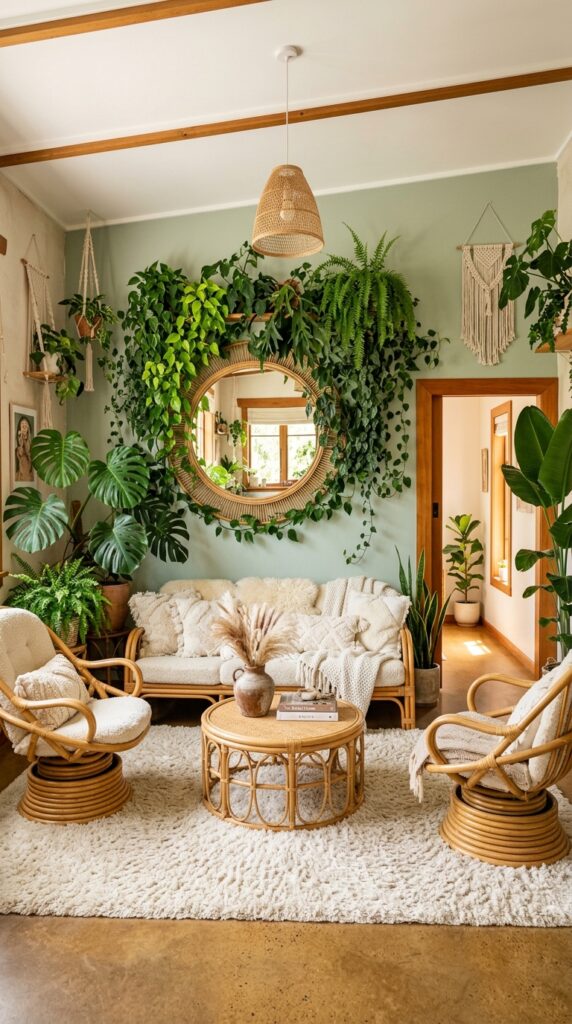
In most rooms, a round rattan mirror would be the star. Here, it’s nearly consumed by a dense cascade of trailing pothos and ferns growing up and around its frame, turning the mirror-and-plant combination into a single living wall feature rather than two separate decor choices. Sage green walls and a shag cream rug keep the rest of the room soft enough to let this one wall carry all the drama.
This idea suits committed plant owners who want their greenery to feel architectural rather than potted and placed. It works best against a muted wall color like sage or soft olive, since a brighter or busier wall would fight with the plants for visual attention. The lifestyle it supports is hands-on and nurturing—training trailing plants to grow into a shape like this takes real time and repeated guidance, not a one-time styling session.
The advantage is a genuinely unique focal point that can’t be bought pre-made—every version of this wall will look different depending on how the plants grow. The compromise is patience: this look takes months, sometimes longer, to fill in this fully, and it needs consistent care to keep looking intentional rather than unruly.
To simplify this for a smaller budget, start with one or two trailing pothos in wall-mounted planters near the mirror and let them grow into the frame gradually, rather than trying to buy a fully mature effect all at once. The most common mistake is letting the trailing vines grow without any guidance, which results in random sprawl instead of the considered cascade shown here.
Would this work for you? If you’re patient with plants and want a genuinely one-of-a-kind wall feature, yes. If you’d rather have instant, low-maintenance impact, the sculptural stone wall or gallery wall ideas above will suit you better.
Why the Mirror Still Matters Even Though It’s Barely Visible
Even mostly hidden by foliage, the mirror’s round shape and warm wood frame likely still ground the whole arrangement—one reason this doesn’t read as an overgrown houseplant situation is that there’s a clear, structured object underneath the greenery giving it a defined outline to grow around.
Materials in This Room: Round rattan-framed mirror, trailing pothos and fern varieties, rattan swivel papasan chairs, rattan drum coffee table, and shag cream rug. Color Story: Sage Green, Deep Plant Green, Warm Cream, Natural Rattan. Lighting: A woven rattan pendant plus filtered daylight from a nearby doorway—the sage wall color helps soften and diffuse whatever light reaches this particular corner. Upkeep: Trailing plants trained around a mirror need regular guiding and pruning to keep the shape considered rather than wild, plus consistent watering since a dense cascade like this can dry out faster than a single potted plant.
Where a Plant-Covered Mirror Gets Away From You
- Letting vines grow untrained, resulting in sprawl instead of a shaped cascade
- Choosing a mirror frame too thin to visually anchor the plant growth around it
- Underestimating how much light trailing plants like pothos actually need to stay full
- Skipping regular pruning, which can make the arrangement look neglected rather than lush
The Minimalist Boho Room That Uses Only Woven Texture
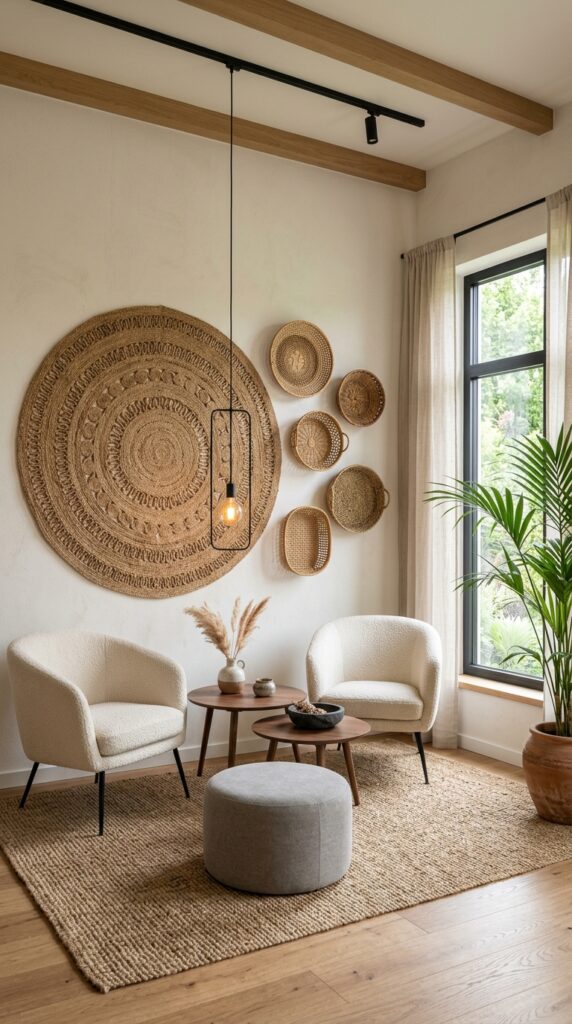
Not every room on this list is dense. This one strips boho down to its most essential ingredients: a large jute mandala wall hanging, a small cluster of woven baskets, two boucle swivel chairs, and a single potted palm. No gallery wall, no dense plant collection, no bold paint—just texture, restraint, and a lot of negative space.
This idea suits people who love the natural materials boho is known for—jute, rattan, boucle—but want a calmer, more editorial version of the style. It works especially well in smaller or narrower rooms, since the lack of visual clutter keeps a tight footprint from feeling cramped. The lifestyle it supports is quiet and pared-back, closer to a reading corner than a gathering space.
The advantage is that this version of boho photographs and lives beautifully in almost any room size, and it’s the easiest of all ten ideas here to keep looking tidy day to day. The compromise is that some people find this version too restrained—if you’re drawn to boho specifically for its abundance and layering, this minimalist take may feel like it’s missing the point.
To simplify this even further, a single woven wall hanging and one pair of neutral chairs are really all this look requires—resist the urge to add more once the basics are in place. The most common mistake is treating this as an unfinished starting point and gradually adding pieces until it drifts into a busier style entirely.
Would this work for you? If you want boho’s natural materials without the layered density, yes. If a room this quiet feels underdressed to you, several of the more layered rooms in this list will feel more satisfying.
The Single Repeated Shape That Ties This Room Together
The circular jute wall hanging and the round wood accent tables echo the same rounded shape at different scales, and that quiet repetition is likely part of why the room feels resolved despite having so few objects in it—swapping either for something angular would probably disrupt that visual thread.
Materials in This Room: Jute woven wall hanging, small woven rattan baskets, boucle upholstered swivel chairs, wood accent tables, and a jute area rug. Color Story: Natural Jute, Warm Cream, Soft Grey, Walnut Brown. Lighting: A single pendant on a black track fixture plus generous daylight through a large black-framed window—the lighting stays as pared-back as everything else in the room.
Common Ways Minimalist Boho Loses Its Warmth
- Adding too much cool-toned furniture, which can make the room feel sterile instead of calm
- Skipping the woven wall texture altogether, leaving nothing to signal “boho” at all
- Choosing furniture with sharp, angular lines that clash with the room’s rounded shapes
- Over-editing to the point the room feels empty rather than intentionally minimal
The Glass-Box Sunroom Anchored by a Bold Medallion Rug
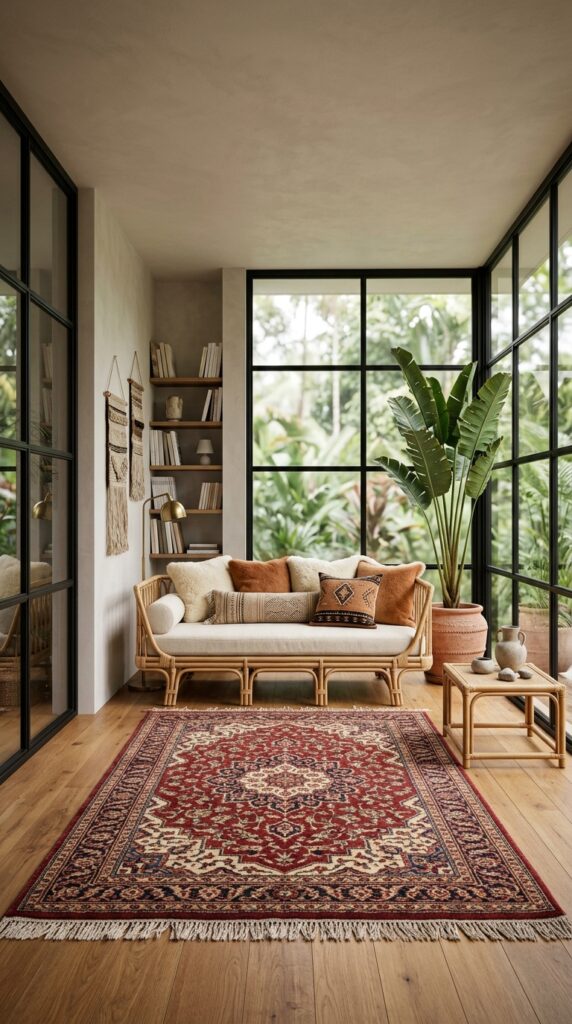
Floor-to-ceiling black steel-framed windows give this room an almost greenhouse-like architecture, and against all that glass and greenery outside, the design leans on one bold interior anchor: a red Persian-style medallion rug grounding a rattan daybed sofa. Everything else in the room—the rattan furniture, the terracotta planter, the wood shelving—stays neutral, letting the rug’s pattern and color carry the entire boho statement.
This idea suits homes with a true sunroom, conservatory, or heavily glazed addition, where the architecture itself already does a lot of the design work. It’s a strong fit for anyone who wants a global, Moroccan-influenced boho feel without layering patterns across every surface—here, the rug alone delivers that reference point. The lifestyle it supports is bright and plant-adjacent, a room for morning coffee surrounded by garden views.
The advantage is that letting one bold rug carry the color story keeps the rest of the room flexible—furniture and accessories can change over time without needing to match a complicated palette. The compromise is that an investment-grade rug like this is genuinely expensive, and in a sun-drenched room like this one, UV exposure can fade a rug’s colors faster than in a room with less direct light.
To simplify this for a smaller budget, choose a machine-made rug in a similar medallion pattern rather than a hand-knotted original, and rotate the rug periodically if the room gets strong, consistent direct sun. The most common mistake is adding more than one bold pattern to the room, which competes with the rug instead of letting it lead.
Would this work for you? If you have a bright, glazed space and want one confident pattern moment, yes. If your room doesn’t get much natural light or you already have another dominant pattern in the space, this exact approach may compete with what you already have.
Why One Bold Rug Reads as Confident, Not Overdone
With the surrounding furniture kept entirely neutral, the medallion rug’s saturated red and navy tones stand out clearly without a second pattern to dilute them—a matching or clashing accent pillow nearby would likely pull attention away from the rug rather than reinforcing it.
Materials in This Room: Hand-knotted or machine-made wool medallion rug, rattan daybed sofa frame, sheepskin throw, wood ladder shelving, terracotta planter. Color Story: Deep Red, Navy, Cream, Warm Rattan Tan. Lighting: Abundant natural daylight through the full glass wall is the room’s main light source during the day, supplemented by a simple floor lamp for evening use. Upkeep: A rug this saturated in a sun-heavy room benefits from periodic rotation to prevent uneven fading, and hand-knotted wool rugs should be professionally cleaned rather than machine washed.
What Undermines a Bold Rug Anchor Room
- Adding a second strong pattern elsewhere in the room, which competes with the rug
- Placing the rug where it gets constant direct sun without ever rotating it
- Choosing furniture in a color that clashes with the rug’s palette instead of staying neutral
- Skipping a rug pad, which shortens the lifespan of a rug this substantial
Furniture Layout Tips for a Boho Living Room
- Anchor seating around one clear focal point—a wall feature, a rug, or a plant wall—rather than splitting attention across several bold moments at once
- Keep at least one seating piece low-profile, like a floor cushion or low bench, so the room doesn’t feel visually top-heavy with tall rattan furniture
- Leave clear walking paths around trailing or oversized plants so foliage doesn’t block natural traffic flow through the room
- Balance heavily patterned or textured pieces with at least one solid, unpatterned surface—a sofa, a rug, or a wall—so the eye has somewhere to rest
Who Should Choose This Style?
- Best for renters and homeowners who love layering texture over strict symmetry
- Best for plant lovers who want greenery treated as part of the design, not an afterthought
- Best for anyone drawn to global, vintage, or handmade textiles and objects
- Not ideal for anyone who prefers strict minimalism or a fully matched furniture set
Budget Summary
| Budget | Expectation |
|---|---|
| Low | Jute rugs, macrame wall hangings, thrifted rattan pieces, string lights |
| Medium | Rattan swivel chairs, live-edge wood coffee tables, patterned kilim rugs |
| Premium | Sculptural stone wall art, vintage hand-knotted rugs, custom gallery framing, mature plant collections |
FAQ
How do I keep a boho living room from looking cluttered? Pick one focal point per wall—a single art piece, a rug hung as art, or a plant feature—and let supporting pieces stay quieter in color and pattern, the way each room above builds around one clear idea rather than several competing ones.
What rug works best in a boho living room? Jute and other natural-fiber rugs work well as a neutral base layer, while a bolder vintage-style or medallion rug, as seen in Section 10 above, can serve as the room’s main pattern statement if the rest of the space stays relatively calm.
Do I need a lot of plants for a boho look to work? No—Sections 1, 6, and 9 above all use only one or two plants and still read clearly as boho, proving the style depends more on natural texture and warm materials than plant quantity alone.
Can boho work with dark or bold wall colors? Yes, as shown in Sections 3 and 6 above, a dark or saturated wall can actually make rattan, jute, and other natural boho textures stand out more clearly than they would against an all-neutral backdrop.
What’s the cheapest way to start a boho living room? A jute rug, one or two macrame or woven wall hangings, and a single thrifted rattan chair are typically the lowest-cost entry points, since none of them require construction or custom framing to install.
About the Author
Written by the AestheticLifes editorial team, covering interior design trends, room-by-room styling guides, and practical renovation advice for real homes.
Conclusion
The ten rooms above all wear the word “boho” differently—some through a single sculptural object, some through a wall of trailing plants, and some through one bold rug and nothing else. What they share is restraint around a clear idea, not an absence of it. A genuinely successful boho living room isn’t the one with the most textures piled on; it’s the one where every texture is there because it supports the same single decision. Pick the version above that matches how you actually want to live in the room, and build outward from there.
Explore More
You may also enjoy:
- 10 Dreamy Boho Patios to Inspire Your Next Backyard Refresh—carrying the same look outdoors
- Top 10 Sectional Sofa Designs for Comfort, Style & Small Spaces—finding the right sofa shape for a boho layout
- 10 Wall Murals So Good People Think You Hired a Designer—another way to make one wall the room’s focal point
One Response