
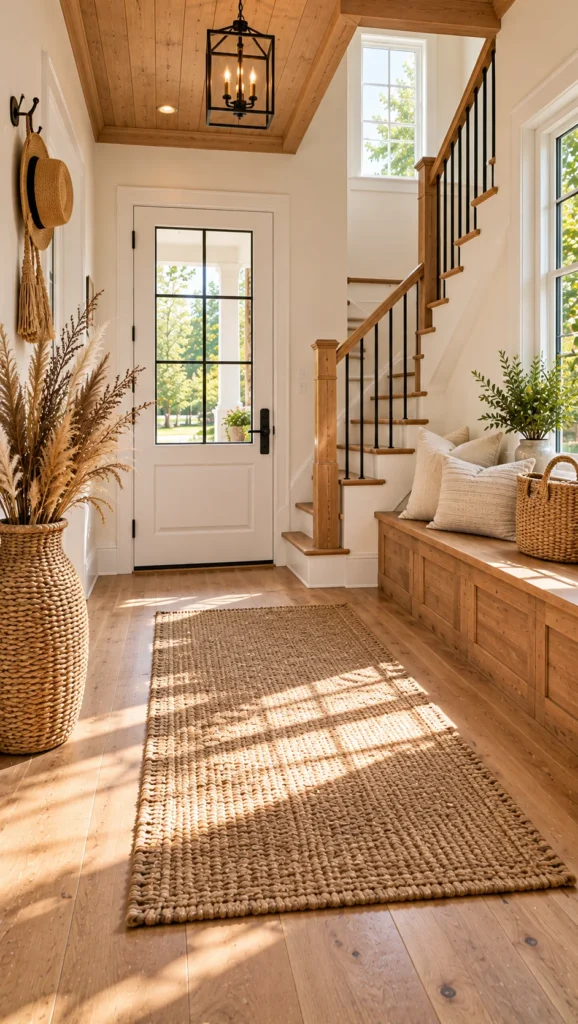
Introduction
An entryway gets about ten seconds of attention and does the hardest job in the house. It takes the coats, the shoes, the bags, the mud, and the first impression, all in a space many houses barely measure. Farmhouse entries do that job with wood and baskets, hooks and benches — nothing fancy, everything in reach. The ten rooms below show ten ways to make a small space work hard without looking busy.
The pattern across all ten is simple: a place to sit, a place to hang, a place to stash, and one thing worth looking at. Miss one of the four and the entry starts collecting clutter. Get all four and the room runs itself. Find the room shaped like yours, take its move, and leave the rest.
A Giant Urn and a Wall of Glass
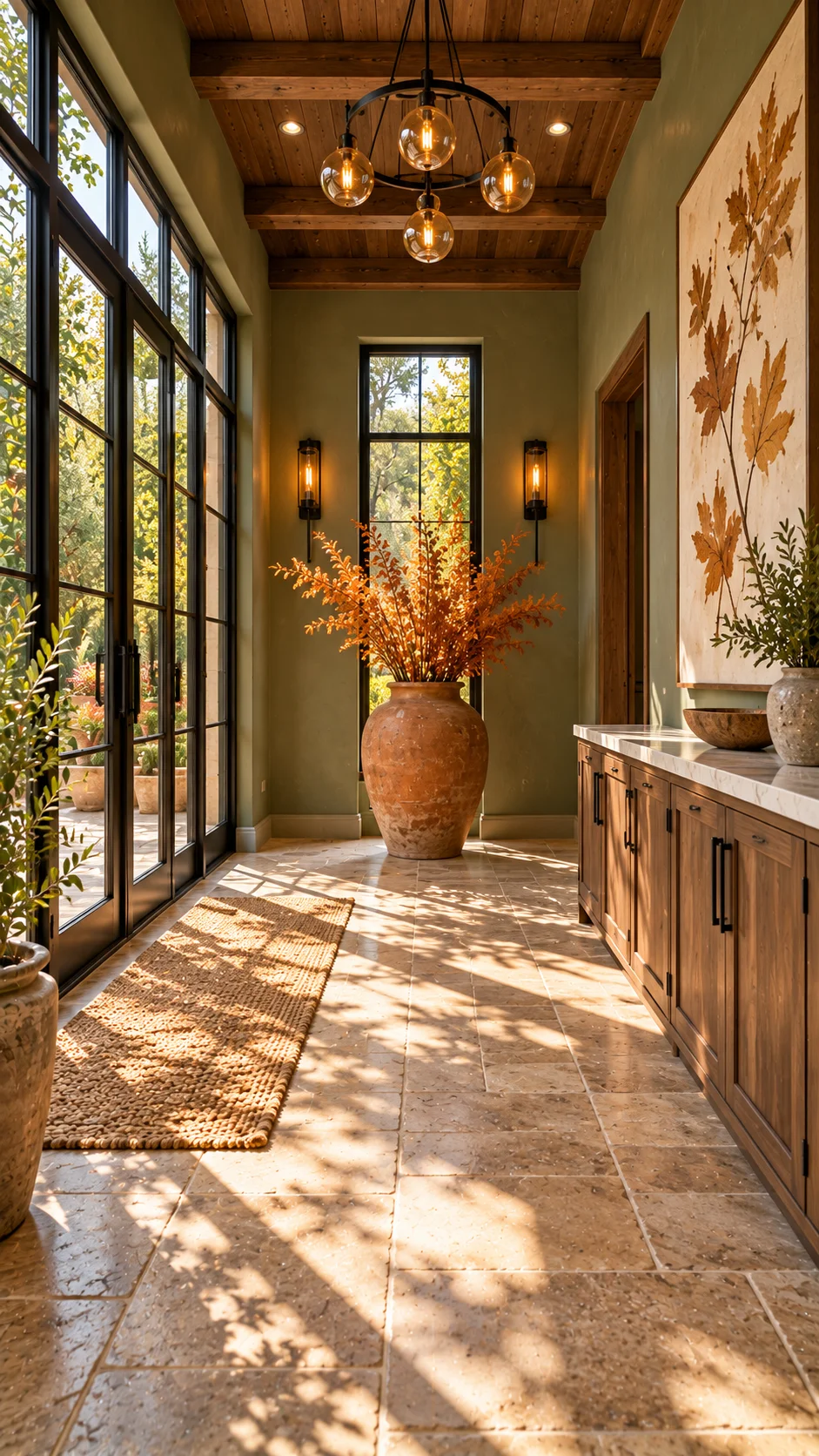
Sage green walls, a wood beam ceiling, and a full wall of black-framed glass doors open this entry to the garden. A giant terracotta urn filled with orange autumn branches stands at the far end. On the right, a long wood sideboard with a marble top holds a bowl and a potted plant. A tall botanical print of brown leaves hangs above it. A jute runner lies on the stone tile floor.
The urn is the move. One oversized object at the end of a walk gives the eye a destination, and it costs less than any built-in. The sideboard does the practical work: closed doors hide the clutter that an entry collects, and the marble top gives keys and mail a landing spot.
The sage green is doing quiet work too. Rooms that follow shades of green that turn your home into a retreat use the same idea — one muted green, repeated on every wall, so the wood and the terracotta can warm it up.
The glass wall does its own work. It turns the entry into a bright room instead of a dark hall, and it lets the garden do the decorating on the entry’s brightest side. An entry with a glass wall needs less art and less color, because the view changes every hour. The urn stands where the glass ends, so your gaze travels the whole room and lands on terracotta.
A Bench Under the Stairs, Hooks for Everything Else
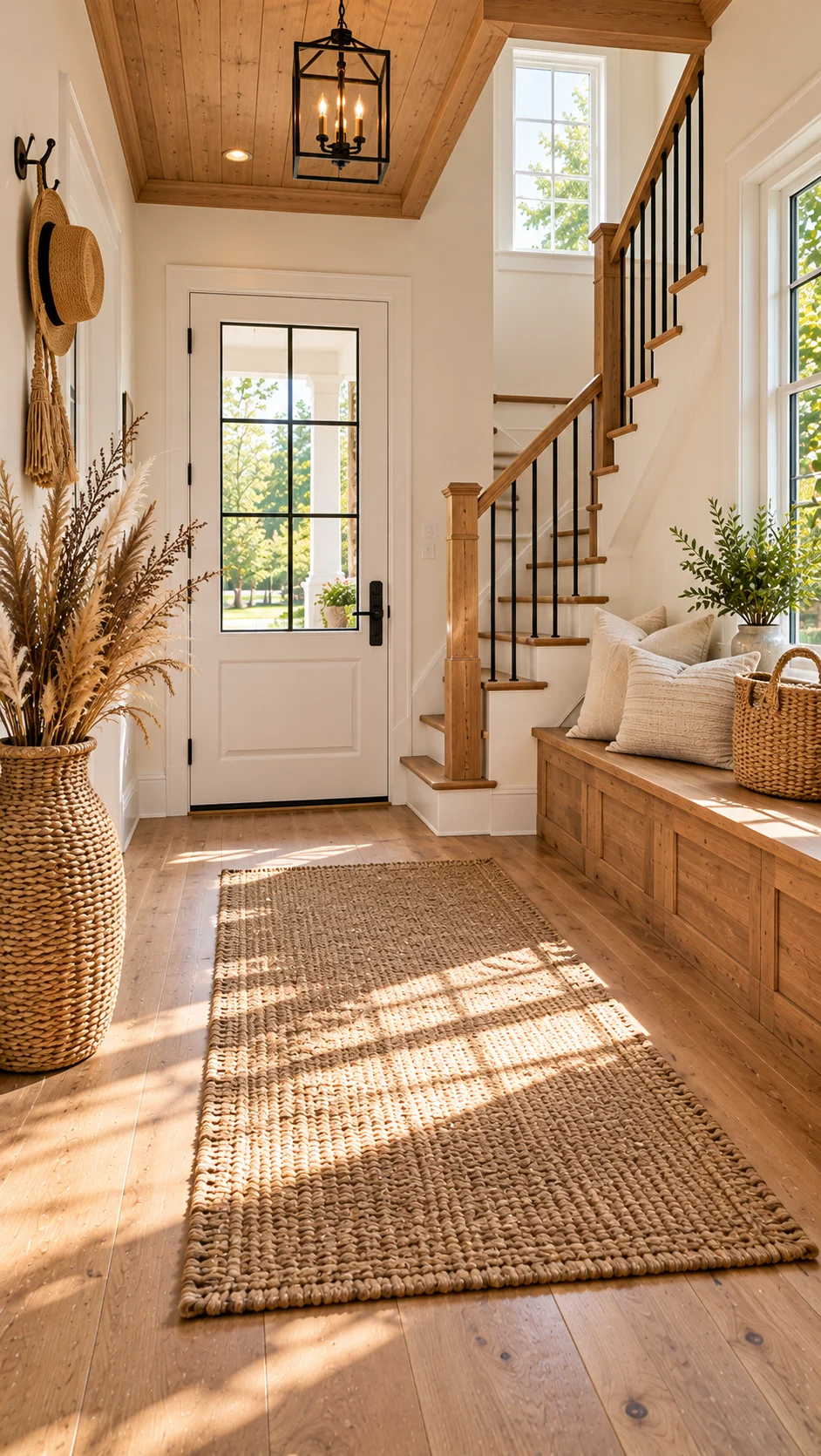
White walls, a wood plank ceiling, and a glass-pane front door open this farmhouse entry. A staircase with wood steps and black spindles climbs the right wall. Under the stairs, a long wood storage bench holds cushions and a wicker basket. A big jute rug covers the wood floor. A woven vase of dried grasses stands on the left, and a straw hat hangs on a wall hook.
- Dead space becomes seating and storage in one move
- Shoes and bags go in the bench, not on the floor
- The stairs stop being a hallway and start being a room
The hat hook is the small lesson. One hook by the door, at arm’s height, catches the thing you grab every day. Five hooks catch the whole family’s coats. Hooks are the cheapest storage an entry can buy, and this room uses them exactly where they get used.
A Console, a Mirror, and Art Leaning Against the Wall
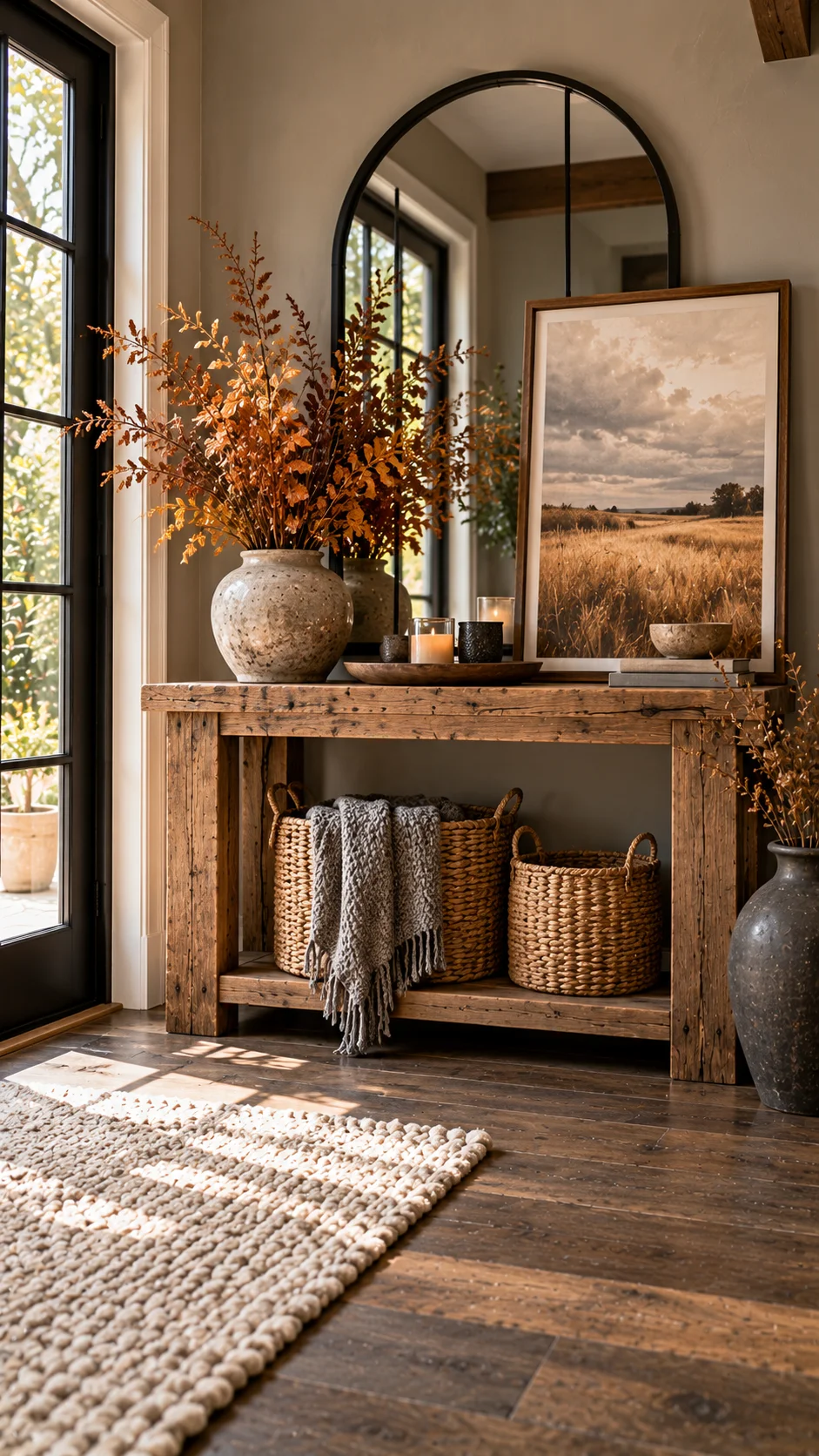
A rustic wood console table stands against the wall in this entry, with an arched black mirror behind it and a framed wheat-field painting leaning against the mirror. A ceramic vase of autumn branches stands beside candles and a bowl on top. Two wicker baskets wait on the lower shelf, one holding a grey throw. A chunky knit rug lies on the dark wood floor, and a glass door lets in daylight.
Why the Art Leans Instead of Hanging
Leaning art is the farmhouse cheat for a wall you do not want to drill. A framed print leaned against a mirror looks deliberate, and it can move when the seasons change. The mirror doubles the light from the door, and the console gives the whole arrangement a base. Nothing here is fixed to the wall except the mirror, so the whole vignette can change in an afternoon.
The baskets do the storage. One holds the throw, one holds whatever the day leaves behind. A console without baskets becomes a shelf for clutter. A console with baskets stays a console.
The leaning painting is worth copying on its own. A frame leaned at a slight angle looks relaxed in a way a hung frame rarely does, and it lets you swap the art when the mood changes. Keep the lean shallow — a few degrees off the wall, not half-fallen — and set the frame’s bottom edge on a felt pad so it does not mark the console.
A Built-In Bench in Dusty Blue, With Baskets for Art
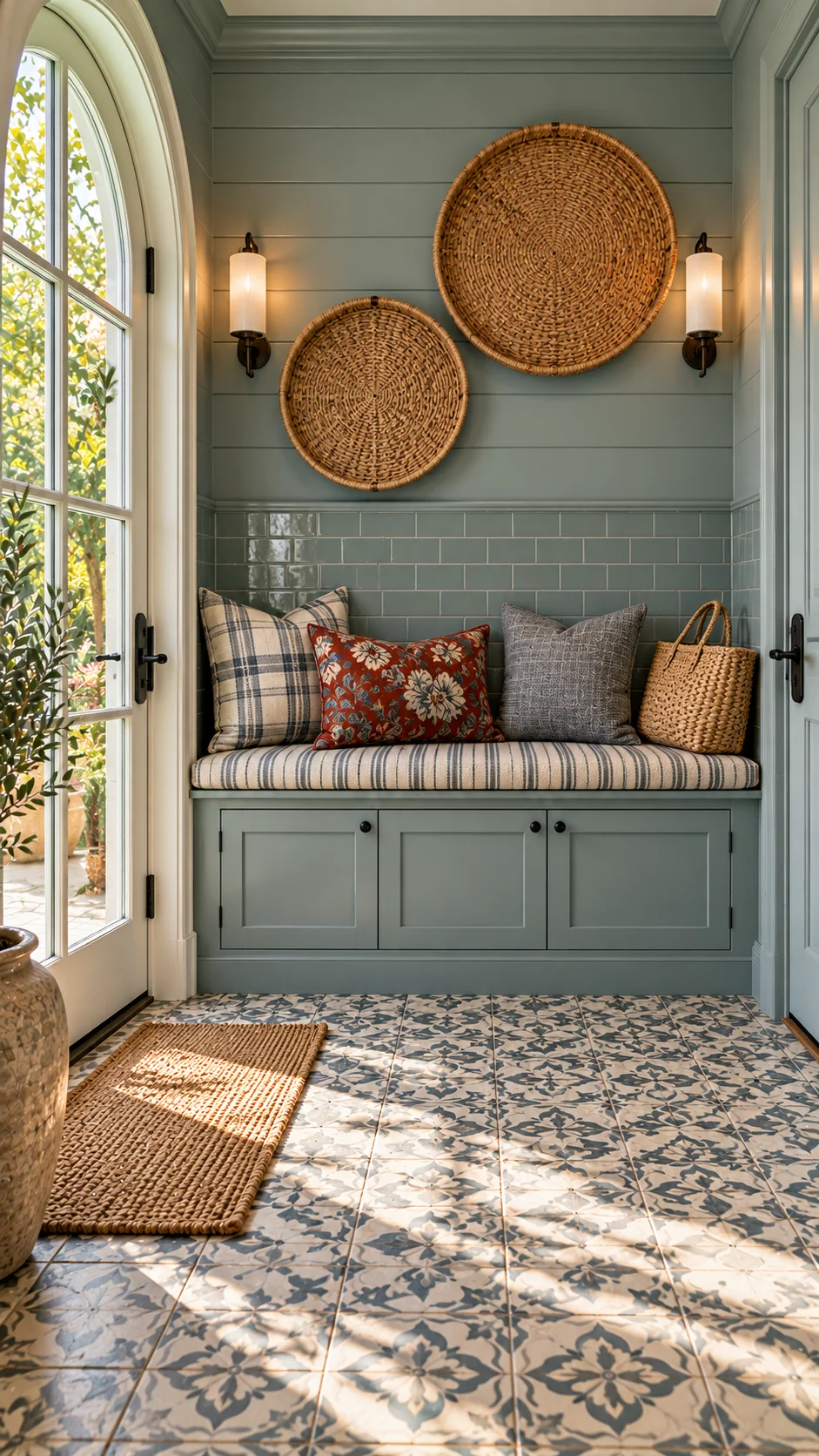
Dusty blue-green shiplap covers the walls of this entry nook, with glossy tile wainscoting below. A built-in bench with a striped cushion and cabinets underneath fills the back wall. Plaid and floral pillows, plus a grey one, pile on the cushion. Two big woven round baskets hang on the wall above, flanked by two sconces. An arched glass door opens to the garden, and patterned blue tile covers the floor.
The baskets on the wall are the move. Woven baskets hung as art cost little, add texture, and can come down to hold things when guests arrive. The built-in bench does the heavy work: cabinets below for shoes, a cushion above for sitting, and pillows that make the nook feel like a room instead of a passage.
The tile wainscoting is the practical hero. An entry wall takes scuffs from shoes and bags, plus boots, and glossy tile wipes clean where paint would mark. The tile also gives the bench wall a finished edge, so the shiplap above it looks like a choice rather than a leftover.
The dusty blue-grey palette leaves the nook calm. Rooms that follow grey living room ideas use the same muted range — grey with a hint of blue, warmed by wood and woven texture.
Hooks on One Wall, Shelves on the Other, Benches on Both
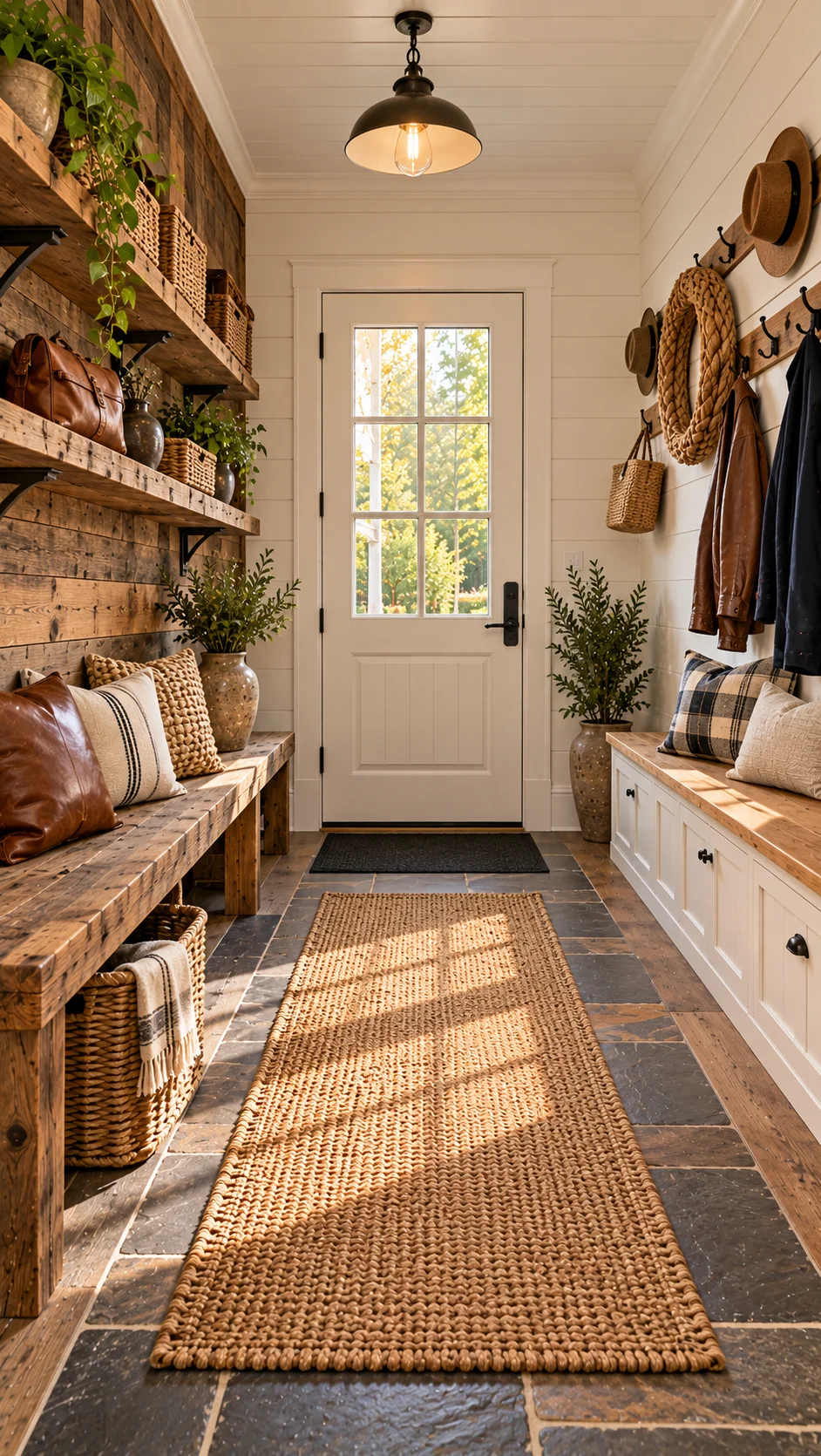
White shiplap and a reclaimed wood plank wall shape this mudroom-style entry. On the left, two open wood shelves hold baskets and bags, plus plants above a long wood bench with leather and knit pillows. On the right, a white storage bench with a wood top sits under two rows of black hooks holding hats and coats, plus bags. A black dome pendant hangs above a jute runner, and slate and wood cover the floor.
- Hooks take the daily coats; shelves take the things that need a home
- Two benches mean two people can sit and put shoes on at once
- Open shelves show what is stored; closed bench hides the rest
This is the room that mudroom storage ideas that make your entryway work overtime describe — every coat on a hook, every pair of shoes in a cubby, and nothing on the floor. The entry works because each side has one job and sticks to it.
A Door Big Enough to Be the Whole Entry
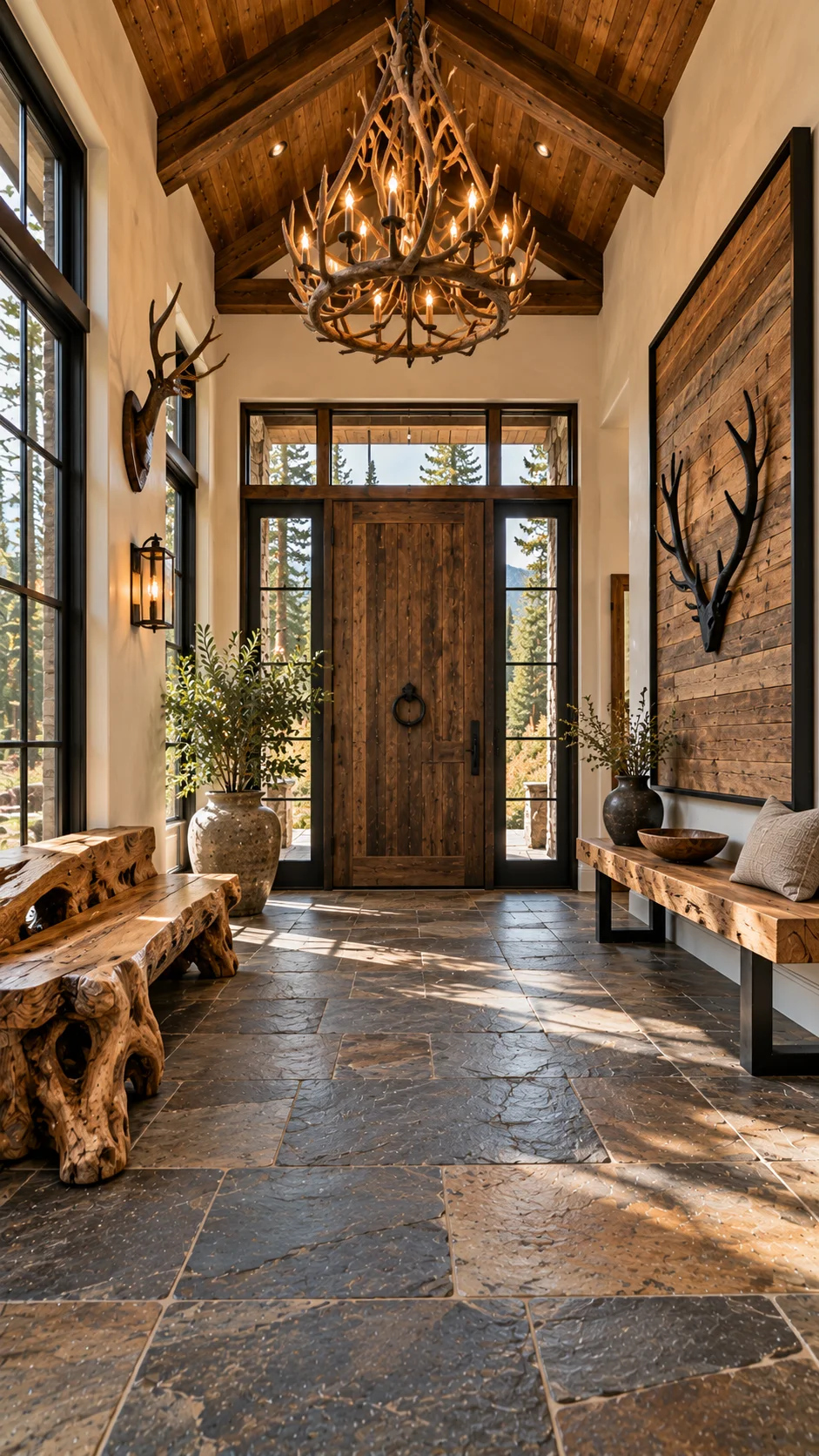
A vaulted wood beam ceiling rises over this lodge-style entry, with a huge antler chandelier hanging at the center. A massive plank wood front door with an iron ring handle stands at the far end, flanked by glass sidelights. Two benches face each other across a stone tile floor: a live-edge log bench on the left, a slab bench on the right. Antlers mount on the walls — a deer head on the left, black metal antlers on a wood panel on the right.
The door is the entry. Everything else — the chandelier, the benches, the antlers — answers it. A door this big makes the room feel grand without a single piece of furniture that matters. The benches are almost an afterthought, and that is fine: in a room with a door like this, seating is a courtesy, not the point.
A front door like this is curb appeal you can see from the street. Victorian porch ideas that add instant curb appeal make the same case — the door and the porch do the greeting, and the inside has to keep up.
One practical note: a door with glass sidelights needs a shade or a film if the entry faces the street. The glass brings in light, and it also brings in eyes.
A Bench Against Stone, With Art Above It
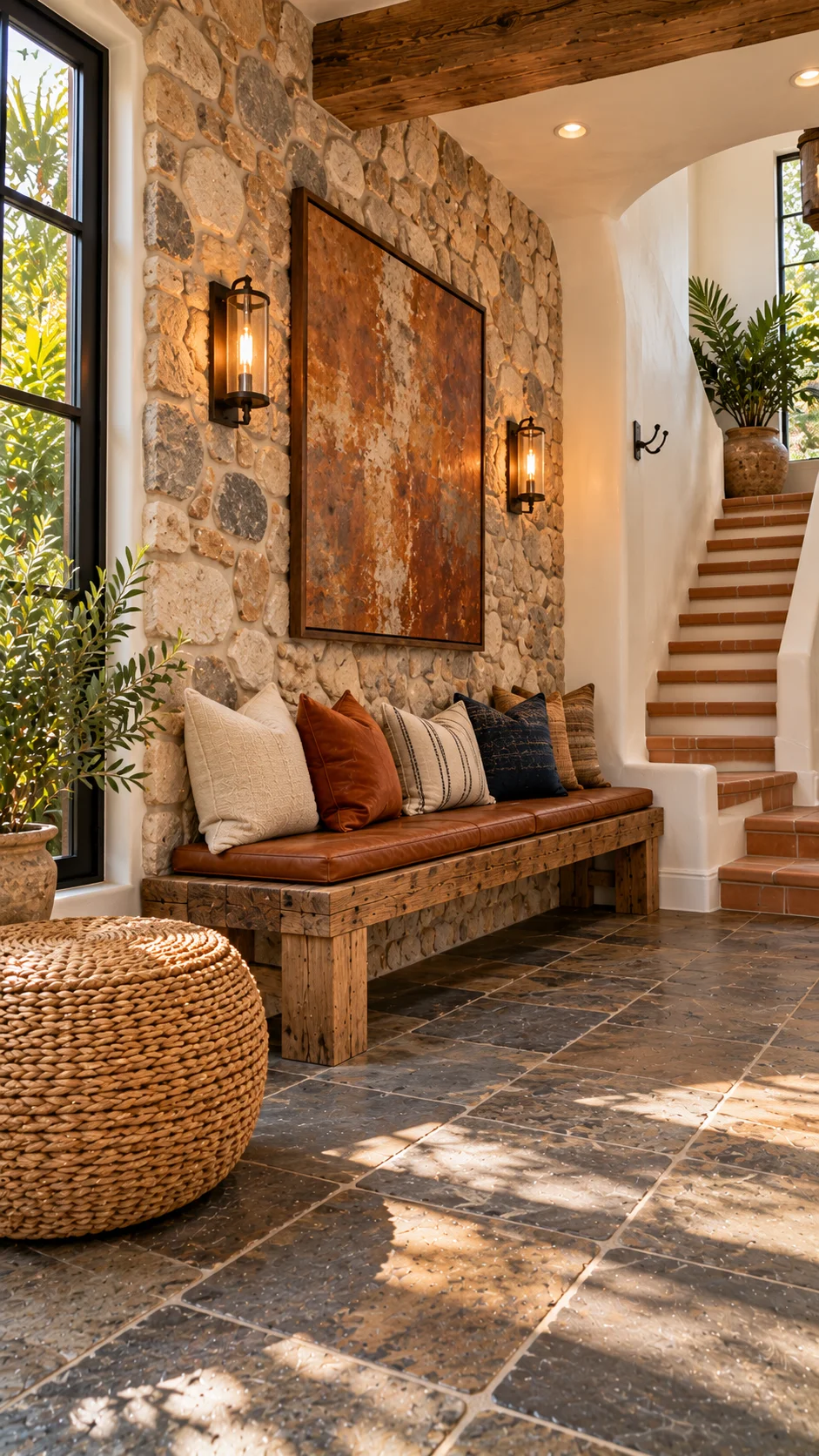
A rough stone wall runs behind this entry bench, with a big rust-toned abstract painting hung above it and two lantern sconces on either side. A long wood bench with a brown leather cushion holds six pillows in cream and rust, striped and navy. A woven round ottoman sits in front, and terracotta stairs climb on the right. Slate tile covers the floor.
Stone Does the Decorating
The stone wall is the whole decoration. No wallpaper, no paneling, no extra art beyond the one painting — the stone’s texture carries the room. A bench against stone needs a cushion with some give, and the leather one here has it. The pillows add the color, so the stone can stay quiet.
The painting above the bench is doing a specific job. A stone wall can swallow small art, so the one painting has to be big and warm-toned to hold its place. The rust tones in the canvas answer the leather cushion below, and the sconces on either side light both the art and the stone after dark.
The ottoman earns its place. It is a second seat, a footrest, and a spot to set a bag while you put on shoes. One round ottoman in a rectangular entry softens the lines, and the woven texture answers the stone.
A Rope Mirror Big Enough to Anchor the Hall
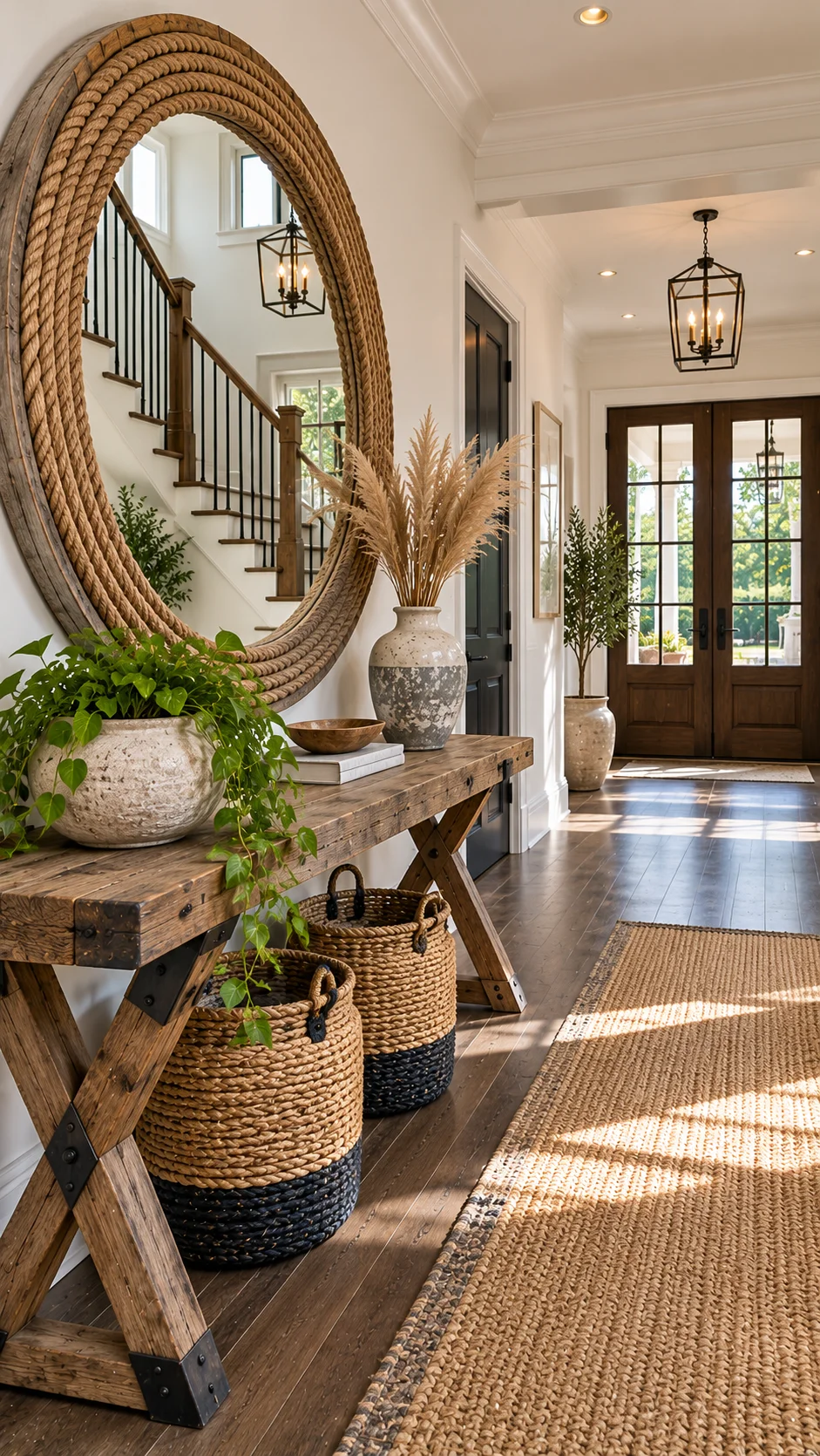
A huge round mirror with a thick rope frame dominates this entry hall, hanging above a wood X-leg console table. A trailing pothos spills from a stone pot on the left, and a vase of pampas grass stands on the right. Two rope baskets sit under the table, one with a black base. A jute runner lies on the dark wood floor, and glass double doors stand at the far end.
The mirror is the anchor. A hall this long needs one object big enough to stop you mid-step, and the rope frame makes the mirror feel like it belongs in a farmhouse, not a hotel lobby. The console below gives it a base, and the baskets give it a job — shoes and scarves, plus bags, go under the table instead of on it.
The rope is the detail to copy. A plain mirror would look bare on a wall this size. A rope frame adds texture and weight for little money, and it ties the mirror to the baskets and the runner. Three rope pieces, one material, one idea.
The double doors at the far end matter as much as the mirror. They give the hall a bright endpoint, so the long walk has somewhere to go. A hall with a mirror but no destination feels like a corridor. A hall with both feels like an arrival.
A Cactus in the Entry, and Why It Works
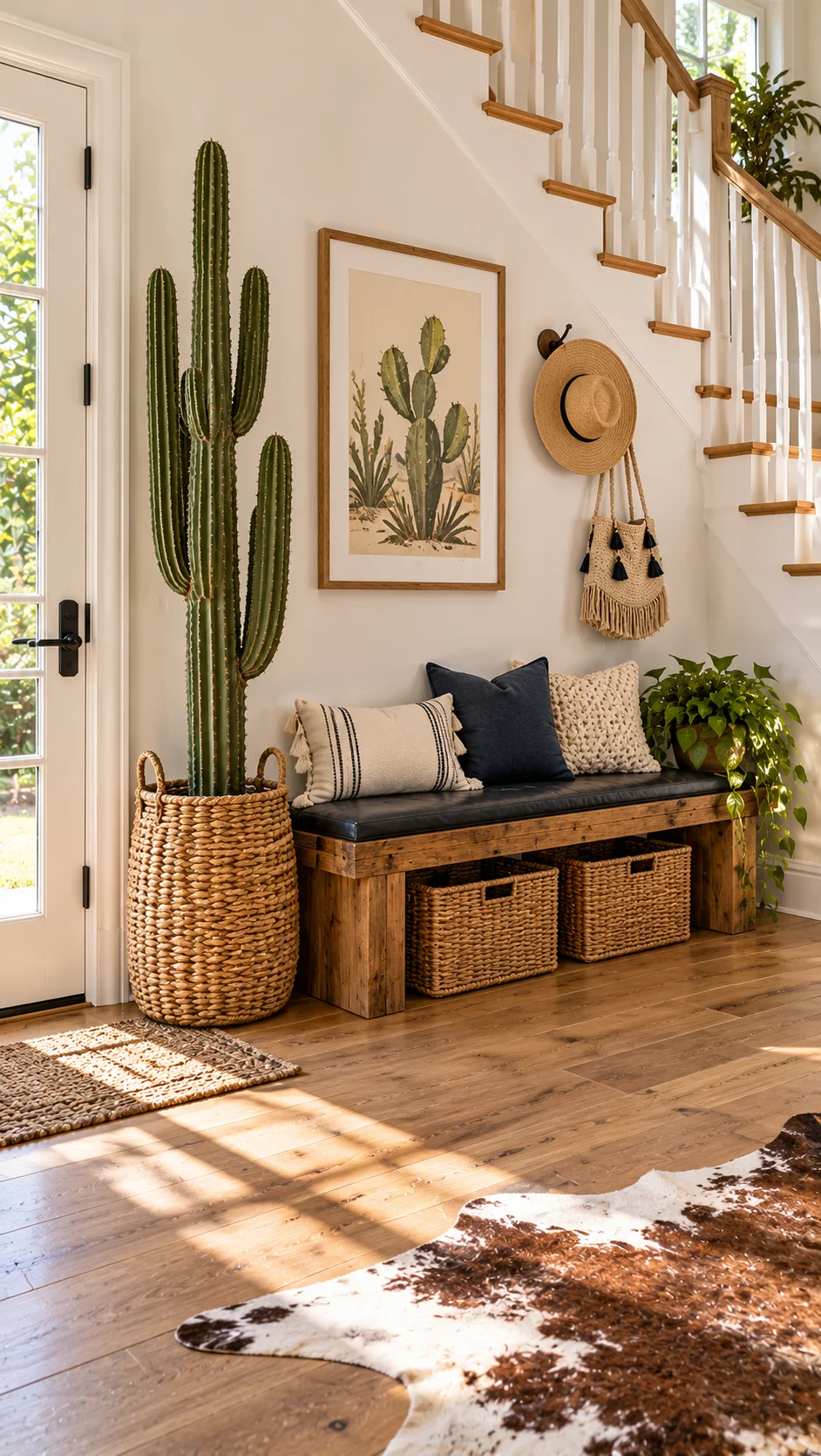
A tall cactus in a wicker basket pot stands beside the front door in this bright entry, next to a framed cactus botanical print. A wood bench with a black leather cushion holds three pillows, with two wicker baskets below. A straw hat and a woven bag hang on wall hooks. A cowhide rug lies on the wood floor, and stairs climb the right wall.
- It needs almost no water and no attention
- Its height fills a corner that would otherwise sit empty
- The print on the wall echoes it, so one plant becomes a theme
The bench does the ordinary work: a seat, two baskets for shoes, and pillows that make it look like furniture instead of storage. The cactus does the memorable work. Guests remember the entry with the cactus. Nobody remembers a plain bench.
Every Coat Gets a Hook, Every Pair Gets a Basket
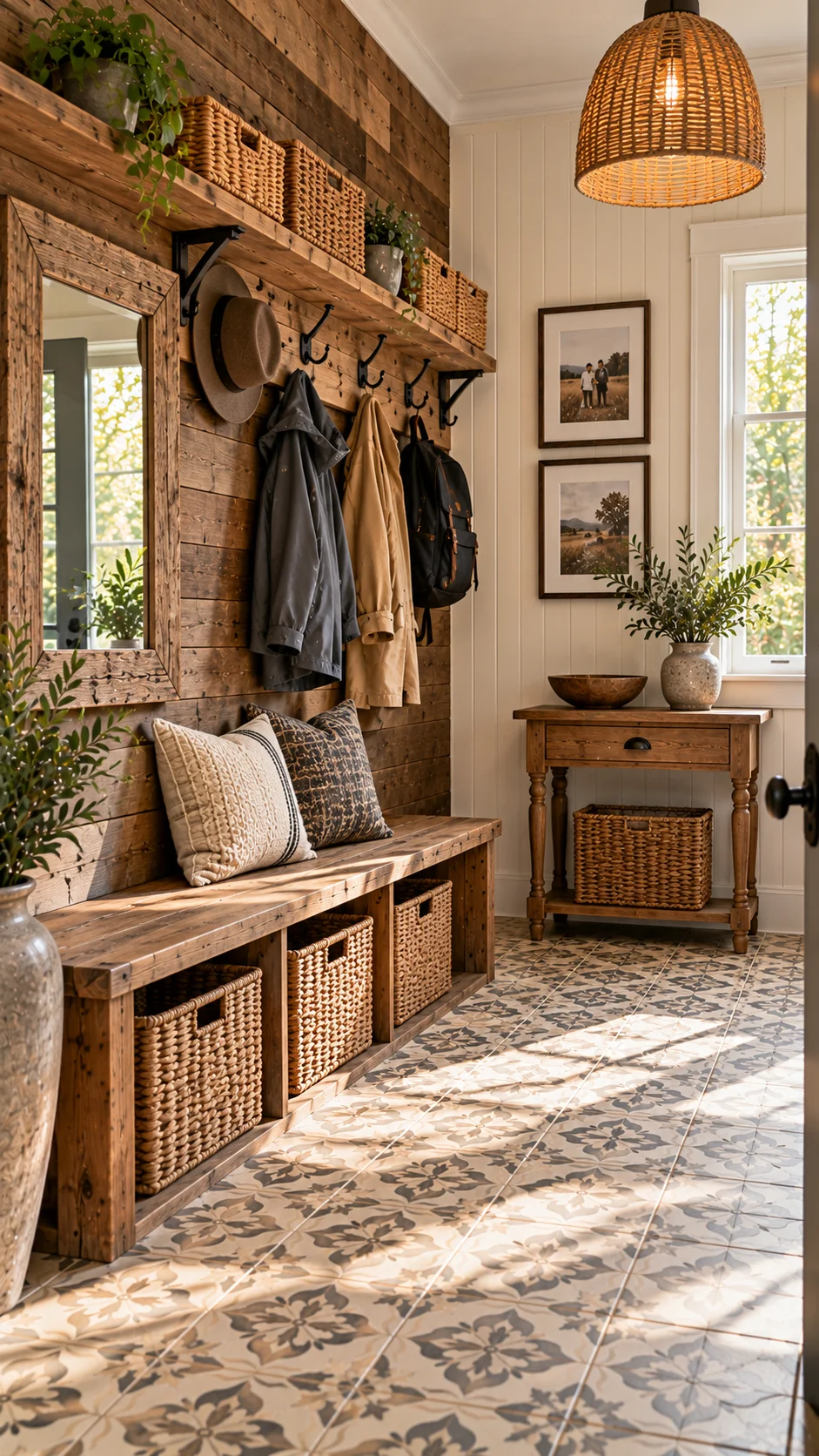
A reclaimed wood plank wall holds this entry’s whole system: a row of black hooks with coats, a hat, and a backpack, a wood-framed mirror, and a shelf above with baskets and plants. Below, a wood bench with open cubbies holds wicker baskets. A small wood side table with a drawer stands by the window, with a basket beneath it. Patterned tile covers the floor, and a wicker pendant hangs above.
This is the hardest-working entry here, and it looks like the simplest. Every item has a hook or a basket, and nothing sits on the floor. The mirror lets you check your coat before you leave. The side table holds the keys. The shelf holds the overflow. Nothing in the room is decoration first — it is all storage that happens to look good.
The side table by the window is the detail many entries miss. A drawer for keys, a top for mail, and a basket below for the bag you grab tomorrow — three jobs in a table the size of a stool. An entry without a landing spot for keys will look messy, no matter how tidy the hooks are.
The cubby baskets under the bench are shoe storage that behaves. Shoe racks that double as entryway decor make the same point — shoes get a home that looks like furniture, and the entry floor stays clear.
Frequently Asked Questions
How do I keep a farmhouse entryway from turning into a dumping ground?
Give everything a hook or a basket, and keep the floor clear as the one rule. Coats on hooks, shoes in cubbies, bags in a basket, keys in a bowl. When something has no home, it lands on the floor. A five-minute reset each evening — coats hung, shoes binned, mail moved — holds the line. If the bench starts collecting coats, add one hook per person and nothing more — extra hooks invite extra clutter.
What if my entryway is tiny — no room for a bench?
Skip the bench and keep the hooks and a narrow shelf. A wall-mounted shelf with three hooks below it takes four inches of depth and holds coats and keys, plus a basket. A mirror above the shelf opens the space. A bench is nice; hooks and a shelf are the entry itself.
Should the entryway match the rest of the house?
It should rhyme with it, not copy it. If the house is farmhouse, the entry can be farmhouse. If the house is modern, a farmhouse bench would look stranded. Match one material — the wood tone, the metal finish — and let the entry have its own character.
Conclusion
The ten entries agree on one thing: an entryway works when four things are in place — a place to sit, a place to hang, a place to stash, and one thing worth looking at. That means hooks and baskets, a bench, plus a mirror or a piece of art. Miss one and the room clutters. Get all four and the room runs itself.
Start with the hooks. They cost the least and change the room more than anything else. Then the bench, then the baskets, then the one thing worth looking at. An entryway does not need a rebuild to feel right. It needs four decisions, made once, and kept.
About the Author
The Aesthetic Life Team writes about home decor and interior design for rooms that get used every day, from the front door to the back porch.

