
Ten different boho home offices, ten different reasons they work. Some lean on a single antique rug, some lean on plants, some lean on a wall of reclaimed wood — and none of them lean on the same trick twice. If you’ve been saving boho desk photos for months and still can’t picture your own version, this guide is built to fix that: what each room is actually doing, who it suits, and what it would cost to get there.
Quick Overview
| Best For | Creatives, remote workers, renters |
| Budget | Low–High (scales easily) |
| Difficulty | Easy–Moderate, mostly DIY-friendly |
| Maintenance Level | Low–Medium |
The Live-Edge Desk That Lets a Vintage Rug Do the Talking
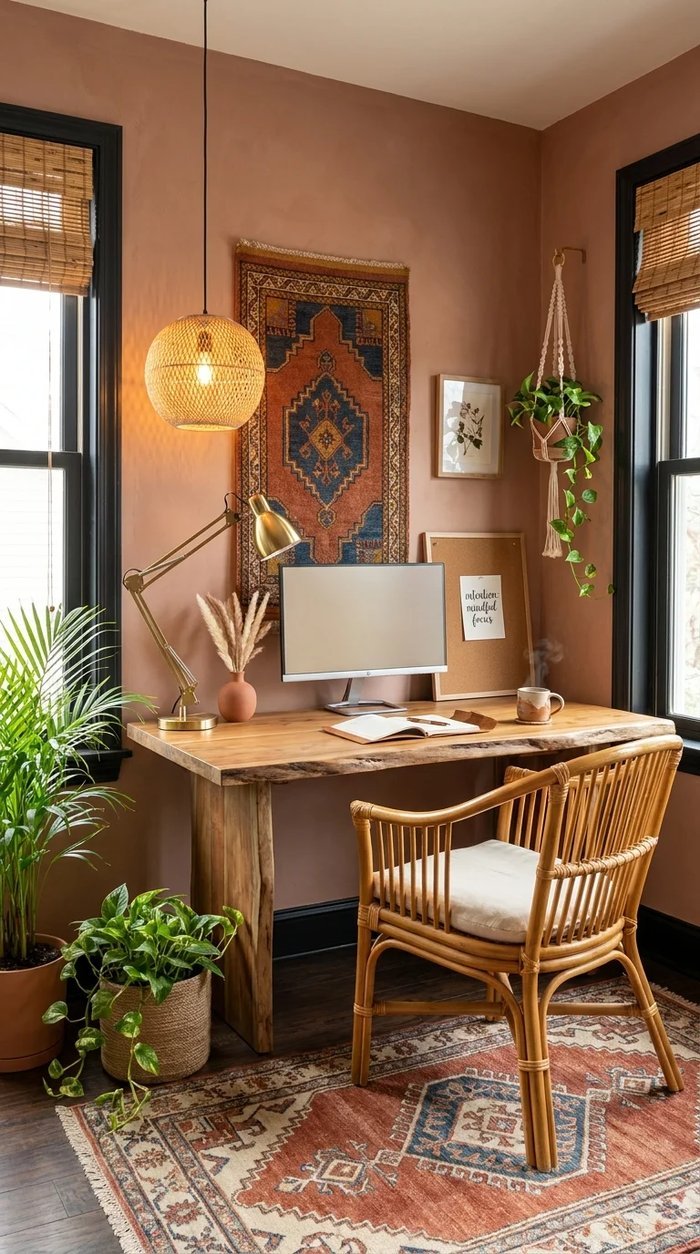
A single antique rug turned wall art carries more visual weight here than anything on the desk.
The wall is the real desk accessory in this corner, not the monitor or the lamp. A hand-knotted rug is hung flat like a tapestry above a live-edge wood desk, and everything else — the woven pendant, the terracotta planters, the rattan barrel chair — is chosen to sit quietly under it rather than compete with it. This is a strong option for anyone working in an open-plan corner rather than a closed room, since the rug and the dusty-rose wall behind it do enough visual work to make the space feel intentional even without a door.
It suits people who already own or want to invest in one genuinely good textile, because the whole room is staged around that single piece. Renters and apartment dwellers benefit too — a hung rug needs only a rod and two hooks, no renovation required. The strongest advantage here is how little furniture is actually needed once the wall is doing the heavy lifting; the biggest trade-off is that a bad or busy rug in this spot will fight the room instead of anchoring it, so the textile has to be chosen first, everything else second.
To recreate it on a smaller budget, swap the antique rug for a flat-weave kilim reproduction and keep the rest of the palette — warm terracotta, brass, and a few varieties of trailing greenery like pothos and other low-fuss plants that do well in an entryway corner too — consistent with the wall color so nothing reads as an afterthought.
Where the Warm Tones Keep Showing Up
The dusty rust of the rug reappears in the terracotta planter, the brass lamp base, and the pampas grass — a repeated warm palette that’s the actual reason this corner feels resolved rather than decorated. Swap any one of those for a cool-toned equivalent and the room would likely lose that sense of everything belonging together. It’s a small, deliberate echo rather than a matched set, which tends to read as more considered than furniture bought as a suite.
Recommended Materials: live-edge hardwood, woven rattan, brass, terracotta, wool rug fibers, bamboo pendant shade
Main Colors: Dusty Rose, Terracotta, Warm Rust, Brass, Charcoal Trim
Best Lighting: A warm-toned pendant compensates well here since the corner sits between two windows with filtered, indirect daylight — task lighting from the brass desk lamp handles close work without competing with the window light.
Maintenance: The palm and pothos need bright, indirect light and a weekly check for dry soil; wipe dust from wide palm leaves monthly so they don’t dull the room’s overall warmth.
Where a Beginner Usually Trips Up Recreating This
- Choosing a rug with too many competing colors, which turns the “wall art” moment into visual noise instead of a focal point
- Skipping the rod-and-dowel hanging method and using adhesive strips that sag under a heavy wool rug within weeks
- Placing the desk lamp so its cord crosses in front of the hung rug, breaking the clean sightline the room depends on
- Adding a second large patterned textile (like a bold throw pillow) that competes with the rug instead of supporting it
Turning Rug Scraps Into a Gallery Wall Worth Framing
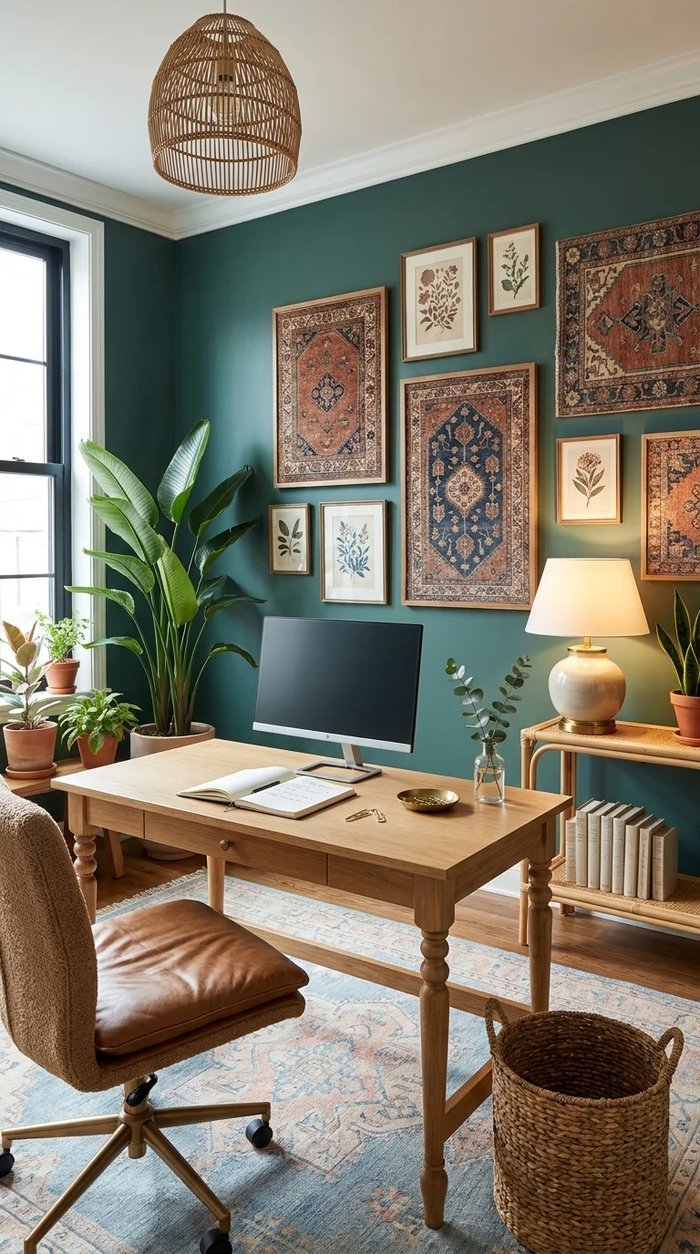
Seven small frames read as one large piece — the trick is keeping every mat and frame identical.
This room takes the “one statement rug” idea from a corner like the first and does the opposite: instead of one large textile, it uses fragments of several rugs and botanical prints, all matted and framed identically, arranged as a single gallery grid against a deep teal wall. It’s a genuinely different way to get the same layered, collected feeling — through repetition of a frame style rather than repetition of one object.
This approach suits people who already have (or want to source) smaller vintage textile pieces too fragile or oddly sized to use as rugs, and it works especially well in a room with enough wall height to support a grid several frames tall. It’s a strong fit for a dedicated office rather than a shared corner, since the gallery wall needs a stretch of uninterrupted wall to read correctly. The advantage is real flexibility — frames can be added or swapped one at a time as new pieces are found. The compromise is cost and patience: framing seven-plus pieces to match adds up quickly, and an uneven grid looks unfinished rather than eclectic.
Budget-conscious readers can start with three or four frames instead of seven, using inexpensive botanical prints alongside one small real textile fragment, and simply leave room on the wall to grow the grid over time — the same instinct behind the layered gallery-style rug hangings in boho bedroom styling, scaled down for an office wall.
What the Eye Finds First in This Room
Because every frame shares the same mat width and wood tone, the grid reads as one large shape before the eye ever separates it into seven pieces — a sightline decision, not a coincidence. The desk and chair sit low and light-colored specifically so nothing below competes with that upper wall. Move the eye down, and there’s very little else asking for attention, which is likely why the gallery wall feels intentional rather than crowded despite the number of individual pieces.
Recommended Materials: oak picture frames, linen mat board, light ash wood desk, boucle-cushioned oak chair, ceramic lamp base
Main Colors: Deep Teal, Terracotta, Rust, Warm Cream, Brass
Best Lighting: A single warm table lamp on the console beside the desk softens the dark teal wall in the evening; during the day, the window to the left is the main light source, so the desk faces sideways to avoid glare on the monitor.
Easy Ways to Get This Grid Wrong
- Mixing frame finishes (gold, black, natural wood) within the same grid, which breaks the “one large piece” illusion
- Leaving uneven gaps between frames instead of a consistent 2–3 inch spacing throughout
- Hanging the grid too high, disconnected from the desk below it, so the two zones feel unrelated.
- Choosing prints and textile fragments in unrelated color families instead of variations on the same warm palette
The Restraint Behind a Wall This Textured
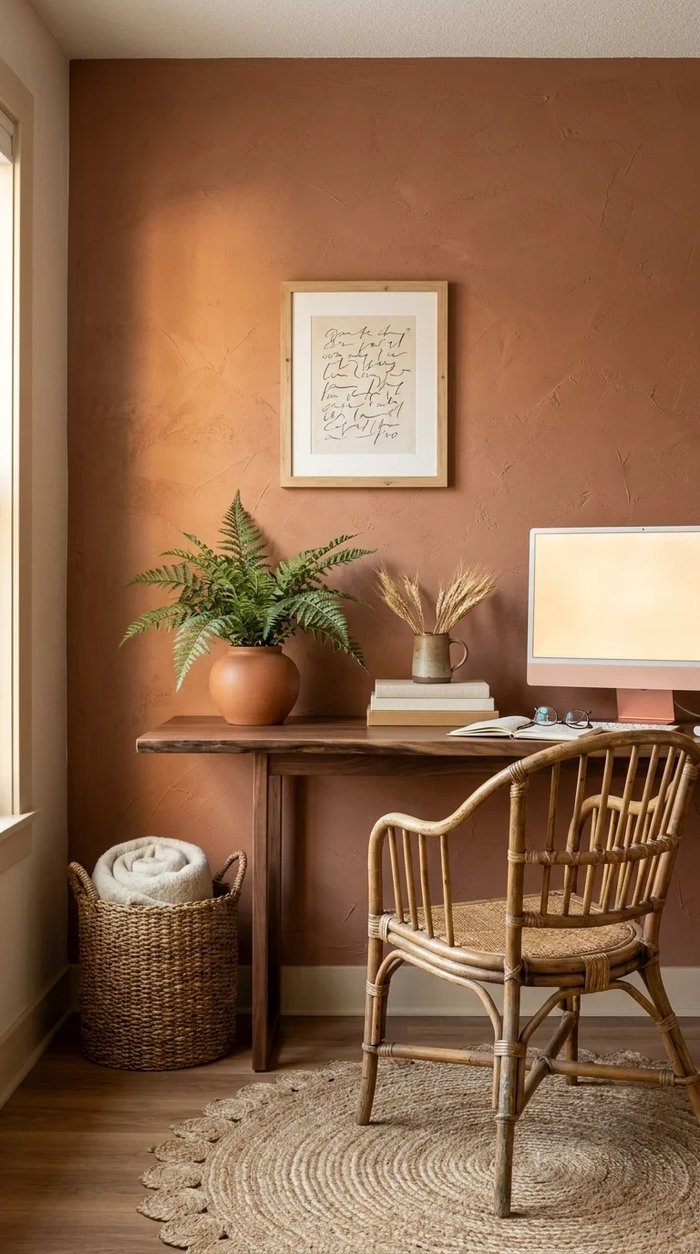
Nearly every surface here is empty on purpose — the plaster texture is the only decoration allowed to compete.
Where the first two rooms build boho warmth through layered objects, this one strips almost everything away and lets a hand-troweled plaster wall carry the entire look. One framed print, one plant, one small vase of dried wheat — that’s the full inventory on the desk. It’s boho reduced to texture and warm color rather than pattern and collected objects, which makes it a genuinely different entry point into the style.
This is the strongest option for anyone who finds classic maximalist boho overwhelming but still wants the warmth of terracotta tones and natural materials — it’s boho for people who actually prefer a clear desk. It also suits smaller rooms particularly well, since negative space reads as calm rather than empty when there’s only one room to fill. The advantage is an almost zero-maintenance styling load once it’s set up; the compromise is that a textured plaster finish is a genuine renovation, not a weekend project, and it isn’t cheap to do properly.
For a lower-cost version, a limewash or textured paint technique over drywall gets close to the same effect without the cost of true Venetian plaster, and pairing it with a simple console-style desk keeps the reading-nook-level minimalism this room is going for intact.
A Small Scale Risk That Actually Pays Off
A wall this textured, left almost entirely bare, is a proportion gamble — most rooms need more on the walls to avoid feeling unfinished, but here the plaster’s own depth and shadow-play function as the decoration. The one framed print is deliberately small relative to the wall, which in a busier room would look under-scaled; in this one, it works because it’s clearly the only competing element the wall has to deal with.
Recommended Materials: Venetian plaster (or limewash paint), dark walnut wood, terracotta ceramic, woven seagrass basket, jute
Main Colors: Warm Terracotta, Rust, Clay, Natural Wood, Cream
Best Lighting: Morning light through the left window rakes across the textured wall and brings out its shadow depth — this effect is worth prioritizing over overhead lighting if a similar wall is being planned.
Maintenance: The fern needs consistent humidity and will brown at the tips in a dry office; misting weekly or keeping it away from direct heating vents helps.
Where This Look Falls Apart if You’re Not Careful
- Adding too many small decorative objects once the wall is finished, which undercuts the whole point of the restraint
- Choosing a glossy paint finish instead of a matte, textured one, which flattens the shadow depth the wall depends on
- Hanging artwork that’s too large relative to the wall, competing with the plaster instead of complementing it
- Skipping a sample patch before committing to a full wall, since plaster color shifts noticeably once dry
When Storage Disappears Into the Wall, One Object Gets to Shine
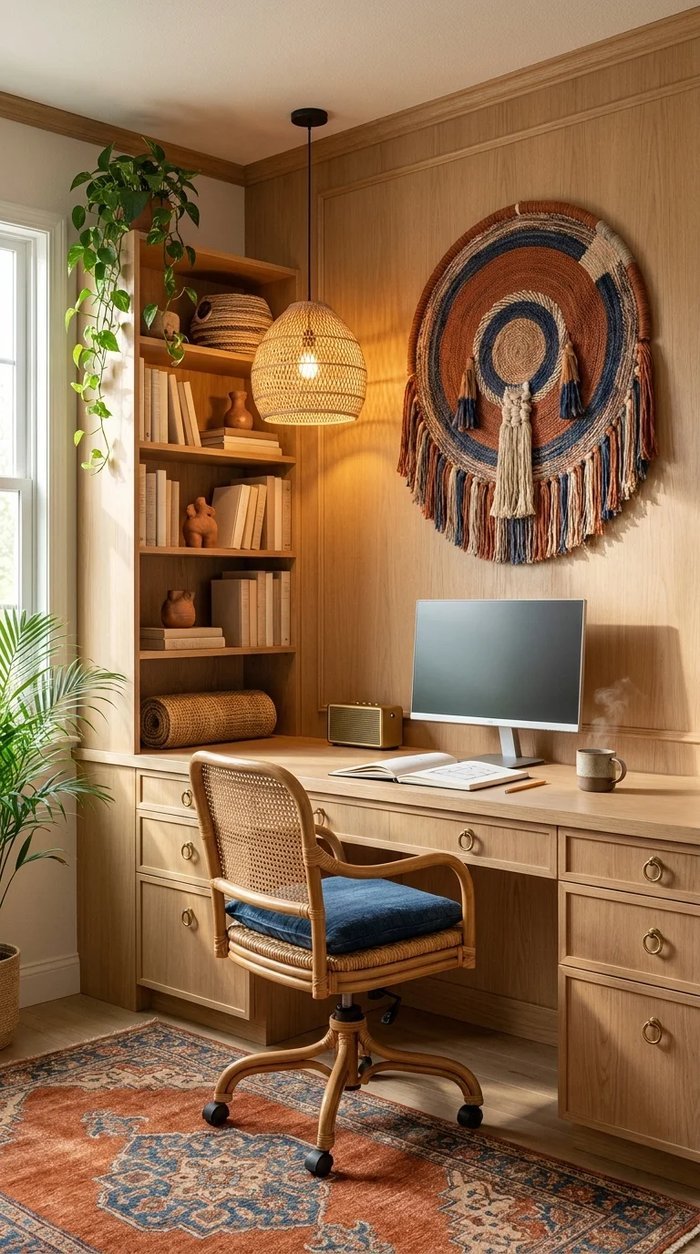
Storage disappears into the millwork so the one woven piece above the desk can carry the room’s personality.
This is the most architectural room of the group — full built-in cabinetry wraps the desk, bookshelf, and storage into one continuous piece of millwork, painted the same warm wood tone as the walls. Against that calm, custom backdrop, a single large circular woven wall hanging is allowed to be the one loud decision in the room. It’s boho achieved through restraint in furniture and boldness in exactly one object, rather than layering many smaller pieces.
This setup is best for anyone renovating or building a dedicated office from scratch, since it requires real carpentry rather than furniture shopping — it isn’t a rental-friendly option. It particularly suits people who need serious storage (books, files, supplies) but don’t want that storage to look like an office supply closet. The advantage is a room that never looks cluttered no matter how much is stored behind those doors; the compromise is upfront cost and the fact that, once built, the layout is far harder to change than a furniture-based room.
A budget-conscious version swaps custom millwork for a stock bookshelf-and-desk combo in a matching wood tone, keeping the woven circular piece as the one splurge — the same “one object, many storage pieces” logic used in rattan furniture pairings elsewhere in boho interiors.
How the Weave Will Actually Behave Over Time
A large woven fiber wall hanging like this one is typically jute, sisal, or a rope-cotton blend, and those materials lighten and soften slightly with sun exposure over a year or two — not necessarily a flaw, but worth knowing before hanging it in a south-facing spot where the fading could be uneven. The cane seat on the office chair behaves similarly: it will develop a slight give and patina with daily use, which is part of cane’s appeal rather than a defect.
Recommended Materials: painted oak millwork, cane webbing, jute rope, navy velvet, brass hardware
Main Colors: Warm Honey Wood, Navy, Terracotta, Rust, Cream
Best Lighting: The black woven pendant is the primary fixture, and it’s positioned directly over the desk surface, not centered in the room — worth copying, since centered pendants often leave the actual work surface underlit.
Is Custom Millwork Worth It Here?
For a room used daily, yes — built-in storage that hides files, cables, and supplies behind matching doors does more to keep a boho room looking calm than any styling trick could. That said, it’s only worth the investment if the layout is genuinely permanent; millwork this integrated has essentially no resale value as furniture if you move, and retrofitting it into a rental is rarely realistic. For anyone renovating a forever-home office, it’s one of the few upgrades here that pays off in daily use rather than just in photos.
Easy Ways to Get This Wrong
- Painting the millwork a different tone than the surrounding walls, which breaks the “disappearing storage” effect entirely
- Choosing more than one bold wall piece, which competes with the woven hanging instead of letting it be the singular statement
- Using a bare cane chair without a cushion for daily 8-hour use, leading to real discomfort within weeks
- Overfilling open shelving with mismatched objects, undermining the calm the built-ins were designed to create
Forty Small Objects, One Wall, Zero Chaos
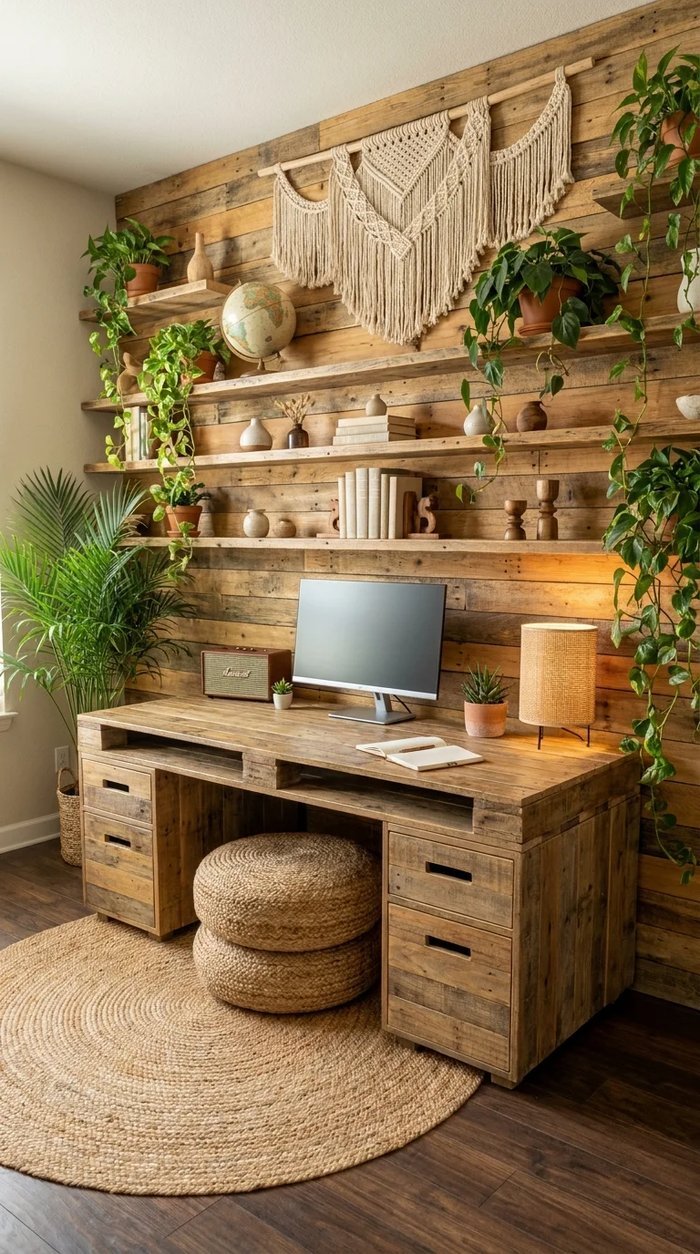
Every shelf item was collected, not bought as a set — that’s what keeps forty objects from feeling cluttered.
A full wall of reclaimed pallet wood backs open shelving loaded with globes, vases, books, and trailing plants, plus a macrame hanging above a rustic desk with real file storage. Unlike the restrained plaster room or the millwork room, this one embraces visible clutter — but it’s curated clutter, grouped by height and color rather than scattered. It’s the version of boho for people who like their office to look genuinely lived-in and collected over years, not staged in a weekend.
This suits writers, researchers, or anyone who actually wants shelf space for physical books and objects rather than a paperless setup. It’s a poor fit for small rooms, since the wood-plank wall and open shelving both need real square footage to avoid feeling cramped. The advantage is a room that can absorb new finds indefinitely without looking “finished” in a way that resists change; the compromise is that open shelving this dense requires real dusting discipline, and a bad edit (too many similar-colored objects bunched together) reads as messy rather than curated.
To recreate this without a full accent wall, a single reclaimed wood shelf unit against a plain painted wall gets close to the effect at a fraction of the material cost, similar to the shelf-and-desk pairing philosophy in this reclaimed-wood approach to a rustic home office.
The Wood Tone That Keeps Repeating
The same warm, weathered wood tone shows up in the plank wall, the desk, the shelving, and even the wood-based decor objects on display — a deliberate repetition that keeps forty-plus small items from reading as chaos. Swap even a few shelf items for a cooler material like black metal or white ceramic in bulk, and the wall would likely start to feel busier rather than more balanced, since the wood repetition is doing more organizing work than the actual arrangement of objects.
Recommended Materials: reclaimed pallet wood, jute, ceramic, brass, woven rattan poufs
Main Colors: Weathered Oak, Warm Brown, Cream, Terracotta Accents
Best Lighting: A small woven table lamp supplements the room since the shelving casts shadows across the desk in the afternoon — worth planning for if a similar shelf wall blocks a window’s direct light.
Maintenance: Trailing pothos on the top shelves need occasional trimming so they don’t obscure the lower display objects, and open shelving of this density genuinely needs a monthly dusting pass to stay looking curated instead of neglected.
What Trips People Up Recreating This
- Buying decor as a matched set instead of collecting pieces over time, which reads as staged rather than authentically layered
- Overcrowding shelves evenly instead of grouping by height, leaving no visual breathing room anywhere on the wall.
- Skipping cable management for the desk lamp and speaker, which stands out against an otherwise natural, cord-free-looking wall
- Choosing a pallet wood finish that’s too uniform and new-looking, losing the reclaimed material’s texture that makes the wall work
A Desk and a Lounge Chair Sharing One Small Wall
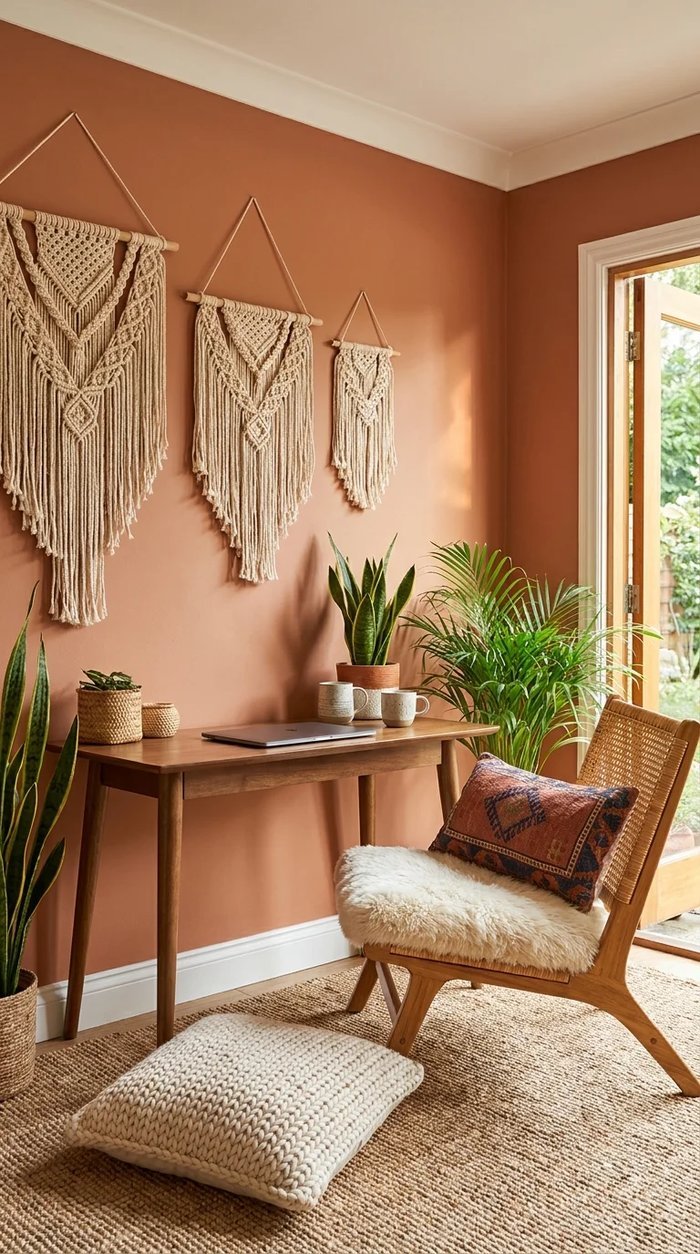
This corner works as a desk and a reading chair at once, because neither piece was chosen to match the other.
Three graduated macrame wall hangings, largest to smallest, sit above a slim mid-century desk — but the chair pulled up to that desk isn’t a desk chair at all. It’s a low rattan lounge chair with a sheepskin cushion, positioned near French doors that open to a garden. This room quietly admits that most home offices double as a reading or thinking spot, and designs for both instead of pretending the desk is the only function happening there.
It’s an especially good fit for anyone whose “office” is really a flexible corner of a living space, since the lounge chair makes the area feel less like a workstation when the laptop closes. It works best with access to a door or window with a real view, since the room is clearly designed to draw the eye outward as much as toward the desk. The advantage is a corner that never feels purely functional; the compromise is that a lounge chair this low isn’t genuinely ergonomic for long typing sessions, so it suits shorter work stretches better than an eight-hour desk day.
A smaller-footprint version keeps just one macrame piece instead of three and swaps the French doors for a single window with a chair angled toward it — the layering instinct is the same one used in macrame-heavy boho bedroom corners, just redirected toward a desk instead of a bed.
Where the Eye Actually Lands First
Because the three macrame pieces step down in size from left to right, the eye is pulled upward and across the wall before it ever reaches the desk below — a clear sightline sequence built by size gradation rather than color or lighting. It’s a subtle way to make a small wall feel taller and more considered than a single same-sized piece would.
Recommended Materials: cotton macrame cord, mid-century walnut wood, rattan, sheepskin, wool kilim
Main Colors: Terracotta, Warm Clay, Natural Wood, Cream, Faded Indigo (kilim accent)
Best Lighting: French doors bring in strong, direct afternoon light — sheer curtains or a light-filtering film are worth adding if screen glare becomes an issue during peak sun hours.
Maintenance: Snake plants tolerate the variable light near the doors well and need watering only every two to three weeks, making them a low-effort choice for a spot with fluctuating conditions.
Common Ways This Corner Goes Wrong
- Choosing three macrame pieces in noticeably different cord thicknesses or knot styles instead of a matched, graduated set
- Using the lounge chair as the only seating for full workdays, leading to poor posture over time.
- Blocking the French doors’ sightline with a tall plant or furniture piece, undercutting the room’s main visual asset
- Picking a kilim pillow in a cool color palette that clashes with the wall’s warm terracotta base
The Macrame That Replaced the Curtains Entirely
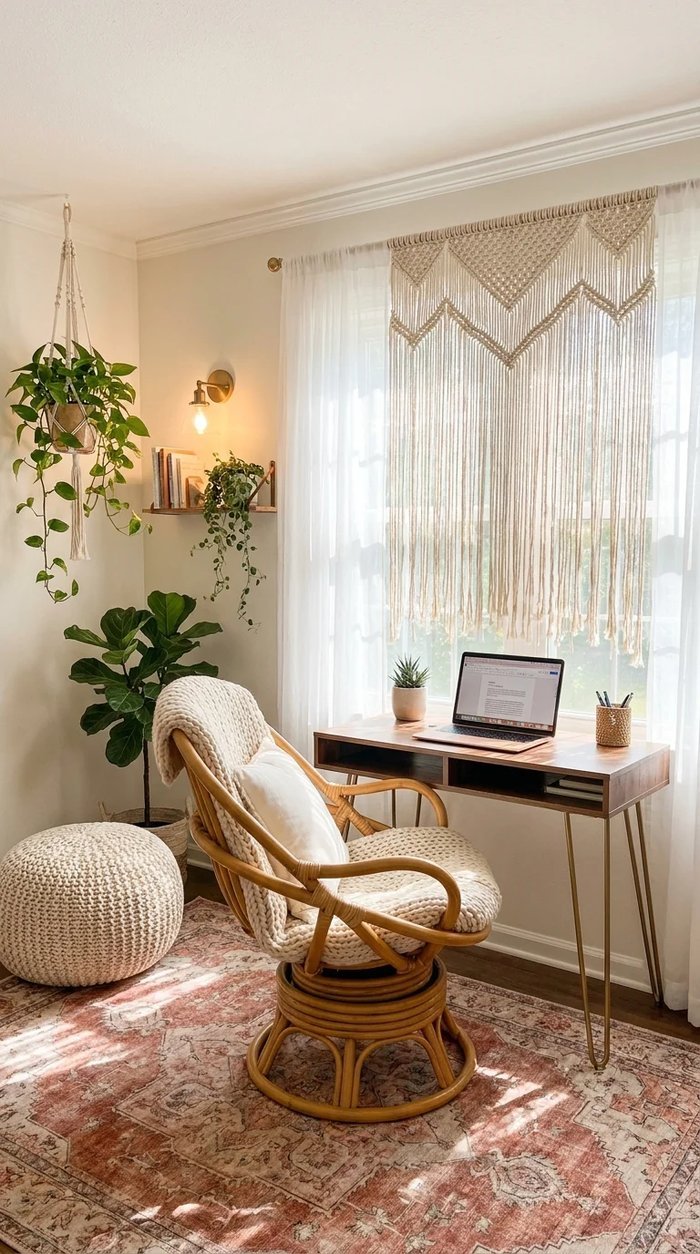
The macrame isn’t decoration on this wall — it’s the actual window covering, doing double duty as art.
Instead of hanging macrame on a wall, this room hangs an oversized chevron-patterned macrame panel directly over the window, layered with sheer curtains underneath. It’s functional and decorative at once — a genuinely different use of the material than every other macrame moment in this list, which all treat it as pure wall art. A rattan swivel chair with a soft knit throw sits at a simple hairpin-leg desk facing the light.
This idea suits bright, sunlit rooms where full blackout coverage isn’t a priority, since macrame filters light rather than blocking it. It’s a strong choice for anyone wanting the room to feel airy and soft rather than moody or dense, and it pairs naturally with a swivel chair, since the room is oriented entirely around that one window. The advantage is a completely custom-feeling window treatment for a fraction of the cost of made-to-order drapery; the compromise is genuinely limited privacy and light control, which rules this out for street-facing windows or anyone needing a darker room for video calls at certain hours.
A simpler, lower-cost version uses a single smaller macrame panel layered over one sheer curtain rather than a full chevron design spanning the whole window, borrowing the same soft, filtered-light approach used in cozy reading-nook window treatments.
A Bigger Piece Than the Room Strictly Needs
The macrame panel is genuinely oversized relative to the window it covers, extending well past the frame on both sides — a deliberate proportion choice that makes the piece read as a design statement rather than simple window dressing. A smaller panel sized exactly to the window would function the same way practically but would likely lose the dramatic, gallery-like presence this version has.
Recommended Materials: cotton macrame cord, sheer linen or voile, hairpin steel legs, rattan, knit wool
Main Colors: Warm Cream, Natural Rope, Soft White, Blush undertones from the light
Best Lighting: The macrame does double duty as a light diffuser, softening direct sun into a warm, even glow across the desk — a wall sconce nearby covers evening work once natural light fades.
Where People Get This Idea Wrong
- Hanging the macrame panel too close to the window itself, leaving no room for the sheer curtain layer to show underneath
- Using this treatment on a street-level or high-privacy-need window, then adding blackout curtains that visually clash with the macrame’s texture.
- Choosing a chevron pattern too dense to actually let light filter through, defeating the airy effect the room depends on
- Skipping a rod strong enough for the weight of a large cotton panel, resulting in sagging within months
Why This Office Reads as a Greenhouse First, a Desk Second
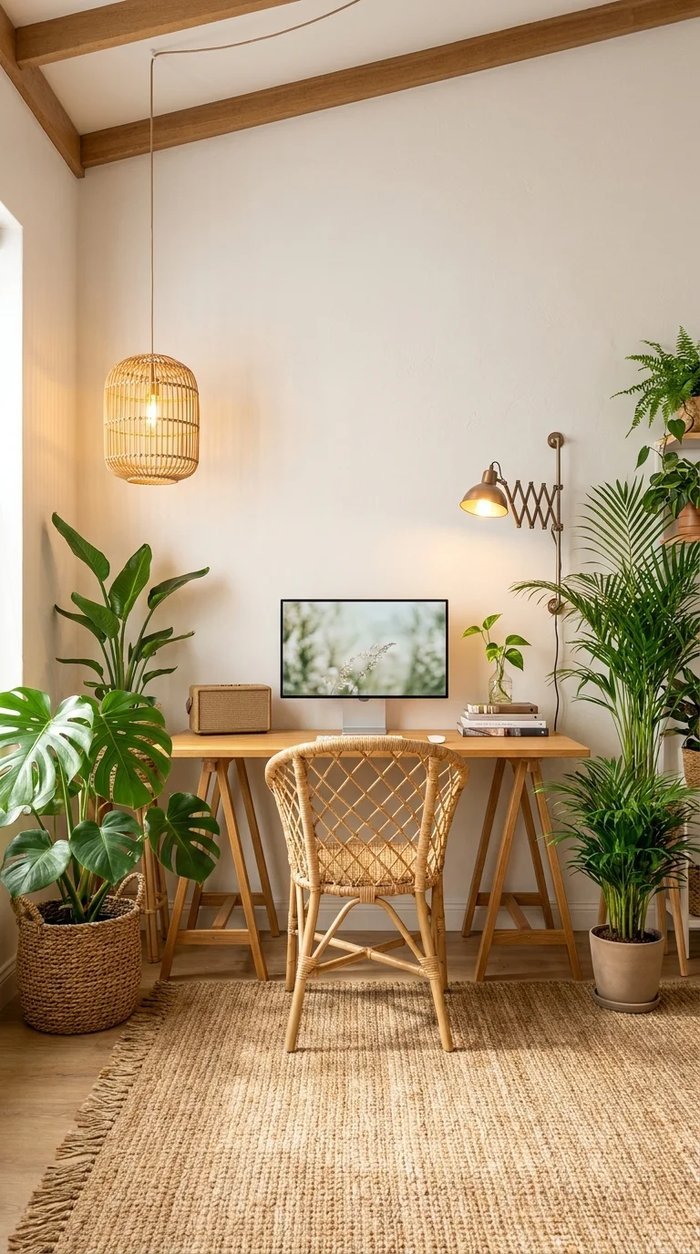
Two different rattan fixtures, one pendant and one sconce, keep the eye moving instead of settling on the desk.
Exposed wood beams and a vaulted ceiling give this room real architectural bones, but it’s the sheer volume of plants — a monstera, a palm, and more crowding both sides of a simple sawhorse-leg desk — that defines it. This is boho pushed toward biophilic design, where the greenery is doing as much visual work as any textile or wall treatment in the other nine rooms.
It’s a strong fit for anyone with genuinely good natural light and enough floor space to let large plants spread out, since cramped versions of this look tend to feel crowded rather than lush. It suits people who already enjoy plant care as a hobby, since a room this plant-dense needs real ongoing attention. The advantage is a workspace that feels alive and changes subtly through the seasons; the compromise is a real time and cost commitment, plus the practical reality that a room this green needs more humidity management than a typical office. It’s worth noting that, contrary to popular belief, a “reasonable number of houseplants” doesn’t meaningfully improve a room’s indoor air quality on its own, per the EPA — the plants here are doing aesthetic work, not filtration work, and ventilation still matters.
A scaled-down version keeps just two or three large plants rather than a full jungle, paired with the same simple sawhorse desk — enough greenery to nod at the look from biophilic living room styling without the full maintenance load.
How the Rattan Fixtures Actually Age
Both the woven pendant and the scissor-arm wall sconce are rattan, and in a room with this much plant humidity, natural rattan can dry out and become brittle faster than it would in a drier space — an occasional wipe with a damp cloth and keeping fixtures a foot or so from direct plant misting helps it hold up over years rather than months.
Recommended Materials: natural rattan, exposed wood beams, painted white walls, woven jute rug, sawhorse wood legs
Main Colors: White, Natural Wood, Deep Green (from foliage), Warm Rattan Tan
Best Lighting: The vaulted ceiling and multiple windows bring in strong ambient daylight most of the day — the rattan pendant and sconce exist mainly for evening use rather than daytime task lighting.
Maintenance: This is the highest-upkeep room in the group: large plants like monstera need repotting every year or two, regular leaf-dusting for photosynthesis, and consistent watering schedules that a smaller plant collection wouldn’t demand.
Easy Ways to Get This Wrong
- Underestimating how much floor and shelf space large mature plants actually need, leading to a cramped rather than airy result
- Choosing plants with different light and humidity needs without a plan for grouping them accordingly
- Skipping a plan for pot drainage, risking water damage to wood flooring under this many potted plants
- Adding heavy patterned textiles on top of this much greenery, competing with the plants instead of letting them lead
The One Plush Rug Doing All the Textural Work
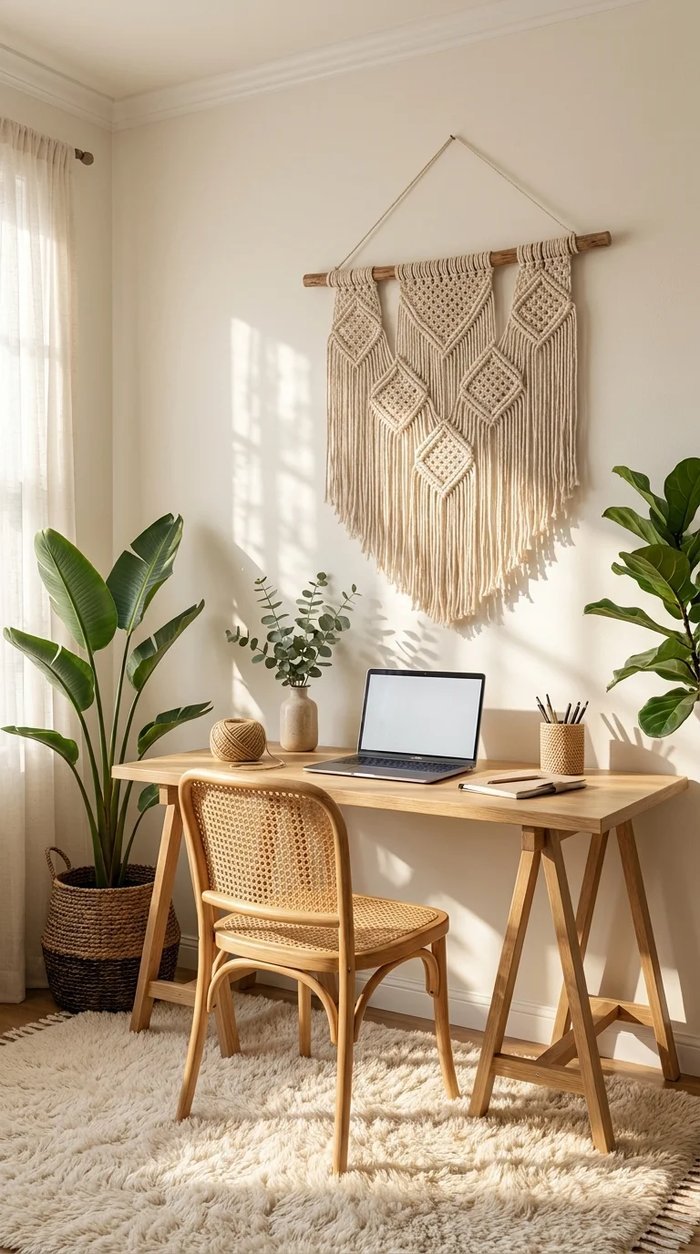
Nothing else in this room is textured enough to compete with the rug, which is exactly the point.
Nearly every surface in this room — walls, curtains, desk — stays in soft neutral tones, and the one place texture is allowed to show up loudly is underfoot, in a thick cream shag rug. It’s the calmest, most restrained version of boho in this whole set, closer to the plaster-wall room in spirit but achieving that calm through softness instead of texture-on-a-wall.
This suits anyone who wants a boho-adjacent room but finds most boho styling visually busy — it’s the option for people who want warmth and softness without pattern or heavy layering. It’s a strong choice for a small, light-filled room where a darker or more textured wall treatment would feel heavy. The advantage is that it photographs and video-calls beautifully, since the background stays simple; the compromise is that a shag rug this plush shows wear and flattening in high-traffic spots faster than a flat-weave alternative, and it’s genuinely harder to keep clean under a rolling desk chair.
A budget version swaps the shag for a more affordable faux-shag blend rug in the same cream tone, keeping the single macrame piece as the only other decorative element — the same one-statement-piece logic as the terracotta wall’s single framed print elsewhere in this guide, just softened here into fiber instead of plaster.
The Repetition That Keeps This Room From Feeling Bare
The same soft cream tone repeats across the rug, the sheer curtains, and the desk chair’s cane frame, with only the green plant leaves breaking the palette — a tight, repeated neutral range rather than true minimalism, which is what keeps a room this sparse from reading as unfinished. Introducing even one strongly contrasting color here would likely undercut the calm the room is built around.
Recommended Materials: shag wool or wool-blend rug, cane webbing, sawhorse wood legs, sheer linen curtains, woven macrame cotton
Main Colors: Cream, Soft White, Natural Wood, Warm Green (plant accent only)
Best Lighting: Sheer curtains diffuse strong daylight into a soft, even glow across the whole room — this treatment works best on a window that gets consistent, not harsh, direct sun for most of the day.
Maintenance: A cream shag rug needs regular vacuuming with a low-suction setting to avoid pulling fibers, and spot-cleaning spills immediately is far more important here than with a flat-weave rug.
Where This Simplicity Tips Into Looking Unfinished
- Choosing a rug pile too thin to read as “plush,” landing in an awkward middle ground instead of true texture
- Adding a patterned throw pillow or blanket that breaks the tight neutral palette the room depends on
- Placing a rolling desk chair directly on the shag rug without a hard-surface chair mat, accelerating wear
- Skipping the single macrame accent entirely, leaving the wall behind the desk looking bare rather than intentionally minimal
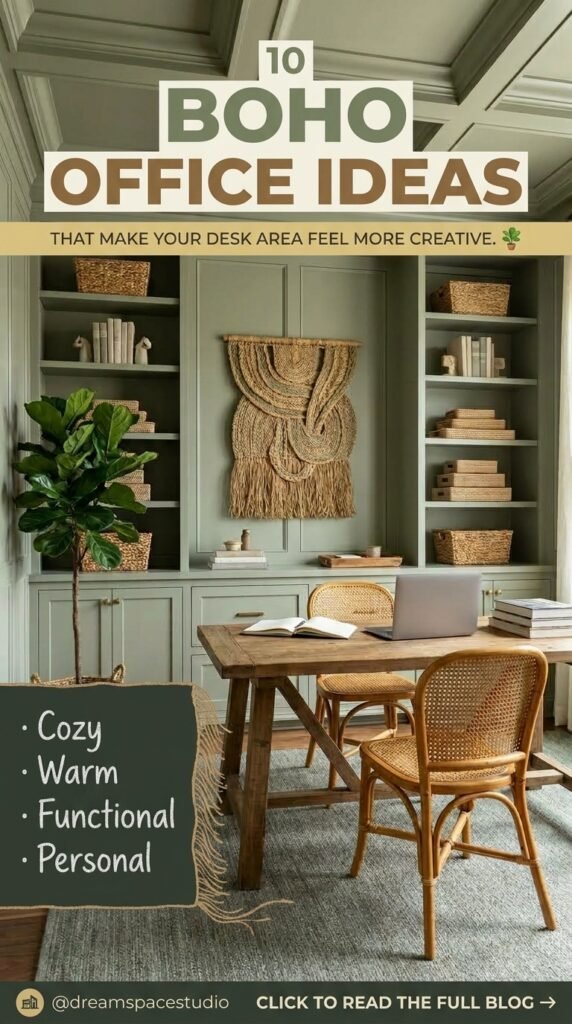
A Ceiling This Detailed Changes What “Home Office” Means
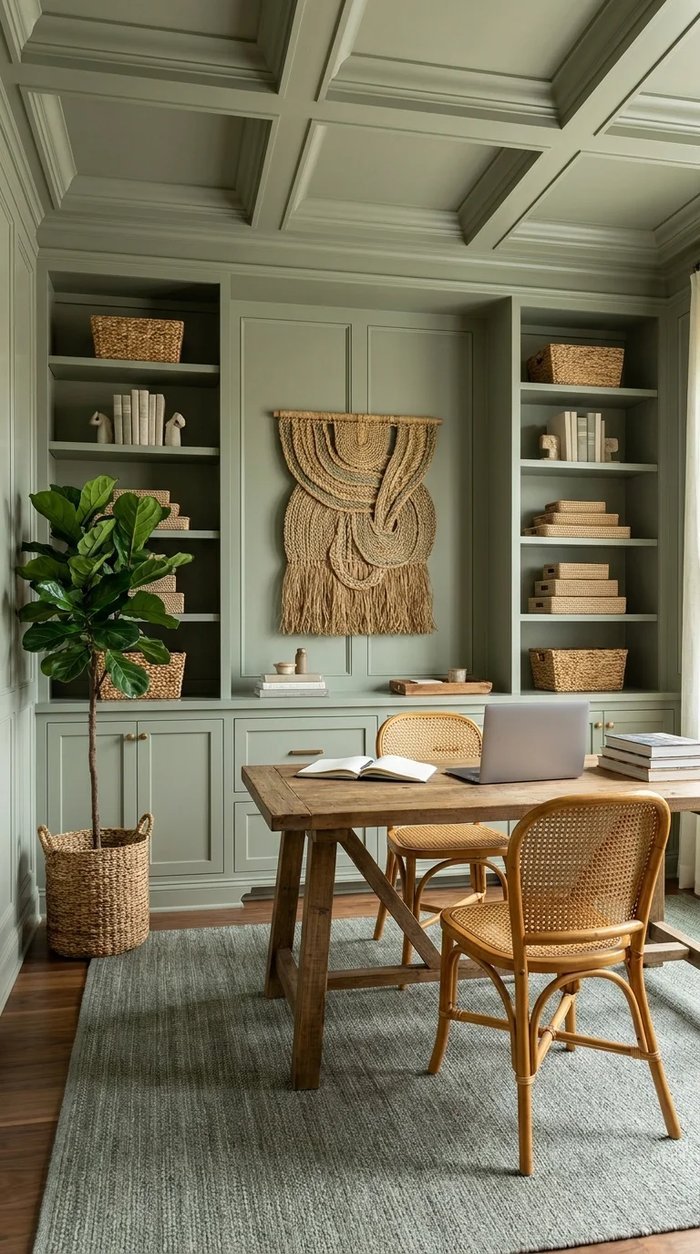
Two chairs at one desk quietly signal this room was designed to be shared, not worked in alone.
A full sage-green coffered ceiling and wall-to-wall built-in cabinetry make this the most formally “designed” room in the set — closer to a dedicated study than a corner workspace. Against that architectural backdrop, a sculptural jute knot wall piece and a reclaimed wood trestle table with two cane bistro chairs keep the room from feeling stiff or overly polished.
This is best suited to a genuinely dedicated room in a larger home, since coffered ceilings and full millwork aren’t retrofits anyone takes on lightly. The two chairs make it a strong option for a shared home office, a small meeting space, or a household where two people need to work in the same room without cramming a second desk in. The advantage is a room that feels genuinely finished and permanent, unlike most of the more furniture-based looks in this guide; the compromise is cost and commitment — this is the least flexible, most expensive room to recreate, and it’s not an option for renters or anyone likely to move soon.
A scaled-back version borrows the sage-green wall color and a single jute wall sculpture over a simpler trestle table, skipping the coffered ceiling and millwork entirely — enough to nod at the same collected, natural-material styling seen in a reclaimed-wood rustic office setup without the architectural investment.
Where the Eye Goes Before It Reaches the Desk
The coffered ceiling’s grid pattern is large enough and high-contrast enough against the walls that it’s genuinely the first thing the eye registers on entering the room, ahead of the desk, the jute sculpture, or the plant — an unusual sightline hierarchy for a home office, where the ceiling typically goes unnoticed. It works here because the ceiling detail is a deliberate architectural feature rather than an afterthought, and everything below it is kept comparatively simple.
Recommended Materials: painted coffered millwork, reclaimed wood, cane webbing, jute rope, woven rattan baskets
Main Colors: Sage Green, Cream, Natural Wood, Warm Gray (rug)
Best Lighting: Diffuse ambient light fills the room evenly, likely from windows outside the frame, which suits a room designed for shared use since there’s no single strong light source creating glare for either seated person.
What Trips Up Most Attempts at This Room
- Painting the coffered ceiling white instead of a saturated color, losing the architectural drama that defines the whole room.
- Choosing two mismatched chairs for a shared desk setup, undercutting the sense that the room was designed for two people.
- Overfilling the built-in shelving with decorative objects instead of using the woven baskets to keep it edited
- Picking a wall sculpture too small to hold its own against a ceiling and millwork this detailed
Focus & Ergonomics Tips
- Position the desk perpendicular to, not directly facing, the brightest window in the room to cut screen glare during video calls.
- Choose a rattan or cane chair with an actual cushion pad rather than a bare woven seat, since unpadded weave isn’t built for full workdays.
- Keep the wall directly behind the webcam simpler than the rest of the room — one macrame piece or a single framed print reads better on camera than a full gallery wall.
- Route desk cords through a woven basket or cable box at floor level so plant-and-textile styling doesn’t double as a tripping hazard
Who Should Choose This Style?
- Best for creatives, writers, and remote workers who want a desk that feels personal rather than corporate
- Best for renters and small-space dwellers, since most of these looks layer onto existing walls without renovation
- Not ideal for anyone who needs a strictly minimal, brand-neutral backdrop for frequent professional video calls
Budget Summary
| Low | Jute area rug, single macrame wall hanging, secondhand rattan chair |
| Medium | Rattan pendant light, cushioned cane office chair, framed botanical print set |
| Premium | Live-edge hardwood desk, genuine vintage rug, custom built-in millwork |
FAQ
Does boho style work in a small home office? Yes — several of the rooms here, like the plaster-wall corner and the shag-rug room, are built specifically around restraint, using one or two statement elements rather than dense layering, which suits a small footprint well.
How many plants is too many for a boho home office? It depends entirely on light and floor space; the greenhouse-style room in this guide works because the room has genuinely strong natural light and room for plants to spread, not because more plants are automatically better in any space.
What’s the best desk material for a boho home office? Live-edge or reclaimed hardwood is the most common choice across these rooms because its natural grain and imperfections support the organic, collected feel the style depends on, though a simple hairpin or sawhorse-leg desk works just as well as a neutral base.
Can I get this look without buying an expensive vintage rug? Yes — flat-weave reproductions, faux-shag blends, and framing smaller textile fragments (as in the gallery-wall room) all get close to the effect at a fraction of the cost of an authentic antique piece.
How do I keep a boho office from looking cluttered on video calls? Simplify only the section of wall directly behind the camera — one macrame piece or a single framed print reads cleanly on screen even if the rest of the room is more layered.
Is a rattan or cane chair actually comfortable for full workdays? Only with a cushion. Bare woven seats look great but aren’t built for eight-hour days; every comfortable version in this guide pairs the chair with a real seat pad or cushion.
About StartechLife Team
StartechLife Team is a home décor and interior design publication written by a team who researches and curates real, achievable design ideas for everyday homes rather than aspirational showrooms. For this guide, the team focused specifically on small-space and renter-friendly workspace styling — the kind of home office setup someone can build in a weekend, not a full renovation. Every material and budget note here reflects choices the team believes are genuinely realistic to recreate, not just photograph well.
Conclusion
Ten rooms, ten different reasons boho works as a home office style — a hung rug instead of a print, a coffered ceiling instead of a bare wall, a lounge chair instead of a desk chair. The through-line isn’t a fixed shopping list; it’s natural materials, warm color, and at least one object doing real visual work in an otherwise calm room. Pick the version that matches your actual space and budget, not the one with the most items in it, and the result will hold up far longer than a trend-chased copy of any single photo.


One Response