A rustic home office isn’t just brown furniture in a small room. It’s a specific formula — raw materials, warm light, and a deliberate lack of visual noise — that happens to be one of the best ways to make a workspace feel calm instead of clinical. Results will vary by space, budget, and personal taste, and pairing bold ideas with a professional’s eye is always smart for anything structural or costly. The ten rooms below each teach one piece of that formula. Study the why, not just the what, and you can build this look in almost any room shape.
Quick Overview
| Style | Rustic / Modern Rustic |
|---|---|
| Best For | WFH professionals, cabin and farmhouse homes, cozy-corner offices |
| Budget | Low–Medium |
| Difficulty | Moderate—mostly furniture and lighting swaps |
| Maintenance Level | Low–Medium |
Where Stone Meets Live-Edge Wood, and Why It Works
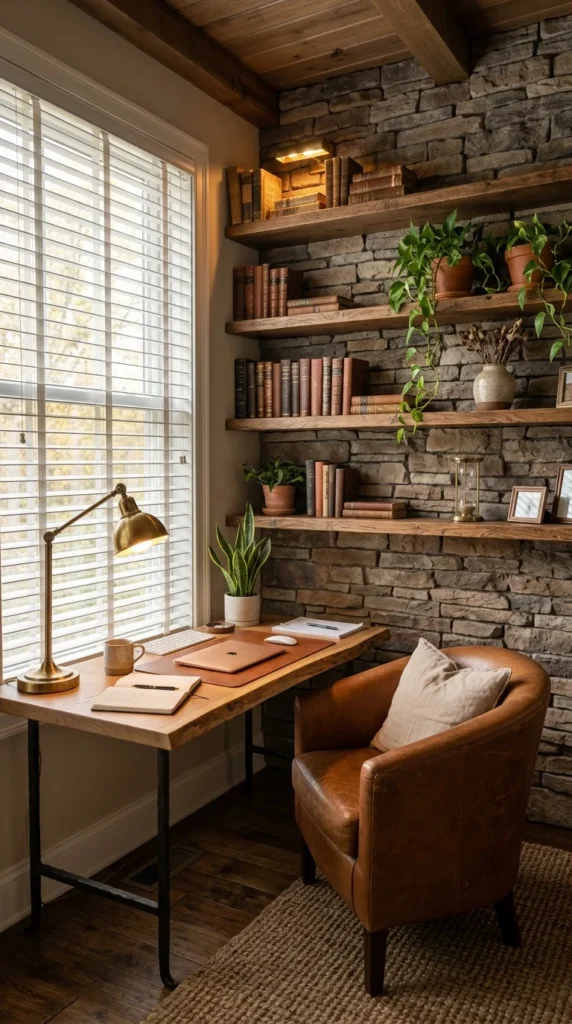
A live-edge wood desk set against a stacked stone wall is doing something most home offices never attempt: pairing two raw, unpolished materials instead of softening one of them with paint or veneer. The stone’s rough, uneven surface and the desk’s organic edge share the same “unfinished by design” quality, which is what keeps the pairing from feeling like two competing textures.
Brass task lighting and a leather chair add warmth without introducing a third dominant material—brass reads as a finishing touch, not a rival to the stone or wood. A snake plant on the desk breaks up the hard lines with something soft and living, and floating wood shelves above echo the desk’s grain so the eye reads the whole wall as one continuous material story rather than separate purchases.
☐ What to Gather Before You Start This Look ☐ A slab-style or live-edge desk (real wood or a laminate with visible grain) ☐ One textured wall treatment—stone veneer, brick, or reclaimed board ☐ A warm-metal task lamp (brass or aged bronze, not chrome) ☐ At least one low-maintenance plant at desk height ☐ A leather or leather-look chair to bridge the two materials
Why the Leather Chair Will Only Get Better With Use
Leather is one of the few materials in a home office that improves with time rather than degrading — the surface softens and takes on a slight sheen exactly where an arm or shoulder rests most often. That kind of visible wear reads as character on leather in a way it never would on fabric. Placed against a cool stone wall, the leather’s warmth also does real work: without it, the stone could tip the whole corner toward feeling more like a cellar than a workspace.
Recommended Materials
- Stacked natural stone
- Live-edge or slab wood
- Brass hardware and lighting
- Leather upholstery
Main Colors
- Warm Gray Stone
- Honey Oak
- Antique Brass
- Deep Brown Leather
Best Lighting
- Natural side light from a large window
- Brass articulating task lamp
- 2700K warm bulbs throughout
Where This Combination Falls Apart
• Choosing a glossy, sealed desk finish that fights the stone’s matte texture • Adding a second bold material (like patterned tile) that competes with the stone for attention • Skipping task lighting and relying only on the window, which leaves evening work sessions dim • Using a cool-white bulb that turns the stone gray and lifeless instead of warm
A Workspace Built Around Its Own Treeline
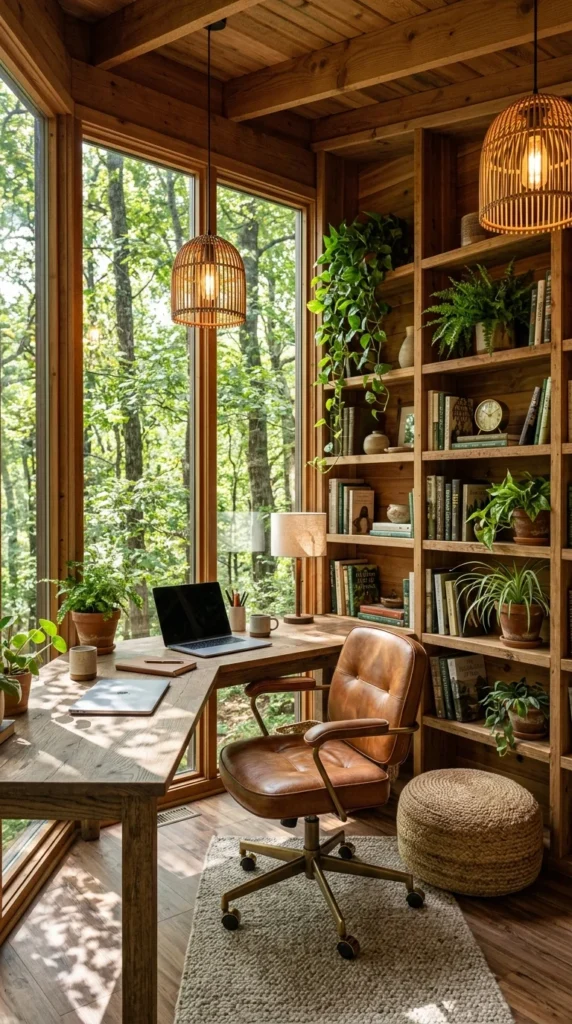
Floor-to-ceiling windows on two sides turn this desk into the least important design decision in the room—the forest outside is doing most of the visual work. That’s a deliberate strategy: when a view this strong is available, the smartest move is to keep the interior materials quiet enough that they don’t compete with it.
Rattan pendant shades filter the overhead bulbs into a soft, dappled glow that echoes the light falling through the trees outside, and open wood shelving stays low-profile so it never blocks a sightline to the glass. A woven pouf sits in for a second chair without adding bulk, and the wood ceiling beams pull the same warm tone down from the window frames — nothing in the room reads as store-bought when everything shares one material language.
💡 Pro Tip If your desk faces a window, position the monitor slightly off-axis from the brightest light source. A screen facing directly into strong daylight washes out and forces squinting within the first hour of work.
Where the Eye Lands First in This Room
The eye goes to the window before anything else and stays there longer than a typical desk view would allow—the glass takes up more of the wall than the furniture does. That imbalance is intentional. A smaller window would have forced the shelving and desk to carry more visual weight; here, they’re allowed to recede.
Recommended Materials
- Natural wood beams and shelving
- Rattan pendant shades
- Wool or jute area rug
- Reclaimed wood desk
Main Colors
- Warm Honey Wood
- Forest Green (from the view)
- Natural Rattan
- Soft Cream
Best Lighting
- Abundant natural light from two window walls
- Rattan pendant fixtures for ambient warmth
- 2700K bulbs to match daylight’s warmth in early morning or dusk
Maintenance
- Wipe down window glass monthly to keep the view clear
- Dust rattan pendant shades every few weeks, since woven texture traps particles
- Rotate any potted plants toward the strongest light source seasonally
- Check wood beam finish yearly if the room gets direct sun exposure
What Trips People Up Building a Window Nook Like This
• Hanging heavy drapes that block the very view the room is built around • Choosing dark furniture that fights the light instead of reflecting it • Overfilling open shelving until it becomes visual clutter competing with the trees • Placing the desk chair with its back to the window, wasting the best seat in the room
Restrained Color, Layered Texture
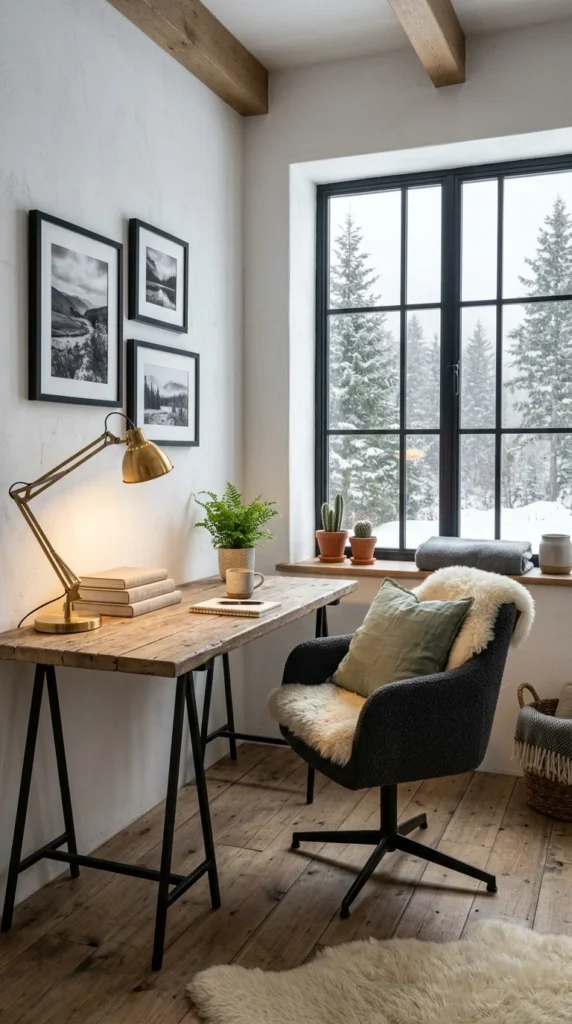
White plaster walls and black-framed windows strip away almost every color decision, which shifts all the design weight onto texture instead. A boucle desk chair layered with a sheepskin throw does the job color usually does in a rustic room—it’s what keeps the corner from reading as sterile or overly Scandinavian.
A trio of black-and-white framed photographs adds a second, quieter texture layer on the wall, and the exposed wood ceiling beam overhead is the only warm material in the whole frame — which is exactly why it stands out instead of blending in. Three potted plants on the windowsill (a fern and two cacti) keep the palette from tipping fully monochrome without introducing an actual new color.
Black Framing, Repeated Three Times, Holding the Wall Together
Three identical black frames on an all-white wall create a rhythm the eye can follow without effort, which is part of why the gallery reads as curated rather than accidental. Repeating the same frame style at least twice tends to signal intention in a way that mismatched frames rarely manage. Swap even one frame for a different finish and the wall would likely start to feel like three unrelated purchases instead of one composed grouping.
Recommended Materials
- White lime-wash plaster
- Black-framed steel windows
- Boucle upholstery
- Sheepskin throw
Main Colors
- Warm White
- Matte Black
- Natural Sheepskin Cream
- Sage Green (from potted plants)
Best Lighting
- Diffused daylight through black-framed windows
- Brass task lamp for warm contrast against the cool white wall
- 2700K bulb temperature to counter the room’s cool base tone
Easy Ways to Undercut a Room This Quiet
• Adding a second patterned textile that competes with the sheepskin for attention • Choosing a cold-white bulb that makes the plaster wall feel clinical rather than cozy • Hanging more than three or four frames, which turns restraint into clutter • Using a glossy black frame finish instead of matte, which reads as too formal for the room
Arched Stone as the Room’s Only Focal Point
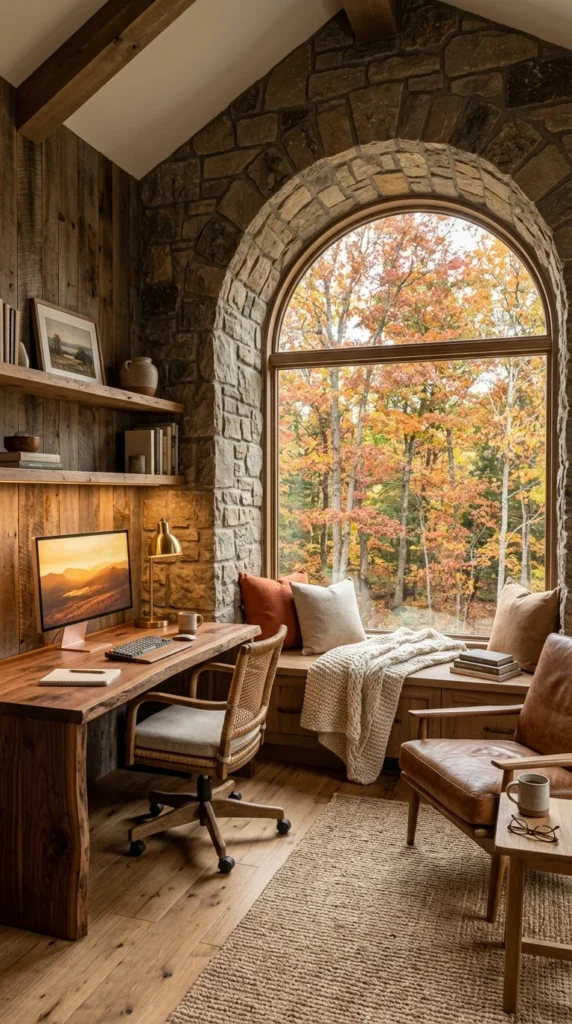
An arched window this size, framed in rough stone, doesn’t need competition—and this room correctly treats it as the single focal point rather than splitting attention with a second statement piece. The desk and window seat both face the glass, which means every seat in the room shares the same view instead of one person getting the good angle.
A rust-colored throw pillow on the window seat is the only saturated color in the frame, chosen specifically because it echoes the autumn foliage visible through the glass — a small detail that ties interior and exterior together without requiring a full color scheme change. Cream and beige cushions do the heavy neutral work, letting that one rust pillow read as a deliberate accent rather than random.
⚠️ Warning Arched windows are expensive to reproduce exactly, but the effect — a single oversized window treated as the room’s focal point — can be approximated with a standard window and no competing wall decor. Don’t try to fake the arch with molding; it usually reads as an obvious imitation rather than architecture.
A Window This Large Needed a Room Willing to Stay Quiet
Scale only works when the rest of the room agrees to stay out of the way, and this one commits fully — no wall art, no secondary window treatment, nothing pulling focus from the arch itself. A window taking up this much wall space would have overwhelmed a room with a busier palette or more furniture competing for attention.
Recommended Materials
- Rough-cut stone window surround
- Reclaimed wood flooring
- Woven rattan chair
- Knit throw blanket
Main Colors
- Weathered Stone Gray
- Warm Oak
- Rust
- Cream
Best Lighting
- Full daylight through the arched window
- Warm desk lamp for evening hours
- Minimal artificial lighting needed during the day
What Ruins This Look
• Adding a second large window treatment that competes with the arch • Choosing bright white trim instead of natural stone, which flattens the depth of the opening • Overloading the window seat with too many pillow colors, diluting the one accent tone • Placing tall furniture in front of the window that blocks the sightline from the desk
Six Botanical Prints, One Disciplined Grid
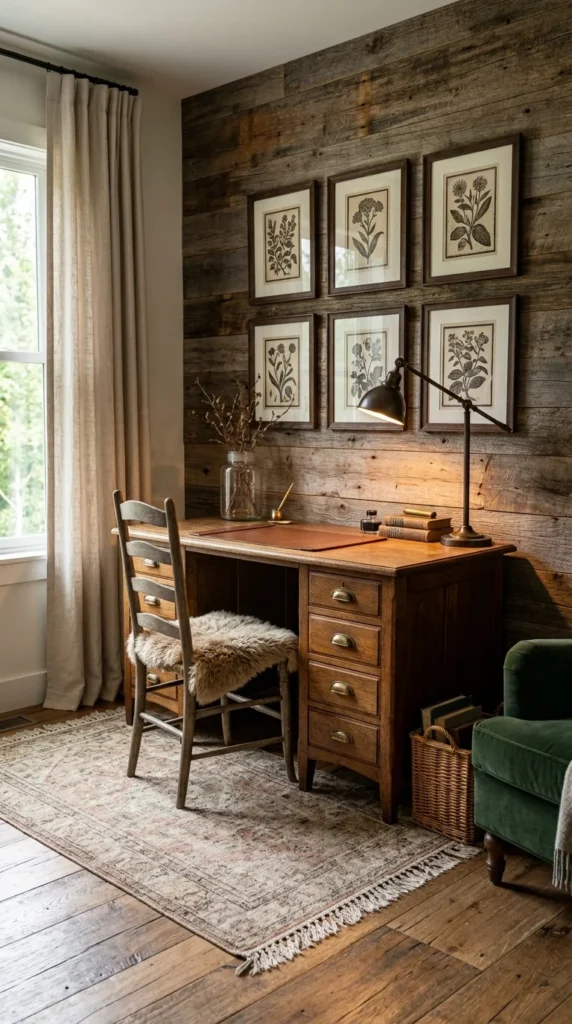
A reclaimed-plank wall this textured could easily overwhelm a room, but hanging six matching botanical prints in a tight 3-by-2 grid gives the eye a structured place to land before it has to process the wood’s irregularity. The frames’ straight edges are doing quiet, necessary work against all that organic grain.
A worn wood ladder-back chair, dressed with a sheepskin cushion, sits at a partner-style desk with brass drawer pulls — hardware finish repeated from the lamp base ties the metal tones together across the whole vignette. A woven basket tucked beside a green velvet chair adds one more natural texture without adding a new color family.
Why Six Frames Read as One Piece, Not Six
Identical frame size and spacing, repeated six times, is what turns individual prints into a single wall composition instead of six separate decisions. That kind of repetition tends to read as more deliberate than a single oversized piece would in the same spot—the grid format signals intention. Mismatched frame sizes in the same grid would likely break that cohesion almost immediately.
Recommended Materials
- Reclaimed wood plank wall
- Antique wood desk with brass hardware
- Vintage-style area rug
- Green velvet upholstery
Main Colors
- Weathered Brown Wood
- Antique Brass
- Forest Green
- Dusty Rose (rug tones)
Best Lighting
- Natural side light from a nearby window
- Brass articulating desk lamp
- Warm 2700K bulbs to complement the aged wood tones
What Undermines a Grid Wall Like This One
• Uneven spacing between frames, which reads as a mistake rather than a style choice • Mixing frame finishes (black, brass, wood) within the same grid • Choosing prints with different color intensities, making some frames pull focus unevenly • Hanging the grid off-center relative to the desk below it
Why Does One Rug Have to Ground an Entire Wall of Glass?
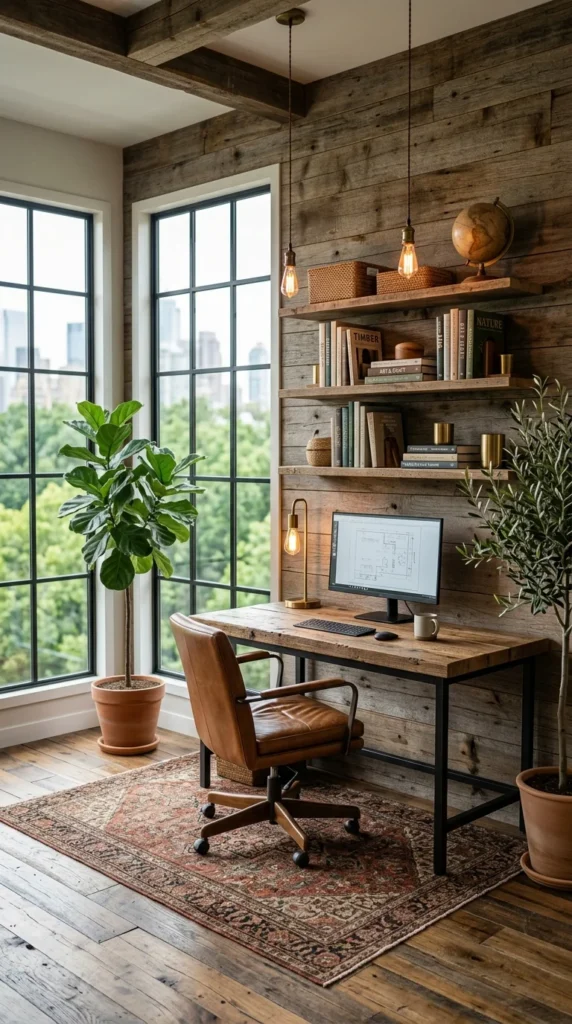
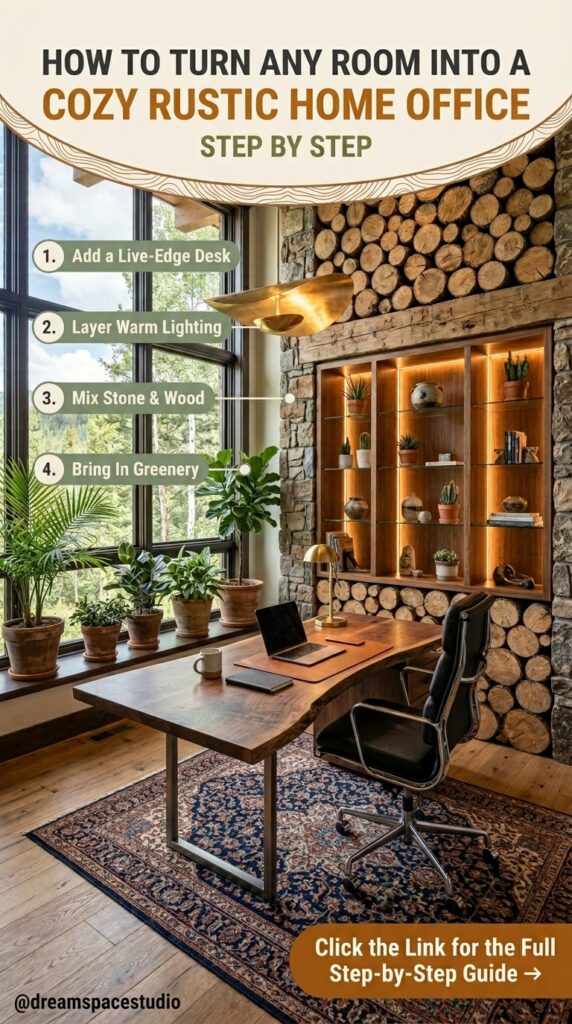
Because without it, a room this open would have no clear floor boundary at all. Floor-to-ceiling windows on one side and a stacked log accent wall on the other are both strong enough to visually expand the room outward—a patterned A Persian-style rug is what pulls attention back down and gives the space a defined center.
Glass-front, LED-lit display shelving built into the log wall repeats the same warm bulb temperature as the brass pendant overhead, so even though the room mixes several light sources, none of them clash in color temperature. A row of small potted cacti and succulents along the windowsill softens the hard edge where glass meets wall without requiring large, high-maintenance greenery.
💡 Pro Tip When a room has one dominant textural wall (like stacked logs), keep the floor treatment patterned but low-contrast. A busy rug in clashing colors will compete with the wall instead of grounding it.
What That Rug Is Actually Doing Underfoot
A rug this size and pattern absorbs sound in a room that would otherwise bounce noise between hard glass and stacked wood — a practical function most readers wouldn’t clock from a photo alone. Beyond acoustics, its navy and rust tones borrow directly from the log wall’s warm browns, which is why the two surfaces feel connected rather than like two separate design zones sharing one room.
Recommended Materials
- Stacked natural log accent wall
- Walnut live-edge desk
- Glass-front lit display shelving
- Persian-style wool rug
Main Colors
- Warm Log Brown
- Navy (rug base)
- Rust and terracotta accents
- Brushed Brass
Best Lighting
- Full-height natural light from floor-to-ceiling windows
- Brass pendant as the room’s ambient anchor
- Built-in LED shelf lighting for evening warmth
Where a Big-Window Office Usually Goes Wrong
• Skipping a rug entirely, leaving hard flooring to feel cold and unfinished against so much glass • Choosing sheer curtains that do nothing to manage glare on a bright afternoon • Overcrowding the display shelving until the warm LED lighting can’t do its job • Placing the desk chair with a hard back to a heavily reflective window, causing screen glare
Splitting One Room Between Focus and Firelight
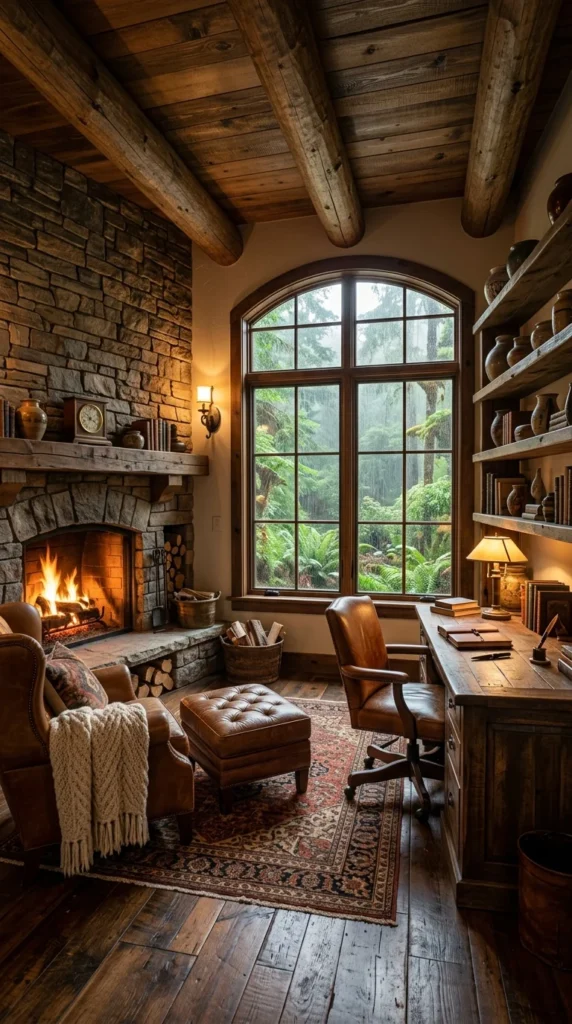
A stone fireplace and a wood desk share this room without competing for the same job—one zone is built for concentration, the other for a break from it. The leather wingback chair and tufted ottoman sit closest to the fire, while the desk and its own leather chair occupy the far end near an arched window overlooking a rain-soaked forest.
That separation is doing more than looking nice. A patterned rug anchors the desk zone specifically, distinct from the floor near the fireplace, which subtly signals to anyone in the room which half is for working and which is for winding down—without a single wall or divider in sight.
[Before Rustic Home Office Fireplace Nooks Get Zoned]
❌ Before: A single-purpose room like this typically forces one activity to dominate, leaving little reason to linger once the workday ends. ✅ After: Splitting the space into a focus zone and a rest zone means the room earns its square footage twice over.
The Fire Pulls Focus Before the Desk Ever Does
Fire is one of the few design elements the eye is biologically wired to notice first, so placing the fireplace prominently in this layout was always going to outrank the desk for initial attention. That’s not a flaw—it means the desk zone can stay understated, since it isn’t fighting for the room’s first impression anyway.
Recommended Materials
- Natural stacked stone fireplace surround
- Aged leather upholstery
- Reclaimed wood desk and shelving
- Wool-patterned area rug
Main Colors
- Charcoal Stone
- Warm Cognac Leather
- Deep Forest Green
- Cream Wool
Best Lighting
- Firelight as a secondary ambient source
- Wall sconces flanking the fireplace
- Natural light from the arched window during the day
How a Cozy Corner Like This Turns Cluttered
• Placing the desk too close to the fireplace, where heat and smoke can affect equipment over time • Using the same rug pattern in both zones, erasing the visual boundary between them • Skipping a reading lamp near the fireplace seating, leaving that half of the room dim at night • Letting firewood storage baskets spill into the desk zone’s walking path
Built-In Shelving as This Office’s Real Statement
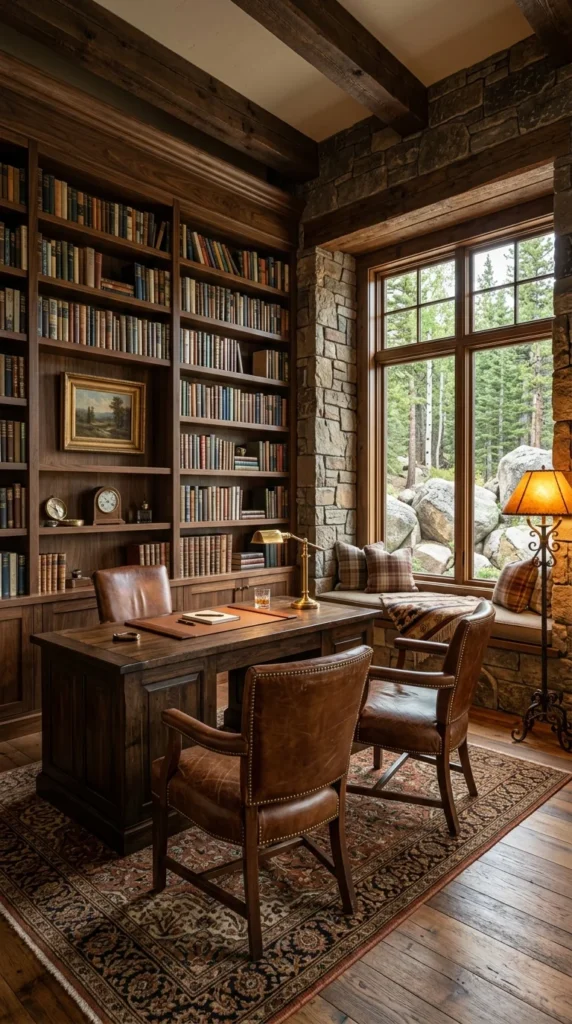
Floor-to-ceiling walnut bookshelves, built directly into the wall on three sides, are the actual design centerpiece here—the desk itself is almost secondary. That’s a deliberate hierarchy: built-in storage for this extensive signal permanence and intention in a way a freestanding bookcase never quite manages.
A stone window bay with plaid cushions breaks up the wall of wood with a cooler material and a change in texture, while a small oil landscape painting and two antique clocks on the shelves add the kind of collected-over-time detail that makes a room feel lived-in rather than staged for a single photo.
A Desk Built to Match Shelves That Reach the Ceiling
A desk this substantial only works because the shelving around it is equally heavy — a lighter, more delicate desk would have looked undersized against floor-to-ceiling walnut. Matching furniture weight to the scale of built-in storage is a proportion decision most readers feel intuitively without being able to name it.
Worth the Built-In Shelving Investment?
Custom floor-to-ceiling shelving like this is one of the most expensive single choices in a rustic home office, and it’s worth acknowledging that plainly. For a permanent home office in a house you plan to stay in, the storage and visual payoff are hard to replicate with freestanding pieces. For a rental or a room you might reconfigure in a few years, it’s a harder cost to justify — open shelving units can approximate the look at a fraction of the commitment.
Recommended Materials
- Built-in walnut shelving
- Natural stone window surround
- Leather nailhead-trim chairs
- Plaid wool cushions
Main Colors
- Deep Walnut Brown
- Weathered Stone
- Forest Plaid
- Warm Brass
Best Lighting
- Brass desk lamp
- Natural light from the stone window bay
- Ambient light reflecting off the polished wood surfaces
What Undermines a Library-Style Office
• Filling shelves entirely with books, leaving no breathing room for objects or negative space • Choosing a desk finish that doesn’t match the shelving’s wood tone, breaking the room’s cohesion • Skipping window seating cushions, which leaves the stone bay feeling unfinished • Overlighting the room with cool overhead fixtures instead of warm, layered lamps
One Warm Palette, Almost No Color Variation
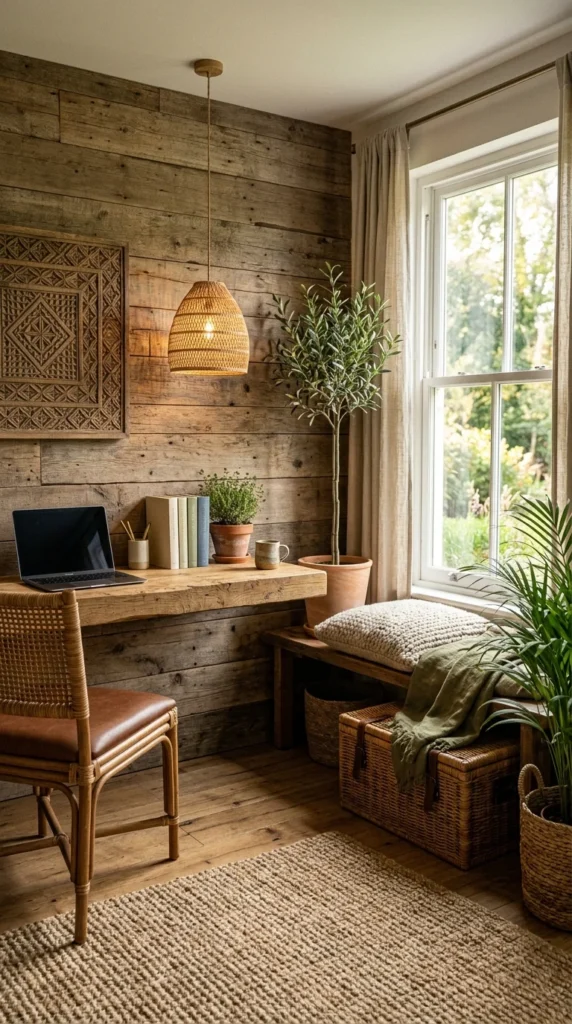
Reclaimed wood plank walls, a rattan pendant, a leather chair, and terracotta planters all sit within a few shades of the same warm brown-tan family — and that restraint is the entire design strategy. Almost nothing here reads as “colorful” in the traditional sense, yet the room doesn’t feel flat because texture is doing the job color usually would.
A carved wood wall panel adds pattern without introducing a new hue, and a woven storage trunk beneath the window pulls double duty as both seating and a texture layer that echoes the wall behind it. An olive tree in a terracotta pot is the only living green in the frame, and it’s placed deliberately close to the window so natural light does most of the work keeping it healthy.
💡 Pro Tip When building a near-monochrome palette like this, vary the sheen of each material even if the color stays constant — a matte wall, a slightly glossy leather seat, and a woven texture will keep a single-color room from looking flat under photography or daylight.
Rattan, Repeated Just Enough to Read as a Choice
The rattan pendant and the rattan-seated chair share the same weave pattern, which is a small enough repetition to feel intentional without tipping into a themed “rattan room.” Repeating a material exactly twice, rather than once or three-plus times, tends to land in that sweet spot between coincidence and overkill.
Recommended Materials
- Reclaimed wood plank wall
- Rattan pendant and chair seat
- Terracotta planters
- Woven storage trunk
Main Colors
- Weathered Tan Wood
- Warm Terracotta
- Natural Rattan
- Olive Green
Best Lighting
- Rattan pendant fixture for ambient warmth
- Natural light from a nearby window
- Warm 2700K bulb temperature throughout
Maintenance
- Water the olive tree every 7–10 days, letting soil dry between waterings
- Dust the carved wood panel monthly to keep detail visible
- Wipe down rattan surfaces occasionally to prevent dust buildup in the weave
- Rotate the potted olive tree toward the window every few weeks for even growth
Where a Warm-Palette Room Tips Into Boring
• Choosing every material in the exact same shade instead of varying sheen and texture • Skipping any living element, which removes the one truly variable color in the room • Using a cool-white bulb that flattens all that carefully matched warm brown • Overfilling the space with matching brown objects until nothing stands out as a focal point
Layering Light So No Single Source Carries the Room
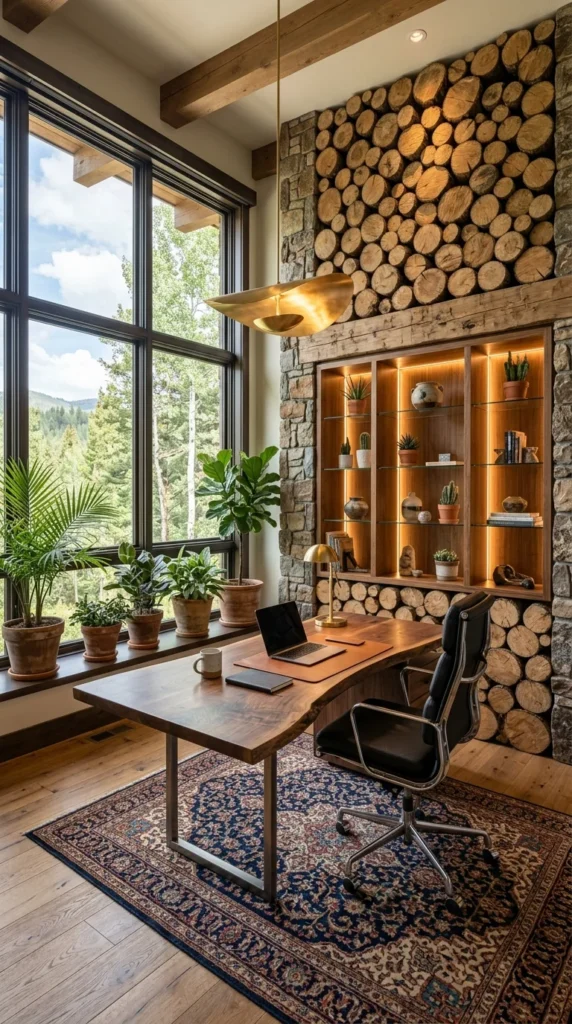
Four distinct light sources work together here — natural light from floor-to-ceiling windows, a sculptural brass pendant overhead, a brass task lamp on the desk, and hidden LED strips inside the built-in display shelving. That kind of layering means the room never depends on any one fixture to feel finished, which matters most in the evening when daylight disappears.
The stacked log accent wall catches the LED shelf lighting at a low angle, throwing soft shadows across the log ends that a single overhead fixture could never replicate. A walnut live-edge desk anchors the foreground, its polished surface reflecting just enough of that layered light to keep the whole wall from reading as flat.
💚 Affordable: A single warm-toned floor lamp plus string lights inside open shelving 💛 Mid-Range: A statement pendant light plus a brass desk lamp 💎 Investment: Built-in LED shelf lighting plus a sculptural pendant fixture
Why the Walnut Slab Will Darken With Every Year of Light
Walnut is one of the few woods that visibly deepens in color with sustained light exposure, meaning this desk will likely look richer and more saturated in five years than it does today. That’s worth knowing before committing to a lighter finish elsewhere in the room, since the desk’s tone won’t stay static the way a painted surface would.
Recommended Materials
- Walnut live-edge desk
- Stacked log accent wall
- Glass-front LED display shelving
- Brushed brass pendant fixture
Main Colors
- Deep Walnut Brown
- Warm Log Tan
- Brushed Brass
- Soft Amber (LED tone)
Best Lighting
- Floor-to-ceiling natural daylight
- Brushed brass sculptural pendant
- Built-in warm LED shelf lighting
- Brass task lamp on the desk
Mistakes That Undo Good Layered Lighting
• Mixing bulb temperatures (cool white LEDs against warm brass fixtures) so the room’s light looks inconsistent • Relying on the pendant alone at night, leaving the desk surface under-lit for close work • Skipping dimmers, which makes it impossible to shift the room from daytime focus mode to evening ambiance • Positioning the desk so window glare hits the monitor during peak afternoon hours
Focus & Ergonomics Tips
- Keep the desk within arm’s reach of natural light, but angle the monitor perpendicular to the window to avoid glare
- Choose a chair with real lumbar support even if it’s leather or rattan-framed—looks shouldn’t override hours of daily use
- Add a rug or soft flooring layer under the desk chair; hardwood alone gets uncomfortable and noisy during long calls
- Keep frequently used items on open shelving within a seated arm’s reach, so the room’s storage stays functional and not just decorative
Related Guides
- 10 Attic Office Design Ideas for a Cozy, Functional Workspace—another take on building focus into an unconventional room
- Light, Layers, and Comfort: 10 Reading Nook Ideas That Work—for the seating half of a dual-purpose office
- Small Space, Big Comfort: 9 Reading Nook Ideas Worth Copying—more ways to soften a hardworking corner
- 10 Fireplace Feature Walls That Prove Less Is More—if a fireplace-adjacent office appeals to you
- 10 Gaming Setup Inspirations: What Actually Works vs. What Just Looks Good on Camera—a useful contrast in how a desk-centered room can go a very different direction
Who Should Choose This Style?
- Best for cabin, farmhouse, or mountain-style homes with existing wood or stone architecture
- Best for anyone who works long hours and wants a room that feels calming rather than corporate
- Best for homeowners planning to stay put, since some elements (built-in shelving, stone surrounds) are permanent investments
- Not ideal for strict minimalists who prefer clean, monochrome modern spaces with little texture
- Not ideal for small rental rooms where structural changes like stone walls or built-ins aren’t possible
Budget Summary
| Budget | Expectation |
|---|---|
| Low | Reclaimed-look wood shelving, a jute rug, terracotta planters, and a warm-bulb floor lamp |
| Medium | A live-edge desk, a leather or boucle accent chair, and a rattan pendant light |
| Premium | Custom built-in shelving, natural stone wall treatment, and a solid walnut desk |
FAQ
How do I make a small home office feel rustic without it looking cluttered?
Pick one or two dominant natural materials—wood and stone, or wood and leather—and repeat them rather than adding new textures for every surface. A small room reads as curated when it commits to a limited material palette and cluttered when every shelf and wall tries a different texture.
What actually makes a room read as “rustic” instead of just brown?
Texture, not color, is the real signal. Visible wood grain, uneven stone, woven rattan, and aged leather all carry a tactile roughness that flat-painted or laminate surfaces don’t — a room can be almost entirely brown and beige and still read as sleek and modern if every surface is smooth and uniform.
Can I get this look on a tight budget?
Yes—the highest-impact, lowest-cost swaps are a warm-bulb lamp, a jute or wool rug, and one piece of real or real-look wood furniture. Built-in shelving and natural stone walls are the expensive end of this style, but they’re not required to capture the overall feeling.
Will a rustic office still function well for daily work?
It can, as long as ergonomics aren’t sacrificed for aesthetics. Choose a supportive chair regardless of its material, keep the desk at a proper height, and make sure task lighting is strong enough for close work — the rustic materials are a styling layer on top of a functional setup, not a replacement for one.
Julia Ren writes about approachable, real-budget home design for Aesthetic Life. Her focus is on rooms that hold up to daily use, not just staged photography.
Explore More
You may also enjoy:
10 Slatted Wood Wall Designs That Turn Plain Rooms Into Japandi Retreats
Inside 10 Walk-In Closets: What Each Layout Gets Right
Tags
rustic home office, live-edge wood desk, reclaimed wood wall, stone accent wall, cabin office decor, farmhouse home office, layered lighting design
2 Responses