
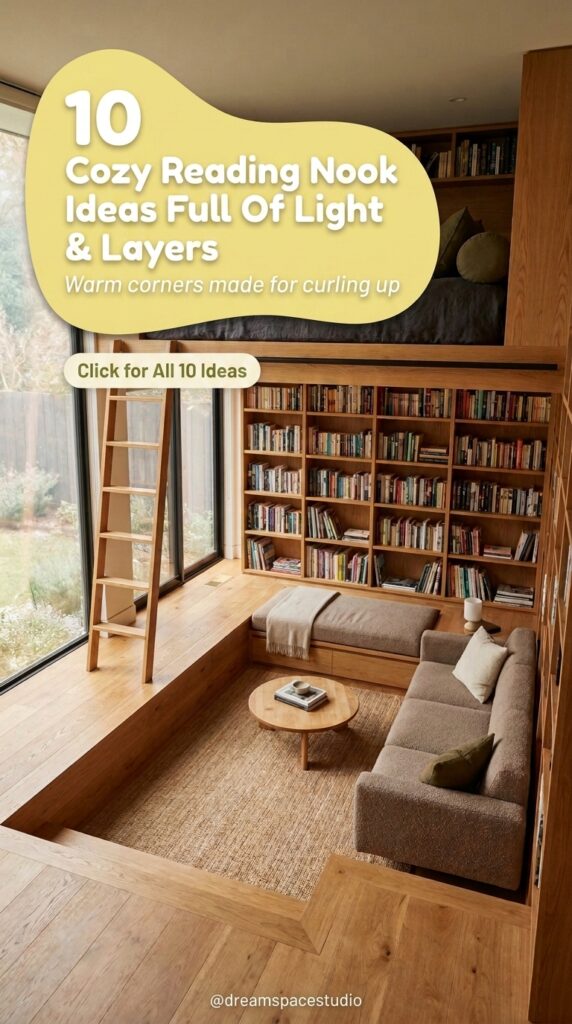
A reading nook rarely needs its own room. Most of the best ones are carved out of leftover space—a dead corner, an unused alcove, or a stretch of wall that was never going to hold furniture anyway. What turns that leftover space into somewhere people actually want to sit is a fairly short list: a seat deep enough to curl into, light that lands where the book is instead of where the ceiling fixture happens to be, and shelving close enough that getting up mid-chapter isn’t necessary.
The ten spaces below take that idea in very different directions—some built from custom joinery, others assembled from little more than a sofa and the right bookshelf—but each one earns its place as somewhere to actually stay and read, not just somewhere to photograph.
A Sculpted Wood Alcove That Doubles as a Private Library
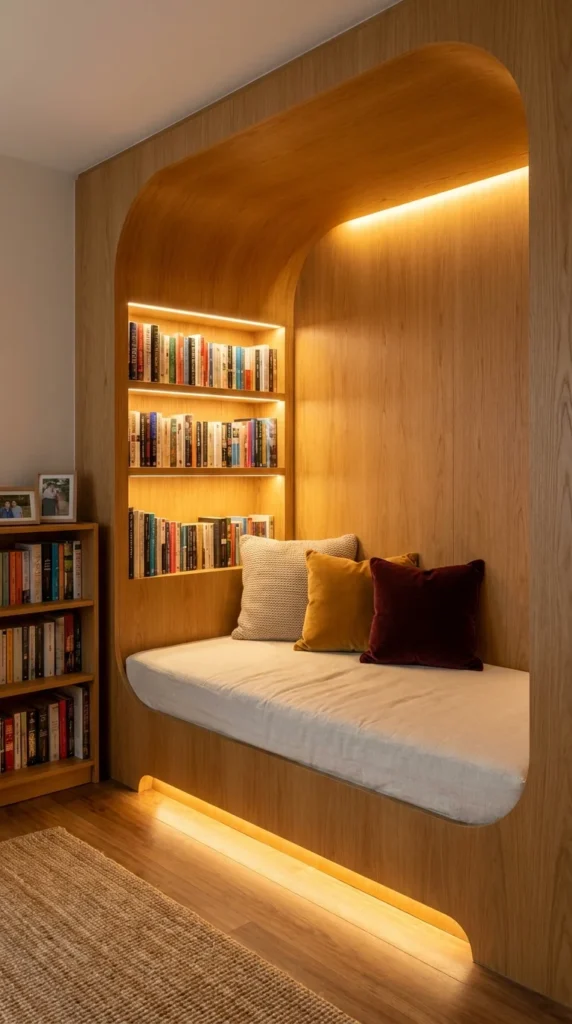
Carved into a curved wood surround, this nook wraps a cushioned bench with three tiers of open shelving on one side and a warm, glowing recess on the other. The LED strip tracing the underside of each shelf and the base of the seat gives the whole space a soft amber cast, even without an overhead fixture doing any of the work.
💡 Pro Tip
Placing a light strip along the underside of a shelf, rather than mounting a lamp above the seat, keeps the glow close to the books and avoids the kind of overhead glare that makes reading at night uncomfortable. It also means the light source stays hidden, so the nook looks lit rather than lamp-lit.
The single bench cushion, kept in a plain oatmeal tone, lets the wood and the shelved books carry all the color—proof that a reading nook doesn’t need a busy palette to feel warm.
Warm Boucle Curves Under an Oversized Round Window
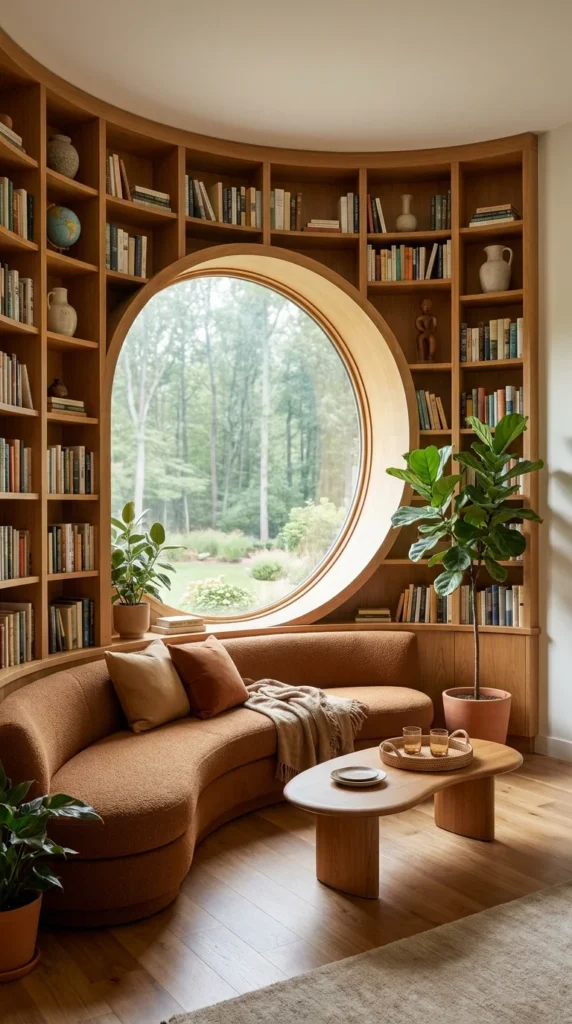
An entire wall of curved bookshelves wraps around a single oversized circular window in this nook, with a matching curved boucle sofa following the same rounded line beneath it. The forest view fills nearly the whole window, so the seat below effectively becomes a spot to read with the outdoors as a backdrop rather than a wall.
Round architectural details like this window work best when the furniture picks up the same geometry instead of fighting it—the curve of the sofa mirrors the arc of the window frame, and the rounded coffee table continues that shape down at a lower height. Terracotta cushions and a soft throw keep the whole setup from feeling too architectural or cold, adding the kind of texture a nook needs to actually feel inviting rather than just well-designed.
Circular Repetition: When the Shelf and the Seat Share One Shape
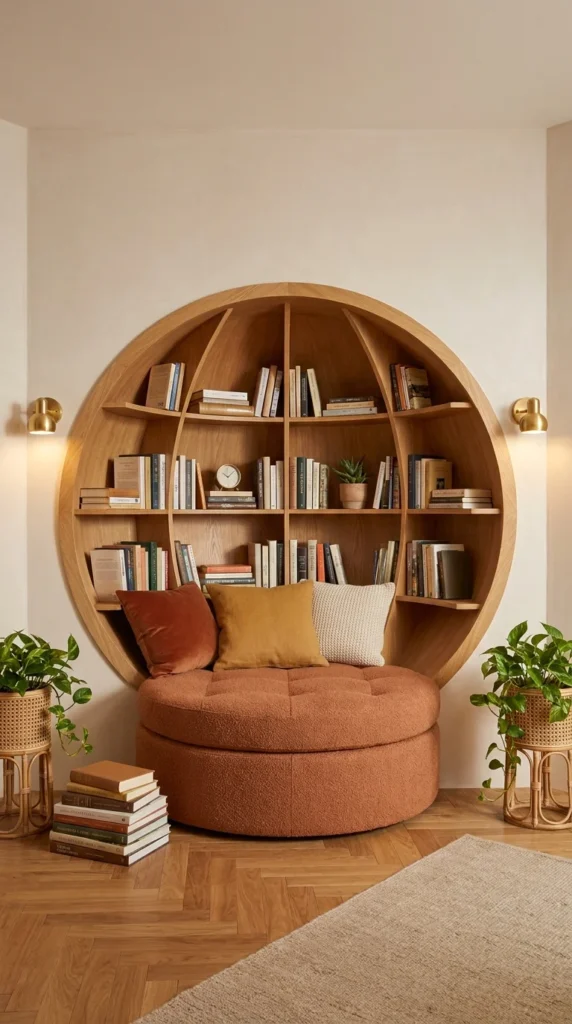
A wood-paneled globe-shaped bookshelf anchors this nook, its wedge-cut compartments radiating out from a center point exactly like the round ottoman seat placed in front of it. Rust, mustard, and cream cushions pile against the shelf’s lower curve, and rattan plant stands flank both sides.
📌 Important Note
Matching a rounded seat to a rounded shelf like this only works when the two pieces are sized close to each other. If the ottoman had been noticeably smaller than the shelf, the pairing would look unbalanced rather than intentional—the visual echo depends on the proportions lining up.
Wall sconces mounted on either side add symmetry without requiring a ceiling fixture, which matters in a nook this compact—anything hanging down from above would crowd a space already built around one strong circular form.
How a Loft Level Turns One Room Into Two Reading Spaces
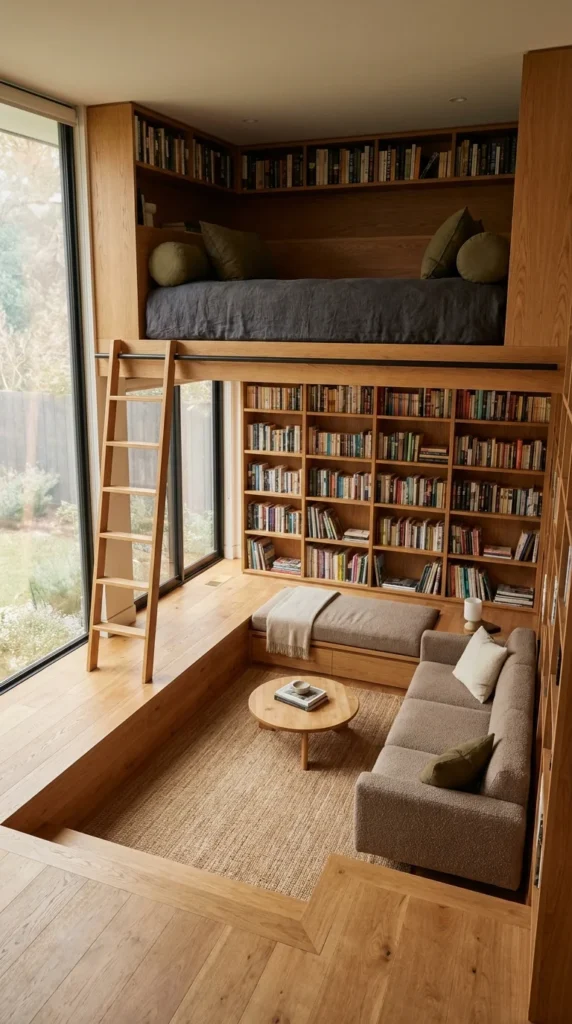
A wall of open bookshelves runs floor to ceiling in this space, but the real trick is the second level tucked above—a daybed reachable by a short wood ladder, with its own row of shelving built into the headboard wall. Down below, a low sectional and bench seat sit on a woven jute rug, giving the room two entirely different ways to read depending on the mood.
What Makes a Loft Reading Nook Work
☐ A sturdy, fixed ladder rather than a freestanding one ☐ A guardrail or wall barrier along the open edge of the upper level ☐ Shelving built into the loft itself, not just the lower walls ☐ A rug or soft flooring below to soften the transition between levels ☐ Natural light reaching both levels, not just the lower floor
Splitting a reading space vertically like this makes sense mainly in rooms with enough ceiling height to spare—the upper daybed only feels cozy rather than cramped because there’s still headroom to sit up comfortably.
Twin Arched Niches That Give Books Their Own Address
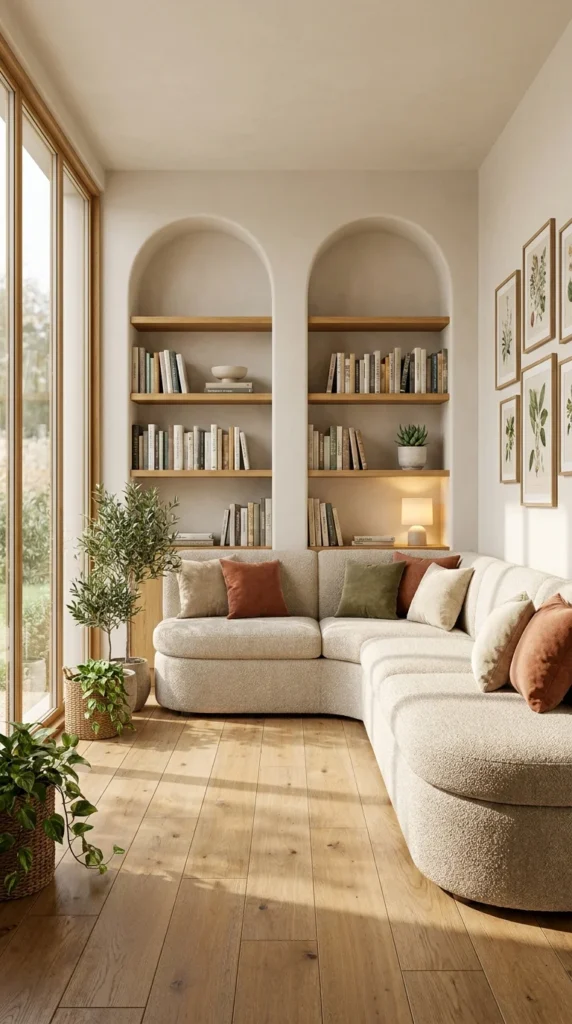
Two matching arched recesses are carved directly into the wall here, each holding three shelves of books above a curved sectional in soft ivory boucle. The arches give the shelving a sense of permanence that a freestanding bookcase wouldn’t have, as if the wall was always meant to hold them.
Botanical prints line the opposite wall in a tight grid, and a small lamp tucked into one niche adds a pool of warm light without needing a separate side table. The overall effect leans quiet and architectural rather than cozy-cluttered—everything here is curved, from the arches down to the sofa’s rounded arm, which keeps the room feeling soft despite how structured the shelving is.
Rooms built around built-in niches like these tend to photograph best when the books themselves stay loosely organized by color or size rather than perfectly straight—the slight irregularity is what keeps the space from reading as a showroom display.
Rough Beams, Soft Corduroy—A Reading Room Built on Contrast
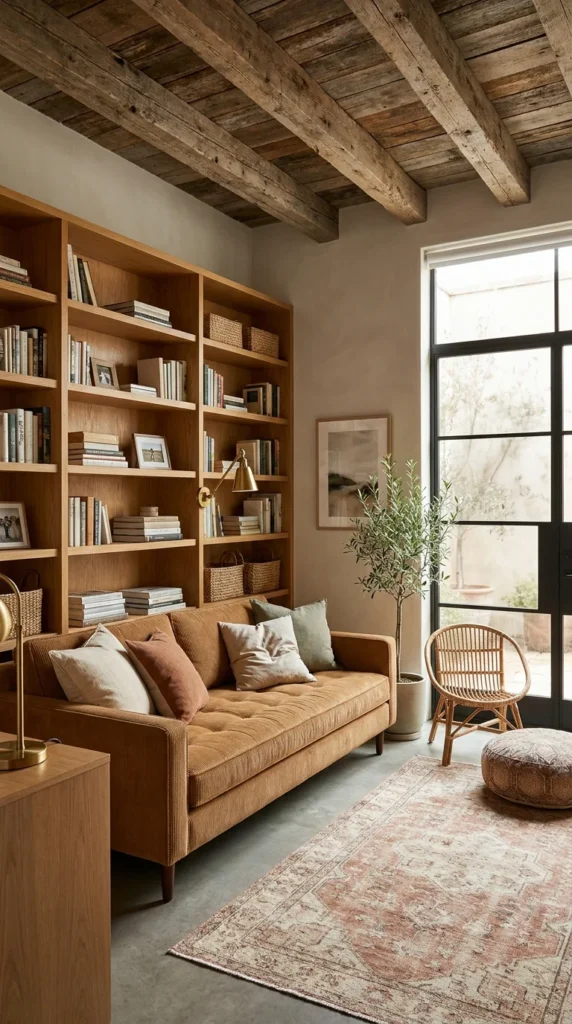
Weathered wood beams cross the ceiling of this space, their raw, unfinished texture sitting in deliberate contrast to the smooth camel-colored corduroy sofa below. A wall of open wood shelving holds books alongside woven baskets, and a faded vintage-style rug adds one more layer of texture to a room already built on mismatched materials.
⚠️ Warning
Combining this many raw textures—rough beams, woven rattan, faded rug, and ribbed corduroy—risks feeling chaotic if the color palette isn’t kept tight. This room avoids that by staying almost entirely within warm browns, tans, and dusty pinks; every material is different, but nothing clashes because the color range stays narrow.
A rattan chair and a floor lamp with a brass base round out the seating, giving the room a second, smaller spot to read besides the main sofa.
Depth Carved Into a Wall, Used Entirely for Storage and Glow
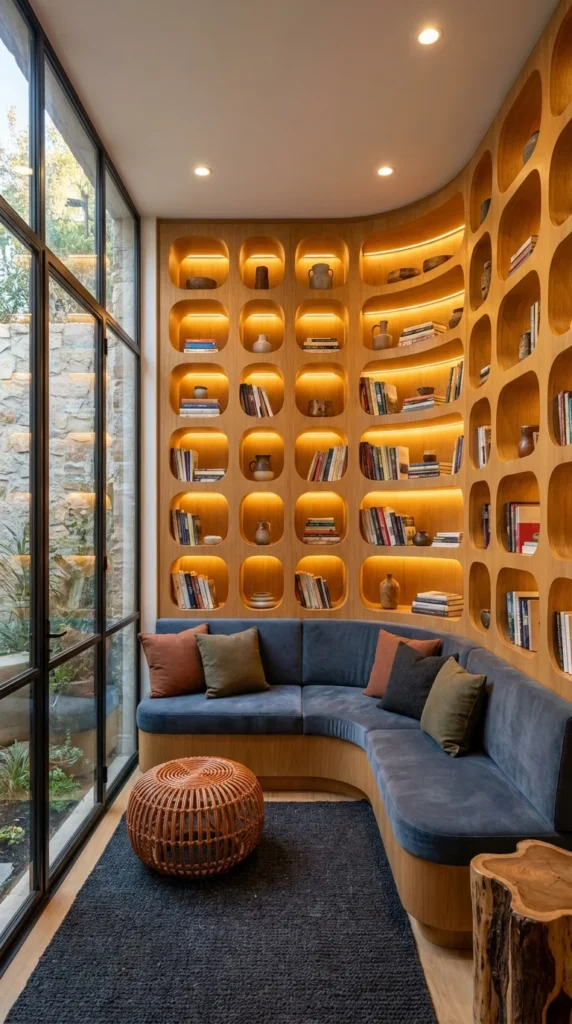
Dozens of individually carved niches cover this wall, each one lit from within and holding either books or small ceramic pieces. Below it, a deep navy velvet bench curves around the corner of the room, upholstered in the same tone throughout so the wall of glowing wood stays the clear focal point.
💡 Pro Tip
Carved niches this deep only glow evenly if the light source runs along the back of each compartment rather than the front edge. Front-mounted lighting casts shadows forward and darkens the books inside; backlighting illuminates the object without throwing shade across the shelf below it.
A rattan pouf and a raw tree-stump side table bring in natural, unfinished materials that keep the highly designed wall from feeling too polished or cold.
What a Star-Lit Ceiling Does for a Reading Corner After Dark
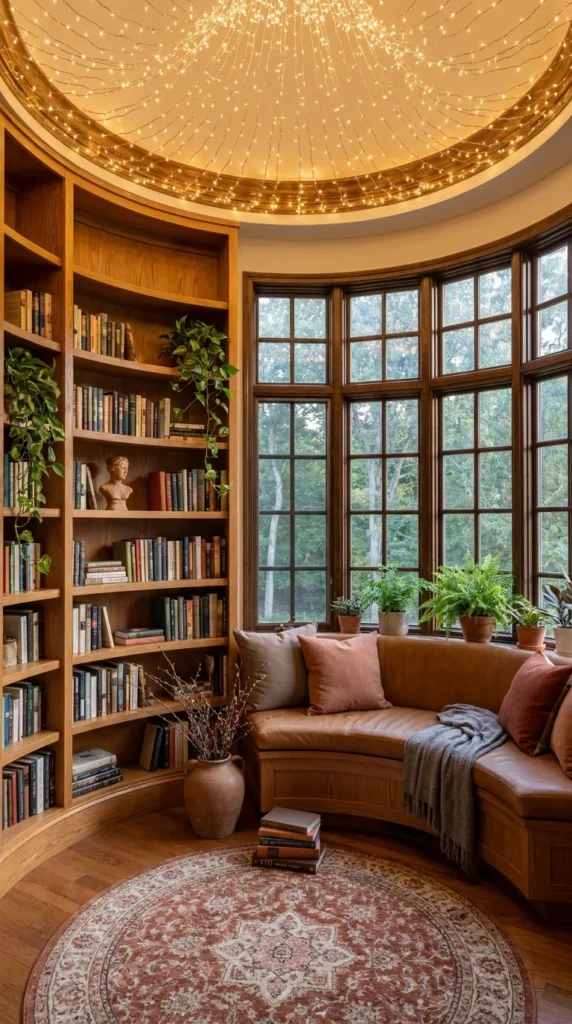
Strings of tiny lights trace a domed pattern across the ceiling of this space, turning what would otherwise be a plain curved ceiling into something closer to a night sky once the sun goes down. Below it, a leather bench seat wraps the base of a floor-to-ceiling window, framed on both sides by curved wood shelving packed with books.
During the day, the tall windows and forest view do most of the work—the room needs almost no artificial light to feel bright and calm. Once evening comes, the ceiling lighting takes over, and the mood shifts noticeably without a single piece of furniture changing. A round patterned rug and a stack of books left on the floor keep the space feeling used rather than staged, even with this elaborate ceiling treatment.
Oversized Round Seating Framed by a Glowing Circular Shelf
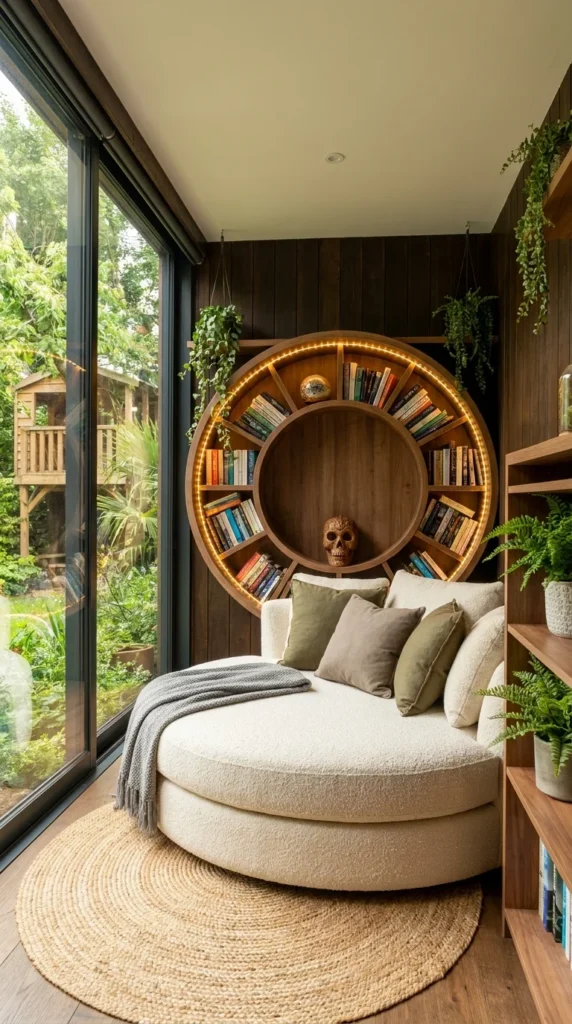
A ring-shaped bookshelf, lit from within along its inner edge, wraps around a set of sage and olive cushions piled on an oversized cream ottoman seat. Hanging plants drape down from either side of the shelf, and a floor-to-ceiling window brings in a garden view that includes a distant treehouse.
Before and After
❌ Before: A standard rectangular bookshelf against this same wall would have left the corner feeling boxy, with the seat looking like an afterthought placed in front of it. ✅ After: Curving the shelf into a full circle and centering the round seat inside it turns the whole corner into a single unified shape, rather than two separate pieces of furniture placed near each other.
The jute round rug underneath continues that same circular logic, tying the floor to the shape of the shelf above it.
An Arched Wood Nook Built Entirely From Shelving
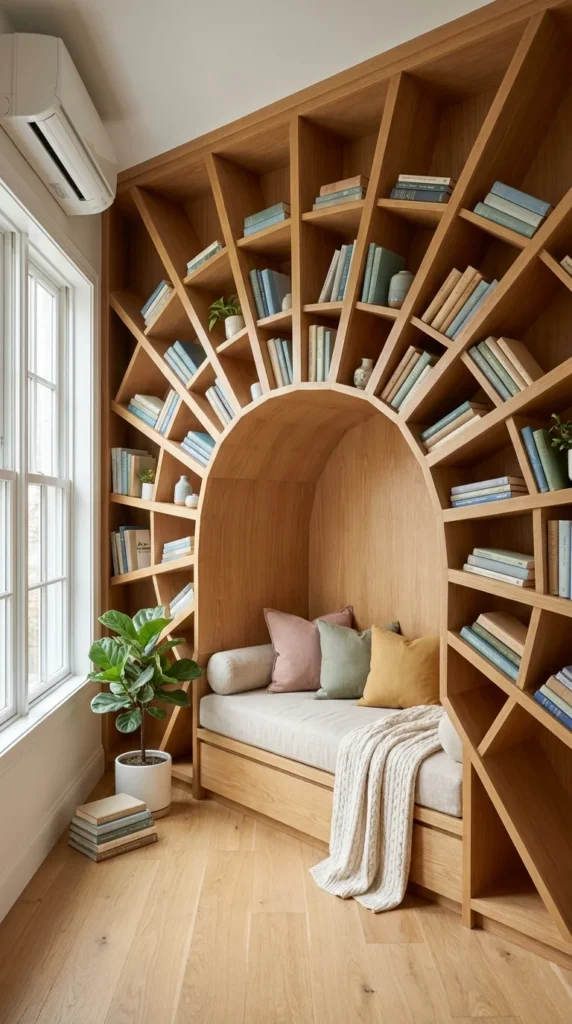
A sunburst arrangement of angled wood shelves radiates outward from a central arched opening, and tucked into that opening is a simple cushioned bench just large enough for one person to stretch out. Soft pastel pillows in blush, sage, and mustard sit against the plain cream cushion, adding the only real color in an otherwise wood-and-white room.
Recreating This Look: Budget Tiers
💚 Affordable: A single arched wall decal or painted archway behind a window bench can suggest the same shape without custom carpentry. 💛 Mid-Range: Modular cube shelving arranged in a rough arch pattern around a daybed gets close to the radiating layout without a fully custom build. 💎 Investment: A carpenter-built shelving wall with an arched cutout, shaped specifically around the bench dimensions, is the only way to achieve this exact radiating symmetry.
The angled shelf compartments aren’t just decorative—tilting them slightly makes book spines easier to read at a glance from the seat below, which is a small detail that adds up in a nook meant for actual daily use.
Final Thoughts
None of these ten nooks rely on square footage to feel special—some take up an entire wall, others fit into a corner barely wide enough for one chair. What they share is a clear sense of purpose: the shelving is close, the lighting is considered, and the seat is built for staying put rather than just passing through. Whether the starting point is a spare alcove, an oddly shaped window, or simply one wall that’s been sitting empty, the same basic formula — good light, soft depth, and books within reach — is what turns any of these corners into somewhere worth returning to.
Frequently Asked Questions
How much space does a reading nook actually need? A workable reading nook can fit into as little as 3 to 4 feet of wall space—enough for a single chair or a narrow window bench. Built-in options like alcove seating or a daybed generally need a bit more depth, around 30 to 36 inches, so the seat itself is deep enough to sit in comfortably rather than perch on the edge of.
What’s the best lighting for a reading nook? A dedicated reading light positioned above and slightly behind the shoulder works better than relying on overhead room lighting, since it reduces glare on the page. Warm-toned bulbs, in the 2700K to 3000K range, are generally more comfortable for extended reading than cooler white light.
Should a reading nook have a window? It isn’t required, but natural light makes a noticeable difference for daytime reading and helps a small nook feel less enclosed. In nooks without direct window access, a well-placed floor or wall lamp can largely make up the difference.
What kind of seating works best for a reading nook? Bench seating with a deep, supportive cushion tends to work well because it allows for multiple sitting positions—cross-legged, stretched out, or leaning against a corner. A single oversized chair or ottoman is a strong alternative in smaller spaces where a full bench wouldn’t fit.
How do I keep a small reading nook from feeling cluttered? Keeping the shelving built-in or wall-mounted, rather than adding a freestanding bookcase, generally saves the most floor space. Limiting cushions and throws to two or three pieces, and choosing a single accent color rather than several competing patterns, also helps a small nook feel calm instead of crowded.
One Response