

A flocked or “snow” tree isn’t just a white Christmas tree — it’s a decision about how the whole room reads for six weeks a year. Some flocking is barely-there, just enough to soften the green underneath. Some goes almost fully white, turning the tree into more of a sculpture than a plant. The six rooms below use six different amounts of that same idea, in six very different homes, and each one solves a slightly different problem. Look at what the room already has before picking which direction to copy.
Quick Overview
| Style | Flocked & Snow-Effect Christmas Trees |
|---|---|
| Best For | Neutral living rooms, statement staircases, entryways with a strong focal wall |
| Budget | Medium–High |
| Difficulty | Moderate — pre-flocked trees skip the DIY step |
| Maintenance Level | Medium — flocking sheds and needs gentle handling |
A Flocked Tree Built for a Room That Already Looks Finished

This is the safest version of a snow tree, and that’s exactly its appeal. The room was already neutral — cream paneling, a grey tufted sofa, a mantel dressed in candlesticks — so a heavily flocked tree doesn’t fight anything. It just adds texture in a palette that was already decided. Silver ornaments, a silver snowflake on the wall, and the candle flames all sit on the same warm-cool line, which is why the tree looks like it belongs rather than like it was added on top.
Should you choose this if your living room is already fairly neutral? Yes — this is the lowest-risk version of a flocked tree, and it’s the one most people can copy directly without repainting or reupholstering anything first.
Why the Silver Repeats Instead of Clustering
One reason this room feels resolved rather than decorated is that the same silver tone shows up at least three separate times — the ornaments, the star-shaped topper, the wall snowflake — instead of being confined to the tree alone. That repetition is what stops the tree from reading as a separate object dropped into the living room, and it’s a detail worth checking before adding ornaments: pick one metallic, then find two more places for it in the room.
This is also a good layout to steal if the sofa itself is doing a lot of the work. A tufted grey sofa like this one carries a lot of visual weight on its own, and a heavily flocked tree next to it needs to stay soft rather than loud — gold or bronze ornaments here would compete with the sofa’s warmth instead of complementing it. Anyone building a room around a similar grey sofa will run into the same balance problem the rest of the year, not just at Christmas.
Main Colors
- Warm cream (walls, trim)
- Antique silver (ornaments, topper, wall art)
- Soft brass (candlesticks)
- Snow-flocked white (tree)
Where This Look Goes Wrong
- Mixing warm gold ornaments in with the silver instead of picking one metallic
- Skipping the wall décor and leaving the corner behind the tree empty
- Using cool-white LED lights instead of warm white, which fights the cream walls
- Overcrowding the tree skirt with too many differently wrapped gifts, breaking the palette
The Sculptural Tree That Skips the Ornaments Entirely

This one barely reads as a tree at all — it’s built from draped, ribbon-like layers of white fabric wrapped around an internal light structure, more art installation than fir tree. In a loft with exposed brick and steel-framed windows, a traditional ornament-covered tree would have looked out of scale and out of character. This piece solves that by becoming architecture instead of decoration.
Should you choose this if your space already has strong industrial bones? Yes, but only if you’re comfortable with the tree functioning as a lighting fixture rather than a traditional, ornament-covered fir — there’s no ornament layer to fall back on if the shape itself doesn’t work for you.
What Happens When Fabric Replaces Branches
Fabric behaves differently from flocked pine under warm light — it diffuses rather than reflects, which is why this piece glows evenly instead of showing individual points of sparkle the way a traditional flocked tree does. That diffusion is what lets it hold its own against ten-foot brick walls without needing ornaments to add visual interest.
The choice to leave it unadorned also says something about scale: at this height, ornaments would mostly disappear from a normal sitting distance anyway. Leather lounge chairs and a live-edge coffee table keep the rest of the room warm and textural, so the tree doesn’t need to supply that warmth itself — it just needs to supply light and shape.
Easy Ways to Undercut This Effect
- Adding ornaments anyway, which flattens the sculptural silhouette
- Using a tree this tall in a room without at least 9–10 feet of ceiling height
- Pairing it with patterned rugs or busy upholstery that compete for attention
- Placing it away from a window, losing the contrast between its glow and the dark evening outside
Letting the Staircase Carry the Tree
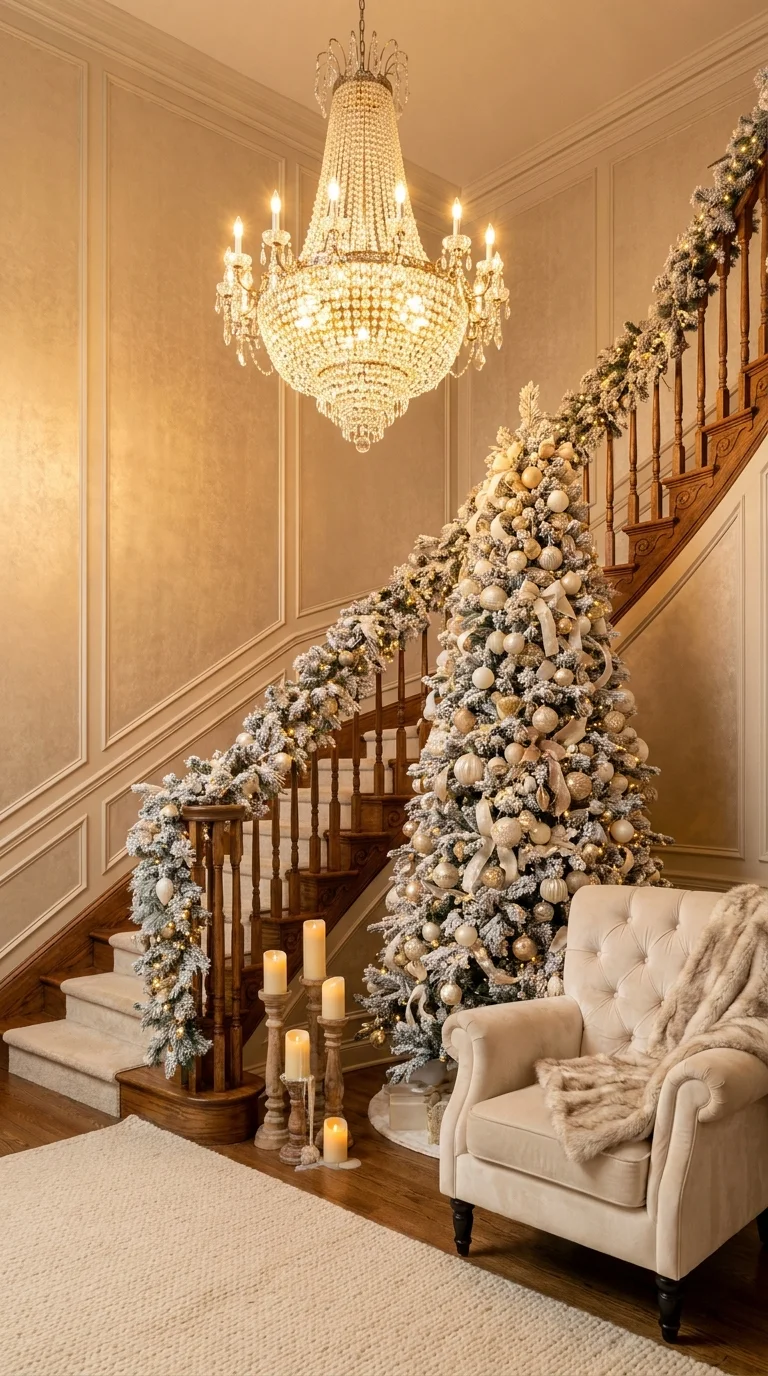
Here the tree isn’t really a standalone object — it’s part of a continuous line that starts at the crystal chandelier, runs down the banister as garland, and pools into the tree at the base of the stairs. That’s a different design decision than the other rooms on this list: instead of one focal point, the entry gets one continuous gesture.
Should you choose this if you have a staircase visible from your front door? Yes — this is one of the few tree placements that photographs and reads well from a distance, which matters most in an entryway people pass through rather than sit in.
Where the Eye Lands First on This Staircase
The chandelier is lit brightest, so it pulls attention first, then the garland’s gold ribbon leads the eye straight down to the tree — a deliberate sightline rather than an accident of placement. Losing the garland here would leave the chandelier and the tree feeling like two separate holiday moments instead of one composed entryway, which is the real function that banister greenery serves beyond decoration.
Ornament-wise, this room leans fuller than the other neutral spaces on this list — a genuinely maximalist amount of texture, in cream, gold, and champagne tones layered onto flocked branches. That density works here because the staircase gives it somewhere to go rather than clustering it all in one corner.
What Trips People Up on a Staircase Tree
- Garland that stops partway up the banister instead of running the full length
- Skipping a tree skirt or base wrap where the tree meets the stairs, leaving the transition messy
- Using ornaments too small to register from across an entryway
- Forgetting the chandelier’s bulb color, which can clash badly with warm garland lighting
The Red-and-Gold Tree That Still Feels Restrained
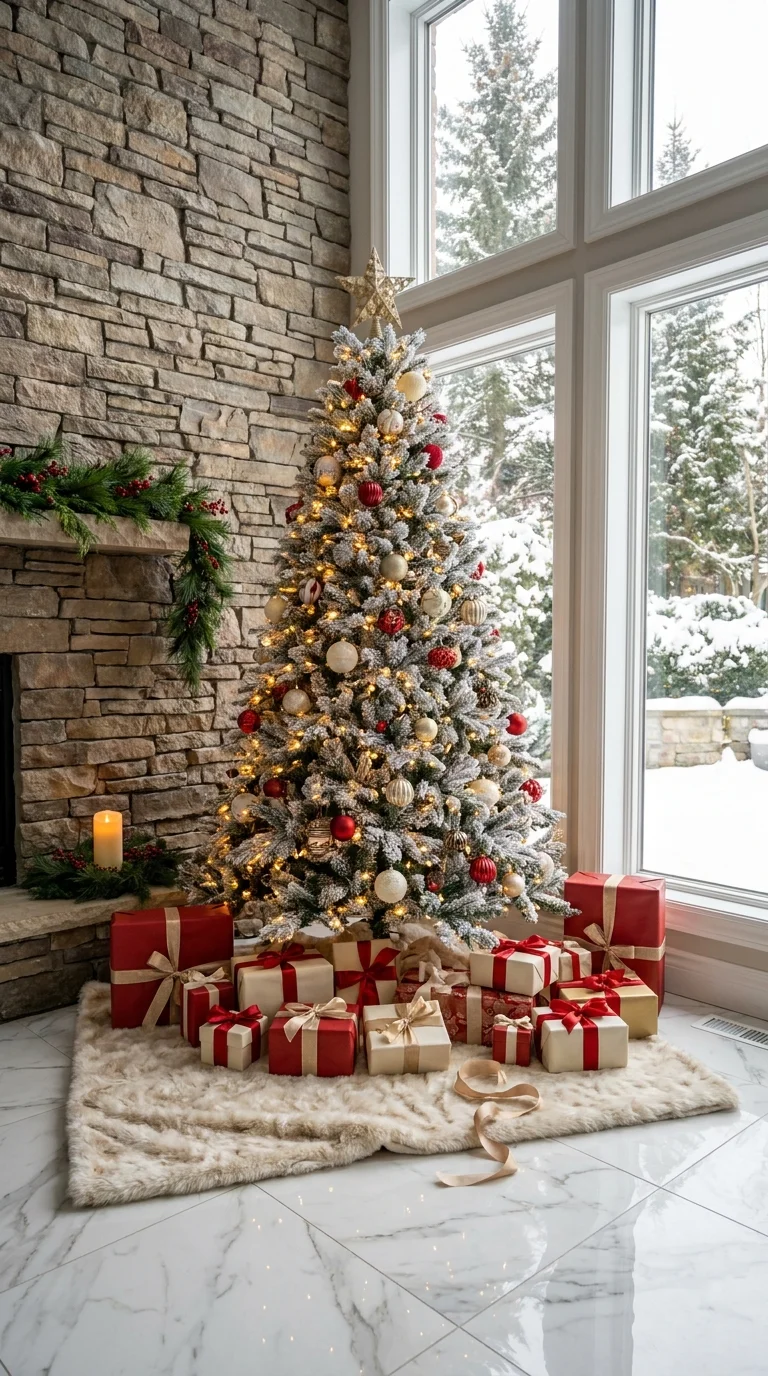
This is the most classic tree on the list — red and gold ornaments on a lightly flocked tree, gifts wrapped in matching red-and-gold paper on the floor beneath it. What keeps it from tipping into cluttered is restraint elsewhere: a plain stacked-stone fireplace, a simple evergreen garland with a few red berries, and a single candle instead of a whole mantel of them.
Should you choose this palette if your living room already has warm, natural materials like stone or wood? Yes — red and gold read as traditional rather than dated specifically when the surrounding materials are this raw and unfussy, the way they would in a country living room built around similar stone and wood tones.
Recommended Materials
- Lightly flocked artificial or fresh-cut fir
- Stacked natural stone (fireplace surround)
- Mixed-finish glass and matte ball ornaments
- Faux fur tree skirt
- Kraft-paper and ribbon gift wrapping
Is a Flocked Tree Actually Worth the Extra Cost?
A pre-flocked artificial tree typically costs noticeably more than an unflocked version of the same height, and the honest answer is that it’s worth it mainly for rooms like this one, where the tree sits directly against a busy backdrop — here, textured stone. Against a plain wall, a regular tree with white string lights gets most of the same effect for less money. Against stone, brick, or a patterned wallpaper, the flocking gives the tree its own visual layer instead of blending into the background, which is where the extra cost actually earns its place.
Where a Classic Tree Can Tip Into Cluttered
- Mixing more than two ornament finishes (matte, glossy, glitter) without a plan
- Wrapping every gift in a different paper instead of a shared 2–3 color scheme
- Skipping the tree skirt, which leaves the stand and cord exposed on hard flooring
- Adding colored string lights instead of warm white, which competes with red-and-gold ornaments
Rooms built around a real stone or brick fireplace often need this kind of restraint the rest of the year too — anyone planning fireplace feature wall updates will notice the same rule applies outside December: let one strong material do the talking and keep everything else quiet.
A Blush Tree for a Room Already Dressed in Pink
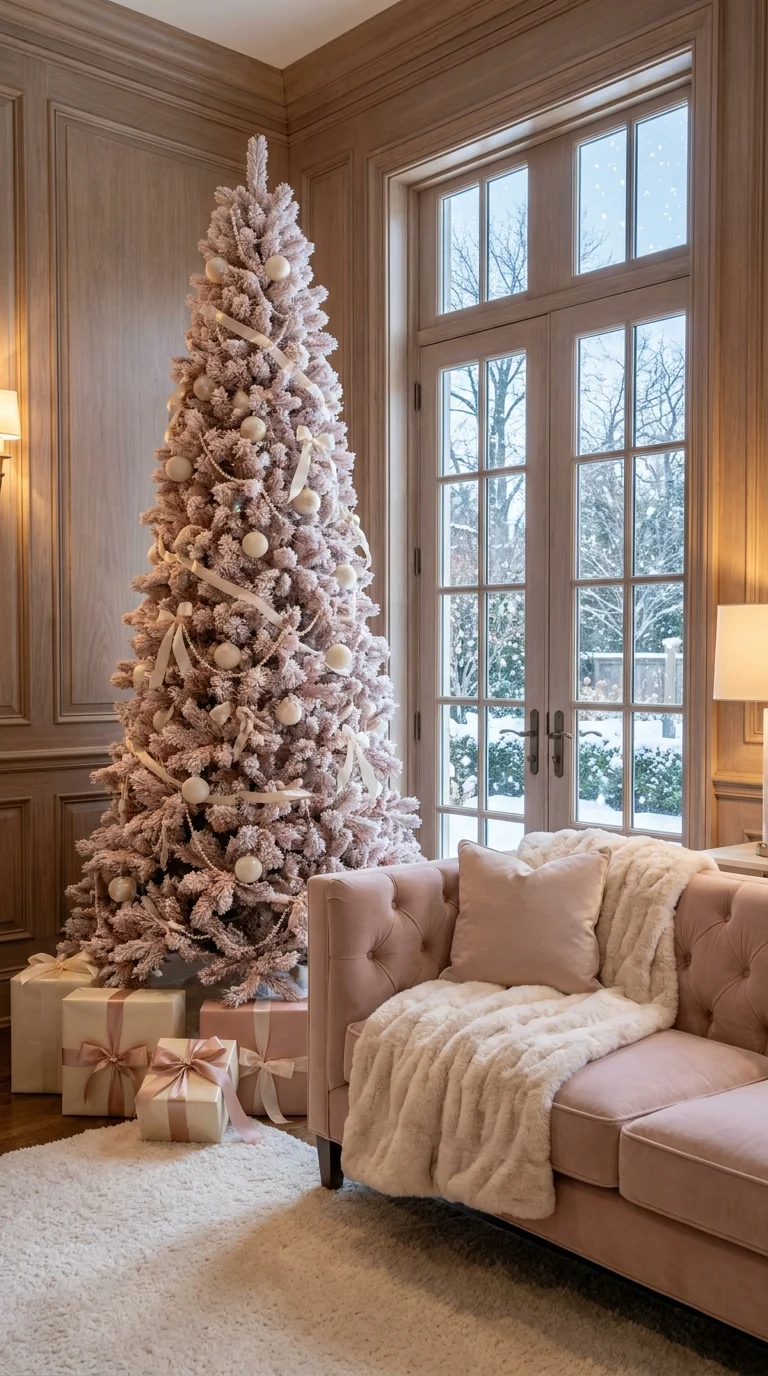
This tree isn’t white at all — it’s flocked in a soft blush that matches the velvet sofa, faux fur throw, and wood paneling almost exactly. That’s a harder trick to pull off than plain white flocking, because a mismatched blush reads as pink-gone-wrong rather than intentional. Here it works because the color was clearly chosen to match furniture that already existed, not the other way around.
Should you choose blush flocking if your room’s palette is mostly neutral with no pink already in it? Probably not on its own — this only reads as sophisticated because the sofa and throw already established the color first. Introducing blush for the first time via the tree alone risks looking like a seasonal mistake rather than a considered choice.
Why This Tree Reads as Tall Without Feeling Overwhelming
The tree is genuinely full-height for the room, reaching close to the ceiling, but it doesn’t overwhelm the space the way a tree this size often can. That’s partly proportion: the panel molding on the walls has a strong vertical line already, so the tree’s height echoes something the room was doing before the tree arrived, rather than introducing scale on its own.
Cream ribbon garland winds through the branches instead of the more common bead-style garland, which keeps the texture soft rather than sparkly — a deliberate choice given how much the sofa’s velvet and the throw’s faux fur are already doing on the texture front.
Main Colors
- Blush pink (tree flocking, sofa)
- Warm honey wood (paneling)
- Cream (ribbon, pillow)
- Ivory faux fur (throw)
How a Blush Tree Can End Up Looking Washed Out
- Using white ornaments that disappear into the pink flocking instead of contrasting with it
- Choosing a blush shade that doesn’t match any existing furniture, so it looks accidental
- Skipping a darker anchor color (the honey wood here) that keeps the palette from going flat
- Lighting the tree only with warm white bulbs, which can shift pink toward peach in photos
A Lightly Flocked Tree That Lets the Forest Outside Do Half the Work
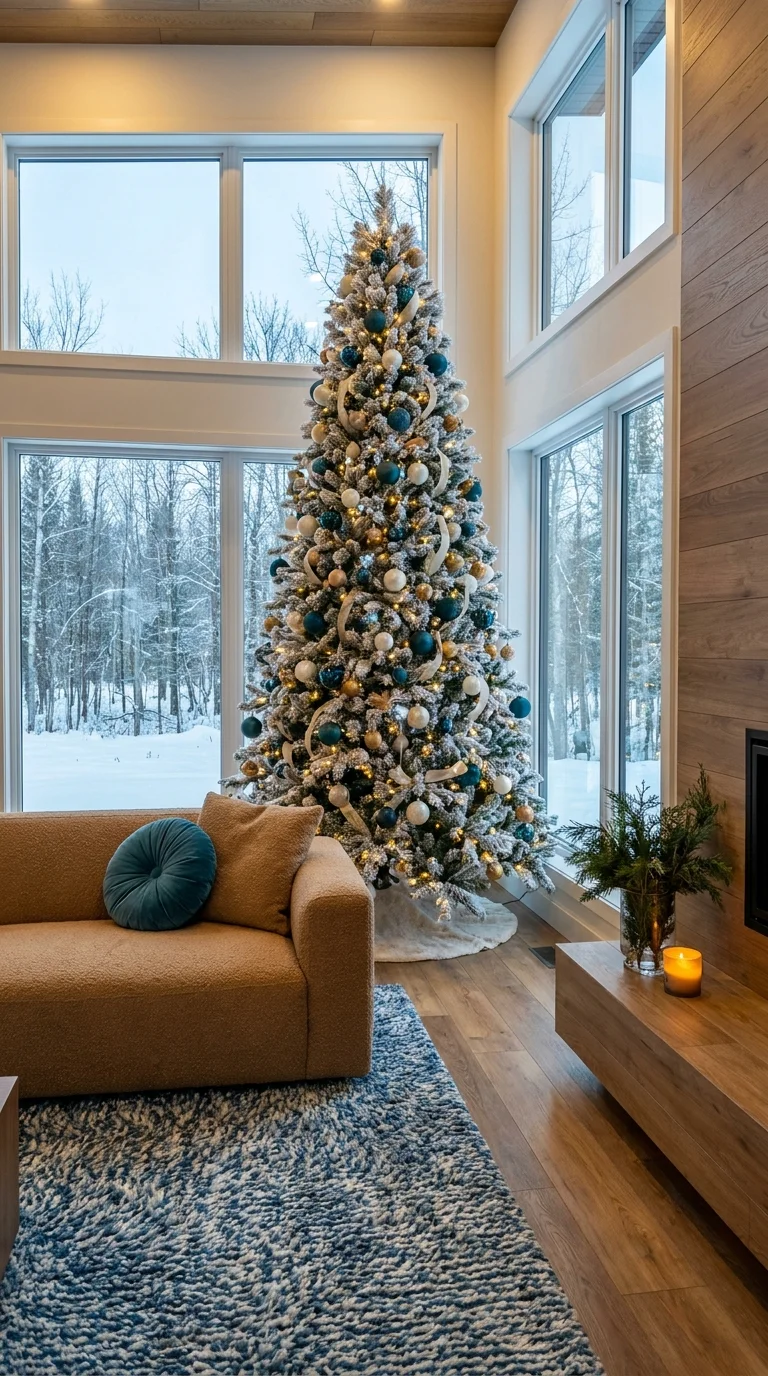
Floor-to-ceiling windows here mean the tree is competing with an actual snowy forest for attention, so it’s flocked only lightly — just enough to tie it to the view outside without trying to out-white the real thing. Teal ornaments and a round teal pillow on the sofa pull one accent color through the room, against an otherwise wood-and-neutral cabin palette.
Should you choose a lightly flocked tree if your windows already frame real snow or greenery? Yes — a heavily flocked tree in front of a snowy window can actually look flatter than a lightly dusted one, because it stops contrasting with what’s already outside the glass.
How One Teal Note Ties the Whole Corner Together
Teal shows up at least twice — the ornaments and the round throw pillow — which is the same repetition principle at work in the neutral living room earlier on this list, just in a bolder color. That repetition is what keeps a single accent color from looking like a random ornament choice; it needs at least one other appearance in the room to read as intentional.
Best Lighting
Natural daylight from the wall of windows does most of the work here during the day; in the evening, the tree’s own warm string lights and a single glass candle on the console are enough, since large windows at night reflect interior light back into the room rather than needing extra fixtures.
What Can Flatten This Cabin Look
- Choosing a fully white-flocked tree, which loses contrast against snow visible through the windows
- Skipping the teal repeat elsewhere in the room, leaving the ornaments feeling random
- Using a patterned rug that fights the room’s mostly solid, textured fabrics
- Blocking window light with heavy curtains instead of letting the view stay part of the room
Finding Room for a Full-Size Tree Without Losing the Sofa
- Place the tree in a corner near a window rather than against a solid wall, so it gets natural light from at least one side
- Keep at least 3 feet of clear floor space between the tree and the main walking path
- Avoid setting it directly in front of a fireplace — the two focal points compete instead of supporting each other, as several rooms on this list show
- For ceilings under 9 feet, a 7–7.5 foot tree usually reads as full without brushing the ceiling
Who Should Choose a Flocked Tree
- Best for neutral or muted living rooms where a plain green tree would feel like it’s missing something
- Best for entryways or staircases with an existing architectural line — a banister, a tall window — for the tree to work with
- Best for households willing to vacuum flocking residue a few extra times through December
- Not ideal for homes with pets that chew branches, since flocking spray isn’t meant to be ingested
Budget Summary
| Budget | Expectation |
|---|---|
| Low | Spray-on flocking applied to a tree you already own, dollar-store snowflake picks, existing warm white lights |
| Medium | A pre-flocked artificial tree, one or two tones of glass ball ornaments, a faux fur tree skirt |
| Premium | A large pre-flocked designer tree, hand-blown glass ornaments, professional flocking service on a live cut tree |
Frequently Asked Questions
What actually makes a tree a “snow” or flocked Christmas tree? Flocking is a fibrous, snow-like coating applied to the branches — either sprayed on at home with a flocking kit or built into a pre-flocked artificial tree at the factory. It ranges from a light dusting to a nearly solid white coat, depending on how much is applied.
Does flocking damage a real, live Christmas tree? Flocking sprayed onto a fresh-cut tree doesn’t harm the tree itself, but it does make the branches messier to dispose of afterward and can shed fibers throughout the season, so it’s worth lining the base area before starting.
Can I flock an artificial tree I already own instead of buying a new one? Yes — spray flocking kits work on artificial branches, though the coverage tends to look less even than a factory-flocked tree, since the fibers don’t bond to plastic needles quite the way they bond to real pine.
Do flocked trees work in a small living room, or do they need a big space? They work in smaller rooms too, but a heavily flocked, densely ornamented tree like the staircase example on this list needs more visual breathing room than a lightly flocked one like the cabin example — in a tight space, less flocking and fewer, larger ornaments usually read cleaner than a lot of small details.
How do I stop flocking from shedding all over the floor? Handle a flocked tree by the trunk and main branches rather than the tips, keep it away from direct heat vents that dry out the coating, and vacuum gently around the base every few days rather than letting flocking build up.
Explore More
You may also enjoy:
- Boho Fireplace Ideas That Turn the Fireplace Into the Heart of the Room
- 10 Dark Academia Fireplace Ideas That Balance Mood and Function
- Light, Layers, and Comfort: 10 Reading Nook Ideas That Work
Conclusion
The amount of flocking is really the only decision that matters here — everything else follows from it. A heavy, near-white coat works when the tree needs to hold its own against a busy backdrop like stone or a staircase full of garland; a light dusting works when there’s already something white or wintry outside the window doing that job. Pick based on what your room is doing before the tree goes up, not based on which photo looked prettiest.
Aesthetic Life Team The Aesthetic Life Team covers home design, seasonal styling, and room-by-room decorating ideas, with a focus on choices readers can actually recreate in their own spaces.

