

A small balcony fails for one of two reasons: it either tries to copy a full-size patio and ends up cramped, or it plays it too safe and never feels like a real room. The ten spaces below solve that problem in ten different ways — through plants, lighting, seating shape, flooring, and color — so you can borrow the specific idea that actually fits your footprint instead of guessing.
Quick Overview
| Style | Global Eclectic Balcony |
|---|---|
| Best For | Renters, apartment balconies, small terraces |
| Budget | Low–Medium |
| Difficulty | Mostly DIY-friendly |
| Maintenance Level | Low–Medium |
The Hanging Swing That Doubles as a Privacy Screen
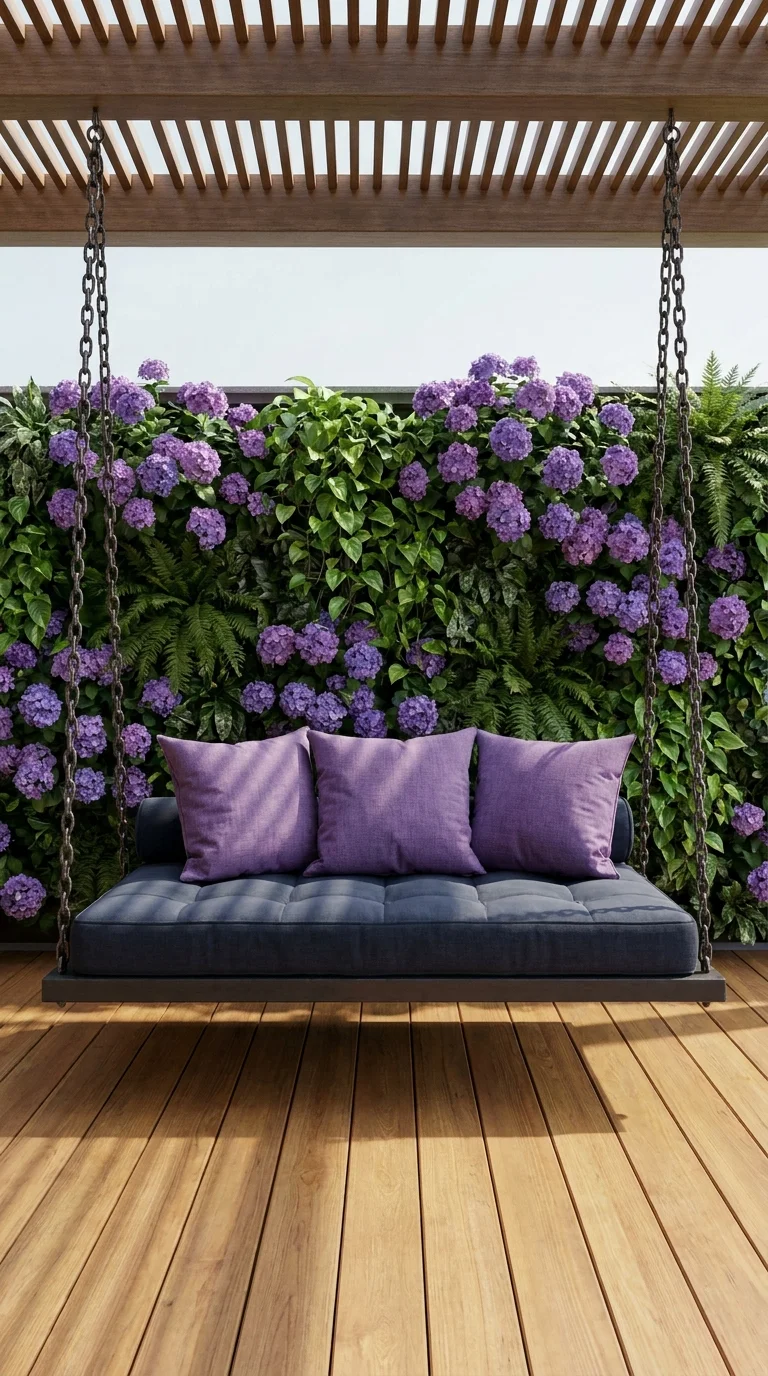
The furniture here isn’t really the point — the flowering wall behind it is doing the real work. A chain-hung bench floats in front of a dense hydrangea-and-fern backdrop, and that single green wall replaces what would normally require a railing screen, a privacy fence, or an awkward neighbor-facing view. The navy cushions and lavender throw pillows repeat the same purple tone found in the flowers, which is why the seating reads as part of the planting instead of sitting in front of it.
This idea suits a balcony that backs onto another building or a shared wall, since the greenery does double duty as screening and scenery. It’s a poor fit if your balcony gets heavy wind, since a hanging bench needs a solid overhead beam and stable chain anchors to feel safe rather than wobbly. On a smaller footprint, a single hanging chair achieves the same screened, floating effect without needing the floor space a full bench demands.
Materials to source: climbing or trellis-trained hydrangea, weatherproof chain hardware, tufted outdoor cushions, cedar or teak decking.
A Monochrome Lavender Palette That Makes a Narrow Balcony Feel Bigger
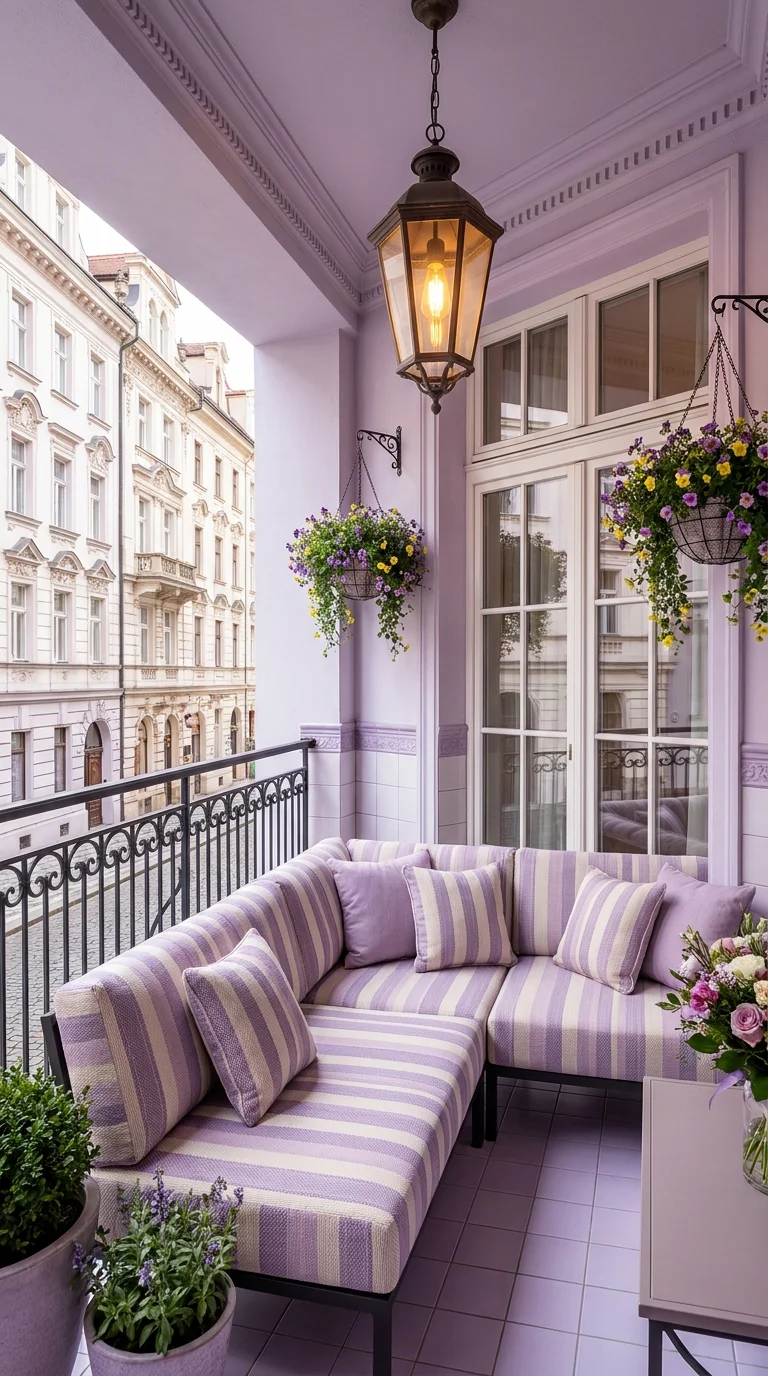
Painting the walls, tile, and even the ceiling the same soft lavender is what makes this narrow balcony feel wider than it is — there’s no hard color break between surfaces for the eye to stop at, so the whole space reads as one continuous room instead of a strip. The striped cushions echo that same lavender rather than introducing a competing color, and a single brass lantern and hanging flower baskets keep the palette from feeling flat.
A near-monochrome approach like this rewards a balcony with good architectural bones — molding, tile, a real railing — since the paint has less texture to disguise a mistake in. It’s genuinely relevant here because it’s easy to get wrong: going one shade too saturated on a small, enclosed balcony can make the space feel like it’s closing in rather than opening up.
Where this tends to go wrong:
- Choosing a saturated lavender instead of a soft, greyed-down tone, which reads as closed-in rather than airy
- Mixing warm-white and cool-white light fixtures, which breaks the color continuity at night
- Skipping the ceiling and only painting the walls, which re-introduces the hard edge the whole idea is meant to avoid
- Using patterned cushions in an unrelated color family instead of a tonal stripe
A Living Wall That Turns a High-Rise Balcony Into a Private Retreat
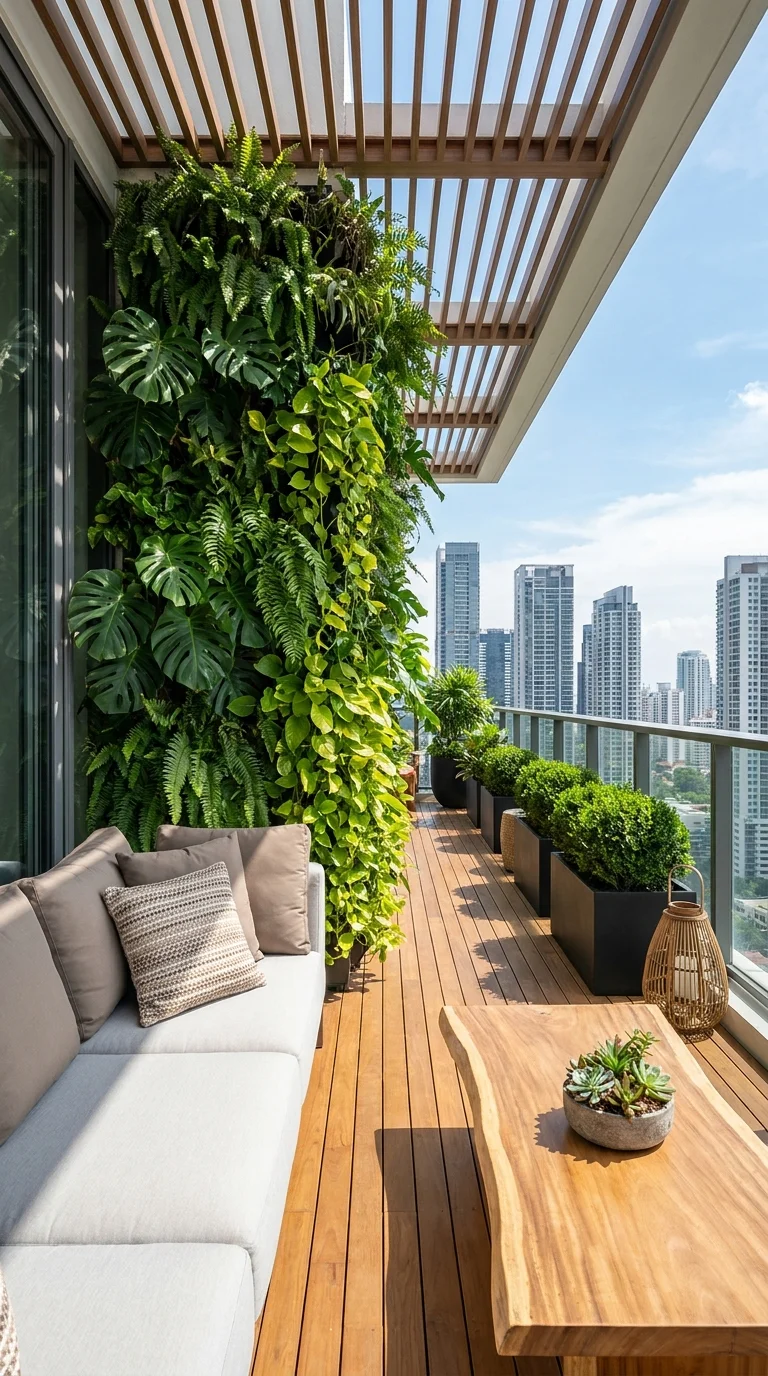
On a high floor with a wide-open skyline view, privacy usually isn’t the issue — feeling like you’re sitting in an empty concrete box is. A vertical garden solves that by giving the eye something layered and organic to land on before it reaches the glass railing and the towers beyond. Ferns, pothos, and a monstera are stacked at different heights along the wall, which is what keeps the planting from reading as one flat green rectangle.
This is one of the more practical small-space ideas on this list, since a living wall claims almost no floor area — the growing happens vertically, so the actual seating footprint stays exactly the same as an empty balcony would. It does ask for more upkeep than a few potted plants: soil in a wall-mounted system dries faster than a floor planter, and mixed species need slightly different watering schedules. A simpler version uses two or three tiered plant stands instead of a built wall-mount system, which gets most of the visual effect with far less irrigation planning. Readers looking to round this out further can look at this guide to styling indoor and balcony plants for species that tolerate a wall-mounted setup well.
The Tuscan Terrace Built Almost Entirely From Light
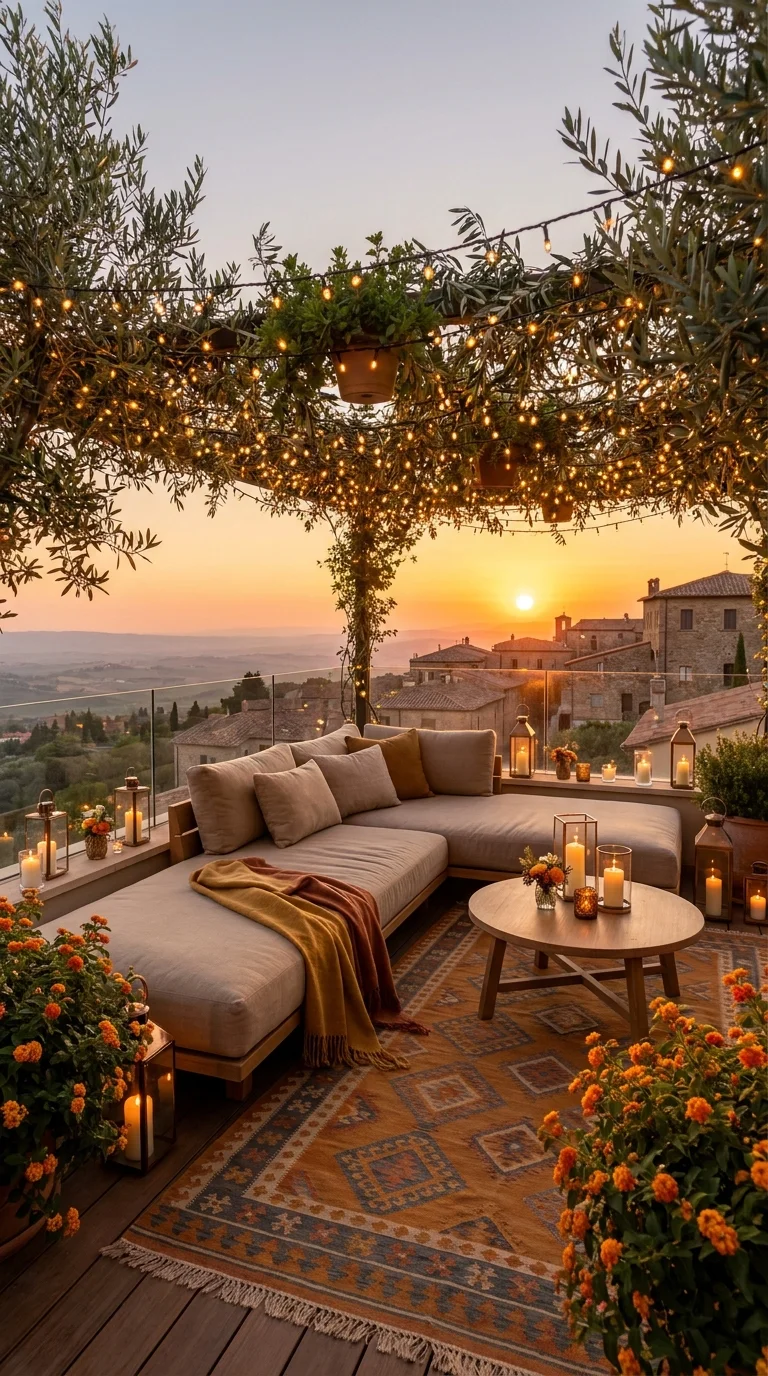
This is the one setup on this list I’d actually call the strongest execution of a single idea, and the idea is light, not furniture. String lights are woven directly through an olive canopy overhead, then repeated again at ankle height inside glass lanterns along the ledge — so the eye gets a warm point of light at two completely different heights instead of one flat string along a railing. Everything else, from the kilim rug to the mustard throw, is chosen to sit quietly underneath that lighting rather than compete with it.
It’s a genuinely low-cost idea to recreate: an olive or fig tree in a large pot, a run of warm-white LED string lights, and a handful of secondhand lanterns gets most of the way there even without the hillside view. The trade-off is that it’s an evening-focused space — during the day, without the lit contrast, it reads as a fairly ordinary neutral seating area. If your balcony gets real evening use, that’s a fair swap; if it’s mostly a daytime coffee spot, the lighting investment won’t pay off the same way.
A Gravel-and-Wood Path That Solves the “Rooftop With No Soil” Problem
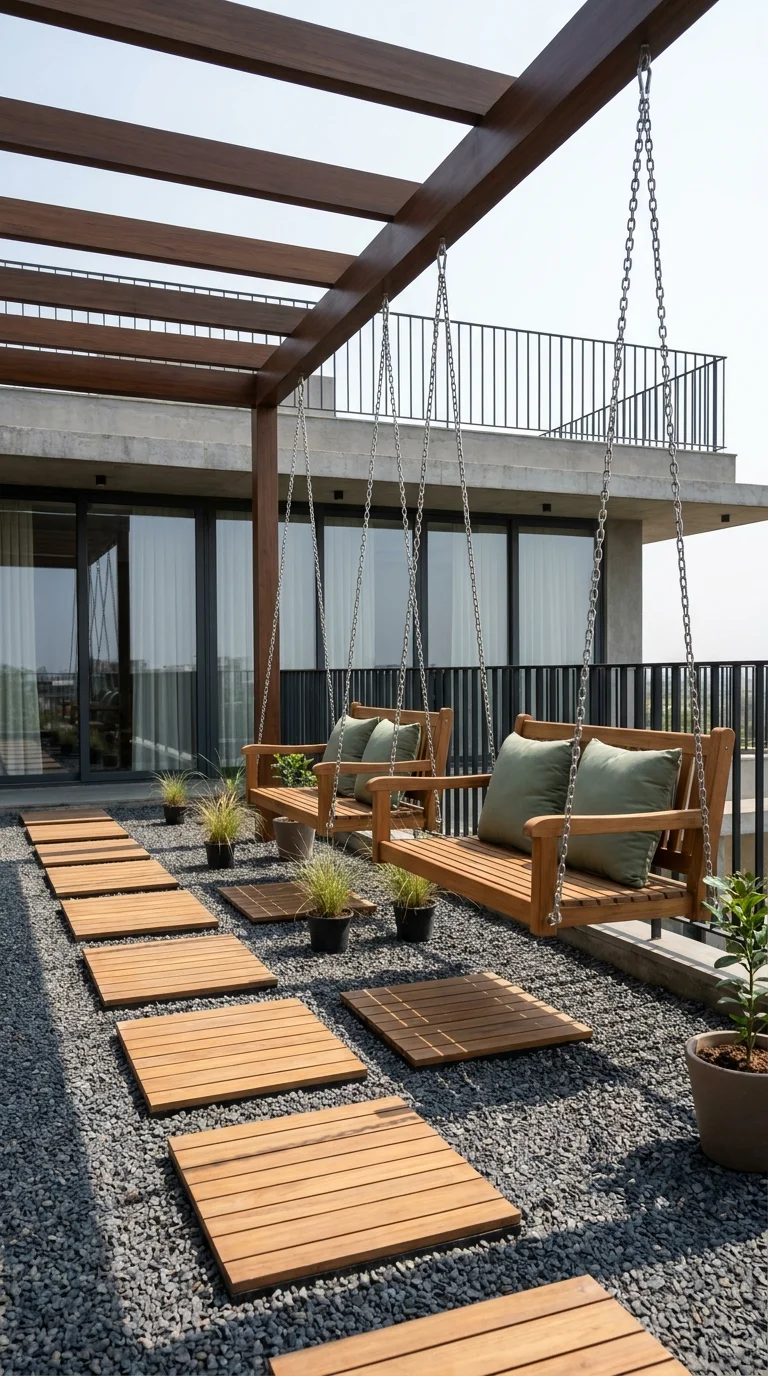
Most rooftop and roof-deck balconies share the same structural limit: you can’t dig a garden bed into concrete. This layout works around that by laying loose gravel over the whole surface and setting individual wood-slat tiles into it as a floating path, so the ground plane itself becomes the design instead of something to cover up with a rug. Potted grasses tucked between the tiles soften the hard edges without adding any real weight load.
This idea is specifically for a wide, open rooftop rather than a tight apartment balcony — the walking path only earns its place when there’s enough room for the eye to follow it somewhere, in this case toward a pair of hanging pergola swings. A common misstep with this layout is spacing the tiles too evenly, which starts to look like a factory-laid checkerboard instead of a deliberate stepping path; slightly irregular spacing reads as far more intentional.
A White Wisteria Canopy Over a Built-In Candle Niche
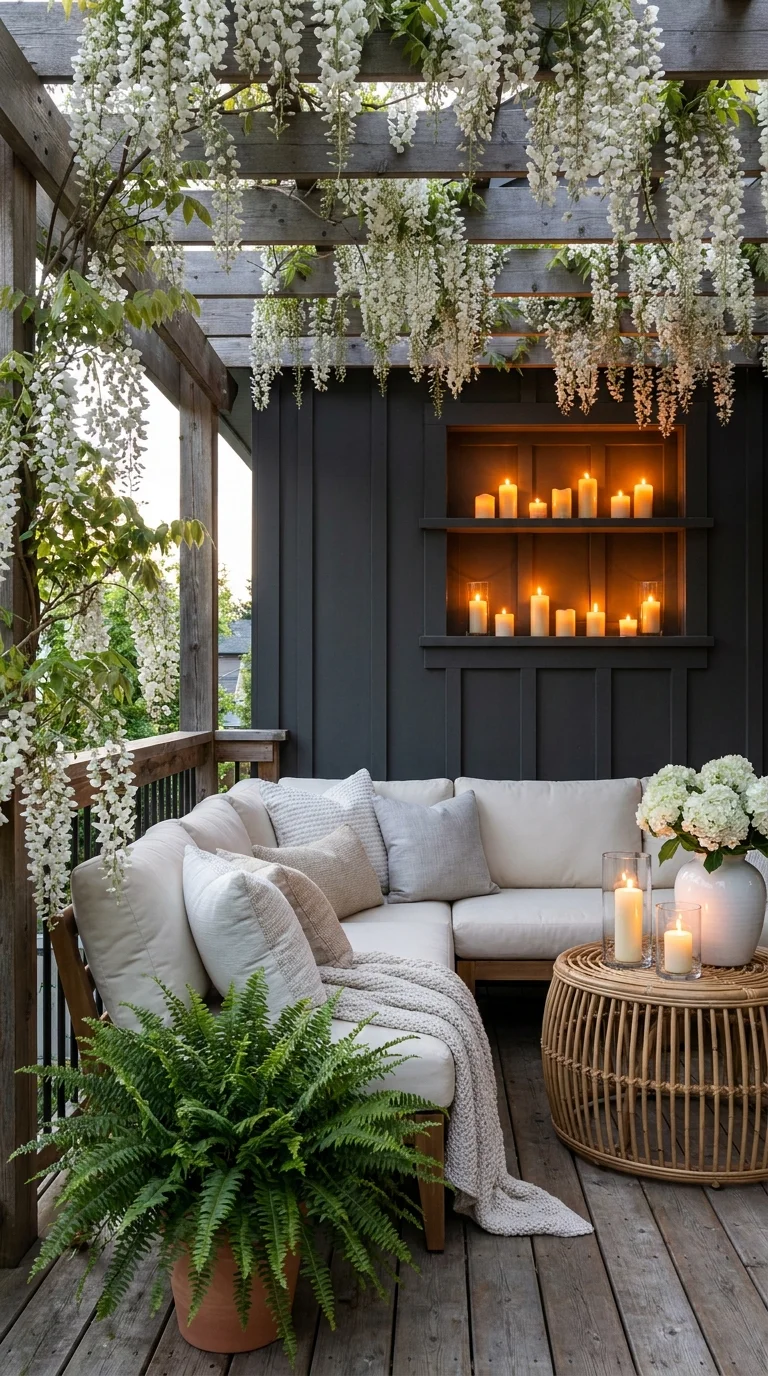
The dark charcoal wall paint is what makes this section work — against a light-colored siding, the recessed candle shelf would just look like a shadow box, but against near-black paneling, twelve small flames read as a genuine architectural feature. Draping white wisteria over the pergola above adds a second focal point without stealing attention from the built-in niche, since the flowers hang loosely rather than filling the frame solidly.
A trained climbing vine like wisteria is the one real commitment in this section: it needs a sturdy structure to climb, regular pruning to keep it from overtaking the pergola posts, and a few seasons before it fills in this fully. A faster substitute is a strand of artificial floral garland, which gets the visual drape immediately with none of the growing season. Either way, the candle niche itself is the part worth copying even on a much simpler balcony — it’s just cut lumber shelving mounted flush into a painted wall panel.
A Rooftop Fireplace That Extends the Balcony Season
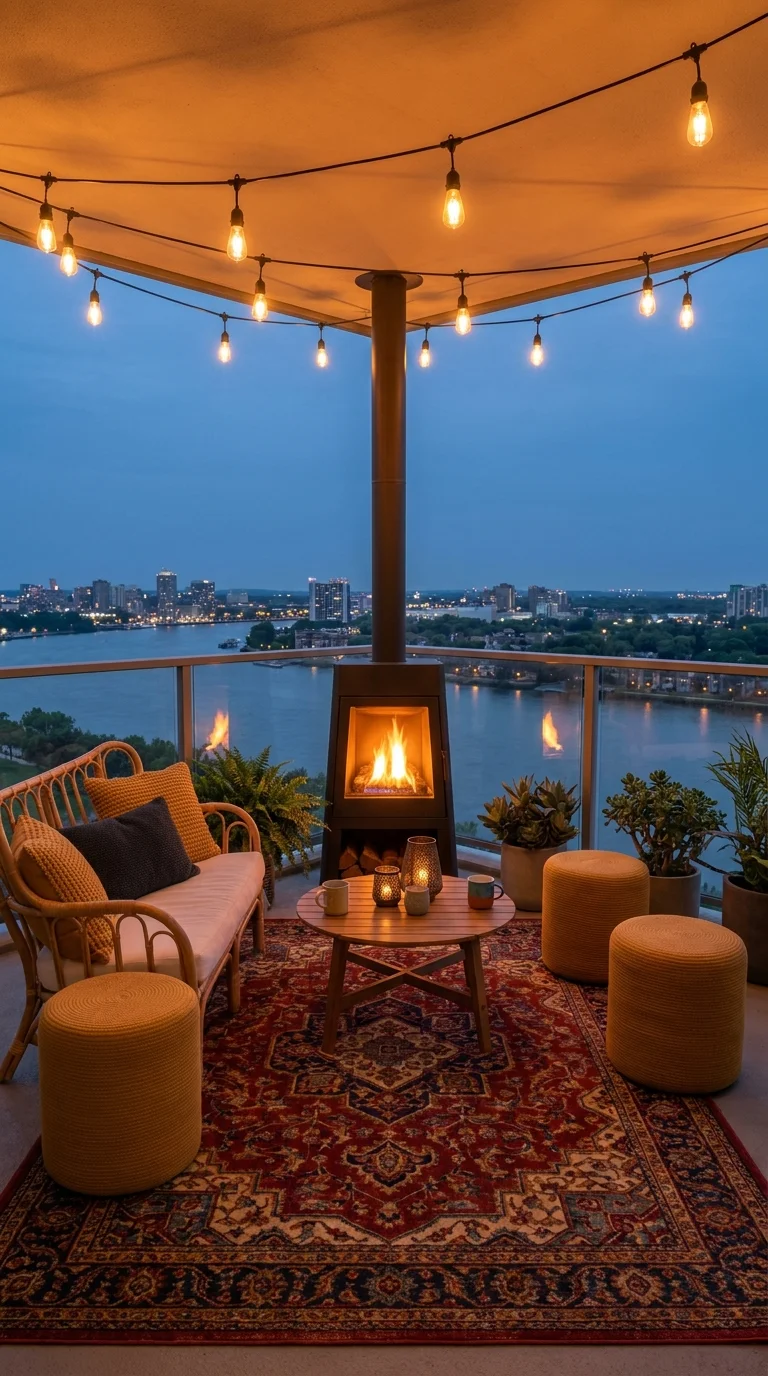
A freestanding wood-burning stove is the reason this balcony gets used past early fall, when most open-air seating areas around it get put away for the year. Positioned as the room’s actual center, with rattan seating and woven poufs arranged around it the way a living room wraps around a fireplace, the stove turns “outdoor seating” into something closer to a real, usable room. A patterned rug underneath does the rest of the work of making a concrete or composite deck feel finished.
This is a genuine investment piece, not a weekend project, and it needs real clearance from anything flammable plus a permitted flue — this isn’t a DIY installation to attempt without checking local building and fire codes first. A gas fire table is the more balcony-realistic substitute for most apartments, since it skips the venting requirement while still giving you a live flame to sit around. Anyone weighing that decision alongside seating might also want to see these fire pit chair pairings built specifically around heat-source seating.
A Plaid-and-Evergreen Palette Built for Autumn Use
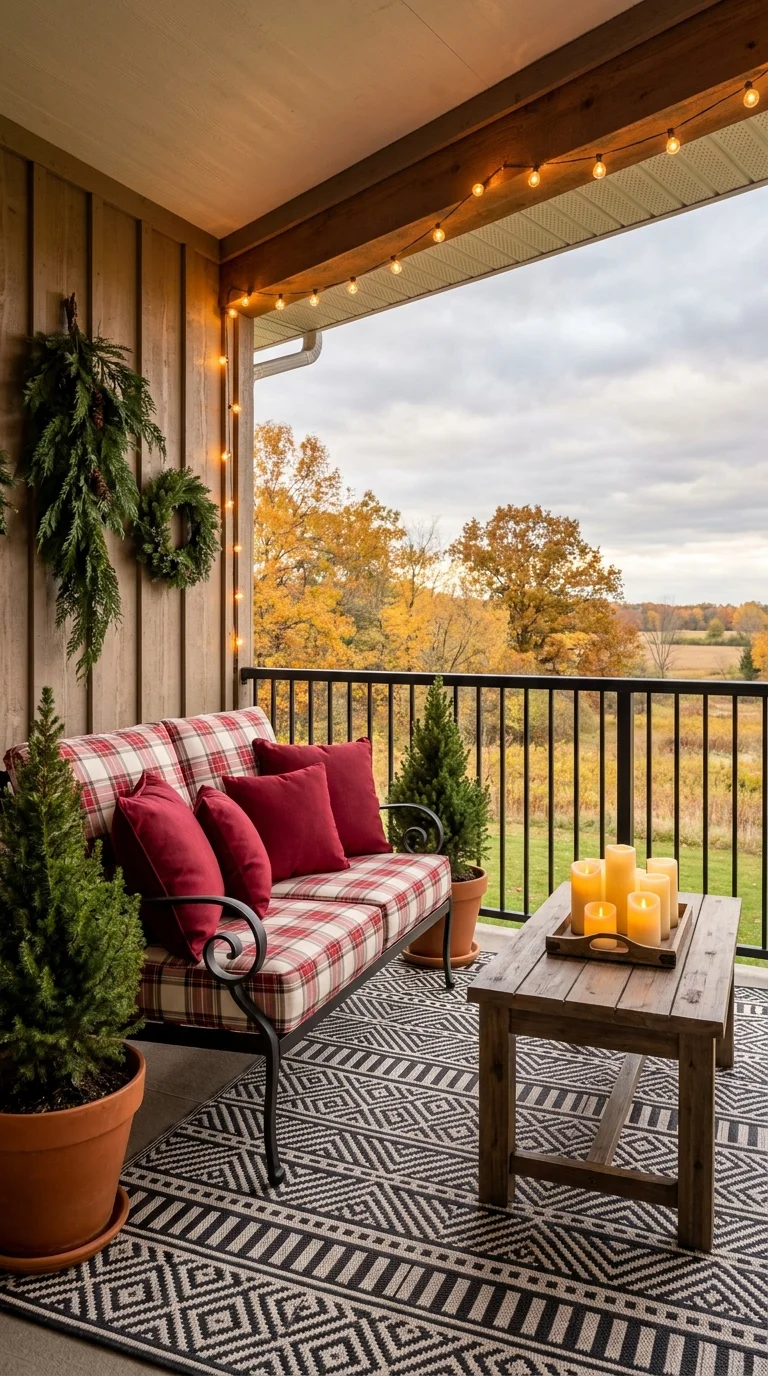
Where most of the balconies on this list lean toward a neutral, year-round palette, this one commits fully to one season. Cardinal-red pillows sit against a plaid cushion base, a fresh evergreen wreath and swag hang on the wall, and a geometric black-and-white rug grounds the whole thing so the red doesn’t read as the only color in the space. It’s a genuinely useful example of how much a balcony’s mood can shift with textiles alone, since the actual furniture — an iron-framed loveseat, a simple wood coffee table — is fairly plain underneath the styling.
The advantage here is cost: swapping a set of cushion covers and adding a seasonal garland is far cheaper than reworking furniture, and it can be undone in a weekend once the season changes. The trade-off is exactly that impermanence — this look is meant to be temporary, so it’s not the right choice if you want one balcony setup that carries the whole year without a refresh.
A Mediterranean Terrace Built on Stone, Linen, and Wicker
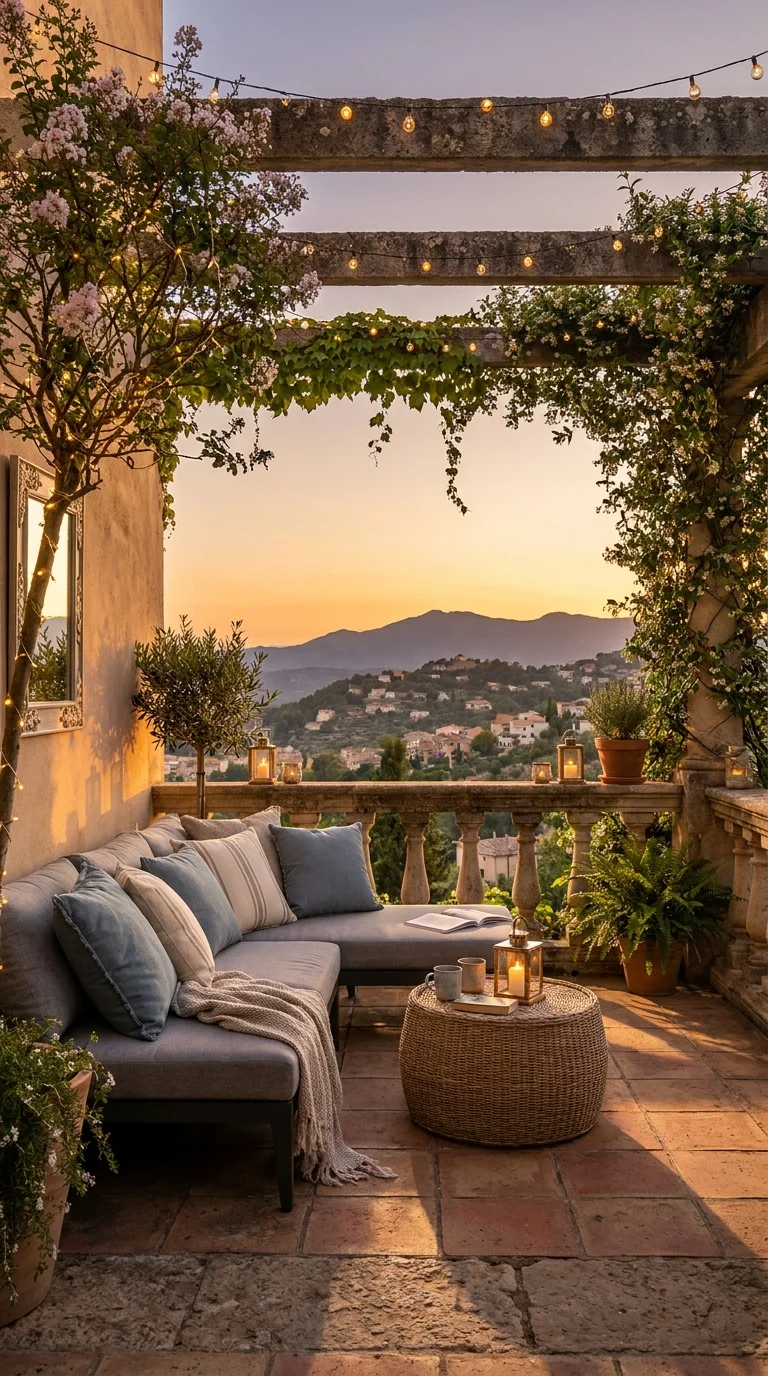
Three materials carry this entire terrace: warm terracotta floor tile, a classical stone balustrade, and a soft blue-grey linen sectional. Nothing here is glossy or hard-edged — even the wicker coffee table has a woven, matte texture — and that consistency is what makes an otherwise ornate stone balcony feel relaxed rather than formal. Trailing jasmine and a potted olive tree along the railing repeat the same soft, unstructured quality as the linen cushions.
This palette suits an older or more architecturally detailed balcony — one with real stone, tile, or ironwork already in place — since the materials are meant to feel inherited rather than newly installed. On a plain modern railing with no existing texture, the same linen-and-wicker combination still works, but it reads as more generically coastal than genuinely Mediterranean without that stonework underneath it. Readers drawn to this softer, sun-faded mood might also like these coastal garden ideas for extending the same palette into planting.
A Circular Bistro Layout Made for Conversation, Not Views
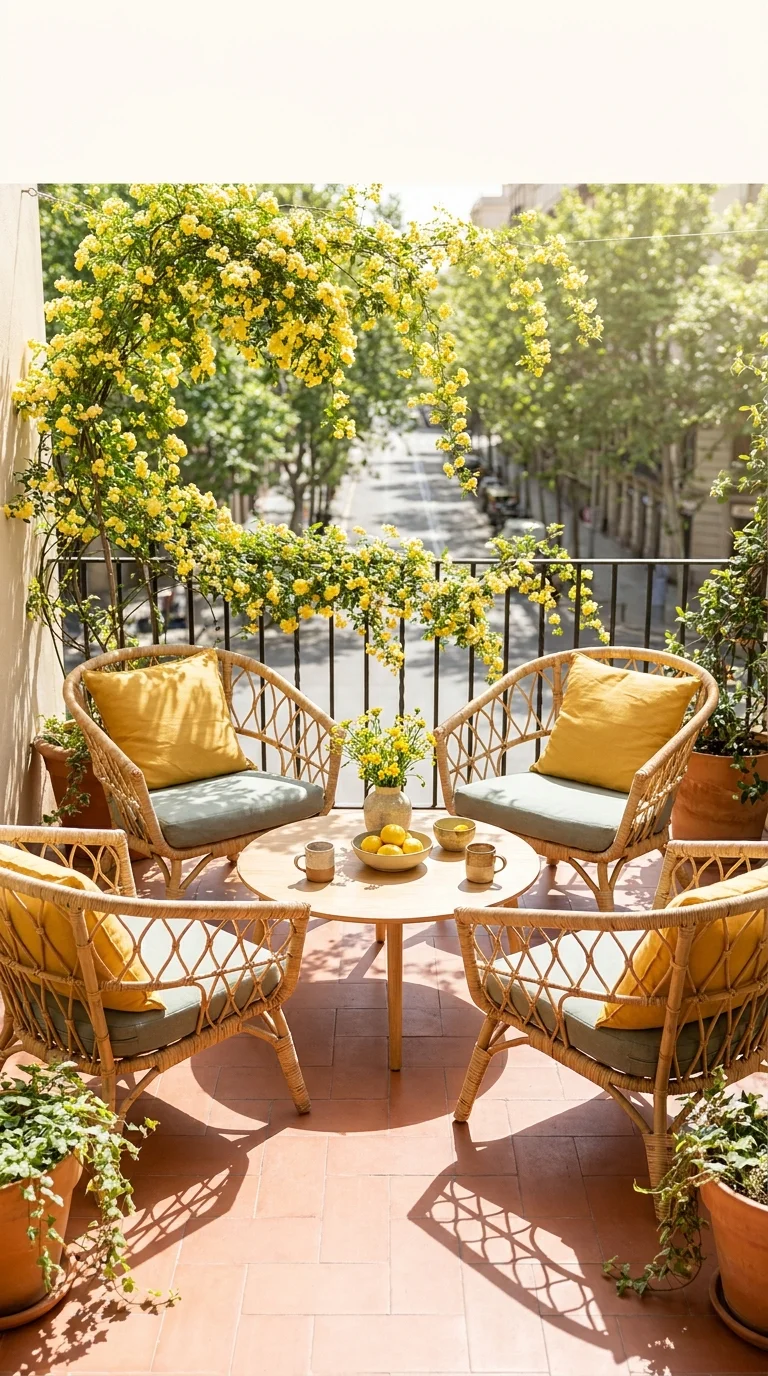
Every other setup on this list is arranged to face outward, toward a skyline or a garden. This one faces inward: four rattan chairs are set in a tight circle around a small round table, which puts conversation ahead of the view — a deliberate choice for a street-facing balcony with a fairly unremarkable outlook below. Mustard-yellow cushions pull directly from the climbing roses trained overhead, so the seating and the planting share one color story instead of two separate ones.
A four-chair circle is one of the more space-efficient shapes for a balcony, since it seats more people per square foot than a sofa-and-armchair arrangement would in the same footprint. It only works, though, if the balcony is roughly square — the same four chairs pushed into a narrow rectangular space end up blocking the walkway on both sides. On a tighter footprint, dropping to a two-chair version of the same circular idea keeps the conversational feel without the traffic problem.
Weatherproofing Tips for Balcony and Patio Furniture
- Choose cushion covers rated for outdoor use, and bring them inside (or under cover) during extended rain rather than relying on the fabric alone to shed water
- Stick to powder-coated metal, teak, or synthetic wicker for anything left outside year-round — untreated wood and standard rattan break down faster in direct weather
- Check overhead structures like pergolas and swing anchors before storm season, since hardware loosens gradually and won’t always show visible wear until it fails
- Keep climbing plants and vines trimmed back from any fabric or upholstery they’re growing near, since trapped moisture under foliage is a common cause of mildew on outdoor cushions
Who Should Choose a Small-Balcony Design Like These
- Best for renters and apartment dwellers who need furniture and styling that doesn’t require permanent structural changes
- Best for anyone trying to make a single balcony work for both daytime relaxing and evening entertaining
- Not ideal for households wanting one fixed look that never needs a seasonal or maintenance refresh — several of these ideas (living walls, climbing vines, string lighting) ask for ongoing upkeep
Budget Summary
| Budget | Expectation |
|---|---|
| Low | Cushion covers, potted plants, string lights, a secondhand bistro set |
| Medium | A hanging bench or swing, a small living-wall kit, an outdoor rug |
| Premium | A wood-burning stove or gas fire table, custom pergola work, stone or tile flooring |
Frequently Asked Questions
How small can a balcony be and still fit real seating? A two-chair bistro set or a single hanging chair generally works down to around 25–30 square feet, as long as there’s still a clear walking path. Below that, wall-mounted fold-down seating is usually a better fit than freestanding furniture.
Do hanging benches and swings actually work on an apartment balcony? Only if there’s a structurally sound beam or a dedicated free-standing frame rated for the weight — a hanging bench should never be anchored into a ceiling or railing that wasn’t built for that load. Check with a building manager before installing one permanently.
What’s the easiest way to add privacy without a full living wall? A single row of tall potted grasses or a trellis with a fast climbing vine gets partial screening within one growing season, at a fraction of the setup involved in a full vertical garden.
Is a wood-burning stove realistic for most balconies? Not usually — most apartment balconies and shared rooftops don’t allow solid-fuel appliances due to fire code and venting requirements. A gas fire table or electric heater is the more realistic substitute for the same effect.
How do I choose a color palette that won’t feel dated in a year or two? Lean on natural materials — wood tone, stone, woven fiber — as the base, and treat color (cushions, a rug, seasonal accents) as the part that’s easy to swap. That’s the same logic behind the plaid-and-evergreen balcony above: the furniture underneath stays neutral.
Conclusion
The balconies that work best here don’t try to do everything at once — each one leans into a single strong idea, whether that’s a living wall, a lighting layer, or a single bold seasonal palette, and lets everything else in the space support it. Pick the one idea from this list that solves your actual problem, whether that’s privacy, an awkward view, or too little floor space, rather than trying to combine all ten.
Explore More
You may also enjoy:
- 10 Dreamy Boho Patios to Inspire Your Next Backyard Refresh
- Inside 10 Apartment Deck Designs: A Closer Look at What Works
- 10 Balcony Fragrant Plant Ideas That Fill Your Outdoor Space With Beautiful Scents
Written by the Aesthetic Life Team, who cover small-space outdoor design, seasonal styling, and practical furniture guidance for balconies, patios, and rooftop spaces.

