
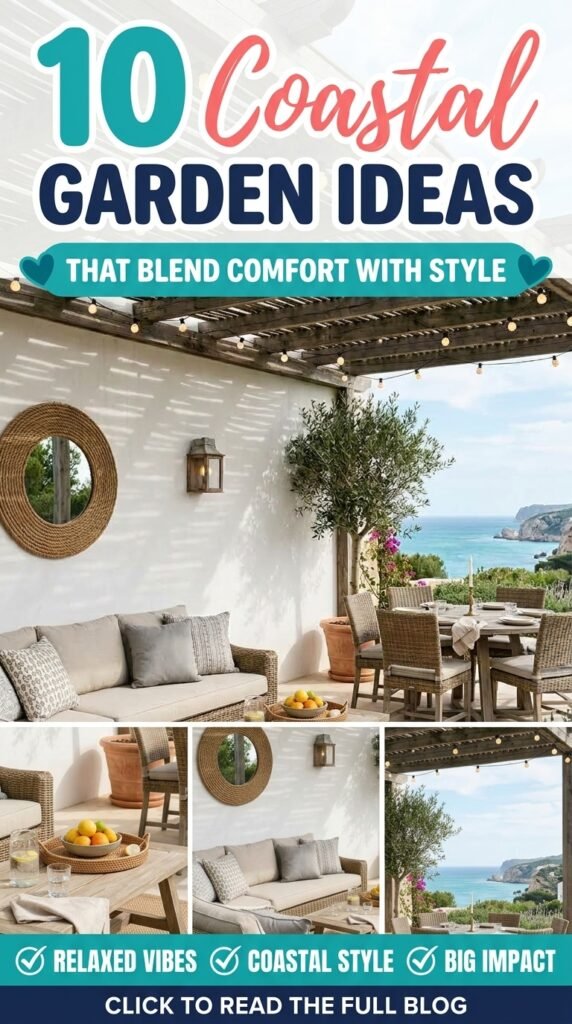
If your outdoor space already gets plenty of sun and salt air, coastal design might be the most natural direction to take it. But “coastal” covers far more ground than driftwood and blue stripes — it can mean a glass-roofed room dense with plants, a whitewashed Mediterranean archway, a drought-tolerant courtyard with no lawn at all, or a cedar porch built entirely around sunset light. The ten spaces below each solve the coastal-outdoor equation differently, so you can work out which version actually fits your climate, your appetite for upkeep, and the house you already have.
Quick Overview
| Style | Coastal & Mediterranean Outdoor |
| Best For | Patios, balconies, garden rooms |
| Budget | Low–Medium |
| Difficulty | Easy–Moderate, DIY-friendly |
| Maintenance Level | Medium |
The Glass-Roofed Plant Room That Blurs Indoors and Out
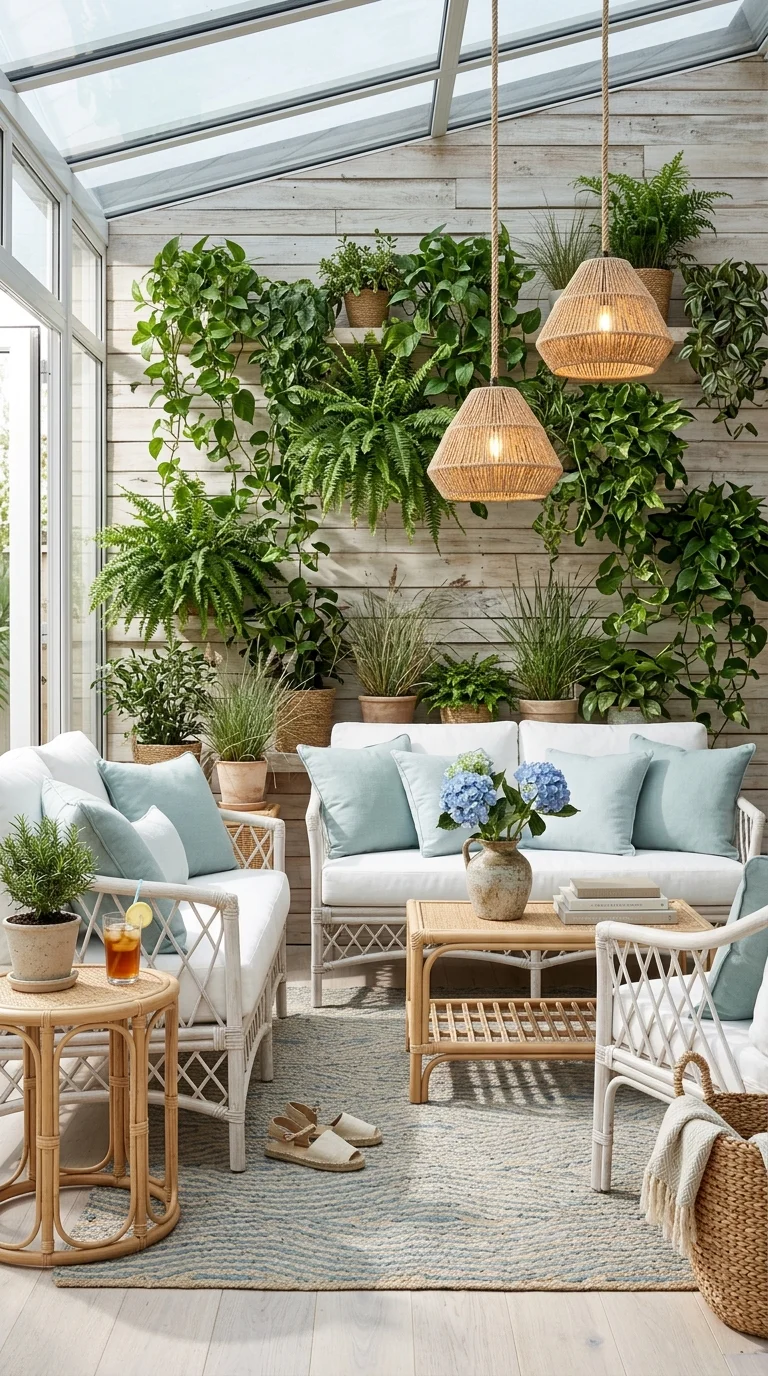
This space takes an underused sunroom or conservatory and treats the entire back wall as a living tapestry — ferns, pothos, and philodendron cascading from staggered shelves — so the greenery does the job an accent wall or piece of art would do in a more conventional room. Instead of a few potted plants lined along a windowsill, the density and layering make the wall itself the room’s main event.
What sets it apart is scale: this isn’t a couple of houseplants; it’s a floor-to-ceiling planting scheme that reads as architecture rather than decoration. It suits plant collectors, anyone converting a rarely used sunroom, or households who want a room that feels alive through the winter months when the rest of the garden goes dormant. The glass roof does double duty as skylight and greenhouse, giving plants the light level they’d struggle to get behind ordinary windows — a genuine advantage over a plant collection kept indoors.
The trade-off is real upkeep: this density of planting means humidity and watering become an actual routine, not a set-and-forget arrangement. To recreate it, start with reclaimed whitewashed shiplap, tiered wall-mounted shelving at uneven heights, rattan seating in dusty blue and sage textiles, and one or two woven pendant lights on rope. On a smaller budget, stock shelving instead of custom millwork and a handful of resilient trailing plants (pothos, philodendron) do most of the visual work before anything fussier, like ferns, gets added — ferns need more humidity than most rooms hold naturally, so they’re worth adding last, once the basics are thriving.
Why the Plant Wall Reads as One Idea, Not Ten
The pothos, ferns, and trailing vines all repeat the same cascading habit down the wall, and that repeated shape — rather than variety — is what keeps a dozen mismatched planters from feeling cluttered. One reason it works is that pot size and species change from shelf to shelf, but the downward-draping silhouette never does; swapping that rhythm for a row of upright plants would likely read as scattered rather than intentional.
Recommended Materials
- Reclaimed, whitewashed shiplap paneling
- Rattan and wicker furniture frames
- Jute area rug
- Woven rope pendant shades
- Glass roof paneling
Main Colors
- Weathered White
- Sage Green (foliage)
- Dusty Blue
- Natural Rattan Tan
Best Lighting
Diffuse daylight through the glass roof is the main light source here, and it’s the reason this planting density can thrive indoors at all. Warm woven pendants take over once the sun drops, keeping the room usable into the evening without competing with the plants for attention.
Keeping the Living Wall Healthy
Rotate pots occasionally for even growth toward the light, wipe down the glass roof panels seasonally since a dusty roof measurably cuts light levels, and expect the upper shelves to need more frequent watering than the lower ones, since heat collects near the glass.
Where a Plant Wall Like This Usually Goes Wrong
- Hanging every plant at the same height, which flattens the layered look the design depends on
- Choosing high-humidity plants like ferns as the majority instead of a small accent
- Skipping drainage trays, which leads to water stains on wood shelving
- Under-lighting the lowest shelves, so plants near the floor gradually thin out
The Minimalist Deck That Lets an Ocean View Do the Decorating
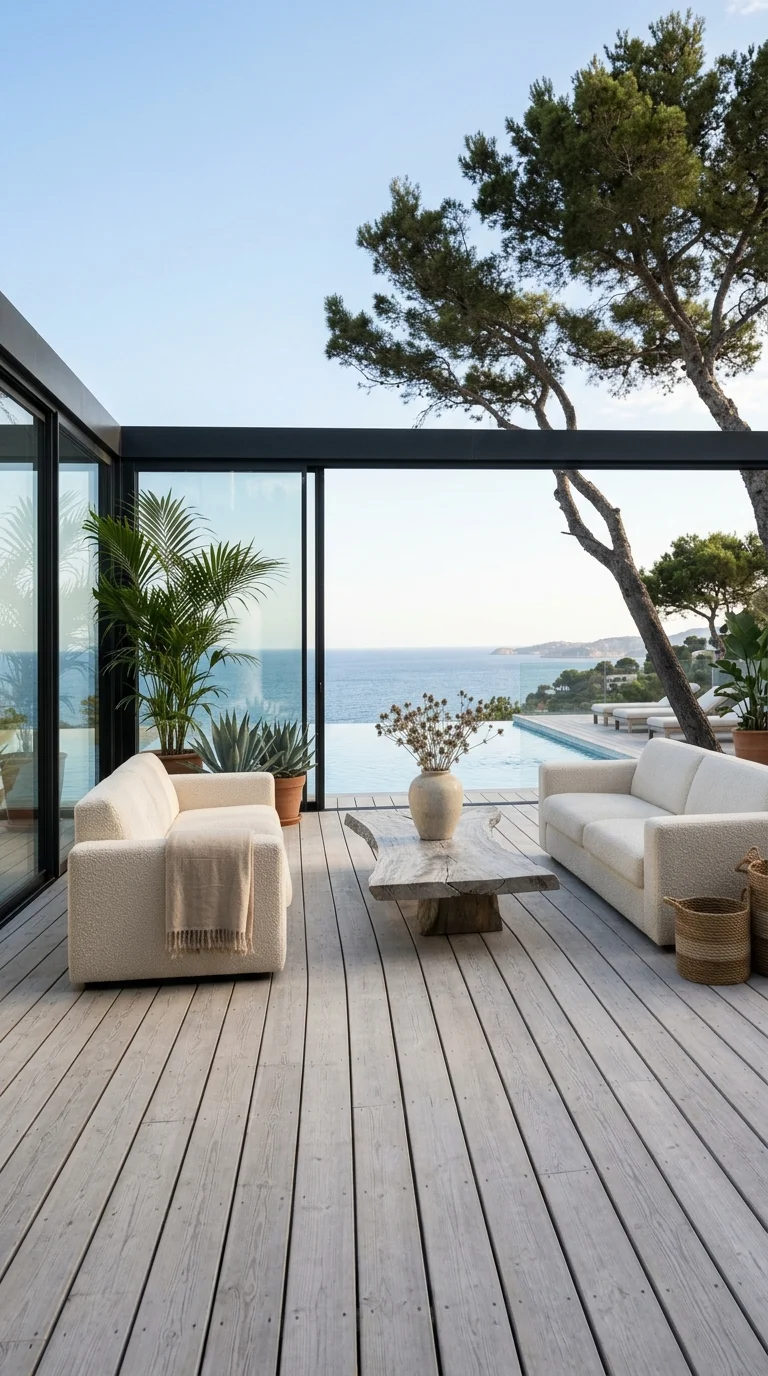
Two boucle sofas and one substantial live-edge coffee table — nothing else competes for attention here. Most coastal patios build interest through pattern and texture; this one earns its calm by removing almost everything and letting the horizon supply the visual interest instead.
It suits homeowners with an actual view worth protecting, committed minimalists, and anyone tired of overfurnished patios that never quite get used. Low visual noise means the space photographs and lives well in almost any light, and it’s genuinely easier to keep clean with so little surface area to maintain. The honest trade-off is that this design borrows a lot of its impact from the landscape — the same sparse layout without a view like this can read as unfinished rather than intentional.
To recreate it: black-framed floor-to-ceiling glass doors, two low-profile boucle sofas, one substantial reclaimed-wood or live-edge coffee table, and a woven basket or two for texture. On a tighter budget, a linen-blend slipcover sofa reads similarly to boucle at a fraction of the cost, and a simple slab table stands in for the live-edge piece, which carries a real price premium. The main discipline required is resisting the urge to add a third seating piece just to fill space — the gaps between furniture are doing real work here.
A Coffee Table Heavy Enough to Anchor an Almost-Empty Room
The reclaimed-wood coffee table looks noticeably heavier than the two sofas around it, and that weight ratio is deliberate — in a room this stripped back, a lighter table would read as an afterthought rather than a centerpiece. It’s a small risk, since over-scaling furniture in a tight space usually backfires, but the wide deck and low ceiling height here give it room to work.
Recommended Materials
- Powder-coated black steel window/door framing
- Boucle upholstery
- Reclaimed live-edge wood
- Woven rattan storage baskets
- Weathered pine decking
Main Colors
- Warm White (boucle)
- Driftwood Grey
- Charcoal (steel framing)
- Natural Timber
Where the Light Actually Comes From
Unfiltered western light through the full glass wall is the main event in late afternoon — skip heavy window treatments and let it in. Add only low, warm accent lighting after dark, since anything brighter competes with the ocean view at dusk.
Easy Ways to Overcrowd a View Like This
- Adding a third sofa or sectional that blocks the sightline to the water
- Choosing patterned or brightly colored cushions that compete with the ocean instead of framing it
- Using an indoor-grade boucle fabric outdoors, which mildews quickly in humid air
- Placing the coffee table off-center from the seating, breaking the room’s calm symmetry
The Whitewashed Archway Loggia With a Hanging Chair as the Focal Point
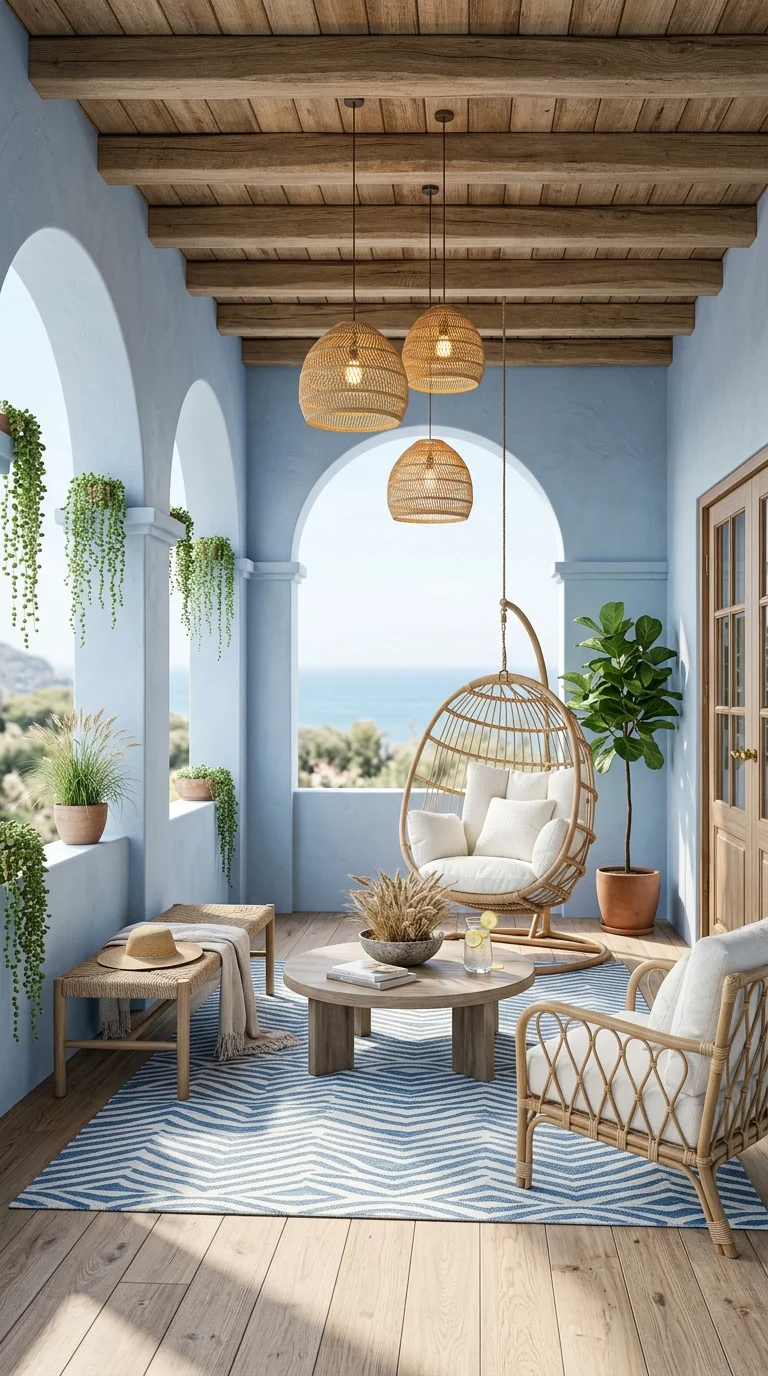
A covered loggia with a run of white arches frames the sea view like a series of picture windows, and a single rattan hanging chair sits in the leftmost open arch — becoming the visual anchor without needing to be flashy. The pale blue walls and dark wood beam ceiling do the quiet work of setting a Mediterranean, holiday-house mood around it.
This look suits homes that already have arched or covered-porch architecture; a flat-roofed patio can’t fully borrow this personality without adding arch detailing first. It rewards a slower lifestyle — mid-day naps, reading out of direct sun — and the covered ceiling means the seating stays usable even at midday, which fully open patios can’t offer. The one real caution is structural: hanging chairs need a genuinely secure ceiling mount, and this isn’t a piece to improvise on a flimsy pergola frame.
To recreate it: pale blue limewash or stucco paint, a dark stained wood beam ceiling, one rattan hanging chair on a rated mount, a round wood coffee table, and a chevron-patterned indoor-outdoor rug. On a smaller budget, paint an existing wall the same blue instead of re-stuccoing, and use a wicker basket chair on a stand rather than a hanging mount if the ceiling can’t support one. Keep everything else in the room low — a bench, a simple armchair — so the hanging chair stays the one thing the eye lands on.
What Pulls Your Eye First in This Loggia
The eye goes to the hanging chair before anything else, largely because it’s the only object breaking the horizontal lines set up by the arches and the bench below them — everything else in the room sits low and still. Removing the chair would likely leave the space feeling like a pass-through corridor rather than somewhere to stay.
Recommended Materials
- Lime-washed stucco
- Dark stained wood ceiling beams
- Rattan (hanging chair and accessories)
- Woven jute bench
- Encaustic-look outdoor tile flooring
Main Colors
- Powder Blue
- Whitewash
- Espresso Brown (beams)
- Natural Rattan
Best Lighting
The covered ceiling filters direct sun into soft, even shade through the day — a genuine benefit in climates with intense midday glare — while three woven pendant fixtures take over once the sun sets.
Maintenance Notes
Limewash or stucco may need occasional resealing where salt air is a factor, and rattan pieces should stay out of direct rain exposure to avoid warping over time.
What Trips People Up Copying This Loggia Look
- Mounting a hanging chair to a ceiling joist not rated for dynamic swinging weight
- Painting the arches a brighter blue than the walls, breaking the intended monochrome calm
- Overfilling the space with extra seating, crowding the walking path between arches
- Using an indoor-only rug that grows mildew in humid, covered outdoor air
The String-Lit Pergola That Turns a Patio Into a Dinner Destination
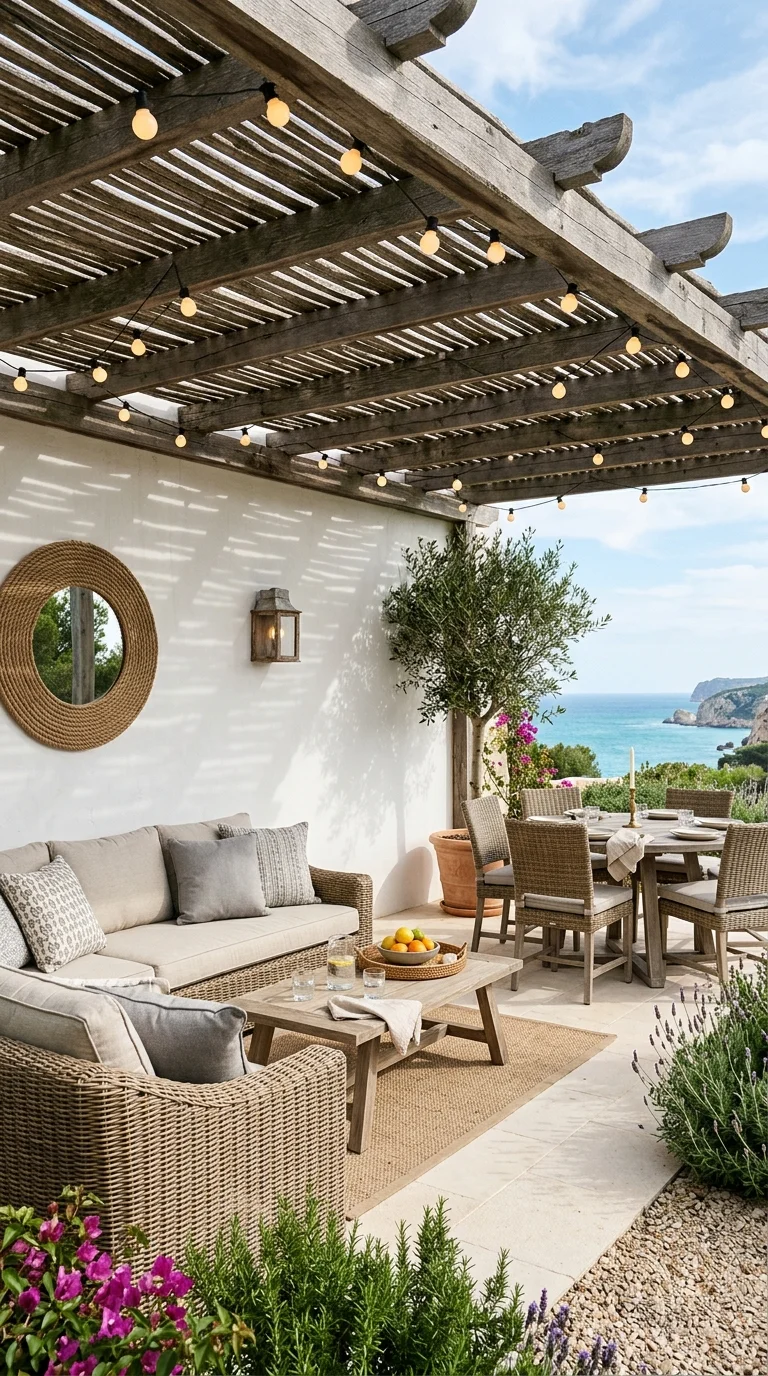
An aged wood pergola strung with warm bulb lighting hung low enough to actually illuminate the dinner table underneath — not just glow decoratively from a distance. Where many coastal patios treat string lights as ambiance, this one uses them as genuine task lighting for eating outdoors after sunset.
It suits households that entertain regularly, multi-generational dinners, and anyone whose patio currently goes dark and unused once the sun sets. A round rope-framed mirror on the wall bounces both daylight and the string-light glow back into the seating area, making the space feel larger after dark than its actual footprint. The sun-bleached patina on the pergola wood is a deliberate, earned look — new lumber won’t read the same way for several seasons, so patience (or pre-weathering) is part of the deal.
To recreate it: a cedar or reclaimed-wood pergola, warm white bulb string lights strung in a zigzag, a round rope-framed mirror, a stone-topped dining table, and mixed wicker dining chairs. To simplify, solar-powered string lights install more easily than wired ones, a smaller round table seats four instead of six, and a flea-market mirror does the same reflective job as a designer rope-framed piece. The lights should hang low — around 7 to 8 feet — so they actually cast usable light on the table rather than just silhouetting the pergola beams.
Is Wiring Real String Lighting Worth It Over Solar?
Hardwired string lighting is the one upgrade in this whole roundup worth calling out on its own. Solar lights install without an electrician, but they dim fast and rarely survive a full season of coastal humidity at useful brightness. A properly wired, weatherproof run costs more upfront and usually needs an outdoor outlet installed, but it holds real brightness for genuine dinner-table use for years, which solar rarely manages. The one exception is renters or short-term setups, where solar’s zero-commitment install is the more honest trade-off.
How This Pergola Wood Will Keep Changing
The beams have already weathered to a soft driftwood grey, and untreated cedar or reclaimed wood left exposed to salt air keeps lightening and roughening in texture year over year rather than settling into a fixed look. That ongoing change is part of the appeal, but it also means that matching new lumber to old beams later means accepting a visible seam for a season or two, or pre-weathering new wood before installing it.
Recommended Materials
- Cedar or reclaimed pergola wood
- Stone-top dining table
- Mixed wicker dining chairs
- Rope-framed wall mirror
- Terracotta planters
Main Colors
- Driftwood Grey
- Warm White (string light glow)
- Olive Green
- Terracotta
Best Lighting
Warm white bulb string lights zigzagged under the pergola are the primary evening light source, with a wall lantern near the door supplementing the entrance.
Maintaining an Outdoor Pergola
Reseal or oil untreated wood every couple of seasons if you want to slow, not stop, the greying process, and wipe down string light fixtures before storing them over a freezing winter.
Common Setup Mistakes With a Pergola Dining Area
- Stringing lights too high to actually illuminate the table surface
- Mixing too many wicker chair styles without a shared color thread to tie them together
- Skipping a table umbrella or shade option, leaving the space unusable during peak sun
- Placing the mirror where it reflects direct afternoon glare into diners’ eyes
The Xeriscaped Courtyard That Skips the Lawn Entirely
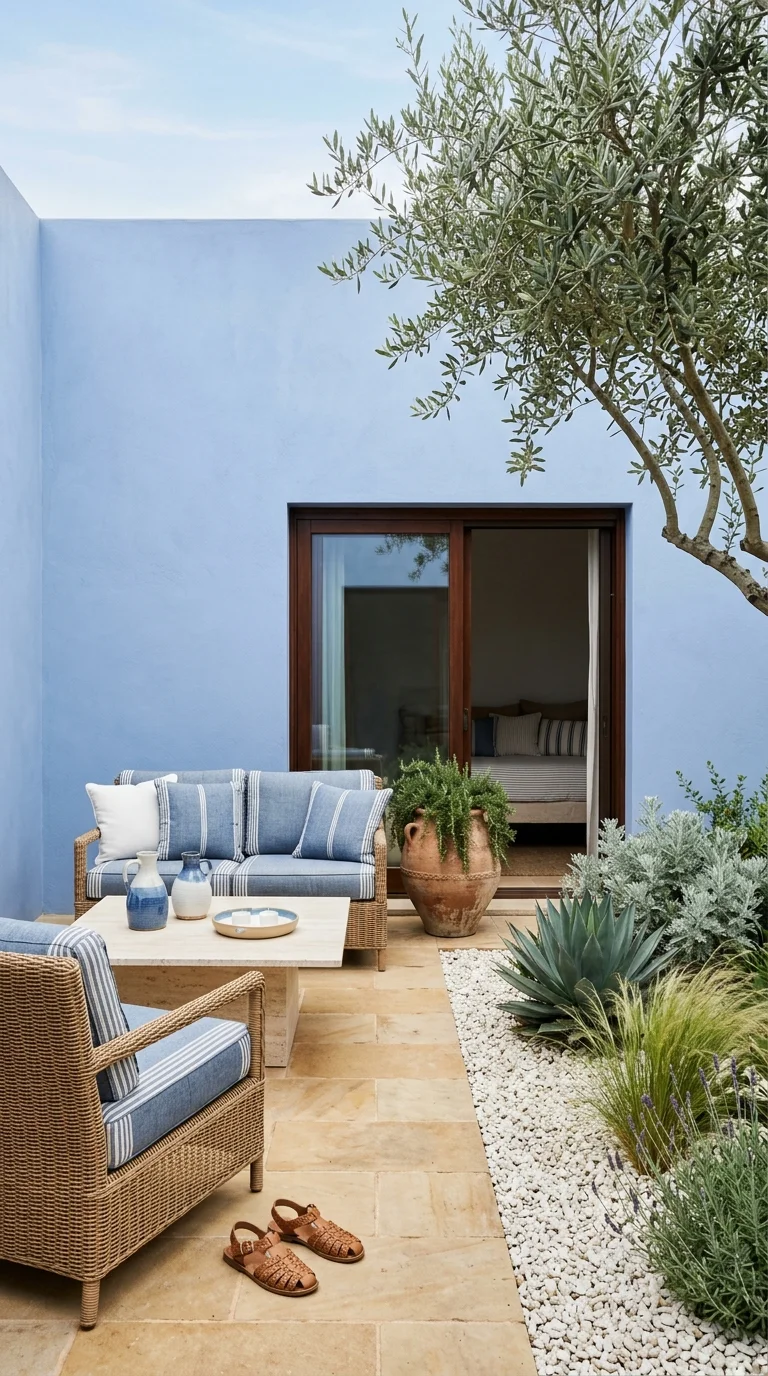
Rather than lush, greenery-heavy planting, this courtyard leans fully into drought-tolerant landscaping — agave, lavender, and ornamental grass set in white pea gravel against a saturated cobalt-blue wall. It proves “coastal” doesn’t require abundant planting at all; here, color and texture contrast carries the entire mood.
It suits homeowners in dry or water-restricted climates, anyone who wants a low-maintenance garden, and small courtyards without room for a lawn. Xeriscaping genuinely cuts both water use and upkeep time compared with a planted bed or lawn. The honest compromise is that it reads starker in winter than a green garden would, since agave and grasses don’t offer the seasonal bloom color a planted bed provides.
To recreate it: deep cobalt or indigo stucco paint, white pea gravel groundcover, clustered agave and lavender, a stone-topped coffee table, and striped indoor-outdoor cushions. On a renter’s budget, potted agave stands in for in-ground planting, and painting one accent panel achieves the color impact without a full stucco job. The one real planning tip is grouping plants by water need rather than just appearance — agave and lavender both tolerate dry soil, so pairing them avoids conflicting watering schedules.
Why the Blue Wall Needed to Be This Saturated
A paler or more muted blue on a wall this size would likely wash out next to the pale gravel and silvery agave. The deep cobalt gives the wall enough visual weight to balance the airy, low-profile garden bed in front of it — a proportion call about color intensity rather than square footage. A lighter tint here would probably let the striped cushions and stone table read as the more dominant color instead.
Recommended Materials
- Cobalt stucco
- White pea gravel
- Travertine-look stone coffee table
- Agave, lavender, and ornamental grass
- Woven rattan seating frame
Main Colors
- Cobalt Blue
- Warm White
- Sage/Silver-Green (agave)
- Natural Stone Tan
Best Lighting
Full sun exposure through most of the day is exactly what agave and lavender need, and no supplemental lighting is required for this planting scheme to thrive.
Living With a Low-Water Garden
Agave and lavender are genuinely low-fuss once established, but the gravel groundcover itself needs occasional raking and weeding to keep its crisp, intentional look.
Where This Drought-Tolerant Courtyard Look Falls Apart
- Planting moisture-loving greenery alongside agave, which overwaters one plant or underwaters the other
- Choosing gravel that’s too fine, which tracks into the house on shoes
- Skipping a defined bed edge, letting gravel and soil migrate together over time
- Painting the wall a pastel instead of a saturated blue, losing the color contrast that makes it read as intentional
The Rope-Hung Porch Swings That Make an Ocean View Feel Weightless
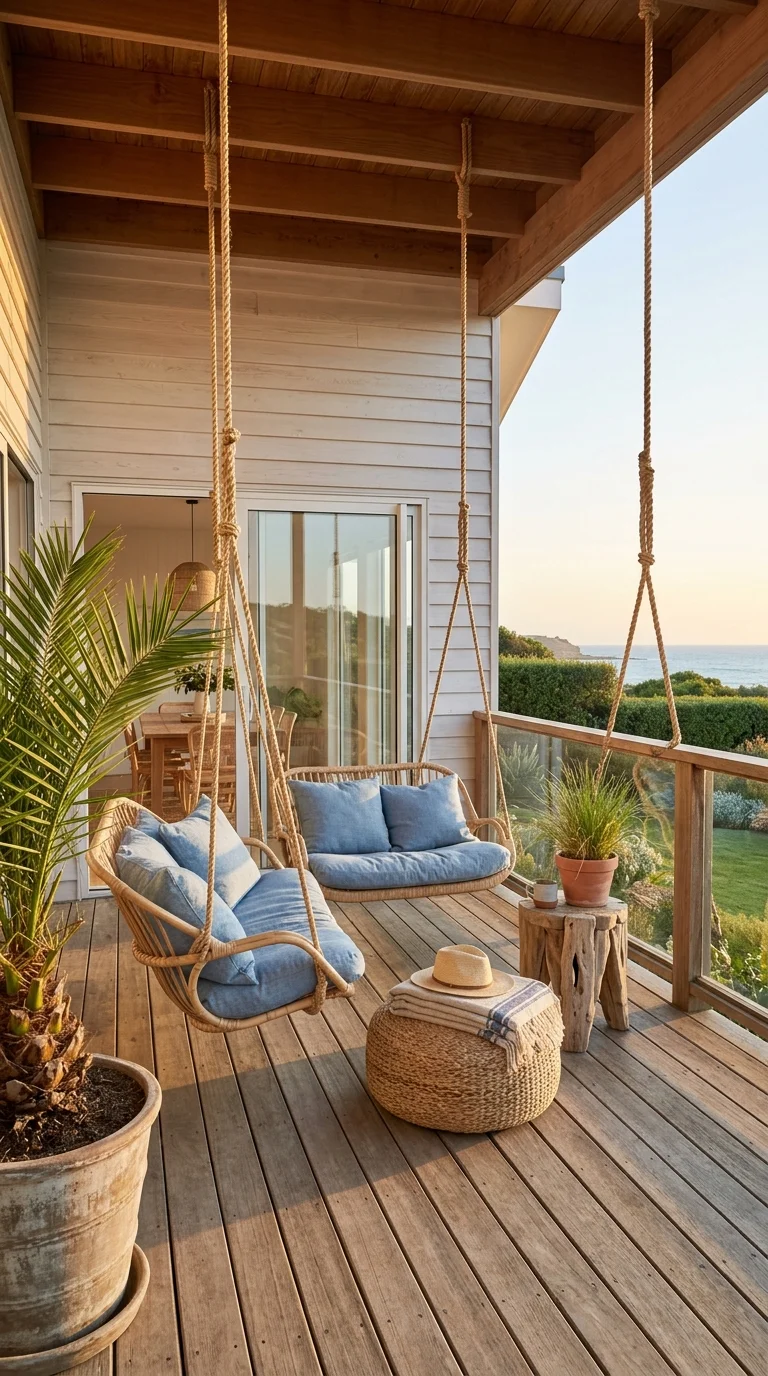
Two full rope-suspended swing loveseats replace standard porch furniture entirely, so the seating itself moves gently with the breeze off the water. Where the loggia earlier in this list uses one hanging egg chair as an accent, this porch builds its entire seating plan around suspended furniture.
It suits beach house owners, anyone who wants a porch that feels playful rather than formal, and households with the structural beams to anchor rope mounts securely. The gentle sway genuinely changes how the porch feels to sit in compared with a stationary sofa — it’s a sensory shift, not just a styling one. The real caution is structural: rope swings need serious ceiling support, and this isn’t a retrofit for a lightweight or newer stick-built porch roof without reinforcement first.
To recreate it: exposed structural beams rated for swing weight, thick nautical rope, chambray or solid blue-and-white cushions, and a small driftwood or live-edge side table. To simplify, install a single swing instead of two, and use chain-and-eyebolt hardware instead of full rope rigging for an easier — and often safer — install. Leave enough clearance behind each swing for its natural back-and-forth arc, since crowding them against a wall defeats the point.
Why the Swings Face the Water, Not Each Other
Both hanging loveseats angle toward the ocean rather than facing one another across a coffee table, keeping the view as the primary focus instead of turning the space into a conversation pit. In a design built around a water view, that orientation choice does more for how the room feels than the furniture material itself.
Recommended Materials
- Nautical rope
- Cedar or teak swing frames
- Chambray or canvas cushion covers
- Driftwood side table
- Weathered cedar decking
Main Colors
- Sky Blue
- Soft White
- Natural Cedar
- Sun-Bleached Grey
Best Lighting
Golden-hour western light is the main event here; keep artificial lighting minimal — a single lantern or sconce — so it doesn’t compete with sunset views.
Keeping Cedar and Rope in Good Shape
Untreated cedar decking benefits from an annual wash and occasional oil, and rope hardware should be checked yearly for salt-air corrosion on any metal fittings.
Easy Mistakes With a Rope Swing Porch Setup
- Underestimating the ceiling load rating needed to hold two adults safely
- Choosing indoor-weight cushion fabric that soaks and doesn’t dry between uses
- Positioning swings too close together so their arcs collide
- Skipping a side table within reach, leaving nowhere for a drink or book while swinging
The Overgrown Cottage Garden Pergola With a Coastal View Peeking Through
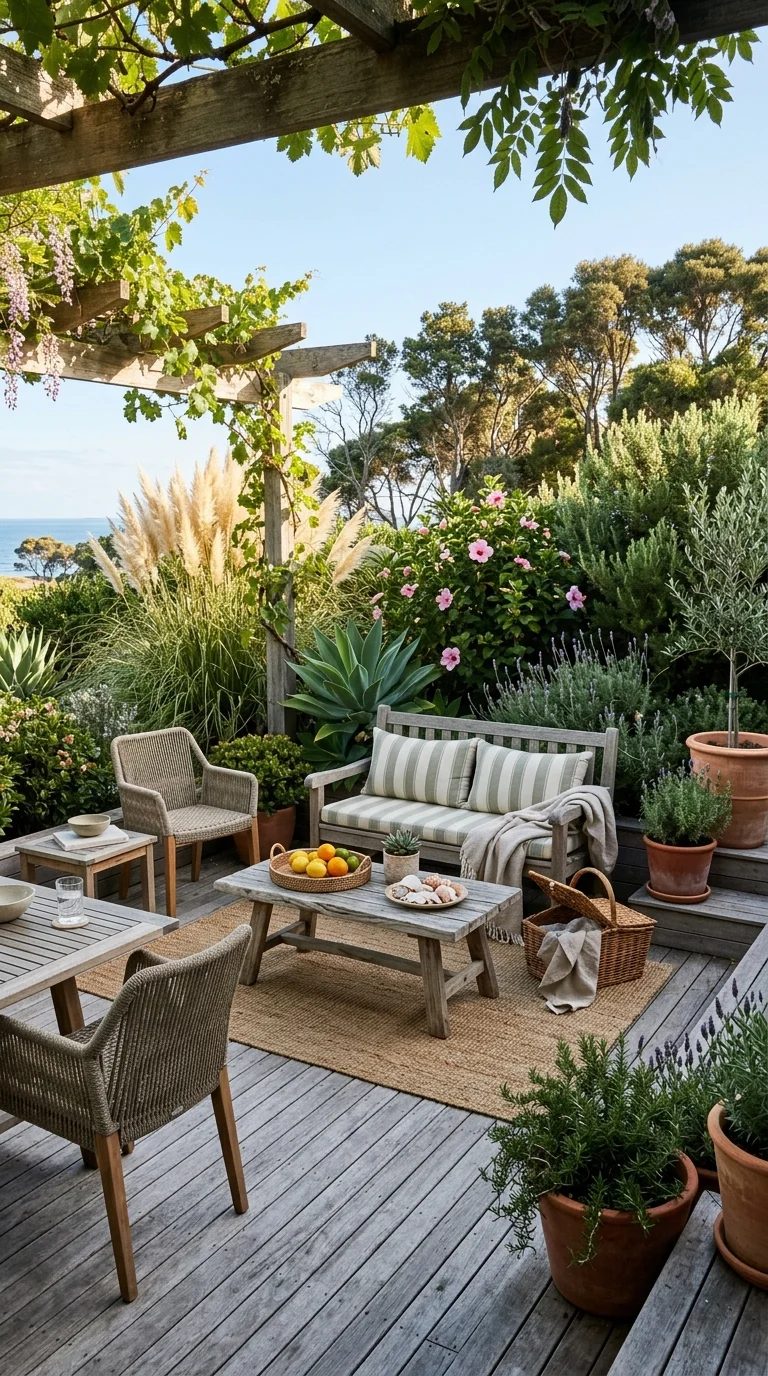
Instead of clearing sightlines to the water, this space leans fully into dense, layered planting — pampas grass, agave, roses, lavender — and treats the ocean as a partial reward glimpsed through the garden rather than the main event. It’s the one space in this roundup that deliberately hides its view instead of showcasing it.
This suits gardeners who want a genuine hobby as much as a hangout spot, and homes set slightly back from the coast with an obstructed rather than wide-open outlook. Mature, layered planting provides real privacy and windbreak that an open patio simply can’t offer. The honest trade-off is time: this kind of lush maturity typically takes multiple growing seasons to establish, so it isn’t a weekend transformation.
To recreate it: a simple wood pergola with a climbing vine (grape or wisteria), pampas grass and agave for height and texture, wicker seating, a low wood coffee table, and a woven basket as a styling touch. To simplify, fast-growing annual vines cover the pergola sooner than grape or wisteria, and container-grown pampas grass works for renters without in-ground planting rights. Layer plant heights deliberately — tall grasses at the back, mid-height shrubs and lavender in the middle, low ground cover at the front — rather than planting everything at one height.
Why the Pampas Grass Is Allowed to Dominate
The pampas plumes stand noticeably taller than every other plant and furniture piece here, and that oversized scale gives the otherwise low seating area a sense of height and drama it wouldn’t have with only knee-high shrubs. It’s a bigger visual risk in a small yard than a large one, since overscaled planting can crowd a tight space quickly.
Recommended Materials
- Wood pergola
- Climbing grapevine
- Wicker furniture
- Jute area rug
- Woven basket accessories
Main Colors
- Sage Green
- Warm Terracotta (planters)
- Soft Pink (florals)
- Natural Wood Tan
Best Lighting
Dappled shade from the vine canopy filters direct sun for most of the day — a genuine advantage in hot climates where full sun on furniture and skin becomes uncomfortable by midday.
The Real Upkeep Behind This Look
This is the highest-maintenance option in the roundup — pruning, seasonal deadheading, and grapevine training all need regular attention to keep the abundance looking curated rather than overgrown.
Where an Overgrown Garden Look Tips Into Actually Overgrown
- Skipping seasonal pruning, which turns “lush” into “neglected” within a year or two
- Planting aggressively spreading species without root barriers
- Letting the vine canopy grow so dense it blocks all light to the furniture below
- Overcrowding plant varieties without any repeated species to visually tie the bed together
The Stone-Walled Courtyard That Uses Color, Not Calm, to Feel Coastal
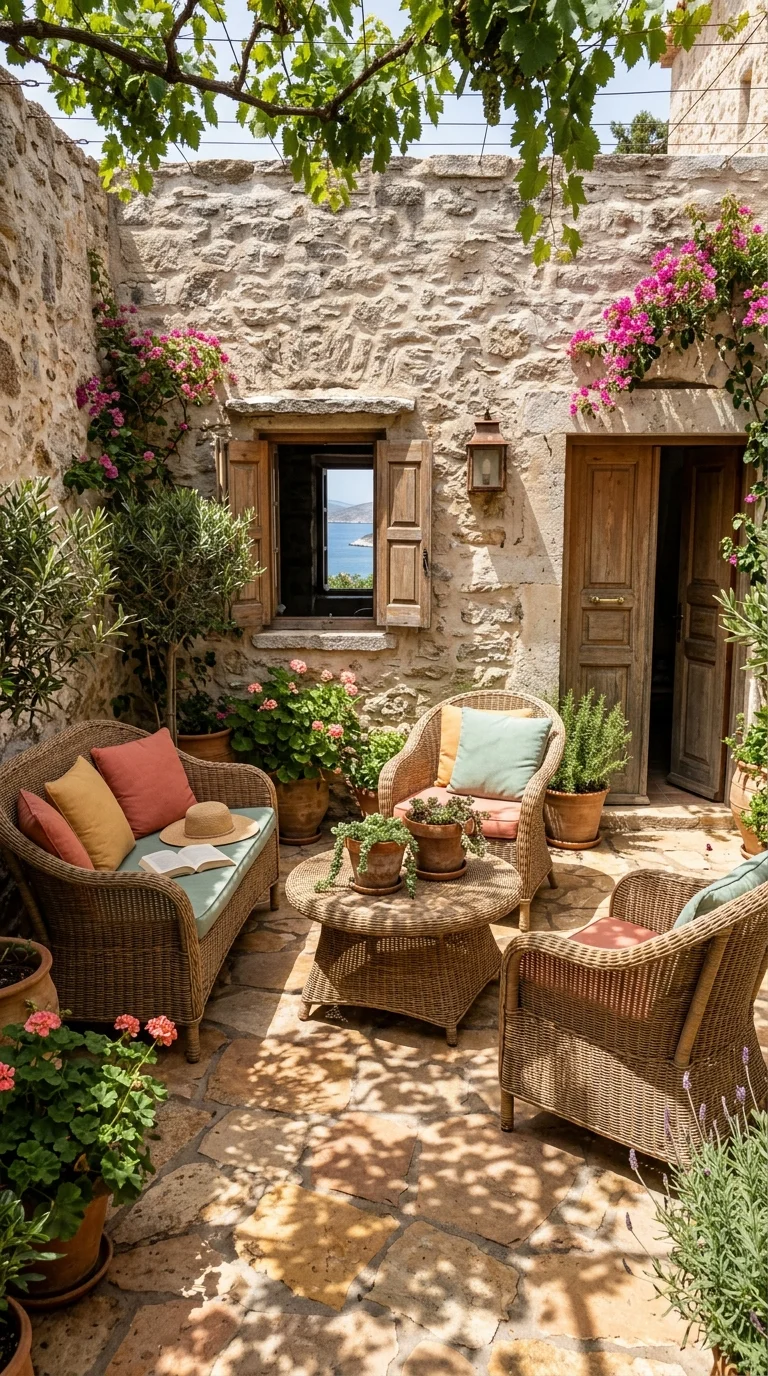
Instead of the blue-and-white palette most coastal spaces default to, this courtyard mixes warm coral, mustard, and sage cushions against raw fieldstone walls and climbing bougainvillea. It’s the only genuinely maximalist, warm-colored space in this whole roundup, and it stays unmistakably Mediterranean through its materials rather than its color choices.
It suits anyone who finds all-blue coastal design a little predictable, owners of older stone or rustic-built homes, and warm-climate island-style properties. The enclosed stone walls create real wind shelter and a warmer microclimate than an open patio gets. The honest caution is that this much pattern and color mixing needs a confident hand — without a shared undertone, it can tip quickly from curated into visually noisy.
To recreate it: raw or lightly mortared fieldstone walls, wicker furniture with a mixed warm-toned cushion palette, potted geraniums and climbing bougainvillea, and a round wicker coffee table. To simplify, paint an existing plain wall to mimic warm stone tones, and stick to two coordinating cushion colors instead of four for an easier mix. The key discipline is picking one warm undertone — terracotta, mustard, or coral — that every cushion and pot shares, even as the actual colors vary.
The One Undertone Holding This Colorful Mix Together
Coral, mustard, and sage cushions sit side by side here, and what keeps that combination from feeling chaotic is a shared warm undertone running through all three — none of them lean cool or grey. That consistency does more organizing work in this space than the stone walls or furniture shape; swap even one cushion for a cool-toned blue and the balance would likely shift noticeably.
Recommended Materials
- Raw fieldstone
- Wicker and rattan furniture
- Terracotta planters
- Climbing bougainvillea
- Woven straw accents
Main Colors
- Coral
- Mustard Yellow
- Sage Green
- Warm Stone Grey
Best Lighting
A wall lantern by the door supplements strong midday sun filtering through overhead vines, and the stone walls hold and radiate that warmth into the evening.
Living With Bougainvillea and Fieldstone
Bougainvillea needs regular pruning to control its spread and thorny growth, while fieldstone itself is essentially maintenance-free beyond occasional moss removal in damp climates.
Common Missteps With a Warm-Toned Stone Courtyard
- Mixing cushion colors with no shared undertone, which reads as clutter instead of curated maximalism
- Letting bougainvillea grow unpruned near a walking path, where its thorns become a real hazard
- Choosing stone that’s too polished or uniform, losing the raw texture that makes this look feel authentic
- Skipping shade entirely in a full-sun courtyard, making the space uncomfortable exactly when it’s most used
The Apartment Balcony That Proves Container Gardening Can Carry a Whole Look
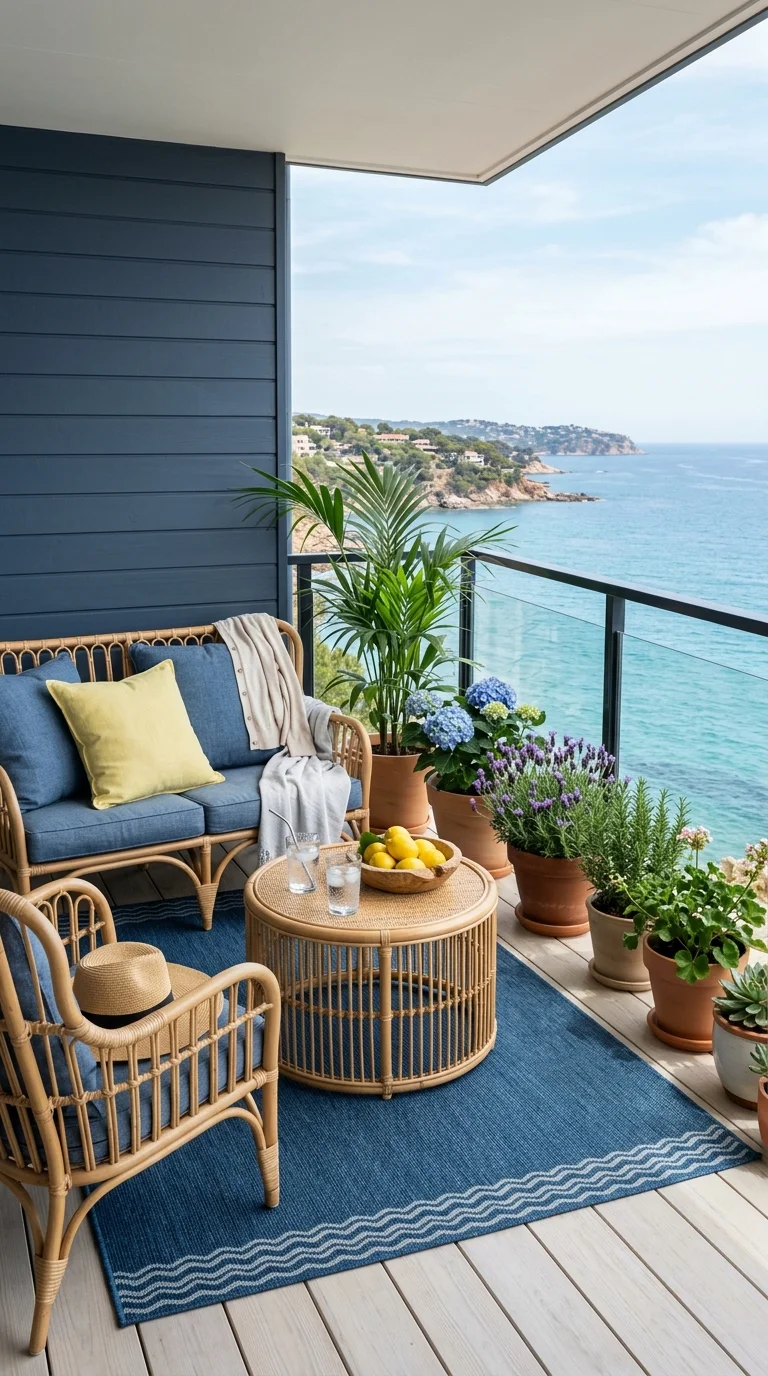
A narrow high-rise balcony where a dense line of potted herbs, succulents, and flowering plants along the railing does all the “garden” work, since there’s no ground-level planting possible at all. Every other space in this roundup has at least some in-ground or built-in planting; this one is entirely container-based by necessity, and it still reads unmistakably coastal.
It suits renters, apartment and condo owners, and anyone without ground-level outdoor space at all. Pots are fully portable, so this look can move with a renter, and any struggling plant can be swapped out without disturbing anything else. The trade-off is that container plants dry out faster than in-ground planting, especially at height where wind exposure increases, so watering has to be more frequent than a ground-level comparison would suggest.
To recreate it: navy or dark exterior paint as a backdrop, a rattan loveseat and chair with navy and citrus-yellow cushions, terracotta pots lined along the railing with herbs, lavender, and a trailing succulent, and a round rattan drum coffee table. To simplify, one long planter box replaces multiple individual pots for easier watering, and faux citrus or lavender picks suit renters who travel often. Group pots by water needs along the rail — herbs like basil together, drought-tolerant succulents at the far end — so a single watering routine doesn’t over- or under-serve half the plants.
How Terracotta Pots Behave Differently at This Height
Unglazed terracotta pots on an exposed high-rise balcony dry out noticeably faster than the same pots would at ground level, since wind speed increases with height and terracotta is porous enough to wick moisture out through its walls. The same plant that thrives in a terracotta pot in a sheltered backyard may need watering nearly twice as often up here to stay healthy.
Recommended Materials
- Navy exterior cladding
- Rattan furniture frames
- Terracotta pots
- Woven jute-look rug
- Glass railing
Main Colors
- Navy Blue
- Citrus Yellow
- Lavender Purple
- Warm Terracotta
Best Lighting
Full, largely unobstructed sun for most of the day, thanks to the height, is ideal for the sun-loving herbs and succulents lined along the rail, though it also means cushion fabric needs to be genuinely UV-resistant.
Watering a Balcony Garden at Height
Container plants at height need more frequent watering than ground-level equivalents, and herb pots should be checked each season for root-bound growth and sized up as needed.
Where Balcony Container Gardens Usually Go Wrong
- Mixing high-water-need herbs with drought-tolerant succulents in the same watering routine
- Choosing pots without drainage holes, which traps water and rots roots
- Overcrowding the railing so airflow is blocked, and plants compete for light
- Skipping UV-resistant outdoor fabric, leading to fast fading on an all-day-sun balcony
The Sunset Porch That Trades Blue-and-White for Warm, Sun-Baked Tones
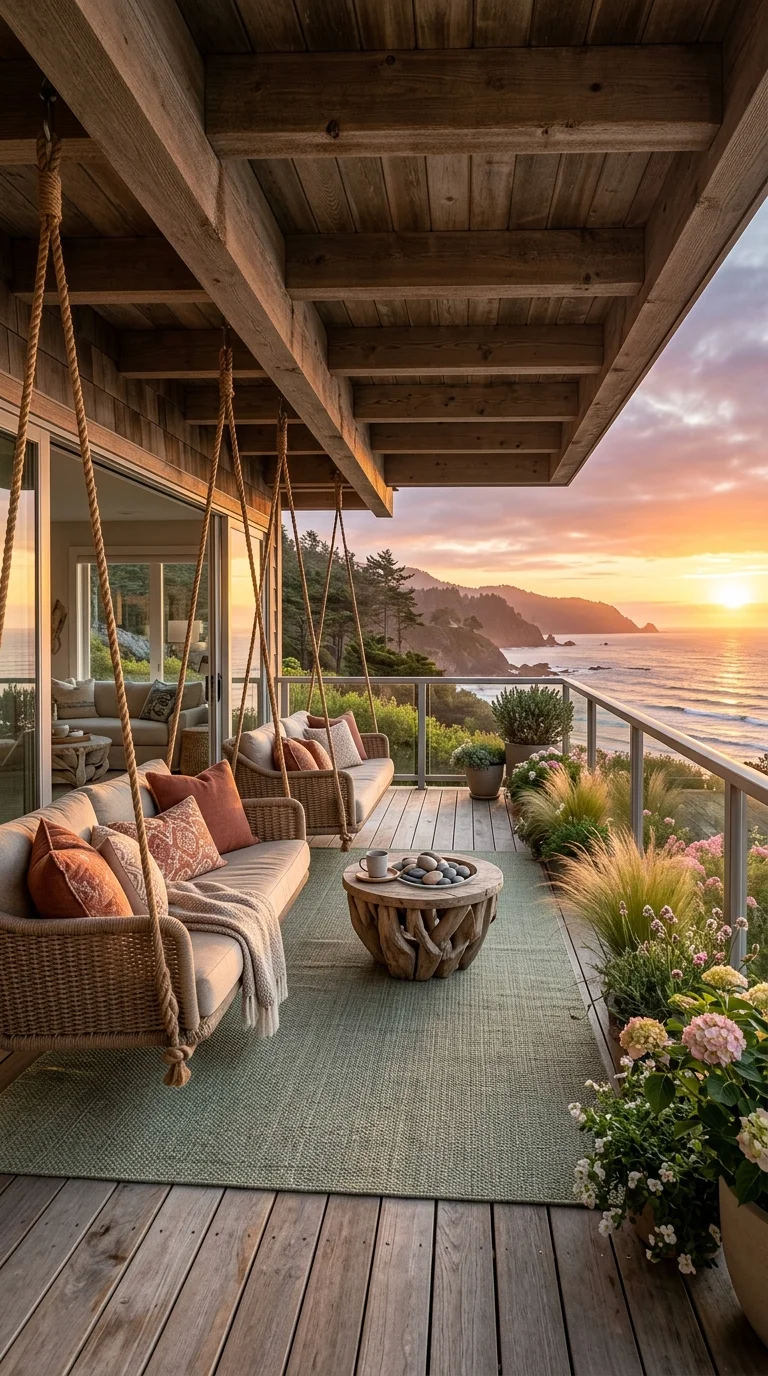
This porch takes the hanging-swing format seen earlier in this list and shifts the entire palette warm — rust, terracotta, and blush cushions instead of blue and white — so the space reads as a sunset-hour retreat rather than a bright midday hangout. A sculptural driftwood-root coffee table reads as a found object rather than a simple accessory, reinforcing the warm, textured mood.
It suits homeowners who want a coastal porch that doesn’t default to blue and white, sunset-watching households, and anyone drawn to a more layered look than crisp coastal minimalism. Warm tones hold their richness in low, golden light in a way cool blues and whites can wash out under, making this palette specifically suited to west-facing sunset views. The honest caveat is that the same palette can feel heavy or dated under flat midday light, since it depends on that golden-hour glow to look intentional rather than simply warm-toned.
To recreate it: weathered cedar decking, hanging rope swings, a driftwood-root coffee table, a rust-and-terracotta pillow mix with one ivory pillow to break up the warmth, and ornamental grasses in simple pots. To simplify, a resin “driftwood-look” table stands in for a genuine reclaimed piece, and two coordinating cushion colors work instead of the full rust-terracotta-blush mix. Orient the swings to face west if the goal is genuinely to use this space at sunset — an east-facing version of the same setup loses most of its intended effect.
Why This Porch Is Built Around a Time of Day, Not Just a View
Every material choice here — the warm cushion tones, the low driftwood table, the western orientation — points toward one specific moment: sunset. That’s a different design logic than simply facing a porch toward “the view,” since a space tuned this precisely to golden hour can look comparatively flat at other times of day, which is worth knowing before committing to the palette.
Recommended Materials
- Weathered cedar decking and roof beams
- Nautical rope
- Driftwood-root coffee table
- Canvas or linen cushion covers
- Terracotta plant pots
Main Colors
- Rust Orange
- Warm Terracotta
- Blush Pink
- Ivory
Best Lighting
Golden-hour western light is the entire point of this design; supplement after dark with a single warm lantern rather than bright overhead lighting, which would undercut the mood.
Keeping Weathered Wood and Driftwood in Shape
Weathered cedar benefits from an occasional oil treatment if you want to slow, rather than stop, further greying, and any genuinely reclaimed driftwood furniture should be checked periodically for structural soundness.
Mistakes That Undercut a Sunset-Facing Porch
- Orienting the setup toward the wrong compass direction, losing the golden-hour effect entirely
- Choosing overly cool-toned grasses or planters that fight the warm palette
- Over-lighting the space after dark with bright white bulbs instead of warm, low lighting
- Using a genuinely reclaimed driftwood table without checking it for structural stability first
Keeping These Outdoor Fabrics and Woods From Aging Badly
- Choose genuinely outdoor-rated fabric, not just water-resistant, for anything left outside year-round — fading shows fastest on the warm-toned and navy palettes shown above
- Oil or reseal exposed wood — pergolas, decking, driftwood tables — at least once a year in coastal salt-air climates
- Bring frost-sensitive terracotta pots indoors or into a garage before the first hard freeze, since porous terracotta cracks when the water inside it freezes
- Check rope, rattan, and swing hardware for salt-air corrosion or fraying each season before heavy use resumes
Who Should Choose This Style?
- Best for homeowners with an actual water view or coastal-adjacent climate who want their outdoor space to lean into it
- Best for renters and apartment owners, since several of these looks — the balcony container garden, the sunroom plant wall — scale down to container-only setups
- Not ideal for anyone wanting a fully hands-off outdoor space, since most of these looks depend on live plants, natural wood, or woven materials that need seasonal upkeep
Budget Summary
| Budget | Expectation |
|---|---|
| Low | Potted herbs and succulents in terracotta pots, solar string lights, budget wicker bistro sets, jute-look indoor-outdoor rugs |
| Medium | Cedar pergola kits, mid-range boucle or canvas outdoor cushions, wall-mounted planter shelving, a stone-topped bistro table |
| Premium | Custom-built pergolas with hardwired lighting, reclaimed live-edge or driftwood furniture, in-ground xeriscape or cottage-garden landscaping, full stucco or limewash wall treatments |
Frequently Asked Questions
Does a coastal outdoor space need to be blue and white?
No. Several of the spaces here, including the stone courtyard and the sunset porch, lean into warm terracotta and coral tones instead and still read as coastal because of their materials — wicker, stone, weathered wood — rather than any fixed color palette.
Can I get this look on a balcony with no ground planting at all?
Yes. The container-only balcony design shows that a line of potted herbs, succulents, and flowering plants along a railing can carry the whole aesthetic without any in-ground bed.
How much upkeep does a coastal garden style actually take?
It varies widely across these ten looks. The xeriscaped courtyard and the container balcony are genuinely low-maintenance, while the plant-wall sunroom and the overgrown cottage pergola both require regular, ongoing care to keep their look intact.
What’s the easiest starting point on a small budget?
A few terracotta pots, an inexpensive rattan bistro set, and one run of string lights are usually enough to borrow the coastal mood without committing to structural changes like a pergola or a re-stuccoed wall.
About Aesthetic Life Team
Aesthetic Life Team covers home decor and outdoor design with a focus on practical, real-world styling — the kind of ideas readers can actually adapt to their own space, climate, and budget rather than simply admire in a photo.
Conclusion
Coastal outdoor design turns out to be less about a single fixed formula and more about which trade-off actually fits your life — a lush plant wall versus a low-water courtyard, an open ocean view versus a garden that deliberately hides it. Whichever version from this list matches your climate, your appetite for upkeep, and the house you’re already working with is the one worth building toward, rather than the one that simply photographs best.
Explore More
You may also enjoy:


One Response