

Scroll through any saved board of cottagecore bedrooms and you’ll notice the same split. Some rooms are one idea done quietly, like a row of dried lavender on a wall. Others are full fantasy, with a ceiling of roses or a wisteria tree growing through the rafters. Both are lovely to look at, but they ask very different things from the person who wants to live in one.
These ten bedrooms cover that whole range. Each is built around a single decision you can borrow: where the color comes from, how a bold pattern stays calm, what to do with a sloped ceiling, and which parts are real design versus pure staging. Some ideas are almost free to copy. A few are better admired and then scaled down to a garland, a rug, or a coat of paint.
Treat them as a menu of ideas, not ten rooms to reproduce. Start with the one whose light, ceiling, or budget looks closest to your own.
Dried Lavender Bundles Turn a Blank Wall Into the Room’s Color Source
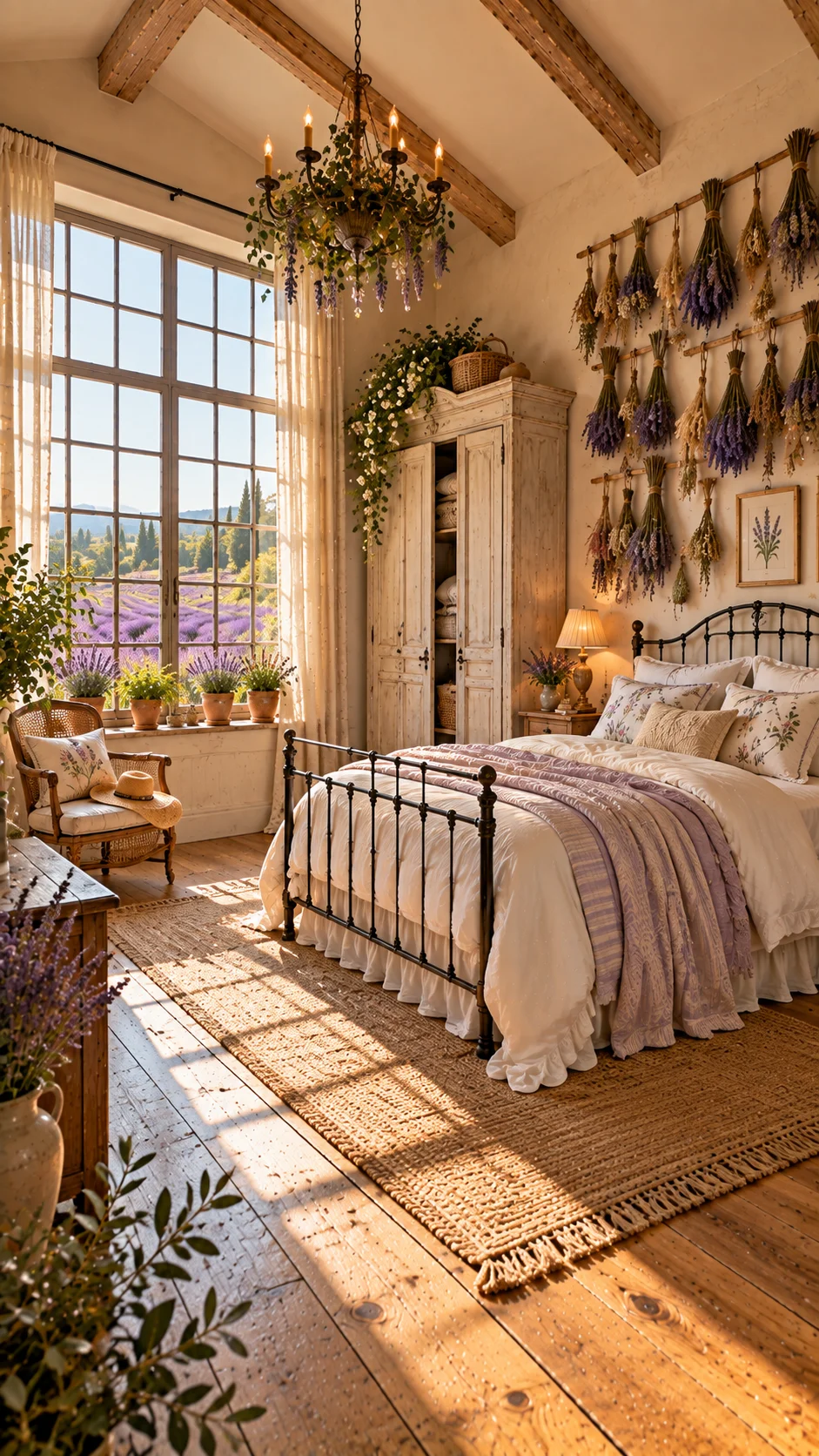
The color in this room comes from two places that match: the lavender field visible through the tall window and the dried lavender bundles hung in rows from wooden rods on the wall. Because the purple outside and the purple inside agree, the bedroom feels tied to its landscape. Everything else stays quiet to protect that effect. The bedding is white and cream, the throw is a soft lilac, and the black iron bed frame adds one thin, dark line.
The wall display is also the easiest idea here to copy. Dried lavender, mixed with pale grasses or wheat-colored stems, can be tied with twine and hung from a rod or a row of pegs. Hanging bundles upside down in a dry spot is how flowers get dried in the first place, so the wall works as a drying rack and as decoration at once. One caution: this wall catches strong, warm light, and direct sun fades dried flowers toward gray over time. Choose a wall with softer light if you want the purple to last, and swap bundles out when they go dull.
If the palette appeals to you beyond a single wall, these purple bedroom ideas that feel surprisingly sophisticated show how far lilac and violet can go.
Big Floral Wallpaper Stays Calm When One Solid Color Gets to Rest
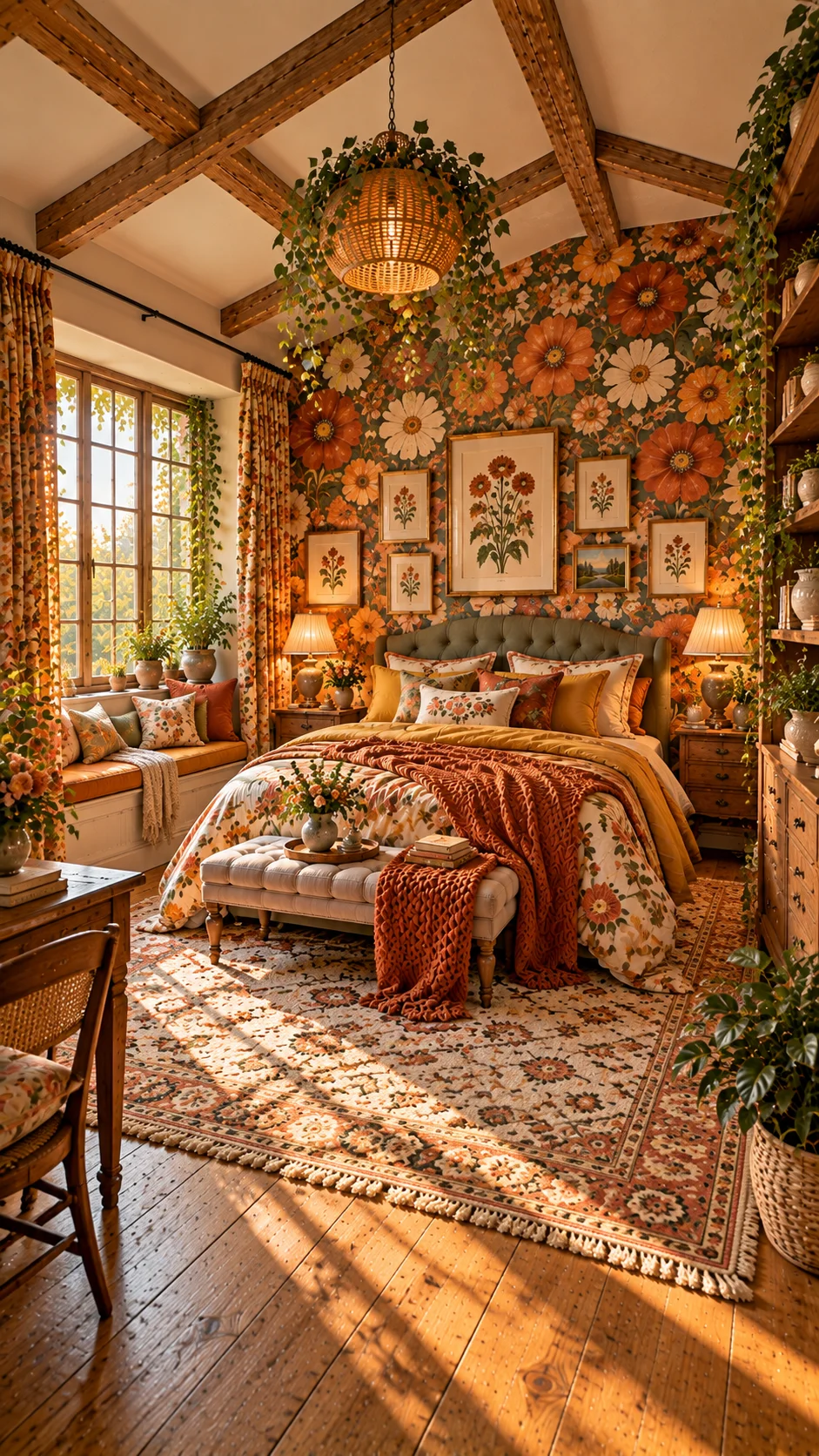
Oversized floral wallpaper makes people nervous, and this room shows the trick. The wall pairs huge rust, orange, and cream blooms on a deep green ground, and the curtains, duvet, and rug all repeat the same few colors: rust, mustard, olive, and cream. When the palette is shared, the prints can disagree about scale without fighting.
Scale is the second half of it. The wallpaper is enormous, the curtains are medium, the duvet is smaller and busier, and the rug is a tight, small-flower pattern. Each print gets its own size, so no single one competes with its neighbor.
The part that’s easy to miss is the olive tufted headboard. It’s a plain, solid surface sitting in the middle of all that pattern, and it gives the eye somewhere to land. Take it away and the wall would feel like it was closing in. The mustard quilt and the rust knit throw work the same way, breaking up the florals with flat color.
The bold paper also covers just one wall, which is a smart limit for a smaller room. And if you’d like to test your tolerance for pattern before committing to wallpaper, floral printed furniture is a lower-stakes way to find out.
A Canopy of Roses Is Staging, and That’s Fine If You Know What to Keep
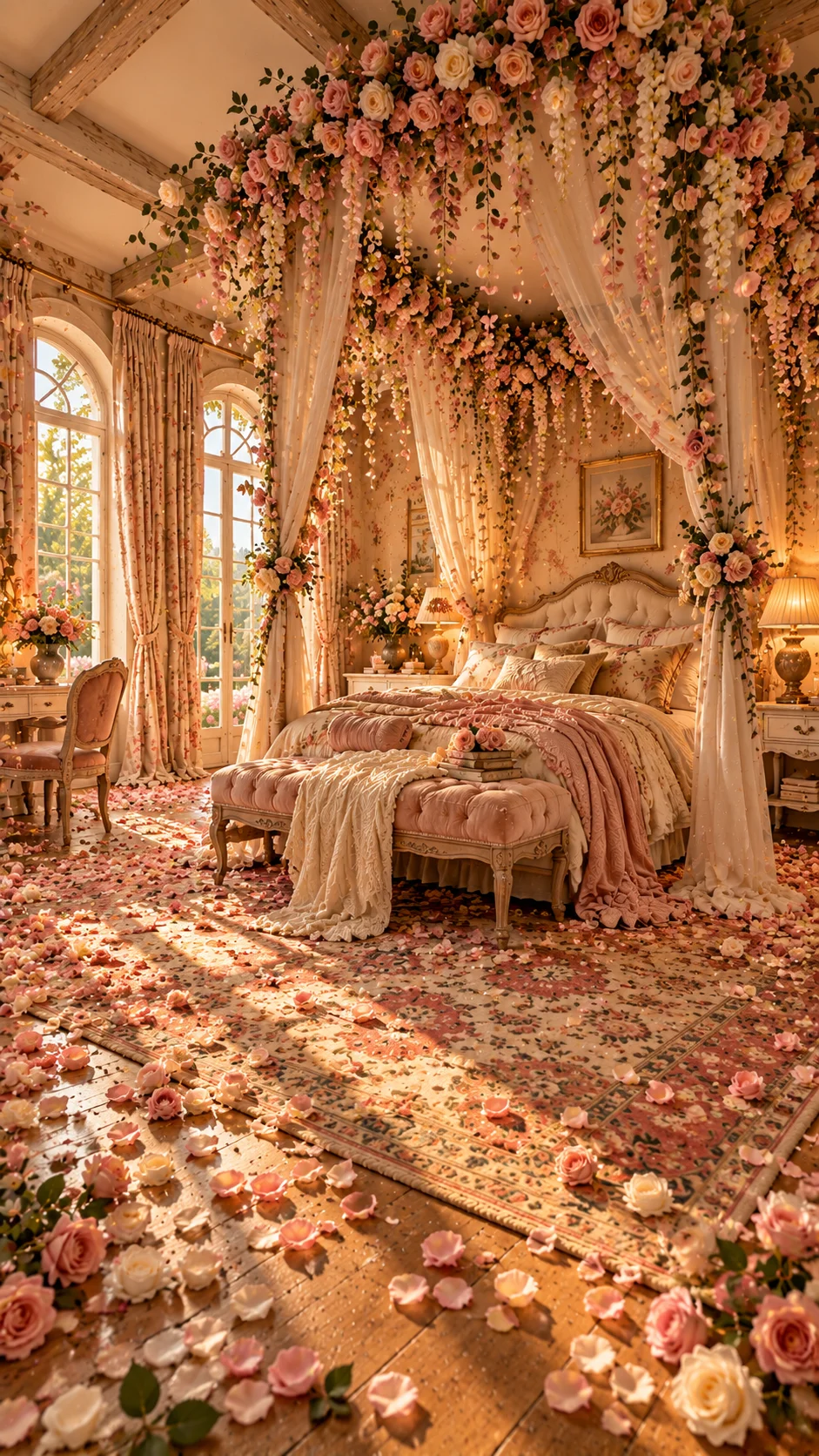
Read this one as a set. Pink and cream roses, along with trailing white blooms, hang over the whole bed, and petals cover the floor and rug. Real flowers in that quantity would wilt within days, and the cleanup would be a chore. It looks like event styling, not a room set up for everyday use.
What’s worth taking from it is the structure. Sheer curtains fall from the canopy’s corners, so the bed becomes its own enclosed space inside a large room. The flowers sit high, which makes the ceiling height part of the show. And the palette stays disciplined: blush, ivory, and soft pink repeat in the tufted bench, the knit throw, the round bolster, and the curtain print, so the roses feel like the source of everything else.
To live with the idea, scale it down. A single faux rose-and-greenery garland across the headboard wall, or curtain panels hung from a ceiling-mounted rod around the bed, gives you the garden-arbor feeling with nothing to water or sweep. Faux stems also stay put, which matters if you want the look to last longer than a weekend.
Dress the Four-Poster You Already Have With Loose Fabric and a Thin Garland
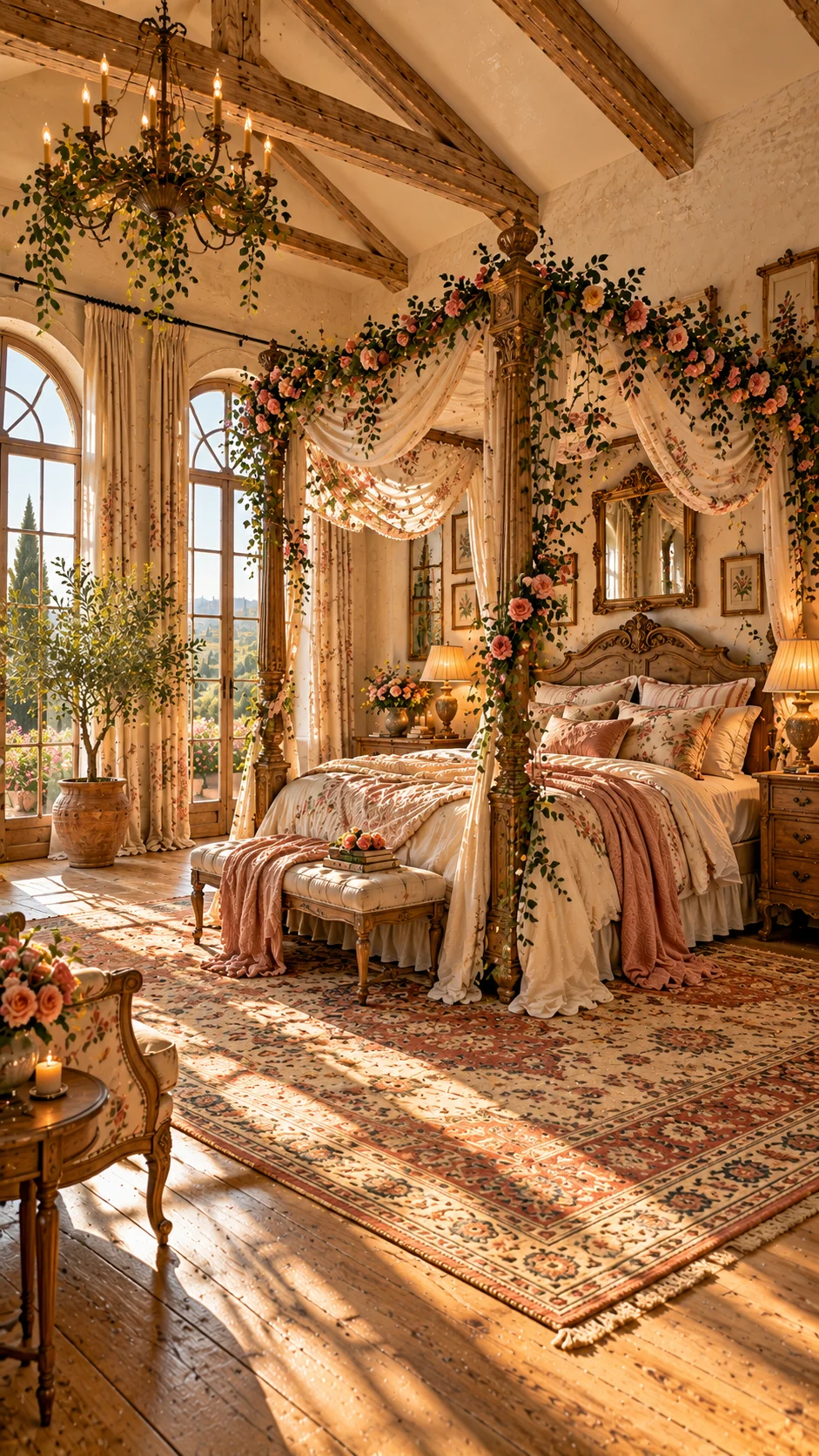
The carved wooden four-poster in this room does the architectural work, and the decoration is a light layer on top. A thin garland of roses and leaves follows the top rails and wraps two of the posts, while floral-print fabric hangs between them in soft swags. The frame itself is honey-toned and detailed, so it holds its own without help.
That’s the useful lesson: dress a frame you have before you think about building a canopy from scratch. Fabric draped loosely looks relaxed, and a garland only needs to cover the top rails and one or two posts to make its point. The rest of the bed stays open and visible.
A four-poster does need space, though. This room has high ceilings and tall arched French doors, and the large patterned rug stretches well past the bed. In a standard-height bedroom, a lower frame or a simple rod mounted over the bed would give a similar effect without crowding the ceiling.
The potted olive tree by the windows adds green at floor level, and it’s a good reminder that cottagecore doesn’t have to mean only flowers. For the outdoor side of the same mood, try these cottagecore garden ideas with storybook charm.
Whitewashed Planks Keep a Steep Attic Ceiling From Feeling Heavy
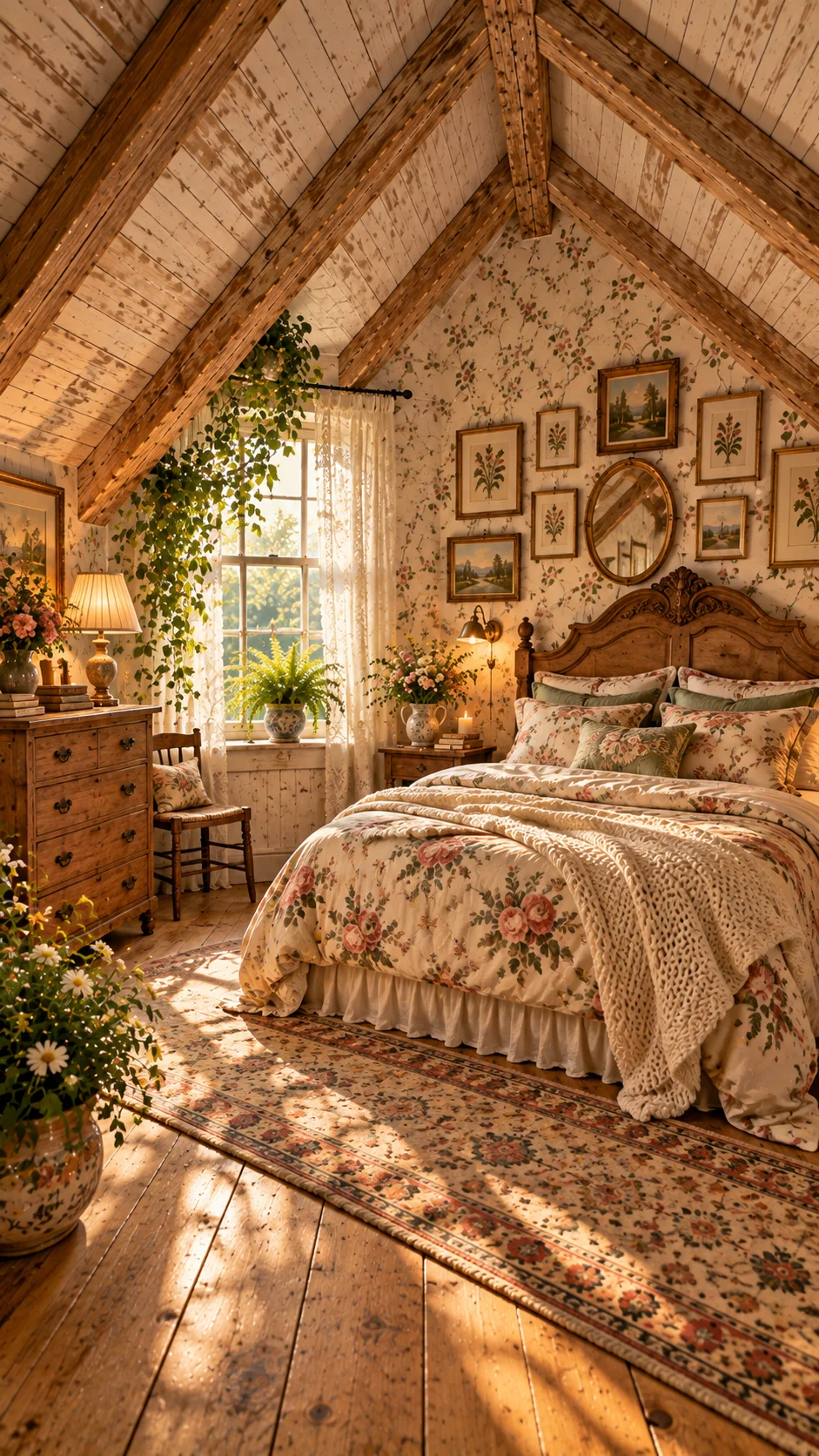
A steep ceiling can feel like a lid on a room, and this attic handles it with tone. The boards are painted a worn cream, and the wallpaper below is a small vine print on a similarly pale ground, so wall and slope read as one continuous surface. The dark beams then do the structural drawing, giving the roofline clear lines without darkening the room.
The small print matters here. A large floral on an angled wall would get chopped up by the rafters, while this tiny pattern behaves almost like texture. The headboard sits against the full-height back wall, where there’s room to sit up in bed, and the dresser appears to tuck toward the lower side. Sorting out where the bed and tall furniture can go is the first job in any attic bedroom, and this guide to styling an attic bedroom around the slope problem goes through it in detail.
Above the bed, botanical prints and small landscape paintings hang in warm wood and gilt frames, and an oval mirror breaks up all those rectangles while bouncing window light back into the room. A loose cluster suits a sloped wall better than a tight grid, since the layout can bend around the angles.
Painting Everything Sage-Teal Lets Wisteria Be the Only Loud Thing
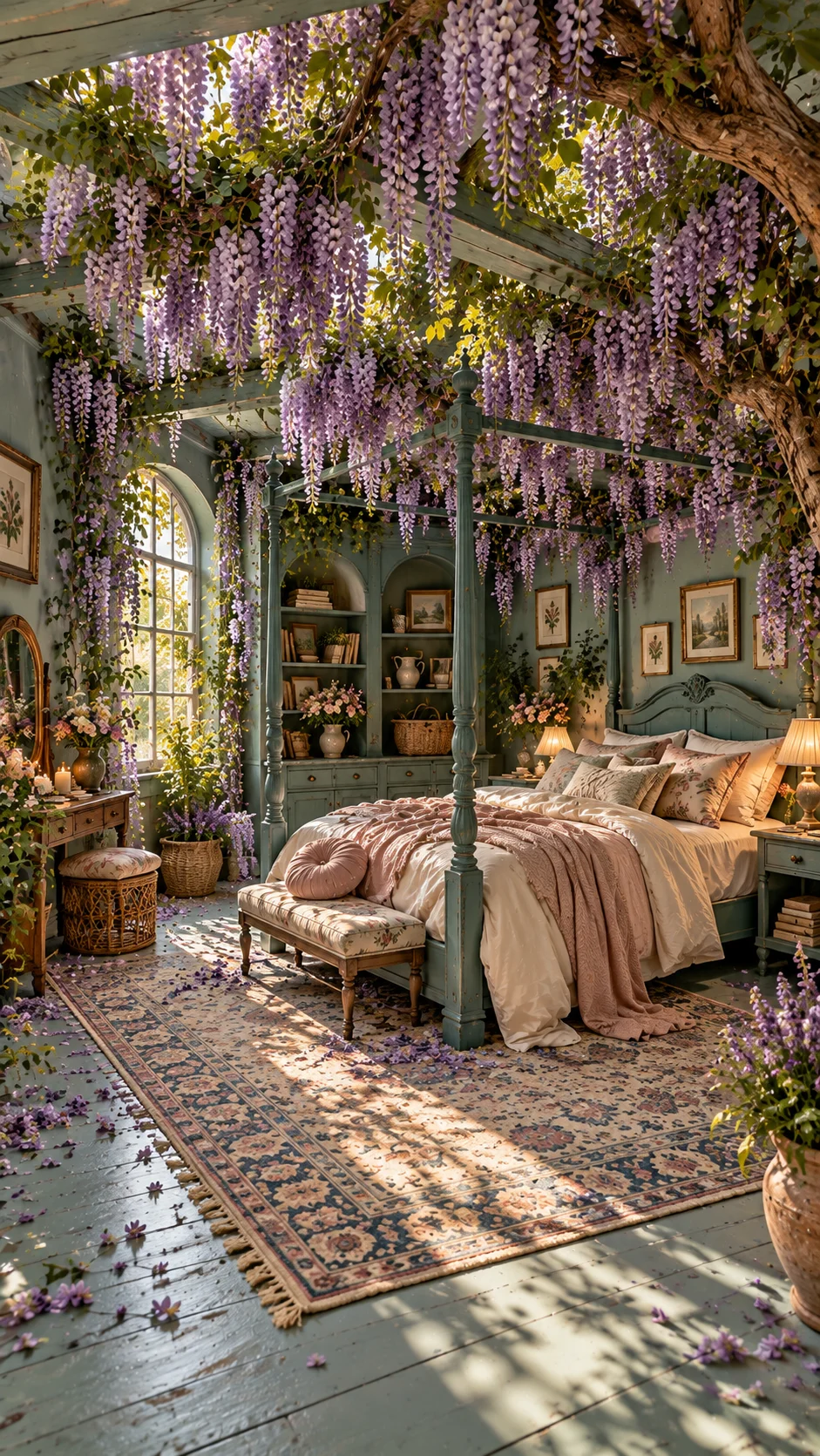
Nearly every wooden surface in this room is painted the same muted blue-green: the four-poster, the built-in shelves, the ceiling beams, the walls, even the floorboards. That one soft sage-teal works as a backdrop, so the purple wisteria, the pink throw, and the rose-and-navy rug are the only things that read as color. They stand out because nothing around them is competing.
The shelves, the small writing desk, and a woven stool all stay in the same quiet range, with baskets and pottery as the only decoration. If you want a cottage bedroom to feel layered without feeling busy, painting the woodwork one color does more than adding another dozen objects would.
The wisteria needs a reality check. It’s a large, vigorous outdoor vine, and a tree-sized specimen growing through a bedroom ceiling is a fantasy. Faux wisteria stems run along a beam or over a curtain rod give the same effect with no pruning.
Painted floors also take real wear at the bedside and by the door. A floor-rated paint with a clear protective topcoat holds up better than wall paint, and a rug in the busiest spot helps. The small vanity at the left of this room is a nice example of how a corner can earn its keep, and these dressing table designs show more ways to set one up.
Forest-Green Walls Turn a Plain Wood Cottage Into a Woodland Hideaway
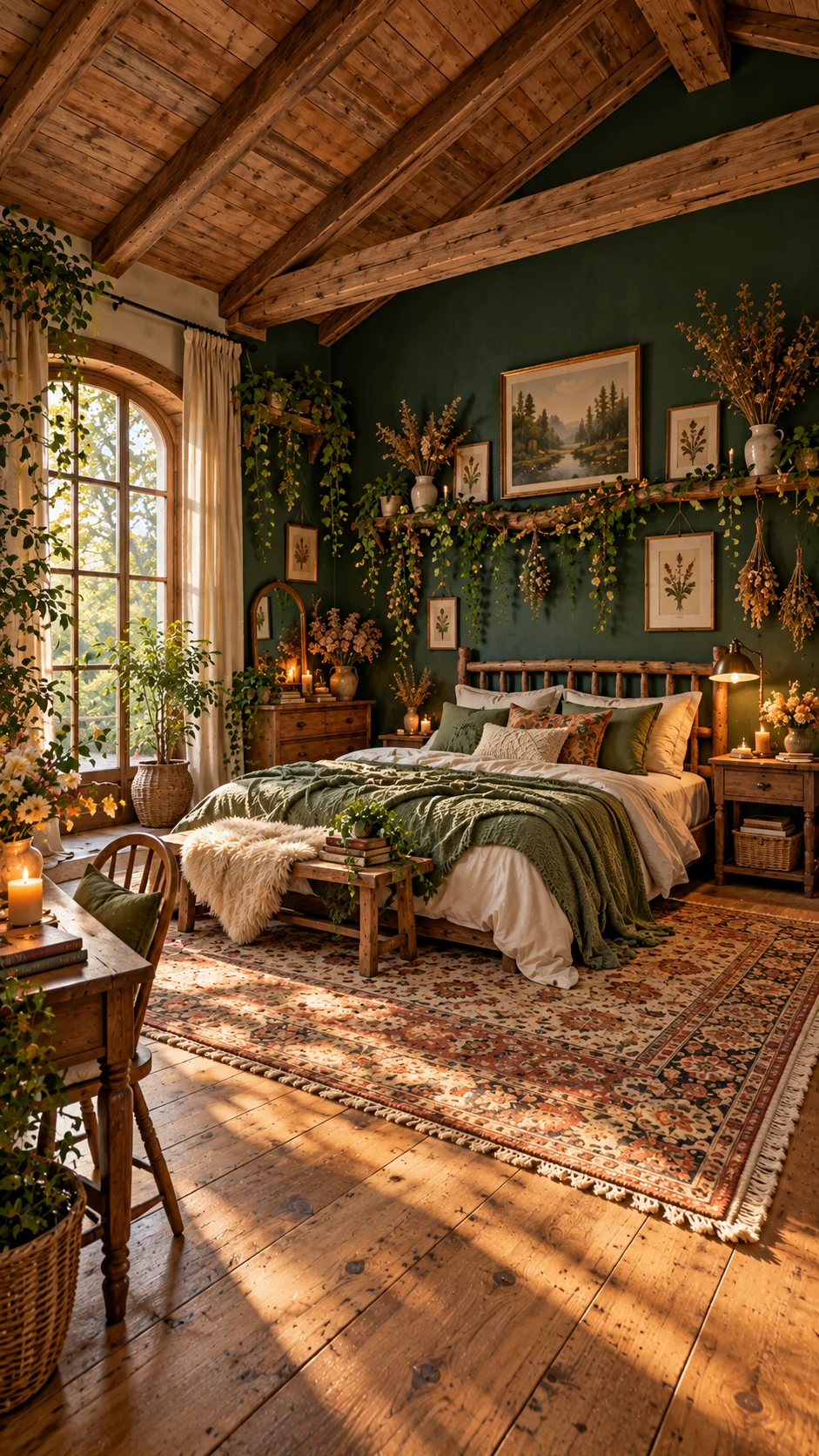
Dark green is the boldest wall color in this set, and it works here because of what surrounds it. The ceiling is warm wood planking with heavy beams, the headboard looks like it’s built from rough branches or small logs, and the floor is a honey-toned plank. All that wood keeps the green from going cold. Cream pillows, a fluffy sheepskin, and white bedding then give the dark wall something bright to push against.
Lighting does quiet work too. Candles sit on the nightstands and the shelf, and a wall-mounted arm lamp hangs near the bed, so the room glows low and warm in the evening. Dark paint absorbs light, which means it needs this kind of layered lamplight, and it’s worth testing a large sample on the actual wall before committing. A small or north-facing room can feel heavy in deep green. This one has a tall arched window to balance it.
The long shelf above the bed carries ivy, dried flower arrangements, and framed botanical prints, so the green wall doubles as a backdrop for plants. Even the textiles stay tonal, with an olive knit throw and sage pillows. For more rooms that lean on natural wood, take a look at these rustic bedroom designs with a cozy cabin feel.
A Round Window and a Round Rug Add Curves to a Room of Planks and Slopes
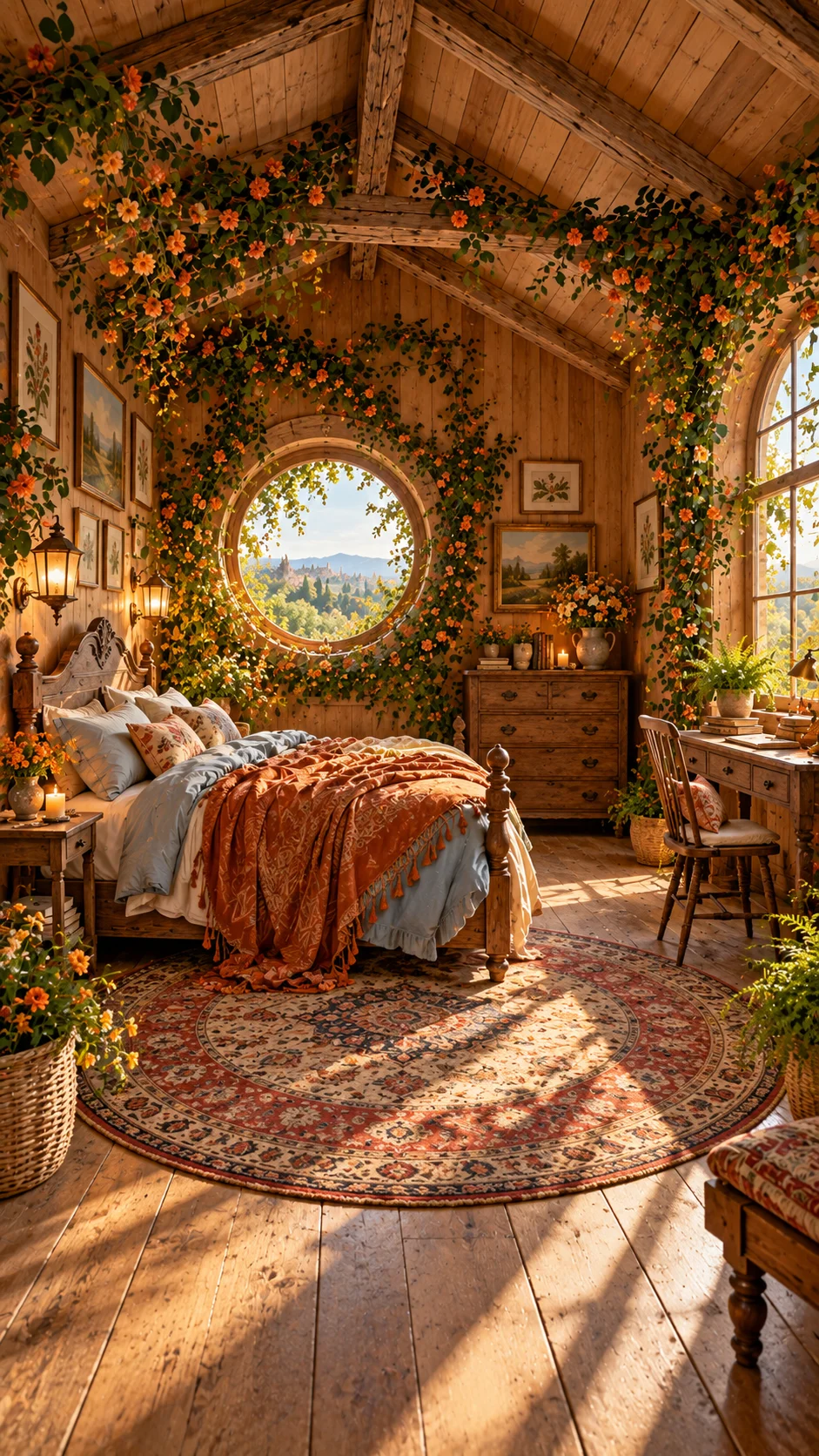
Almost everything in this attic is straight: planked walls, angled rafters, rectangular drawers. The round window and the round rug are the exceptions, and sharing a shape makes them feel related even though they sit on opposite sides of the room. The window has a wooden ring around it and a trailing vine with orange blossoms, so it reads like a living wreath with a view of hills and a village behind it.
The vine also ties colors together. Its orange repeats in the rug and in the bed’s rust, tasseled throw, and it sits comfortably against the greenery outside. A pale blue duvet lies under that throw, and blue and orange are near opposites, which is why the bed looks lively without any extra pattern.
A round rug can be easier to place in a room with an irregular layout than a rectangle that has to square up with the walls. This one sits mostly in the open floor at the foot of the bed. For help with sizing and placement, these rug styles that make a bedroom feel cozier cover the options.
You can borrow the wreath effect indoors with a faux flowering garland pinned with small hooks around a window or mirror frame.
Daisies on Cream: One Flower and One Neutral Do More Than a Full Garden
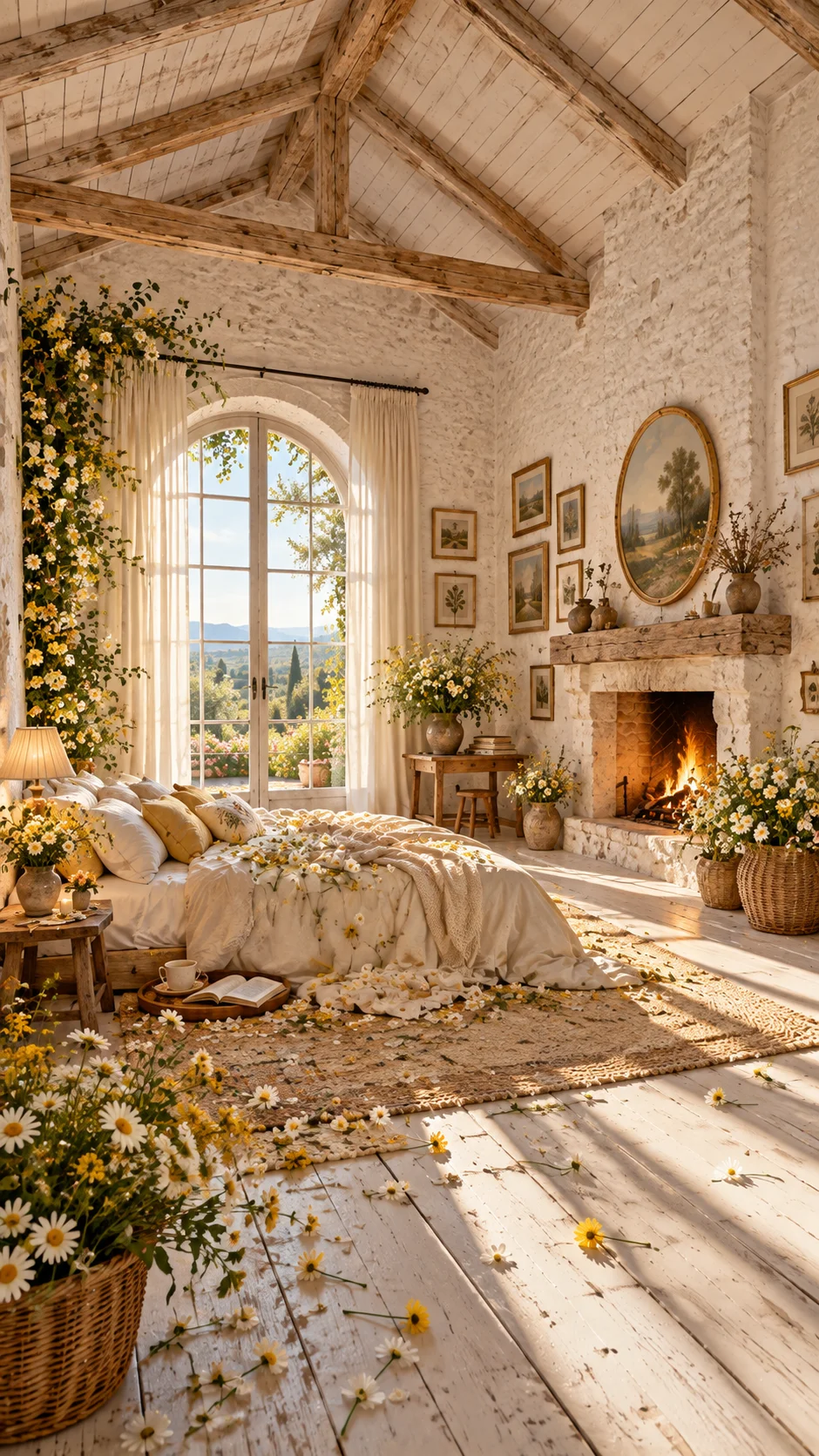
This is the quietest room in the set, and nearly all of it is cream. The textured walls are whitewashed, the plank floor is painted white, the bedding is ivory linen, and a jute rug adds the only coarse texture. The color comes from one source: white daisies with yellow centers, plus a few yellow wildflowers, in baskets, in a vase on the table, and scattered across the floor and bed. Mustard cushions repeat that yellow once more.
The limited palette is why it works. One flower type in two colors looks intentional, while a bouquet of five different varieties in a neutral room would start to look scattered. If you like this look, buy daisies by the armful, since a single stem looks sparse, and keep them in simple containers like baskets, stoneware jugs, or glass jars.
Two details make the room look used: a tea tray with an open book on the bed, and a lit fireplace under a rough wooden mantel. Both suggest a slow morning. A working fireplace is a bigger commitment, but a bedroom without one can get a similar mood from a tray, a good reading lamp, and a basket of flowers by the door.
Coral and Peach Roses Look at Home Against Stone Walls and Terracotta Tile
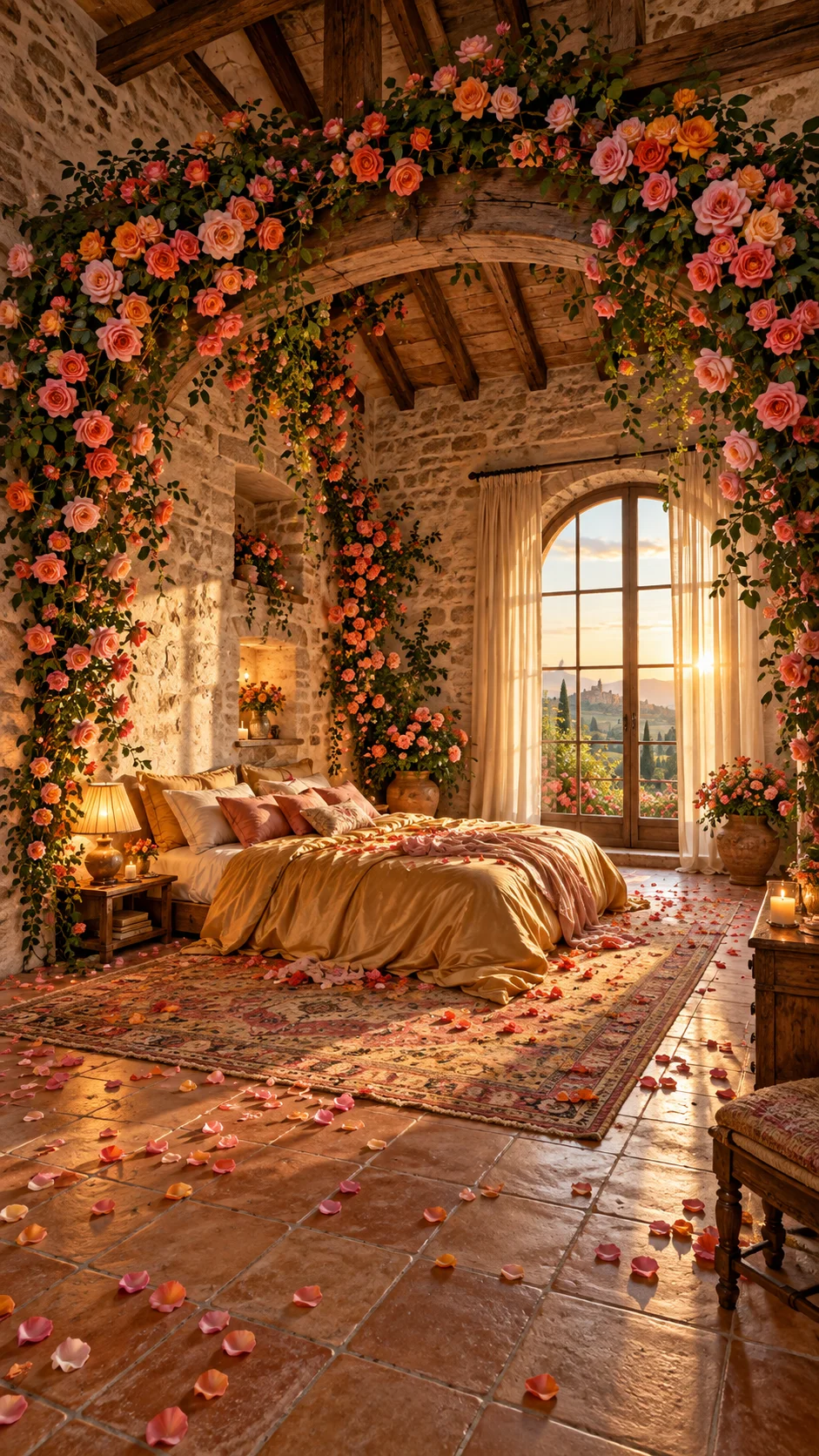
The rough stone walls, terracotta floor tiles, and wooden beams in this room are all warm, so the roses climbing the arch are warm too: coral, orange, peach, and a few soft pinks. That’s a color-matching decision, and a cooler, bluer pink would likely sit less comfortably against the clay-colored floor. The golden satin bedding continues the warm run, and the sunset in the arched window finishes it.
The arch works like a built-in trellis, framing the bed with greenery and marking out a sleeping zone without a single piece of dividing furniture. Small niches in the stone, holding candles and a few stems, add depth without adding clutter.
Hard surfaces need softening, though. Terracotta tile and stone are durable but can feel cool and hard underfoot, so the patterned rug at the bed and the satin and knit layers on the mattress matter more than they look. If you’re planning a similar floor, a large wool rug at the bedside is a sensible early purchase. For more on bringing natural, earthy materials into the bedroom, try these earthy bedroom ideas for a warm and natural retreat.
FAQ
Which colors suit a cottagecore bedroom?
Start with a soft neutral like cream, whitewash, or warm white, then choose one accent family and repeat it. The rooms above use lavender and gray-green, rust and mustard, blush and ivory, sage-teal, forest green, and daisy yellow. Three or four colors repeated in several places feel more settled than six colors used once each.
Can I get this look in a small or rented bedroom?
Yes, and the portable pieces do most of the work: floral bedding, a patterned rug, dried bundles, framed botanical prints, a pair of warm lamps, and a basket of seasonal flowers. If you can’t paint or hang wallpaper, removable peel-and-stick wallpaper on a single wall behind the bed gets close to the pattern effects shown here.
How do I mix floral patterns without the room looking messy?
Keep the colors shared, vary the scale, and include at least one solid surface. If two prints are the same size and compete for attention, change one of them. A plain headboard, a solid knit throw, or a painted wall gives the eye a rest between prints.
Are fresh flower canopies and petal-covered floors realistic?
Not for daily life. Fresh blooms in that quantity fade within days and shed on the floor. Faux garlands, dried bundles, and a few fresh stems in a jug give you the same feeling for far longer and with far less cleanup.
What flooring and rugs suit a cottagecore bedroom?
The rooms here use wide wood planks, painted or whitewashed boards, and terracotta tile. A patterned wool rug adds softness and color, and a jute rug adds a more rustic, textured look. Whichever you pick, place the rug where bare feet land first, at the bedside.
Conclusion
The ten rooms look different, but each one starts from something real: a window view, a bare wall, a slope, a stone arch. The flowers come second. That’s the most useful way to approach a cottagecore bedroom. Look at what your room already gives you, choose the one idea from this list that works with it, then pick three or four colors and repeat them in at least three places. Add the flowers last, and favor ones you can keep, like dried bundles, a faux garland, or a basket of daisies in season. A cottagecore bedroom doesn’t need a ceiling of roses to feel like one. It needs one clear idea, followed through.
Explore More
You may also enjoy:
- Cottagecore house exterior ideas that bring countryside charm to modern homes
- Country living room ideas that feel warm, cozy, and timeless
- 10 boho bedroom looks that feel curated, not cluttered
Aesthetic Life Team The Aesthetic Life Team writes home décor and interior styling guides focused on ideas readers can adapt to their own spaces, from small bedrooms to full renovations.

