Anyone who saves Victorian living rooms knows the feeling: the velvet, the gold frames, the chandelier, and no clear idea which part you could actually borrow. That gap is what this guide is for. The nine rooms below share a vocabulary of tufted seating, gilded frames, crystal light and a fireplace, but each one is built on a different decision, and those decisions are what travel to a normal home.
A quick note on labels. A few of these rooms lean more French than strictly Victorian, with curved gilded frames and pale walls. Victorian decorators often borrowed from French styles, so the two sit together without much friction, and the ideas apply either way.
You don’t need a ballroom ceiling to use much of what follows. How to split two jewel colors, where to hang drapes, how to scale a rug, how to light a dark wall: all of it works in an ordinary-size living room. Read for the decision in each image, then decide which one fits your own walls, your light and your budget.
Red and Navy Velvet Split Across Two Seating Groups
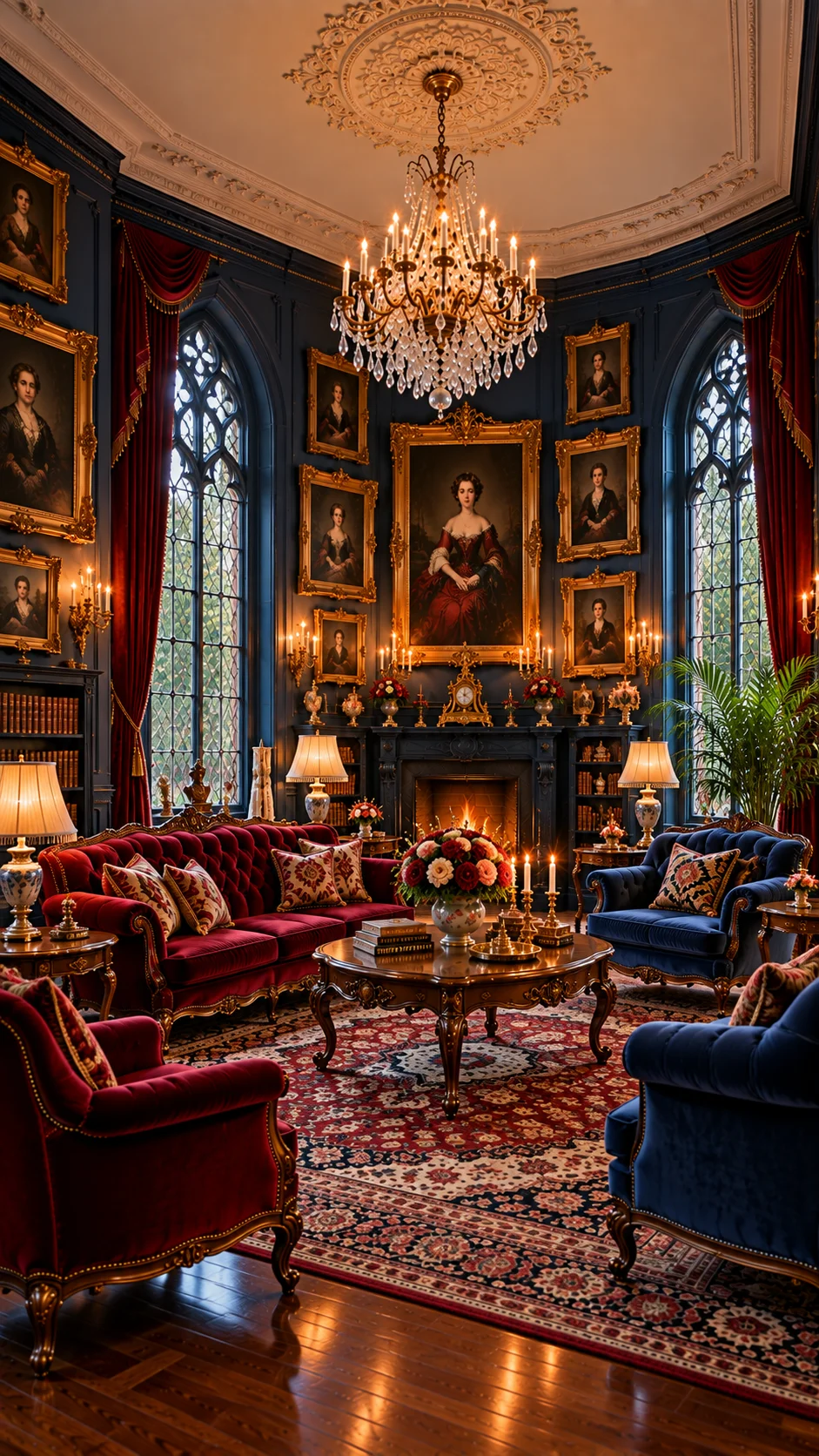
Red velvet covers the sofa and one armchair. Navy velvet covers the other two chairs, on the far side of the coffee table. Neither color gets the whole room, and that split is the idea worth stealing. When a single jewel tone upholsters every seat, it starts to read like wallpaper. Dividing it gives the eye somewhere to travel, and a big room ends up with two conversation spots instead of one.
The rug is what stops the split from looking accidental. Its pattern carries red, navy and cream together, so both seating groups have something to echo underfoot. Without a rug that contains both colors, the arrangement would probably look like two unrelated sets sharing a room. If you try this, choose the rug first and match upholstery to colors already in it. Patterned cushions in red and cream sit on the navy chairs too, which lets the colors cross over.
The dark blue walls help. Navy is deep enough that red velvet stays the loudest thing in the room, and the gilded frames repeat the gold trim on the furniture. The gallery wall, with one oversized portrait and smaller frames stepping down around it, follows the same all-in logic as maximalist living rooms that actually work, where the discipline comes from a limited palette and not from leaving walls bare.
Dark Paneled Walls Need Light at Four Heights
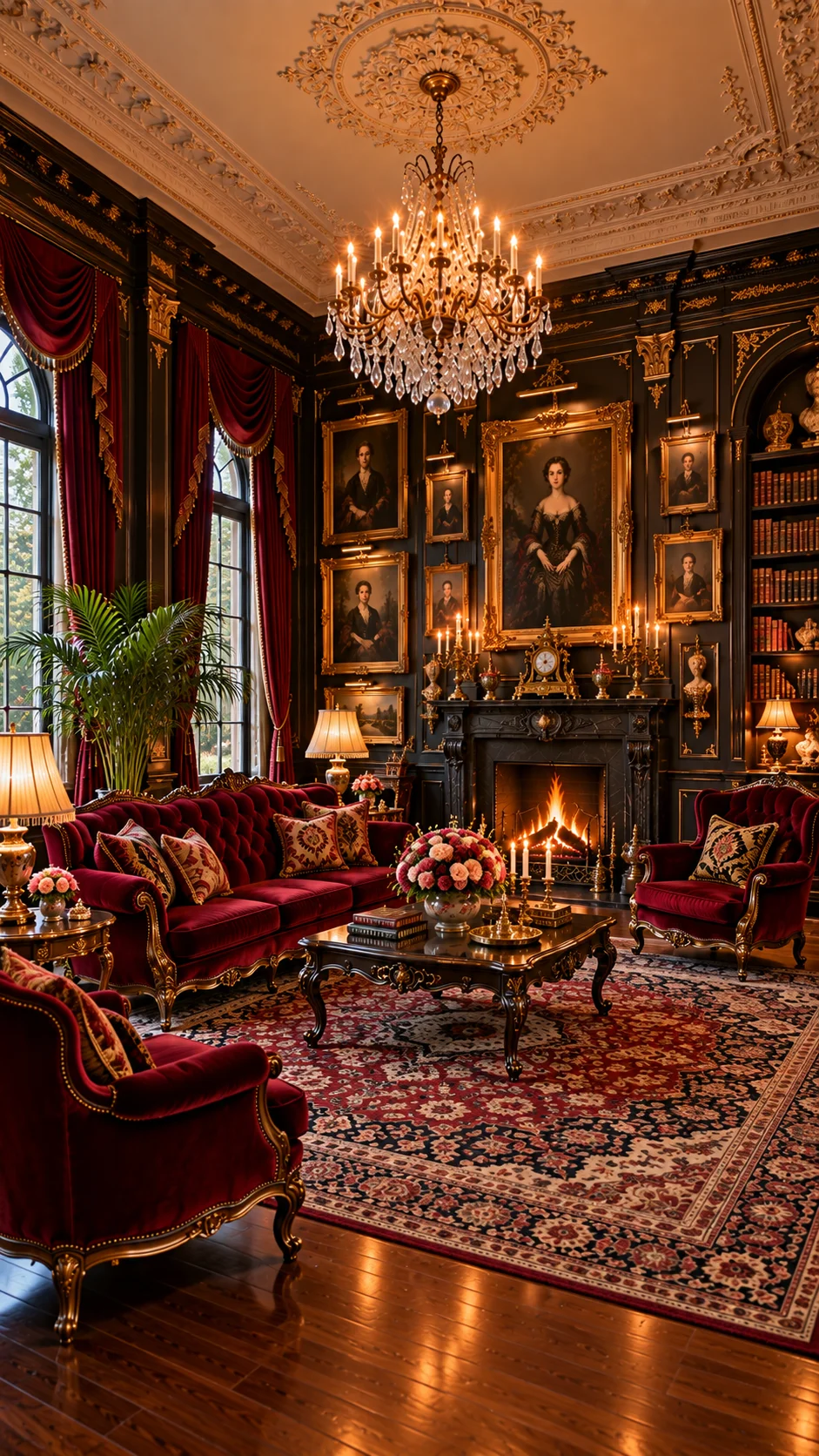
Near-black walls soak up light, so a room like this lives or dies on its lighting plan. This one layers light at four different heights. A crystal chandelier covers the ceiling. Small picture lights sit above the framed portraits. Shaded table lamps handle the sofa and chair level, and the mantel gets candles plus a lit fire, which add the lowest and warmest glow.
Spreading light this way means no single source has to do everything. A chandelier alone would leave the dark walls flat and the corners dim, while lamps alone would miss the gilt molding up near the ceiling, where much of the room’s detail sits. The gold trim on the carved paneling catches that light and gives dark paint a few bright edges to work with.
Scaling it down is straightforward. In a smaller room, skip the chandelier and keep the other three levels: a plug-in picture light over one large frame, two lamps, and a few candles (flameless ones work fine). Warm white bulbs, usually labeled around 2700K, keep gold looking like gold, while a cooler bulb can make the same trim look paler and flatter. If a dark room with a fire is the mood you want, these dark academia fireplace ideas cover it in more compact spaces.
A Pair of Tall Mirrors Does the Work of Extra Windows
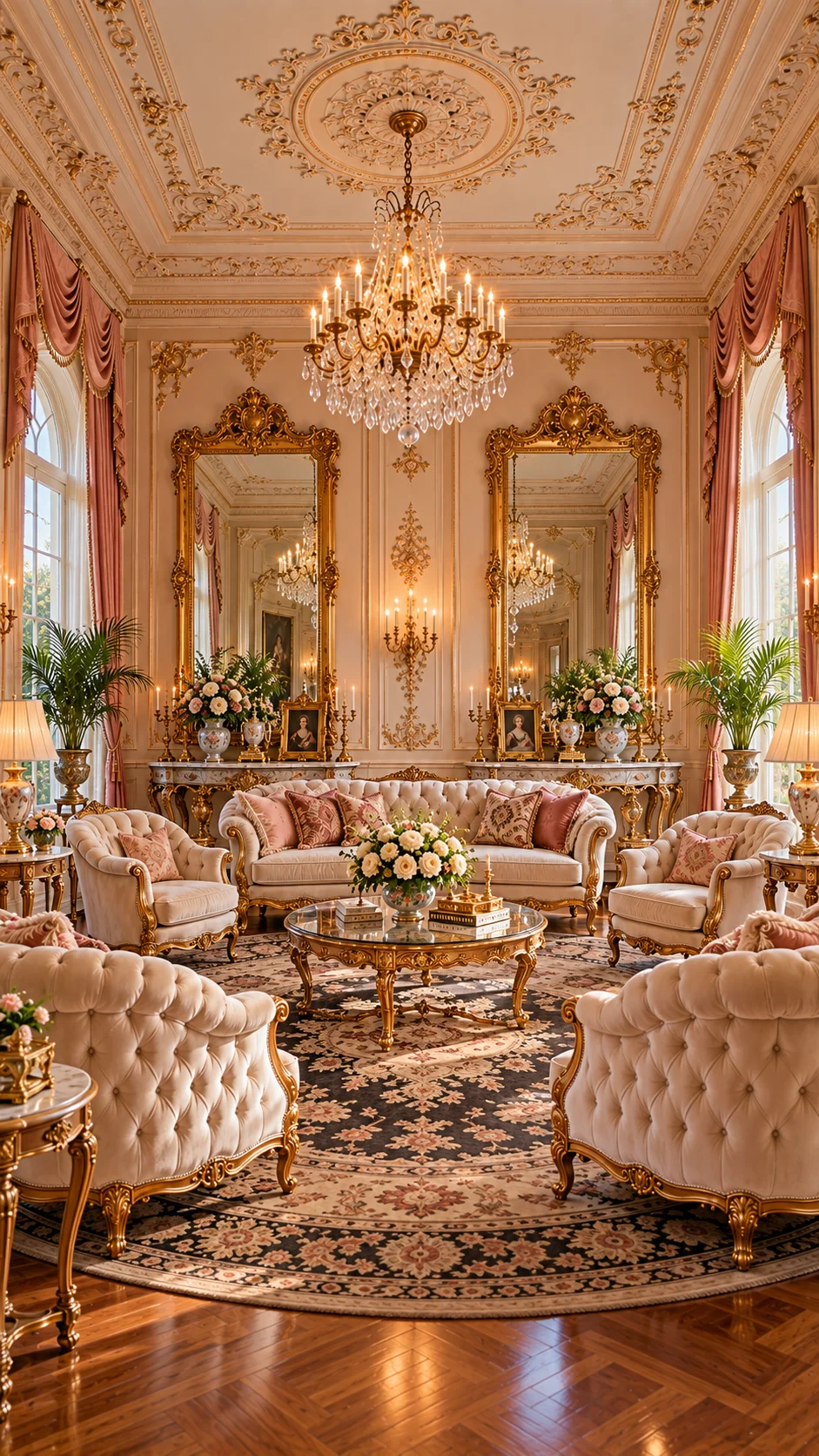
Two gilt-framed mirrors hang side by side on the wall behind the sofa, with a carved gold sconce between them. Each sits above a console table holding a bouquet and candlesticks, so the wall reads as two matched stations instead of one big blank. In the reflections you can make out a chandelier, an ornate ceiling and part of a framed portrait. The mirrors double the room’s strongest details as well as its floor space.
That’s the idea: choose a mirror for what it reflects. If a room has a good ceiling, a strong window wall or a standout light fixture, a large mirror brings that feature into a second part of the space. Placing one opposite or beside a window is the usual way to push daylight deeper into a room. Here the tall windows flank the room’s ends, and the mirrors face back across it, so they likely catch both the chandelier and the daylight.
The pale palette matters too. Cream, blush and gold are all light colors, so reflected light has little to absorb. Put the same mirrors against deep navy walls and the gain would be smaller. A smaller room can get by with a single tall mirror, and these wall mirror ideas for small rooms cover sizing and placement.
Two Facing Sofas and a Long Rug Make a Conversation Corridor
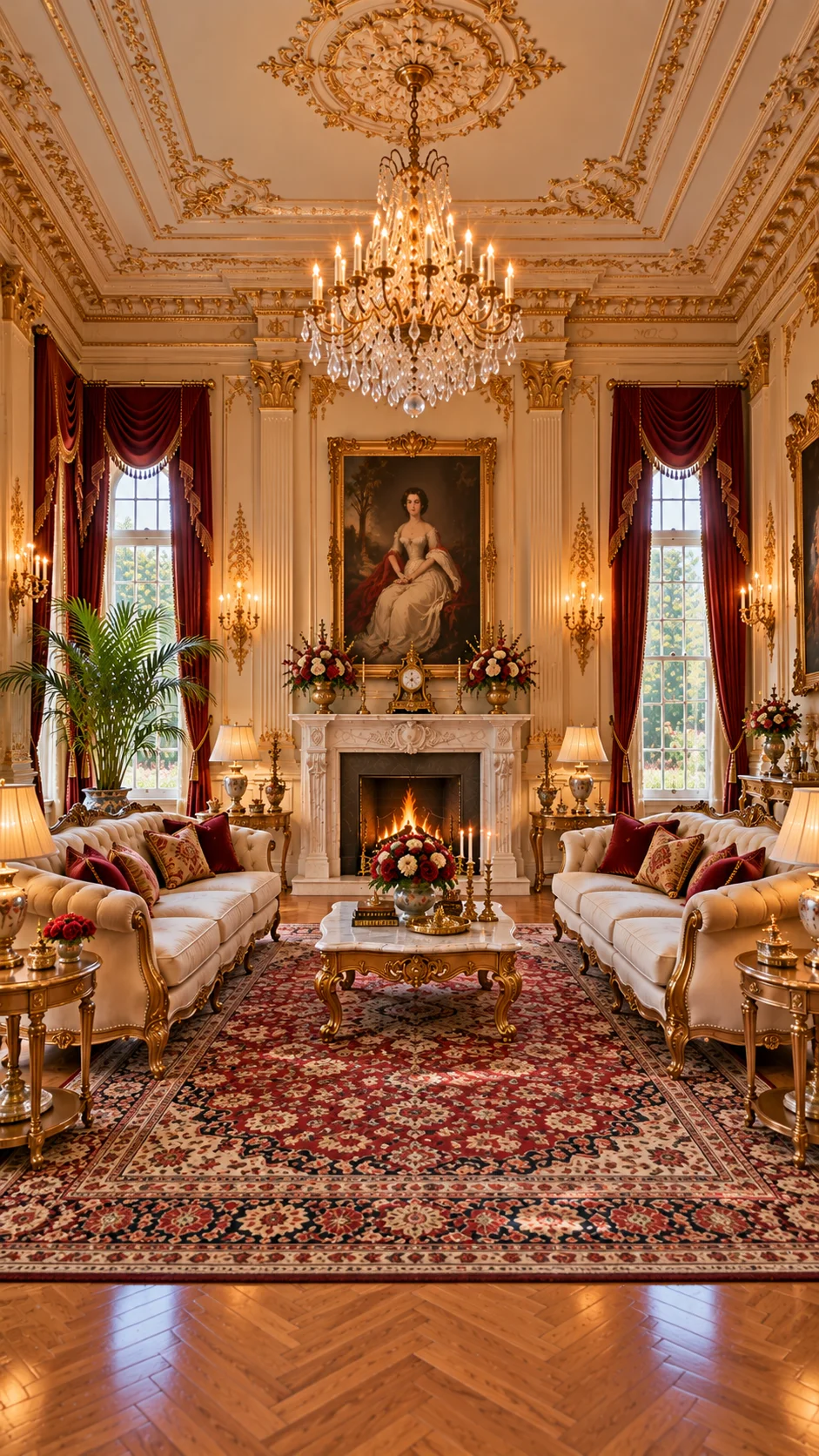
Instead of one sofa and a loose ring of chairs, this room sets two cream tufted sofas face to face, with a marble-topped coffee table between them and the fireplace at the head of the room. It’s a layout built for talking. Everyone can see everyone, nobody has to twist, and the low table sits within reach of both sides.
The long red rug does the structural work. It runs the length of the seating area, and the front legs of both sofas rest on its edges, so rug and furniture read as one unit. Matching lamps and side tables at each end, plus burgundy pillows on both sofas that echo the drapes, keep the symmetry tight. The fireplace wall is as full as they come, with a large portrait, fluted pilasters and mantel arrangements. If you’d like the plainer version, fireplace feature walls that prove less is more shows how little a mantel needs.
When Your Room Is Narrower Than This One
Facing sofas suit long, rectangular rooms, especially ones with a fireplace at the short end. In a squarer room, two full-size sofas can crowd each other and leave too little walking space. A sofa facing two armchairs gives a similar conversational feel with less bulk. A common guideline is roughly 14 to 18 inches between the sofa’s edge and the coffee table, which is close enough to reach and far enough to walk past.
Giving a Grand Piano Its Own Zone
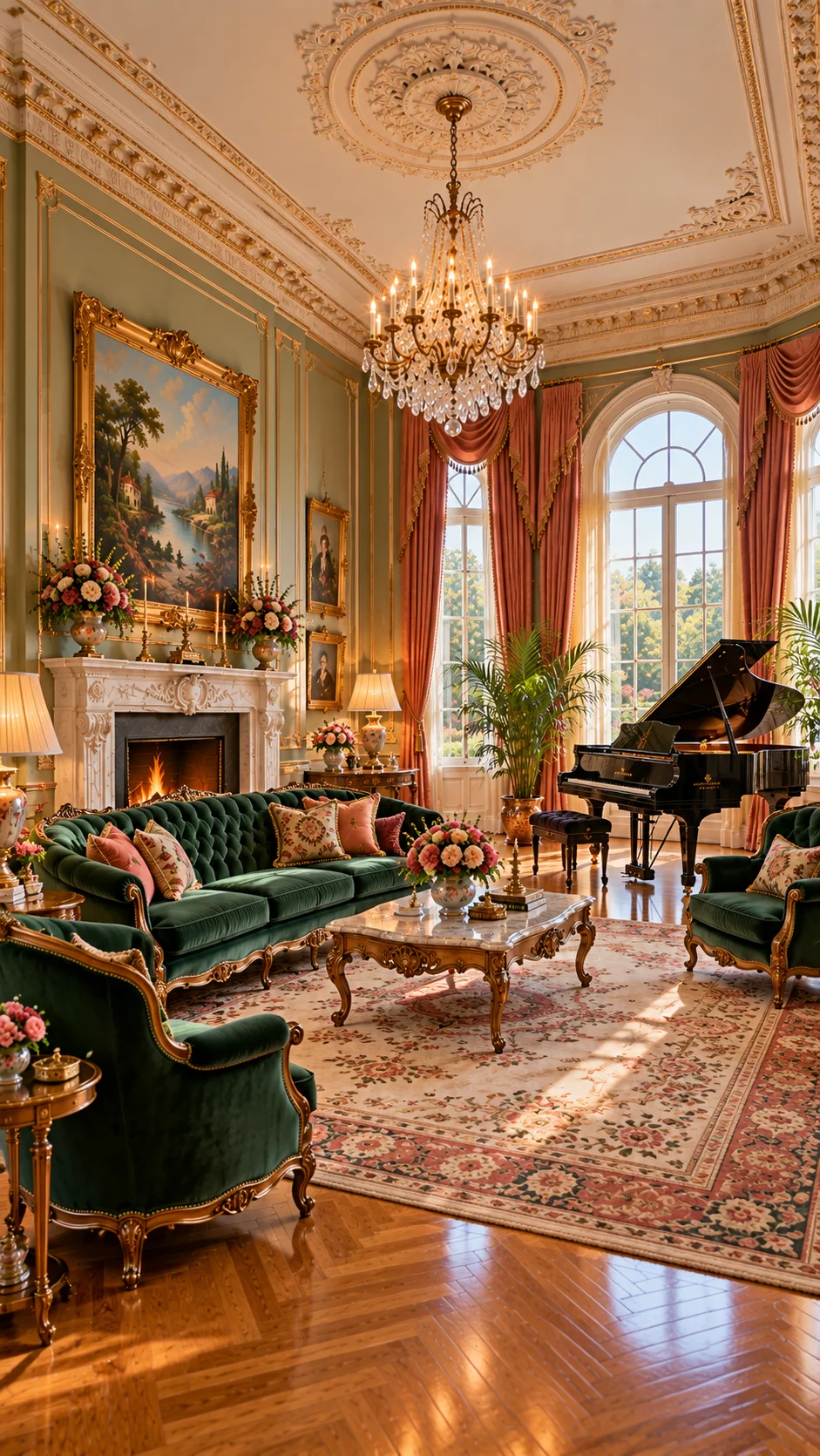
A grand piano shares this room with a full sofa group, and the layout keeps the two apart. Green velvet seating clusters around the white fireplace on the left. The piano sits near the tall arched windows on the right, bench pulled up, with a large palm beside it. The seating gets a rug underneath, and the piano gets bare herringbone floor and room to breathe.
Separating them is practical as well as visual. A player needs elbow room, and a grand’s raised lid needs clearance. The window position also gives light for reading music, though it comes with a catch: pianos are generally sensitive to humidity swings and strong direct sun, which can stress the wood and finish over time. A spot slightly off the glass, or sheer curtains on the sunniest side, would be a safer choice than sitting the instrument right against a south-facing window.
The wall and drapery colors deserve a note too. Sage green walls and coral-pink drapes sit roughly opposite each other on the color wheel, but both are soft enough that they don’t fight. A polished black piano against that muted green looks calm. For more on building a room around this wall color, see these sage green living room design principles.
Hang Drapes at the Ceiling Line, Not the Window Frame
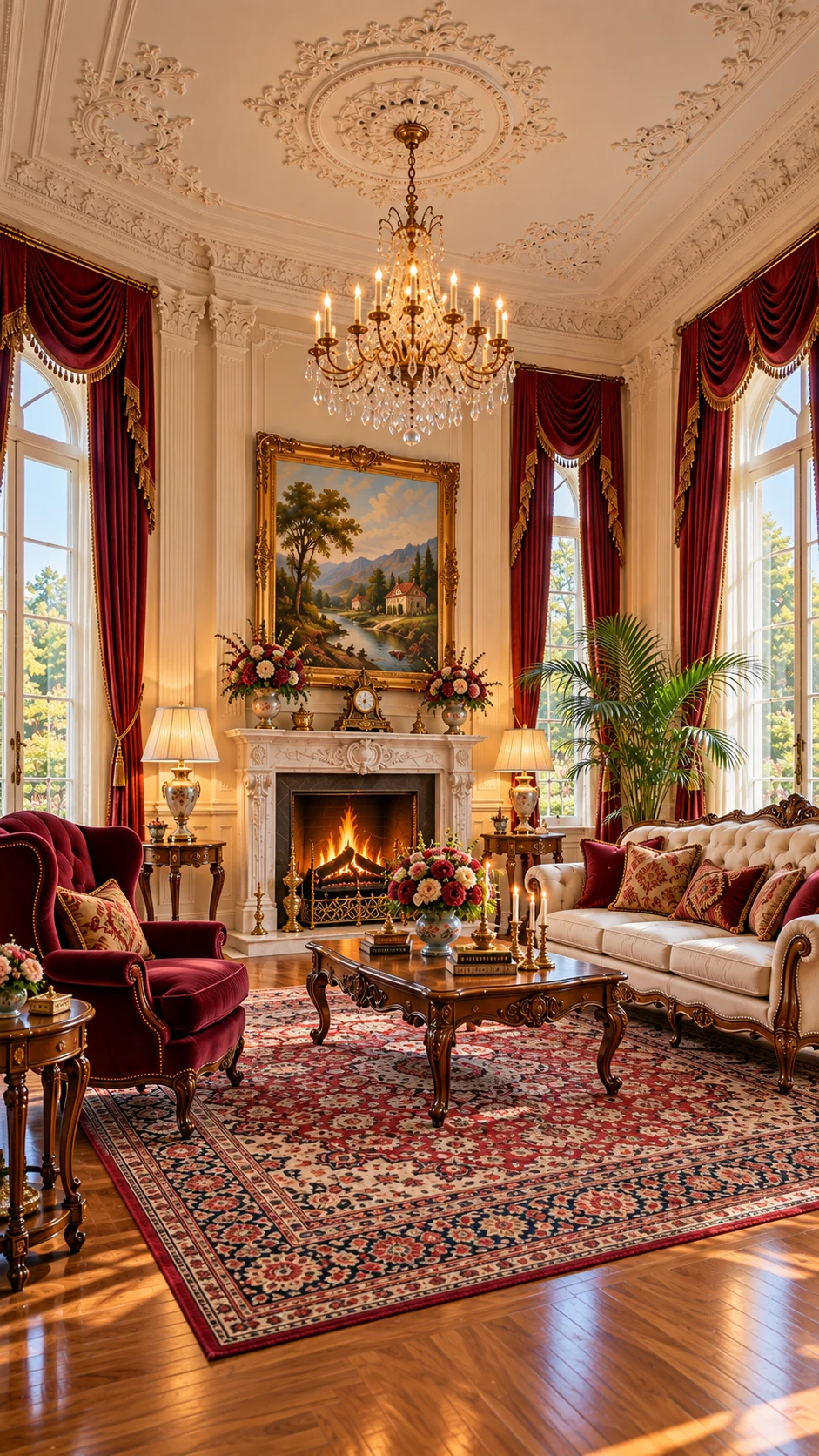
The burgundy panels here start high, just under the crown molding and well above the arched window tops, then fall straight to the floor. A gathered valance with gold fringe sits across the top. Hanging drapes this way makes the windows read taller than they are, and with a ceiling this high it also fills the blank wall between the window and the cornice.
The panels stack at the sides and leave much of the glass clear. That matters in a room whose main light source is the window, since the cream walls, pale sofa and polished floor all depend on that daylight to look warm.
A standard-height ceiling can borrow the trick on a smaller scale. Mount the rod several inches above the window frame, or closer to the ceiling, and choose panels long enough to graze the floor. The trade-off is fabric: it takes noticeably more than a window-height rod does. One burgundy wing chair beside the cream sofa repeats the drapery color at seat level, so the red doesn’t feel stranded up at the windows.
One Rose Motif at Four Different Scales
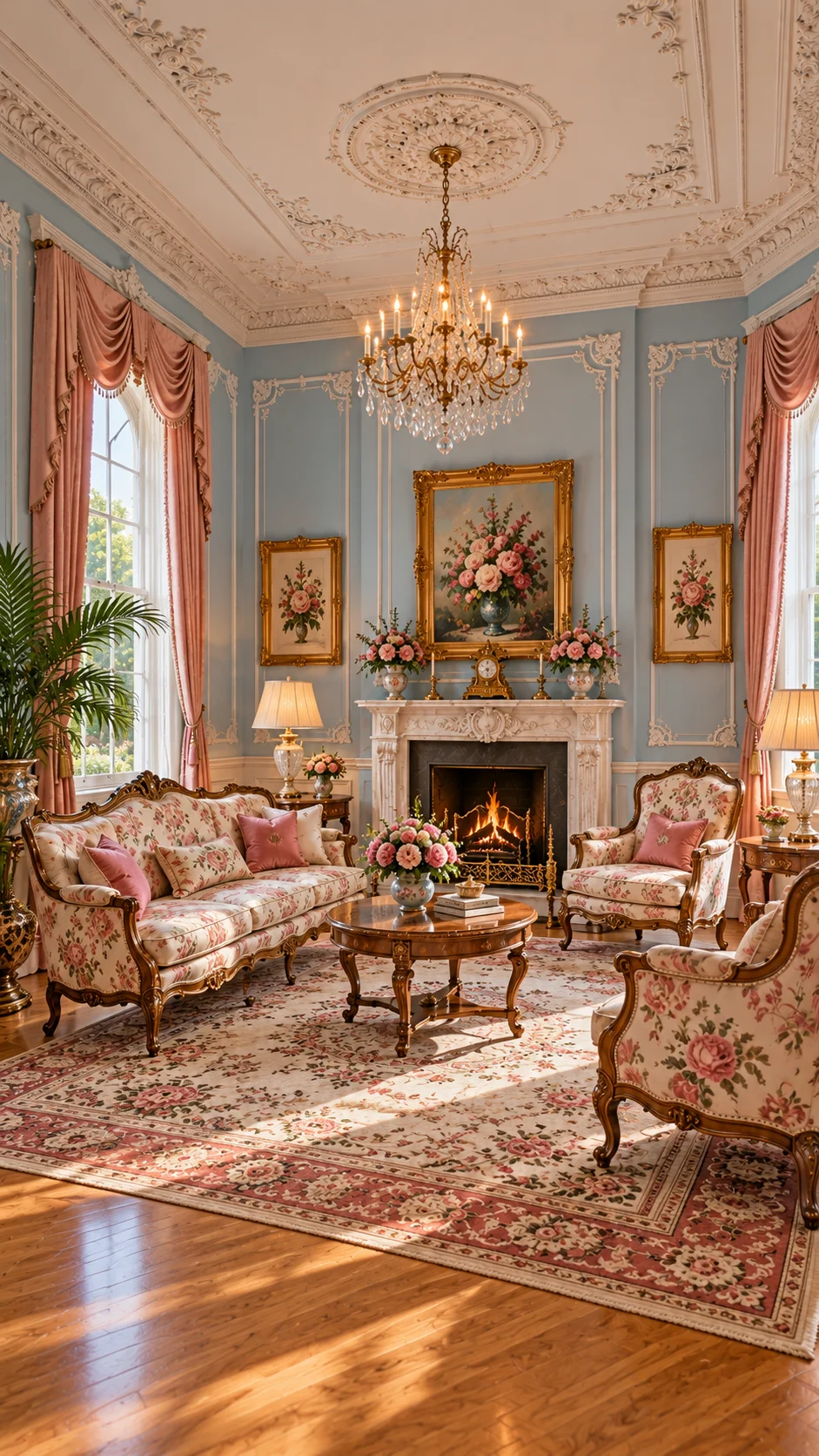
Roses show up all over this pale blue room, and it works because they’re sized differently each time. A large rose still life hangs over the fireplace, flanked by smaller framed bouquets. The sofa and armchairs wear a mid-size floral print, the rug carries a smaller floral pattern, and fresh pink bouquets sit on the mantel and coffee table. One motif repeated at large, medium and small scale tends to read as a theme, because the eye keeps recognizing the same shape.
Two details keep the pattern from running away. The upholstery has a cream background, so the flowers have space around them, and solid pink pillows on the sofa and chair give the eye a plain place to rest. The wall color helps as well. Pale blue with white molding panels is a cool, quiet backdrop that lets the pinks read warmer.
Florals on every large surface are a bigger commitment than most people want. Start with one chair and a rug that echoes its colors, then add from there. These floral printed furniture ideas go deeper on making patterned pieces look grown-up.
A Modern Painting in a Traditional Gold Frame
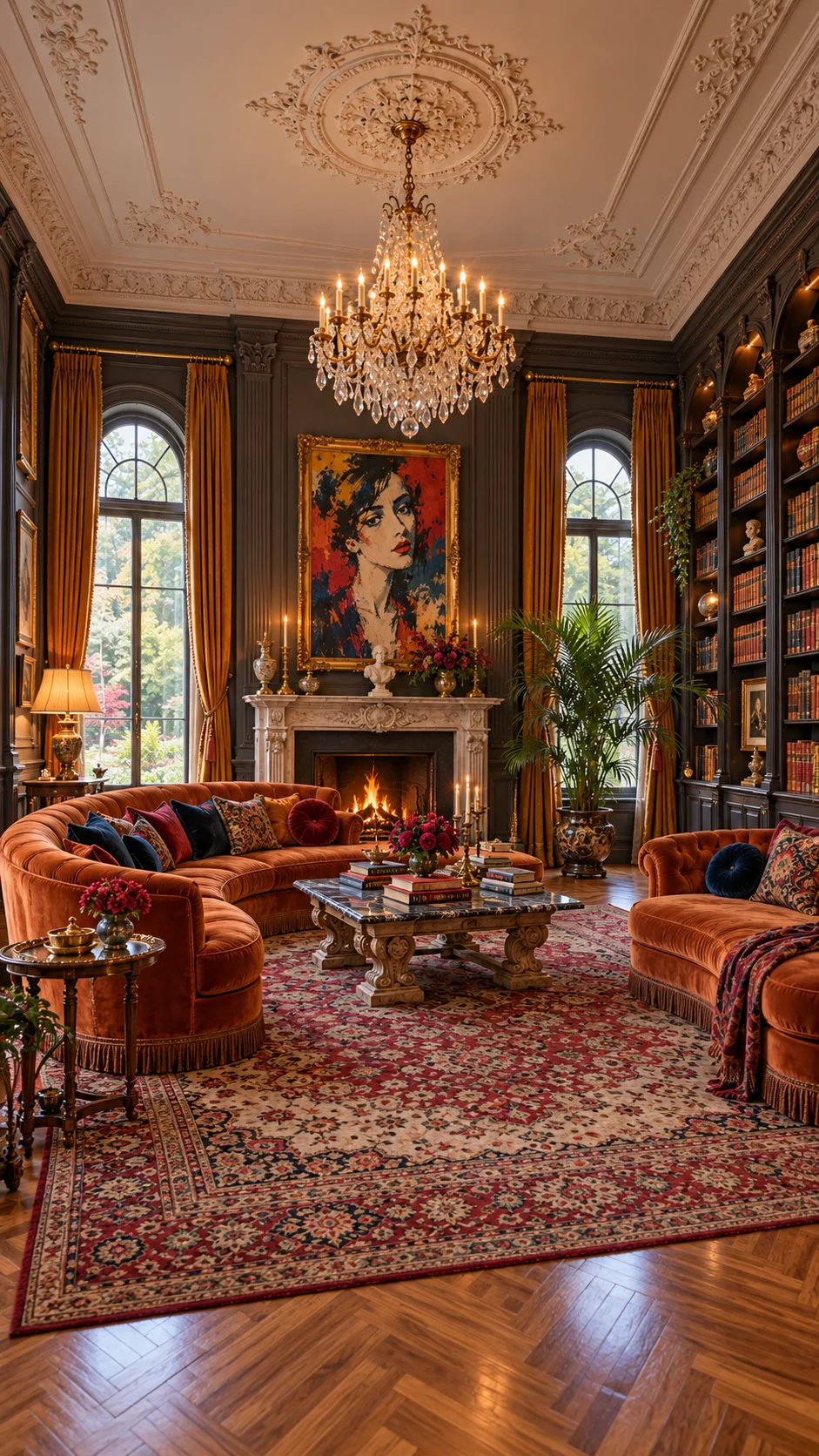
The art above this fireplace is a loose, painterly portrait in red, navy and orange strokes, but it hangs in a heavy gilded frame that would suit an old master. That contrast keeps a modern picture from feeling dropped in. The frame speaks the room’s language while the paint does the surprising part. If your room is traditional and your taste isn’t, this is a low-risk way to bring in contemporary art.
The painting also borrows from the room’s palette. Its reds repeat in the rug and the dark red cushions, its navy shows up in the blue pillows, and its orange sits close to the rust velvet on the sofas. That overlap makes the piece look chosen for the room instead of added to it.
The seating is worth a look as well. Two rounded rust-colored sofas with fringe at the base face each other across a stone-topped table, in front of floor-to-ceiling bookshelves. Curves soften a room full of straight shelving and rectangular panels. For more on that side of the look, see how warm tones and curved furniture are returning in living rooms.
A Seascape That Repeats the View Outside
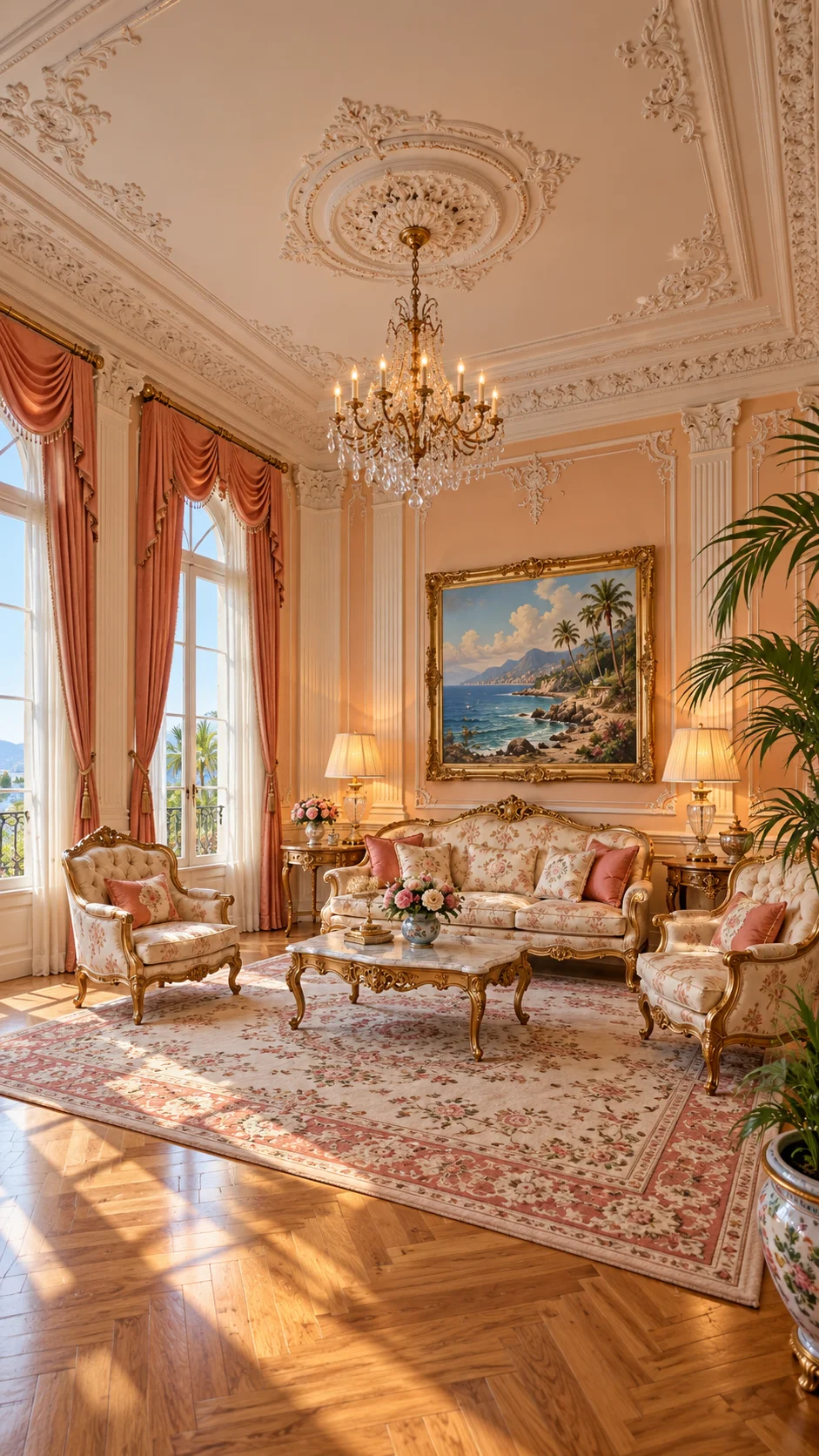
The tall windows in this peach-walled room open onto palms, a balcony railing and what appears to be the sea, and the large gilt-framed painting on the wall shows a coastline with palm trees. That echo ties the room to its location. The painting is the view you can keep looking at when the windows are behind you or the weather turns.
Peach walls with coral drapes are a bold choice, and strong daylight carries them well. In the image, sun patches cross the herringbone floor and the walls glow. In a room with weaker light, the same peach may read flatter or more orange, so test a large sample at different times of day before painting. The white ceiling relief and wall moldings help here, since they break the peach into panels and keep it from feeling heavy. The cream sofa and chairs, with their small floral print, stay quiet and let the walls lead.
If you don’t have a sea view, the idea still holds. Whatever the windows show (garden, hills, rooftops), choose art with a similar subject and the room will feel anchored to its place.
Frequently Asked Questions
Can a small living room carry a Victorian look?
Yes, if you pick three things instead of thirty: one tufted or carved-frame piece such as a sofa or a pair of chairs, one gilded frame or mirror large enough to matter, and a rug with a traditional pattern. A full chandelier needs ceiling height. Under roughly 8 feet, a flush or semi-flush crystal fixture will likely look better proportioned.
Is velvet practical with kids or pets?
It can be. Densely woven performance velvet (usually polyester) generally resists wear and wipes down better than natural-fiber velvet. Ask the seller for the fabric’s abrasion rating, often listed as double rubs, and request a sample to test with a damp cloth before committing to a full sofa.
Which wall color suits a Victorian living room?
It depends on when you use the room. Dark navy or charcoal walls absorb light, so they suit rooms used mostly in the evening, with plenty of lamps. Pale blue, sage, cream or peach reflect more daylight and suit rooms that get strong sun, as the nine rooms above show.
Do I need a working fireplace?
No. All nine rooms point their furniture at one, but a mantel with a large mirror or painting above it gives the seating the same place to face. An electric insert can fill the opening if you want visible flame without a chimney.
What to Borrow First
Nine rooms, nine different decisions, and hardly any of them depend on square footage. Splitting a color between two seating groups, lighting a dark wall at four heights, choosing a mirror for what it reflects, hanging drapes high: each one can be done with a single piece or a single wall. If you’re starting from nothing, the rug and the lighting are the two choices that set up everything else. Get those right, and the velvet, the gilt frames and the chandelier can arrive slowly, one decision at a time.
About the Author: Aesthetic Life Team. The Aesthetic Life editorial team covers home décor, interior styling and design inspiration for living rooms, bedrooms, kitchens and outdoor spaces.