

Laundry rooms don’t usually get much design attention, but they’re one of the few rooms in the house you visit almost every day, whether you want to or not. These ten rooms treat that reality as an opportunity instead of an afterthought, using warm wood, worn textiles, and living plants to make a purely functional space feel like somewhere you’d actually choose to spend twenty minutes. Each one solves the same short list of problems — machines, folding space, storage — in a genuinely different way. The goal here isn’t to admire all ten. It’s to figure out which one actually fits your space, your budget, and how much upkeep you’re realistically willing to take on.
Quick Overview
| Style | Boho / Eclectic Boho |
| Best For | Small to mid-size laundry rooms, mudroom-laundry combos |
| Budget | Low–Medium |
| Difficulty | Easy, DIY-friendly |
| Maintenance Level | Low–Medium |
A Laundry Nook Built Around One Big Rug
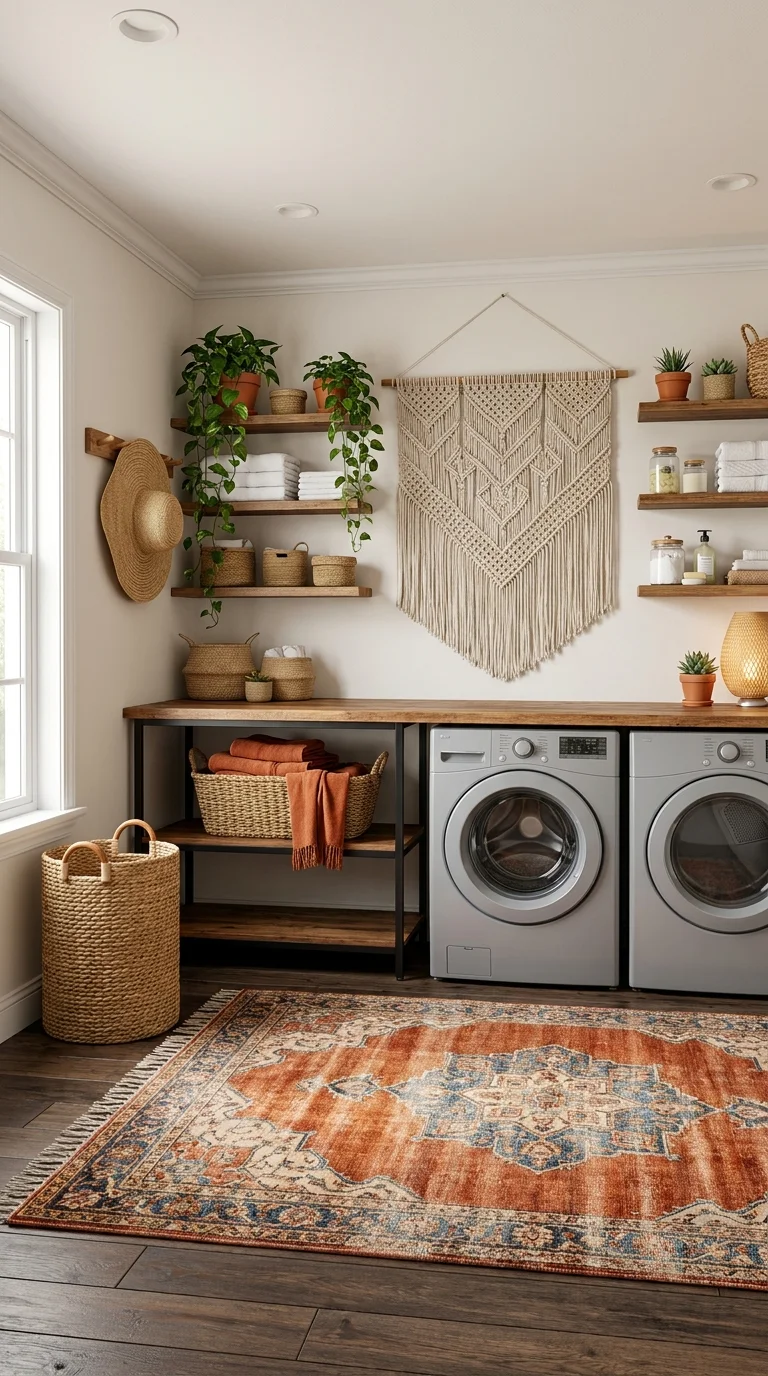
This room’s most unusual decision is also its smartest one: a large, faded medallion rug that would normally live in a living room instead anchors a laundry nook. Everything else — the macrame wall hanging, the trailing plants, the mixed rattan baskets — reads as layered texture rather than a matched set, which is exactly what makes it feel collected instead of decorated in one trip to a store.
The rug is doing more work than decoration here. Warm rust and blue tones pull together the wood counter, the terracotta pots, and the black metal shelving frame, so a room with four different materials in it still reads as one palette. That’s a genuinely useful trick for anyone whose laundry room inherited whatever flooring and appliances came with the house: a bold rug can unify a space you didn’t get to choose from scratch.
This design suits renters and first apartments especially well, since almost nothing here is permanent. The open shelving, the hanging macrame, the baskets — all of it can travel to the next place. It also suits anyone who already owns a few boho pieces from other rooms and wants a way to bring them together rather than buying a new matching set specifically for the laundry room.
The practical tradeoff is that a rug this size in a laundry room lives directly in the path of lint, dropped detergent, and dripped water from wet clothes on their way to the dryer. It needs to be washable or, at minimum, easy to shake out, or it becomes another chore rather than a design win. A jute or low-pile washable rug — the same category covered in these rug styles worth considering for busy rooms — gets the same visual effect with far less risk.
To recreate this on a smaller footprint, start with the rug and build outward from its colors rather than starting with the shelving. Pick two or three rug colors and let those show up again in the towels, the baskets, and one plant pot — that’s the repetition that makes a mixed-materials room feel intentional instead of random. On a tighter budget, a single macrame piece and a thrifted vintage-style rug will get most of the visual impact without the cost of the open shelving unit.
The most common mistake with this look is matching everything instead of repeating a color. A boho laundry room isn’t supposed to feel like a coordinated set — it’s supposed to feel gathered over time, which means texture and pattern variety matters more than uniformity.
Why the Repeated Rust Tone Is the Room’s Real Structure
The rug’s rust-orange repeats in the folded towels sitting on the shelf and in one terracotta pot — a detail easy to miss on a first look, but it’s the reason the room reads as put-together rather than cluttered. Swap that towel color for white and the whole room would likely feel one degree less resolved, even though nothing structural changed. It’s a small, low-cost lesson: one repeated color does more visual work than several expensive new pieces.
Recommended Materials: reclaimed or stained wood countertop, black powder-coated metal shelf frame, natural rattan and seagrass baskets, macrame cotton rope, terracotta planters.
Main Colors: Warm Rust, Terracotta, Faded Indigo, Cream, Aged Black.
Best Lighting: This room relies on a mix of a nearby window and recessed ceiling fixtures — daylight is doing most of the color work here, so a warm-white bulb (not cool daylight) keeps the rust and terracotta tones from looking washed out after dark.
Maintenance: The trailing plants on the open shelf need regular dusting since laundry rooms accumulate lint in the air, and the macrame hanging should be vacuumed gently on a low setting every few weeks to keep it from collecting the same lint.
Where This Look Falls Apart
- Choosing a rug that isn’t washable or spot-cleanable for a room that regularly sees water and detergent spills
- Buying an entirely matched rattan collection instead of mixing basket shapes and weaves
- Skipping the color repetition step and treating the rug as a stand-alone statement piece
- Overcrowding the open shelving so the plants and baskets lose their breathing room
A Golden-Hour Laundry Corner Built on Warmth, Not Color
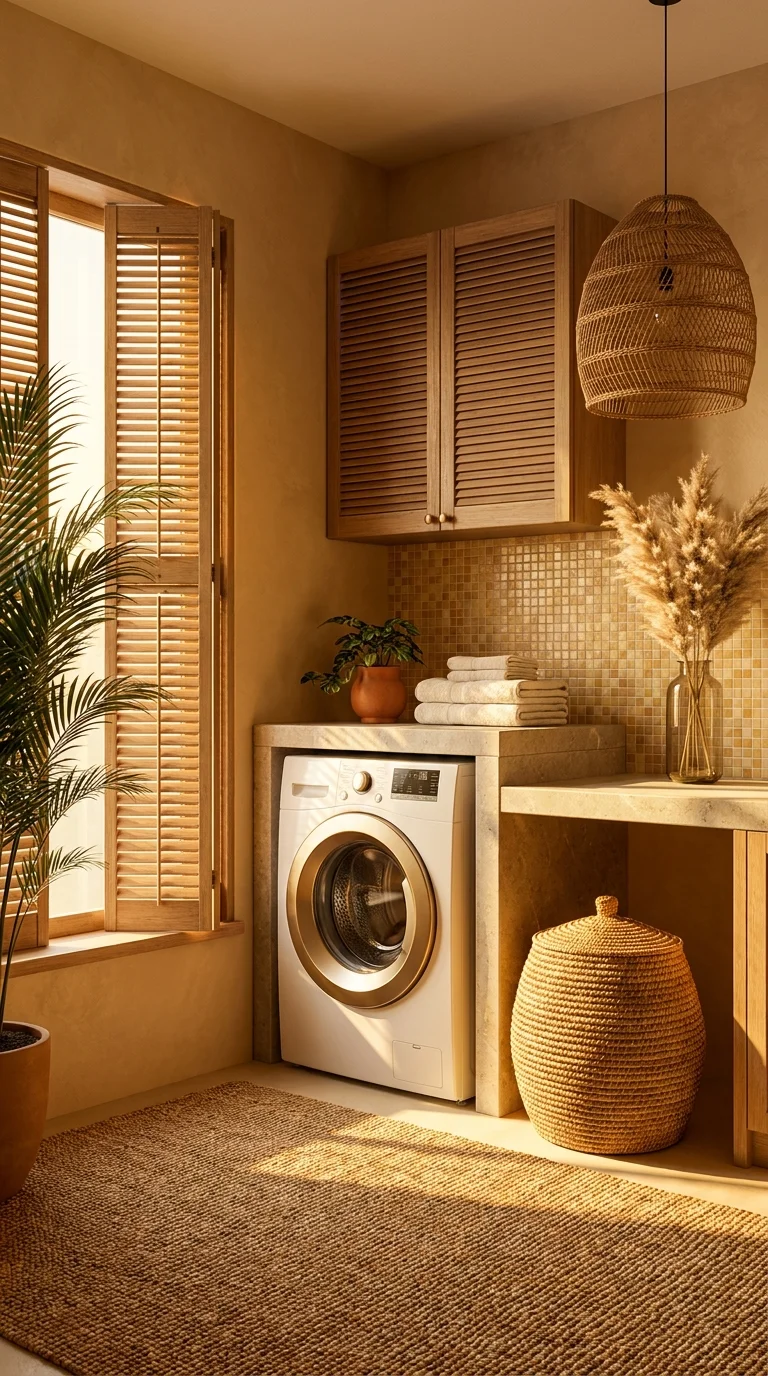
Where most boho rooms lean on color contrast, this one leans entirely on temperature — every material here, from the tiled backsplash to the wood shutters to the woven pendant, sits somewhere on the same warm amber scale. The effect is closer to a sun-drenched Moroccan riad than a typical American laundry room, and it’s achieved with almost no actual color variety at all.
The mosaic tile backsplash is the room’s quiet workhorse. Its small, irregular gold-and-cream tiles catch the afternoon light differently than a single large tile would, giving the wall a subtle shimmer that a flat surface couldn’t produce. Paired with the stone countertop, it also solves a real functional problem: both materials shrug off water and heat far better than the painted drywall a laundry room usually gets stuck with.
This design is best suited to a south- or west-facing laundry room that already gets strong natural light in the afternoon, since the entire look depends on that warm glow to read correctly — the same room under cool north light or fluorescent tubes would feel flat rather than golden. It also suits someone drawn to a Mediterranean or desert-modern aesthetic elsewhere in the home, since this room would feel disconnected next to a cooler-toned kitchen or hallway.
The honest compromise is that a room this warm-toned can feel closed-in rather than cozy if the space is genuinely small or dim. Warmth reads as inviting in a sunlit room and can read as cramped in one that isn’t.
For a lower-cost version, a peel-and-apply mosaic backsplash panel and a warm LED bulb swap can approximate the effect without retiling. The pampas grass and woven pendant are inexpensive additions that do a lot of the atmosphere-building on their own.
Recommended Materials: gold-toned mosaic tile, natural stone or stone-look laminate counter, stained wood louvered shutters and cabinetry, woven rattan pendant shade, terracotta plant pot.
Main Colors: Warm Gold, Honey Amber, Terracotta, Cream, Deep Walnut.
Best Lighting: Natural afternoon sun is the star here; supplement with a warm 2700K bulb in the pendant rather than a bright white one, which would fight the room’s amber cast.
Maintenance: Stone countertops need periodic resealing to resist detergent staining, and pampas grass should be kept dust-free with an occasional gentle shake outdoors rather than washed.
A Palette Built Around One Temperature, Not Several Colors
- Introducing a cool-toned accent (like a blue rug or gray basket) that fights the room’s single warm temperature
- Using a bright white or cool LED bulb that flattens the golden effect entirely
- Skipping a sealant on natural stone counters in a room that sees constant detergent splash
- Overfilling the small counter surface so the mosaic backsplash — the room’s real feature — gets visually crowded out
A Farmhouse Sink Splitting Two Machines Down the Middle
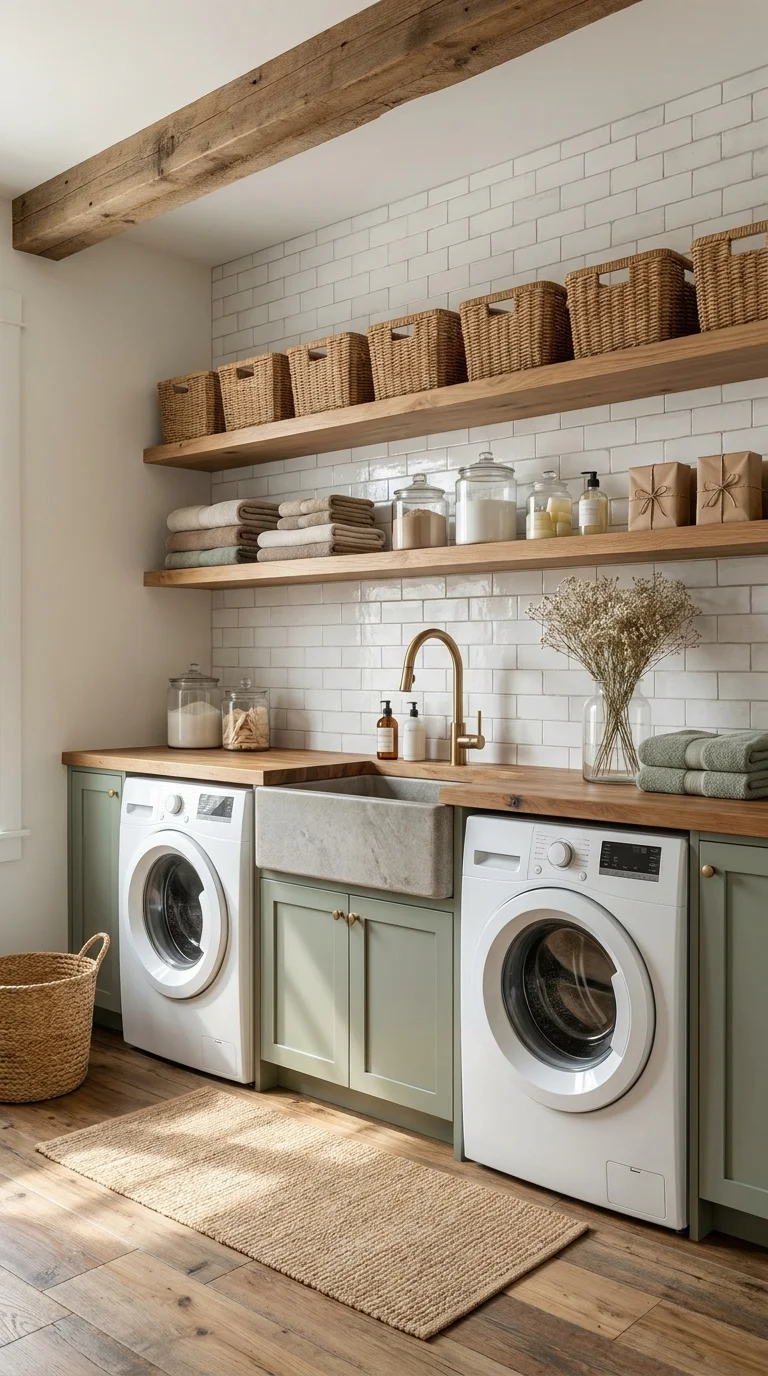
Most laundry rooms treat the washer and dryer as a single unit pushed against a wall. This one does something rarer: it puts a farmhouse apron sink directly between two separate machines, turning the counter into a genuine workstation rather than just a lid over the appliances. It’s the kind of layout choice that only works with enough width to spare, but where the reader’s eye lands first tells the whole story — it’s the sink, not the washer, that anchors the room.
That sink placement is a functional decision disguised as an aesthetic one. Pre-treating a stain, hand-washing a delicate item, or rinsing out a mop all need running water right at counter height, and most laundry rooms send you to a bathroom or kitchen sink for that instead. Building the sink into the counter removes an entire category of extra trips.
The sage green shaker cabinetry below is doing quieter work — it’s soft enough not to compete with the exposed wood beam overhead, but saturated enough to read as an intentional color choice rather than a leftover builder-grade white. Paired with white subway tile — the same material doing quiet work in these boho kitchens built from simple materials — and a brass gooseneck faucet, the palette stays firmly in classic farmhouse territory even though the layout is unusually functional for the style.
This idea suits larger laundry rooms with plumbing already nearby, since adding a full apron sink mid-counter is a real plumbing project, not a weekend DIY. It’s a strong match for anyone who does a meaningful amount of hand-washing, gardening cleanup, or pet-washing and has been improvising with a bathroom sink until now.
Worth noting for smaller budgets: the two-basin farmhouse sink is the most expensive single element in this room by a wide margin. A single bar sink or even a deep utility sink from a hardware store gets most of the function at a fraction of the cost, without needing the extra counter width.
Recommended Materials: white subway tile, natural wood ceiling beam, painted sage green shaker cabinetry, butcher block or reclaimed wood countertop, fireclay farmhouse sink, brushed brass fixtures.
Main Colors: Sage Green, White, Warm Oak, Brass, Cream.
Best Lighting: Overhead can lighting plus under-shelf task lighting directly above the sink and folding area — a farmhouse sink used for actual washing needs brighter, cooler task light than the rest of a boho room typically wants.
Where the Eye Actually Lands First
Even with two visible washers flanking it, the sink pulls focus first — its deeper basin and contrasting white against the wood counter create a visual break that a single continuous countertop wouldn’t. That’s a deliberate way to keep a purely mechanical room from reading as just two appliances side by side.
Common mistakes to avoid:
- Adding a full apron sink without confirming the plumbing can support two water sources on one wall
- Choosing a faucet finish that doesn’t match anything else in the room, breaking the cohesive brass-and-sage palette
- Placing the sink so close to one machine that loading or unloading laundry becomes awkward
- Using open shelving above the sink for anything that can’t handle occasional water splash
A Deep Green Cabinet Wall With a Porthole Mirror
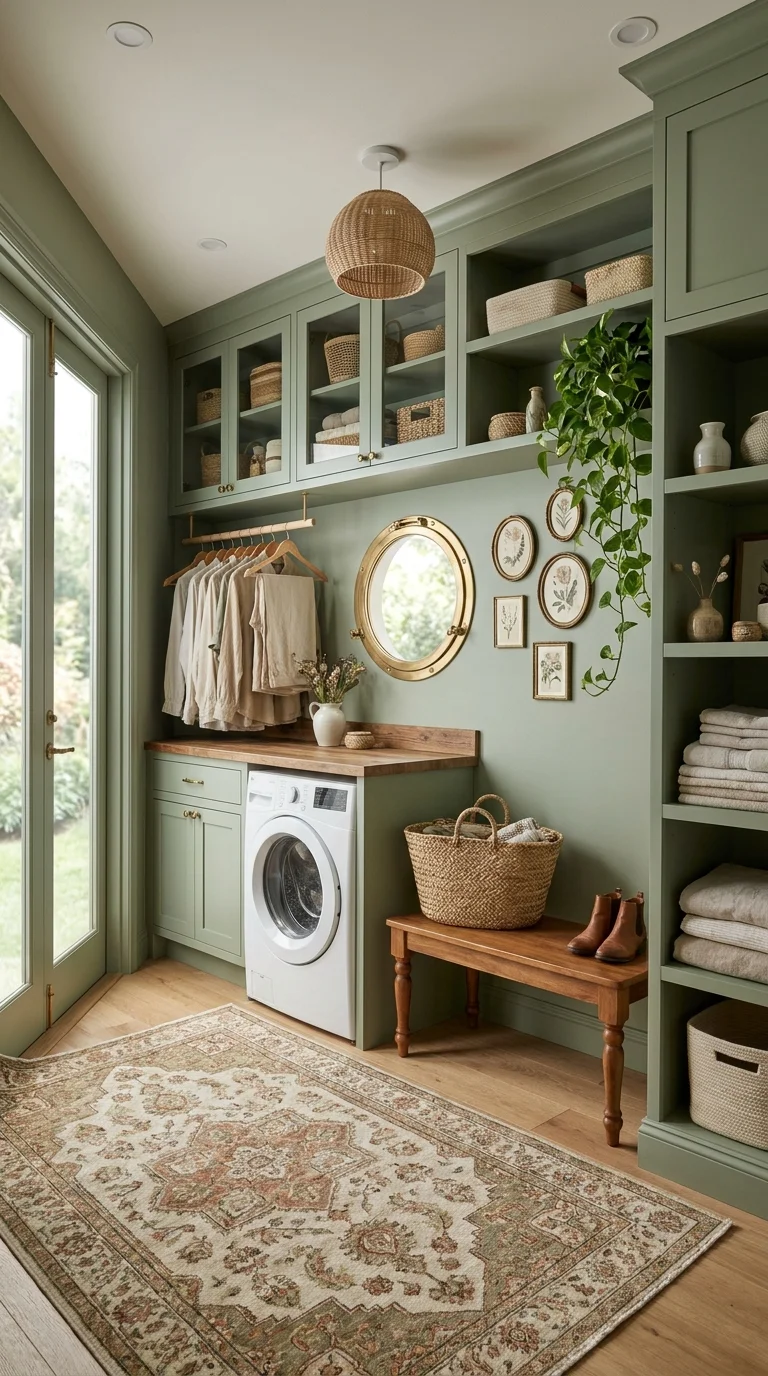
This laundry room commits to color in a way most of the others don’t — floor-to-ceiling sage-olive cabinetry wraps the entire wall, turning what’s usually a white utility box into something closer to a furnished room. Inside that bold backdrop, a small brass porthole mirror becomes the single most interesting object in the space purely because of scale: it’s tiny compared to the cabinetry surrounding it, and that size contrast is what makes it worth a second look rather than a glance.
A mirror this size wouldn’t register in a plain white laundry room the way it does here. Against a wall of uninterrupted color, even a modest object gets visual weight it wouldn’t otherwise earn — the same porthole mirror hung on a white wall would likely read as an afterthought instead of a focal point. Scale relative to its surroundings, not size on its own, is what makes an object feel intentional.
The gallery wall of small botanical prints surrounding the mirror reinforces the same idea in miniature — none of the individual frames are large, but grouped together against the deep green, they read as a considered collection rather than scattered decor.
This design is best suited to larger laundry rooms with real storage needs, since wrapping the entire wall in cabinetry only makes sense if there’s enough length to also include open shelving, a hanging rod, and a bench — the same trio that anchors many boho entryways built around rattan and texture — a small closet-sized laundry room would feel overwhelmed by this much color and cabinetry in close quarters.
The honest compromise: painting or installing this much cabinetry is a serious investment of both money and time, and a color this saturated is genuinely difficult to change your mind about later. Committing to full-wall sage-olive means living with it for years, not one season.
Recommended Materials: painted shaker-style built-in cabinetry, brass porthole mirror and hardware, reclaimed wood bench, natural rattan basket, framed botanical prints.
Main Colors: Deep Sage Olive, Brass, Cream, Warm Oak, Terracotta accents.
Best Lighting: Natural light from the glass garden doors carries most of the room during the day; a warm brass sconce or pendant is worth adding for evening laundry runs since the deep green will otherwise absorb a lot of overhead light.
Maintenance: None of the materials here need special upkeep beyond standard cabinet cleaning — this is one of the lower-maintenance looks in this list precisely because it skips high-upkeep plants and natural fiber rugs in favor of hard, wipeable surfaces.
Easy Ways to Get This Wrong
- Choosing a mirror or hardware finish too large or bold, which cancels out the intentional scale contrast
- Painting only part of the cabinetry run, which reads as unfinished rather than deliberately bold
- Skipping evening lighting, leaving the deep green wall looking flat and cave-like after dark
- Hanging the gallery wall in a perfectly even grid, which fights the room’s otherwise relaxed, gathered feel
A Hand-Painted Floral Wall Framed by a Twig Wreath
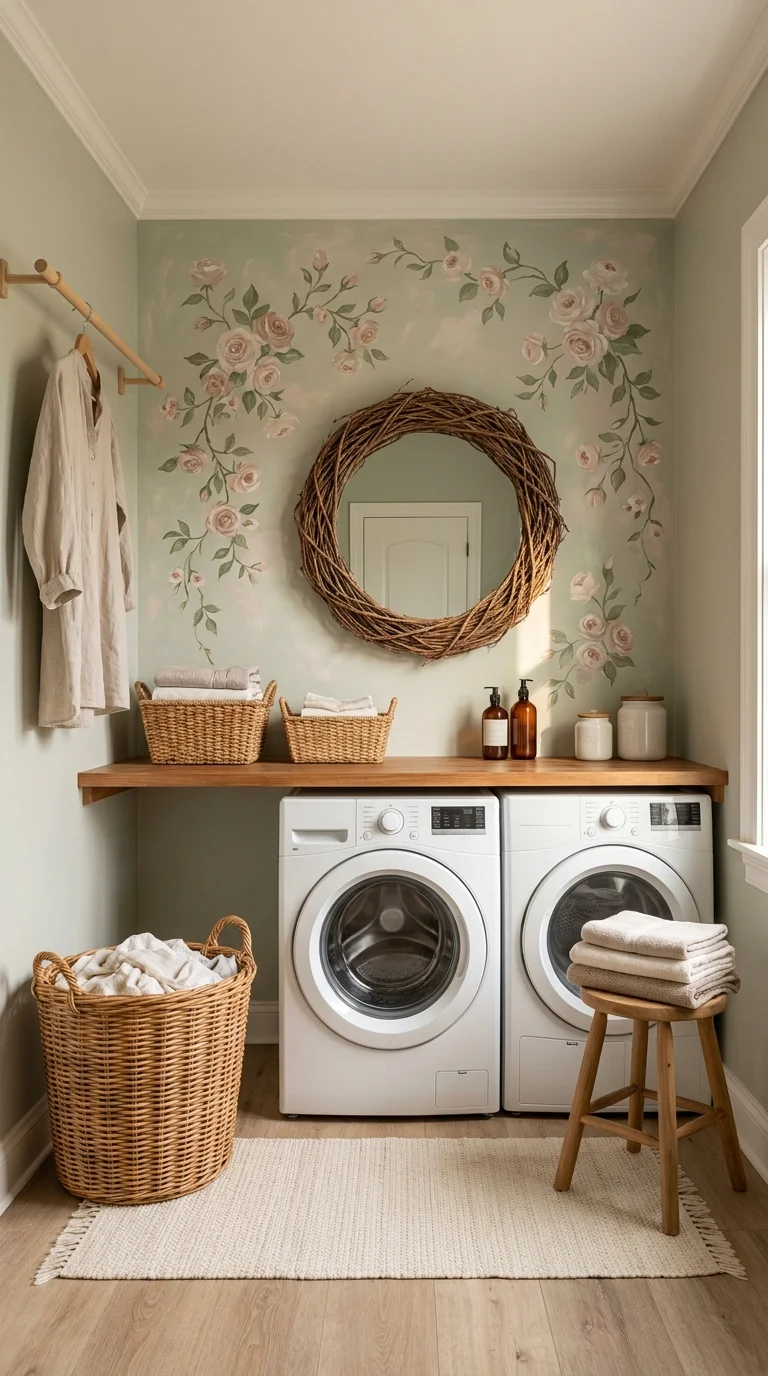
This is the most quietly maximalist room in the group, even though nothing in it is loud. A soft, hand-painted rose vine mural climbs across a pale sage wall, and rather than competing with it, a rustic woven twig wreath mirror sits directly in the center — repeating the same climbing, organic shape as the painted roses in a completely different material.
That repetition is the room’s real design decision. The mural’s curling vines and the wreath’s woven twigs share the same loose, circular movement, which is why the pairing feels connected rather than like two separate decorating ideas layered on top of each other. Swap the twig wreath for a straight-edged rectangular mirror, and that visual conversation disappears — the wall would still be pretty, but it would stop feeling composed.
This look suits anyone drawn to cottagecore or romantic country style who wants that softness somewhere in the house without committing an entire bedroom or living room to it — a laundry room is a lower-stakes place to try a hand-painted mural for the first time. It particularly rewards a small or narrow laundry space, since the mural does the visual work that a larger room might need furniture or layered textiles to achieve.
The real tradeoff is durability and reversibility. A hand-painted mural is either a genuine artistic commitment or a peel-and-stick wallpaper standing in for one — and unlike paint color, it’s not something you touch up in an afternoon if you change your mind in a year.
To simplify this for a lower budget or a rental, a removable floral wallpaper achieves a similar effect without the painting skill or long-term commitment, and a simple round rattan mirror gets close to the wreath’s organic shape for a fraction of the cost of a driftwood original.
Recommended Materials: hand-painted or wallpaper floral mural, woven willow or grapevine wreath mirror, butcher block open shelf, natural rattan baskets, reclaimed wood stool.
Main Colors: Pale Sage, Dusty Rose, Cream, Natural Wood, Soft White.
Best Lighting: Bright, even daylight is essential for a hand-painted mural to read correctly — this look loses most of its charm in a dim or windowless laundry room, so a skylight or large window nearby matters more here than in most other entries.
A Wreath Chosen to Echo the Wallpaper, Not Just Decorate It
- Hanging a mirror shape that doesn’t echo the mural’s organic lines, breaking the visual connection between the two
- Choosing a mural with too many colors, which competes with rather than complements a soft palette
- Installing this look in a room with poor natural light, where the mural’s detail gets lost
- Overcrowding the counter below with too many objects, which pulls focus away from the wall itself
A Window Bench That Turns Laundry Into a Waiting Room
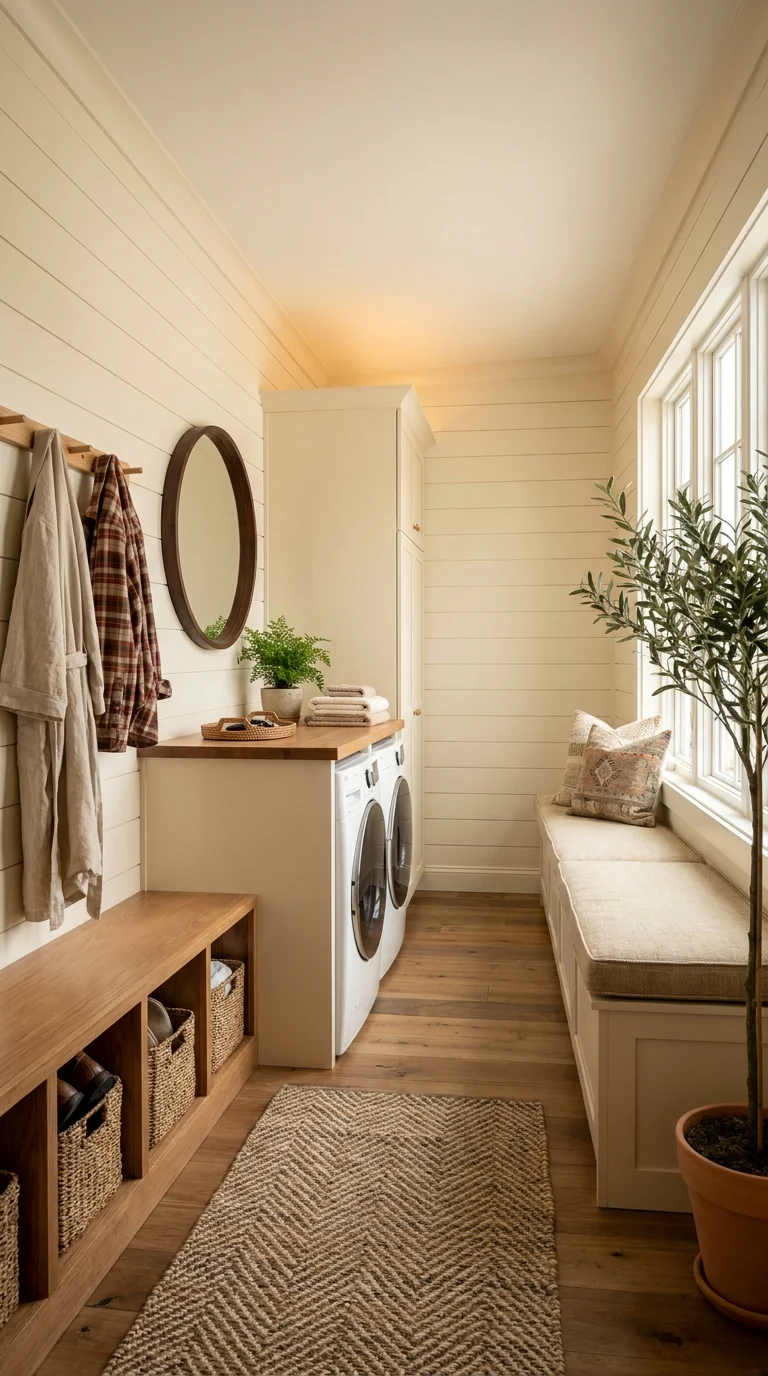
Rather than treating the laundry room as a single-purpose closet, this design borrows a mudroom idea and gives the space a genuine built-in bench beneath a window, complete with a cushion and a throw pillow. It quietly reframes what a laundry room is for: somewhere to actually sit and wait out a cycle, not just somewhere to load a machine and leave.
The eye is drawn first to that window seat, not to the machines tucked into their own cabinet a few feet away — a direct result of the natural light pouring in and the cushioned seat’s warmer, more inviting materials compared to the closed cabinetry beside it. Where the light and softest surface both land is where attention follows, which is exactly the kind of sightline planning that separates a considered layout from a purely functional one.
This idea is particularly well suited to narrow, hallway-style laundry rooms that might otherwise feel purely utilitarian — the bench gives an otherwise wasted stretch of wall an actual purpose, and it doubles as a spot to set folded laundry down without needing extra counter space.
The tradeoff is that a built-in bench with storage cubbies below is a carpentry project, not a weekend swap, and it only makes sense if the room’s shoe-and-jacket storage genuinely needs a home nearby — a bench in a laundry room with no adjacent entryway function is a lot of built-in cost for occasional seating.
For a smaller-scale version, a freestanding bench with a cushion on top and baskets underneath gets most of the same function without any built-in carpentry at all.
Recommended Materials: painted wood shiplap paneling, built-in wood bench with storage cubbies, upholstered cushion and pillow, rattan storage baskets, potted olive tree.
Main Colors: Warm Cream, Natural Wood, Soft White, Muted Terracotta accent.
Best Lighting: Large windows do the heavy lifting during the day; a warm sconce above the bench extends its usefulness into evening laundry sessions.
Maintenance: The potted olive tree needs bright, indirect light and infrequent but deep watering — it will struggle in a laundry room with no natural light, so this element specifically depends on the window this design is built around.
Where This Layout Solves a Real Daily Problem
Anyone who’s stood in a laundry room scrolling their phone while waiting for a cycle to finish will recognize the gap this bench fills. It turns dead waiting time into a genuinely comfortable few minutes, which is a small but real quality-of-life upgrade most laundry rooms never bother offering.
Common mistakes to avoid:
- Adding a bench without also including shoe or jacket storage, which wastes the mudroom-style opportunity
- Choosing cushion fabric that isn’t washable in a room where lint, water, and pet hair are constant
- Placing the bench in a spot with no natural light, undercutting the whole point of a window seat
- Skipping a coat hook or robe hook nearby, leaving the bench without an obvious daily use
A Zellige Tile Wall Anchored by Pampas and Woven Plates
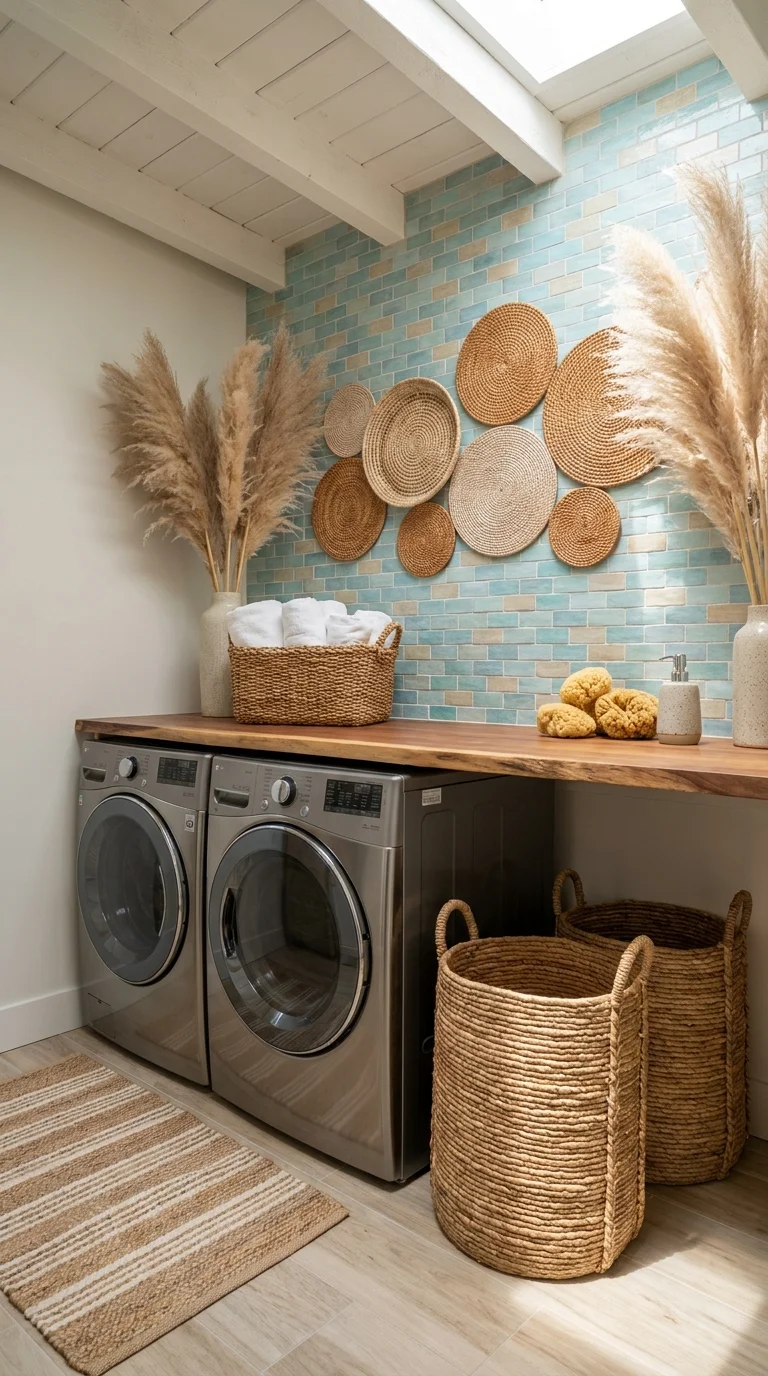
Under a skylight, this room leans hard into a coastal Mediterranean mood, built almost entirely around one material: a hand-glazed zellige-style tile wall in shifting blue-green tones. Because each tile is intentionally uneven, the wall catches light differently across its surface — something a uniform, machine-made tile simply can’t replicate.
That’s a material worth understanding before committing to it. Zellige tile is more porous and less perfectly flat than standard ceramic tile, which means grout lines read as slightly irregular by design rather than as an installation flaw — a detail worth knowing going in, since it can look “wrong” to someone expecting factory-perfect uniformity. It also means it benefits from a sealant in a room that sees regular water exposure, more so than a standard glazed tile would.
The collection of woven decorative plates mounted above the counter mirrors the tile’s handmade irregularity in a completely different material, while the pampas grass on either side softens the wall’s boldness with something loose and organic. Between the tile, the plates, and the pampas, almost nothing in this room is a hard straight line — a deliberate softness that keeps a tiled feature wall from feeling cold or clinical.
This look is best suited to a room with natural overhead light, since a skylight or large window is what lets the tile’s color-shifting quality actually show. It also suits someone comfortable with a genuinely bold, colorful accent wall, since this is one of the more visually assertive entries in the group.
Worth noting: zellige tile sits at the premium end of backsplash materials. A patterned ceramic tile in a similar blue-green colorway gets a comparable visual effect at a meaningfully lower cost, without the same sealing requirements.
Recommended Materials: hand-glazed zellige or zellige-style tile, live-edge wood countertop, woven seagrass wall plates, dried pampas grass, natural stainless steel appliances.
Main Colors: Seafoam Blue-Green, Cream, Warm Oak, Sandy Neutral.
Best Lighting: A skylight or large overhead window is close to essential — this tile’s whole appeal depends on shifting natural light, and it would look flat under a single static overhead bulb alone.
Maintenance: Zellige tile should be sealed periodically to resist water and detergent staining, and pampas grass sheds fine fibers over time, so it’s worth setting it somewhere it won’t drop directly into an open hamper.
Where the Wall’s Imperfection Is the Whole Point
- Expecting perfectly even grout lines and being disappointed by zellige’s natural, handmade irregularity
- Skipping the sealant on a tile installed directly behind a water source
- Choosing plates or baskets in a finish too glossy or matched, which fights the tile’s handmade texture
- Placing this look in a windowless room, where the tile loses the light-shifting effect that justifies its cost
A Black-and-White Room That Uses One Dark Object on Purpose
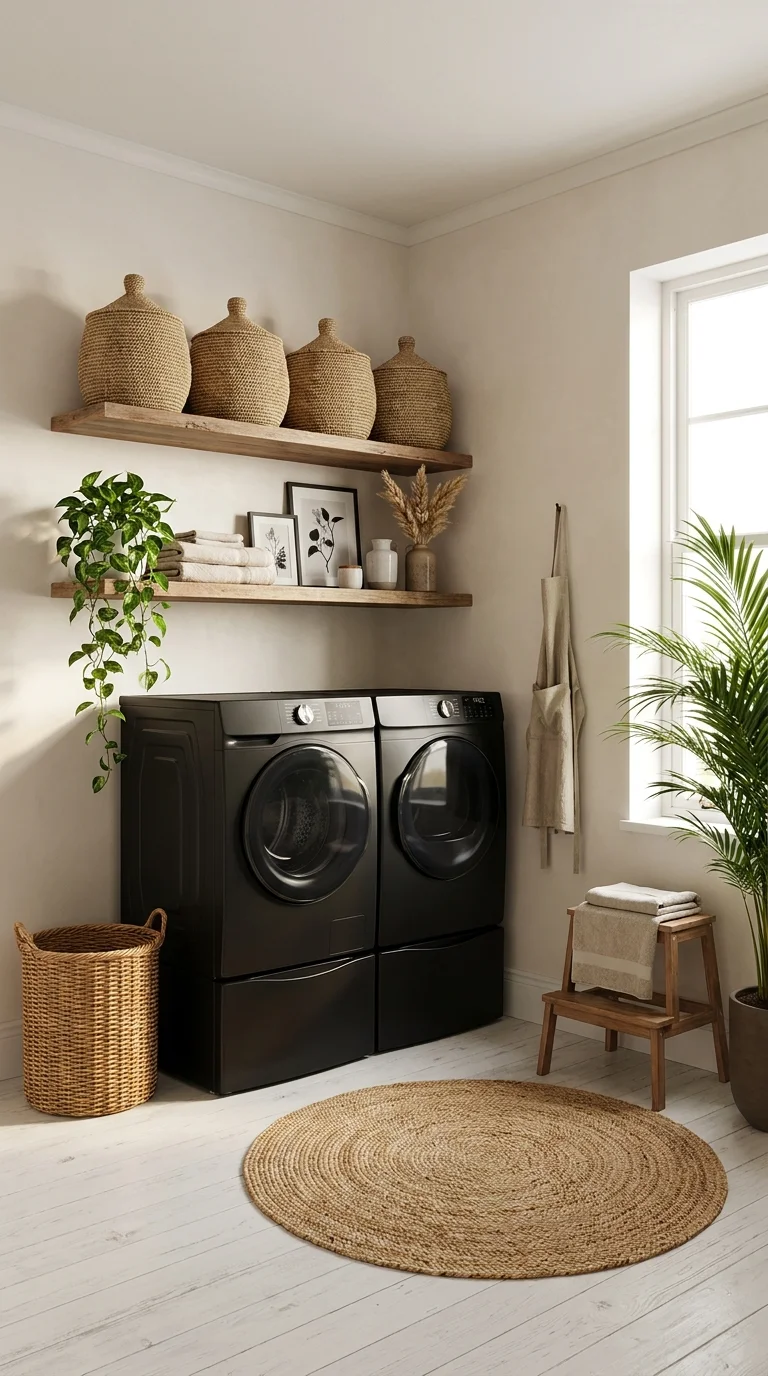
Nearly everything in this laundry room is white or a pale neutral — the walls, the floor, the shelving — which makes the matte black washer and dryer the only object the eye can land on. That’s not an accident of appliance shopping; it’s a scale and contrast decision, and it’s a bold one, since a pair of machines this large in solid black could easily overwhelm a small space if the rest of the room weren’t kept this quiet.
A dark object reads as heavier than the same object in white, even at an identical physical size — which is exactly why the rest of this room stays so restrained. Busy shelving or a patterned rug next to black appliances this size would likely tip the room from bold into cluttered. The lidded woven baskets on the floating shelves above stay pale and textural rather than colorful, keeping the visual weight concentrated exactly where it’s meant to be.
This approach suits someone who wants a genuinely modern, gallery-like laundry room rather than a rustic or maximalist one — it’s the most minimal entry in this group, even though it still qualifies as boho through its rattan baskets, potted palm, and braided jute rug. It’s a strong option for anyone replacing appliances anyway who wants the new machines to double as the room’s design statement instead of trying to hide them.
The honest tradeoff: black appliances show water spots, dust, and lint far more visibly than white or stainless ones, so this look demands more frequent wiping down than any other entry in this list — a real maintenance cost in exchange for the visual impact.
Recommended Materials: matte black washer and dryer, white oak floating shelves, lidded woven rattan vessels, braided jute rug, potted areca or kentia palm.
Main Colors: Matte Black, White, Warm Oak, Soft Greige.
Best Lighting: Bright, even natural light from a nearby window keeps the black appliances from reading as heavy or cave-like — this look needs more light than a similarly sized room in an all-neutral palette would.
Maintenance: Matte black appliances need wiping with a microfiber cloth regularly to avoid visible water spotting and dust, considerably more upkeep than a white or stainless finish in the same spot.
Is the Black Appliance Upgrade Worth It?
Choosing black machines specifically for the design impact is a real decision, not a neutral default the way white or stainless usually is. If frequent wiping down feels like a chore rather than a minor task, a warm stainless finish gets a similar grounding effect with a fraction of the visible smudging — worth weighing honestly before paying a premium for the matte black finish.
Common mistakes to avoid:
- Adding colorful or patterned accessories that compete with the black appliances for visual weight
- Choosing a matte black finish without accounting for the extra cleaning it requires
- Overfilling the open shelving, which crowds out the negative space this look depends on
- Skipping a light or bright rug underfoot, making the room feel heavier than intended
A Jungle-Dense Laundry Room Built on Repetition of Green
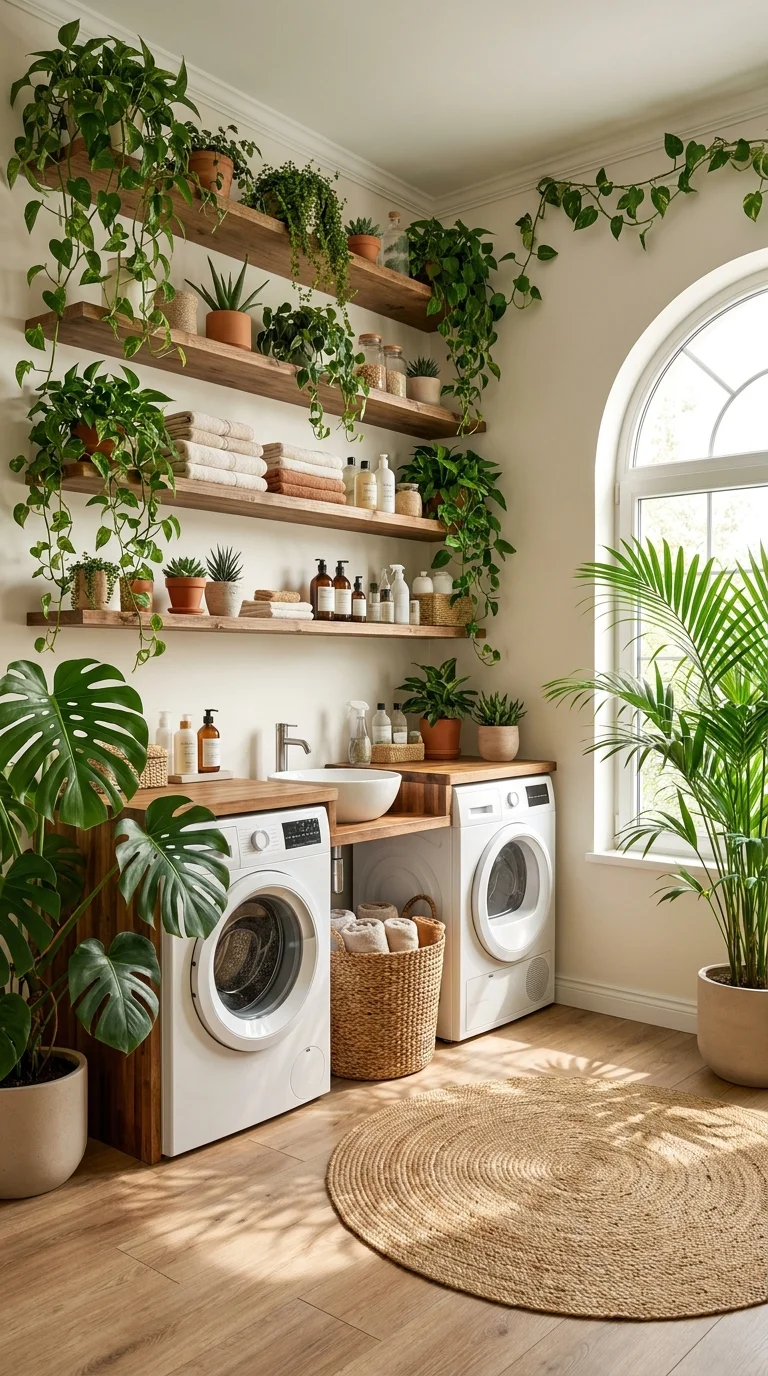
This room takes the “add a plant” boho instinct and pushes it about as far as it will go — pothos, monstera, palms, and trailing vines fill nearly every shelf, corner, and countertop. It’s the most maximalist entry in the group, and its entire identity rests on one repeated element done at real scale rather than a scattering of variety.
Repeating the same handful of plant types across every surface, rather than collecting one of everything, is what keeps a room this packed with greenery from looking chaotic — the eye recognizes the pattern of trailing vines and broad leaves again and again rather than trying to process dozens of unrelated shapes. A single plant on a single shelf would read as decoration; dozens of plants repeated this consistently read as an intentional style.
The arched window and vessel sink underneath keep the room from being purely about foliage — but even those architectural details get partly obscured by trailing pothos draping down from the shelves above, which is either the room’s biggest strength or its biggest risk depending entirely on how much upkeep someone actually wants to commit to.
This look is best suited to plant-experienced homeowners with genuinely good natural light, since this many plants will not survive, let alone thrive, in a dim or windowless laundry room. It’s a poor match for anyone who travels frequently or already struggles to keep a single houseplant alive — the maintenance load here is real and constant, not occasional.
Recommended Materials: wood open shelving, mixed terracotta and ceramic planters, woven rattan hamper baskets, round jute rug, vessel sink with wood counter.
Main Colors: Layered Greens, Warm Cream, Natural Wood, Terracotta.
Best Lighting: Strong, consistent natural light is non-negotiable — an arched window or equivalent large window is essentially a requirement for this look, not a nice-to-have.
Maintenance: This is the highest-maintenance entry in the entire list. Regular watering across many pots, periodic repotting, leaf dusting to keep pores clear of laundry lint, and pest-checking are all ongoing tasks, not one-time setup work.
Who Should Skip This Style?
This look is genuinely not for everyone, and it’s worth saying plainly rather than glossing over. If your laundry room gets minimal natural light, if you’re often away for stretches at a time, or if keeping even a single low-maintenance plant alive has been a struggle, this density of greenery will likely become a source of stress rather than relaxation — which defeats the entire premise of a calming laundry space. A handful of hardy, low-light plants gets a lighter version of the same feeling with a fraction of the upkeep.
Common mistakes to avoid:
- Attempting this look in a room without strong, consistent natural light
- Choosing high-maintenance tropical varieties instead of hardier trailing plants suited to a humid, lint-prone room
- Letting trailing vines hang directly over the washer or dryer vents, where lint and heat can damage leaves
- Skipping regular leaf dusting, which allows lint buildup to block light absorption
A Patterned-Tile Room With Gold Hardware as the Quiet Upgrade
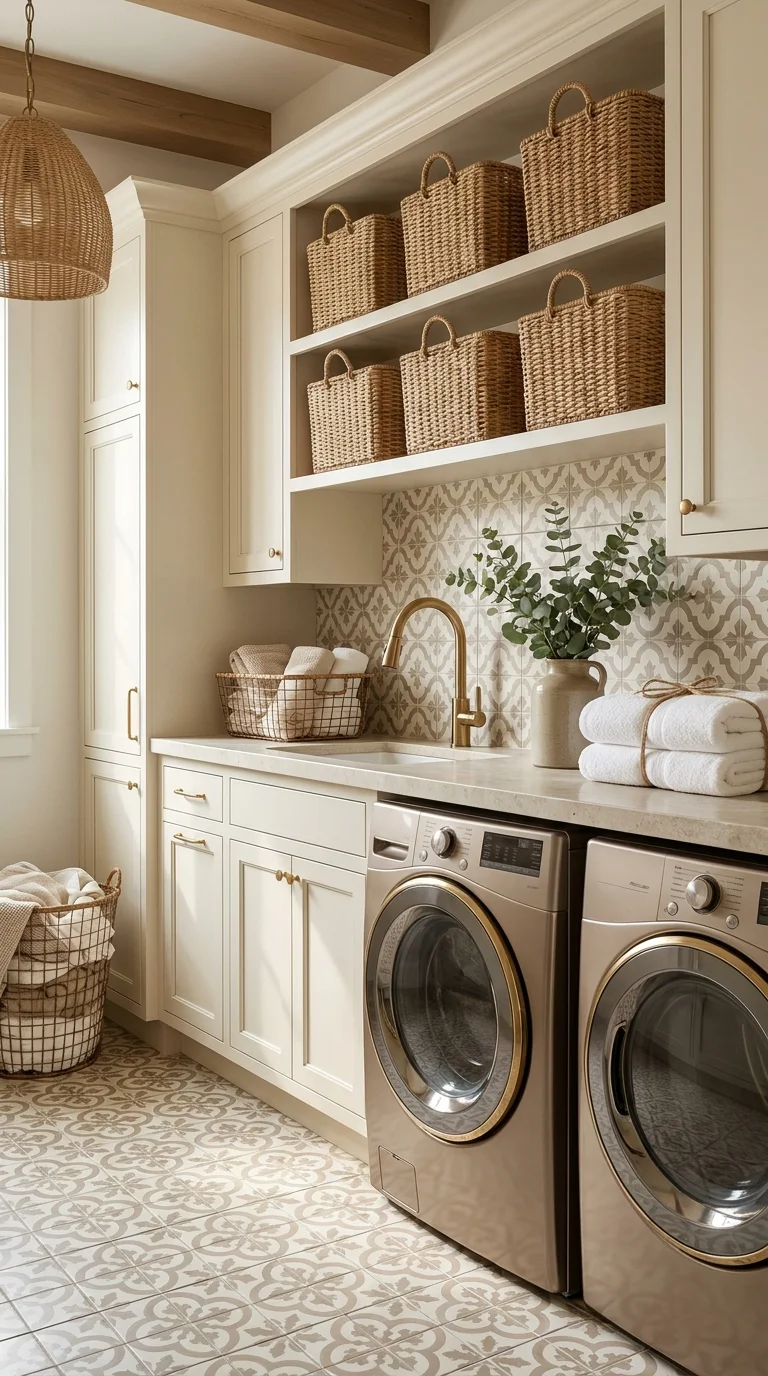
The most refined entry in the group swaps rattan-and-macrame informality for something closer to elevated farmhouse: patterned cement-style tile underfoot and on the backsplash, cream shaker cabinetry, a farmhouse sink, and gold hardware and appliance trim throughout. Nothing here looks inexpensive, and that’s clearly the point.
The eye moves first to the gold gooseneck faucet and matching appliance trim, not to the patterned tile beneath it, even though the tile technically covers more visual area. Gold catches and reflects light in a way that a matte tile pattern simply can’t, which is why a relatively small amount of gold hardware ends up carrying a disproportionate amount of the room’s perceived luxury.
That’s a genuinely useful lesson for a smaller budget: you don’t need to upgrade every surface to get an elevated feeling — upgrading the hardware finish alone does a lot of that work. The patterned tile adds real cost and installation time, but the gold faucet and appliance trim are a comparatively small expense for how much visual impact they’re carrying.
This design suits someone renovating a laundry room as part of a whole-home elevated farmhouse or transitional style, where matching brass or gold hardware already appears in the kitchen and bathrooms. It’s a mismatch for a purely rustic or thrifted boho home, where this level of polish would feel out of place next to more worn, collected pieces.
Recommended Materials: patterned cement or cement-look tile, cream shaker cabinetry, fireclay farmhouse sink, brushed gold fixtures and appliance trim, woven rattan baskets, eucalyptus stems.
Main Colors: Cream, Warm Gold, Soft Grey Pattern, Natural Wood.
Best Lighting: Bright, warm overhead lighting is worth prioritizing here specifically because it makes the gold hardware read as warm and rich rather than dull — this look loses a lot of its impact under cool fluorescent light.
Maintenance: Patterned cement tile should be sealed to resist detergent and water staining, and gold hardware finishes vary widely in durability — worth checking whether a given fixture is a genuine plated finish or a coating that can wear thin with daily use.
Where the Eye Goes First — and Why That Matters for Your Budget
- Choosing an unsealed cement tile in a room that regularly sees water and detergent spills
- Mixing multiple metal finishes (gold, chrome, brushed nickel) instead of committing to one throughout
- Under-lighting the room, which mutes the gold hardware’s reflective quality
- Assuming full tile replacement is required to get this look, when hardware alone carries much of the effect
Laundry Room Workflow Tips
- Keep a lidded hamper within arm’s reach of the washer so sorting happens at the machine instead of across the room, cutting down on trips back and forth.
- Store stain treatment and detergent at counter height, not floor level, so pre-treating a stain doesn’t mean bending down mid-load.
- Leave at least one open surface near the dryer for folding straight out of the machine, which meaningfully cuts down on wrinkles compared to letting clothes sit in a basket.
- Position any hanging rod or drying line where dripping items won’t land on wood shelving or electrical outlets below it.
Who Should Choose This Style?
- Best for homeowners who already lean toward warm, collected, lived-in interiors elsewhere in the house
- Best for laundry rooms with at least some natural light, since several of these looks depend on it for their material and color choices to read correctly
- Best for renters and first-time apartment dwellers, since many boho elements here (rugs, baskets, macrame, plants) are portable rather than built-in
- Not ideal for households wanting a strictly clinical, all-white utility space with minimal styling or upkeep
Budget Summary
| Budget | What to Expect |
|---|---|
| Low | Jute or washable area rug, rattan baskets, macrame or woven wall hanging, a hardy trailing plant, thrifted mirror |
| Medium | Butcher block countertop, open wood shelving, peel-and-apply mosaic or patterned tile, a few well-chosen ceramic or terracotta planters |
| Premium | Zellige or hand-glazed tile, fireclay farmhouse sink, gold or brass plumbing fixtures, full custom cabinetry in a saturated color |
Frequently Asked Questions
Is boho style practical for a room with constant moisture and lint? Yes, with a few material adjustments. Natural fiber rugs like jute handle occasional dampness better than plush pile rugs, and sealed stone, tile, or butcher block counters hold up better than unsealed wood against detergent splashes.
What plants actually survive in a laundry room? Pothos, snake plant, and ZZ plant tolerate the inconsistent humidity and occasional low light that laundry rooms often have far better than more delicate tropical varieties, making them a safer starting point than a monstera or fiddle leaf fig.
How do I add boho character to a laundry room with no windows? Lean on warm-toned lighting, textured baskets, and hardy artificial greenery rather than live plants, since several of the looks in this list depend on natural light that a windowless room simply won’t have.
Do I need to replace my washer and dryer to get this look? No — most of these designs get their visual impact from shelving, textiles, and small styling choices rather than the appliances themselves, with the black-appliance room being the one clear exception.
Conclusion
The most useful thing all ten of these rooms have in common isn’t a shared color palette or material list — it’s that each one treats the laundry room as worth a real design decision rather than an afterthought. Whether that means a bold rug, a hand-painted mural, or simply choosing gold hardware over chrome, the smallest utility room in the house can hold its own aesthetic point of view. Pick the version that matches how much upkeep you actually want to take on, not just the one that photographs best, and laundry day gets a little easier to live with.
Explore More
You may also enjoy:
- 10 Boho Bedroom Looks That Feel Curated Not Cluttered
- Boho Fireplace Ideas That Turn the Fireplace Into the Heart of the Room
- Boho Garden Ideas for Creating an Outdoor Space Full of Soul
Aesthetic Life Team covers home décor, renovation, and design ideas for real, livable spaces — with a focus on rooms that balance style with everyday function.

