
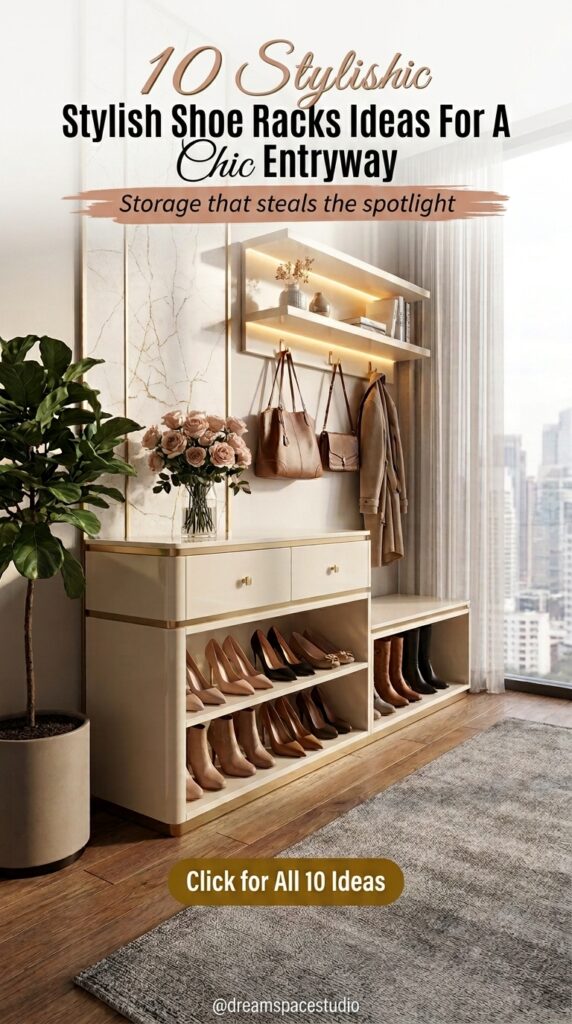
Shoe storage is one of those problems that either gets solved properly at the door or ends up as a permanent pile on the floor. The gap between the two usually isn’t about how much space is available—it’s about whether the storage piece was chosen to actually fit the entryway or just wedged in as an afterthought.
The ten pieces below cover a wide range of approaches, from built-in benches to sculptural floating shelves, and none of them look like they were bought purely for function. Each one manages to keep shoes contained while still working as a real piece of the room’s design—proof that an entryway doesn’t have to choose between organized and good-looking.
A Cushioned Bench That Hides a Week’s Worth of Shoes Underneath
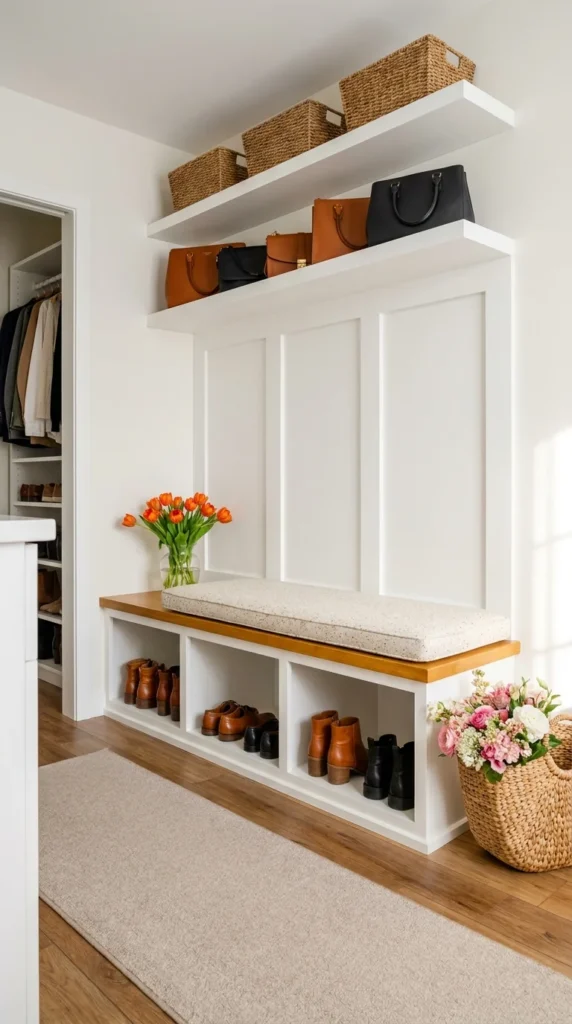
This built-in bench pairs a padded seat with three open cubbies below, each sized to hold a couple of pairs without shoes toppling over into the next compartment. Floating shelves above hold baskets and bags, so the entire wall—not just the floor-level storage—is doing something useful.
📌 Important Note
A bench like this only stays comfortable to sit on if the cushion has enough depth—thin padding over a hard wood seat gets uncomfortable fast, especially if it’s used daily for putting on shoes. Look for at least two inches of foam and a cushion cover that’s easy to remove and wash, given how much dirt tends to collect near a door.
The open-cubby layout below also makes it easy to see at a glance what’s stored where, which matters more in a busy household entryway than a closed cabinet might.
Flip-Down Drawers That Keep a Slim Entryway Wall Fully Functional
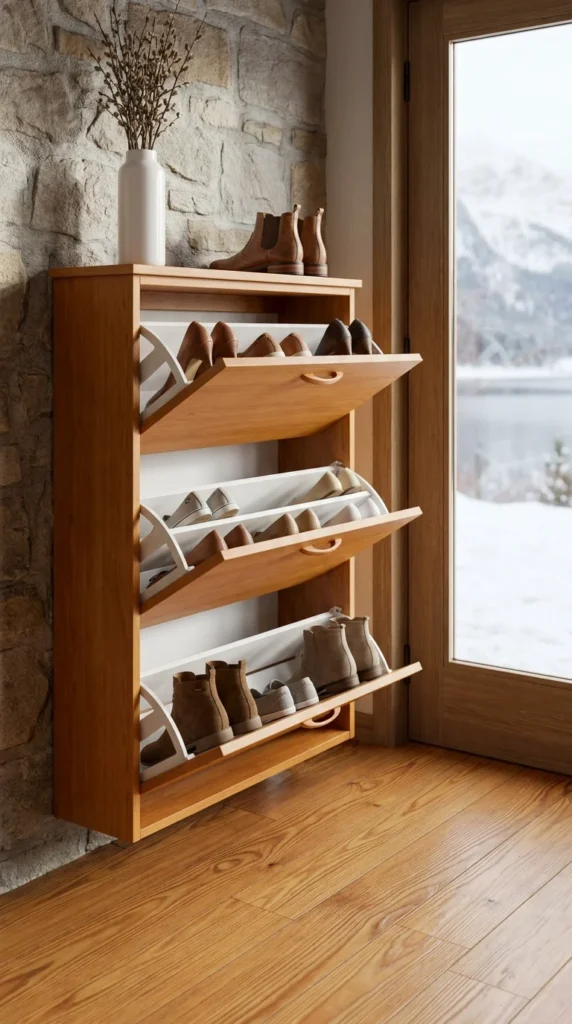
Wall-mounted and only a few inches deep when closed, this cabinet uses three tilt-out drawers that angle downward to reveal a full row of shoes tucked flat against a hidden interior rack. It’s a shape built specifically for narrow entryways where a standard bench or cubby unit simply wouldn’t fit.
⚠️ Warning
Tilt-out shoe cabinets need clearance in front of them to open properly—mounting one directly across from a door that swings inward can create a collision zone. Measure the drawer’s open angle before choosing a wall, and leave at least a foot of clearance so the drawer can drop fully without hitting anything.
Because the whole unit sits flush against the wall when closed, it works well in hallways or narrow entries where floor space for a bulkier piece just isn’t available.
How a Glass-Front Cabinet Turns Shoe Storage Into Display
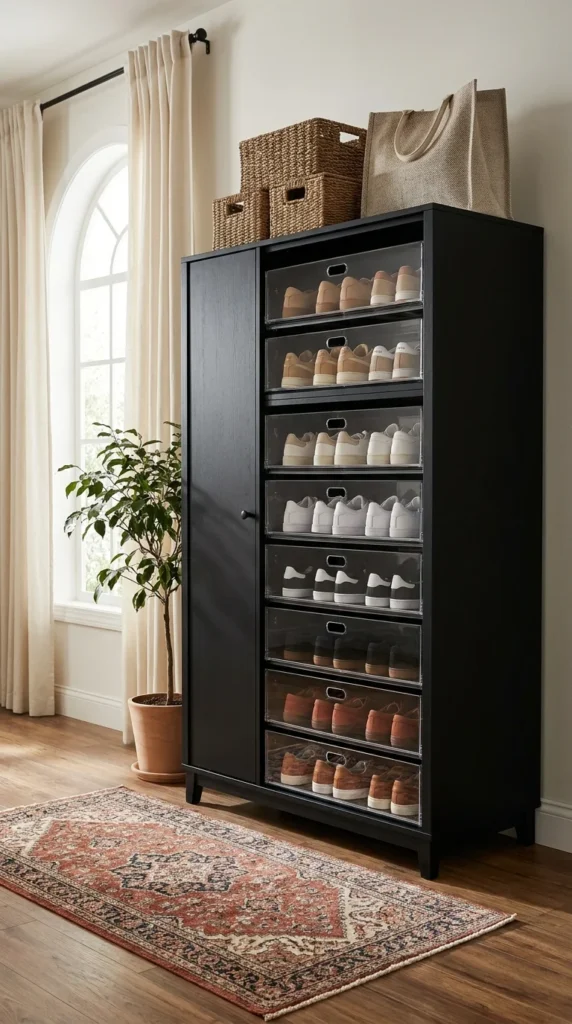
Clear pull-out drawers line one side of this tall black cabinet, each holding a single row of shoes visible through the glass front—part storage, part display case. A solid door on the left conceals additional space for bulkier items, giving the piece a mix of open and hidden storage in one frame.
💡 Pro Tip
Glass-fronted drawers look their best when the shoes inside are grouped by color rather than type—a row of neutral sneakers reads very differently through glass than a mixed jumble of colors and styles. Since the drawers are visible at all times, treating them like a small display case rather than blind storage keeps the whole piece looking intentional.
Woven baskets on top handle the items that don’t need visibility—scarves, gloves, anything better kept out of sight than on show.
Built Into the Staircase: A Shoe Wall That Fills Dead Space
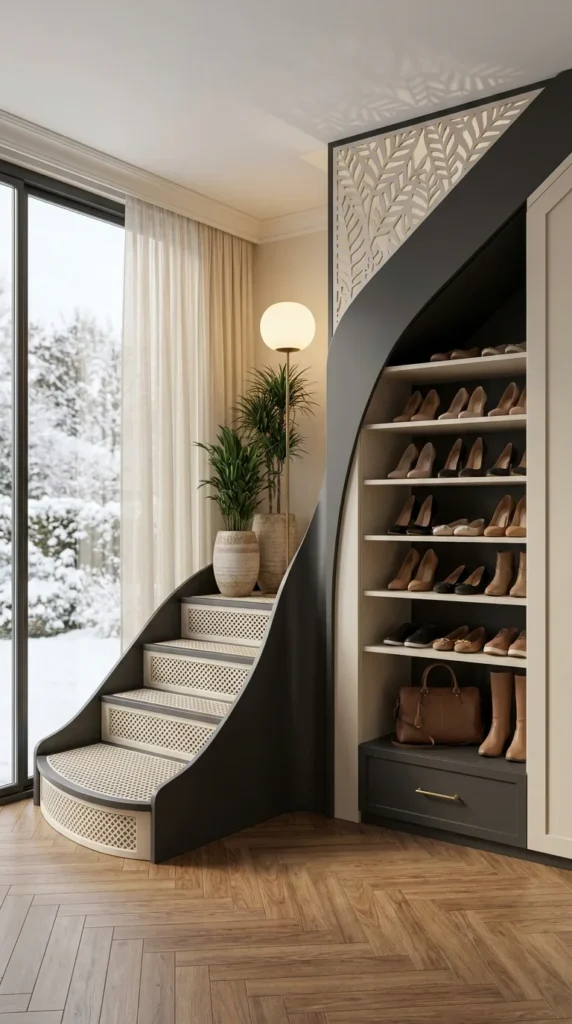
Rather than adding a separate piece of furniture, this design carves shoe shelving directly into the wall beside a curved staircase—a space that would otherwise go completely unused. Open shelves hold heels and flats in neat rows, while a drawer at the base handles bulkier boots and bags.
This kind of built-in only makes sense during a renovation or new build, since it requires cutting into the wall structure itself rather than simply placing a cabinet against it. For anyone with a staircase and an awkward triangular gap beside it, it’s worth asking a contractor whether that dead space could hold shelving instead of standing empty—the shoe storage ends up costing almost nothing in floor space because it was never usable floor space to begin with.
The decorative fretwork panel above ties the shelving into the rest of the staircase design, so the storage doesn’t read as a separate addition.
Sculptural and Floating: A Shelf That Barely Looks Like Storage
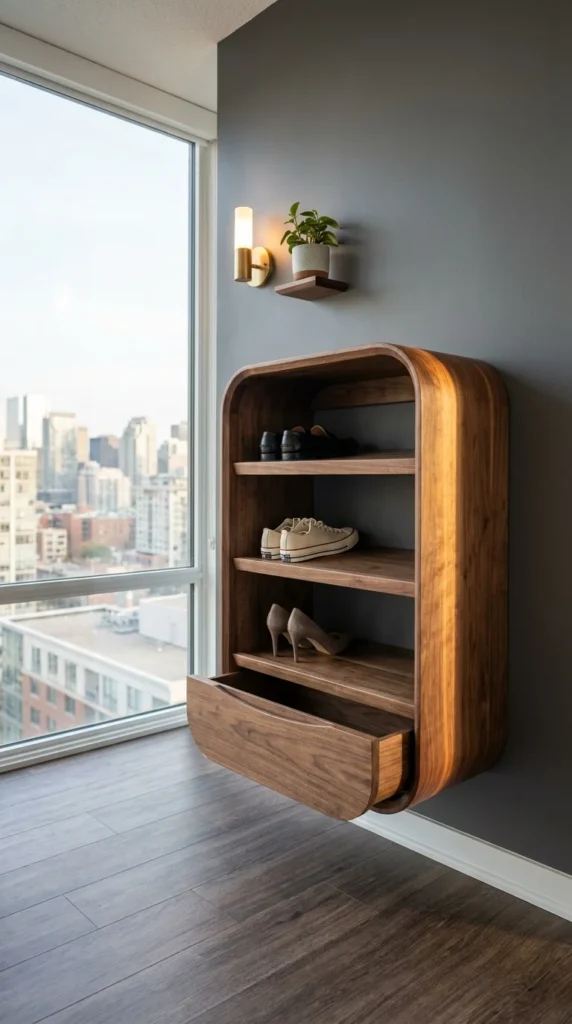
Rounded at every corner and mounted directly to the wall with no visible legs, this walnut shelf looks more like a piece of furniture-grade sculpture than a shoe rack. Three open shelves hold a small, curated rotation of shoes, while a hidden drawer beneath handles anything that doesn’t need to be on display.
What a Floating Shelf Like This Needs
☐ Wall studs strong enough to support the shelf’s weight fully loaded ☐ Concealed mounting hardware, rated for the shelf’s total weight ☐ A wall finish that can handle drilling without visible damage if removed later ☐ A shallow enough depth that shoes don’t overhang the shelf edge
Because it floats without visible support, this style works best as a low-capacity option—a small, rotating selection of shoes rather than the household’s entire collection. It suits an entryway that already has other storage elsewhere and just needs a stylish spot for the shoes in current rotation.
Gold-Trimmed Storage That Treats Shoes Like Part of the Decor
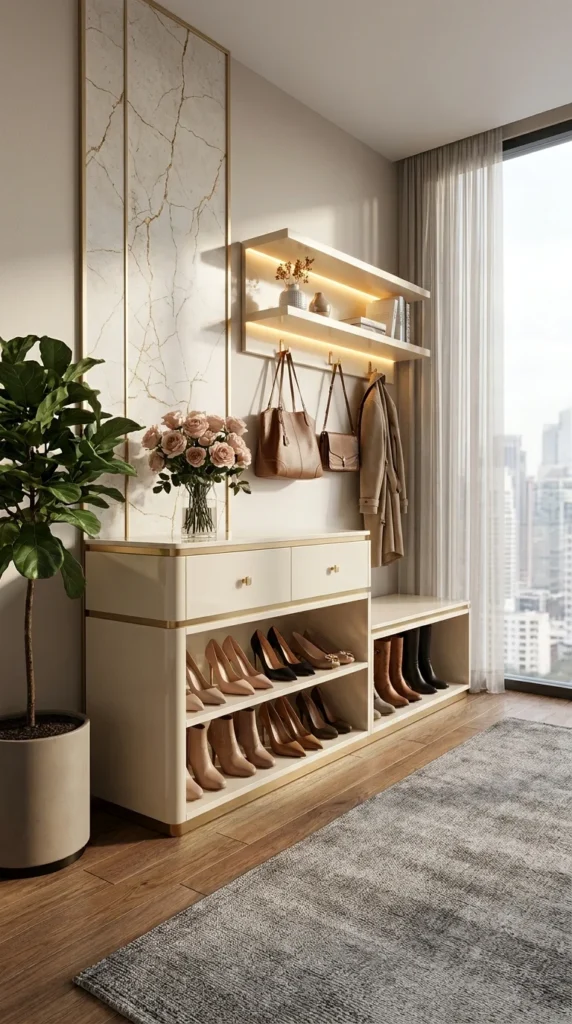
Cream lacquer and brass trim give this cabinet a dressier finish than most shoe storage typically gets, with two closed drawers on top for smaller items and open shelving below for shoes in daily use. A lit floating shelf above adds hooks for bags and coats, and a marble panel on the wall pulls the whole corner together as a designed vignette rather than a functional afterthought.
This piece works because every component earns its place—the drawers hide clutter, the open shelves keep daily shoes accessible, and the hooks handle outerwear that would otherwise end up draped over a chair. Treating an entryway storage piece with the same finish quality as the rest of the home’s furniture, rather than defaulting to something purely utilitarian, is really what turns it into decor instead of just equipment.
What a Two-Tier Cabinet Solves That a Simple Rack Can’t
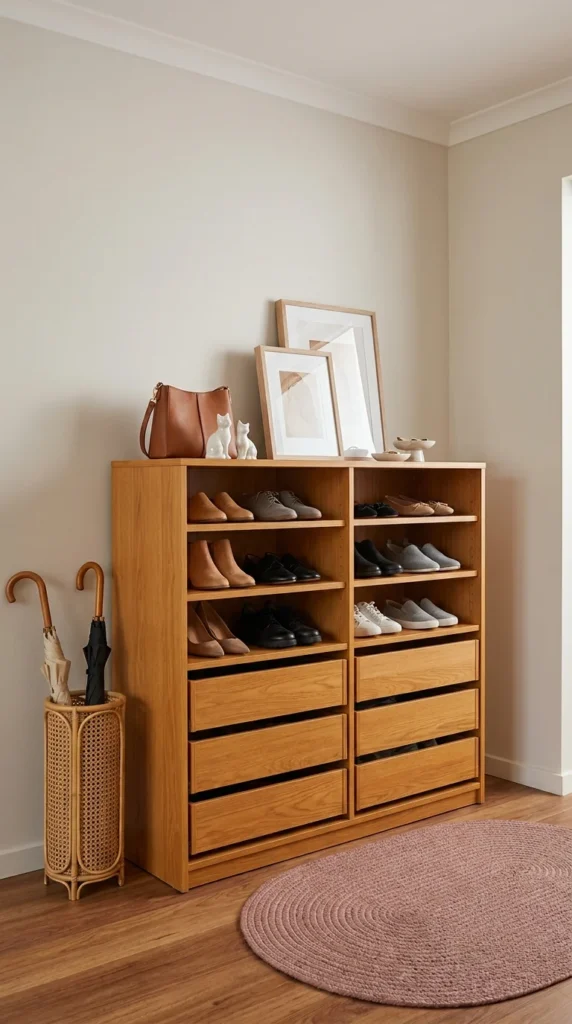
Open shelving on top holds shoes in easy view, while three drawers underneath conceal anything from off-season boots to cleaning supplies. This two-tier wood cabinet solves a problem that a single-style rack usually can’t: some shoes need to be grabbed quickly, and others just need to be out of sight.
Open Shelving vs. Closed Drawers
| Factor | Open Shelving | Closed Drawers |
|---|---|---|
| Best for | Daily-use shoes | Seasonal or rarely worn pairs |
| Dust exposure | Higher | Lower |
| Visual clutter | More visible | Fully hidden |
| Speed of access | Fastest | Slightly slower |
Combining both formats in a single piece, as this cabinet does, avoids having to choose one approach for the entire household. A framed print and a small bag left on top round out the styling without adding any extra furniture to the space.
Angular Wood Shelving That Turns Shadows Into Part of the Design
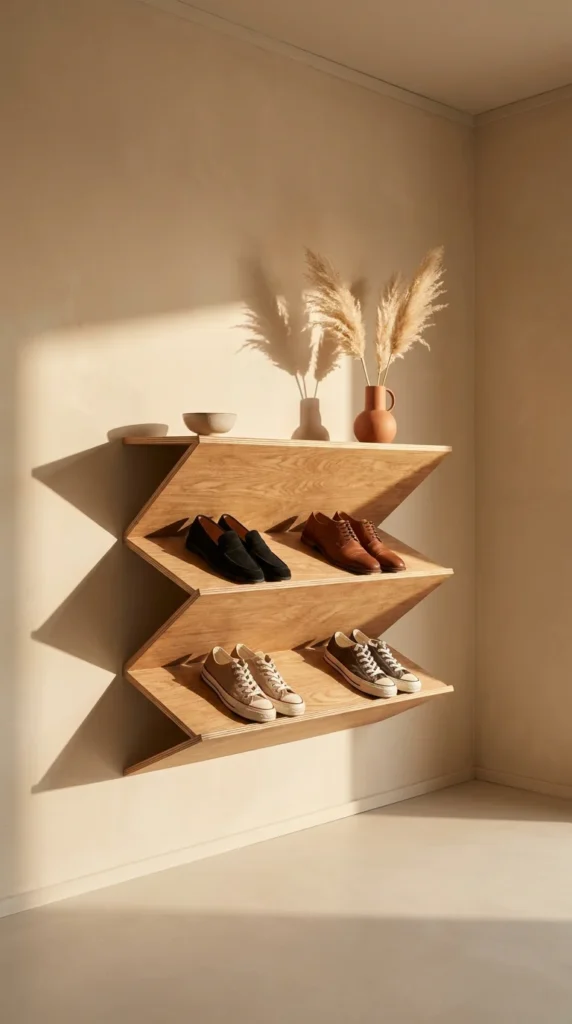
Zigzagging diagonally across the wall, this shelf unit uses angled wood planes instead of flat horizontal ones, throwing dramatic triangular shadows across the wall whenever sunlight hits it directly. Each angled shelf holds a single pair of shoes, turning what’s normally a purely functional object into something closer to wall art.
⚠️ Warning
Angled shelves like this rely on the shoe sitting at the correct point on the slope to stay put—shoes placed too close to the open edge can slide off if the shelf isn’t level or the surface has any texture. This design works because each shelf is shallow enough that shoes naturally settle against the back corner rather than resting near the edge.
A scattering of dried pampas grass and a small ceramic bowl on the top shelf keep the piece from reading as purely utilitarian, even with shoes as the main content on every level.
Two Wood Pieces, One Shape Language: Star-Shell-Meets-Slatted-Bench
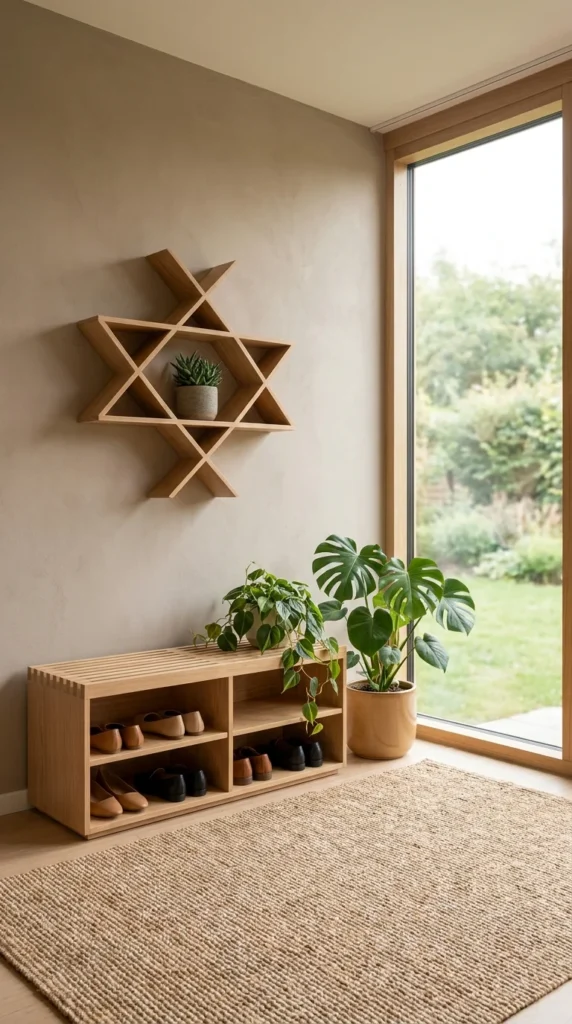
A hexagram-shaped wall shelf hangs above a slatted wood bench in this entryway, and though they’re two separate pieces, the shared geometric wood tone ties them into a single visual set. The star shelf holds a single plant rather than shoes, while the bench below does the actual storage work through two open cubbies.
💡 Pro Tip
Pairing a decorative, non-functional shelf with a purely practical storage piece—rather than trying to make one object do both jobs—often produces a more balanced result. The star shelf gets to stay simple and sculptural because it isn’t carrying storage weight, and the bench gets to stay purely practical without needing to look ornamental.
A trailing monstera plant softens the geometric hard edges of both pieces, and the jute rug underneath keeps the corner from feeling too rigid despite all the straight lines and angles involved.
Modular Cubes That Expand as a Shoe Collection Grows
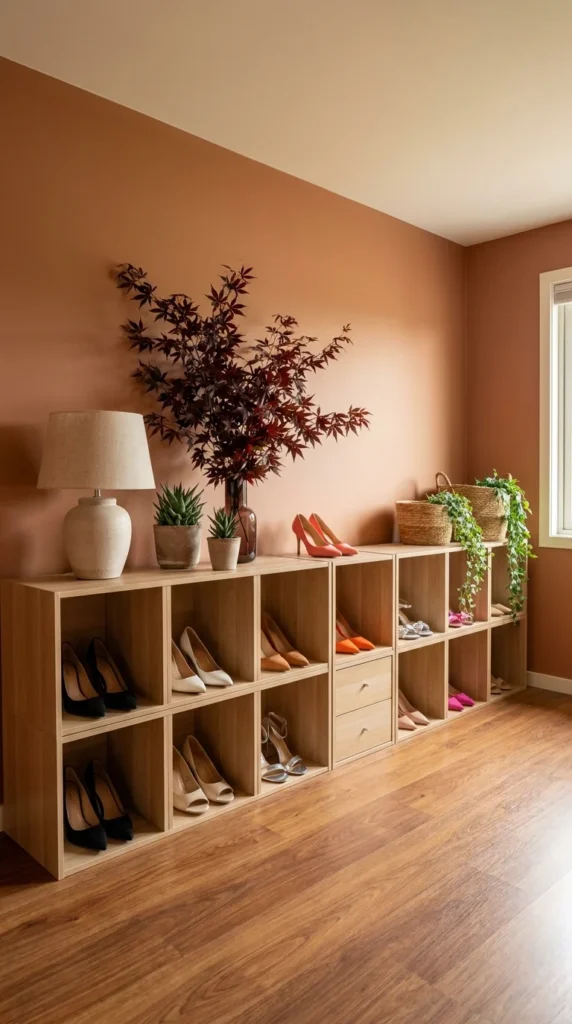
A long row of open wood cubbies stretches across this wall, each cube sized for a single pair of shoes standing upright. Built-in drawers break up the row at intervals, adding closed storage without interrupting the overall modular look.
Recreating This Look: Budget Tiers
💚 Affordable: Stacking a few ready-made cube storage units side by side achieves a similar modular look without custom carpentry. 💛 Mid-Range: A semi-custom shelving system, ordered to a specific width and cube count, gets closer to a seamless built-in appearance. 💎 Investment: A fully custom wall-length unit, built to the exact dimensions of the entryway with integrated drawers, offers the most precise fit and the highest shoe capacity.
The real advantage of a modular layout like this is scalability—additional cubes can be added later as a shoe collection grows, without needing to replace the entire piece the way a fixed-size cabinet would require.
Final Thoughts
Across all ten pieces, the same principle keeps showing up: shoe storage works best when it’s designed to match the entryway rather than dropped into it as an obligation. Whether that means a built-in wall carved into unused space, a sculptural floating shelf, or a simple modular cube system that can grow over time, the goal is the same — shoes stay contained, and the entryway still looks like a room someone thought about, not just a landing zone by the door.
Frequently Asked Questions
How many pairs of shoes should an entryway rack hold? A good starting point is planning for two to three pairs per household member for daily rotation, with additional off-season or occasional-use shoes stored elsewhere, like a closet. Trying to fit an entire shoe collection into the entryway usually leads to overcrowding regardless of how the storage is designed.
Is open shelving or a closed cabinet better for shoe storage? Open shelving makes daily shoes faster to grab and put away, but it does show more visual clutter and collects more dust over time. Closed cabinets or drawers keep things tidier-looking and protect shoes from dust, though they take slightly longer to access—many entryways benefit from a mix of both.
What’s the best material for an entryway shoe rack? Solid wood and wood veneer are common choices because they hold up well to daily use and match easily with other furniture. Metal or wire racks are more budget-friendly and better suited to wet or muddy shoes, since they don’t absorb moisture the way wood can if shoes aren’t fully dry before storage.
How do I stop a small entryway from feeling cluttered with shoe storage? Choosing a single piece that combines storage and display, rather than several separate baskets or racks, generally keeps a small entryway feeling more organized. Wall-mounted or floating options also help, since they keep the floor clear and make the space feel less crowded than a bulky freestanding cabinet.
Can a shoe rack be styled to look like a regular piece of furniture? Yes—treating the top surface as display space for a lamp, a small plant, or a framed print, and choosing a finish that matches the rest of the entryway’s furniture, generally makes a shoe rack read as intentional decor rather than purely functional storage. Adding a cushion or upholstered top, as with a storage bench, can further blur the line between seating and shoe storage.
2 Responses