
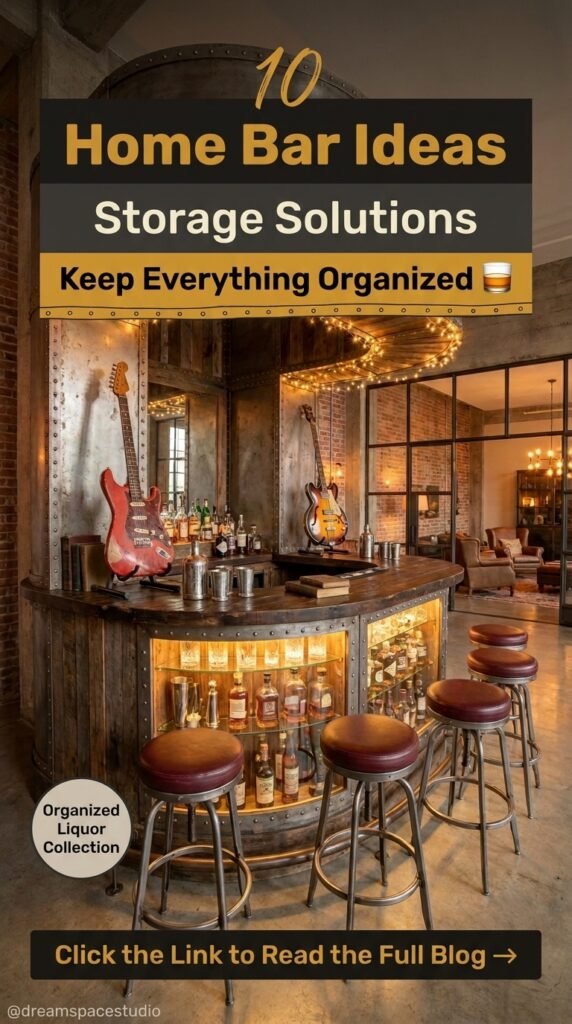
Most home bars fail for the same reason: someone bought a cart, some glasses, and a string of lights, and called it done. A home bar that actually gets used — night after night, party after party — is built around a decision, not a purchase. It has to answer where people will stand, what the room already gives you for free (a window, a wall, a leftover nook), and how much upkeep you’re honestly willing to do. The ten spaces below were chosen because each one solves that problem differently. By the end, the goal isn’t to love all ten — it’s to know exactly which one is yours.
Quick Overview
| Style | Eclectic Home Bar Design |
|---|---|
| Best For | Empty corners, dining rooms, dedicated bar rooms |
| Budget | Low–High (fully scalable) |
| Difficulty | Easy DIY to full renovation |
| Maintenance Level | Low–Medium |
The Backlit Onyx Wall That Makes a Navy Dining Room Feel Like a Private Club
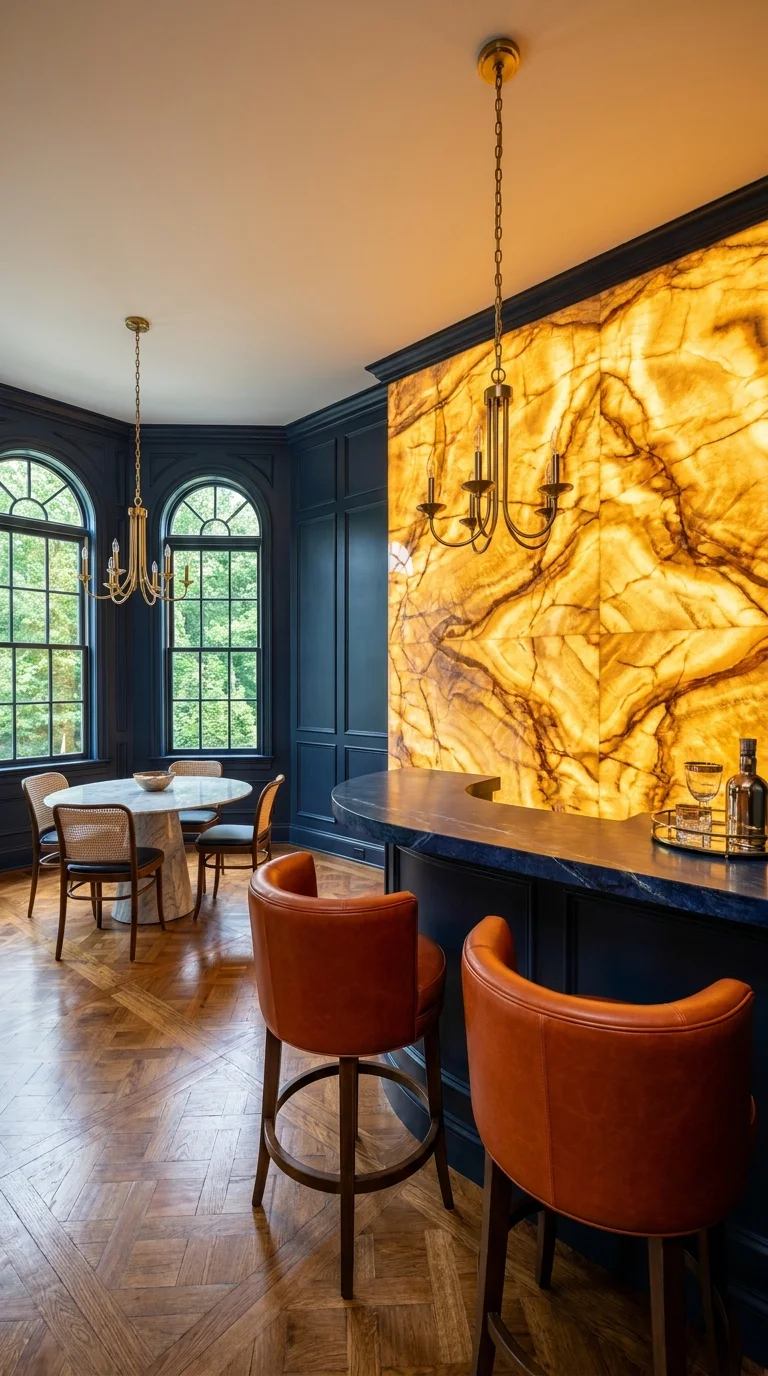
This room works because it never asks the amber stone to compete with anything. The walls, trim, and even the ceiling molding are painted a single deep navy, so when the eye reaches the backlit onyx wall, there’s nothing else pulling attention away from it. That’s the first decision this space makes for you: pick one material to glow, and paint everything else quiet enough to let it.
The lighting strategy here is doing more work than the stone itself. Onyx is translucent, which means it only reads as “glowing amber marble” when lit from behind — lit from the front, it would just look like brown stone. Whoever designed this wall knew that, and built the light source into the paneling rather than bolting a fixture onto the surface. It’s a good example of image-based observation: the warmth reads gold and honeyed here, but onyx can shift cooler or more orange depending on the bulb temperature behind it, so what’s pictured is one specific outcome, not a guarantee.
Proportion matters too. The bar counter is kept low and dark — sintered stone in a deep charcoal-blue — so it recedes and lets the wall behind it stay the visual anchor. Swap that counter for something pale or reflective and the room would suddenly have two competing focal points instead of one.
This look suits a formal dining room or a converted parlor more than an open-concept kitchen, because it depends on four walls and real ceiling height to hold the drama. It rewards homeowners who already lean toward moody, tailored interiors — if your home is Scandinavian minimalist elsewhere, this corner will read as a jarring left turn rather than a natural extension. It’s the same instinct that shows up in this small Art Deco dining room built around a single bold material — restraint everywhere except one deliberate splurge.
The biggest advantage is drama on a fixed footprint — this doesn’t need square footage; it needs contrast. The biggest compromise is cost: book-matched or lit stone slabs are a genuine investment, and the navy millwork isn’t a weekend paint job. To recreate this on a smaller budget, skip the real onyx and look at large-format porcelain panels with an onyx print backed by an LED panel — visually similar from across the room, at a fraction of the price. The most common mistake is lighting the stone too brightly; onyx looks best glowing, not blazing, so a dimmer isn’t optional here; it’s structural to the design.
Would this work for you? If you want one show-stopping wall and you’re willing to keep everything else in the room deliberately restrained, yes. If you’d rather your bar blend into a busy, layered room, this isn’t it.
Where the Warmth Actually Comes From
The chandeliers add sparkle, but they’re secondary lighting — the real light source is behind the stone. That single decision is why this room photographs and feels warm even with cool daylight pouring through the arched windows on the opposite wall; the two light temperatures balance each other instead of fighting.
Recommended Materials: Backlit onyx or marble panels · Dark sintered stone or soapstone counter · Herringbone parquet flooring · Cane and rattan seating · Polished brass fixtures
Main Colors: Deep Navy · Honey Amber · Aged Brass · Rust Leather
Best Lighting: Lead with the backlit stone panel as the primary light source, then layer in warm-toned brass chandeliers on dimmers for ambient fill — avoid any cool-white overhead lighting, which will fight the amber tone of the stone.
Where This One Falls Apart Fast
- Choosing a glossy or pale counter that competes with the backlit wall instead of grounding it
- Lighting the onyx too evenly, which flattens its natural veining instead of letting shadows define it
- Painting the room in more than one dark color, which muddies the single-focal-point effect
- Skipping a dimmer switch, leaving no way to soften the glow for daytime use
A Wall-to-Wall Walnut Bar Built to Disappear Into Dinner Parties
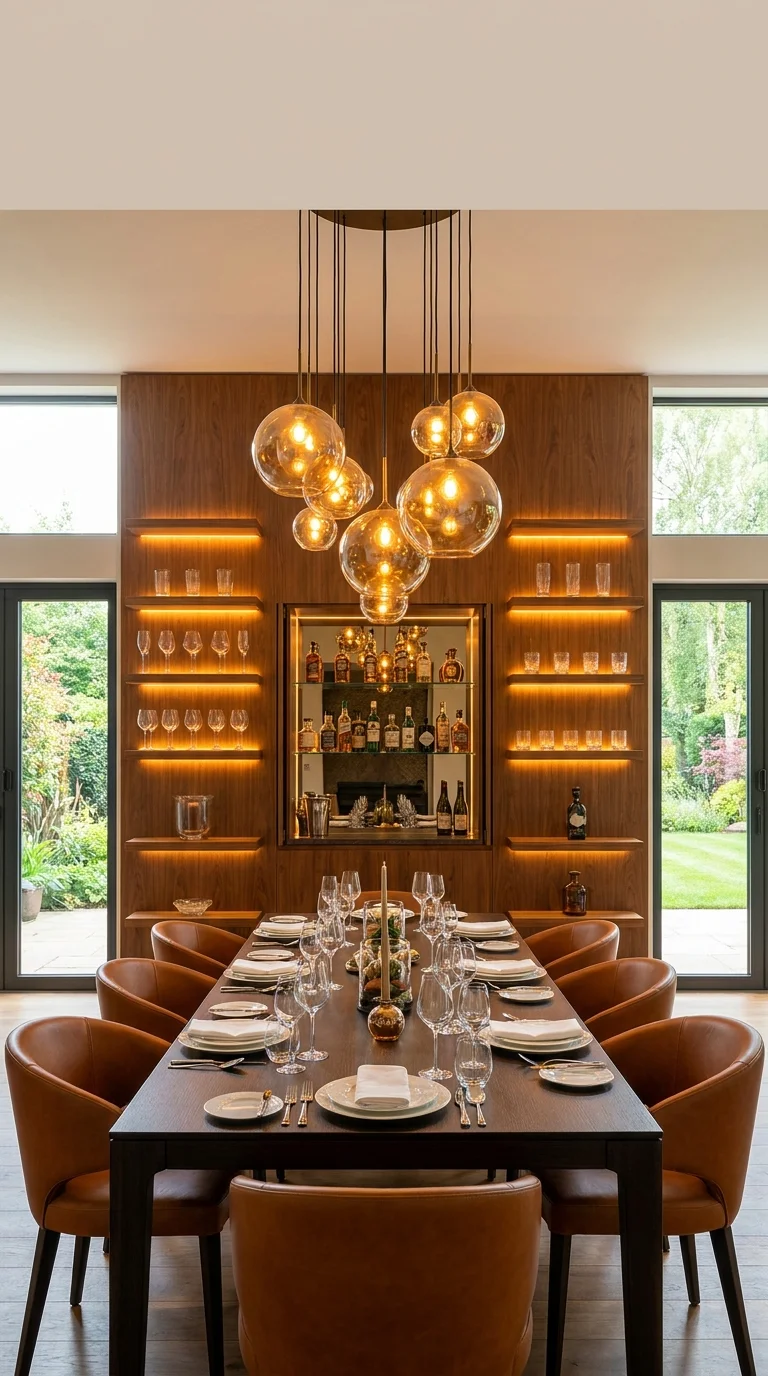
Unlike the last room, this one isn’t trying to be the loudest thing in the house — it’s trying to be the most useful. The walnut millwork runs the full width of the wall, split symmetrically around a mirrored niche, which is a balance and hierarchy decision: it tells the eye this is architecture, not an accessory piece dropped into the room.
The under-shelf lighting is the detail worth studying. Rather than one bright fixture, warm LED strips are tucked beneath each shelf, so every level of glassware and bottle gets its own soft glow. It’s a repetition principle at work — the same lighting treatment repeats across eight shelves, which is exactly why the wall reads as “resolved” rather than “shelved.” Break that repetition with one unlit shelf and the whole system would look unfinished.
This is a dinner-party-first design, not a stand-and-drink bar. The long table anchors the room, and the bar wall is arranged to be reached from a seated position — glasses within reach, bottles up higher, mirror at eye level to bounce light back into the room. That’s a real functional benefit for anyone who entertains seated dinners rather than cocktail-hour mingling.
The cluster of glass bubble pendants overhead adds visual movement without adding clutter, since they’re all clear glass and repeat the same warm bulb color as the shelving below — another quiet repetition that keeps a busy ceiling from feeling chaotic.
Worth the investment? Full wall-to-wall millwork like this is a genuine renovation, not a weekend project — it usually means custom carpentry, electrical work for the lighting, and a mirror cut to fit. It’s worth it if this room is a permanent, primary entertaining space in the home. It’s overkill for a bar you’ll use twice a year.
To simplify this for a smaller budget, keep the symmetry and the under-shelf lighting — those two moves do most of the visual work — but swap built-in walnut cabinetry for stock shelving units painted or stained to match, framed by simple trim.
Would this work for you? If you host seated dinners regularly and have a full wall to dedicate, this is close to ideal. If your entertaining is mostly casual and standing, the formality here may feel like more commitment than you want.
Common Mistakes to Watch For
- Mixing warm and cool bulb temperatures across shelves, which breaks the repetition that makes the wall feel cohesive
- Centering the mirror off the room’s sightline, which kills the light-bouncing effect from the entry
- Skipping the under-shelf lighting and relying only on the ceiling pendants, leaving bottles in shadow
- Overfilling every shelf with bottles and glassware, leaving no negative space for the eye to rest
Recommended Materials: Walnut millwork · Mirrored glass panel · Glass bubble pendant fixtures · Solid wood dining table · Leather upholstered chairs
Main Colors: Warm Walnut · Cognac Leather · Brass · Soft White
Maintenance: Walnut cabinetry needs occasional oiling or conditioning to keep its color from drying out, especially near the LED strips, which generate mild heat over long use.
Fluted Light and Dark Green Walls: A Bar Designed to Be the Main Event
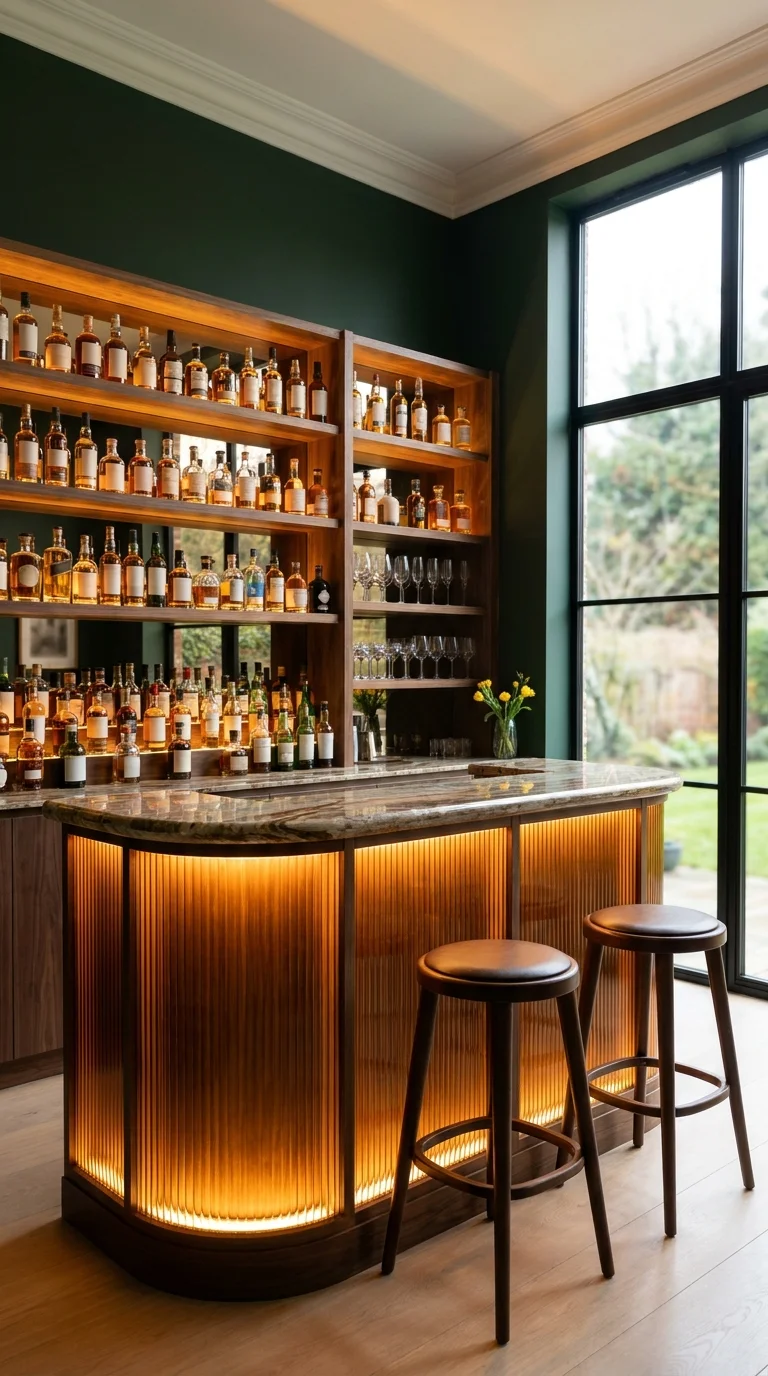
If the last two rooms treated the bar as part of a larger space, this one flips that entirely — the bar is the room. The dark green walls are the first decision worth understanding: a saturated, moody green recedes visually the way navy or black does, but it reads warmer and less severe, which is why fully stocked open shelving against it feels inviting rather than cluttered. That pairing is one reason this kind of deep green backdrop changes how an entertaining room feels compared to a neutral one.
The fluted, backlit bar front is the signature move. Vertical reeding catches light differently depending on where you stand, so the glow shifts subtly as people move around the room — a sightline detail that a flat, unlit bar front simply can’t produce. It’s a proportion risk too: a curved, glowing bar front this size could easily overwhelm a small room, but it works here because the ceiling height and tall factory windows give the room enough volume to absorb it.
The open shelving is the functional heart of the design. Every bottle is visible and reachable, which suits someone who actually mixes drinks rather than someone who wants bottles hidden behind cabinet doors. That’s a real lifestyle fit question: this design rewards a host who enjoys the ritual of building a drink in front of guests, not one who wants the bar tucked away between uses.
Would this work for you? If you want your liquor collection on display as part of the room’s decor, yes — this is built for exactly that. If you prefer a bar that can close up and disappear, the fully open shelving here will feel like constant upkeep rather than style.
Reading the Room’s One Real Risk
Green this dark only works with warm, plentiful light — in a room with fewer windows or no under-shelf lighting, the same wall color would likely read heavy rather than moody. The natural light from the tall window is doing real work here, balancing the depth of the paint.
Recommended Materials: Fluted wood or brass paneling · Marble or quartz countertop · Solid walnut open shelving · Turned wood barstools
Main Colors: Dark Forest Green · Warm Amber Glow · Natural Walnut
Best Lighting: Backlight the fluted bar front and every shelf edge with warm LED strips, and let the tall window carry daytime light — avoid overhead ceiling fixtures, which would flatten the fluting’s shadow play.
Category Tips — Keeping an Open-Shelf Bar Looking Curated, Not Cluttered
- Group bottles by color or category rather than lining them up by height
- Leave visible gaps between bottle clusters so the shelving doesn’t read as solid mass
- Face labels outward and evenly, since open shelving makes every label part of the decor
- Dust and wipe bottles regularly — visible shelving shows fingerprints and dust far faster than closed cabinets
When a Tree Becomes the Light Fixture Over a Live-Edge Bar
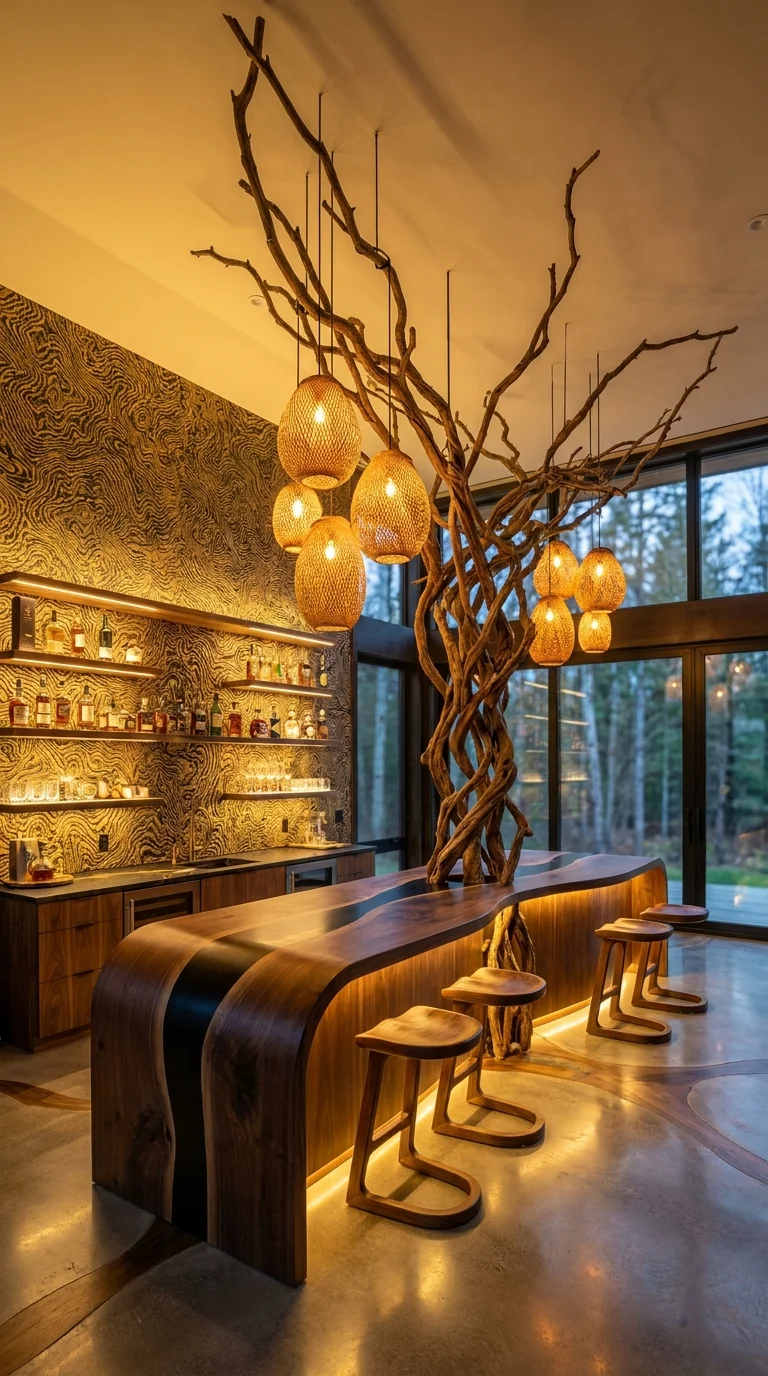
Every other bar on this list starts with the counter or the wall. This one starts with the branch sculpture overhead, and that changes the whole hierarchy of the room. The gnarled, tree-like fixture hung with woven amber pendants is a sightline anchor — it’s the first thing the eye finds, before the counter, before the shelving, before the view outside.
That’s a deliberate risk. A fixture this sculptural competes for attention with almost anything else in the room, which is why the rest of the space is kept quiet: dark textured wallpaper instead of pattern-heavy tile, a single waterfall-edge wood counter instead of a busy backsplash, plain concrete floors instead of a patterned rug. Repetition and restraint elsewhere are what lets the one bold gesture — the branch fixture — actually land.
The counter itself deserves its own conversation. A live-edge waterfall slab like this is one of the more consequential material decisions on this whole list, since choosing the right countertop material shapes both the look and the long-term upkeep of a bar far more than any accessory will. Live-edge wood brings warmth and genuine one-of-a-kind grain, but it also needs regular oiling and isn’t as forgiving of standing water or citrus splashes as stone.
This look suits a home with real architectural presence — floor-to-ceiling glass, a forest or landscape view, generous ceiling height. It would feel out of scale in a small, low-ceilinged basement bar, where the branch fixture would have nowhere to breathe.
To simplify this for a smaller budget, the branch fixture itself can be a genuine DIY: driftwood or a manzanita branch from a garden center, wired with simple pendant sockets, costs a fraction of a custom sculptural piece and reads almost as dramatic in photos.
Would this work for you? If your space has height and a view worth framing, this rewards both. If your bar corner is boxed in with a low ceiling, skip the branch fixture — it needs room to read as sculpture rather than clutter.
The One-Detail Gut Check
- Hanging the branch fixture too low, where it becomes a hazard rather than a focal point
- Pairing a live-edge counter with a busy patterned backsplash, splitting attention between two textures.
- Choosing bright white lighting instead of warm bulbs, which makes the amber woven pendants look dull rather than glowing
- Skipping wood conditioning on the counter, leading to visible dryness and cracking at the live edge within a year
Recommended Materials: Live-edge black walnut counter · Woven rattan pendant shades · Reclaimed branch or driftwood fixture frame · Polished concrete flooring
Main Colors: Charcoal Wallpaper · Warm Walnut · Amber Glow · Matte Black
Maintenance: A live-edge wood counter needs food-safe oil every few months, more often near a sink, to prevent the exposed grain and edge from drying and splitting.
A Curved Bar That Puts the Ocean Ahead of the Bottles
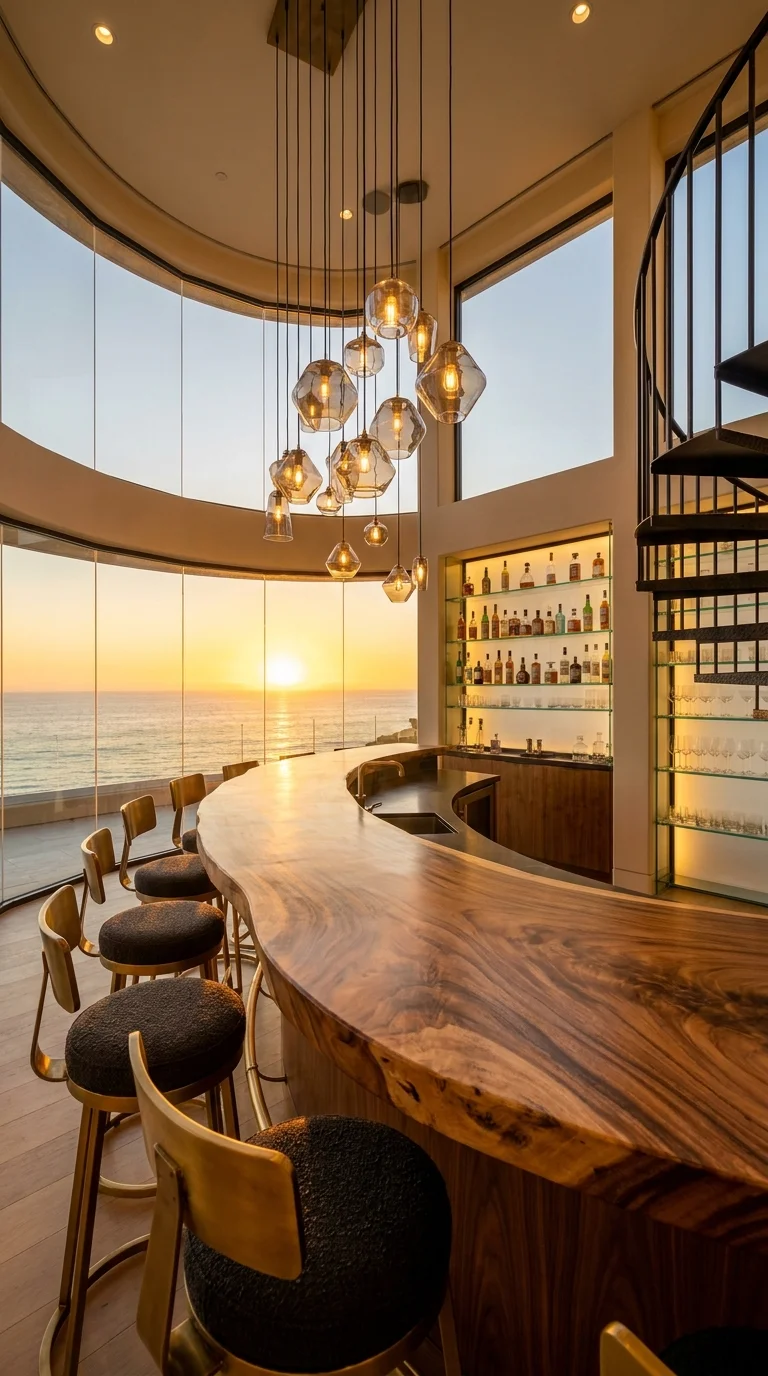
Most bars are designed to be looked at. This one is designed to be looked past. The entire curved layout follows the shape of the glass wall behind it, which means every barstool faces the ocean first and the bottle display second — a flow decision that puts the view, not the liquor, at the center of the room.
The cascading cluster of amber glass pendants is doing quiet, important work here. Hung at staggered heights rather than one flat line, they fill the tall vertical space above the bar without blocking any part of the window wall — a proportional solution for a room where the ceiling height would otherwise dwarf a standard-height fixture.
The live-edge wood counter curves with the room instead of running straight, which is a genuinely difficult and expensive fabrication choice — curved wood slabs like this typically require specialized cutting and finishing that a straight counter never would.
Worth the Investment?
This is the one room on this list where the honest answer is: only if the view is already there. A curved glass-walled bar built around city rooftops or a parking lot loses its entire reason for being. The premium here isn’t really the wood or the lighting — both can be recreated affordably elsewhere — it’s the architecture of glass walls meeting a waterfront lot, which isn’t something a renovation budget can manufacture from scratch. If you have the view, this layout is worth the curved millwork. If you don’t, put that budget into a flat bar and a great piece of art instead.
Would this work for you? If you’re building or renovating a home with a real view worth protecting, yes, without hesitation. If you’re working with an interior room or a modest window, borrow the amber pendant cluster and the wood tones, but skip the curve — it only pays off with a view behind it.
Common Mistakes to Avoid Here
- Placing the bar where the counter blocks sightlines to the view instead of framing it
- Choosing cool-toned glass or metal finishes that clash with a warm sunset light
- Overcrowding the pendant cluster so it visually competes with the window instead of complementing it
- Skipping a curved layout in a curved room, leaving awkward wasted corner space.
Recommended Materials: Curved live-edge hardwood counter · Amber glass pendant cluster · Glass shelving · Brass hardware · Boucle upholstered stools
Main Colors: Sunset Amber · Warm Wood Tone · Soft Black · Brass
Best Lighting: Let the natural sunset carry the room during golden hour, and rely on the pendant cluster’s warm bulbs only as evening ambient light — daytime overhead lighting here would compete with, not enhance, the view.
One Glowing Seam of Turquoise Down the Middle of a Communal Bar Table
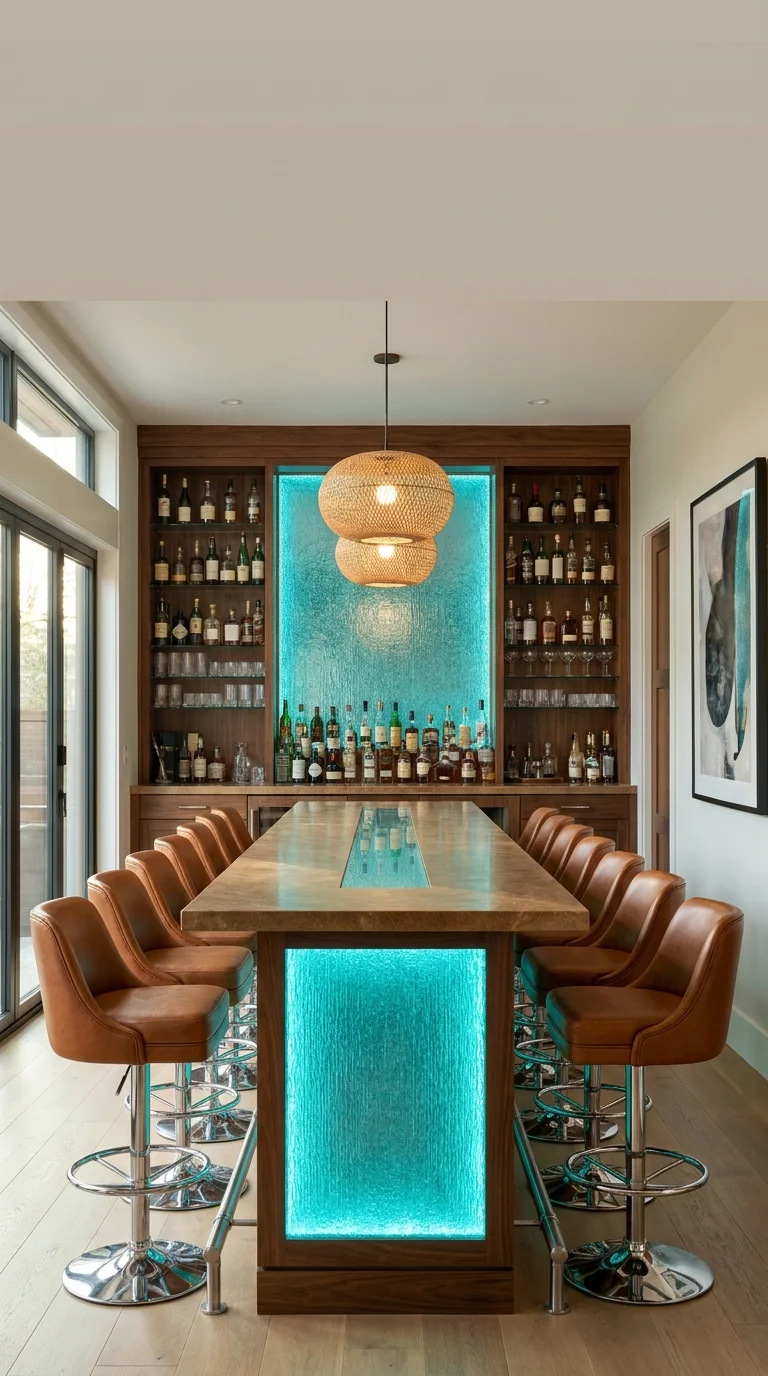
This is a repetition principle room built around a single unusual choice: a strip of backlit textured glass running down the center of a long communal table, echoed in the wall niche behind the bar. That one glowing detail, repeated twice, is what keeps a very long table from reading as a plain slab with stools around it.
The seating count is the real functional story here. A dozen swivel stools with chrome bases line both sides, which tells you this room is built for groups, not couples — this is a design for hosting a crowd, not for a quiet nightcap. The mid-century-leaning chrome-and-leather stools echo the kind of pieces that show up across retro-leaning apartments built around warm wood and metal accents, which is worth noting if you’re chasing a specific style lineage rather than picking furniture piece by piece.
The turquoise glow is a genuine styling risk — a saturated accent color like this either becomes the signature of the room or clashes with everything else in the home. Here, it’s kept to a single narrow strip rather than a full wall, which limits the risk considerably; the same color across a whole backsplash would be a much bolder, harder-to-live-with bet.
Would this work for you? If you regularly host larger groups and want one memorable, photographable detail, yes. If your entertaining tends to be smaller and quieter, a table built for twelve will likely feel oversized and the glowing accent unnecessary.
Where This Setup Trips People Up
- Choosing an accent color without testing it under both daylight and evening lighting, since backlit glass shifts dramatically between the two
- Buying stools that don’t swivel or aren’t barstool height for a communal table this long, creating awkward gaps
- Running the glowing strip the full length of the table, which becomes visually exhausting rather than a focal detail
- Placing the table where foot traffic on both sides isn’t possible, defeating the point of double-sided communal seating
Recommended Materials: Backlit textured glass or resin panel · Warm stone or wood tabletop · Chrome-based leather stools · Walnut back-bar cabinetry
Main Colors: Turquoise Glow · Warm Wood · Cognac Leather · Brushed Chrome
Best Lighting: Keep the backlit glass on its own dimmer separate from the room’s ambient lighting, so the glow can be adjusted independently for daytime versus evening entertaining.
A Riveted Steel Bar Built As It Belongs on a Loading Dock
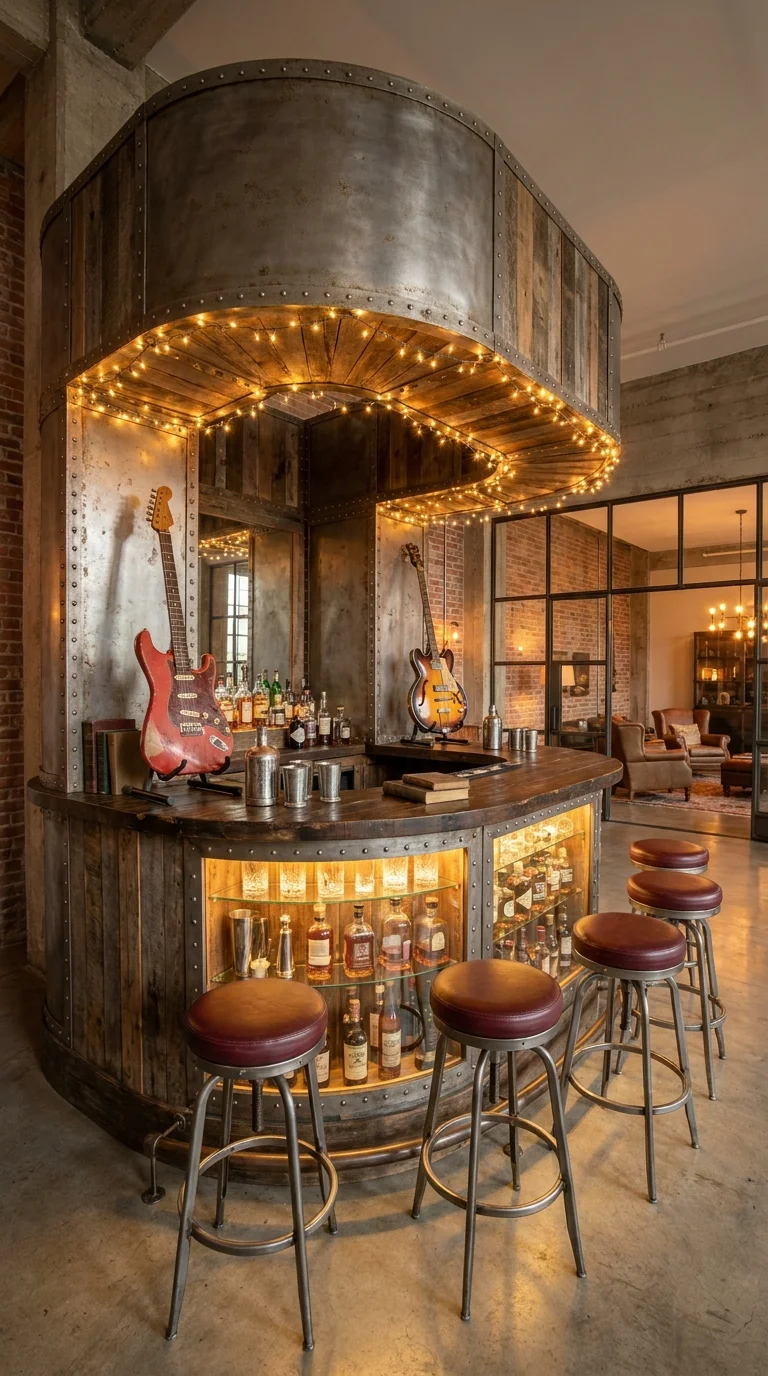
Every material choice in this room points the same direction: reclaimed wood, riveted sheet metal, exposed brick, string lights strung like a backstage rig. This is a design psychology case study in how materials alone can build a personality — nothing here is polished, and that’s entirely the point.
The curved metal enclosure is the boldest structural decision on this whole list. Riveted panels wrapping a circular bar are a genuine fabrication commitment, not a finish you add after the fact — it changes the bar from furniture into architecture. That’s a proportion and scale risk: a metal drum this size could easily feel like a bunker in a small room, but the high ceilings and open sightlines to the adjoining brick-walled space give it room to read as a feature rather than an obstacle.
The mounted guitars are a personalization detail worth calling out separately, because they do something most bar decor doesn’t: they turn the space into a specific person’s room rather than a generic style. This is the kind of maximalist confidence that shows up in living rooms built around genuine personal collections instead of matched decor sets — the lesson transfers directly to a bar built around a hobby or passion.
Who should skip this style? Anyone renting, anyone in a home with a more formal or traditional architecture elsewhere, and anyone who doesn’t already have a genuine collection or hobby to display. Faked industrial decor — string lights and reclaimed wood with nothing personal behind it — reads as a theme rather than a room.
Would this work for you? If you have a real collection, a genuinely industrial or converted space, and a taste for unpolished materials, this is one of the most personality-forward looks on this list. If your home leans traditional or you’re aiming for resale-neutral design, this is the hardest one here to soften down.
Easy Ways to Get This Wrong
- Buying new materials distressed to look reclaimed instead of sourcing the real thing, which rarely reads as convincingly worn
- Filling the display shelving with generic decor instead of a genuine personal collection
- Under-lighting the curved metal, which needs the string lights and under-counter glow to avoid feeling like an unfinished garage
- Mixing in polished, contemporary furniture that clashes with the intentionally raw materials elsewhere
Recommended Materials: Riveted sheet metal paneling · Reclaimed barn wood · Exposed brick · Vintage-style bulb string lights · Metal-framed leather-top stools
Main Colors: Weathered Steel · Reclaimed Wood Brown · Warm Bulb Amber · Aged Burgundy Leather
Two Oversized Ceramic Jars Holding Up a Stone-Backed Bar
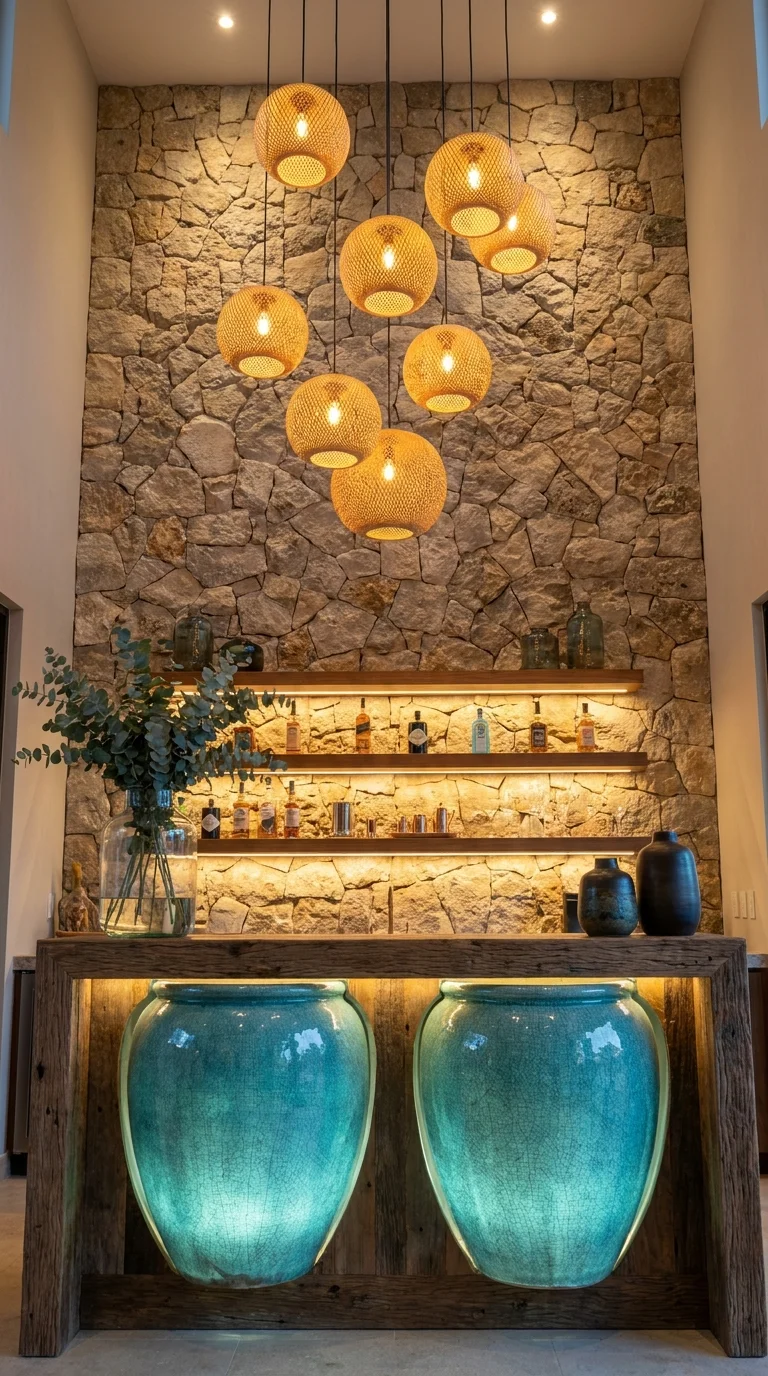
This is the most texturally ambitious room on the list — natural fieldstone, a cluster of woven rattan pendants, reclaimed wood framing, and two enormous crackle-glazed turquoise vessels doing the work most bars give to a cabinet base. That last choice is the furniture analysis worth sitting with: repurposing oversized ceramic jars as a structural-looking base is a genuinely unusual move that most bar designs never consider, because it treats storage vessels as sculpture rather than utility.
The stone wall behind the shelving is left completely raw and unfinished, which is a material behavior choice with real long-term implications — natural, uncut fieldstone like this is essentially permanent and low-maintenance once installed, unlike painted drywall, which will need touch-ups over time. The floating wood shelves are backlit from beneath, echoing a lighting strategy that shows up again and again across these ten rooms: light the object, not the room.
The eucalyptus greenery isn’t just styling — its presence alongside so many organic, textured materials (stone, rattan, unglazed clay tones in the vessels, reclaimed wood) is part of a broader earthy, natural-material approach that shows up in cozy farmhouse kitchens just as much as it does in a bar niche like this.
Would this work for you? If you already gravitate toward organic, handmade-feeling materials and have a genuine stone or textured wall to work with, this is one of the more achievable high-impact looks here. If your home is sleek and contemporary, the raw stone and oversized ceramics will likely feel like a stylistic detour rather than a natural fit.
What Trips People Up Recreating This
- Choosing a smooth, painted wall instead of real texture, which flattens the entire design’s reason for being
- Using small or delicate vases instead of genuinely oversized vessels, losing the visual weight that makes the base read as furniture
- Skipping the under-shelf lighting, leaving the bottles and glassware in shadow against a dark stone backdrop
- Letting real greenery go unwatered, which is the fastest way to undercut an otherwise polished, organic room
Recommended Materials: Natural fieldstone or dry-stack veneer · Reclaimed wood shelving and framing · Crackle-glazed ceramic vessels · Woven rattan pendant lighting
Main Colors: Warm Stone Grey · Turquoise Glaze · Reclaimed Wood Brown · Amber Glow
Maintenance: Live greenery needs regular watering and occasional trimming, and unsealed reclaimed wood shelving should be dusted and periodically re-oiled to keep its color from graying out.
The Bar That’s Just Three Shelves and a View
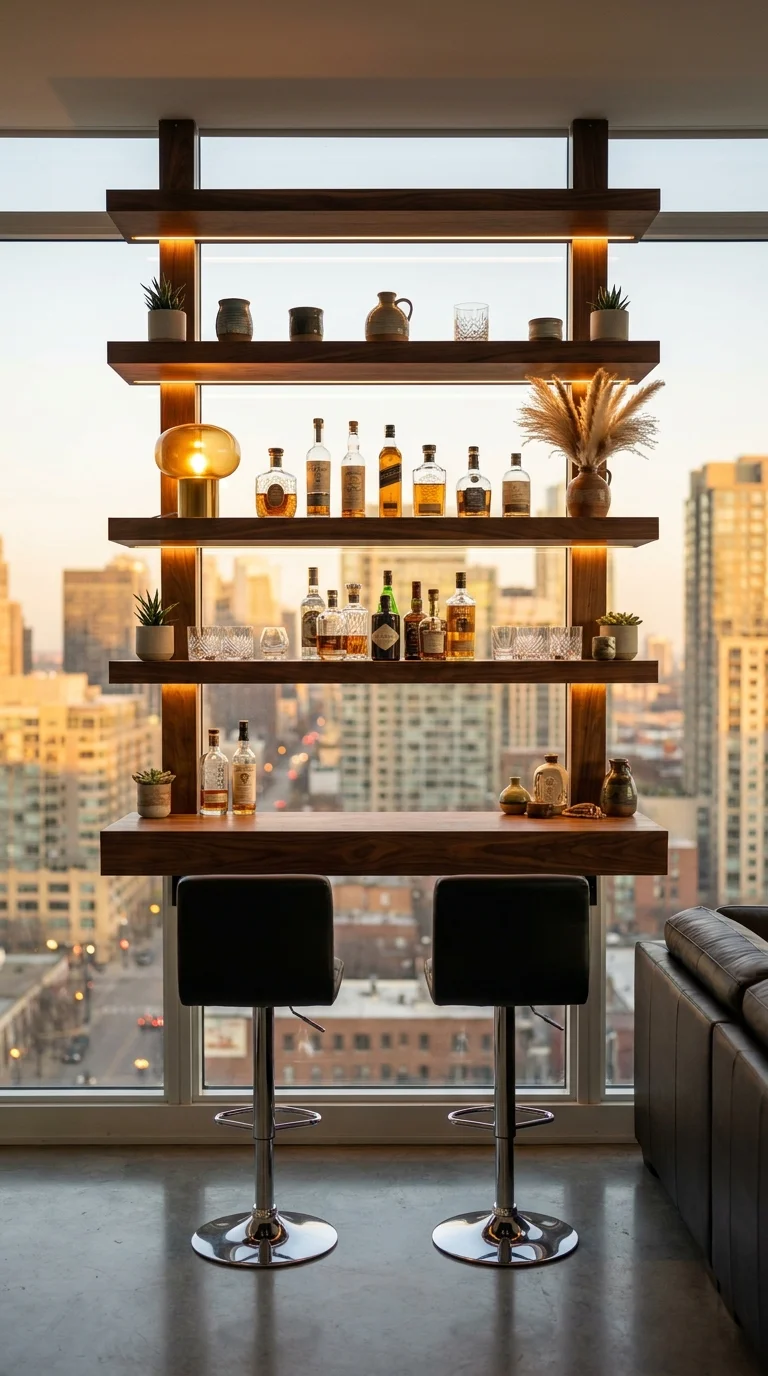
Nine bars into this list, this is the first one with no cabinetry at all — just an open wood-and-steel shelving frame standing in front of a floor-to-ceiling window, two stools, and a skyline. It’s proof that a home bar doesn’t need a counter enclosure to function, only a surface, storage, and somewhere to sit.
This is a small-space solution more than a style statement, and it belongs in the same conversation as other compact bar and beverage station ideas built for rooms that can’t spare a full wall. The open frame construction means the unit reads as furniture rather than built-in architecture, which matters enormously for renters or anyone who might move — this entire piece can be relocated, unlike any of the paneled or millwork bars earlier on this list.
The backlighting under each shelf does the same job it does everywhere else on this list — making bottles glow rather than sit in flat daylight — but here it’s doing double duty, since the shelf unit sits directly against a bright window and would otherwise wash out in silhouette against the daytime skyline.
The styling restraint matters too: a few plants, one lamp, minimal glassware. Overfilling shelving this open and exposed would clutter the one thing this design is actually selling, which is the framed view beyond it.
Would this work for you? If you have a great window and limited floor space — an apartment, a condo, a small den — this is one of the most realistic looks on this entire list to actually recreate. If you want a bar with storage capacity and a finished, enclosed look, this design will feel underbuilt for your needs.
Mistakes That Undercut This Look
- Overloading the open shelves with bottles and glassware until the view disappears behind clutter
- Placing the unit somewhere without natural light or a real view, losing the entire reason for an open frame
- Skipping under-shelf lighting, leaving the display dim against a bright window during the day
- Choosing bulky, upholstered stools that visually block the open, airy feel the design depends on
Recommended Materials: Dark walnut open shelving · Steel or blackened metal frame · Chrome or leather barstools · Small potted plants and dried pampas grass
Main Colors: Dark Walnut · Warm Brass Accent Lamp · Soft Neutral Backdrop
Best Lighting: Rely on the window for daytime brightness and switch to the under-shelf LED strips as the sole light source after dark, keeping the unit from ever looking flat or shadowed.
A Glowing Stone Slab Turns a Dining Corner Into a Bar Without Adding a Bar
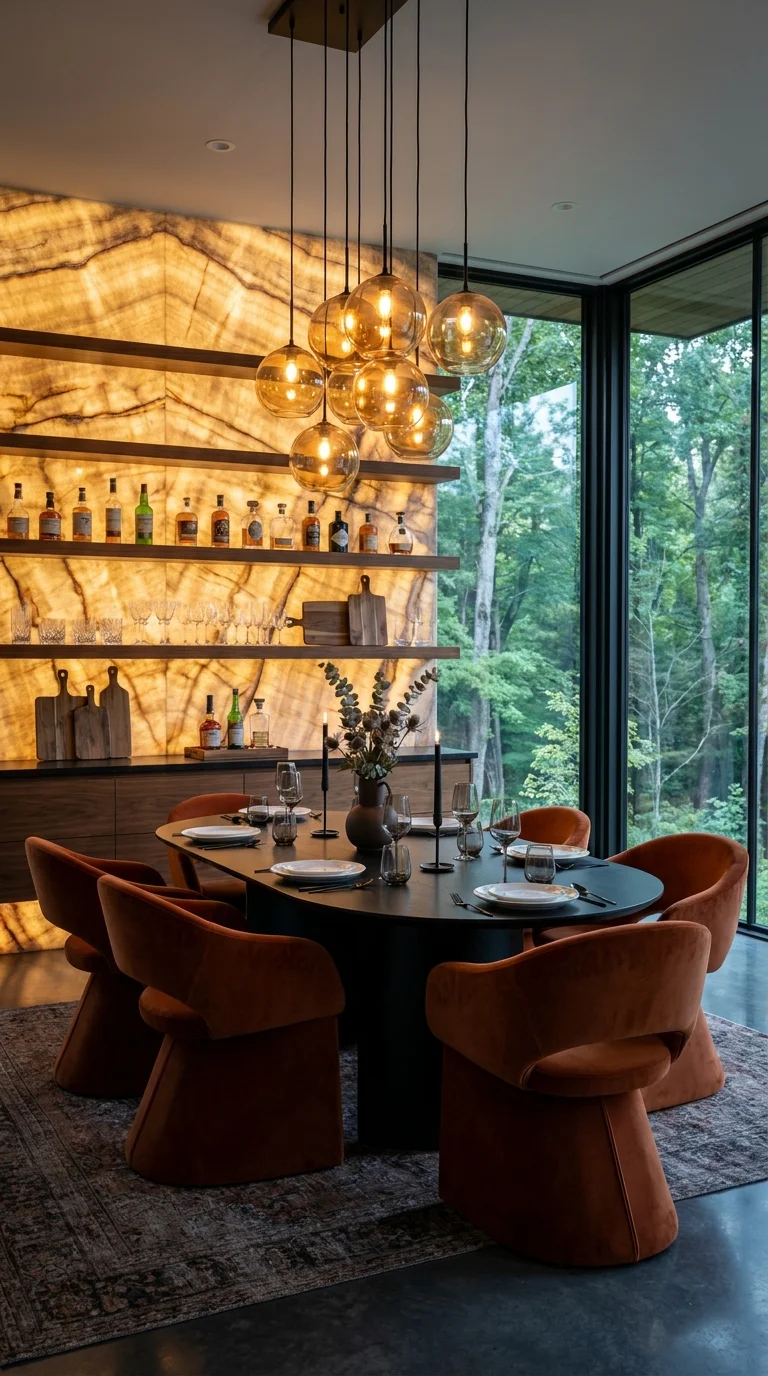
The last room on this list makes the case that a home bar doesn’t need a counter, stools, or even a defined footprint — it just needs a dedicated wall. A backlit, wood-grain-patterned stone slab sits behind open shelving stocked with bottles, glassware, and cutting boards, directly adjacent to a dining table rather than a separate bar area entirely.
This is the same backlit-stone strategy seen in the very first room on this list, but the outcome couldn’t feel more different — proof that material choice alone doesn’t determine mood; context does. Where the navy paneled room used deep, saturated color and traditional brass fixtures to feel like a private club, this room uses black steel, a bare oval table, and forest views through glass walls to feel contemporary and unfussy. Two rooms, same core material, two completely different personalities.
The cluster of amber glass pendants overhead ties the dining and bar functions together visually, repeating the warm bulb tone found in the stone’s backlighting — a repetition detail that keeps a room serving two purposes from feeling like two separate design projects stitched together.
This approach genuinely suits open-concept homes and smaller footprints where a dedicated bar room isn’t realistic, since it borrows an existing dining wall rather than requiring new square footage. It’s the most space-efficient full-bottle-display option on this entire list.
Would this work for you? If you want a properly stocked bar display but don’t have room for a stand-alone bar, dedicating one wall like this is one of the smartest space trades on this list. If you specifically want a place to stand and mix drinks separate from the dining table, this open shelving approach won’t give you that.
What Trips People Up Here
- Choosing a busy, high-contrast dining chair color that competes with the warm stone backdrop instead of complementing it
- Placing the backlit wall somewhere it can’t be seen from the seated dining position, wasting its impact.
- Skipping cutting boards and serving pieces as styling elements, leaving the shelving looking like storage rather than a curated bar wall
- Overcrowding the shelf with too many bottle sizes and shapes, breaking the visual rhythm that makes the display feel intentional
Recommended Materials: Backlit stone or porcelain slab paneling · Dark wood open shelving · Glass pendant cluster · Oval blackened-steel dining table · Velvet upholstered chairs
Main Colors: Warm Amber Stone · Matte Black · Burnt Orange Velvet · Natural Wood
Best Lighting: Match the pendant cluster’s bulb warmth to the backlit stone’s glow so the two light sources read as one cohesive system rather than two competing color temperatures.
Keeping the Pour Line Moving at Your Own Home Bar
A home bar has to survive actual use, not just photograph well, so the details that matter here are functional rather than stylistic.
- Keep a wipeable surface — stone, sealed wood, or metal — within reach of where drinks are actually poured, since spills happen at the pour point more than anywhere else in the room.m
- Store heavier bottles on lower shelves and glassware higher up, both for stability and for easier one-handed pouring.
- Leave at least 30 inches of clearance behind any stool line so guests can get up and move without squeezing past seated friends.
- Plan for a small trash or recycling bin near the bar itself — carrying bottle caps and citrus peels across the room after every drink adds up fast during a party.
Who Should Choose This Style?
- Best for homeowners who entertain regularly and want a dedicated space that does more than a kitchen counter can
- Best for open-concept homes looking to give one wall or corner a genuine sense of purpose and personality
- Best for anyone with an existing architectural feature — a window, a stone wall, real ceiling height — worth building around
- Not ideal for renters in short-term leases, where custom millwork, backlit stone walls, and structural bar builds won’t transfer to a next home
Budget Summary
| Budget | Expectation |
|---|---|
| Low | Open wall shelving, string lights or basic LED strips, thrifted or budget bar stools |
| Medium | Butcher block or laminate stone-look counters, mirrored backsplash panel, mid-range upholstered stools |
| Premium | Book-matched backlit stone or onyx slabs, custom millwork cabinetry, live-edge hardwood counters, professional electrical lighting integration |
Frequently Asked Questions
How much space do I actually need for a home bar? A functional bar can work in as little as a few feet of wall space with open shelving and a narrow counter — the window-shelf design on this list proves a full room isn’t required. A dedicated bar room with seating typically needs enough clearance for both a counter and comfortable stool access on at least one side.
Do I need a sink in my home bar? It’s a convenience, not a requirement. Many of the bars on this list function purely as a pour-and-display station without plumbing, relying on ice buckets and a nearby kitchen for water and cleanup.
What’s the best countertop material for a home bar? It depends on how the bar is used. Stone and sealed quartz resist spills and citrus best for a high-use bar, while live-edge or butcher block wood adds warmth but needs more regular maintenance and care around standing liquid.
How do I light a home bar without it feeling like a kitchen? Backlighting bottles, shelves, or a feature wall — rather than relying on a single bright overhead fixture — is the detail that shows up across nearly every room on this list, and it’s the single biggest factor separating a bar that feels intentional from one that feels like leftover kitchen lighting.
Can I build a home bar without a full renovation? Yes — several of the designs here, particularly the open shelving and floating-shelf styles, are achievable with stock shelving, paint, and plug-in LED strip lighting rather than custom carpentry or electrical work.
About the Author
Aesthetic Life Team
The Aesthetic Life team covers home design, entertaining spaces, and everyday styling ideas for readers building homes that reflect how they actually live and host. Our focus stays on practical, achievable design choices drawn from real interiors, not trend-chasing for its own sake.
Conclusion
A great home bar isn’t the one with the most bottles or the boldest lighting — it’s the one that matches how you actually want to host. Some of the ten spaces above lean into drama and material investment; others prove a window, a shelf, and good lighting can do almost as much. The through-line across all ten is restraint somewhere in the room, whether that’s a single bold wall against quiet surroundings or a tight color palette holding a busy layout together. Pick the one whose compromises you can genuinely live with, not just the one that photographs best, and it’ll get used far more than twice a year.
Explore More
You may also enjoy:


3 Responses