
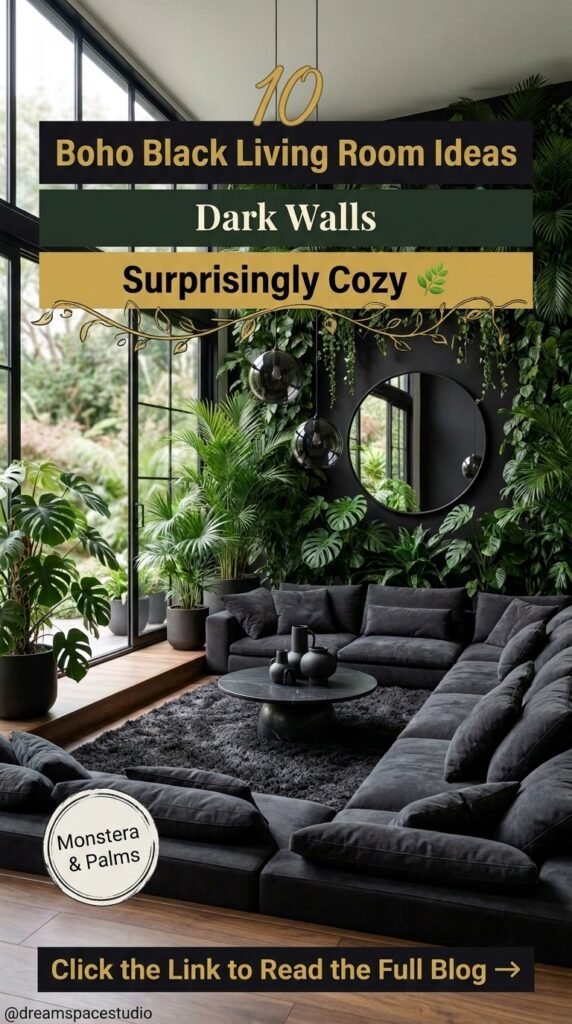
Black walls sound like a bold, maybe even risky, choice for a boho room — the style is usually associated with sun-bleached plaster and light rattan, not dark paint. But the ten rooms below prove black and boho aren’t opposites. Each one pairs a dark backdrop with a different kind of warmth — leather, wood, rattan, wool, or plants — so the room reads moody without ever feeling cold. By the end, you’ll know which pairing actually fits the room you’re working with.
Quick Overview
| Style | Boho / Moody Eclectic |
|---|---|
| Best For | Living rooms wanting drama with warmth |
| Budget | Low–High |
| Difficulty | Easy–Moderate |
| Maintenance Level | Low–Medium |
The Wall-Paneled Room That Treats Leather Like a Neutral
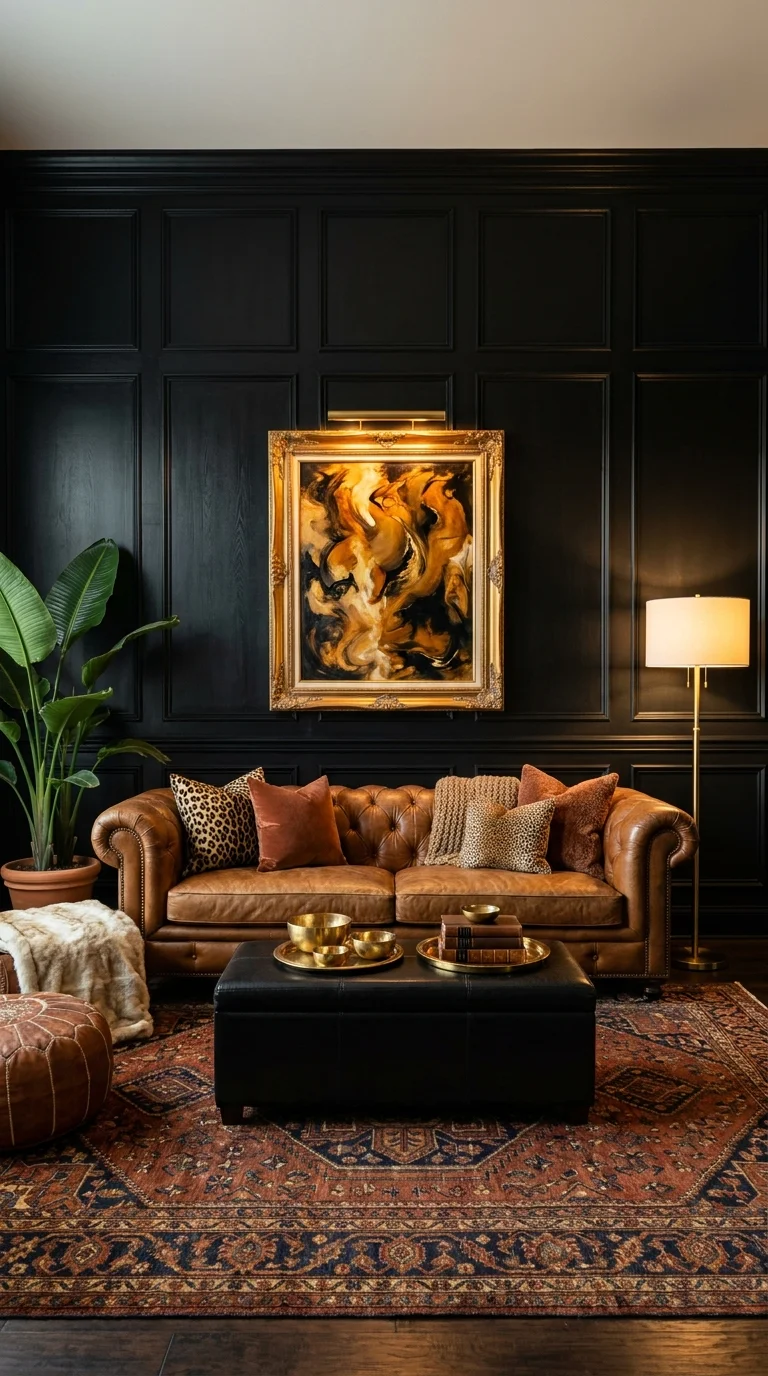
Black wainscoting-style paneling covers this entire wall, and instead of fighting that much dark surface, the room leans a cognac leather chesterfield directly against it — proof that leather this warm can act almost like a neutral against black rather than adding a competing color. A gilt-framed abstract painting in amber and gold sits dead center, lit by its own picture light, and does the job a window might in a room this dark: it’s the one place the eye can find brightness.
This idea suits anyone who already owns or wants classic, investment-grade furniture — a tufted leather sofa, brass trays, a real antique-style rug — rather than lighter, more disposable boho pieces. It works especially well in a formal or secondary living room, a den, or a library-adjacent space, since the mood here reads more “after-dinner drinks” than “everyday lounging.” The lifestyle it supports is a little more grown-up and considered: this isn’t a room built for kids’ toys underfoot.
The leopard-print and rust-toned pillows are doing real work — they’re the bridge between the room’s two loudest materials, leather and black paneling, translating the animal-print pattern into something that reads as boho-collected rather than costume-like. A Persian-style rug in deep reds and navy grounds the black coffee table and brass accessories, and this is one of the sections in the 10 Maximalist Living Room Ideas to Steal for a Room Full of Personality guide worth cross-referencing if this density of pattern and material genuinely excites you.
The advantage here is durability and timelessness — leather, brass, and wood paneling age well rather than dating quickly. The compromise is upfront cost: genuine leather chesterfields and real millwork paneling aren’t a weekend project or a budget swap. To simplify this for less money, MDF picture-frame paneling painted black gets most of the visual depth, and a faux-leather sofa in the same cognac tone reads similarly from a normal viewing distance. The most common mistake is pairing this much dark paneling with cool-toned metals instead of warm brass, which flattens the room’s warmth immediately.
Would this work for you? If you already lean toward classic, collected furniture and want drama without going full-modern, yes. If your taste runs lighter and more casual, one of the rattan-heavy rooms further down this list will suit you better.
A Ratio That Keeps the Paneling From Reading as a Box
The picture-lit painting takes up roughly a third of the wall’s visible height, framed by an unusually generous amount of blank paneling on every side — that much breathing room is likely what keeps the wall from feeling like a single dense object, letting the paneling’s grid pattern stay a quiet backdrop instead of visual noise competing with the art.
Where This Look Falls Apart
- Skipping the picture light and leaving the artwork to compete with the room’s low ambient light
- Choosing a cooler-toned rug instead of the warm reds and rust that balance this much black
- Mixing chrome or silver accessories in with the brass, which reads as mismatched rather than layered
- Leaving the leather sofa bare instead of adding pattern through pillows, which makes the room feel unfinished
Recommended Materials: black-painted wood paneling, cognac leather, brass, wool Persian-style rug, faux fur throw
Main Colors: Matte Black, Cognac Leather, Amber Gold, Rust
Best Lighting: A brass floor lamp and a dedicated picture light over the artwork carry this room after dark; without at least one warm accent light, this much black paneling will read flat rather than rich.
The Wood-Disc Wall That Turns Restraint Into the Whole Design
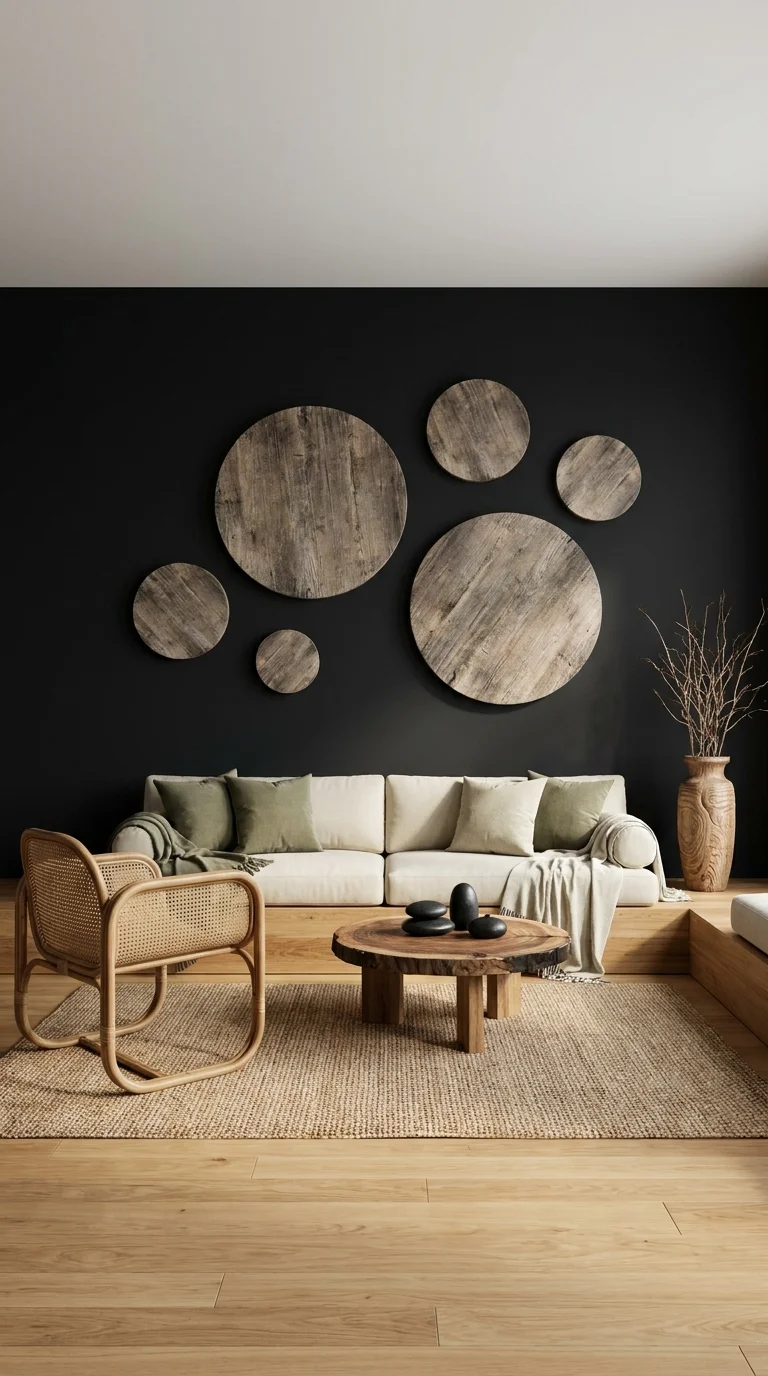
Seven reclaimed wood discs, cut at different diameters, float against a plain black wall in a loose, asymmetrical cluster — no frame, no gallery grid, just circles of varying size doing the entire job of wall art. Below them, a cream boucle sofa with sage-green pillows sits on light oak flooring, which is the real twist here: this is the only room on this list that keeps its floor and furniture almost entirely light, letting the black wall function as a single graphic backdrop rather than an enveloping color.
This idea suits minimalists who want boho’s natural materials — wood, rattan, jute — without boho’s usual layering of pattern and pillows. It’s a strong fit for smaller or narrower living rooms, since a light floor and light sofa keep the room feeling open even with one fully dark wall. The lifestyle it supports is calm and editorial, closer to a considered gallery space than a room built for entertaining a crowd.
The repetition of the circular shape is the room’s real organizing idea: the wood discs on the wall, the live-edge round coffee table, and the woven cane chair’s curved back all repeat the same rounded geometry at different scales, which is a large part of why a room built from so few objects still feels intentional rather than sparse. Two black stones on the coffee table are a small, deliberate echo of the wall’s material — wood and stone — kept in the same tonal family as everything else in the room.
The advantage is that this look is genuinely easy to keep looking tidy, since there’s very little to clutter or rearrange. The compromise is that it can feel underdressed to anyone who came to boho for its usual abundance — if you love a layered, pattern-heavy room, this restrained version may feel like it’s missing the point. To simplify this for a smaller budget, three or four discs cut from a single fallen tree branch, sanded and sealed, get most of the visual effect without buying a designer wall-art set. The most common mistake is adding a rug with a heavy pattern, which fights the wall’s quiet geometry instead of supporting it.
Would this work for you? If you’re drawn to boho’s textures but not its usual visual noise, yes. If a room this pared-back feels underdressed to you, keep looking further down this list.
Where the Eye Lands First on a Wall This Sparse
With so few objects on the wall, the eye is pulled toward the largest disc slightly left of center rather than the smaller ones around it — its size gives it priority the way a single bold print would in a busier gallery wall, and the smaller discs read as satellites orbiting that one anchor rather than equal partners.
Common Ways This Minimalist Look Loses Its Warmth
- Choosing a stark white sofa instead of a warm cream or oatmeal, which can tip the room cold
- Hanging the wood discs in a symmetrical grid instead of a loose, organic cluster
- Adding too many small accessories to the coffee table, cluttering what should stay a quiet vignette.
- Skipping the rattan chair’s texture in favor of an upholstered piece, losing the room’s one woven element
Recommended Materials: reclaimed wood discs, cane and rattan, live-edge wood, boucle upholstery, jute rug
Main Colors: Matte Black, Sage Green, Warm Oak, Cream
Best Lighting: This room relies almost entirely on daylight and ambient light rather than dramatic fixtures — a plain black wall; this graphic doesn’t need a spotlight the way a busier gallery wall would.
The Living Plant Wall That Makes Black Feel Alive, Not Heavy
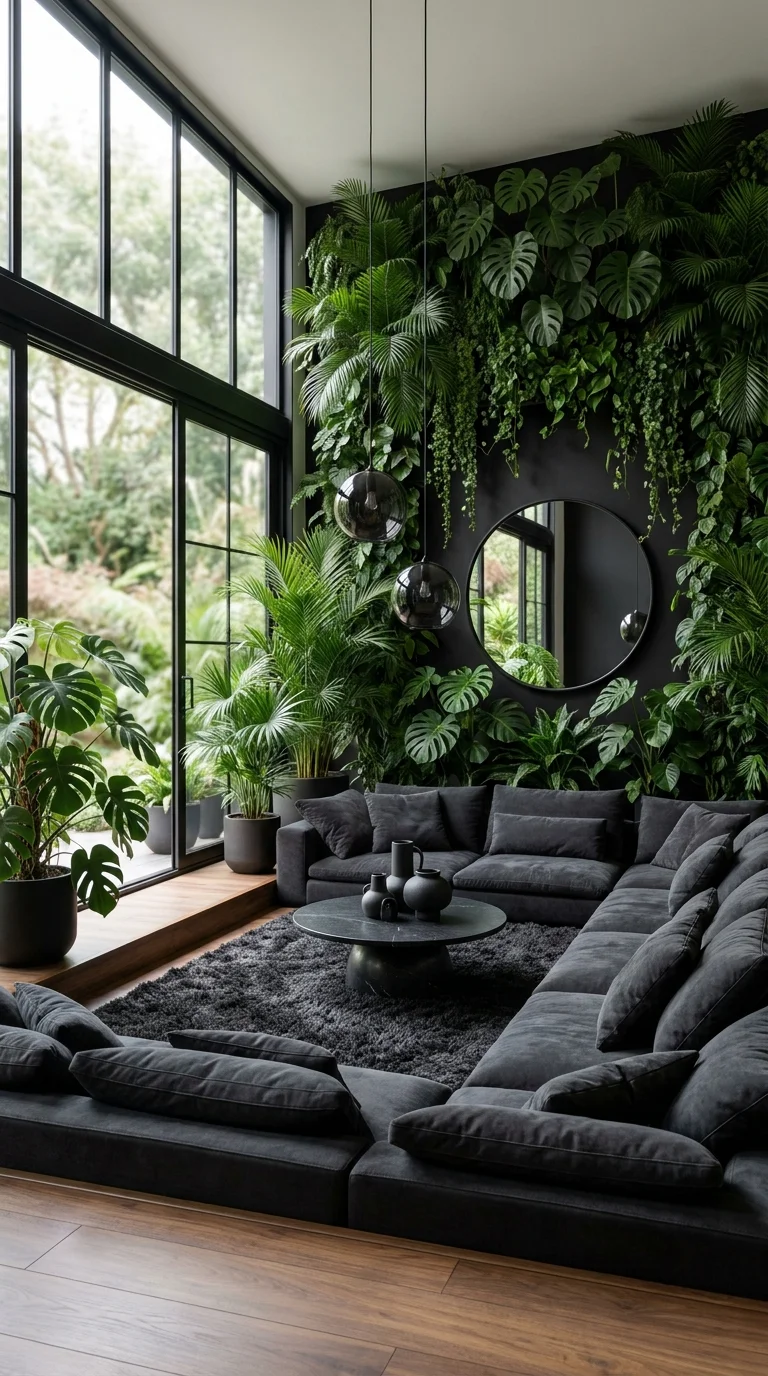
Most black living rooms rely on furniture and art to add warmth. This one uses an entire wall of live monstera, palm, and trailing pothos, cascading from ceiling-hung pendants down past a round black mirror, so the black wall behind it barely reads as a wall at all — it’s closer to a plant-covered backdrop with a mirror embedded in it. Floor-to-ceiling black-framed windows on the adjacent wall bring in enough natural light to keep a plant collection this dense genuinely alive, not just styled for a photo.
This idea suits committed plant owners specifically — anyone drawn to the biophilic side of boho who wants greenery to feel architectural rather than a few pots scattered around. It works best in rooms with real south- or west-facing light, since a wall this green needs consistent sun to thrive long-term. If you want a fuller breakdown of plant-heavy living rooms specifically, the Biophilic Living Room Guide goes deeper into light requirements and plant selection than this section has room for.
The oversized L-shaped charcoal sectional and matching shag rug keep the seating area intentionally quiet and monochrome, which is what allows the plant wall to carry all the color in the room without a second competing element. Smoked-glass pendant lights hang at staggered heights in front of the greenery, and their dark, reflective surface picks up the black wall’s color even where leaves cover it, tying the two ends of the room together visually.
The advantage is that a living wall like this changes with the seasons and genuinely improves indoor air quality — something no textile or wall art can offer. The compromise is real commitment: a collection this size needs a watering rotation, regular pruning, and consistent light, and an under-lit or neglected corner will visibly drag the whole look down within weeks. To simplify this for a lower-maintenance version, cluster three or four large floor plants along the wall instead of training vines across its full height, and mix in one or two realistic faux plants in the lowest-light corners. The most common mistake is choosing plants without matching their light needs to the room’s actual exposure, which leads to leggy or dying greenery fast.
Would this work for you? If you already garden or genuinely enjoy plant care and have strong natural light, yes. If plant maintenance realistically isn’t part of your routine, a single large plant paired with plain black paint will hold up far better long-term.
Why the Eye Goes to the Mirror First, Not the Plants
Even surrounded by dense greenery, the round black mirror is likely still the first thing the eye settles on — its perfectly circular, reflective surface stands apart from the organic, irregular leaf shapes around it, giving the wall a clear anchor point the way a single structured object often does inside an otherwise loose, natural arrangement.
Where a Plant Wall Like This Gets Away From You
- Letting vines grow untrained across the windows, which blocks the light the whole wall depends on
- Mixing plants with very different watering needs directly next to each other
- Skipping regular leaf dusting, which dulls the look of large glossy leaves like monstera
- Overcrowding the seating area with patterned textiles, which compete with the wall instead of supporting it
Recommended Materials: live monstera and palm, smoked glass, black steel window framing, velvet upholstery, shag wool rug
Main Colors: Matte Black, Deep Green, Charcoal Grey, Smoke Glass
Best Lighting: Full-height black-framed windows are the actual engine of this room — without that much genuine daylight, a plant wall this dense simply won’t stay healthy, fixtures or not.
Maintenance: A wall this plant-dense needs a real watering rotation, occasional turning toward the light source, and monthly leaf dusting to keep the greenery reading as lush rather than dusty.
The Moroccan Niche That Lets Boucle Curves Soften Black Walls
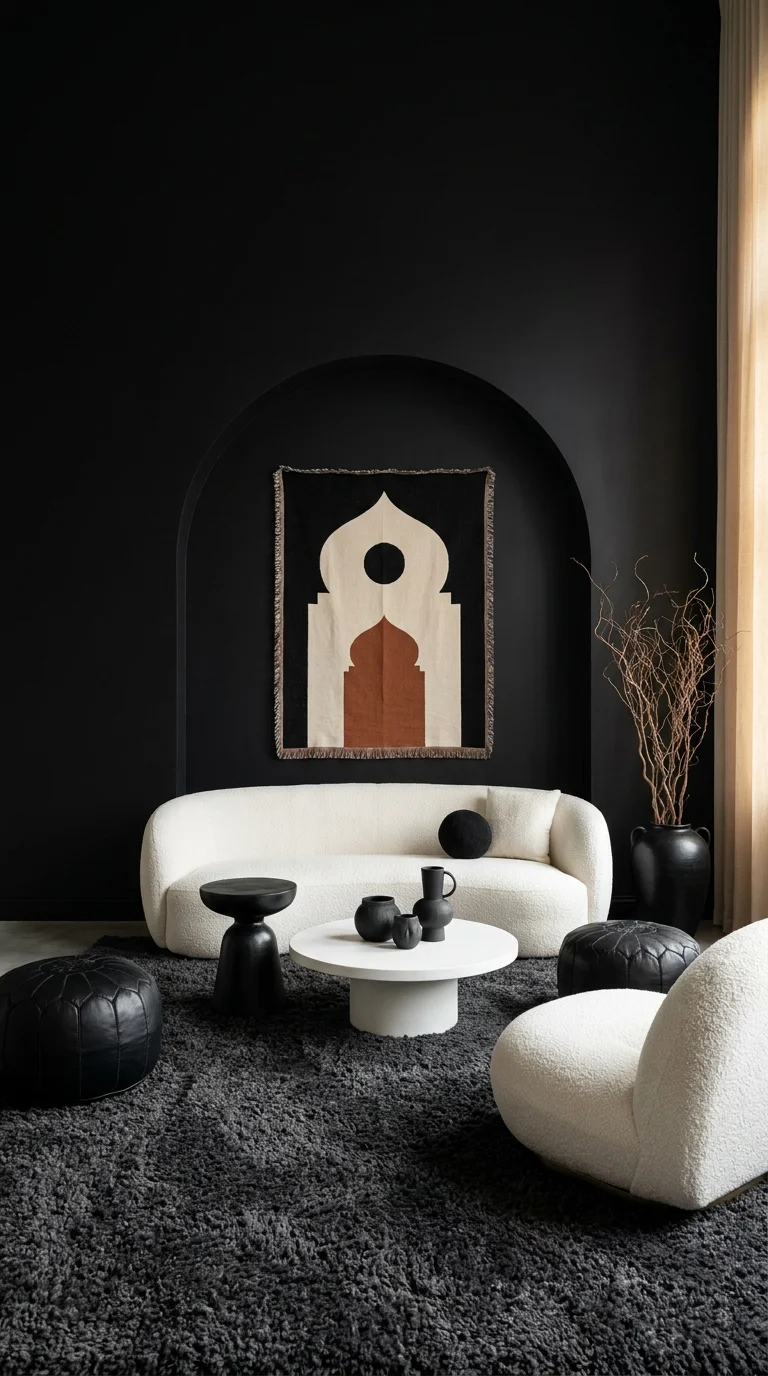
An arched black niche, painted the same charcoal as the surrounding wall, holds a woven tapestry in cream, black, and rust depicting a stylized mosque silhouette — the room’s one clear pattern moment. Everything in front of it is deliberately curved and soft: a cream boucle sofa with rounded arms, a matching boucle armchair, and two black leather poufs, all sitting on a deep charcoal shag rug that swallows sound and hard edges alike.
This look suits anyone drawn to a more minimalist, Moroccan-influenced take on boho rather than a densely layered one — think riad-inspired restraint over souk-style abundance. It works particularly well in rooms with an existing arch or alcove, since the niche here is doing real architectural storytelling that a flat wall couldn’t replicate as convincingly. The lifestyle it supports is quiet and adult-oriented, built around a single evening lamp and a woven throw rather than a room full of activity.
Boucle behaves differently than most boho textiles — its nubby, looped texture catches light unevenly, which is part of why the cream sofa reads as soft and dimensional against the flat black wall rather than simply pale. A tall vase of bare branches beside the niche adds height and a bit of sculptural irregularity to a room that otherwise leans heavily on smooth, rounded shapes. If this quieter, more architectural version of boho appeals to you, Boho Living Room Ideas That Prove Cozy Can Still Feel Stylish covers several more directions built around a single restrained focal point rather than layered pattern.
The advantage is that this pairing photographs and lives beautifully with very little ongoing styling — the curves and the niche do most of the work on their own. The compromise is that boucle shows wear differently than smooth fabric; its texture can flatten in high-traffic seating areas faster than a tighter weave. To simplify this for a smaller budget, a single boucle accent chair paired with a plain cream sofa still captures the softness against black without reupholstering an entire seating group. The most common mistake is adding sharp-edged, angular furniture into this grouping, which fights the room’s consistent curved language.
Would this work for you? If you want boho’s warmth with a calmer, more architectural edge, yes. If you’re drawn to denser pattern and more visual layering, several of the other rooms on this list will feel more satisfying.
How Boucle Actually Wears In a Room Like This
Boucle’s looped texture tends to flatten gradually with regular use, especially on armrests and cushion edges, which is worth knowing before committing a full seating group to it — a rotating pattern of cushion use, or choosing boucle only for lower-traffic pieces like the poufs, helps the texture stay looking full for longer.
Where This Curved, Neutral Look Falls Apart
- Introducing a second bold pattern beyond the niche tapestry, which competes instead of complements
- Choosing furniture with sharp, angular silhouettes that clash with the room’s rounded language
- Skipping the niche’s architectural paint treatment and leaving it the same flat black as the rest of the wall
- Placing cool-white lighting in the space, which can make the charcoal shag rug look muddy rather than rich
Recommended Materials: boucle upholstery, woven cotton tapestry, black leather, shag wool, dried branches
Main Colors: Charcoal Black, Warm Cream, Rust, Terracotta
Best Lighting: A single warm floor lamp is doing the evening work here — bright overhead lighting would flatten the niche’s architectural shadow, which is part of what makes it read as a real alcove rather than a painted rectangle.
The Southwestern Wall Hanging That Pulls a Whole Palette Together
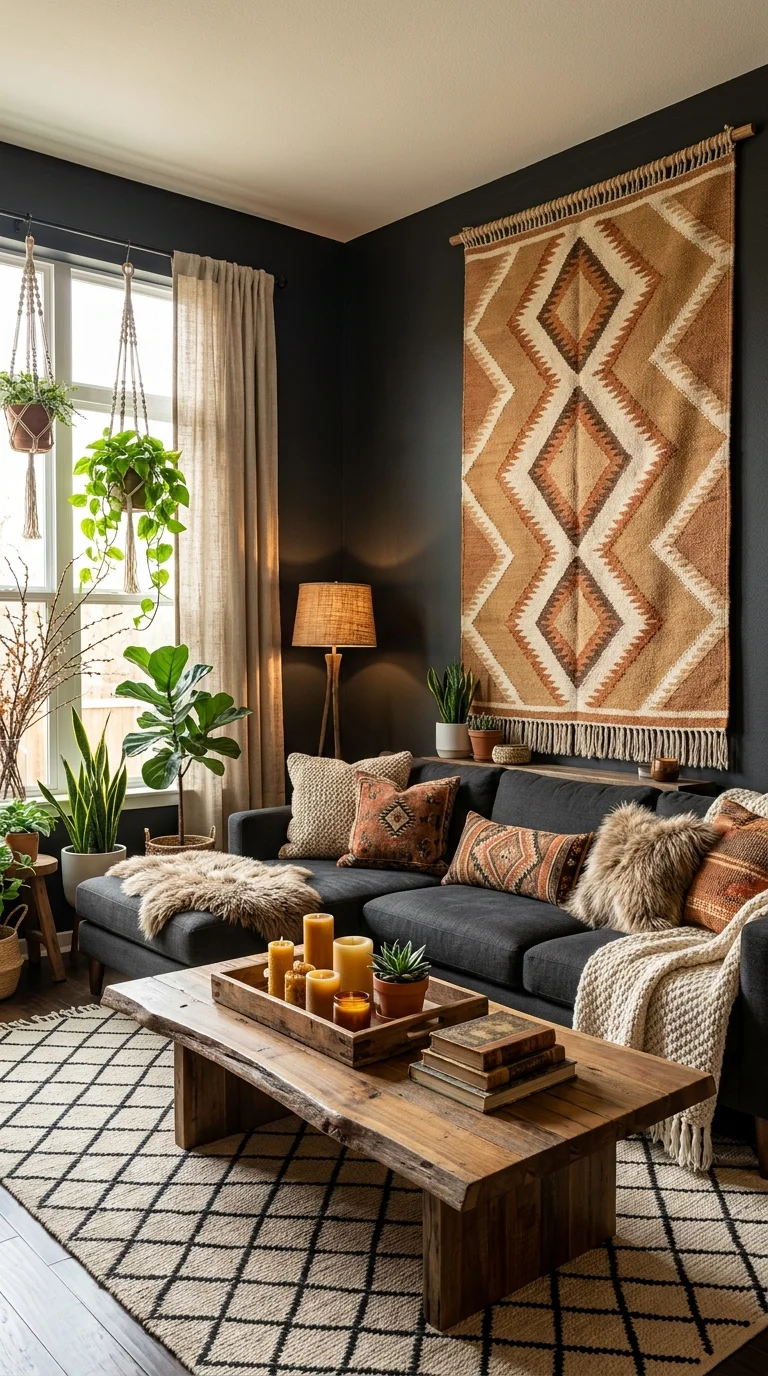
A large diamond-patterned kilim tapestry in rust, cream, and warm brown hangs against a charcoal wall, its fringed edges echoing the macrame plant hangers strung in the window beside it. Below it, a deep grey sectional piled with fur throws and patterned pillows sits on a black-and-cream diamond rug that repeats the tapestry’s geometric language at a completely different scale — the same shape, shrunk down and multiplied underfoot.
This idea suits anyone drawn to Southwestern-influenced boho specifically — think Santa Fe over Marrakesh, warm rust and clay tones over jewel tones. It works especially well in living rooms with a window worth showcasing, since the macrame hangers here are positioned to catch daylight rather than compete with it. The lifestyle it supports is genuinely lived-in and layered — candles, books, and stacked throws all suggest a room built for slow evenings rather than formal entertaining.
That diamond motif repeats three separate times — the wall tapestry, the floor rug, and the smaller kilim-print pillows on the sofa — and this kind of deliberate pattern echo across different scales is a large part of why a room this layered still reads as considered rather than cluttered. A live-edge wood coffee table holding candles and stacked books adds warmth without introducing a competing pattern, giving the eye a plain surface to rest between the tapestry above and the patterned rug below. If you like this kind of pattern-repeat approach applied somewhere quieter than a living room, 10 Boho Bedroom Looks That Feel Curated, Not Cluttered shows several bedroom versions of the same idea.
The advantage is that this much intentional pattern repetition is genuinely hard to get wrong once the color family is locked in — rust, cream, and charcoal sit together naturally in almost any combination. The compromise is that a room this textile-heavy takes real upkeep: fur throws shed, kilim pillows need rotating to wear evenly, and macrame collects dust faster than smooth surfaces. To simplify this for a smaller budget, a single kilim throw pillow paired with a plain charcoal wall gets a lighter version of the same palette without a full wall tapestry. The most common mistake is introducing a fourth unrelated pattern, which breaks the careful repetition holding the room together.
Would this work for you? If you love a warm, layered palette and don’t mind some textile upkeep, yes. If you’d rather keep pattern to one surface only, dial this back to just the rug or just the wall hanging.
The Diamond Motif Repeating at Three Different Scales
The same geometric diamond shows up on the wall tapestry, underfoot on the rug, and again in miniature on the throw pillows, and that repetition across such different scales is likely a big part of why this room reads as one cohesive idea rather than three separate pattern choices competing for attention.
Where People Get This Room Wrong
- Adding a fourth pattern family that doesn’t share the rust-and-cream color story
- Skipping the macrame hangers and leaving the window bare, losing a key texture layer
- Choosing a synthetic faux-fur throw in a cool grey instead of a warm cream or tan.
- Letting candles and books clutter the coffee table until it loses its role as a visual resting point
Recommended Materials: woven wool kilim, macrame cotton cord, live-edge wood, faux fur, jute-backed rug
Main Colors: Charcoal, Rust, Cream, Warm Brown
Best Lighting: A floor lamp near the window plus abundant daylight through the sheer curtains keeps the rust tones in the tapestry looking warm rather than muddy after dark.
Maintenance: Macrame plant hangers collect dust in their knots faster than smooth surfaces, so a light shake-out every few weeks keeps them looking crisp rather than grey.
The All-White Room That Uses Black as a Single Accent, Not a Wall
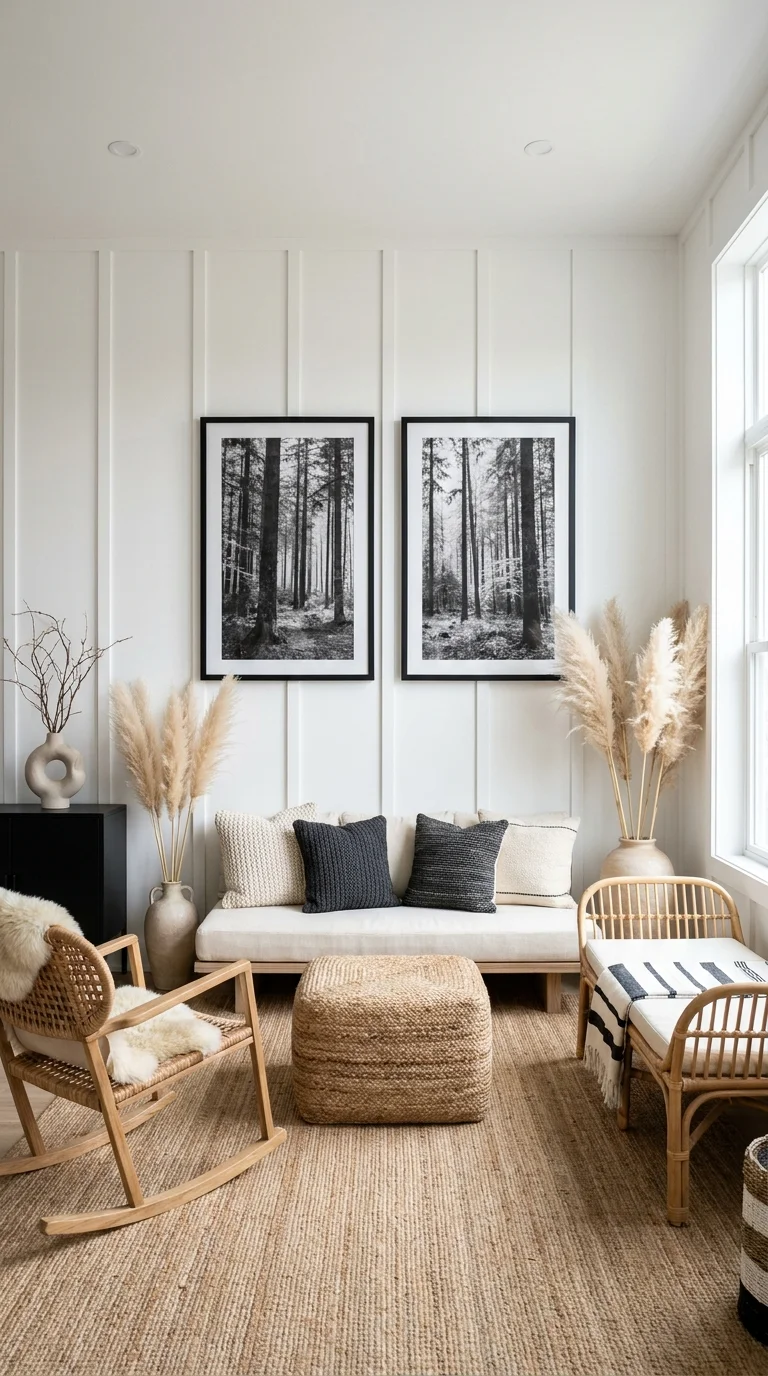
Every other room on this list commits to black walls. This one deliberately doesn’t — white board-and-batten paneling, a cream daybed sofa, and jute flooring keep the entire room light, with black confined to a single knit throw pillow and two matching black-and-white forest photographs. It’s the clearest proof point in this whole list that “boho black” doesn’t require dark paint at all; it can just as easily mean one disciplined dark accent inside an otherwise airy room.
This idea suits anyone renting, or anyone simply unsure about committing to a full dark wall, who still wants a touch of the moodier, more grounded look the other rooms on this list are built around. It works especially well in smaller or lower-light rooms, since keeping the walls pale avoids the light-loss that comes with painting a room this size fully black. The lifestyle it supports is calm and flexible — nothing here is a permanent commitment, from the framed prints to the jute pouf.
Both black-and-white forest photographs are hung at matching heights and sizes, and that consistency is what keeps two separate images reading as one intentional pairing rather than two unrelated frames. Pampas grass in a ceramic vessel on each side of the seating area adds height and softness without introducing any additional color, keeping the black-and-cream palette completely intact.
The advantage is flexibility that a fully painted room can’t offer — swap the pillow, swap the prints, and the entire mood shifts without repainting anything. The compromise, honestly, is impact: a single black accent this restrained will never deliver the drama of a fully dark wall, so anyone hoping for real moodiness should look elsewhere on this list. To simplify this even further, one black-and-white print and a single dark pillow are genuinely enough — resist adding more once those two anchors are in place. The most common mistake is adding a second unrelated dark accent, like a black side table, which starts pulling the room toward looking unfinished rather than intentionally minimal.
Would this work for you? If you like the idea of “boho black” but aren’t ready to commit to paint, yes, this is your entry point. If you’re specifically drawn to the drama of a fully dark room, this section will read as too restrained for what you’re after.
Who Should Skip This Style?
This one deserves an honest answer, since it’s the outlier on this list. If you’re here specifically because you want the moody, enveloping feeling black walls create, this room won’t deliver that — a single pillow and two small frames simply can’t replicate what four dark walls do to a space’s atmosphere. This version is really for a different reader: someone who loves the boho materials — rattan, jute, wood — but wants to test a “black accent” approach before ever touching a paint can, or someone in a rental where painting isn’t an option at all. If that’s not your situation and you’re not worried about commitment, skip straight to one of the fully dark rooms elsewhere on this list; you’ll get a far more convincing result.
Common Ways a Restrained Room Like This Loses Its Point
- Adding more than one or two black accents, which starts to look like an unfinished dark room instead of a deliberate light one
- Choosing warm-white paint that reads slightly yellow next to true black-and-white photography
- Skipping the jute rug in favor of a patterned one, introducing competing texture the room doesn’t need
- Hanging the two photographs at mismatched heights, which breaks the intentional symmetry holding them together
Recommended Materials: board-and-batten paneling, jute, rattan, knit cotton, natural linen
Main Colors: Warm White, Black, Natural Jute, Charcoal
Best Lighting: This room depends on genuine daylight through the nearby window — black-and-white photography especially needs that natural contrast rather than warm artificial light, which can wash out the images’ tonal range.
The Black Library Wall Built Around a Working Fireplace
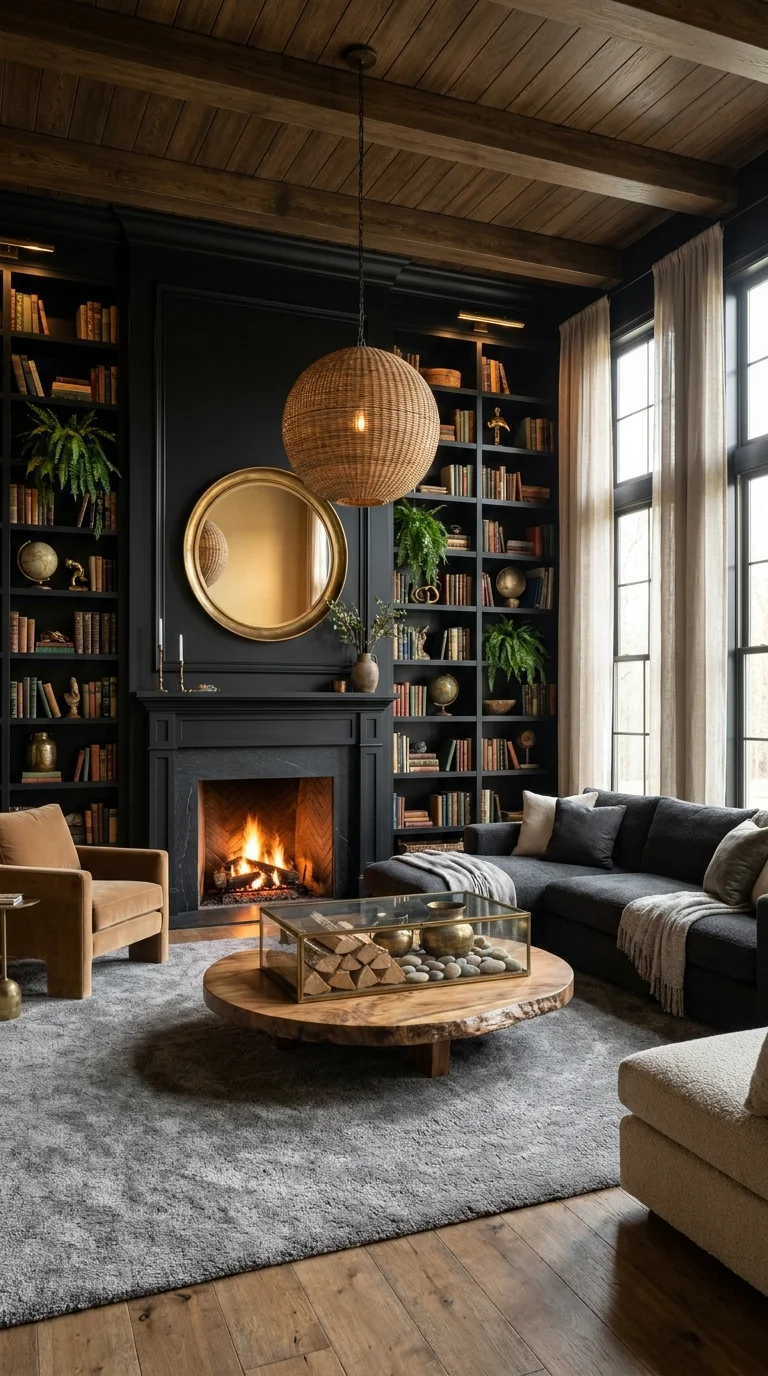
Floor-to-ceiling black bookshelves flank a matching black fireplace, and a round brass mirror plus an oversized woven rattan pendant are the two objects doing the most to keep this much dark millwork from feeling heavy. Exposed wood ceiling beams and warm curtain linen soften the room from above, while a mixed seating group — a charcoal sectional and a tan velvet armchair — avoids matching everything to the walls too literally.
This idea suits homeowners with an existing home library, den, or reading room where built-in storage already makes sense architecturally. It’s a strong fit for households that actually use their fireplace regularly, since the whole composition is designed around a lit fire as the room’s natural focal point. The lifestyle it supports is bookish and slow — this reads as a room for reading chairs and long evenings rather than a high-traffic family space.
The rattan pendant’s scale is a genuine risk that pays off — a globe this large, hung this low over a small round coffee table, is bigger than most rooms would attempt, but it works here because nothing else in the room competes with it for visual weight; the black bookshelves recede as a backdrop rather than a second focal point. A glass-and-brass display case on the coffee table, filled with stones and dried branches, adds one more warm, tactile layer without introducing a new color.
The advantage is that dark built-ins like this genuinely make a large book collection look curated rather than cluttered — spines against black recede in a way they never do against white shelving. The compromise is that painting or installing floor-to-ceiling millwork like this is a real renovation, not a weekend project, and it’s not easily reversed if you change your mind later. If a working fireplace is central to how you want your living room to feel, the Boho Fireplace Ideas That Turn the Fireplace Into the Heart of the Room guide is worth reading alongside this section for more fireplace-specific styling. For a smaller budget, painting existing white shelving black and adding one oversized woven pendant gets a meaningful amount of this room’s effect. The most common mistake is under-filling the shelves, which leaves black millwork looking unfinished instead of intentional.
Would this work for you? If you already have (or want) a book-filled den with a working fireplace, yes. If your living room doesn’t have built-in storage or a fireplace to build around, this specific look will be harder to replicate convincingly.
Why the Pendant Gets Away With Being This Big
A woven globe pendant this size would overwhelm most coffee tables, but here it reads as intentional rather than oversized — the black shelving on either side is dark and recessive enough that it doesn’t add visual competition, leaving the pendant free to be the room’s single largest shape without a second object fighting it for attention.
Where This Library-Den Look Trips People Up
- Leaving shelves half-empty, which makes floor-to-ceiling black millwork look incomplete rather than curated
- Skipping a warm rug underfoot, letting the black fireplace and shelving feel cold instead of cozy
- Choosing a pendant too small for the room’s scale, losing the one statement piece the composition depends on
- Matching every piece of furniture to the black walls instead of mixing in a warm, contrasting fabric like the tan velvet chair here
Recommended Materials: black-painted built-in millwork, brass, woven rattan, tan velvet, reclaimed wood beams
Main Colors: Matte Black, Brass Gold, Warm Tan, Charcoal Grey
Best Lighting: A working fireplace supplies real ambient warmth here, backed up by the brass picture-style shelf lights and the rattan pendant — without at least one warm fixture, a room built from this much black millwork would read cold rather than cozy.
The Antler-and-Stump Room That Leans Lodge Over Global Boho
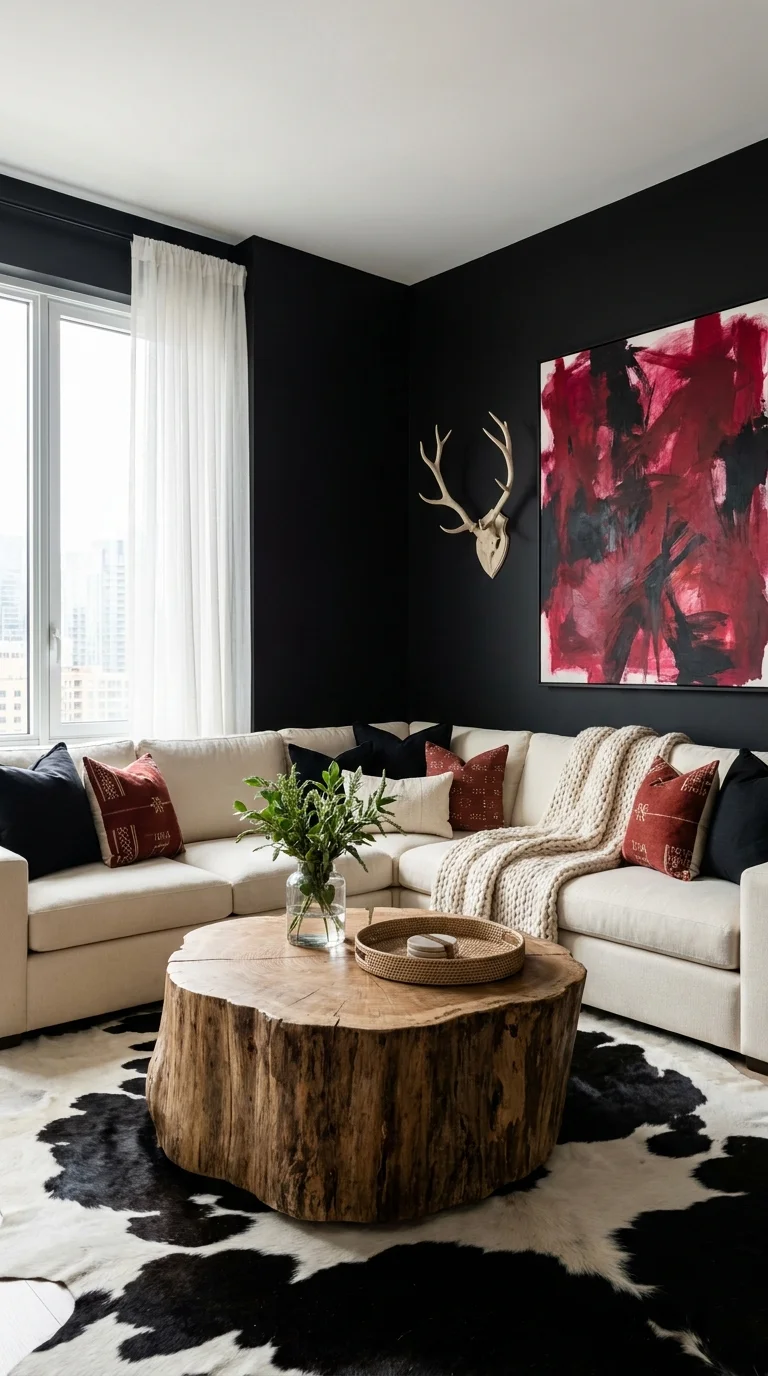
Two black walls meet at a corner here, one holding a pair of natural antlers, the other a large abstract painting in saturated red and black brushstrokes. Below them, a cream L-shaped sectional piled with black and burgundy pillows sits atop a black-and-white cowhide rug, centered on a coffee table made from a single cross-cut tree stump, bark and all.
This idea suits anyone whose taste sits closer to modern lodge or mountain-cabin than global-eclectic boho — natural materials and dark walls, but without masks, kilims, or heavily patterned textiles layered in. It works particularly well in city apartments with skyline views, since the contrast between raw, rustic materials and a polished urban backdrop is part of what makes this specific room feel distinctive rather than purely rustic. The lifestyle it supports is a little more masculine-leaning and low-fuss — texture and material carry the room instead of pattern or collected objects.
The tree-stump coffee table behaves differently than a milled wood table — its bark edge will continue to dry, shift slightly, and develop more visible cracks over the first year or two, which is worth knowing going in rather than discovering as a flaw. The cowhide rug’s irregular black-and-white patches echo the black walls without repeating them exactly, giving the floor its own personality instead of just extending the wall color downward.
The advantage is that natural-edge, one-of-a-kind pieces like the stump table and the cowhide rug genuinely can’t be mass-produced identically, so the room reads as collected even with relatively few objects in it. The compromise is that both pieces require some acceptance of imperfection — cracking wood, an irregular hide shape — that a manufactured, uniform piece wouldn’t come with. To simplify this for a smaller budget, a faux-hide rug and a live-edge (rather than full stump) coffee table get most of the texture without sourcing a genuine cross-section piece. The most common mistake is pairing this raw, textural room with polished chrome or glass accessories, which clashes with the deliberately rough materials everywhere else.
Would this work for you? If you want boho’s warmth without its usual global pattern-layering, yes. If antlers and a full animal-hide rug don’t suit your taste, several of the more textile-driven rooms elsewhere on this list will fit better.
How the Stump Table Will Actually Change Over Time
Unsealed or lightly sealed live-edge wood like this stump will keep drying out slowly after installation, meaning small surface cracks along the bark edge are normal rather than a defect — a light reapplication of oil once or twice a year keeps the wood from drying out further without erasing the natural character that makes the piece interesting in the first place.
Where This Rustic-Lodge Room Goes Wrong
- Pairing the natural stump table with sleek chrome or glass accessories that clash with its raw texture
- Choosing a faux-fur throw in a color too far from the cowhide’s black-and-white palette
- Overcrowding the coffee table so the stump’s natural shape and bark edge get hidden
- Hanging the antlers off-center relative to the corner, which throws off the room’s careful symmetry
Recommended Materials: cross-cut tree stump, cowhide, natural antler, linen upholstery, wool-blend pillow covers
Main Colors: Matte Black, Cream, Burgundy, Natural Bark Brown
Best Lighting: Large windows carry most of this room’s daylight; a single warm floor lamp is enough after dark since the light-colored sectional and cowhide already reflect a good amount of ambient light back into the space.
The Global Tribal Room Built Around Masks and Mudcloth
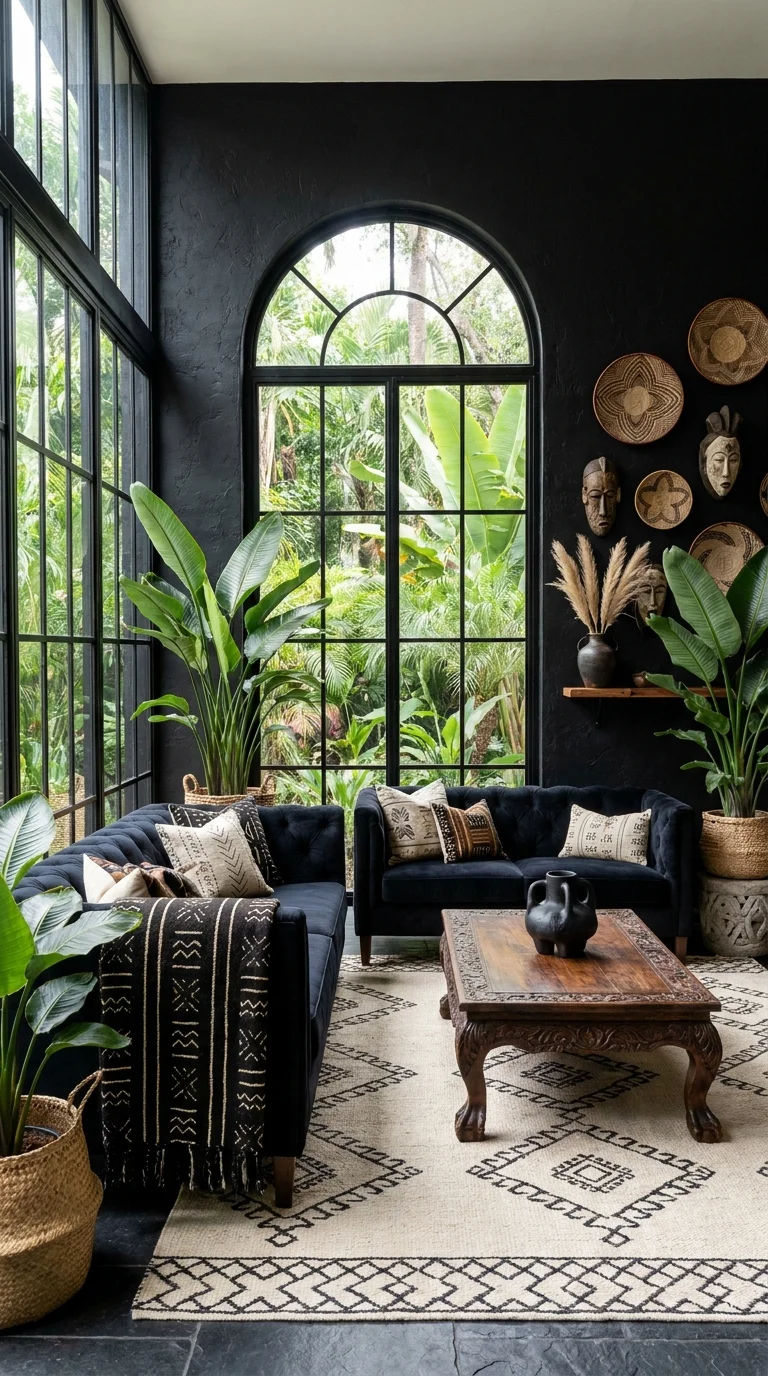
An arched black steel window frames a lush tropical view, while the adjoining black wall holds a genuine collection: carved wood masks, woven baskets, and a textured woven plate, arranged in a loose, organic cluster rather than a formal grid. Two tufted navy velvet chesterfields face each other across a hand-carved wood coffee table, and mudcloth-print throws add the room’s one clear textile pattern.
This idea suits collectors specifically — people who’ve genuinely gathered global, handmade pieces over time (or want to start) rather than buying a themed set all at once. It works best in rooms with real height and strong natural light, since the arched window and tall plants here need that scale to avoid feeling cramped. The lifestyle it supports is well-traveled and story-driven — this is a room built around pieces with provenance, not matching decor.
The wall’s circular and mask shapes repeat at different sizes — the woven baskets, the round textured plate, and the masks’ oval faces all share a loosely rounded geometry, which is likely why a wall this densely populated still reads as one considered collection rather than a random assortment. If this depth of global material and handmade texture genuinely appeals to you, the same collected, texture-forward approach shows up in the entryway directions covered in Boho Entryway Ideas That Bring Rattan, Plants, and Texture Together, if you want to carry the look beyond just the living room.
The advantage is authenticity that can’t be faked with mass-produced decor — a genuine collection like this gives a room more real character than any single trend piece could. The compromise is that this look depends heavily on sourcing pieces thoughtfully; assembled carelessly, the same elements can tip into costume territory rather than considered global style. To simplify this for a smaller budget, start with two or three well-made woven baskets and a single carved piece, adding more gradually rather than filling the wall at once. The most common mistake is layering too many additional patterns onto the sofas, which competes with the wall instead of letting it lead.
Would this work for you? If you’re building (or want to build) a genuine collection of global handmade pieces, yes. If you’d rather your wall art stay simpler or more abstract, this specific tribal-forward direction likely isn’t your fit.
Where the Eye Lands on a Wall: This Layered
Despite the number of objects on the wall, the largest carved mask near the center draws the eye first — its size and the deeper shadow it casts against the black wall give it more visual weight than the smaller baskets and plates surrounding it, which read as supporting pieces orbiting that one anchor.
How This Global-Tribal Look Gets Botched
- Choosing pieces without understanding or crediting where they actually come from
- Layering more than two patterned textiles on the sofas at once, competing with the wall
- Arranging the wall objects in a perfectly even grid instead of a loose, organic cluster
- Placing this collection in a room without enough natural light for the carved textures to actually read
Recommended Materials: carved wood, woven natural fiber baskets, mudcloth cotton, navy velvet, black steel window framing
Main Colors: Matte Black, Navy, Warm Wood Tan, Natural Fiber
Best Lighting: The arched black steel window is doing most of the work here — strong, direct daylight is what lets the carved texture in the masks and woven baskets actually read clearly rather than disappearing into shadow.
Maintenance: Carved wood pieces and woven baskets just need occasional dusting; avoid placing them in direct sun for extended periods, since some natural fiber weaves can dry out and become brittle over time.
The Stone-Walled Retreat That Pairs Black With Paper Lanterns
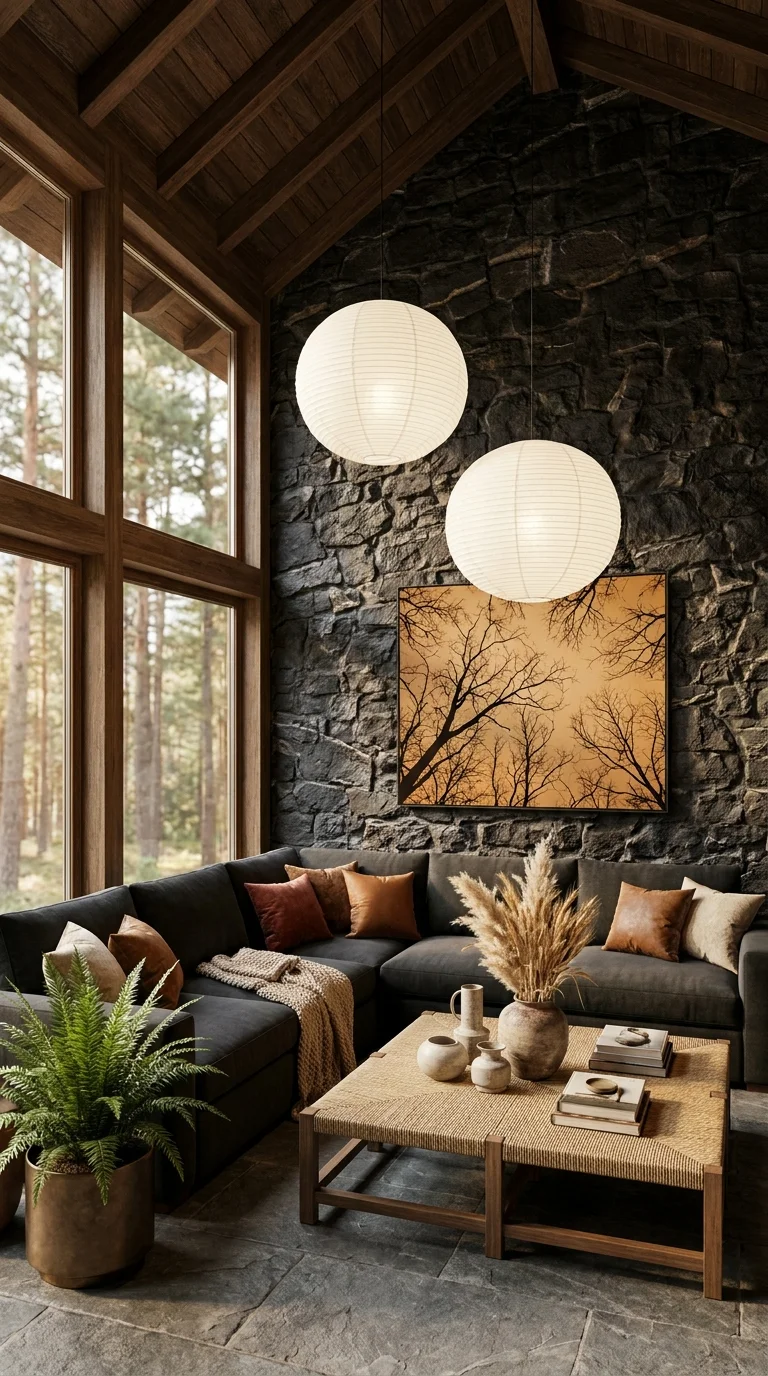
A dark, rough-cut stone wall stands in for painted black here, paired with exposed wood ceiling beams and floor-to-ceiling windows looking out onto pine forest. Two oversized white paper lantern pendants hang low over the seating area, and their soft, glowing surface is the single brightest thing in a room built almost entirely from dark, textured materials.
This idea suits cabin or mountain-home owners with genuine architectural stone or wood already in place, rather than anyone trying to fake the effect in a standard drywall room. It works especially well in vaulted-ceiling spaces, since the tall roofline here gives the hanging lanterns room to read as a real design feature rather than crowding a lower ceiling. The lifestyle it supports is unplugged and seasonal — this is a room built for a fire, a stack of firewood, and long stretches without screens.
The two lanterns are the first thing the eye finds in this room, not the stone wall or the framed tree artwork beside it — their soft white glow stands out clearly against every other dark, textured surface in the space, functioning almost like a pair of moons anchoring the room’s darker materials below them. A woven jute coffee table and a large vase of pampas grass keep the seating area textured without introducing a second competing pattern.
The advantage is that genuine stone and timber age better than almost any manufactured material, gaining character rather than looking dated. The compromise is that this look depends entirely on having real architectural bones — stone walls, exposed beams, a vaulted ceiling — that most standard living rooms simply don’t have and can’t easily fake. For anyone without that structure but who loves this same dark, cabin-like palette, the Black Bedroom Inspiration: 10 Designs That Balance Drama and Warmth guide shows how the same warm-dark pairing translates into a bedroom without needing real stone. The most common mistake is choosing a bright white overhead fixture instead of a warm paper lantern, which kills the soft, glowing quality that makes this room feel intentional rather than simply dim.
Would this work for you? If you already have (or are building) a cabin-style space with real stone and timber, yes. If your living room is a standard drywall box, this exact look will be difficult to replicate convincingly — consider the fireplace-and-millwork room earlier in this list instead.
Where the Light Actually Comes From
Between the wall of forest-facing windows and the two hanging lanterns, this room draws almost all its brightness from two sources rather than a scattered mix of lamps and overheads, and that restraint is likely part of why the space feels calm rather than dim — a third or fourth light source would probably compete with the lanterns instead of supporting them.
What Trips People Up Recreating This
- Choosing a bright white pendant instead of a warm paper lantern, losing the soft glow that anchors the room
- Painting drywall a flat black instead of accepting that this specific texture depends on real stone
- Overcrowding the coffee table, which competes with the room’s otherwise open, breathing layout
- Skipping the pampas grass or a similar textural element, leaving the space feeling too hard-edged
Recommended Materials: rough-cut natural stone, exposed timber beams, paper and bamboo lanterns, woven jute, aged bronze accents
Main Colors: Charcoal Stone, Warm Timber, Soft White, Amber Rust
Best Lighting: The two paper lanterns are non-negotiable to this room’s mood — a bright overhead fixture in their place would flatten the stone’s texture instead of letting it read as rich and dimensional.
Furniture Layout Tips for a Boho Black Living Room
- Float seating slightly away from a fully black wall rather than pushing it flush, so the dark surface reads as a backdrop rather than swallowing the furniture’s silhouette.
- Keep at least one large light-colored anchor — a cream sofa, a pale rug — in the room, since an entirely dark palette with no contrast tends to read heavy rather than moody.y
- Position the room’s main light source (a pendant, a floor lamp, a fireplace) where it can be seen from the main seating area, since black walls depend on a visible warm light to avoid feeling flat.
- Leave genuine negative space around any single bold wall feature — a mask, a mirror, a tapestry — rather than surrounding it with additional decor that competes for attention.ion
Who Should Choose This Style?
- Best for homeowners who already lean toward warmer, more traditional or collected furniture and want to add drama without going fully modern
- Best for rooms with strong natural light or a reliable warm light source, since black walls depend on that contrast to avoid feeling dim
- Best for anyone drawn to natural materials — leather, rattan, wood, wool — over sleek, polished modern finishes
- Not ideal for small, naturally dark rooms without a strong light plan, where a full black wall can make the space feel smaller rather than more dramatic
Budget Summary
| Budget | Expectation |
|---|---|
| Low | A single black accent wall in flat paint, jute or faux-fur throws, thrifted brass accessories, faux plants |
| Medium | Boucle or velvet upholstered seating, a live-edge or reclaimed wood coffee table, a woven rattan pendant |
| Premium | Genuine leather furniture, custom black millwork or paneling, hand-loomed wool rugs, real stone or timber architectural features |
FAQ
Will black walls make my living room feel smaller? Not necessarily — several of the rooms above, especially the plant-wall and stone-walled examples, use strong natural light and a light-colored sofa or rug to keep the room from feeling closed in. The rooms most at risk of feeling smaller are ones with limited daylight and no warm light source to compensate.
Do I need to paint every wall black for this look to work? No. The all-white room in this list proves a single black accent — one pillow, a couple of framed prints — can carry the idea without any paint at all, and even the fully dark rooms above generally keep at least one wall or surface lighter for contrast.
What furniture pairs best with black walls in a boho room? Warm, natural materials — cognac leather, rattan, boucle, live-edge wood — tend to work best, since they add contrast and texture without fighting the wall’s darkness the way a cool grey or white sectional might.
Is a black living room harder to sell a house with later? It can be a more involved repaint than a neutral wall, since dark colors often need extra coats to fully cover. A single accent wall, rather than a fully painted room, is generally the easier one to reverse if resale is a concern.
What lighting works best in a boho black living room? Warm-toned fixtures — brass floor lamps, woven rattan pendants, paper lanterns, or a working fireplace — consistently outperform cool white overhead lighting in these rooms, since black surfaces need that warmth to read as rich rather than flat.
About the Author
Aesthetic Life Team
The Aesthetic Life Team is a group of home decor writers and design enthusiasts who research, curate, and write practical, real-world styling guides for every room in the house. The team draws on interior design principles, current home trends, and hands-on decorating experience to help readers make confident, informed choices for their own spaces. This article, like all Aesthetic Life content, is intended for general inspiration and educational purposes and reflects editorial opinions on interior design trends.
Conclusion
Black walls don’t ask a boho room to give up its warmth — they just change what’s carrying it. Sometimes that’s leather and brass, sometimes it’s a wall of living plants, sometimes it’s nothing more than one dark pillow in an otherwise white room. What separates a boho-black room that works from one that just feels dim is almost always the same thing across all ten examples above: a genuine, warm light source and at least one natural material doing the job of softening all that dark. Pick the pairing that matches the materials and light you actually have, and the drama takes care of itself.
Explore More
You may also enjoy:
- Top 10 Sectional Sofa Designs for Comfort, Style & Small Spaces — finding the right sofa shape for a room like these
- 10 Dreamy Boho Patios to Inspire Your Next Backyard Refresh — carrying the same warm, natural materials outdoors
- Country Living Room Ideas That Feel Warm, Cozy, and Timeless — a lighter, softer alternative to the dark rooms above
2 Responses