
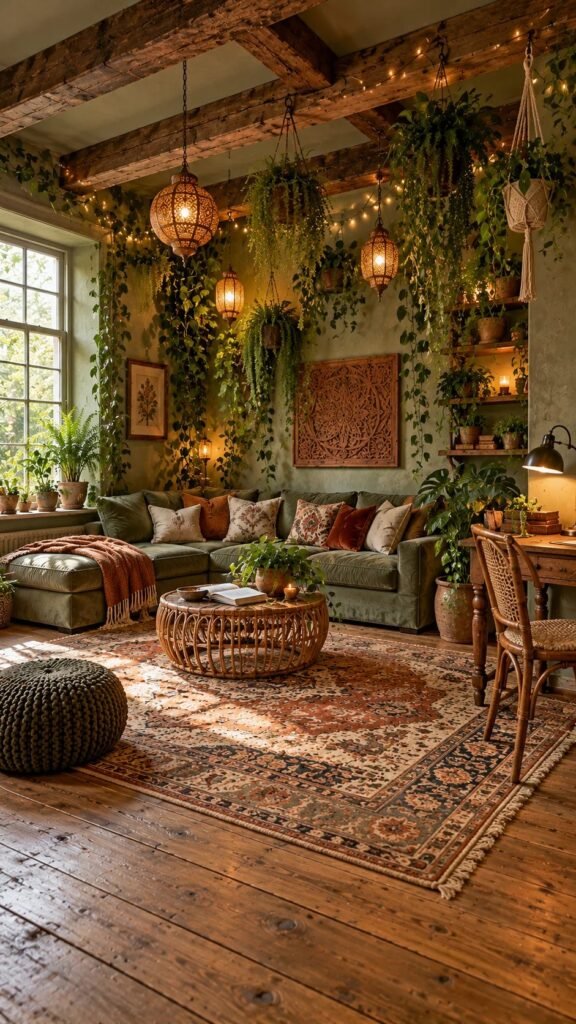
Sage green and rustic texture might be the most forgiving combination in home decor. The color sits exactly between gray and green, so it calms a room without cooling it down, and rustic materials — raw wood, jute, rattan, aged plaster — keep it from ever feeling flat or precious. Together they create living rooms that look collected over years rather than ordered in a weekend, which is exactly why the pairing keeps showing up in real homes.
The ten rooms below all start from the same palette but take it in very different directions: a hanging jungle, a sculptural niche wall, a sunroom, a leather-and-plaster retreat. Each one is built around a single idea you can borrow. Find the room that matches your light, your space, and your tolerance for plants, and take its best move home.
Start With a Hanging Garden and Layers of Warm Light
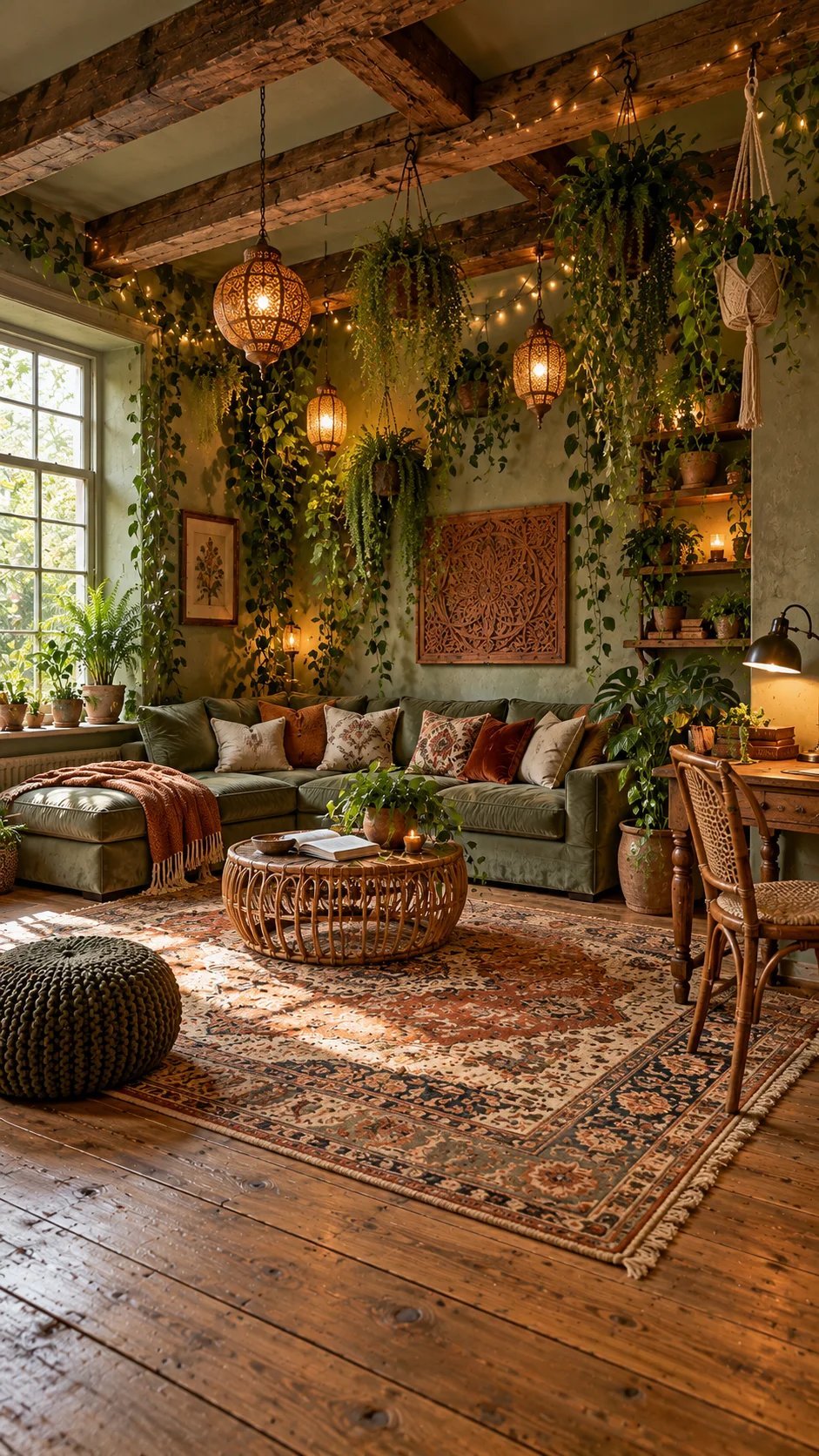
If you want maximum atmosphere with minimum renovation, this is the blueprint: keep the architecture simple and let plants and light do the talking. Dozens of trailing plants hang from the wood beams at different heights — pothos, ferns, philodendrons — so the ceiling feels like a canopy rather than a lid. The trick is varying the drop lengths; when every plant hangs at the same height the effect looks staged, but staggered heights look like a real jungle grew there.
Underneath, a deep green velvet sectional grounds all that airy greenery with something solid to sink into. The warm light comes in three layers: Moroccan pierced-metal pendants that throw patterned shadows, tiny fairy lights strung along the beams, and a practical desk lamp in the corner for actual reading. That layering is what makes the room glow at night instead of going flat. A round rattan coffee table and a Persian-style rug in rust and cream tie the seating area together, while a chunky knit pouf adds a spot for feet. None of this requires construction — hooks in the beams, plug-in pendants, and plants. If the jungle look calls to you but you don't know where to start, this indoor plant styling guide walks through grouping, heights, and pots that keep a plant-filled room looking intentional instead of chaotic.
Steal this: Hang plants at three different heights and light the room at three different levels. The combination reads as lush, not cluttered.
Carve a Round Niche for Display Shelving
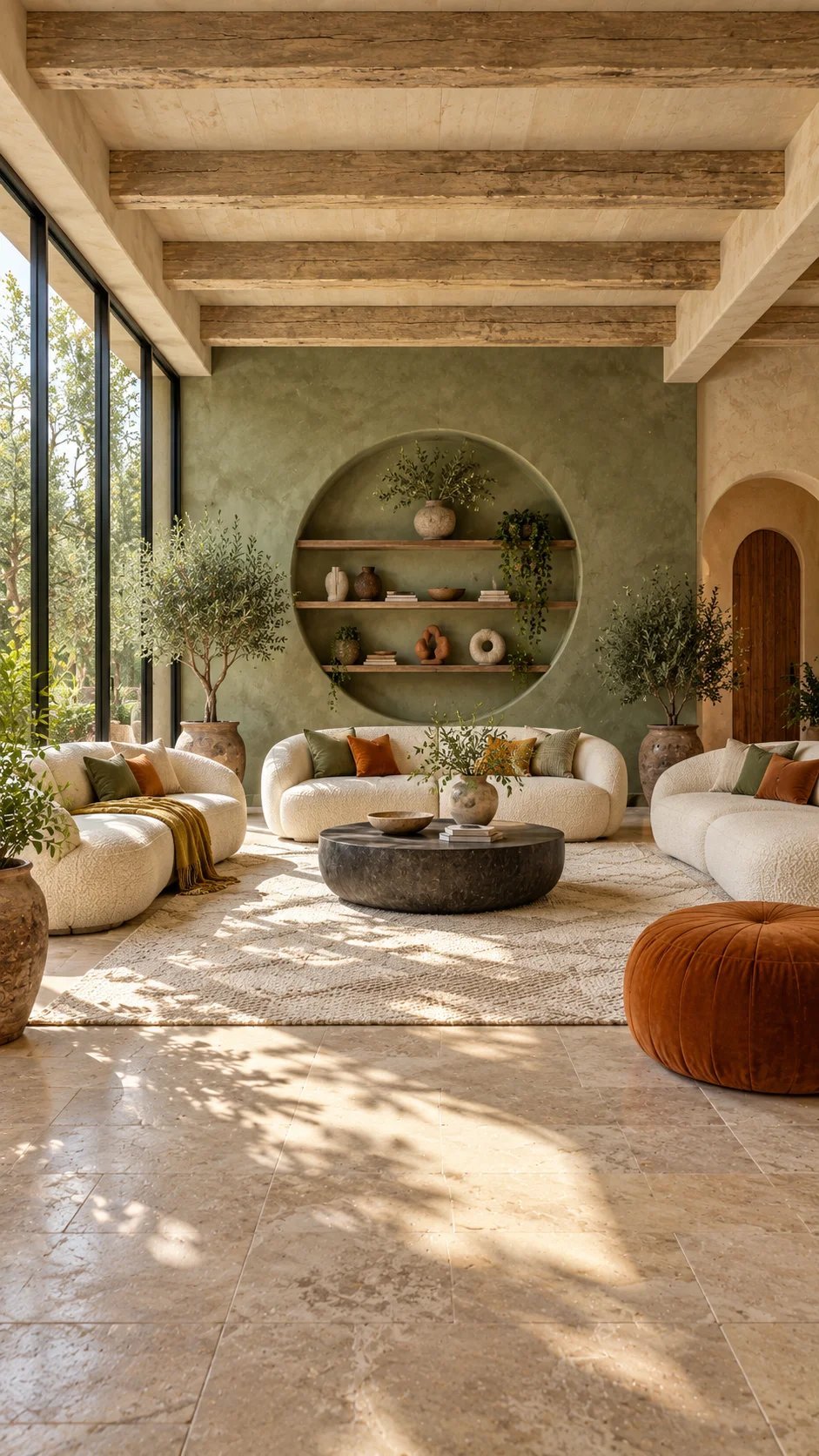
Some rooms get their character from furniture; this one gets it from the wall itself. A huge circular niche is carved into the sage limewash wall, fitted with simple wood shelves, and styled with vases, stacked books, trailing plants, and small sculptures. It turns dead wall space into the room's focal point and gives all those pretty-but-purposeless objects a proper stage. If you're renovating anyway, a niche like this costs little more than the drywall work — and it beats any bookcase for drama.
The seating plays a supporting role on purpose. Three curved boucle sofas in cream face inward, their soft shapes echoing the round niche, while olive trees in big terracotta urns frame the composition like living columns. The palette stays tight — sage, cream, warm wood, terracotta — so the room feels calm despite the high ceiling and big windows. Travertine floors and exposed wood beams add the rustic half of the equation without any clutter. This is the room to study if you like sage green but want it to feel architectural rather than decorative; these sage green living room design principles explain how to balance the color with texture so it never falls flat.
Steal this: One bold architectural move — a niche, an arch, a beam — does more for a room than a dozen small decor items.
Hang a Landscape Gallery Wall Above the Sofa
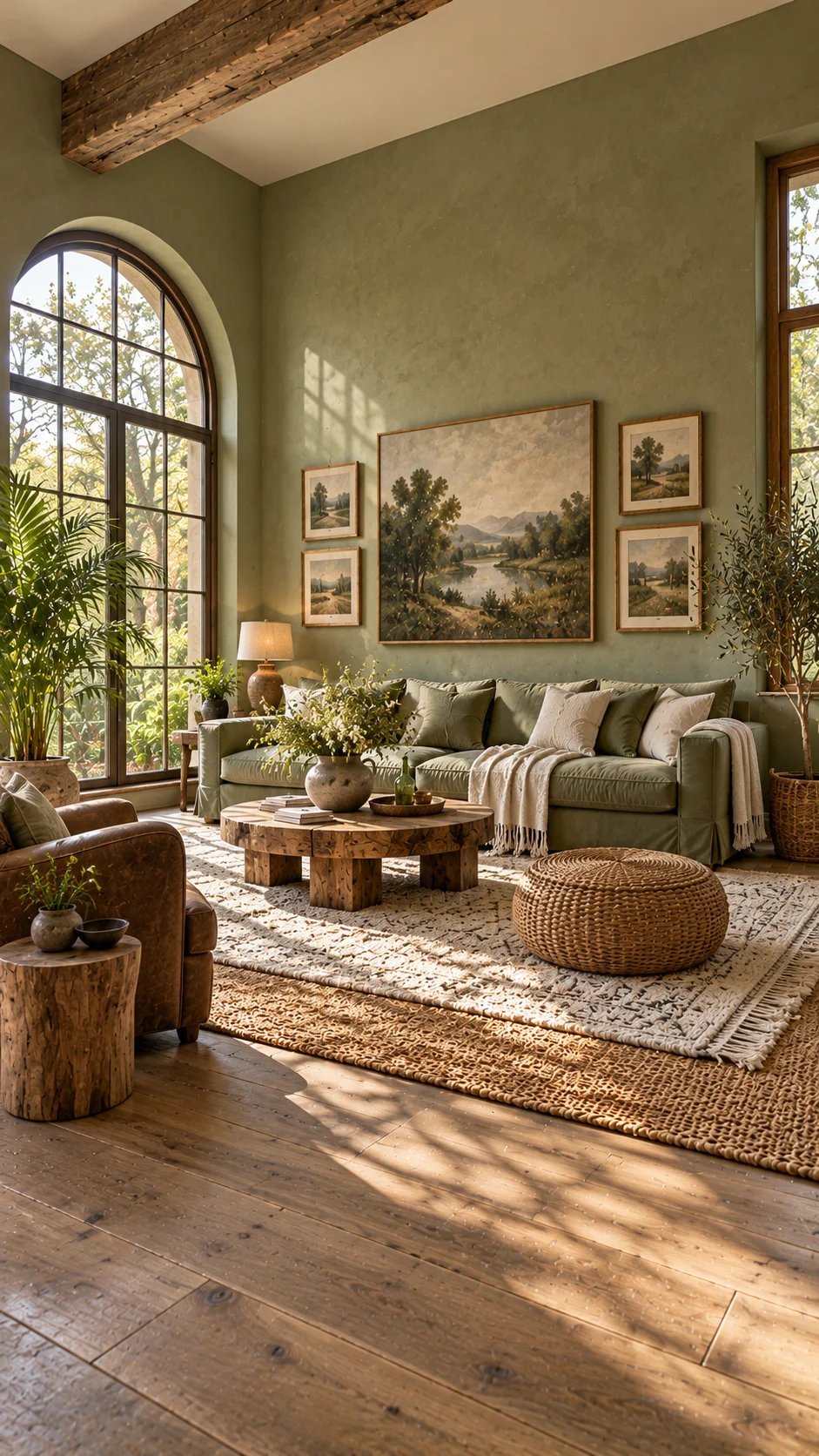
Art is the fastest way to give a sage green room a sense of history, and landscape paintings are its natural partner. Here, one large pastoral canvas hangs centered above the sofa, flanked by four smaller landscapes in a loose grid. The mix of sizes keeps the wall from feeling like a museum corridor, and the gold-toned frames pick up the warm wood elsewhere in the room. Because every painting shares the same subject matter — trees, water, fields — the wall feels curated rather than random.
The furniture stays quiet so the art can lead. A simple green sofa with neutral pillows, a live-edge wood coffee table, a cognac leather armchair, and a round rattan pouf all sit in the same earthy register as the paintings. Arched steel windows flood the room with daylight, which is what makes the sage walls glow instead of going muddy — if your sage room feels dull, the first fix is usually more light, not more color. Layered jute rugs underfoot add the rustic texture that keeps the whole thing from feeling like a gallery. A gallery wall like this is also the most renter-friendly idea on this list: five frames, a hammer, and an afternoon.
Steal this: Keep gallery art to one subject family — all landscapes, all botanicals — and the wall will look collected instead of scattered.
Keep Seating Low and Art Oversized
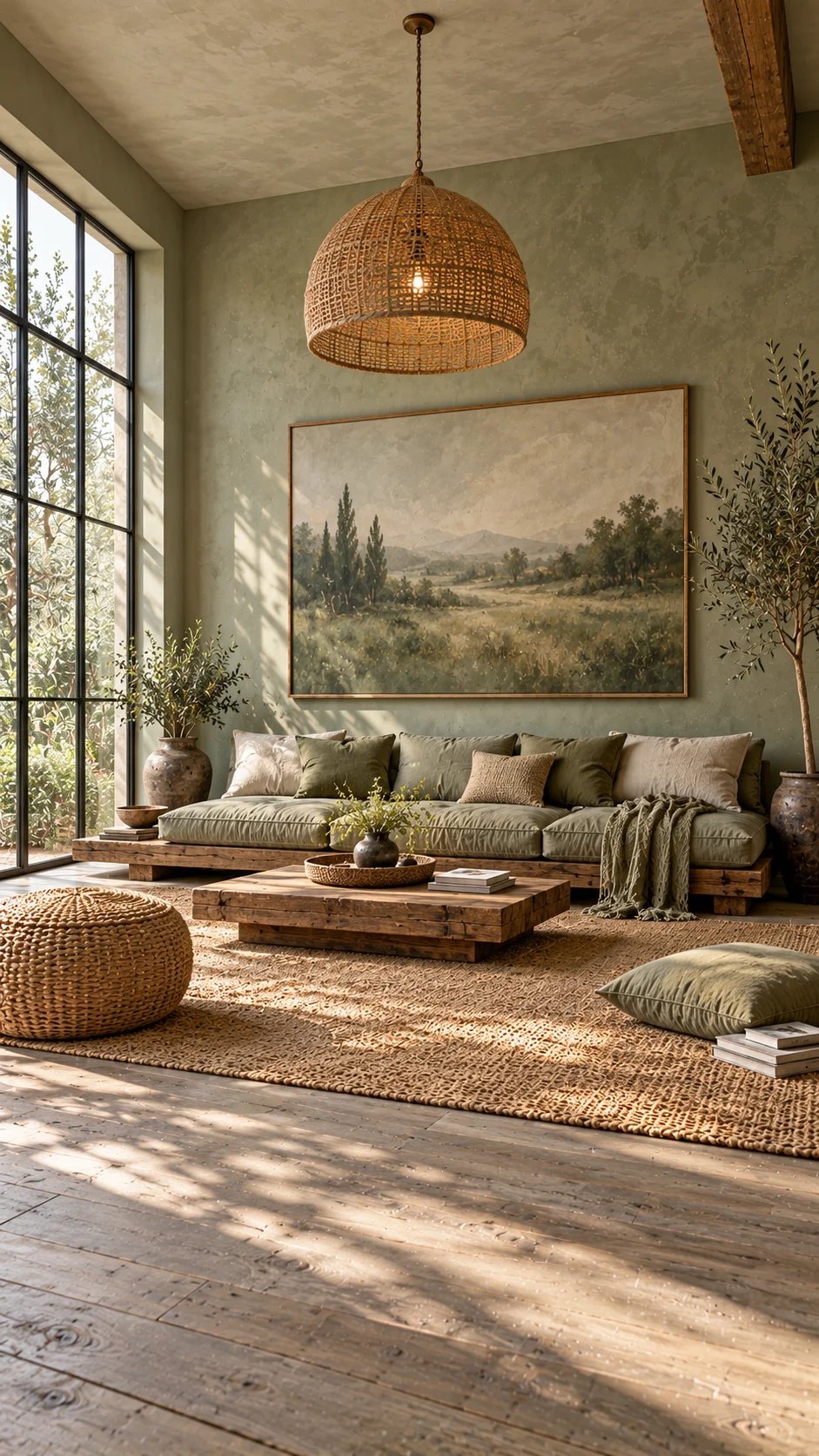
Low furniture changes how a room feels more than most people expect. This setup centers on a wooden platform sofa — essentially a daybed with deep sage cushions — that sits inches off the floor. The low profile makes the high ceiling feel even higher and gives the room a relaxed, lounge-like posture. You don't perch here; you settle in. Flanking the platform, a low wooden bench extends the seating without adding visual bulk.
Above it all hangs one oversized landscape painting, big enough to hold its own against the tall wall. That single large-scale piece is doing the work of an entire gallery wall with a fraction of the effort — when in doubt, go bigger with art rather than adding more pieces. A woven rattan dome pendant hangs low over the seating zone, pulling the eye down and making the arrangement feel intimate despite the volume of the room. Natural jute rugs, olive branches in stone urns, and a chunky wood coffee table complete the earthy material story. Pairing raw wood with sage is a combination worth studying on its own; these sage green and wood pairing ideas show how the two materials bring out the best in each other.
Steal this: One oversized artwork beats five small ones. Scale your art to the wall, not to the sofa.
Let Log and Bamboo Furniture Do the Talking
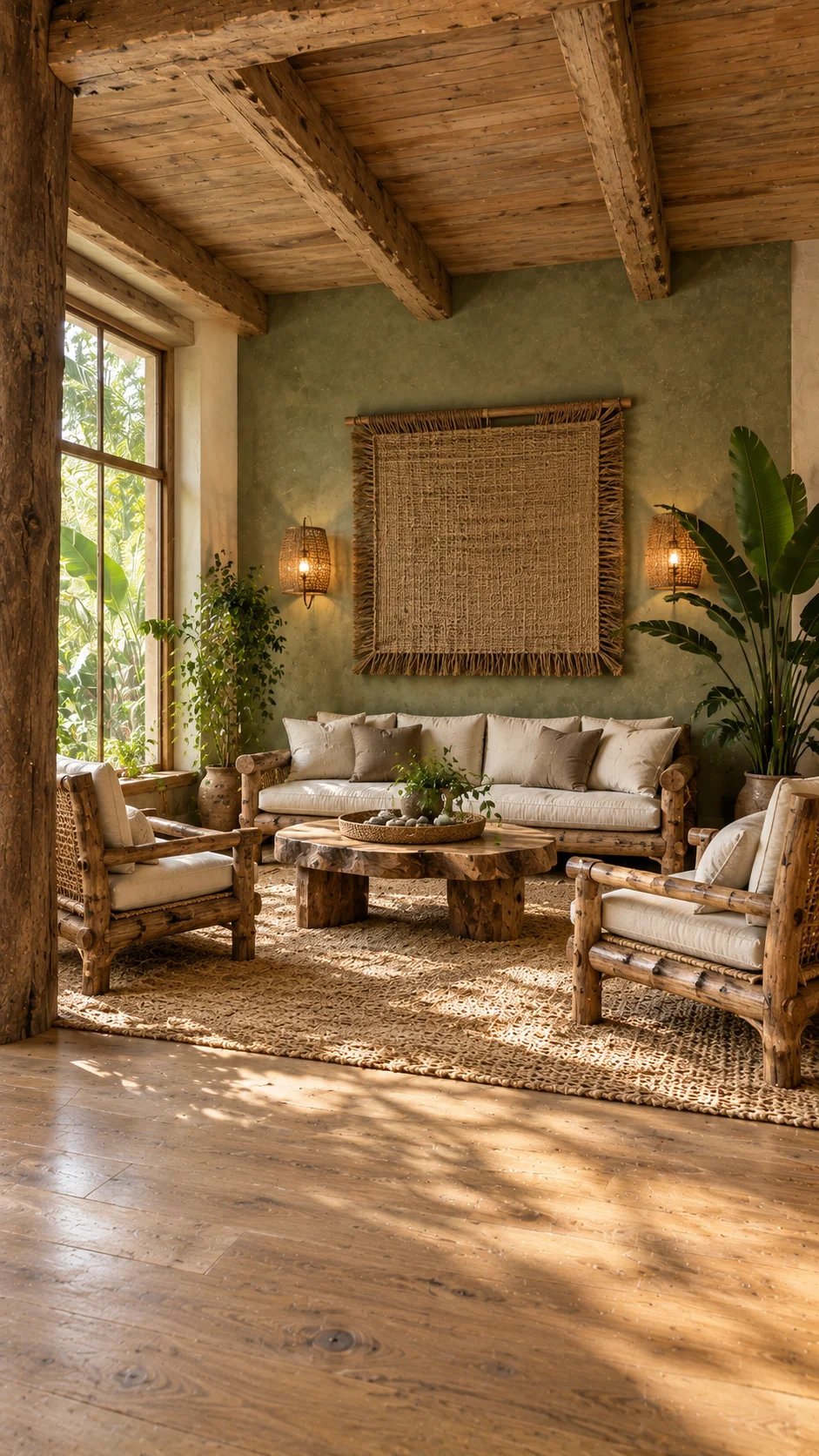
In this room the furniture IS the decor. A sofa and two armchairs built from whole logs and bamboo poles — gnarled, knotted, completely unrefined — carry the entire rustic half of the brief, so everything else can stay simple. Cream cushions keep the seating comfortable without hiding the wood, and a live-edge round coffee table cut from a single slab continues the story. When your furniture has this much character, you don't need much else.
What else there is stays in the natural-fiber family. A huge woven jute wall hanging fills the wall between two rattan sconces, and its fringe edge softens the geometry of the room. The wood plank ceiling with heavy beams wraps everything in warmth, while tall windows and banana plants blur the line between indoors and out. The lesson here is restraint: pick one hero material and let it repeat. Wood appears in the furniture, the ceiling, the coffee table, and the floor — and because it's the same warm tone throughout, the repetition feels rich rather than repetitive. If you love this collected-over-time feeling, these country living room ideas break down how to layer rustic pieces without tipping into theme-park territory.
Steal this: Choose one dominant natural material and repeat it at least four times in the room. Repetition is what makes rustic feel intentional.
Frame the Walls With Botanical Prints
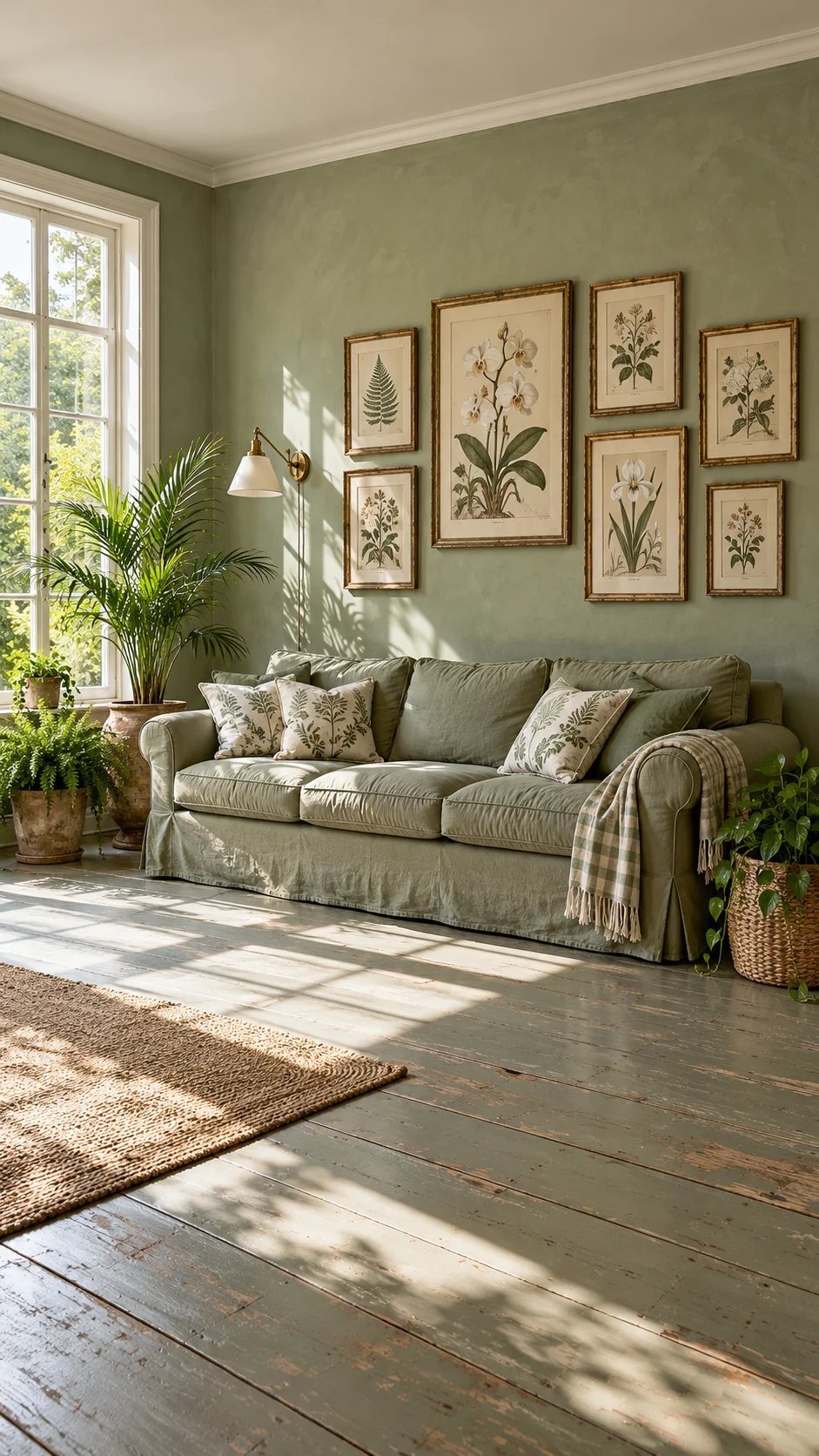
Botanical prints are the quiet achievers of wall decor — inexpensive, easy to find, and almost impossible to get wrong against sage green. This room hangs seven of them in a salon-style cluster: ferns, orchids, and flowering branches in slim gold frames, mixed in size but united by subject and frame color. The cluster fills a large wall without the commitment (or cost) of one huge canvas, and you can build it gradually, one flea-market find at a time.
The rest of the room is deliberately calm so the wall can shine. A slipcovered sage sofa with botanical-print pillows picks up the art without competing with it, and a plaid throw adds a lived-in note. Big leafy plants in terracotta and woven baskets flank the seating — real foliage echoing the illustrated foliage on the wall, which is a lovely bit of visual rhyme. A natural jute rug over wide-plank floors keeps the palette earthy. The whole room proves you don't need bold color to have a bold wall; repetition of a quiet motif does the job. Hang your frames so their centers sit at eye level — roughly 57 inches from the floor — and keep the gaps between frames tight and even, no more than three inches.
Steal this: Unite mismatched art with identical frames. Same frame, same subject family, and seven random prints become a collection.
Turn the Sunroom Into a Hanging Jungle
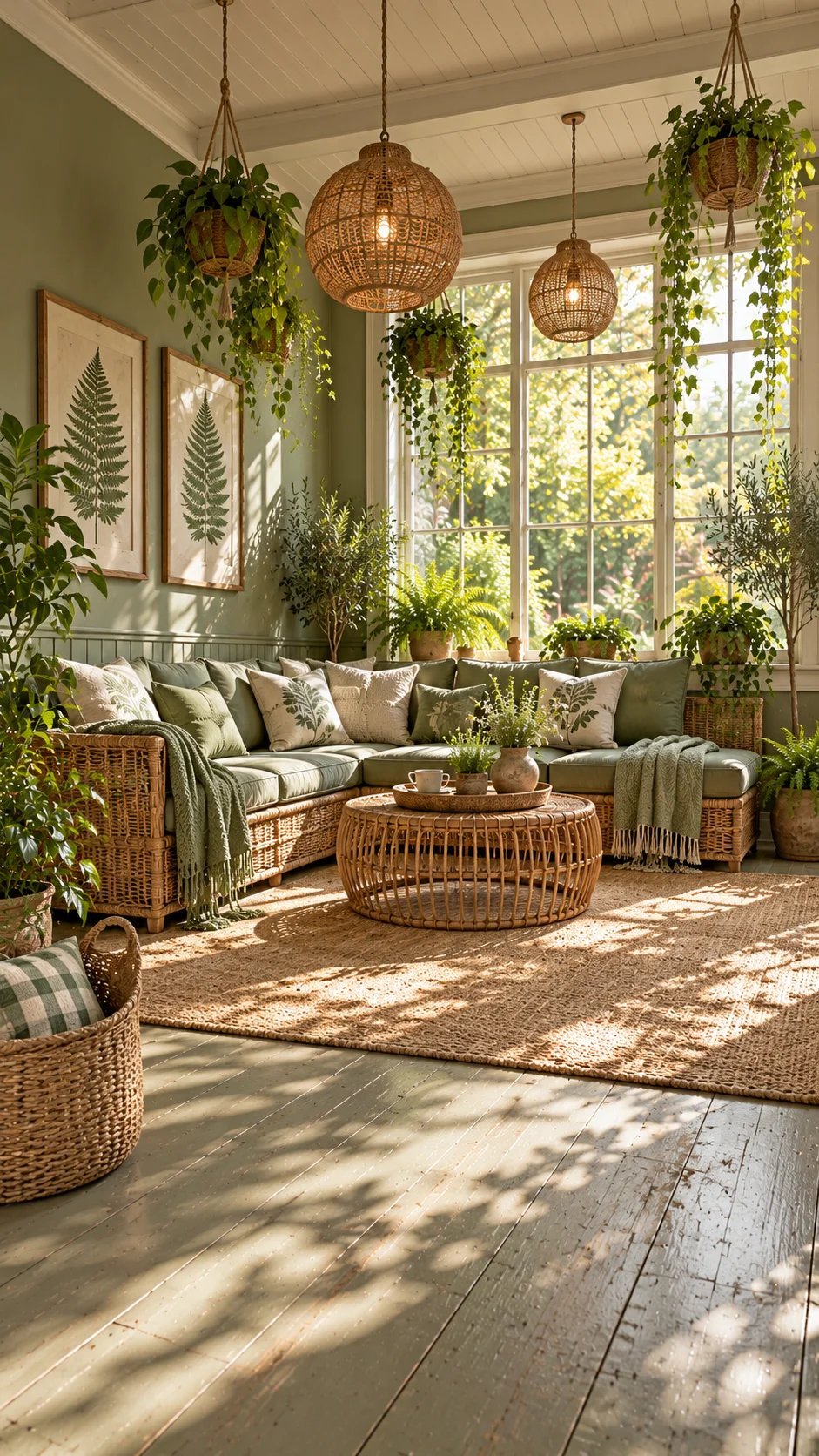
A sunroom with wall-to-wall windows is already halfway to a greenhouse, so this design simply finishes the job. An L-shaped rattan sectional wraps the corner in woven texture, and the ceiling becomes a garden: trailing pothos in hanging baskets at staggered heights, plus three woven rattan pendants glowing warmly among the leaves. The effect at golden hour, with sun streaming through the glass, is the closest thing to sitting in a conservatory.
Because the architecture is mostly glass, the room needs very little else. Two large fern prints on the sage wall give the eye one resting place, a round rattan coffee table holds a simple tray with a teapot and plant, and a flat jute rug defines the seating zone on the painted wood floor. Throw pillows in botanical prints and solid sage tie the upholstery to the walls. The genius of this room is that the plants are the wallpaper — no paint treatment or wall paneling could compete with living greenery backlit by daylight. If you want this look, start with easy trailers like pothos and heartleaf philodendron, and hang them where they'll catch the light; the boho jungle living room guide has more on building that layered, plant-drenched feeling room by room.
Steal this: In a glass-heavy room, decorate the ceiling, not the walls. Hanging plants use the volume everyone else wastes.
Embrace Aged, Distressed Plaster Walls
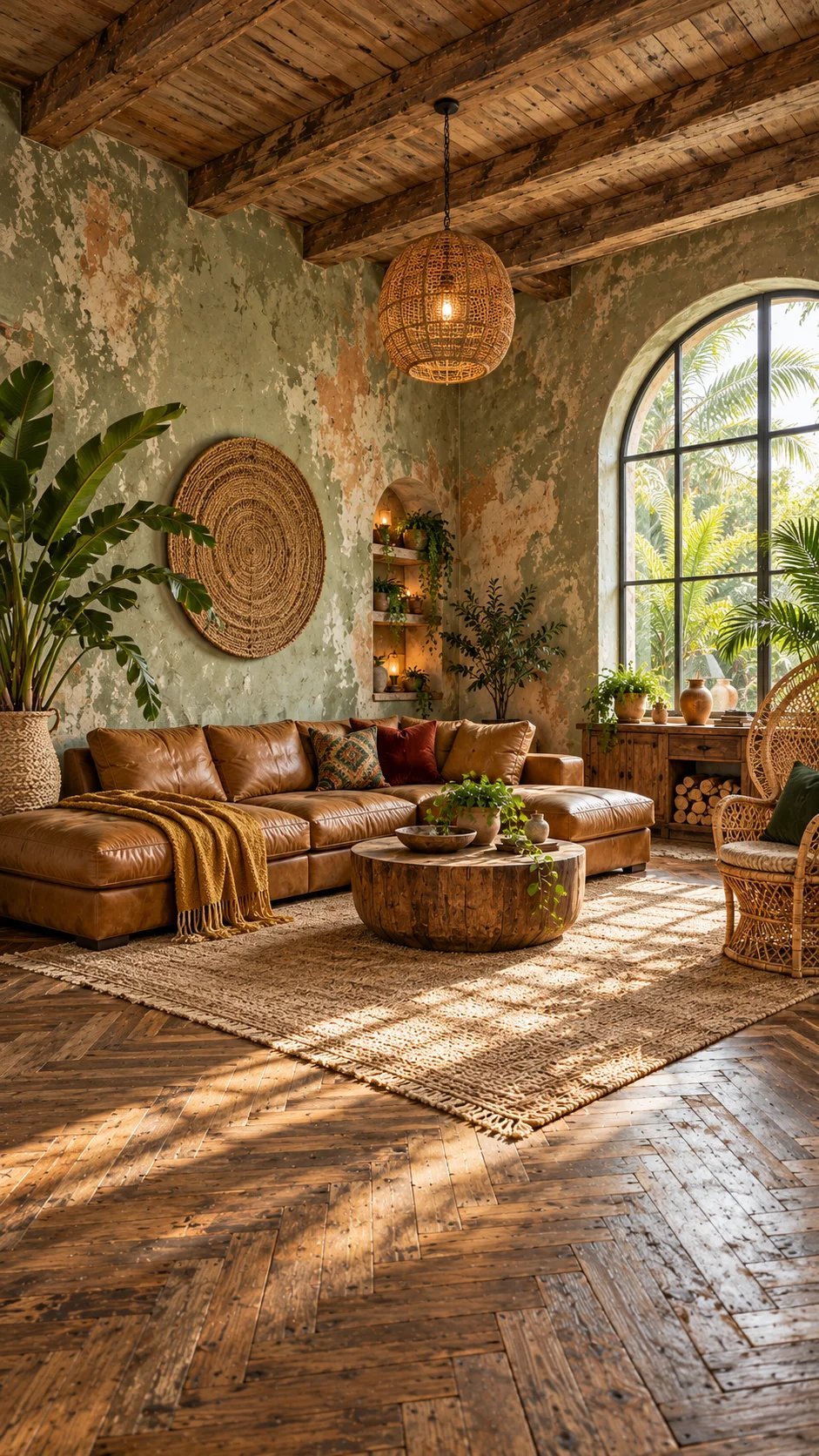
Not every wall needs to look new. These aged plaster walls — green paint worn through to ochre and raw plaster beneath — give the room a soul that fresh paint never could. The patina becomes the artwork, which is why the decor can stay minimal: a cognac leather sectional, a round live-edge coffee table, and a woven jute wall disc are all the room needs. When the walls have this much character, restraint everywhere else is what keeps it sophisticated instead of shabby.
You don't need a 200-year-old villa to get here. Limewash paint, applied in loose overlapping strokes, creates soft mottled movement on new drywall, and there are aging techniques — from color washing to strategic distressing — that fake decades convincingly. The warm palette does heavy lifting too: cognac leather, mustard throw, terracotta pots, and herringbone wood floors all sit in the same honeyed register, so the worn walls feel rich rather than neglected. A rattan pendant and a peacock chair add the boho notes, while the small arched niche with candles borrows a trick from old-world architecture. If your walls are flat and boring, texture is the answer — and it doesn't have to be plaster. Even small doses change a room.
Steal this: Let imperfection be the feature. One aged or textured wall gives a new-build room instant history.
Go Big With Oversized Botanical Art
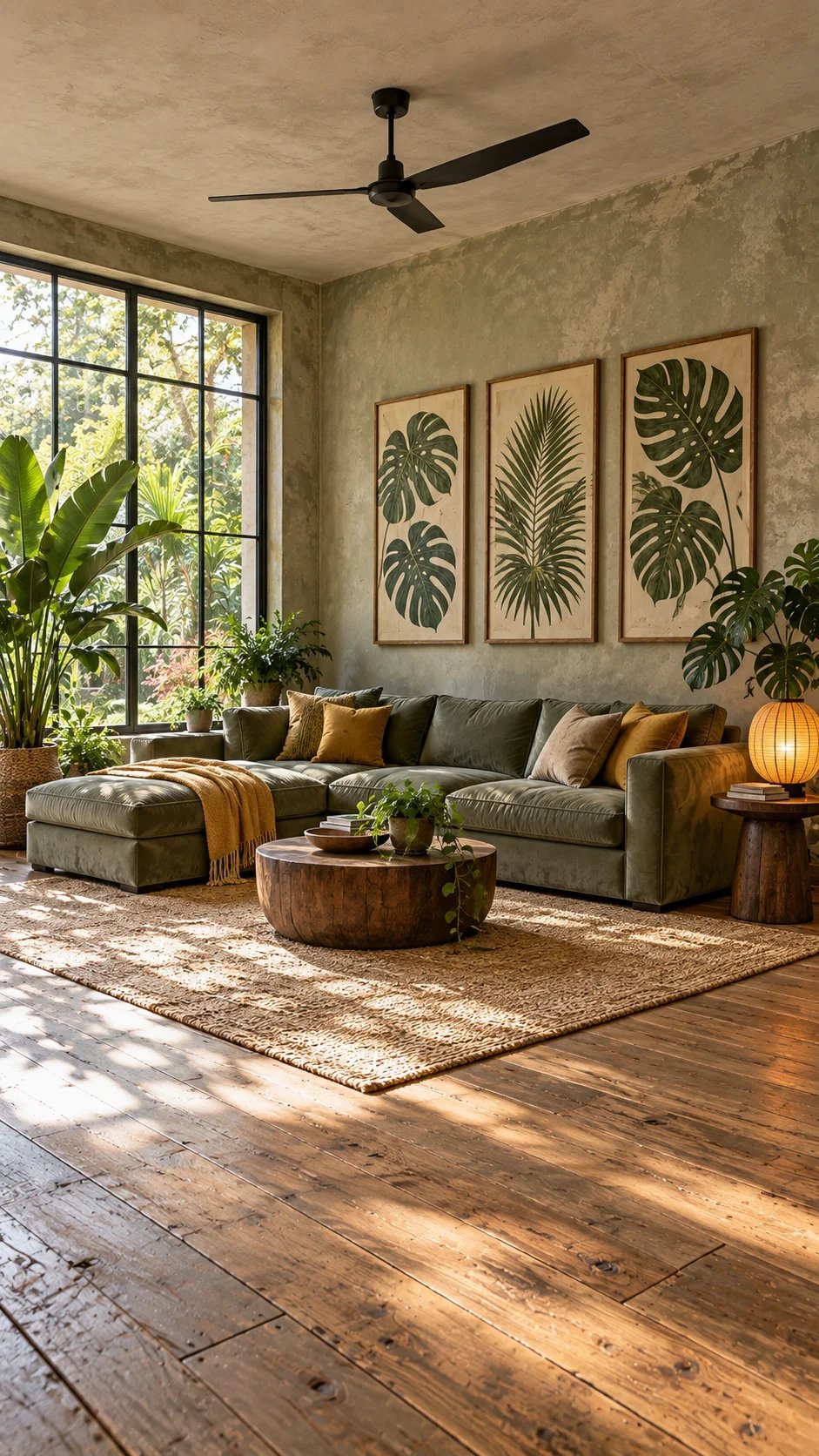
Three enormous framed botanical prints — monstera and palm leaves at a scale that dwarfs the sofa — turn this wall into a statement you can see from the hallway. Oversized art works especially well in rooms with high ceilings and big windows, where normal-size frames get visually swallowed. The trick is committing: the three panels hang tight together with narrow gaps, reading as one continuous installation rather than three separate pictures.
Everything else in the room is chosen not to argue with the art. A deep green velvet sectional with a chaise keeps the seating low and enveloping, ochre and rust pillows echo the warm wood floor, and a round live-edge coffee table adds one organic shape against all the straight lines. The walls have a soft concrete finish that lets the art float without competition, and a black ceiling fan adds a modern line overhead. Real monstera plants in the corners rhyme with the illustrated leaves — again, that echo between art and living plants that makes botanical rooms feel so coherent. A paper lantern glowing on the side table is the only warm light source needed; the daylight does the rest.
Steal this: Size art to the architecture. In a tall room, go floor-to-almost-ceiling or don't bother — timid art disappears.
Add Sculptural Driftwood for Wabi-Sabi Soul
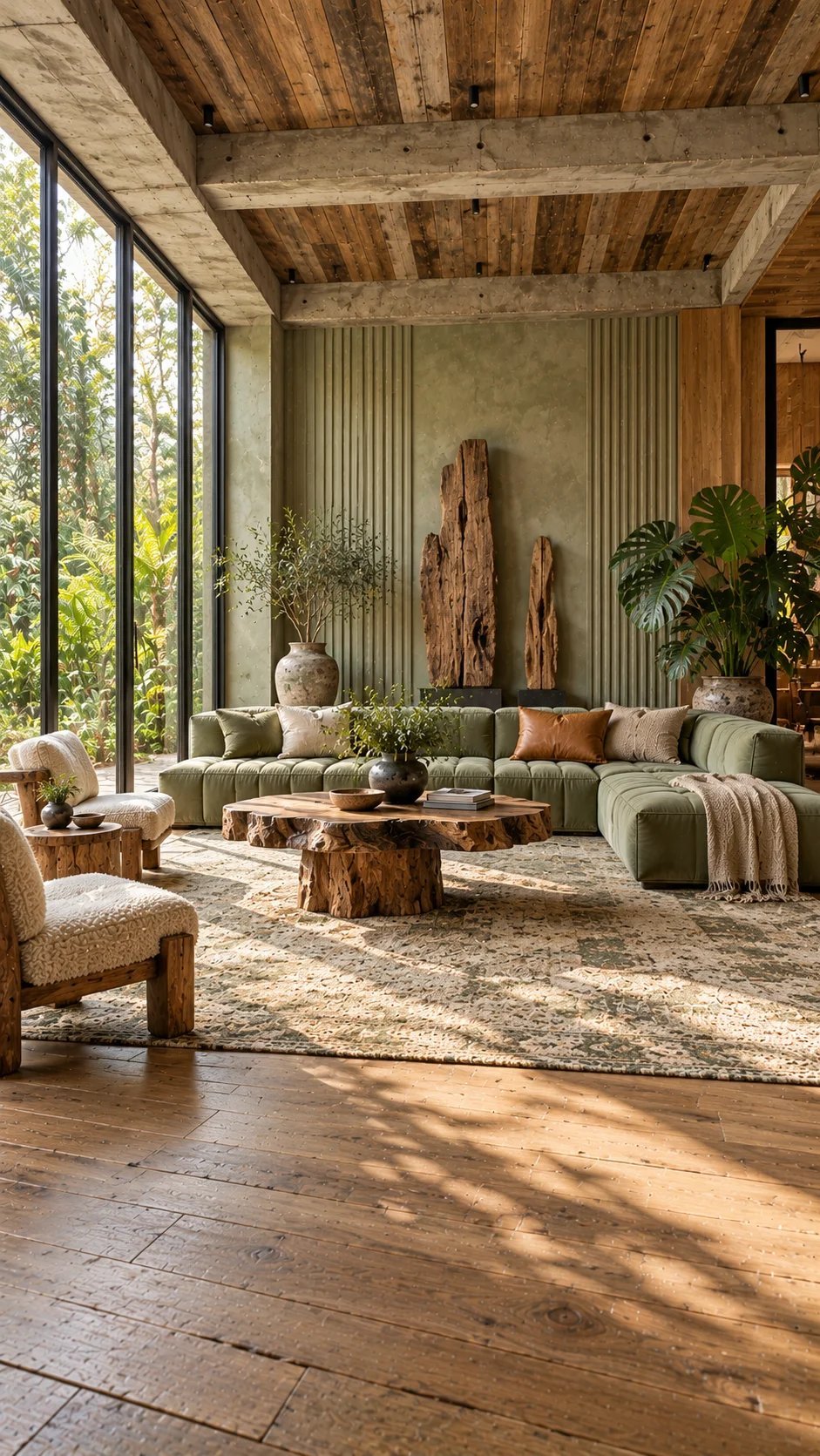
The most striking thing in this room isn't furniture at all — it's two tall driftwood sculptures standing against a fluted sage wall like found art. That is the wabi-sabi move: celebrating the weathered, the asymmetrical, the one-of-a-kind. A piece of driftwood, a gnarled branch, a stone with an interesting face — displayed with intention, these become sculpture. No two rooms will ever have the same one, which is the opposite of catalog decor.
The room around the sculptures supports them quietly. Fluted wood wall panels add vertical rhythm and shadow play, a low tufted sage sectional keeps sightlines open, and a massive live-edge coffee table on a tree-stump base continues the raw-wood story. Boucle armchairs soften the harder textures, and a faded vintage-style rug keeps the floor from competing. The wood beam ceiling wraps it all in warmth. If you love the fluted panel look, the same slatted-wood idea works on a smaller scale as an accent wall — these slatted wood wall designs show how vertical wood battens add depth and calm to plain rooms. Start your own sculpture collection on walks: interesting wood is free, and a simple black stand makes anything look gallery-worthy.
Steal this: Display one wild natural object like art. A single sculptural branch beats a shelf of small decor.
Frequently Asked Questions
What colors go with sage green in a rustic living room?
Warm wood tones, cognac leather, cream and ivory, terracotta, mustard, and aged brass. These all sit in the warm register that keeps sage from feeling cold. Avoid icy grays and stark whites, which fight the earthy mood — if you want contrast, reach for charcoal or deep bronze instead.
How do I keep a plant-filled living room from looking messy?
Group plants in odd numbers, vary their heights, and repeat the same two or three pot materials so the collection reads as intentional. Trailers belong up high, floor plants anchor corners, and one large statement plant beats six small scattered ones. Prune regularly — leggy, yellowing plants are what make a jungle look neglected.
Is sage green going out of style?
Earthy greens have cycled through decor for centuries because they're drawn from nature, not from trend forecasts. Sage in particular is muted enough to act as a neutral, which gives it far more staying power than saturated trend colors. Pair it with natural materials rather than trendy finishes and it will age gracefully.
How can I get the rustic look without real wood beams or plaster walls?
Faux wood beams are lightweight, affordable, and convincing once installed. Limewash paint gives flat drywall soft, cloudy movement that reads as old plaster. Layer in jute rugs, rattan lighting, and raw-edge wood furniture — texture does more for the rustic feel than any single architectural feature.
What kind of rug works best with sage green?
Natural fiber rugs — jute, sisal, seagrass — are the safest pairing and add rustic texture. For pattern, look at Persian or vintage-style rugs with rust, cream, and charcoal motifs; they pick up sage beautifully. Avoid cool-toned or high-shine rugs, which clash with the matte, earthy palette.
Conclusion
Rustic sage green works because it asks so little and gives so much: a paint color that behaves like a neutral, materials that forgive daily life, and a palette that makes both plants and art look better. You don't need all ten of these ideas — you need the one that fits your room. A renter can start with botanical prints and a hanging plant this weekend; a homeowner can plan the limewash walls or the niche shelving over a season. Pick the room that felt most like home when you scrolled through, steal its best move, and let the rest evolve. The most beautiful rooms are never finished all at once anyway.
About the Aesthetic Life Team
The Aesthetic Life Team is a group of home decor writers and stylists who test real layouts, materials, and storage ideas so you don't have to learn the hard way. We photograph what actually works in lived-in homes and turn it into practical guides for yours.

