
Most of the boho rooms people save on Pinterest share a small habit: the prettiest corner usually has a piece of storage in the middle of it. A sideboard, a cane cabinet, a row of little shelves. Furniture that hides clutter also gets to decide how the whole wall above it looks.
This collection walks through ten of those pieces, starting with a walnut sideboard and ending with a bamboo console stacked with craft supplies. Each section pulls out one idea you can borrow: how to pair a dark wood with pale fibers, how to size a wall cluster, where open shelving makes sense, how paint can do the decorating in a tight entry.
If you’re choosing between a sideboard, a dresser, and a wardrobe for a boho room, or you just want your current cabinet to look less like a box, there should be a few usable answers below. Some ideas are about the furniture itself. Others are about what sits on top of it and behind it, since that’s usually where a plain piece becomes a styled one.
A Dark Walnut Sideboard Gives a Pale, Fibrous Room Some Weight
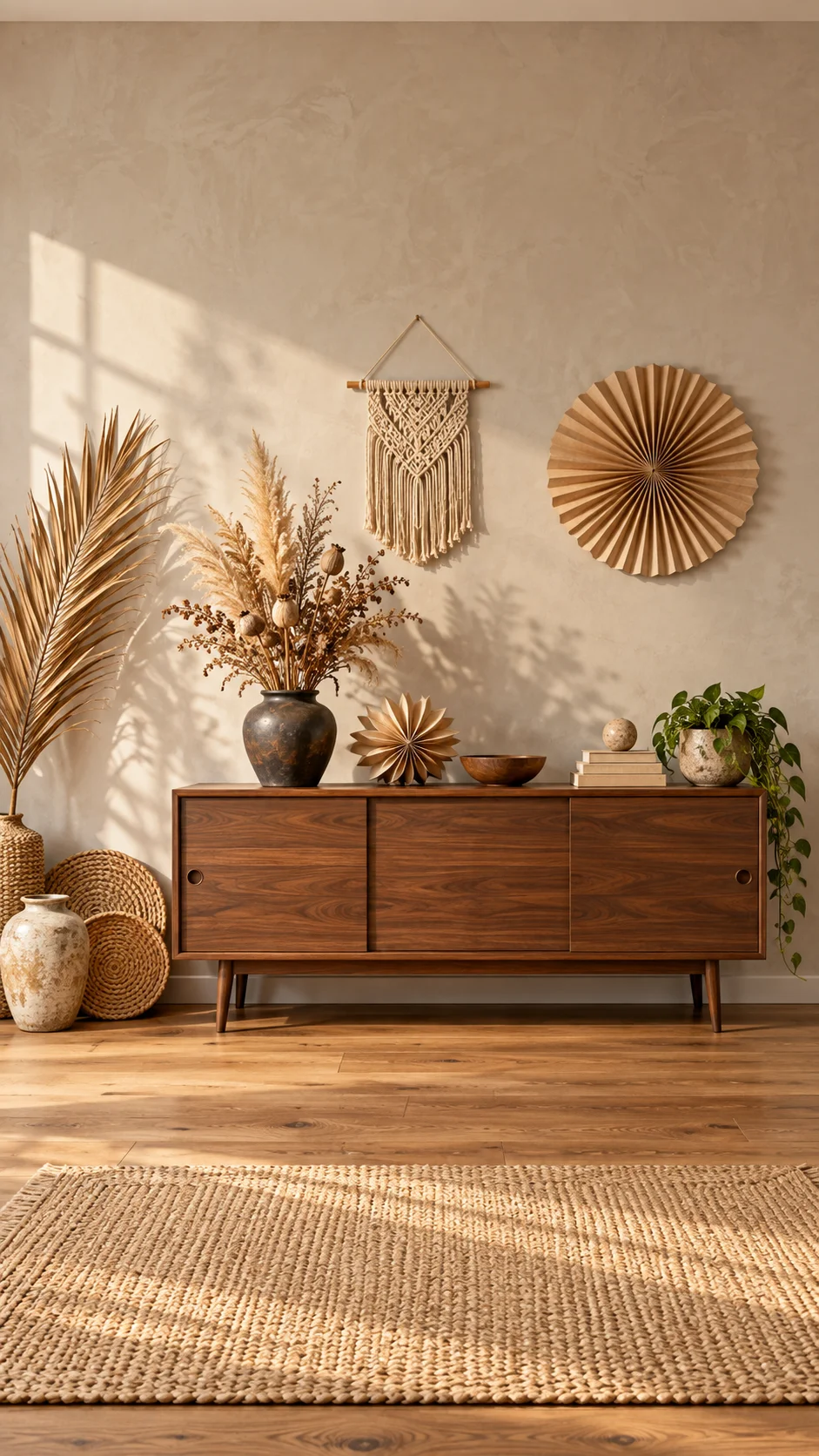
The wall in this corner is pale, mottled plaster, and almost everything placed against it is some shade of straw, sand, or cream: a tall dried palm leaf, a spray of pampas and seed pods, a macramé hanging, a pleated paper fan, a chunky jute rug. On its own that palette would drift. The walnut sideboard is what stops it.
The cabinet appears to have flat, sliding doors with a visible grain, and its dark color sits low, so the room’s heaviest tone is also its lowest point. The dark ceramic vase on top repeats that weight at a smaller size, and the pampas rising out of it softens the move back to light. That small echo is easy to copy: choose one dark object for the top of the cabinet so the wood doesn’t read as a lone block.
Sliding doors suit a room like this, too. Nothing swings into the walkway, and the plain fronts leave the wood grain to do the decorating. If you like this mix of retro furniture and natural fibers, our mid-century apartment ideas show the same pairing at full-room scale.
Hexagon Cubbies Let Teal Do the Organizing
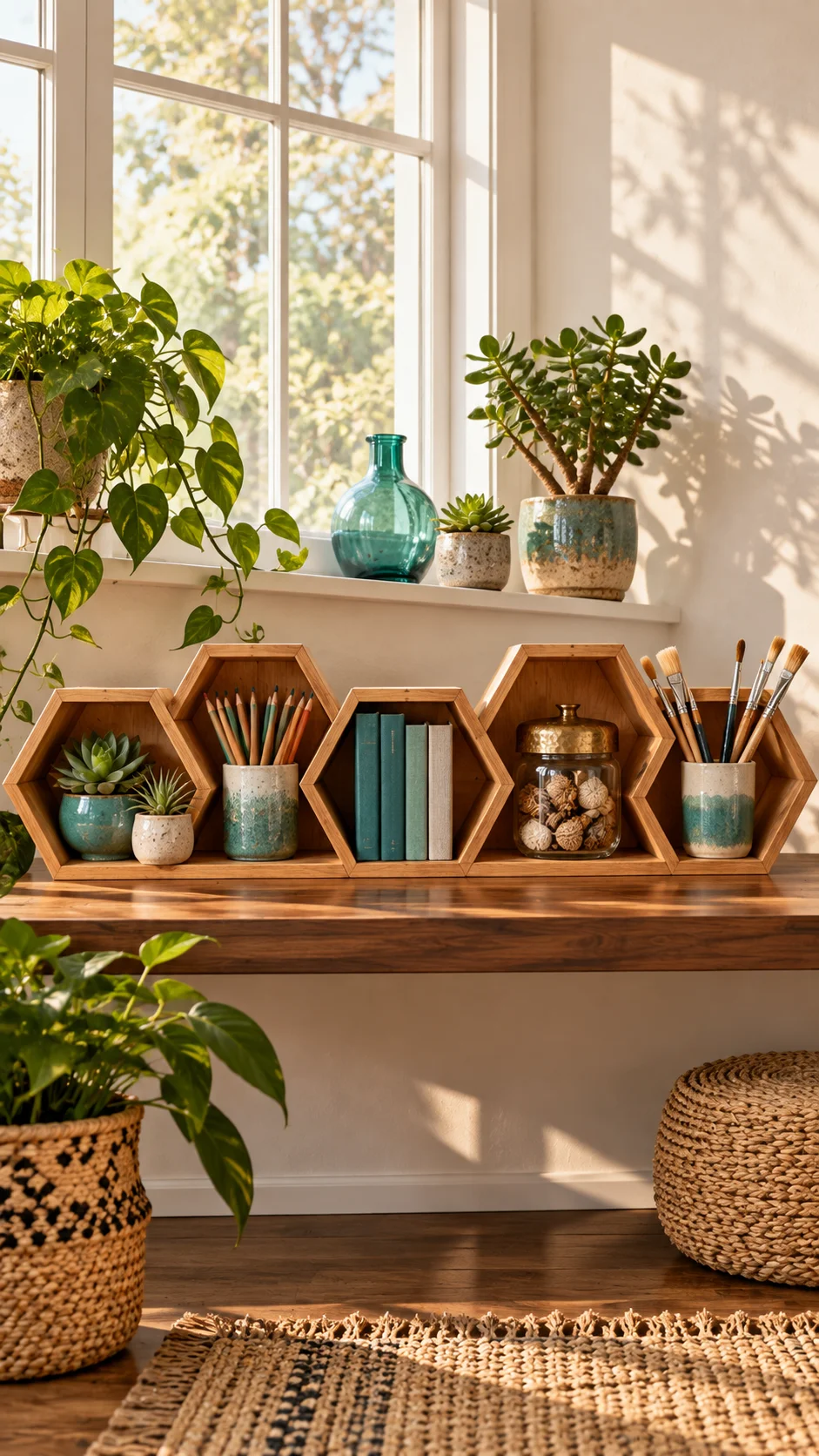
Five hexagonal boxes sit shoulder to shoulder on a plank shelf below a bright window, and each one holds a single kind of thing: a pair of succulents, a cup of colored pencils, four book spines, a glass jar of wooden pods with a brass-toned lid, a cup of brushes. That one-cell, one-category habit is what keeps open shelving from looking like a pile.
Teal runs through the whole arrangement. It shows up in the glazed pots, the cloth book covers, and the cups, then carries on across the windowsill in a green-blue glass bottle and a speckled planter. Because the shelves are honey-toned wood and the walls are cream, the teal reads as the lone accent, and it ties the shelf to the window above it.
The shape has a limit worth knowing. A hexagon cell this size suits small, upright items: pencils, jars, short plants, a few books. A tall vase or a stack of paper won’t sit comfortably inside, so the idea works well for desk and craft supplies, like the setups in our boho home office ideas, and less well for bulkier belongings.
Two Paper Fans and a Pair of Prints Make a Wall Above a Dresser
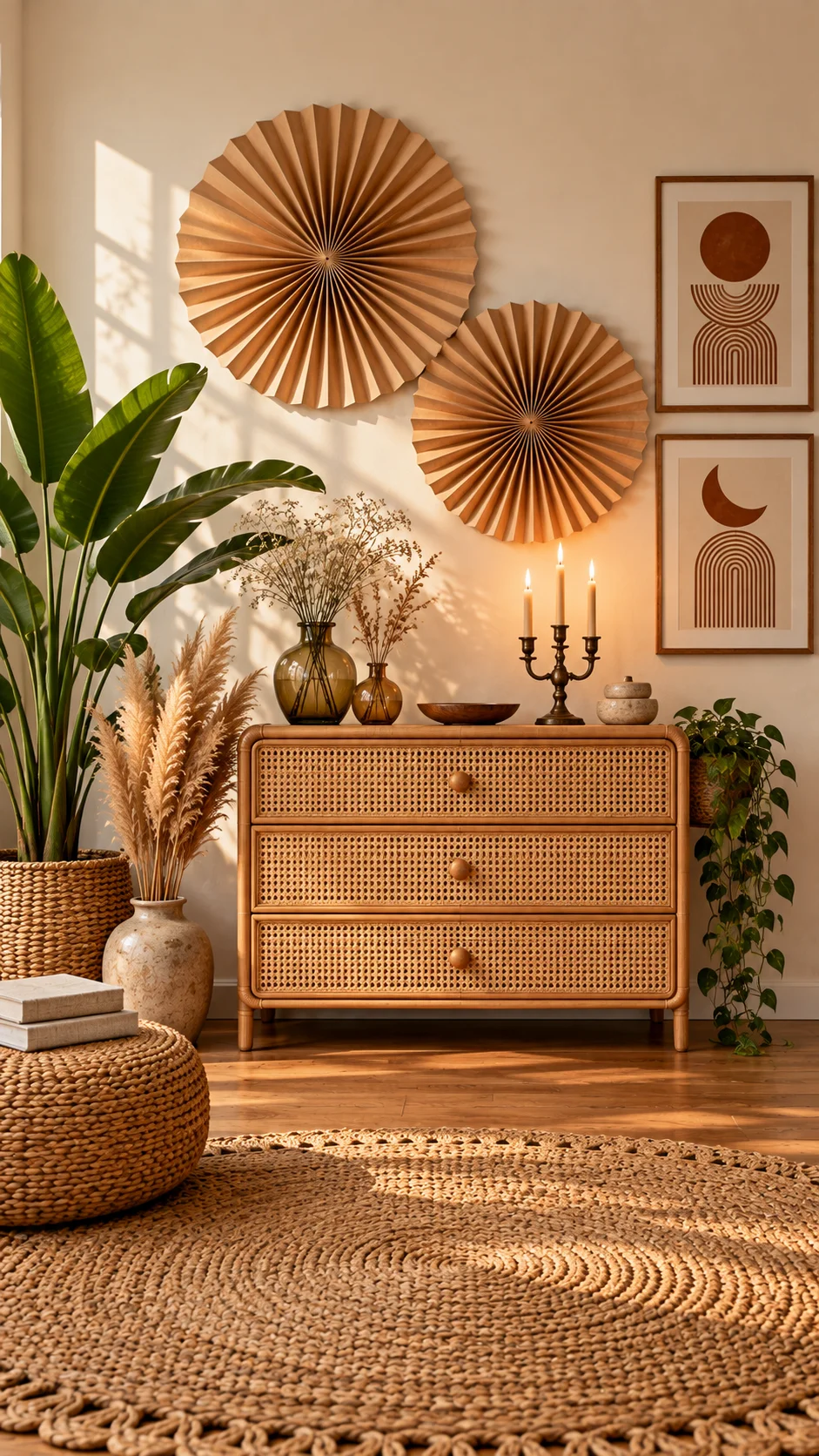
Dressers sit low and wide, which leaves a lot of bare wall above them. Here that space is filled by two overlapping pleated paper fans at the upper left and two stacked, framed prints at the right edge: a rust-colored circle over layered arches, and a crescent moon over the same arch motif.
The arrangement is lopsided on purpose. The fans are large and soft, the prints are small and graphic, and neither group is centered over the dresser. What holds it together is the shared palette. Fans and prints both use burnt orange and sand, so the wall reads as one composition even though it mixes paper, wood frames, and printed art.
The dresser top follows the same logic with smaller parts. Two amber glass vases holding dried stems, a wooden bowl, a stone lidded jar, and a brass three-arm candelabra with lit tapers sit at different heights, so the line along the top steps up and down instead of running flat. Cane drawer fronts with round wooden knobs keep a big piece from feeling heavy. If you’re furnishing a sleeping space with similar pieces, our boho bedroom looks show how far the same palette stretches.
A Brass Rail Turns Wooden Spoons and Boards Into the Wall Art
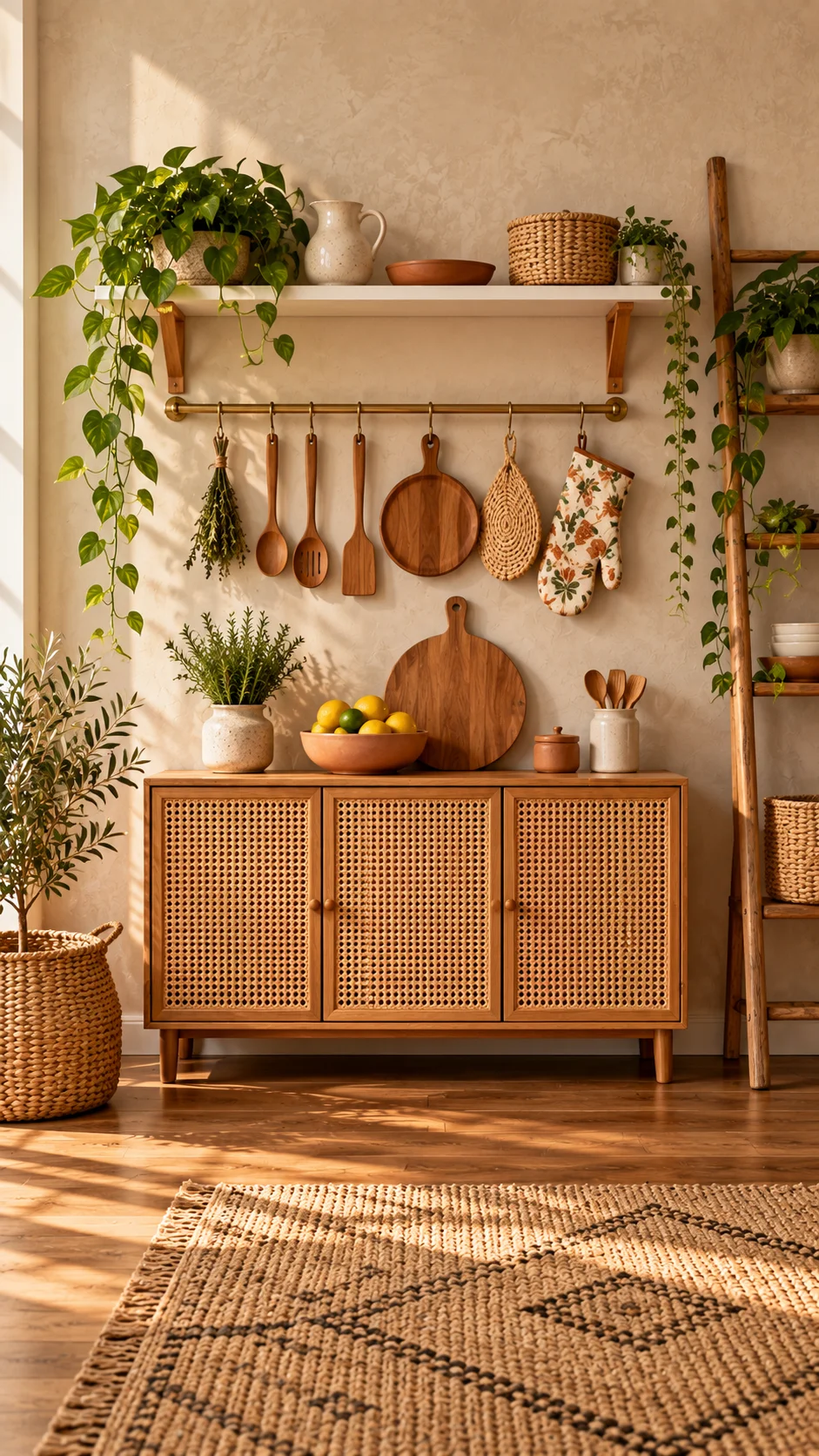
A cane-front sideboard handles the closed storage here, but the interesting move happens above it. A slim brass rail hangs under a white shelf, and from it swing wooden spoons, a spatula, a round board, a woven trivet, a floral oven mitt, and a bundle of dried herbs. Every item is something people use daily, so the display and the kitchen tools are the same objects.
The materials stay in one warm family. Wood, cane, terracotta, and rattan baskets all sit within a few shades of each other, and the greenery supplies the strong contrast: trailing pothos on the shelf, rosemary in a speckled pot, an olive tree in a basket. A bowl of lemons is the one true yellow in the frame, which is why the eye lands on it.
One practical note. Hanging tools collect grease and dust near a stove, and this rail appears to be mounted over a dry sideboard and not a cooking range. That placement is easier to copy in a dining nook, a breakfast corner, or beside a pantry than directly behind a burner. If storage is what you’re short on, what makes a pantry actually functional breaks down ten real layouts.
For more kitchens built from simple natural materials, our boho kitchen designs go further.
How a Woven Wall Cluster Gets Its Scale From the Sideboard Below It
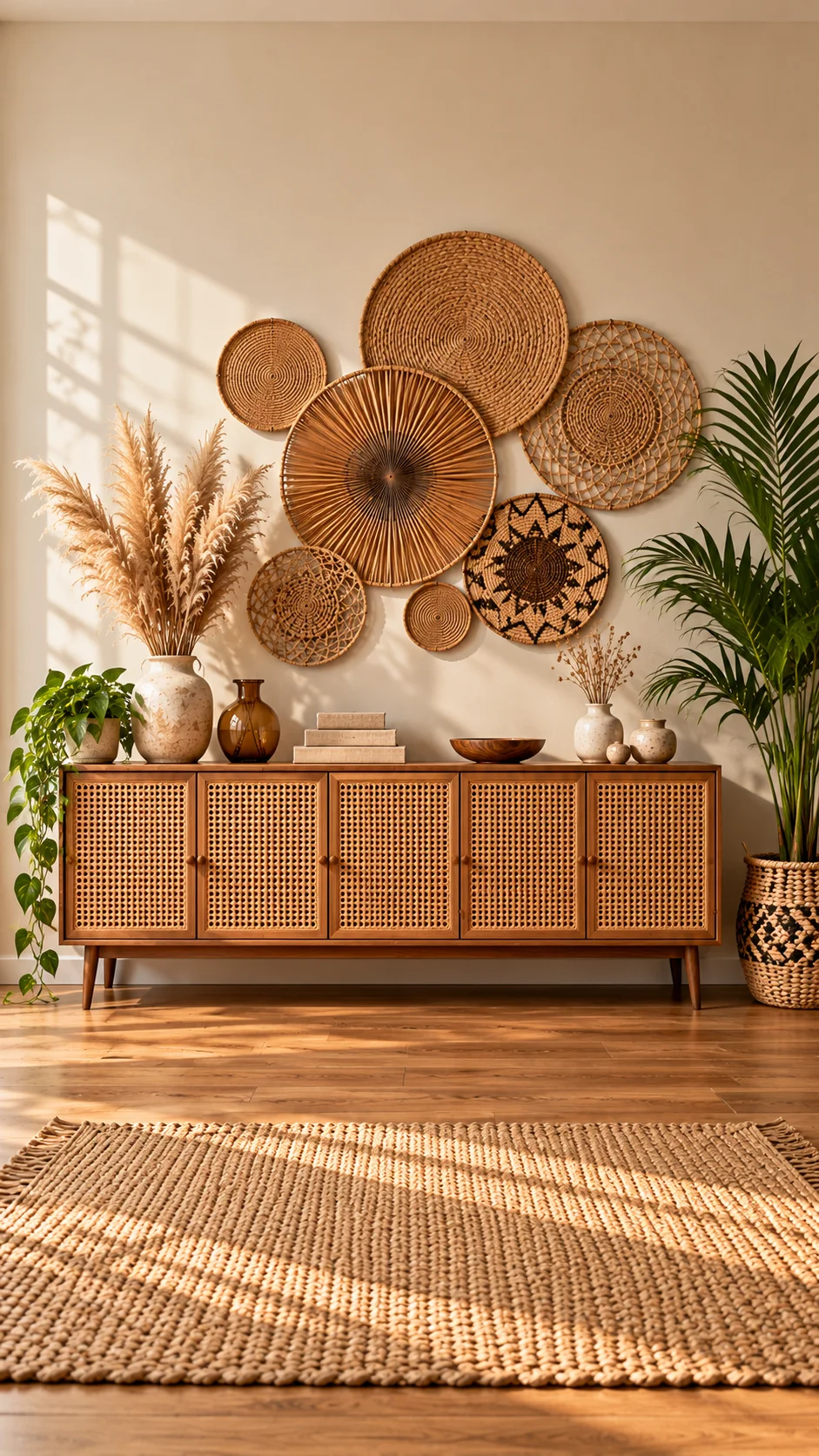
The sideboard here is long, with five cane doors and tapered legs, and the wall cluster above it is sized to match: about seven round woven pieces in different diameters, spanning roughly two-thirds of the cabinet’s width. A cluster much narrower than that tends to look like it slid off the furniture. One wider than the cabinet starts to crowd the plant and vase at each end.
Mixed sizes keep the group from looking like a set of identical plates. The biggest disc, with spokes radiating from a dark center, sits low and just left of middle. A looser openwork piece and a black-and-natural geometric one sit to the right, and two small ones fill the gaps at the edges. The spaces between pieces look fairly even, which does much of the work in making an irregular layout read as planned.
Natural fiber is the shared language. The cane doors, the discs, and the basket holding the palm all have an open weave, though every pattern differs. Pampas on the left, a pothos at the cabinet’s left end, and a tall palm on the right keep the ends of the sideboard from feeling empty.
Fluting Gives Window Light Something to Draw On
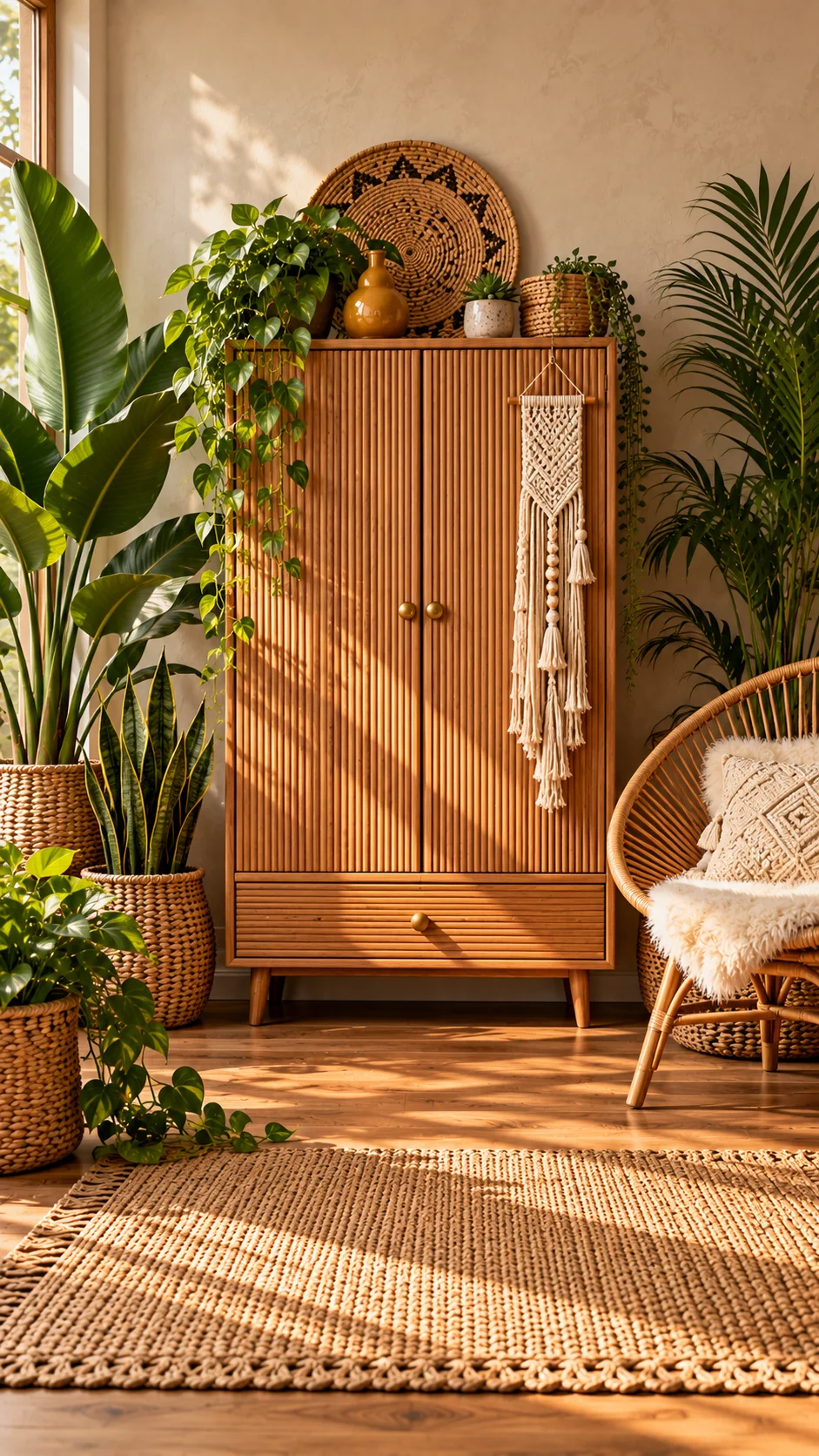
Tall storage rarely gets attention in boho rooms, but this wardrobe makes a case for it. Its two doors and the drawer below are covered in vertical fluting, thin parallel ridges that appear to be carved or applied to the wood. Where sunlight crosses them from the window at left, each ridge catches a thin line of light and shadow, so the cabinet changes character through the day without any added decoration.
The plants around it are scaled to its height. A bird of paradise, a snake plant, and a palm fill the sides, and a pothos trails down from the top. They stand in woven baskets that match each other, so a crowd of different plants looks organized. Up on top, a round woven plate with a zigzag pattern leans against the wall beside an amber gourd-shaped vase and a small planter, which gives the roofline something to finish on.
A macramé hanging with wooden beads and tassels sits on the right door, adding a soft vertical that echoes the ridges. Add the rattan chair and sheepskin beside it, and the corner is built from many fibers in a single warm tone. For more plant-heavy rooms in this spirit, browse our boho jungle living room ideas.
Painted Tiles on a Wooden Chest Give the Room One Loud Pattern
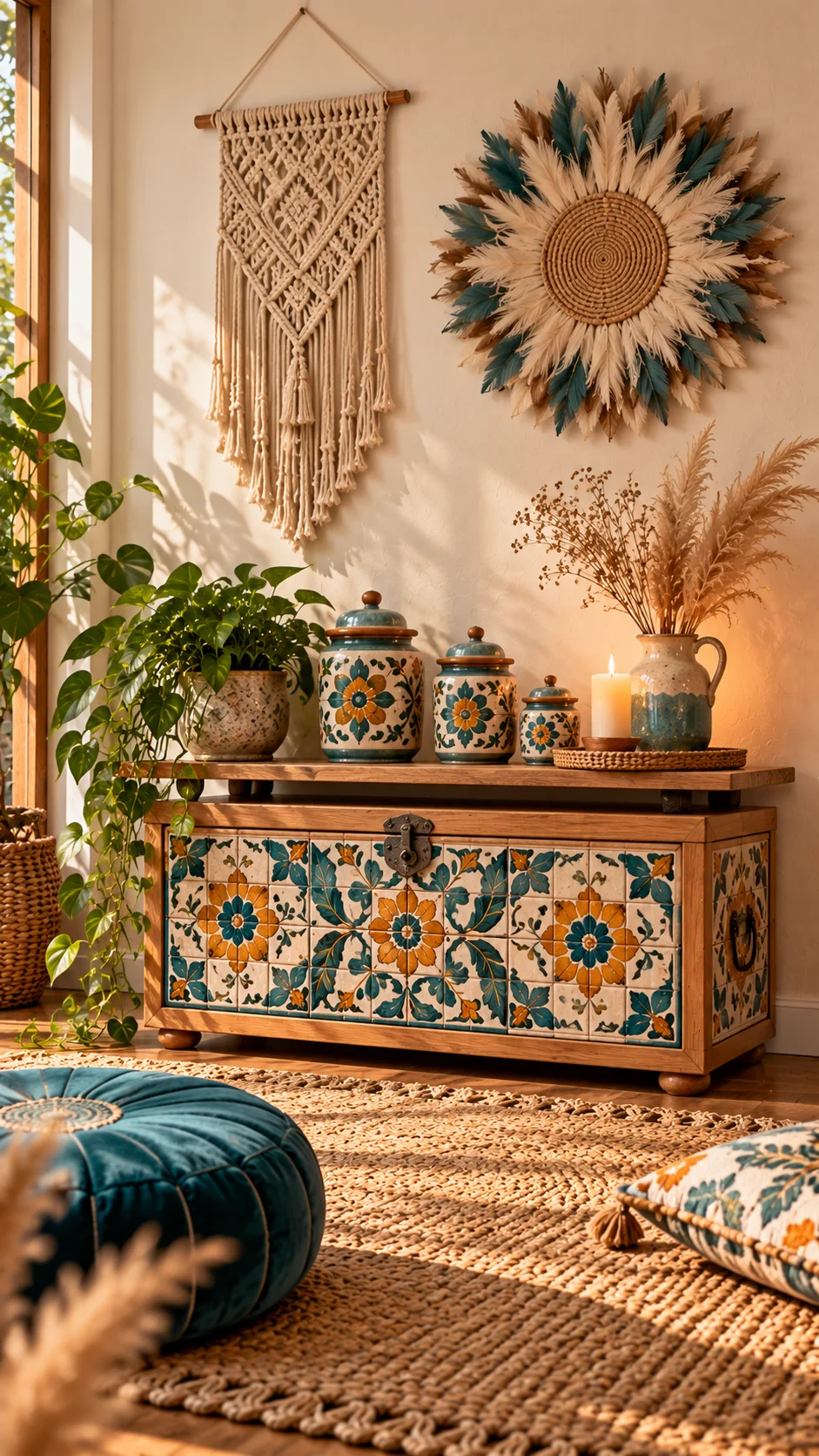
Everything near this chest is neutral or woven, so the tile-front chest gets to be the one busy thing. Its front is covered in floral tiles in teal, mustard, and cream with leaf details, set in a plain wooden frame with an iron latch and ball feet. A wooden plank on top works like a shelf.
The pattern doesn’t stay on the chest. Three lidded ceramic canisters on top repeat the same flower in the same colors at smaller sizes, a velvet pouf in the foreground picks up the teal, and a feathered sunburst on the wall mixes teal and cream feathers around a woven center. Pattern repeated at three scales (large tiles, medium jars, small feather tips) feels deliberate.
The practical side is simple. A chest with a hinged lid can hide blankets, toys, or seasonal linens while the top works as a display shelf. It suits a living room corner or the foot of a bed, as long as there’s room for the lid to open. If the patterned-furniture angle appeals to you, our floral printed furniture ideas take it further.
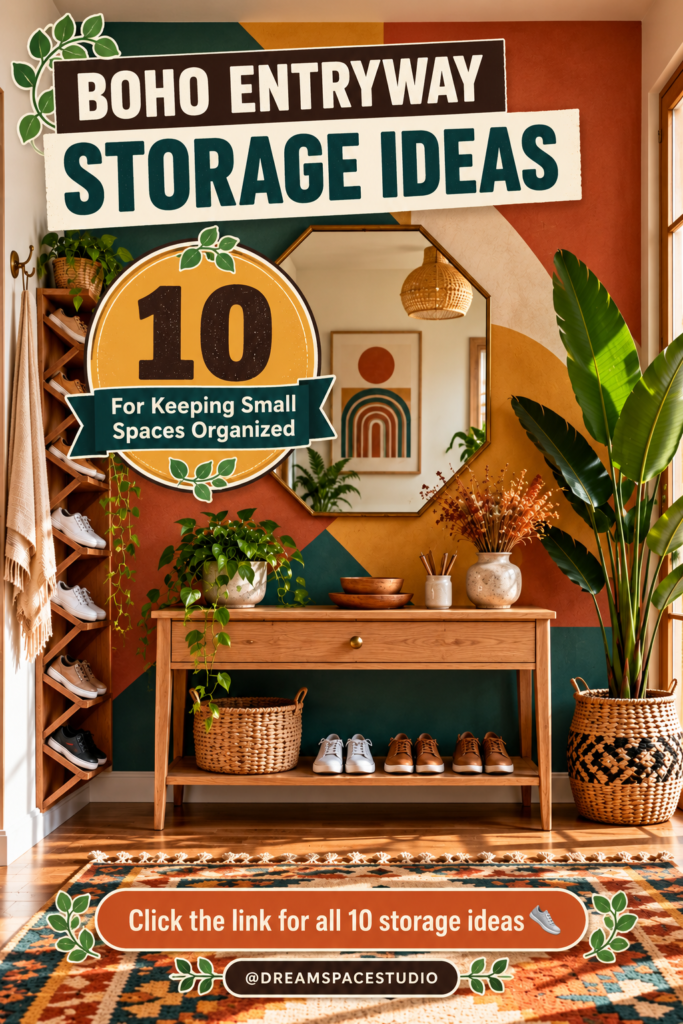
Color Blocking Turns a Narrow Entry Wall Into the Decor
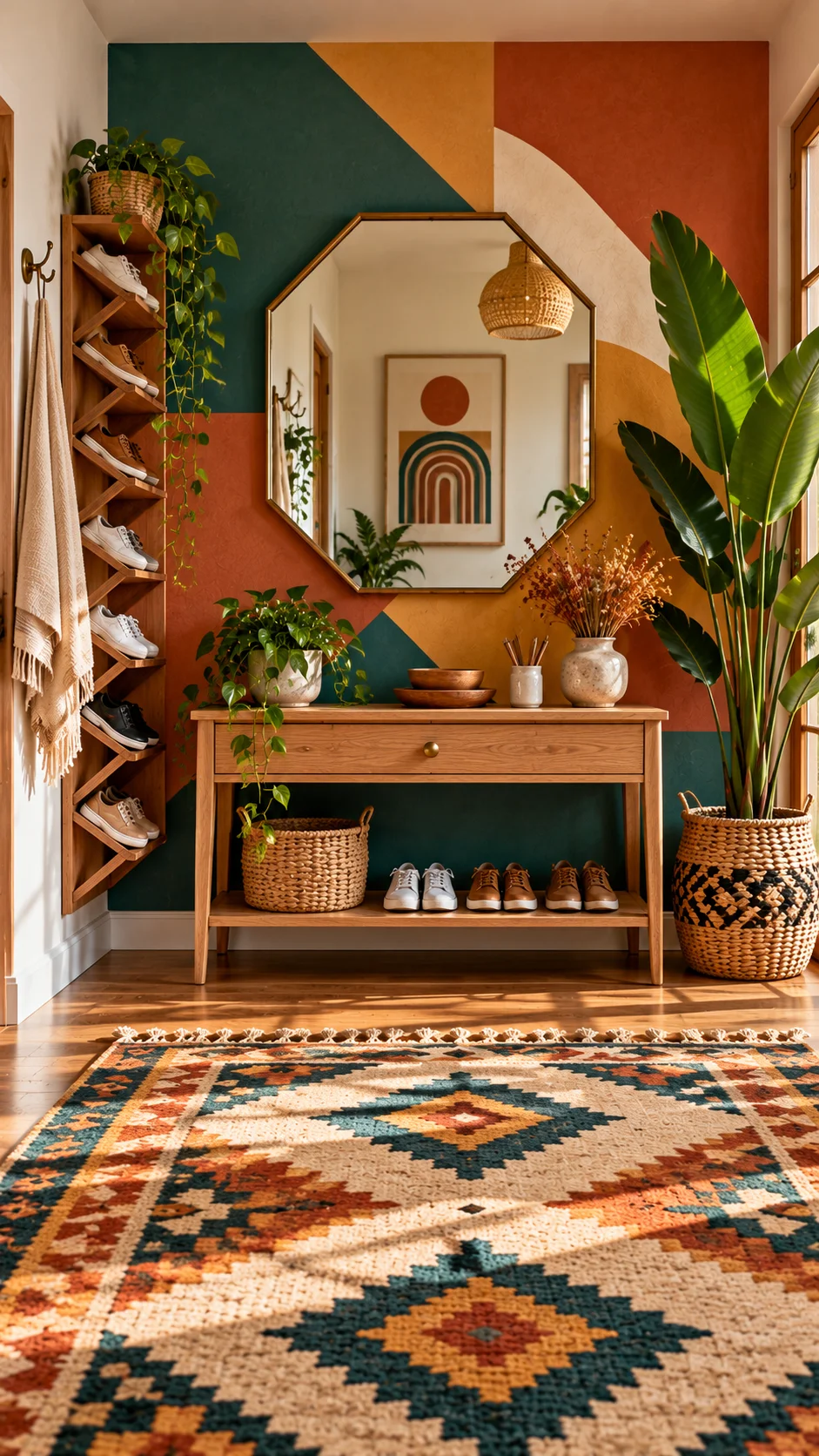
Entryways have to hold shoes, coats, keys, and a mirror in very little space. Here, a wall painted in large geometric blocks of deep teal, mustard, terracotta, and cream carries the decoration, so the furniture can stay simple. A curved cream shape arcs across the upper right, and a hard-edged diagonal splits teal from rust on the left. The painted shapes behave like built-in art and save wall space for useful things.
The octagonal mirror, in a thin wood frame, sits where several blocks meet, so its edges cross multiple colors at once. It also reflects a window-lit room with a woven pendant and framed art, which makes the entry feel deeper than it is. Check that your own mirror faces something worth reflecting. The kilim-style rug on the floor repeats all four wall colors, which closes the loop between wall and floor.
Two Ways to Store Shoes Without Crowding the Floor
Shoes get two homes. A slim wall-mounted rack of angled slots holds at least six pairs against the left wall, and an open lower shelf under the console holds four more beside a basket. The angled slots keep every pair visible, and nothing gets stacked. For more ideas in this vein, see stylish shoe racks that double as entryway decor.
If you’d like the rest of the entry to follow the same direction, our guide to boho entryways with rattan, plants, and texture is a good next stop.
A Nursery Built From Round Shapes and Woven Fibers
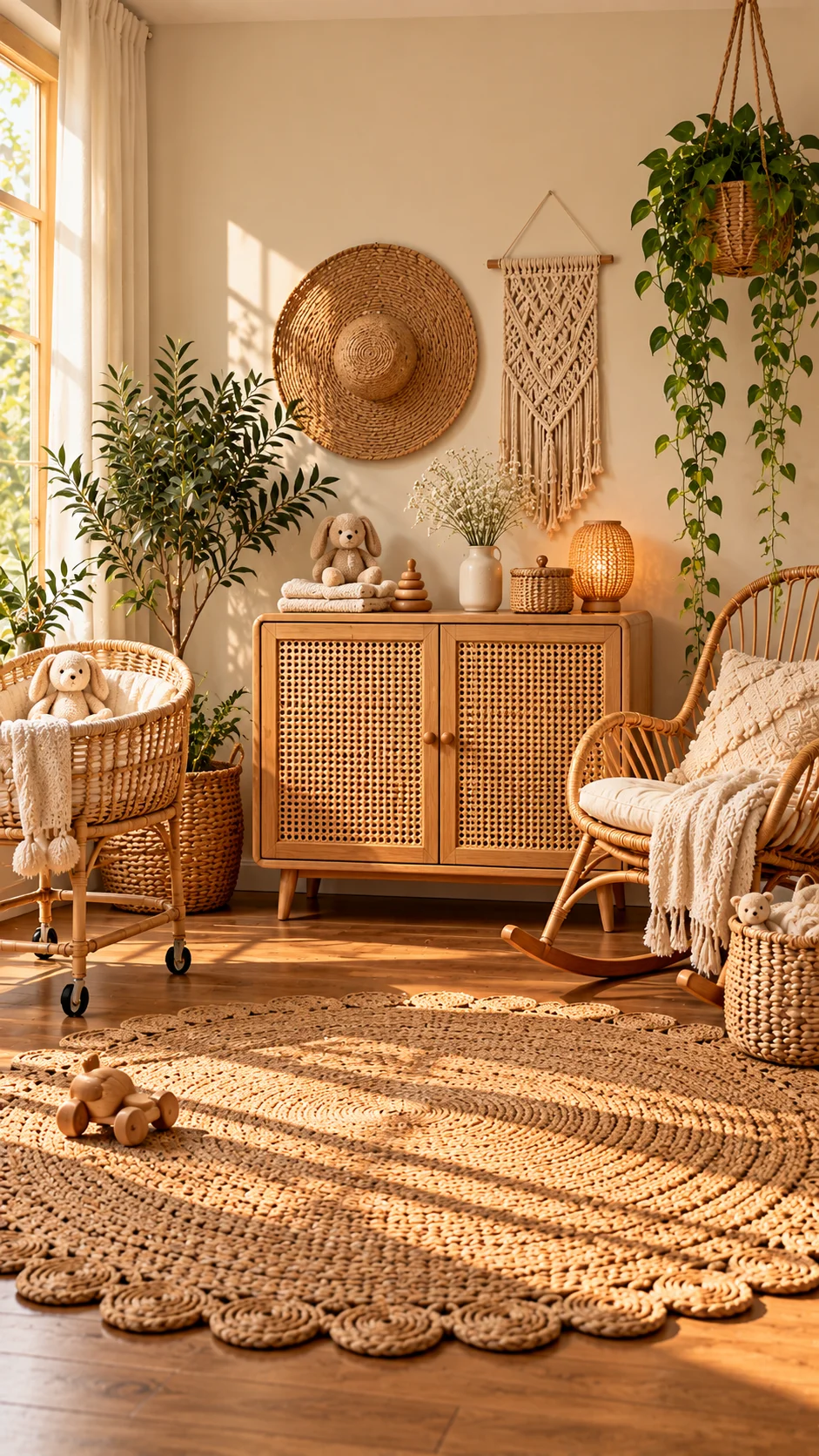
Soft curves do most of the work in this nursery. The rug is a large, scalloped circle of braided jute, the wall basket is round, the rocking chair has a curved rattan back and rockers, and even the bassinet is an oval wicker basket on wheels. Sharp corners are scarce, which suits a room where a small person will eventually crawl around.
The one rectangular piece is a two-door cane cabinet with rounded edges and short tapered legs. Closed doors give parents somewhere to put diapers and spare linens, while the top holds a woven lamp, a lidded basket, a small vase of what looks like baby’s breath, and folded blankets with a stuffed bunny. Cane keeps the cabinet looking light despite its size. If you use a piece like this in a baby’s room, anchoring it to the wall is a sensible step, since tall or top-heavy furniture can tip.
The trailing plant overhead looks like pothos, which is mildly toxic if chewed by children or pets, so a high hanging basket suits it. Our indoor plant styling guide has more on choosing and placing greenery.
A Bamboo Console With Baskets Underneath Gives Craft Supplies a Home
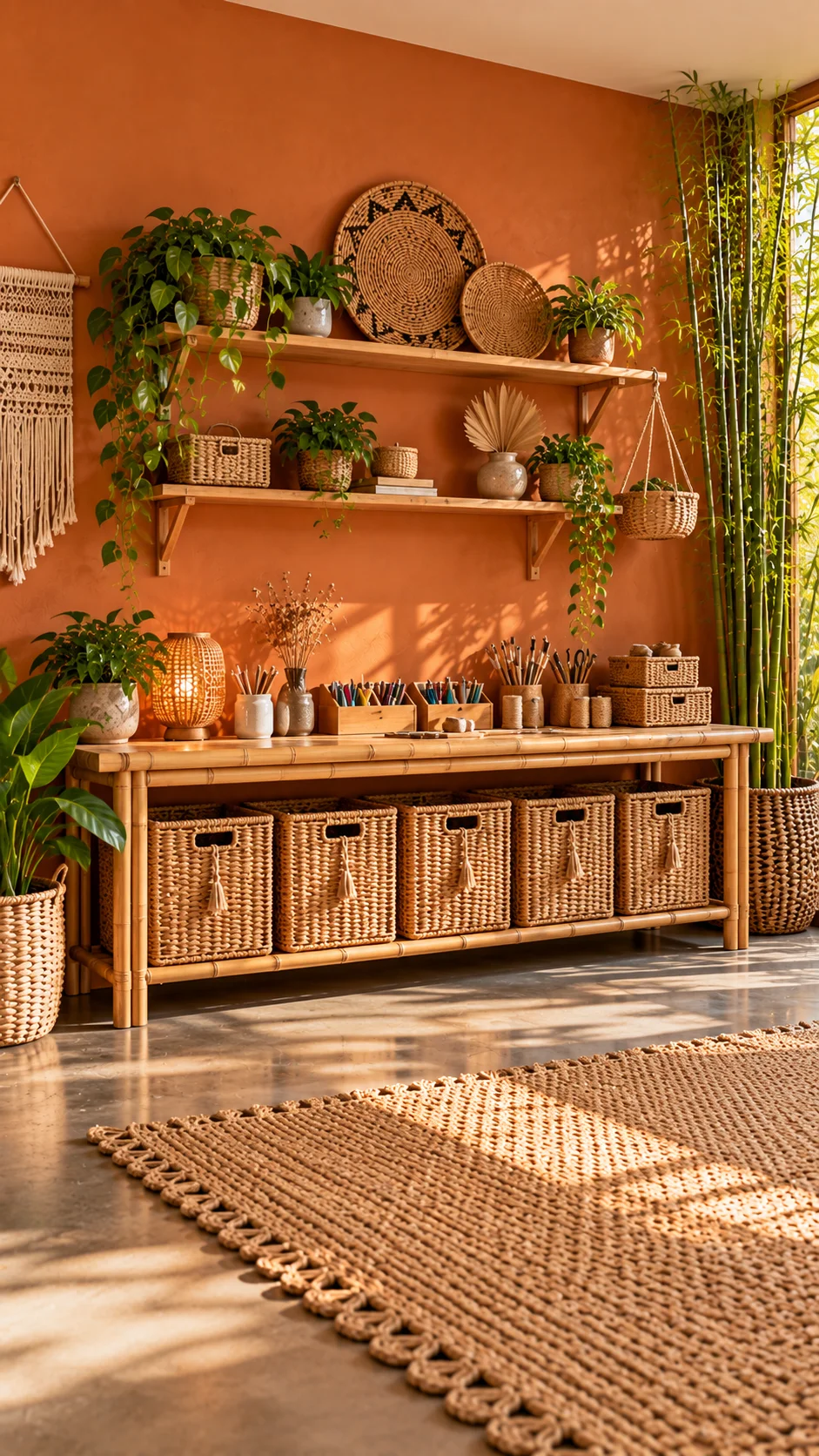
The terracotta-orange wall in this studio is strong enough that the furniture needs to stay calm, and the bamboo console does. It has a long open top and five matching woven bins slid underneath in a row, each with a cut-out handle and a small tassel pull. Five bins of the same size read as one clean band, even though what’s inside can be a mix.
The top holds the items you reach for most: jars of pencils and brushes, small wooden trays of markers, a rattan lantern lamp, and a pair of lidded baskets. Two wall shelves above hold plants, woven baskets, and a dried fan leaf in a vase. That gives the wall three layers: hidden storage below, tools within reach at the middle, and decorative items overhead.
The floor appears to be polished concrete, and the braided jute rug with its looped edge softens it, visually and underfoot. For more on matching natural rugs to a room, see our rug styles guide.
Questions About Styling Boho Storage Pieces
Can I mix cane, rattan, bamboo, and solid wood in one room?
Yes, and the rooms above do it constantly. Keep one wood tone as the lead (walnut in the first room, honey oak in the entryway) and let the woven pieces stay in a similar warm range. Trouble starts when a very red or cool-toned wood sits next to yellow-toned cane, so hold samples side by side in daylight before you buy.
Are cane-front cabinets practical for everyday storage?
They work well for items you don’t mind being faintly visible, such as linens, baskets, and board games. The open weave also lets air move, which helps in humid rooms. Cane panels are lighter than solid wood, so avoid stacking heavy items against them. If you want the contents hidden, a piece of fabric lining the back of the panel does it.
How high should a wall cluster hang above a sideboard?
A common guideline is to leave roughly 6 to 10 inches between the furniture top and the lowest piece, and to keep the group’s center near eye level. Tall objects on the cabinet change that gap, so measure from the tallest vase or lamp, not from the surface.
Will dried pampas and palm leaves fade in a sunny room?
Gradually, yes. Direct sun bleaches dried plant material over months, and pampas sheds as it ages. Keeping stems out of the strongest light slows the fading, and an occasional shake outdoors cuts down on shedding. In a very bright room, plan to swap stems out each season.
Pick the Piece First, Then Repeat One Material
The ten rooms don’t share a furniture style: walnut, cane, bamboo, and painted tile all appear. What they share is a method. The storage piece does the structural job, and one or two materials or colors repeat nearby, whether that’s teal in the shelves, rust across a dresser wall, or woven fiber almost everywhere.
If you’re starting from scratch, choose the cabinet that fits what you actually need to store, then let the wall above and the objects around it echo one detail of that piece. That’s often enough to make storage look intentional.
About the Author: The Aesthetic Life Team writes about home décor, room styling, and practical design ideas for everyday homes.

