A pantry can look organized in photos and still be frustrating to actually use—jars pushed to the back where no one can reach them, shelves too deep to see what’s stored on the far side, and labels facing the wrong way. Function and appearance don’t always line up, and the pantries that manage both usually have one thing in common: every item has a spot that makes sense for how it’s actually used, not just how it photographs.
The ten pantries below range from compact corner solutions to full custom cabinetry, but each one solves a specific version of the same problem—keeping food visible, accessible, and protected without turning the space into clutter. Here’s what makes each one work.
A Rotating Corner Shelf That Puts Every Jar Within Reach
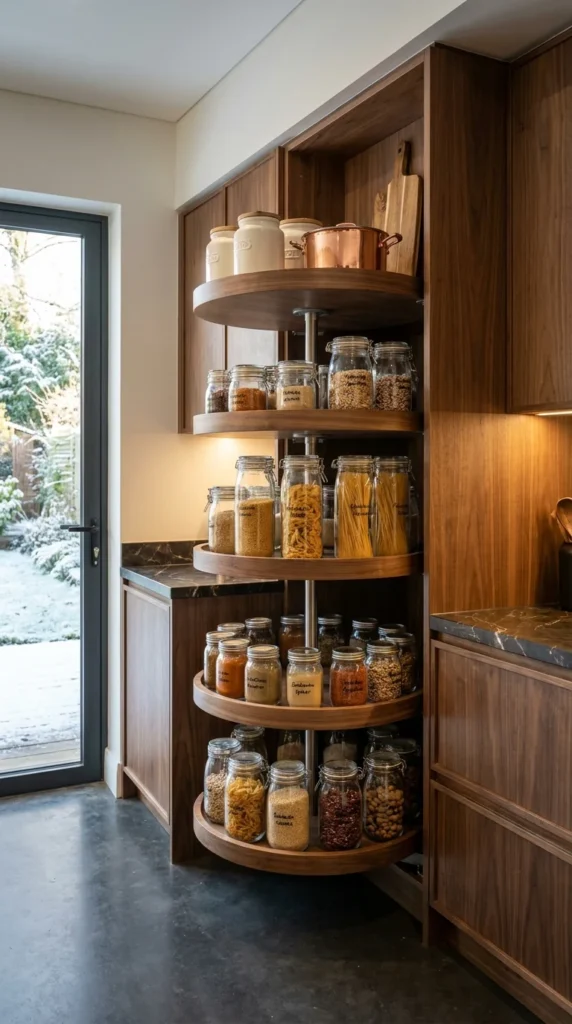
Built around a central pole, this shelving system rotates like a lazy Susan scaled up to fill an entire corner. Each circular tier holds a mix of labeled jars—grains, pasta, spices—arranged so nothing sits permanently out of reach the way items often do in a standard deep corner cabinet.
💡 Pro Tip
Group items by how often they’re used rather than by category when arranging a rotating shelf like this. Keeping daily staples on the tier closest to hand height, with less frequently used items on the top or bottom rings, cuts down on the amount of spinning needed to find anything during regular cooking.
Warm under-shelf lighting keeps the labels legible even on lower tiers, which matters more here than in flat shelving since the rotating design naturally puts some jars in shadow depending on the angle.
How Pull-Out Trays Turn a Deep Corner Into Usable Storage
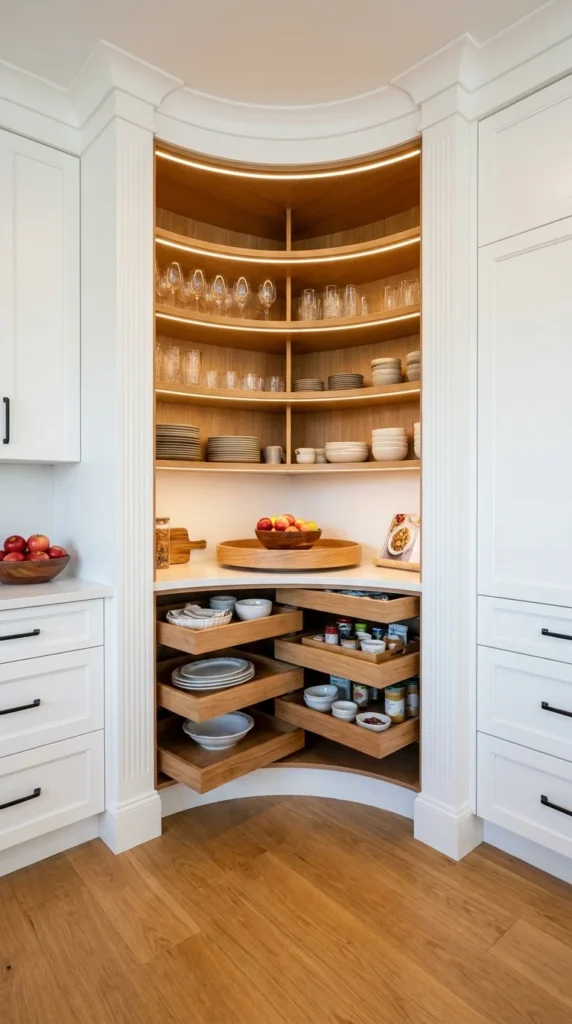
Rather than open shelving, this curved corner pantry uses stacked pull-out wood trays below a run of fixed shelves for glassware and dishware. Sliding each tray fully forward brings items stored at the back of the corner into full view, solving the classic problem of corner cabinets swallowing whatever gets pushed too far in.
📌 Important Note
Pull-out trays need to be rated for the weight of what’s stored on them—a tray holding stacked dinnerware and canned goods carries considerably more weight than one holding lightweight jars. Checking the slide mechanism’s weight rating before loading it up prevents sagging or premature wear on the rails over time.
The curved shelf line above continues the same rounded shape as the tray fronts, which keeps the whole unit feeling like one cohesive piece rather than two mismatched storage systems stacked together.
Open Shelving Up Top, Refrigerated Drawers Below
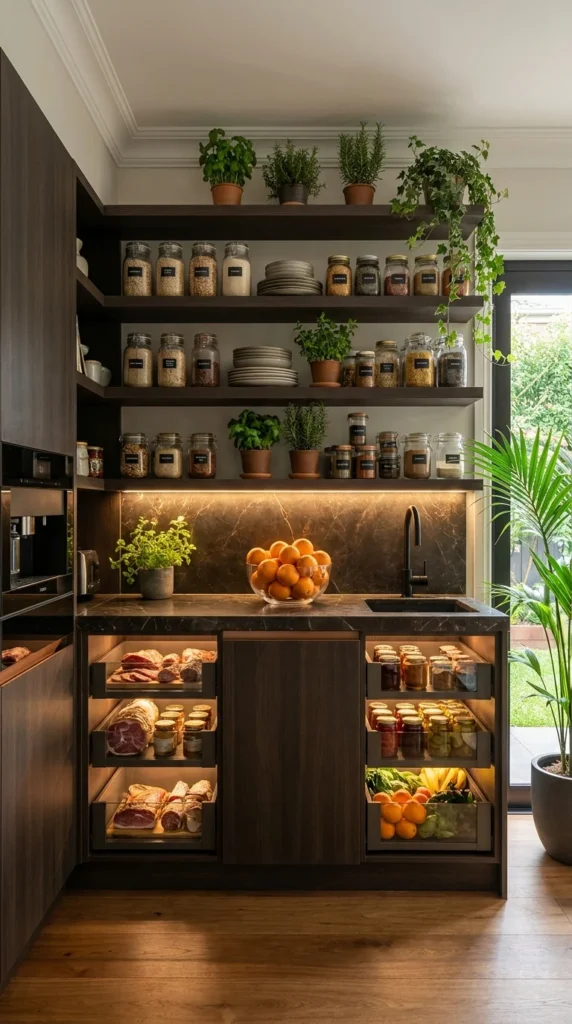
Labeled jars and stacked dishware fill the open shelves along the top of this kitchen wall, while the counter below hides a set of illuminated pull-out drawers built for cold storage—cured meats, produce, and preserved jars all kept chilled and visible at once. Splitting dry and cold storage this way keeps each type of ingredient in the environment it actually needs.
Open shelving works particularly well for items used constantly throughout the week, since nothing needs to be opened or slid out to check what’s available. The drawers below take on a different job entirely, protecting perishables from the room’s ambient temperature while still keeping them easy to survey without lifting a lid or digging through a crowded refrigerator shelf.
Fresh herbs growing along the top shelf double as both ingredient and greenery, which is a small detail that keeps a heavily organized wall from feeling clinical.
Steeply Angled Spice Storage That Makes Every Jar Visible at Once
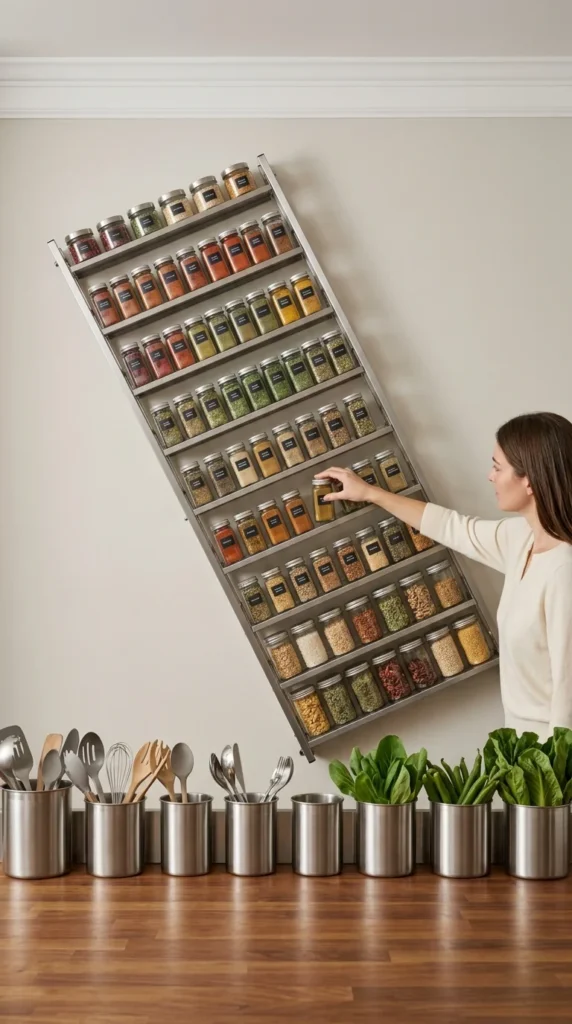
Mounted at a dramatic downward tilt, this spice rack lays every jar at an angle that makes labels readable from across the room, without a single jar hidden behind another. It trades floor-standing storage for a fully wall-mounted system, freeing up counter space that a traditional cabinet-based spice drawer wouldn’t.
⚠️ Warning
A steeply angled rack like this needs to be anchored into solid wall studs, not just drywall anchors—the combined weight of dozens of filled glass jars, all pulling downward at an angle, puts more stress on the mounting points than a flat horizontal shelf would. Skipping proper stud mounting risks the entire rack pulling away from the wall over time.
Rows of stainless steel utensil canisters lined up below make use of the otherwise empty floor space beneath the rack, turning a single wall into two separate storage zones stacked on top of each other.
Glass Doors and a Wine Fridge Built Into One Pantry Wall
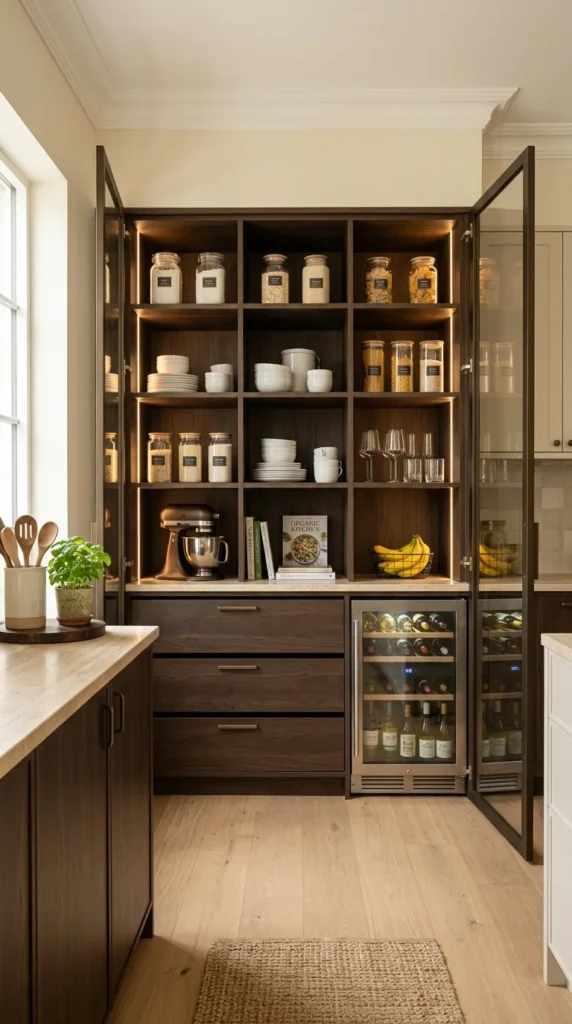
This cabinet combines dry goods, dishware, and a small kitchen appliance display behind glass doors, with a built-in wine fridge occupying the lower right section. Labeled jars of grains and pasta sit at eye level, while less frequently needed items like a stand mixer and cookbooks are positioned lower, within reach but out of the main sightline.
What Belongs Behind a Glass-Front Pantry Door
☐ Labeled jars with consistent, matching containers ☐ Items grouped by category, not randomly placed ☐ Appliances used often enough to justify prime shelf space ☐ A small stack of cookbooks or reference material, if relevant ☐ Nothing still in its original mismatched packaging
Because everything behind glass doors stays visible at all times, this style of pantry works best when contents are kept fairly uniform—a shelf of matching jars reads as organized, while a shelf of assorted boxes and bags reads as clutter, even from behind glass.
Black-Framed Glass That Turns a Pantry Into a Display Case
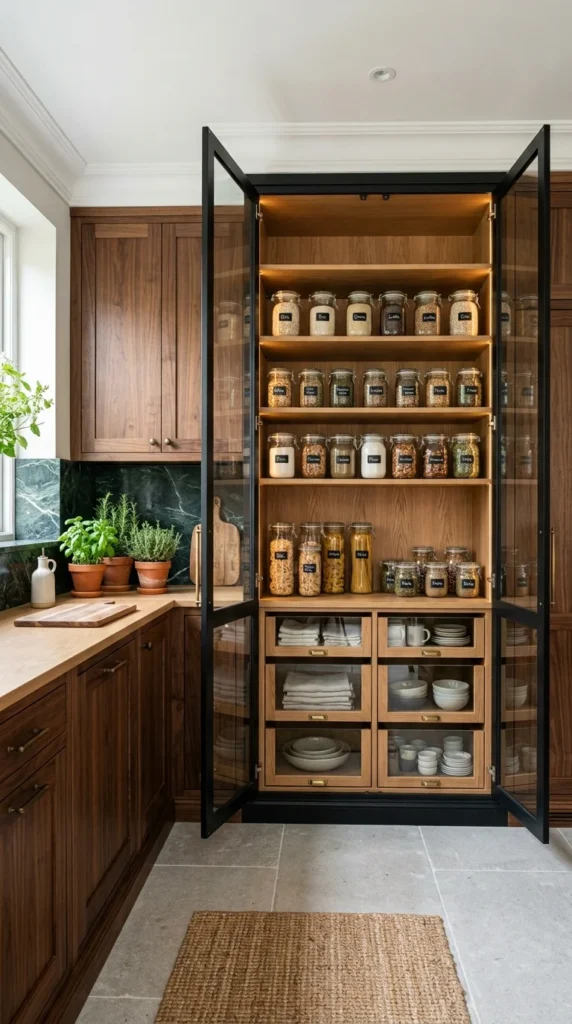
Slim black metal framing wraps the glass doors on this tall pantry cabinet, giving it a look closer to a display case than typical kitchen storage. Inside, walnut shelving holds labeled jars up top and closed drawers with glass fronts below, storing linens and dishware in a way that still keeps their location visible without opening anything.
⚠️ Warning
Glass-front cabinets in a kitchen are more exposed to steam and cooking humidity than solid-door pantries, which can occasionally fog the interior glass on drawers positioned close to a stove or sink. Placing this style of cabinet farther from major heat and moisture sources helps keep the glass clear and the visibility benefit intact.
A woven mat at the base and a scattering of potted herbs on the counter nearby keep the otherwise sleek black-and-glass piece from feeling too formal for daily kitchen use.
Reclaimed Wood and Labeled Jars: A Pantry Built for Slow Cooking
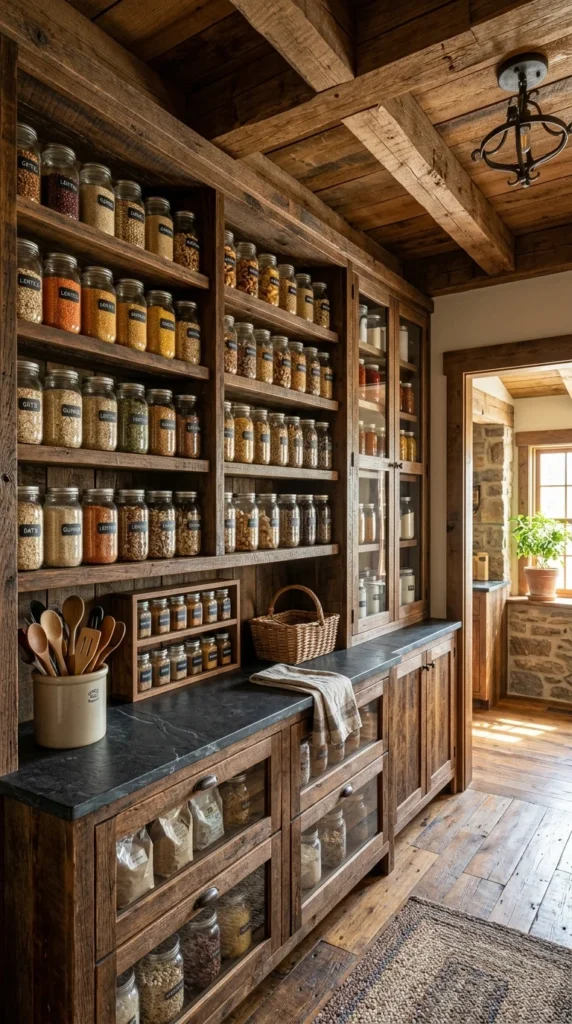
Weathered wood beams and open shelving give this pantry a distinctly rustic feel, with rows of hand-labeled jars holding grains, lentils, and grits arranged by type across multiple shelves. A smaller glass-front cabinet section handles bulk dry goods that need a bit more protection from light and air than the open shelves provide.
💡 Pro Tip
Grains and legumes stored in open glass jars, like the ones lining these shelves, stay fresher longer with an airtight seal rather than a simple lid—look for jars with a rubber gasket and clamp closure rather than a screw-top that can loosen over time. This matters most for anything stored on open shelving where the seal is the only real protection.
A crock of wooden utensils and a woven basket bring in texture that matches the reclaimed wood, keeping the whole wall feeling collected rather than uniformly matched.
What a Freestanding Cabinet Solves That a Built-In Can’t
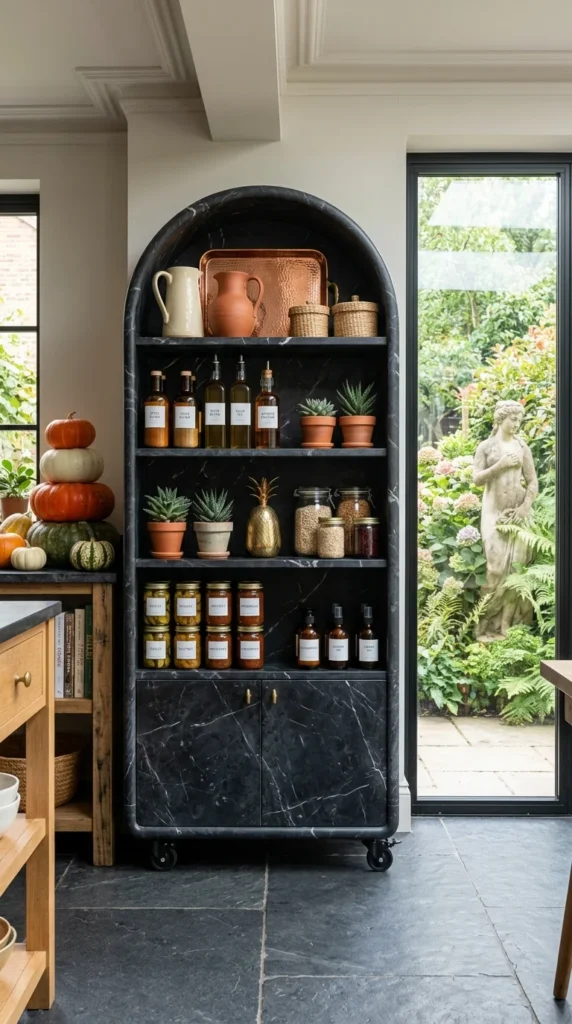
Mounted on small caster wheels, this arched black marble cabinet can be repositioned anywhere in the kitchen—a flexibility no built-in pantry wall can offer. Its shelves hold a mix of oils, preserved jars, and small potted succulents, with a closed lower cabinet handling anything better kept out of view.
A freestanding piece like this makes the most sense in kitchens where the layout might change or in a rental where permanent built-ins aren’t an option. It also works well as overflow storage alongside a smaller existing pantry, rolled into place only when extra capacity is needed and tucked elsewhere the rest of the time. The curved marble top and copper accents give it enough visual weight to work as a standalone piece rather than looking like temporary storage.
Wrapping Storage Around an Awkward Kitchen Corner
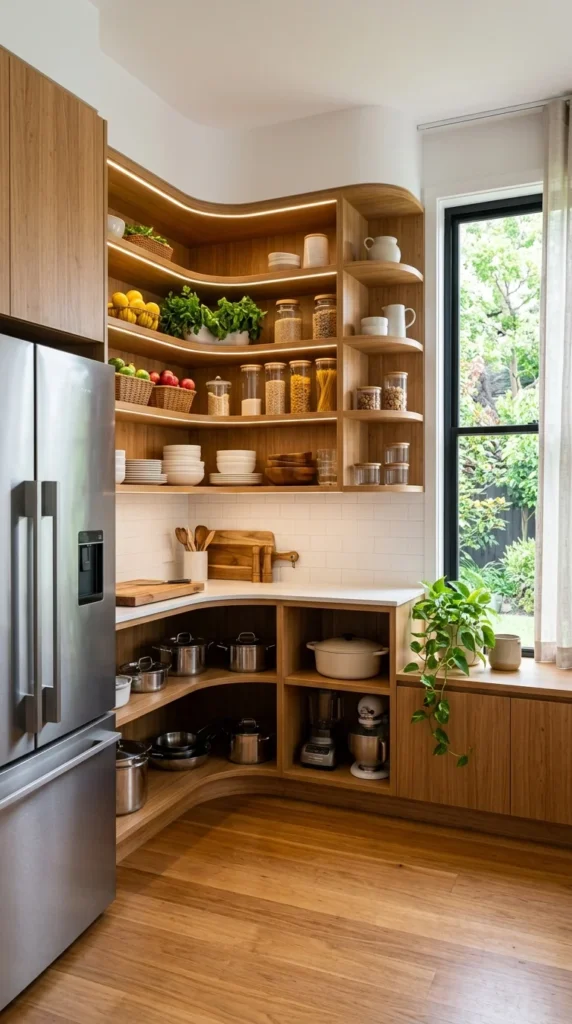
Curved shelving follows the exact contour of this kitchen’s corner wall, with illuminated open shelves up top for jars and produce and deeper cabinet space below for pots, pans, and small appliances. The design turns what would otherwise be an oddly shaped, hard-to-use corner into one of the kitchen’s most functional zones.
Corner Storage: Shelves vs. Cabinets
| Factor | Open Curved Shelves | Closed Curved Cabinets |
|---|---|---|
| Best for | Jars, produce, frequently grabbed items | Pots, pans, small appliances |
| Visibility | Always visible | Hidden until opened |
| Dust exposure | Higher | Lower |
| Corner depth handled | Shallow to medium | Deep, awkward corners |
Pairing both formats in one curved run, as this kitchen does, means the corner handles two very different storage needs without requiring a separate piece of furniture squeezed in elsewhere.
Angled Walnut Doors That Fit a Pantry Into a Tight Corner
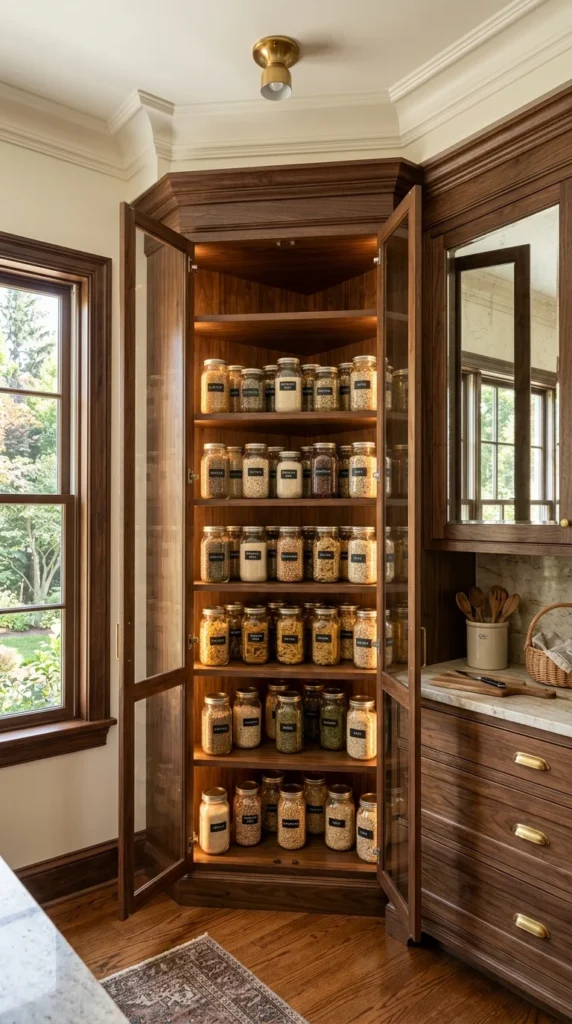
Built to match the angled shape of the room’s corner, this walnut cabinet uses two glass-front doors set at a slight angle to each other, following the wall rather than forcing a flat rectangular cabinet into an irregular space. Inside, rows of labeled jars fill every shelf from floor to ceiling, lit from within to keep contents visible even in the cabinet’s deepest corner.
Recreating This Look: Budget Tiers
💚 Affordable: A standard corner cabinet paired with matching labeled jars can achieve a similarly organized look without a custom angled build. 💛 Mid-Range: A semi-custom cabinet ordered to the room’s specific corner angle gets closer to a seamless fit without full bespoke carpentry. 💎 Investment: A fully custom, built-to-fit angled cabinet with integrated lighting, like this one, makes the most of an irregular corner that off-the-shelf furniture generally can’t match.
The brass ceiling fixture directly above adds a final layer of warm light, supplementing the cabinet’s internal lighting so the corner stays bright even with the doors closed.
Final Thoughts
None of these ten pantries rely purely on how they look to earn their place — each one solves a specific, practical problem, whether that’s a rotating shelf making a corner reachable, pull-out trays preventing items from getting lost, or a freestanding cabinet offering flexibility a built-in never could. A functional pantry isn’t really about how much it can hold. It’s about whether everything inside stays visible, accessible, and easy to put back exactly where it came from.
Frequently Asked Questions
What’s the best way to organize a small pantry? Grouping items by category—grains, canned goods, snacks, and baking supplies—and keeping the most frequently used items at eye level generally makes the biggest difference in a small space. Vertical storage, like stackable bins or door-mounted racks, also helps make use of space that would otherwise go unused.
Should pantry items be stored in matching containers? Matching containers aren’t required, but they do make a pantry look and feel more organized, and they often preserve food better than original packaging once it’s been opened. Clear containers with labels make it easiest to see what’s running low without opening every jar to check.
How often should a pantry be cleaned out? A full clean-out every three to six months is a reasonable target for most households, checking expiration dates and wiping down shelves in the process. A quick weekly check for anything expired or nearly empty helps keep the deeper clean-outs from becoming overwhelming.
What’s the ideal shelf depth for pantry organization? Shelves in the 12- to 16-inch range tend to work best for most pantry items, since deeper shelves make it easy for things to get pushed to the back and forgotten. In corners or deep cabinets, pull-out trays or rotating shelving generally solve the visibility problem better than simply adding more flat shelf depth.
Is it worth adding lighting inside a pantry? Yes—even a small battery-powered LED strip makes a noticeable difference in cabinets or corners that don’t get much natural or overhead light. It’s a low-cost upgrade that makes labels easier to read and items easier to find, especially in glass-front or deep corner storage where shadows tend to hide the back rows.
2 Responses