
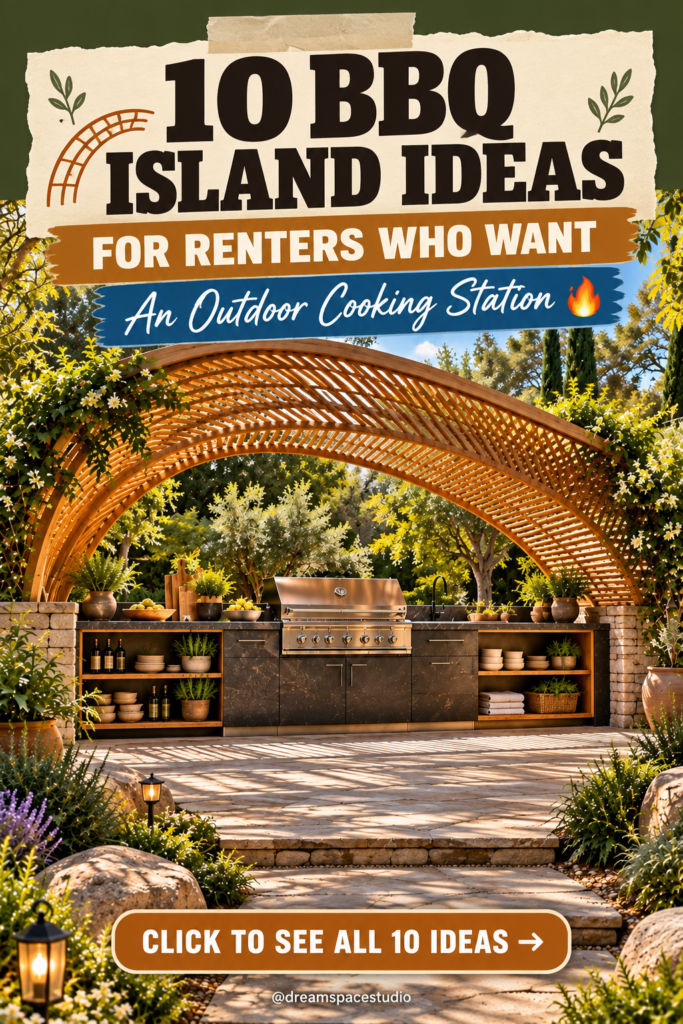
Saving fifty BBQ island photos is easy. Working out which ones could actually exist in your yard is the hard part. A stone-clad island under a pergola and a trailer-mounted smoker both count as BBQ islands, yet they solve different problems: one is a permanent outdoor kitchen, the other is a cook rig you can roll away after the party.
The ten setups below are sorted by the decision each one teaches. Some are about material choice, some about roof and shade, some about where the table sits or how the island is lit after dark. You’ll also find the trade-offs photos tend to hide, like which tiles crack in freezing weather, which counters dislike rain, and why a pergola over a grill deserves a second look at the manual. Pick the two or three that match your climate and space, then let the rest go.
Let the Island Borrow Its Stone From the Wall Behind It
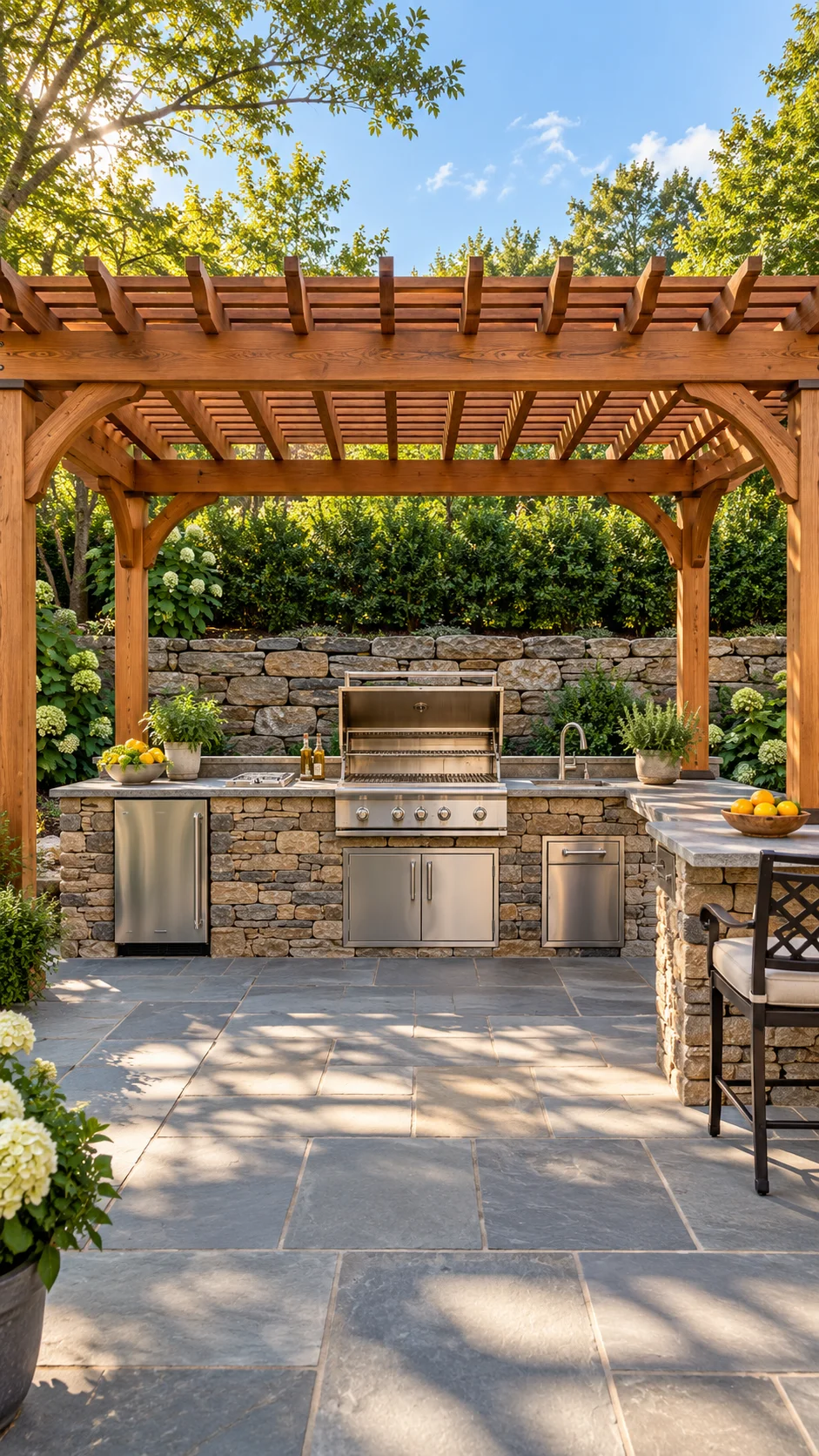
The most convincing detail here isn’t the grill. It’s that the island’s stone veneer base matches the dry-stacked retaining wall directly behind it, so the cooking area reads as part of the hillside instead of a cabinet set down in front of it. Tan and gray stone, a gray slate patio and a cedar-toned pergola stay inside one earthy palette, which keeps the stainless doors and grill from looking out of place.
If your yard already has a wall, a house façade or a paved terrace, copy that material first and choose everything else second. It’s a cheaper route to a cohesive look than picking a trendy finish and hoping it matches. The L-shaped return on the right adds a short bar with one stool, a good use of a corner that would otherwise sit empty. The thick stone-look top also needs to handle heat, grease and weather, and this kitchen countertop guide covers the same material trade-offs you’d weigh outdoors.
One caution about the pergola. Many grill manufacturers warn against cooking under a combustible overhead structure, and slatted wood is combustible. In a setup like this, read the grill manual for the required clearance before the pergola goes up, not after.
When the “Island” Is Really a Kamado, a Side Table, and a Gravel Floor
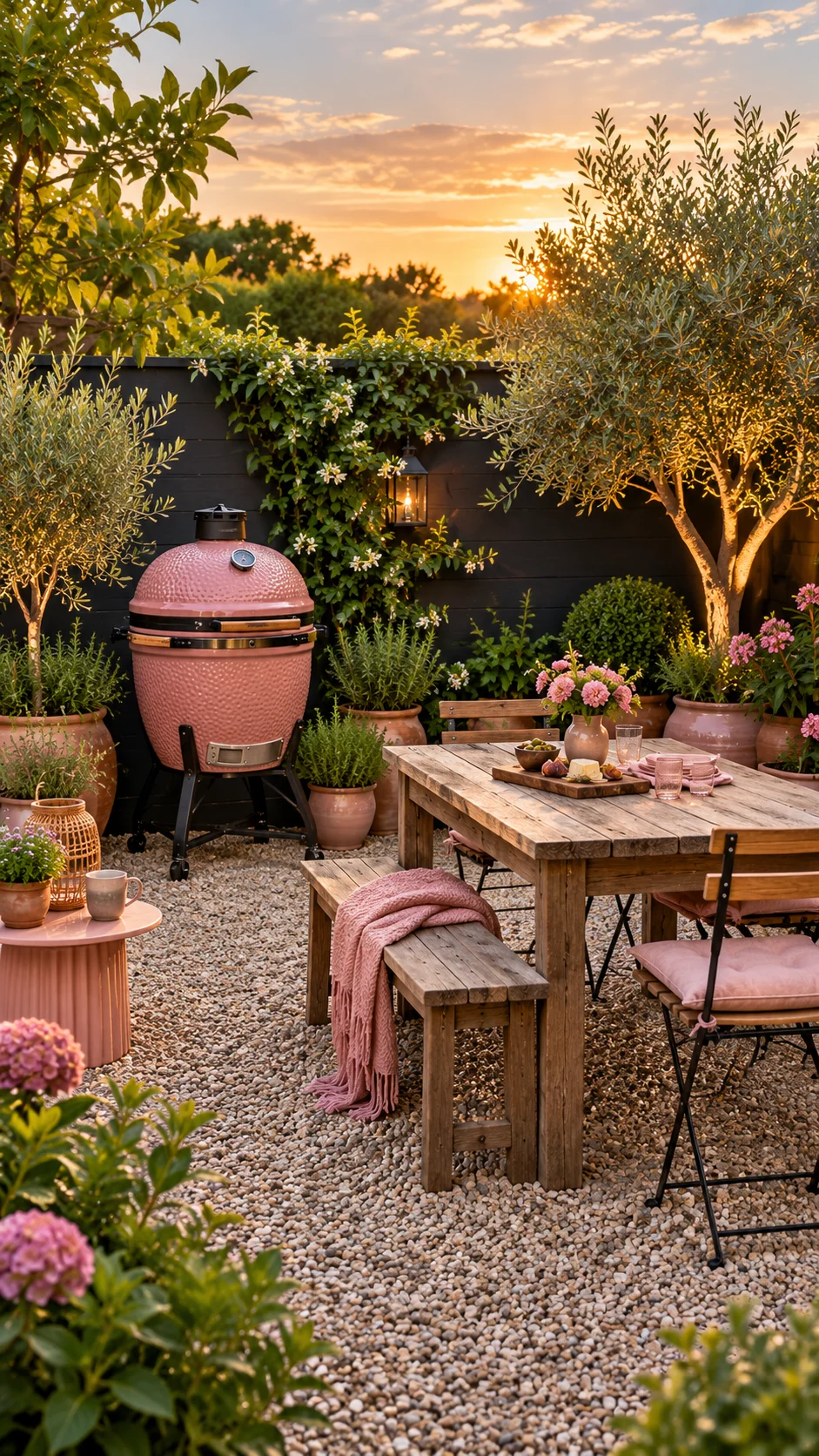
Nothing here is built in. A pink ceramic kamado sits in a wheeled cart against a charcoal fence, a fluted side table stands beside it, and the floor is plain pea gravel. The corner still works as a cooking station because everything around the cooker repeats its color: terracotta pots, blush seat cushions, a rose throw on the bench, pink hydrangeas in the foreground.
This is the version to steal if you rent, if the budget is tight, or if you’re not sure you’ll cook outside often enough to justify a full build. A freestanding cooker moves when you do, and gravel drains quickly, doesn’t burn and costs far less than poured concrete or stone. Boho patio ideas use the same loose, furnished approach, with the grill treated as one more piece in the garden.
The trade-off is work surface. The little round table holds a mug and a lantern, not a cutting board, so a rolling prep cart would be the first addition. Keep fabric in mind too: the throw blanket sits on a bench only a few feet from the cooker, which looks lovely while the grill is cold and less so once the ceramic shell is hot.
A Clear Roof Keeps the Rain Off and the Light On
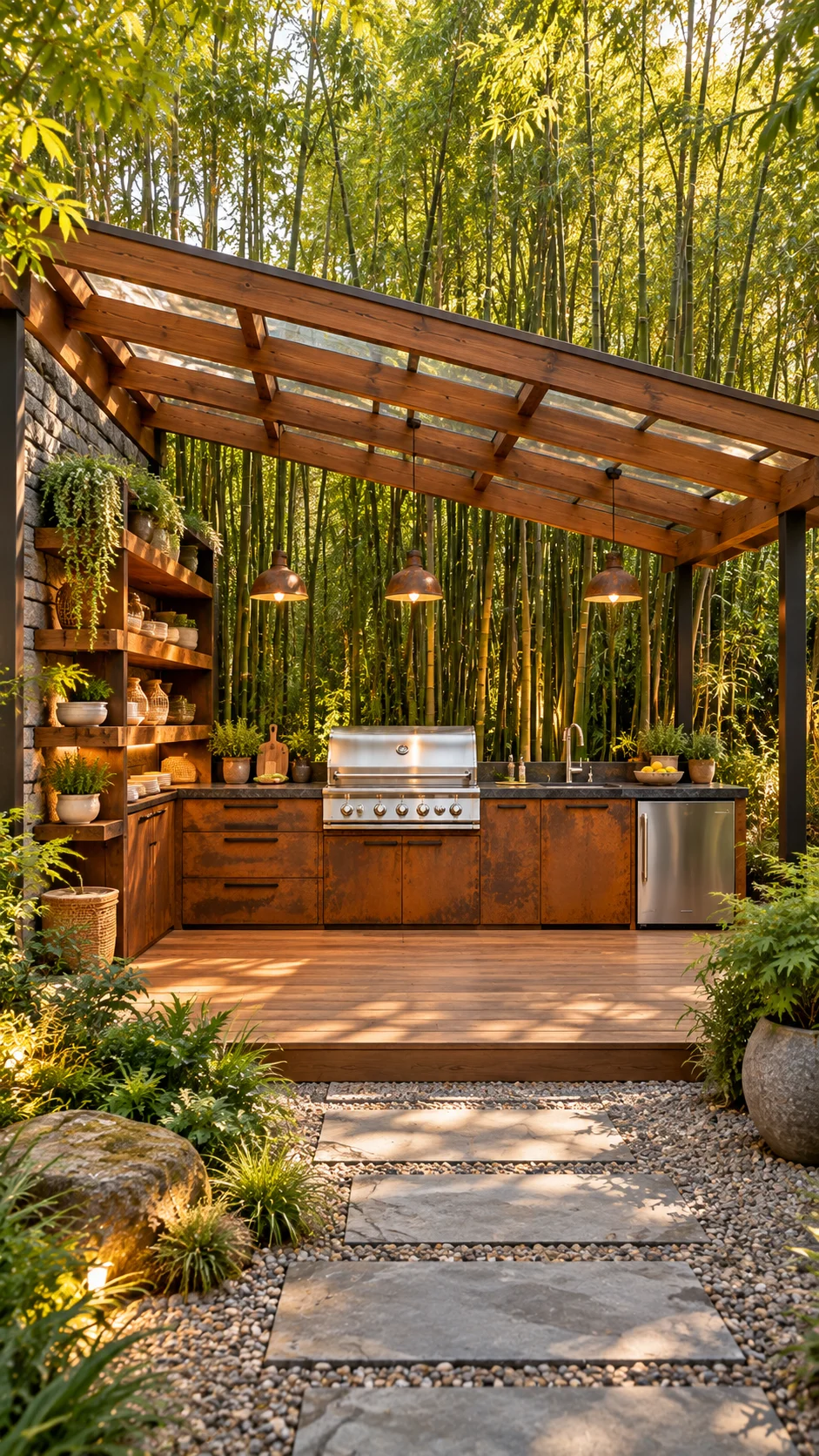
Cooking inside a bamboo grove sounds shady and a little gloomy. This island avoids that with a sloped roof of translucent panels set between wood rafters. Rain stays off the grill and cabinets, but daylight still reaches the deck. Three copper pendants hang from the rafters for evening, and the rust-colored cabinet fronts pick up the same warm tone as the raised plank platform.
The cabinets appear to be weathering steel or a rust-effect finish. If it’s real weathering steel, expect the surface to settle into a stable orange patina over time, and expect rust runoff to stain pale concrete or stone below it. A wood deck and gravel are forgiving, which is probably why this pairing works. Over light pavers, it would be a riskier choice.
The pendants matter for a practical reason as well. Outdoor fixtures need a damp or wet rating, and a roof reduces the exposure without removing it. For more on how copper and black shades set a warm, workshop mood, these industrial lighting ideas go into the look in detail. The stepping stones set in gravel give the platform an entrance without the cost of a poured path.
Bamboo Cladding Works When the Climate Agrees With It
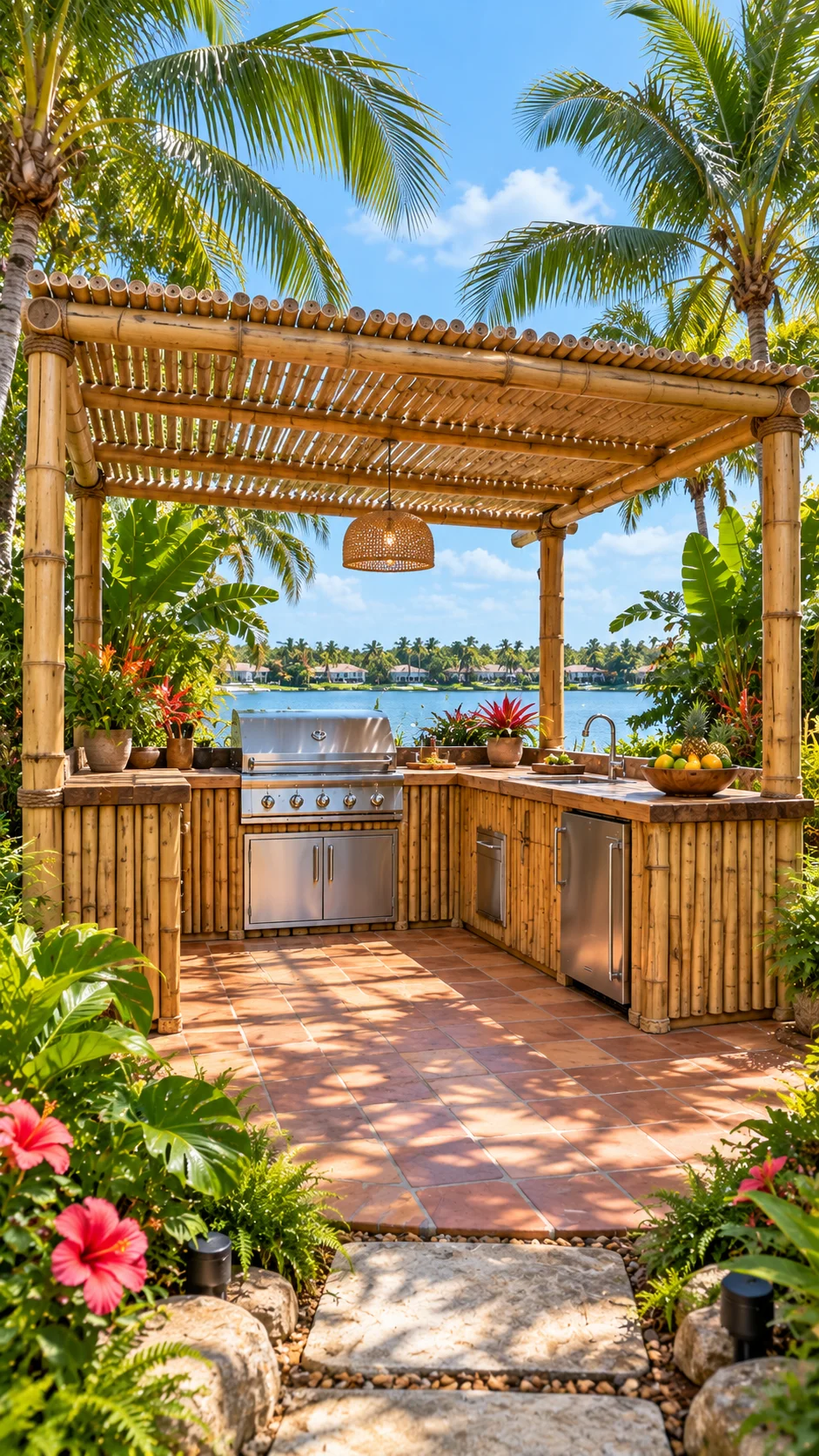
This island is wrapped in vertical bamboo poles and topped with a bamboo-pole pergola. That suits the setting: palms, banana leaves, red hibiscus and a lake behind it make the material look native instead of themed. Terracotta floor tiles and a woven pendant finish a palette that stays in warm yellows and oranges.
Climate decides whether the look lasts. Bamboo outdoors tends to do better when it’s sealed, kept off wet ground and shielded from direct rain; left bare in strong sun and humidity, it can fade, split or grow mildew. Unglazed terracotta has its own limit. In regions with freezing winters it can crack unless it’s rated for frost, so confirm that before copying the floor.
Choose Stainless for the Salt Air
Appliances face the same weather. Marine-grade 316 stainless contains molybdenum and resists chloride corrosion better than the more common 304, which makes it worth asking about if your yard sits near the coast. These coastal garden ideas pair naturally with a kitchen like this one.
Lighting an Island for After-Dark Cooking
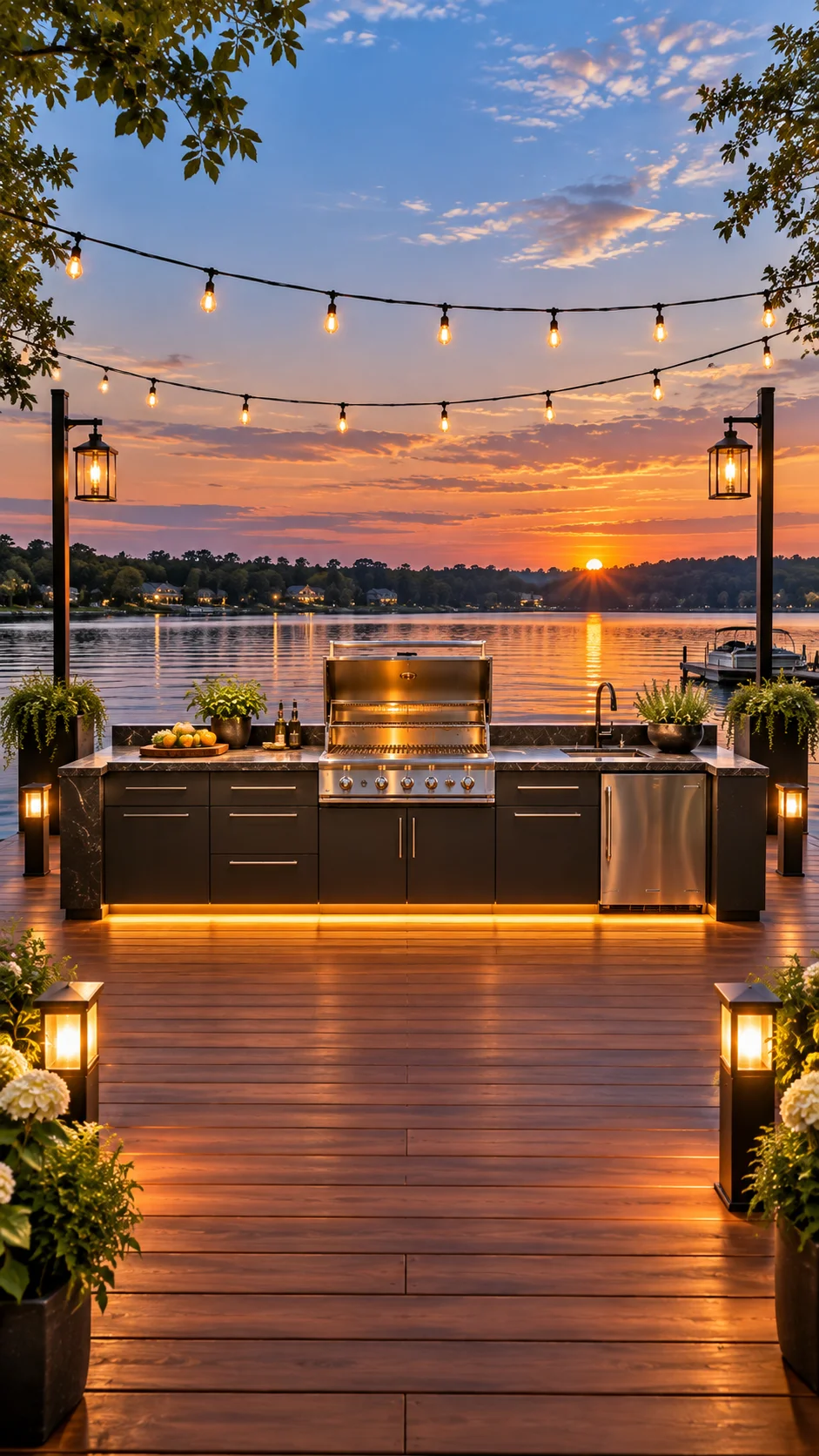
Sunset flatters everything, so look at what the lighting is actually doing. String lights overhead mark out a ceiling, lantern posts at the deck’s edge mark the boundaries, and an amber LED strip under the toe-kick makes the dark cabinets appear to float above the boards. That’s three layers, and none of them compete with the lake view.
What’s missing is task light on the grill itself. The hood glows from inside, but ambient bulbs throw shadows across the burners, so a small directional fixture on a post or an overhang (or a grill with built-in lights) would solve the problem without touching the mood. Outdoor LED strips should carry a weather rating as well.
The deck deserves a thought too. Grease and fuel drips can stain some wood and composite boards, and many manufacturers suggest a grill mat or non-combustible pad underneath. If the island will sit on boards like these, the guide on what makes a backyard deck feel finished is a useful companion read.
Putting the Table Within Arm’s Reach of the Grill
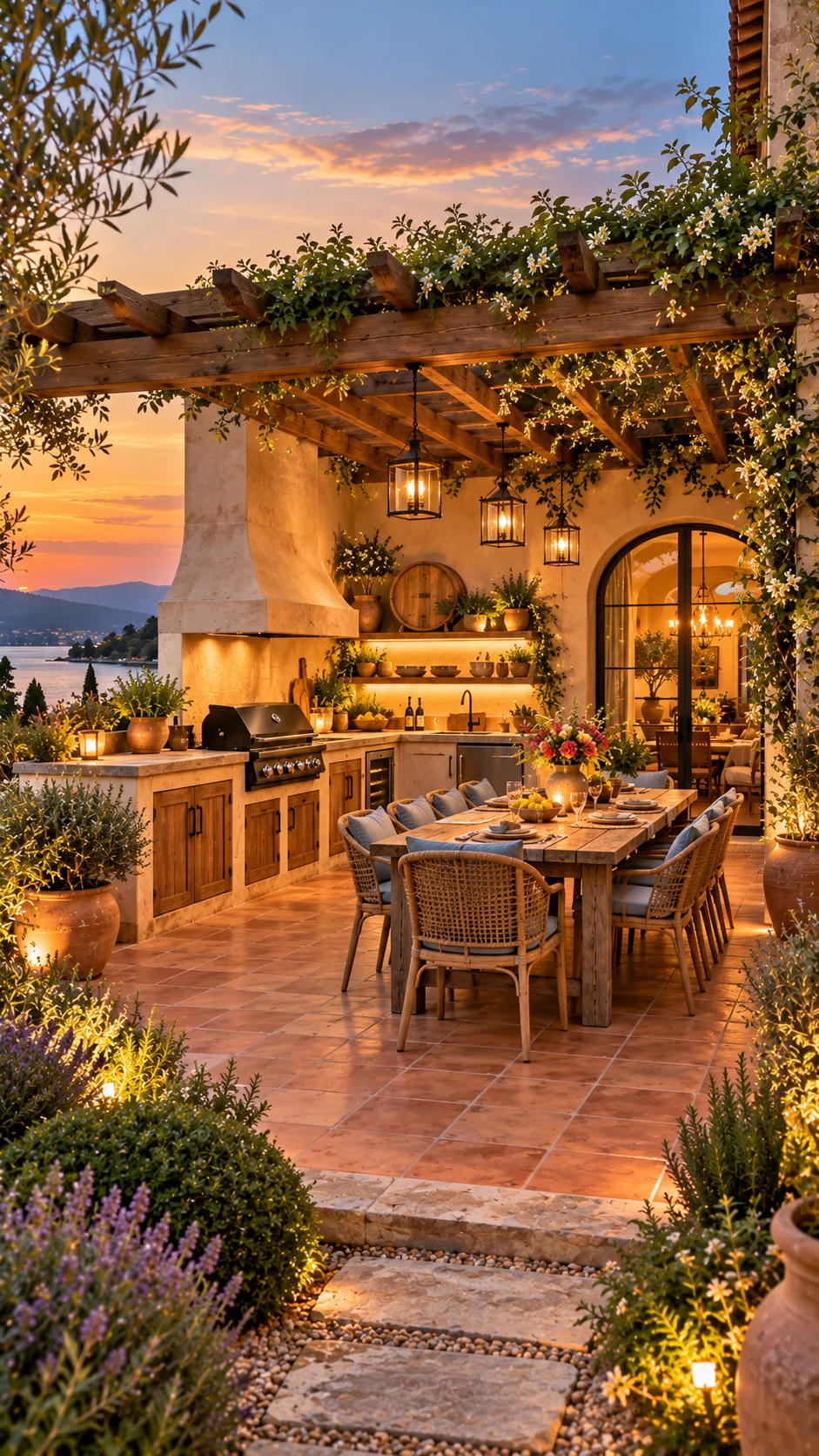
The grill on this terrace sits along the same terracotta floor as a long table that appears to seat ten, so the cook is a few steps from the guests. Behind the table, an arched glass door opens to an indoor dining room, which shortens the trip for plates and platters.
That adjacency is a layout decision, not decoration. Plenty of outdoor kitchens fail because the cooking line gets tucked into a far corner and the cook ends up working alone. Here the island runs along a wall under a stone hood-style surround, the table runs parallel to it, and the walkway between them stays open. Leave room for chairs to be pulled out without bumping the counter; a few feet of clearance behind seated guests is a sensible target.
Overhead, a flowering vine (likely jasmine) climbs the pergola and iron lanterns hang below it for shade and soft light. Gardens with this storybook, climbing-plant look are covered in these cottagecore garden ideas.
Warm Wood Tops on a Dark Masonry Base
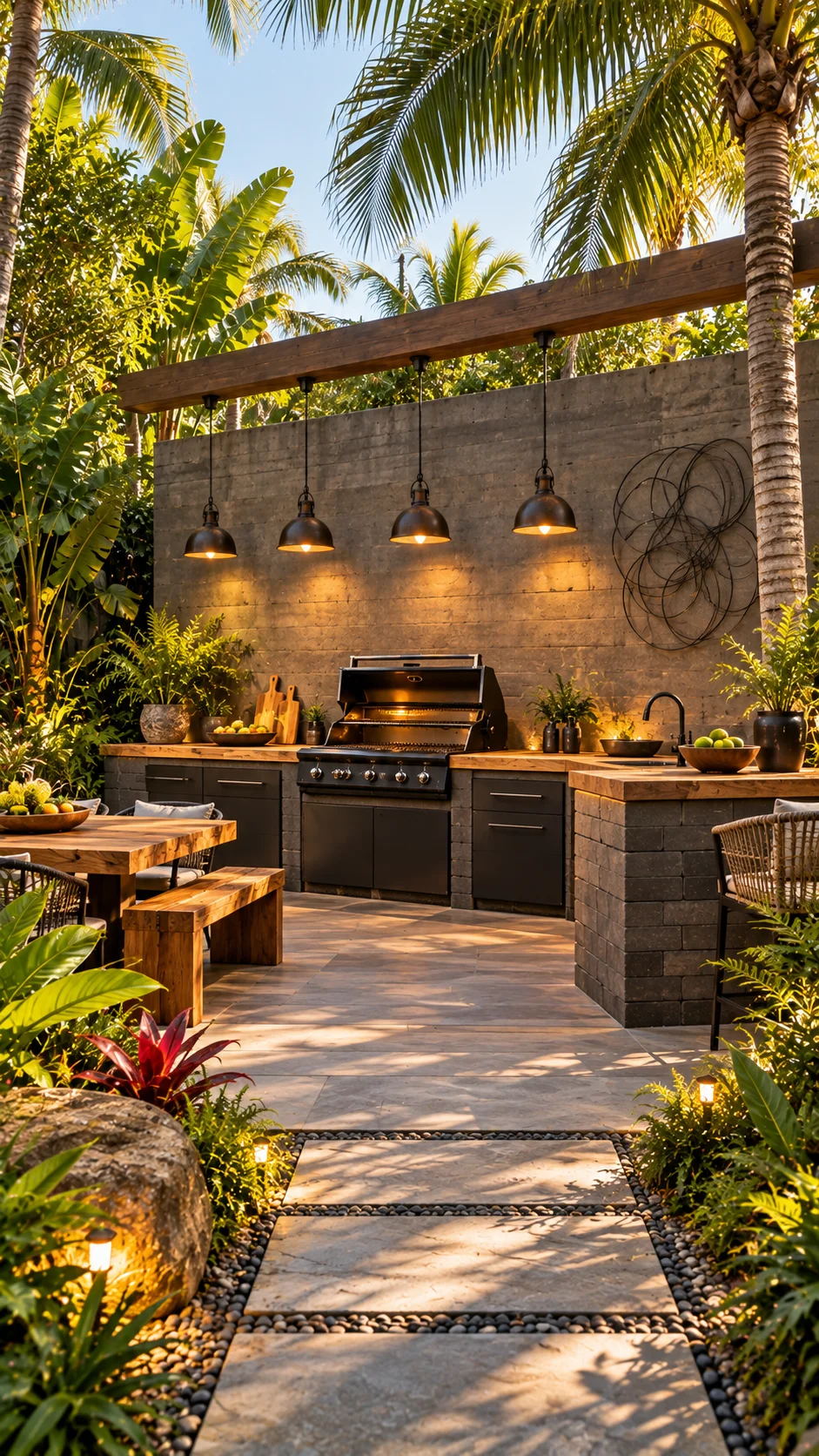
A charcoal masonry base, black cabinet fronts and a board-formed concrete wall could feel heavy in a tropical yard. The wood countertops soften it. They share the honey tone of the dining table and bench on the left, so the dark mass reads warm instead of stern, and four bell pendants hung from a single beam repeat the black of the cabinets.
Wood outdoors needs real upkeep. Tops like these call for an exterior-grade sealer or oil, reapplied when water stops beading on the surface. A dense hardwood such as teak or ipe generally holds up better than softer species, but the photo doesn’t reveal which wood this is, so check before copying. If you’d rather skip the maintenance, a stone or porcelain top over the same dark base keeps the contrast with less work.
The right end of the island turns forward into a short bar with a stool, which lets the cook face the guests instead of a wall.
An Island on Wheels for People Who Cook for a Crowd
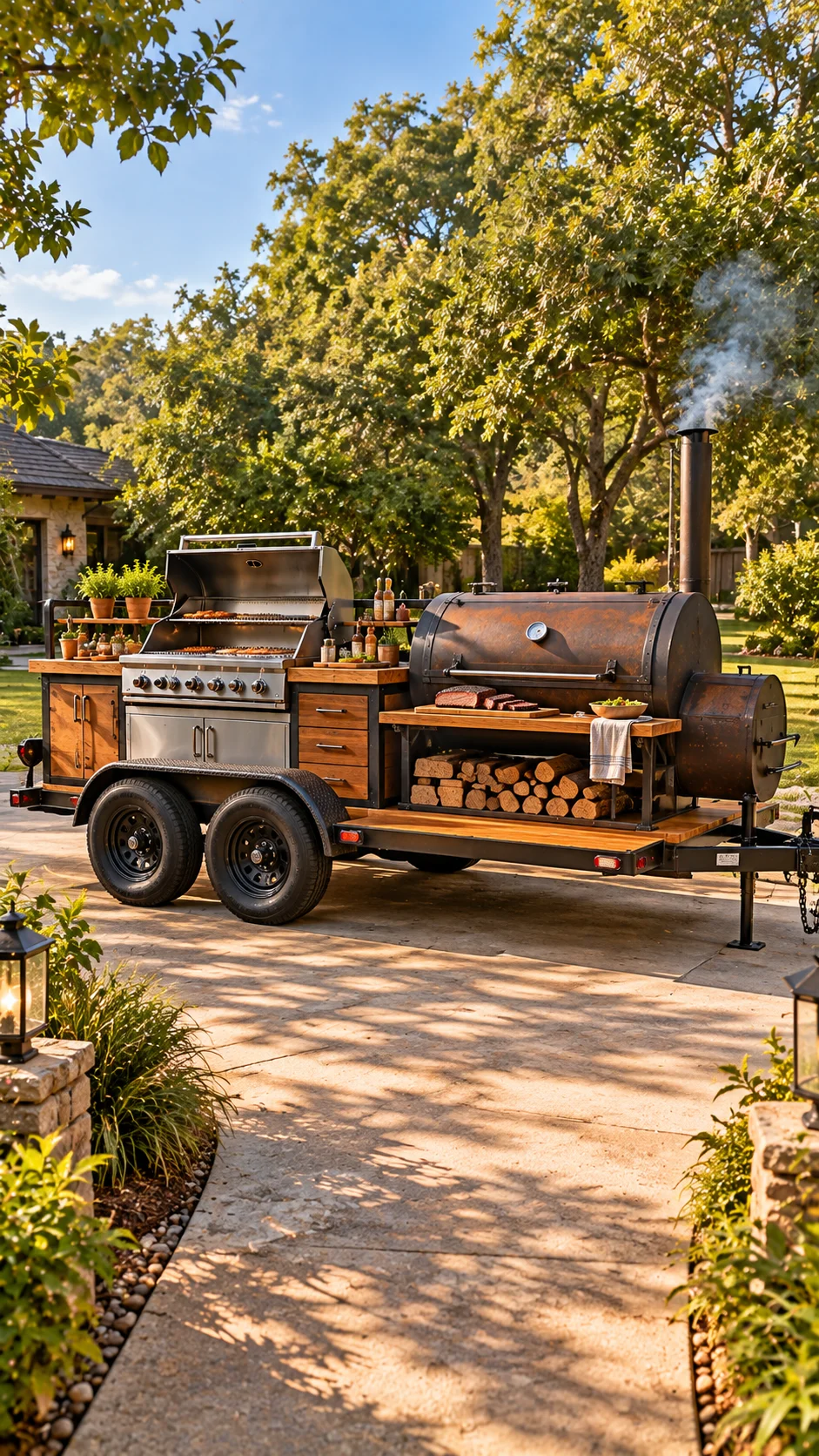
This one isn’t going anywhere permanent, and that’s the point. A gas grill with drawers and cabinets shares a steel trailer frame with an offset smoker, a wood prep shelf and a rack of split logs below it. It looks like a competition rig scaled for a residential driveway.
The appeal is flexibility. Gas covers weeknight burgers, wood smoke covers brisket, and both live on one platform without a masonry build or a gas line. A rig like this may also avoid some of the permitting a built-in structure can involve, though local rules differ. Park it on a paved pad near the house for a party and move it aside afterward. Lantern posts and planted edges keep the driveway from looking like a vendor lot, and since there’s no built-in seating, a few chairs like those in these fire pit chair ideas would round out the setup.
Smoke direction is the thing to plan. The chimney releases a steady stream, so park the smoker where the wind carries it away from neighbors’ windows and your own, and check local rules on smokers and open flame. Firewood stacked directly beneath the cook chamber is convenient, but it’s worth asking whether it sits too close to the heat.
A Curved Lattice Canopy Lets the Heat Out
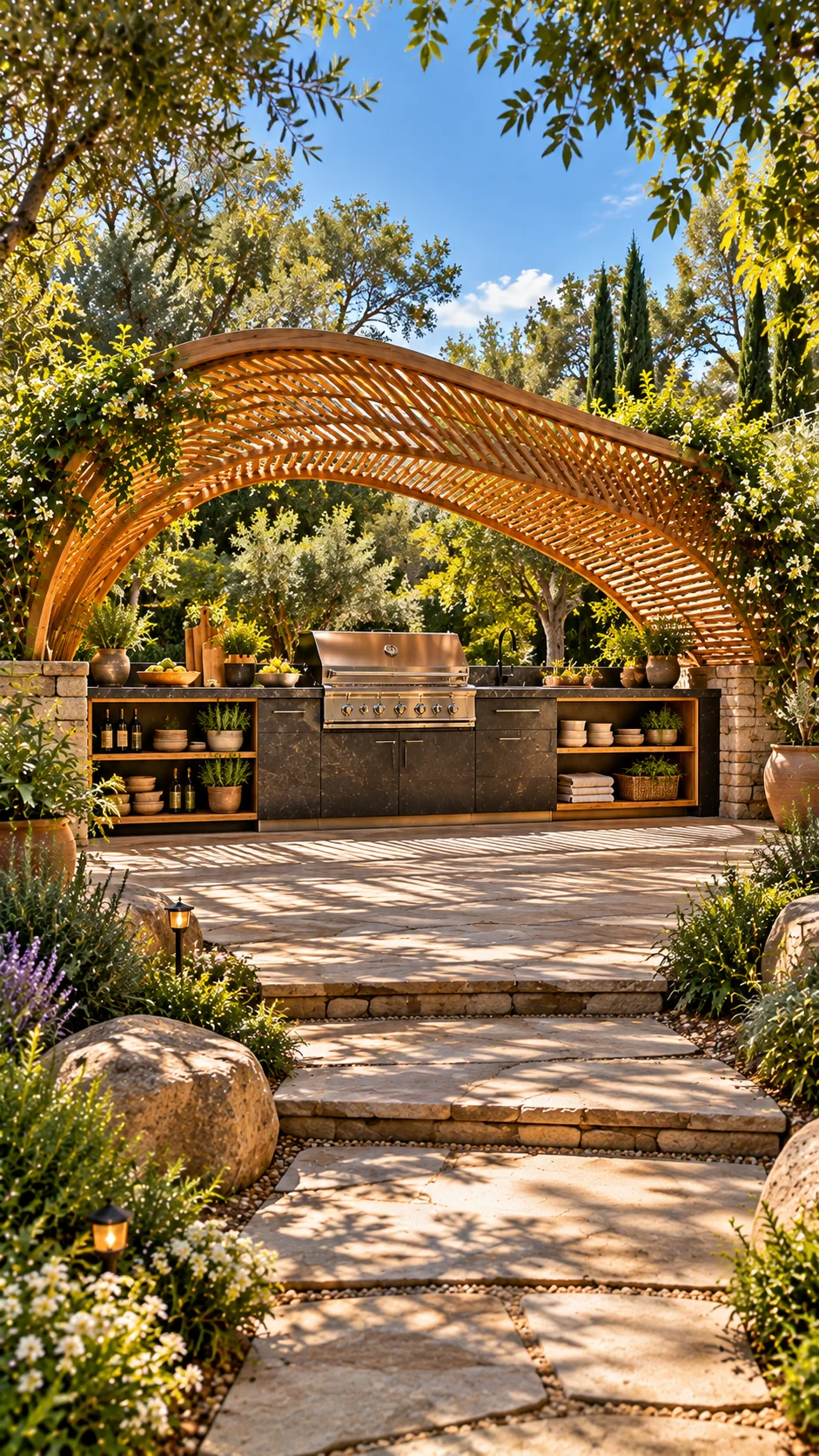
A flat, solid roof holds heat and smoke underneath it. This arched lattice does the opposite. Thin slats leave gaps all the way across, so rising heat has somewhere to go while the canopy still breaks the midday sun into the striped shadows that fall across the stone terrace. Climbing plants wrap both ends, and the curve echoes the cypress trees behind it.
Flanking the grill are two open shelf bays holding plates, bowls, bottles and a basket of towels. Dishes within reach beat a trip indoors, and the dark cabinet block in the middle keeps the grill zone looking tidy. Open storage suits dry climates best, though. Where rain blows sideways or pollen is heavy, closed doors on at least one bay would keep things cleaner.
Three shallow stone steps lift the terrace slightly above the garden path, with boulders and lavender along the edges. It’s a small change in level, but it gives the island a sense of arrival that a flat patio wouldn’t.
Facing the Kitchen Window: A Straight Island That Keeps the Cook Connected
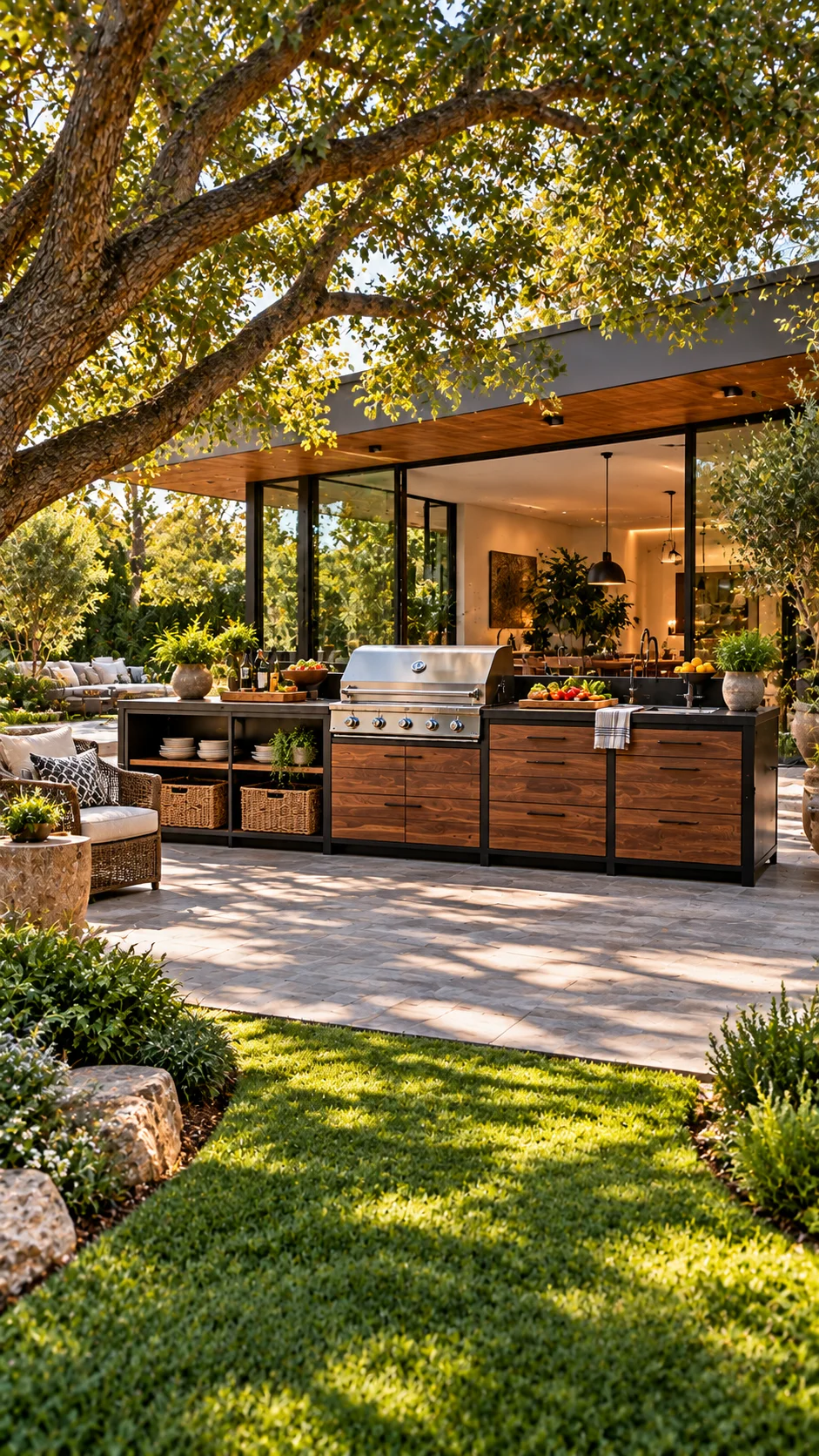
The island here is a single straight run set parallel to a glass wall, so whoever’s cooking can see into the indoor kitchen and dining area, and the people inside can see the grill. A flat roof and big sliding doors make house and yard read as one continuous room, with lawn and lounge chairs filling in the outside.
Black steel framing with walnut-toned drawer fronts keeps the unit modular. Open cubbies with woven baskets sit on the left for napkins and tongs, while closed drawers under the grill and sink hide the greasy gear. The straight layout is also the simplest to plumb and wire, since gas, water and power can run in one line from the house. Check that the wood-look fronts are made for exterior use; outdoor cabinet makers commonly turn to powder-coated aluminum, marine-grade polymer or sealed hardwood for that reason.
If entertaining is the goal, one end of a run like this could hold a drinks station, and these home bar ideas show how small that setup can be.
BBQ Island Questions Worth Answering Before You Build
How much space does a BBQ island need?
A straight run with a built-in grill, sink and some prep counter often lands around 8 to 10 feet long. The grill typically wants open counter or clearance on both sides, and the walkway in front should be wide enough to carry a platter past someone, roughly 3 to 4 feet. Exact clearances vary by grill model, so the manual comes first.
Does a BBQ island need a roof?
No, but weather decides it. Sun and rain are harder on cabinets, electronics and the cook than on the grill. If you add cover, an open lattice or high pergola gives heat room to escape, and the grill manual will say what it allows overhead. A fully enclosed roof usually calls for a proper vent hood and may fall under local code.
Which materials hold up best outdoors?
Stone, porcelain, concrete, stainless steel and powder-coated metal are common because they don’t absorb water. Wood needs regular sealing. Cold climates call for frost-rated tile and stone, and coastal yards benefit from 316 stainless. Ask the supplier for an outdoor rating on anything that isn’t obviously weatherproof.
Should I choose gas, charcoal or a smoker?
Gas is the simplest to build in, since it needs one line and cleans up fast. Charcoal and kamado cookers add flavor but need ash handling and a non-combustible surround. Offset smokers need airflow and a spot where smoke won’t bother anyone. Many people pair a built-in gas grill with a separate kamado or smoker.
How close to the house can the island go?
It depends on local fire and building codes, your fuel type and what the house is made of. A commonly cited guideline for freestanding grills is at least 10 feet from the structure, but built-in installations follow the manufacturer’s instructions and local code. Call your building department, and use a licensed fitter for gas lines.
Three Questions That Pick the Style for You
Every setup above answers the same three questions in its own way. What’s already in the yard that the island can match: a wall, a house façade, a deck? What weather will it sit through: rain, frost, salt air or none of those? And how far is the grill from the table and the indoor kitchen?
Answer those and the style mostly chooses itself. A stone-and-steel island suits a yard with masonry already in place, a rolling rig suits renters and crowd cooks, and a kamado on gravel is the fastest way to test how much you’ll really cook outside. If you’re unsure, start with the cheapest version of the idea and give it a season before committing to a permanent build.
About the Author
Aesthetic Life Team writes about home, garden and outdoor design ideas, with a focus on helping readers turn saved inspiration into practical decisions for their own spaces.

