

A boho garden rarely looks planned, even when every inch of it is. Rattan furniture, vintage rugs laid straight onto stone or deck boards, and plants left to trail wherever gravity takes them—the whole point is a space that feels gathered over years, not installed in a weekend. The nine spaces below get there through nine different routes, from a macramé-anchored pergola to a full glass conservatory wrapped in jungle. Here’s what makes each one work and how to borrow the idea that actually fits your own outdoor space.
Quick Overview
| Style | Boho / Bohemian |
|---|---|
| Best For | Patios, pergolas, sunrooms, courtyard corners |
| Budget | Low–Medium (scalable to premium) |
| Difficulty | Easy, mostly DIY-friendly |
| Maintenance Level | Medium (outdoor textiles + live plants) |
A Macramé Wall Hanging Doing the Heavy Lifting
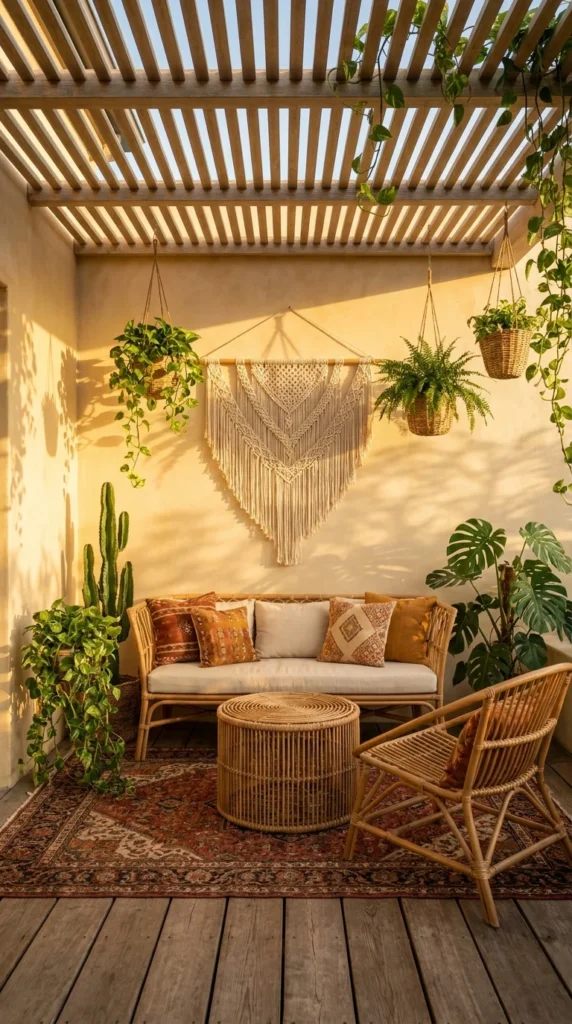
One macramé wall hanging, centered under a wood-slat pergola and flanked symmetrically by two hanging plant baskets, is what turns this corner into a destination rather than just a place to put a sofa. Everything else—the rattan seating, the vintage rug, the pair of cacti bookending the space—is arranged to support that one central piece.
This is a strong starting point for readers who want boho character without committing to a full plant jungle or a loud pattern mix. The symmetry here is doing quiet work: two matching hanging baskets on either side of the macramé piece, two flanking plants at floor level, and a rug centered beneath the seating group. Symmetry is an underused trick in bohemian design, which usually leans asymmetric—using it selectively, on just the wall composition, keeps the space feeling calm rather than chaotic.
It suits covered patios and pergola-shaded corners with a solid wall behind the seating, since the whole layout depends on having a surface to hang the macramé and baskets from. It won’t translate to an open, wall-less deck with nothing to anchor to.
The lifestyle fit is someone who wants a golden-hour hangout spot—this scene reads best in warm late-day light, which the terracotta-toned wall is built to catch. Its strongest advantage is that it delivers a genuinely finished-looking corner using a small footprint: one wall, one rug, and one seating group.
The compromise is that macramé and hanging baskets left outdoors, even under a pergola, take real weather exposure over time—sun bleaches cotton cording, and rain drift can dampen it faster than an indoor piece would ever face. To simplify for a smaller budget, start with just the macramé piece and one hanging plant rather than the full symmetrical pair, and add the second basket once the first placement is confirmed to work.
The most common mistake is hanging the macramé piece too high relative to the seating below it, which breaks the visual connection between the wall art and the furniture it’s meant to anchor.
One practical recommendation: bring macramé indoors or under a fuller cover during heavy rain seasons if your pergola only offers partial protection—a few seasons of full weather exposure will noticeably yellow undyed cotton cording.
Why This Wall Reads as Composed, Not Cluttered
The macramé, the two hanging baskets, and the two floor plants form a rough triangle when you trace them, which is a classic way to balance a wall without lining everything up in a rigid row. The vintage-style rug underneath repeats the same warm rust-and-cream palette as the wall itself, so the floor and the wall read as one connected color story instead of two competing elements.
💡 Small Space Tip: No pergola wall to work with? A single macramé piece hung from a fence post or trellis, with one potted plant beside it, borrows the same anchoring idea in a much smaller footprint.
Recommended Materials: Macramé cotton cording · Rattan (sofa, chair, drum coffee table) · Wool-blend vintage-style rug · Natural fiber hanging baskets · Weathered wood decking
Main Colors: Terracotta · Warm Gold · Rust · Cream
Best Lighting: This scene depends on late-afternoon natural light hitting the terracotta wall directly—if recreating indoors or under deeper shade, warm-toned string lights along the pergola beams get closest to that golden effect after dark.
Maintenance Note: Cacti in this setup need minimal water and thrive in the same bright, dry conditions the macramé prefers—a genuinely low-maintenance pairing for anyone new to outdoor plant care.
This kind of textile-led corner pairs naturally with our guide to boho bedroom looks that feel curated, not cluttered, which uses the same macramé-as-focal-point idea indoors.
Where This Setup Can Go Wrong
- Hanging the macramé too high above the seating group it’s meant to anchor
- Leaving cotton macramé fully exposed to direct rain instead of choosing a well-covered wall
- Skipping the floor-level plants, which is what actually grounds the wall composition
- Choosing a rug pattern that clashes with, rather than echoes, the wall’s warm palette
A Softer, Pastel Take on Boho
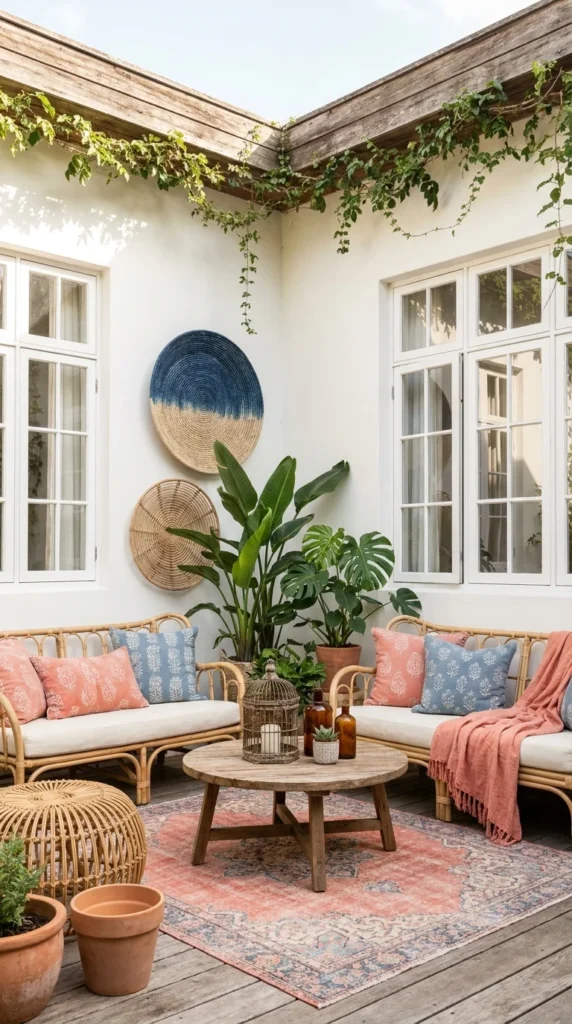
Block-print pillows in dusty blue and blush pink, plus two woven wall discs dip-dyed the same indigo tone, pull this courtyard corner away from the usual warm terracotta palette most boho spaces default to.
The defining idea here is proving boho doesn’t have to mean an all-warm, all-earthy palette. Pastel block prints, a soft pink rug, and blue-dipped wall baskets give this space a lighter, almost coastal feeling while keeping every material choice—rattan furniture, wood table, terracotta pots—firmly in bohemian territory.
It suits bright, white-walled courtyards or patios, where the pale backdrop lets the pastel textiles read clearly rather than getting lost against a busier wall. It’s a smart direction for readers whose homes already lean toward a Mediterranean or coastal white-stucco exterior, where the usual rust-and-clay boho palette would feel like a mismatch.
The lifestyle fit is someone drawn to a gentler, more relaxed version of bohemian style—still layered and textural, but softer in mood than a maximalist, jewel-toned space. Its strongest advantage is versatility: this palette works comfortably across spring and summer without feeling seasonal in the way deep terracotta tones sometimes can.
The compromise is that pale textiles show outdoor dirt and fading faster than deep, saturated colors do—a blush pink cushion will visibly age before a rust-colored one in the same conditions. To simplify for a smaller budget, keep the woven wall discs (an inexpensive, high-impact addition) and swap the full pillow set for two or three block-print covers on existing cushions rather than replacing the whole seating group.
The most common mistake is mixing too many different pastel patterns at once, which can wash out rather than complement the block-print pillows’ quiet elegance.
One practical recommendation: choose an outdoor-rated fabric for the pastel pillow covers specifically—pale, humidity-prone fabric mildews and fades faster than darker tones, so the fabric spec matters more here than in a warm-toned room.
A Palette Lesson Worth Borrowing
One reason this corner doesn’t feel washed out despite its pale palette is the terracotta pots and wood coffee table, which anchor the space in warm, grounded tones even while the textiles stay cool and pastel. Pairing a pastel palette with at least one or two warm, earthy materials is what keeps a light color story from drifting into “too sweet.”
Recommended Materials: Rattan (sofa frames) · Block-print cotton (pillow covers) · Dip-dyed woven wall discs · Reclaimed wood (coffee table) · Terracotta (plant pots)
Main Colors: Blush Pink · Dusty Blue · Cream · Warm Terracotta
Best Lighting: Bright, indirect daylight suits this palette best—the pastels read truest in soft morning or late-afternoon light rather than harsh midday sun.
Maintenance Note: The monstera and bird of paradise plants shown need protection from strong direct afternoon sun in a hot climate, since their broad leaves can scorch faster than smaller-leafed varieties.
Readers who love this lighter courtyard direction may also enjoy our roundup of dreamy boho patios, which covers several other palette variations within the same style.
Common Mistakes With a Pastel Palette Like This
- Choosing indoor-only fabric for outdoor pillows, leading to fast fading and mildew
- Overloading the space with more than two pastel patterns at once
- Skipping warm-toned anchors like wood or terracotta, leaving the palette feeling flat
- Placing pale rugs in high-traffic zones without a plan for regular cleaning
When Swing Chairs Replace the Usual Sofa
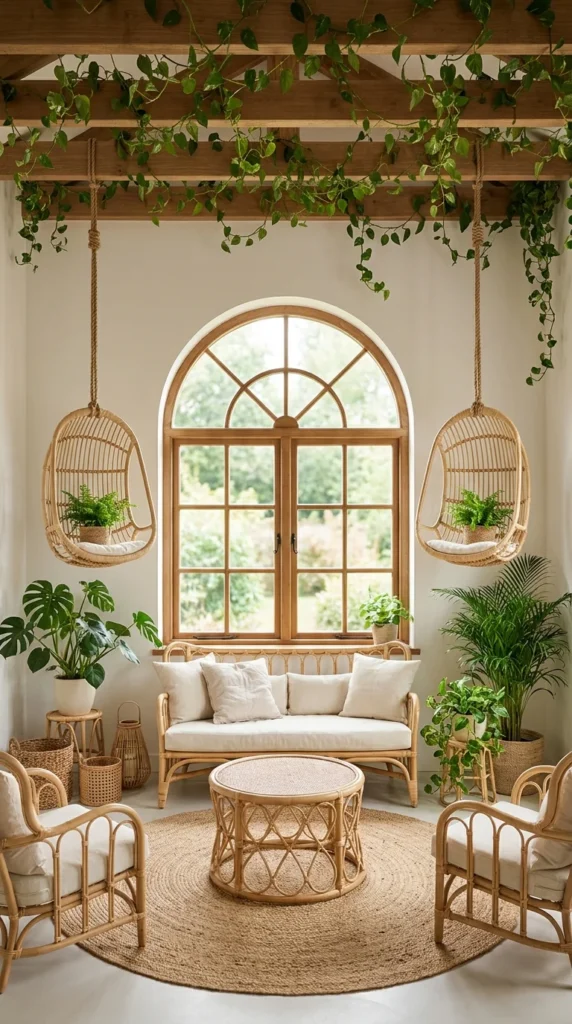
Two hanging rattan egg chairs, positioned in perfect symmetry on either side of an arched window, do something most boho seating layouts don’t: they use the room’s architecture as the actual design device, rather than treating the window as a backdrop for a sofa.
This is a genuinely different seating strategy than the sofa-centered layouts found elsewhere in boho design. Hanging chairs framing an architectural focal point — here, a large arched window — turns the window itself into the room’s centerpiece, with the swing chairs acting almost like parentheses around it.
It suits sunrooms, converted porches, or any indoor-outdoor space with real ceiling height and a structural point to frame, whether that’s a window, a fireplace, or a doorway. It’s a poor fit for a low-ceilinged patio, since hanging chairs need real vertical clearance to swing safely and look proportionate.
The lifestyle fit is someone who wants a reading or lounging spot that feels a little playful—hanging chairs invite a different kind of sitting than a fixed sofa does. Its strongest advantage is how much personality it adds through furniture choice alone, without needing bold color or pattern to carry the room.
The compromise is installation: hanging chairs need a properly rated ceiling mount or freestanding frame, which is a bigger commitment than simply placing a sofa. To simplify for a smaller budget, install just one hanging chair rather than the symmetrical pair, positioned to one side of the window instead of centered—it keeps the playful element without doubling the installation cost.
The most common mistake is under-rating the ceiling mount hardware for the chair’s actual weight capacity, including the person sitting in it—always check the manufacturer’s load rating against a real structural point, not just drywall.
One practical recommendation: if a ceiling mount isn’t possible, a freestanding hanging-chair frame achieves the same look without needing to anchor into a ceiling joist.
The Architecture Is Doing Half the Work Here
Because the window is arched and centered, the two hanging chairs read as a deliberate frame rather than mismatched extra seating—this only works because the room’s architecture gave the layout something worth framing in the first place. The round jute rug beneath the main seating group echoes the arch’s curve, tying the whole floor plan back to that one architectural shape.
⚠️ Watch For: Always confirm hanging chair mounting hardware is rated for both the chair’s weight and an adult occupant—a joist-mounted eye bolt is very different from one anchored only into drywall or a false ceiling.
Recommended Materials: Rattan (hanging chairs, sofa, coffee table) · Jute (round rug) · Reclaimed wood (window frame) · Cotton canvas (seat cushions)
Main Colors: Warm Honey Wood · Cream · Natural Green (from the surrounding plants)
Best Lighting: The arched window is the primary light source during the day; keep any added fixtures minimal so they don’t compete with that natural focal point.
For more ideas on unconventional seating in a relaxed nook, our reading nook roundup features a similar hanging pod chair used indoors.
Where People Get This Layout Wrong
- Mounting hanging chairs without verifying the ceiling’s load-bearing capacity
- Placing the chairs asymmetrically around a symmetrical architectural feature, which looks accidental rather than intentional
- Choosing hanging chairs too large for the room’s actual ceiling height
- Skipping a proper swing radius check, so the chairs collide with nearby furniture
A Bamboo Wall Turned Into a Textile Gallery
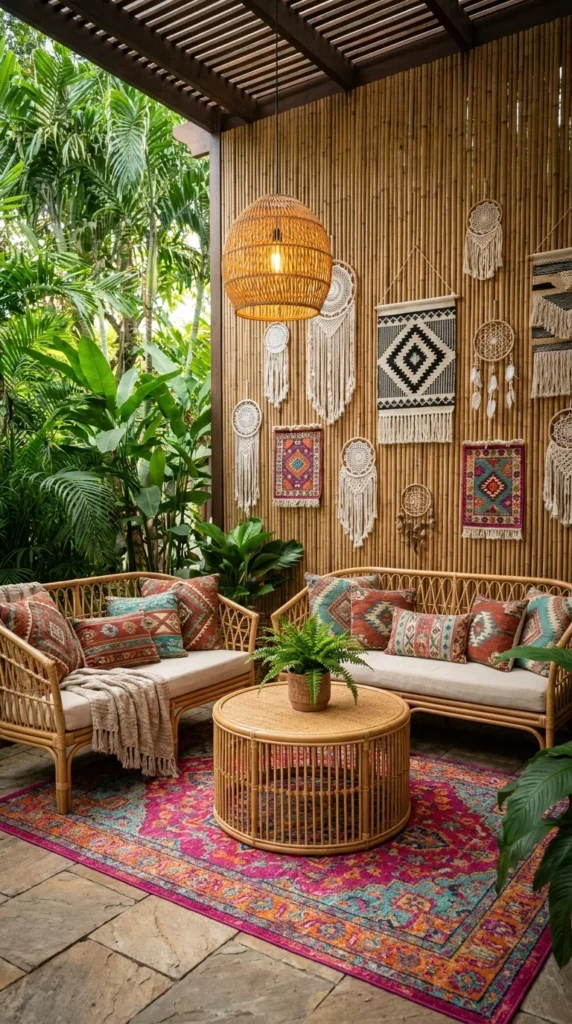
A bamboo slat wall covered edge to edge with macramé pieces, dreamcatchers, and small woven rugs is the most maximalist textile display in this entire list—nothing here is left plain, and that’s clearly the point.
This idea treats a wall the way a gallery treats hanging art: densely curated, mixed scale, with no single piece meant to stand entirely alone. It’s a meaningfully different approach from the single-macramé-piece corner earlier in this guide—where restraint made that space feel calm, deliberate abundance is what makes this one feel rich and collected.
It suits readers who already have (or want to build) a genuine collection of handmade textiles and who have a large enough wall to let a gallery arrangement breathe rather than feel cramped. It’s the wrong fit for a small patio wall, where this density would read as cluttered instead of curated.
The lifestyle fit is someone who travels, thrifts, or commissions handmade pieces over time—this look rewards a slowly assembled collection more than a single big-box purchase. Its strongest advantage is that it’s nearly impossible to replicate cheaply or quickly, which makes it one of the more genuinely personal-feeling spaces in this guide.
The compromise is real upkeep—this many textile pieces on an outdoor-facing wall need consistent moisture and UV monitoring, since a bamboo backdrop in a humid or tropical setting can also invite mold if airflow isn’t good. To simplify for a smaller budget, start with three or four pieces at varying scales—one large macramé, one or two dreamcatchers, and one small woven rug—and build the gallery over time rather than buying a dozen pieces at once.
The most common mistake is arranging every piece at the same size and spacing, which flattens the collected, gathered-over-time feeling this look depends on.
One practical recommendation: rotate or store the most delicate pieces during the harshest weather months if the space isn’t fully enclosed—treating this as a living, changeable gallery rather than a permanent fixed installation extends the life of each piece.
The Mixed-Scale Trick That Makes This Work
Look closely, and the arrangement mixes large pieces, medium pieces, and small accent rugs rather than repeating one size—that variation is what keeps this dense wall from reading as repetitive. The warm rattan pendant hanging in front of the wall adds one more layer of depth, its round wicker shape echoing the circular dreamcatchers without competing with them directly.
Recommended Materials: Bamboo slat paneling (wall) · Macramé cotton cording (wall hangings) · Rattan (pendant, sofa frames, coffee table) · Wool kilim (floor rug)
Main Colors: Warm Bamboo Tan · Magenta · Teal · Cream
Best Lighting: A single warm-toned rattan pendant provides the main ambient light—keep it centered so it doesn’t cast heavy shadows across the textile gallery behind it.
What Trips People Up Recreating This
- Spacing every wall piece identically instead of varying scale and placement
- Overcrowding a small wall until the gallery feels cluttered rather than curated
- Ignoring airflow behind a dense wall of textiles in a humid climate
- Mixing too many unrelated color palettes across pieces, losing the sense of a cohesive collection
When the Garden Aesthetic Moves Indoors
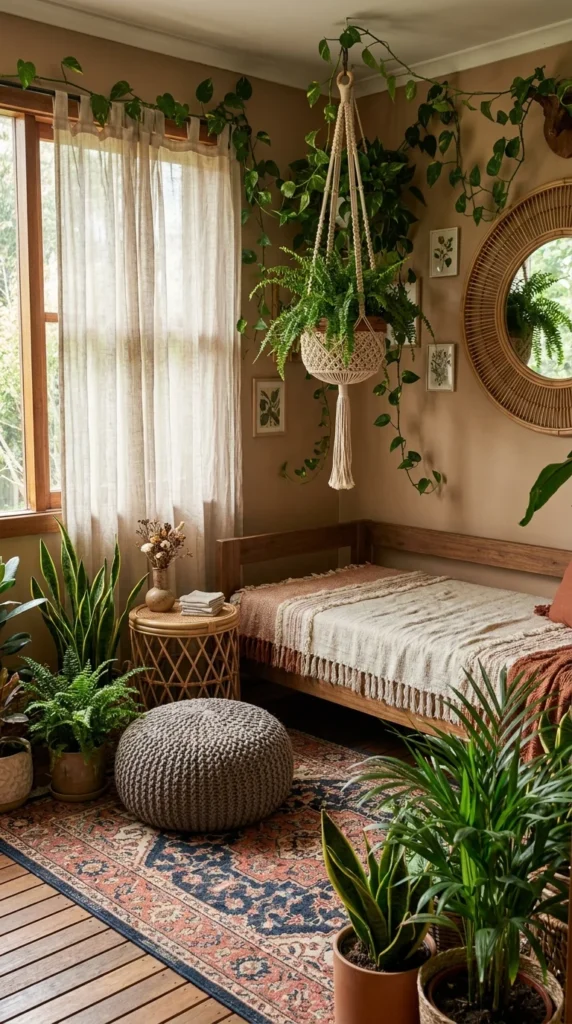
This corner isn’t outdoors at all—it’s a bedroom nook where a macramé plant hanger, cascading pothos, and a small forest of potted ferns and snake plants have taken over the space so completely that it borrows every visual cue of an outdoor garden retreat.
The idea worth taking from this room is that boho garden style doesn’t have to stop at the door. The same macramé hangers, trailing vines, and woven textures used on a patio translate directly indoors, and this space proves the aesthetic can fully take over a bedroom corner without looking out of place.
It suits readers without much outdoor space at all—apartment dwellers, renters without a yard, anyone whose “garden” has to live on a windowsill and a few floor plants instead. It’s a genuinely useful idea for translating this entire guide’s aesthetic into a home with no patio or pergola to work with.
The lifestyle fit is a committed plant parent who wants that jungle feeling available daily, not just when stepping outside. Its strongest advantage is accessibility—every element here (macramé hanger, trailing plants, a knit pouf, a vintage-style rug) is available at almost any budget and needs no outdoor construction at all.
The compromise is that a plant density like this, kept fully indoors, asks more of the room’s light and humidity than a windowsill alone usually provides—snake plants and ferns have genuinely different light needs, and clustering them together only works if both are getting what they individually require. To simplify for a smaller budget, start with the single macramé hanger and one trailing plant, and add the floor-level pots gradually as light conditions prove they’re thriving.
The most common mistake is clustering high-light plants (most ferns) next to low-light-tolerant ones (snake plants) and assuming both are fine with whatever light the spot happens to get.
One practical recommendation: if the window only gets moderate light, lead with snake plants and pothos—both genuinely tolerate lower light—and treat ferns as the plant to add only once you’ve confirmed the space is bright enough.
Bringing the Outside In, Deliberately
The macramé plant hanger is hung directly above the bed’s corner rather than off to one side, which means the trailing vines fall right into the sightline from the pillow—a small placement choice that makes the whole nook feel immersive rather than like a plant shelf tacked onto the room. The mirror’s rattan sunburst frame repeats the same woven material as the hanger and the side table, keeping the room’s few non-plant elements in the same material family.
Recommended Materials: Macramé cotton cording (plant hanger) · Rattan (side table, mirror frame) · Wool-blend vintage-style rug · Solid wood (daybed frame) · Knit wool (floor pouf)
Main Colors: Warm Taupe · Deep Green · Terracotta · Cream
Best Lighting: Sheer linen curtains filter strong daylight without blocking it—a genuinely good compromise for plants that need bright but indirect light.
Maintenance Note: Ferns in a macramé hanger dry out faster than potted floor plants because hanging positions get more airflow—check soil moisture more frequently than you would for plants at floor level.
Easy Ways to Get an Indoor Jungle Nook Wrong
- Clustering plants with conflicting light needs in the same corner
- Letting a hanging fern dry out faster than expected due to increased airflow at hanger height
- Choosing a macramé hanger too small for the pot’s actual weight once soil is watered
- Skipping a saucer under floor-level pots, risking water damage to wood flooring
A Wall Built Entirely From Flowers
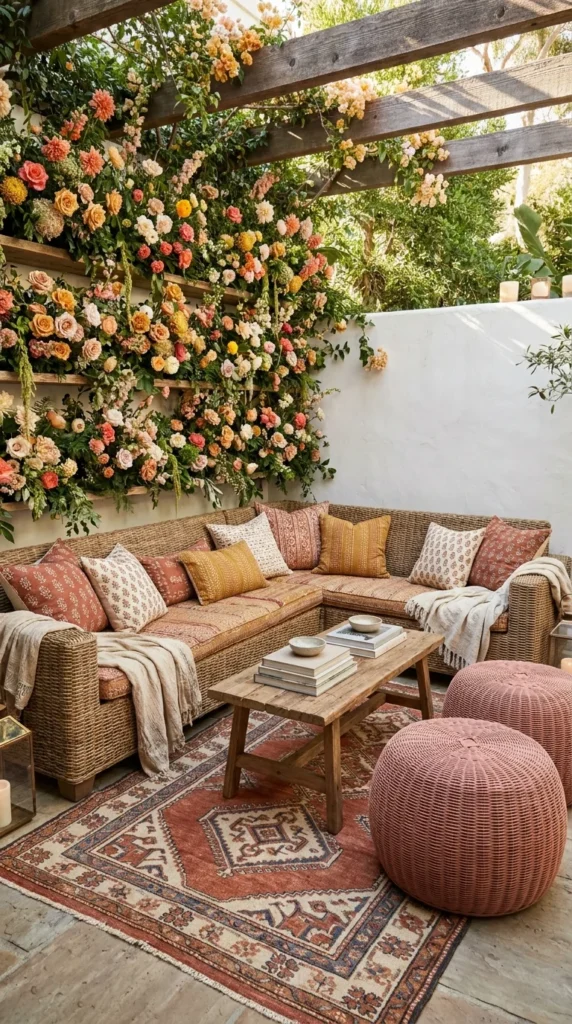
Roses, dahlias, and smaller blooms in peach, coral, and gold climb a wood-shelved pergola wall so densely that the structure underneath almost disappears—this is the most romantic, garden-party version of boho in the entire set.
The defining move is treating fresh or preserved flowers as the wall’s primary material, not an accent. Where other spaces in this guide lean on macramé, rattan, or tile for their focal wall, this one commits entirely to florals, layered from the pergola beams down to eye level.
It suits readers hosting or entertaining regularly, or anyone drawn to a space that feels celebratory rather than purely restful. It’s a strong fit for a courtyard or patio wall backing onto an existing garden bed, where the flower wall can feel like a natural extension of what’s already growing rather than an isolated installation.
The lifestyle fit is someone who loves flowers enough to either grow a real climbing display over years or invest in a well-made faux or preserved version for a similar effect. Its strongest advantage is unmatched visual impact—no other element in a boho garden does more to make a space feel special and occasion-worthy.
The compromise is significant: a genuine, densely flowering wall like this takes real horticultural investment and years of training climbing roses onto a structure, while a convincing faux version is a real cost on its own. To simplify for a smaller budget, start with a single flowering vine trained along one pergola beam rather than the full wall, or use a smaller faux garland along just the seating’s sightline rather than covering the entire structure.
The most common mistake is choosing flowers or a faux arrangement in colors that clash with the seating’s existing pillow palette, rather than picking blooms that echo it.
One practical recommendation: if going the real-flower route, choose climbing varieties suited to your specific climate zone before committing to the structure—a flower wall this dense depends entirely on the right plant surviving and thriving in your actual conditions.
Color Continuity From Wall to Cushion
The coral, rust, and gold tones in the flower wall repeat almost exactly in the wicker sectional’s pillow prints below it, which is what makes the whole space feel like one composed scene instead of a flower wall randomly paired with unrelated furniture. Pink woven poufs pick up the palette’s softest tone, giving the eye a resting point between the busy floral wall and the patterned rug underneath.
Recommended Materials: Climbing roses and dahlias (or high-quality faux equivalents) · Wicker (sectional sofa) · Reclaimed wood (coffee table, pergola shelving) · Wool kilim-style rug
Main Colors: Coral · Peach · Gold · Rust · Cream
Best Lighting: Soft daylight brings out the flower wall’s color range best; add a few low candles nearby for evening use rather than overhead lighting, which can flatten the blooms’ texture.
Common Mistakes With a Flower Wall Like This
- Choosing flower colors that clash with existing cushion or rug patterns
- Selecting climbing varieties unsuited to the local climate, leading to a sparse or failed wall
- Skipping proper structural support for the shelving that holds the display’s weight
- Over-lighting the space at night, which washes out the flowers’ natural color depth
Industrial Brick Meets Layers of Green
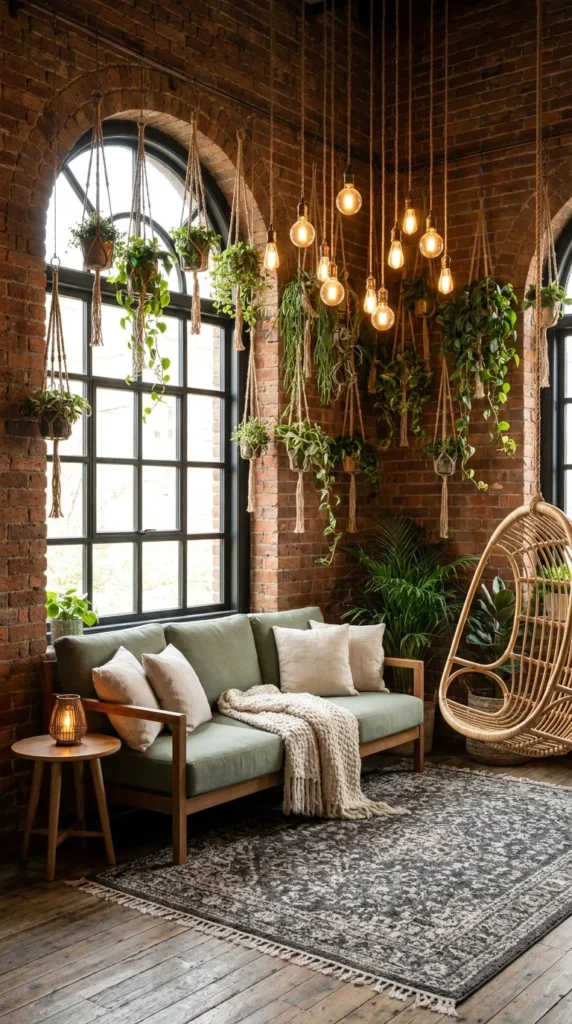
Exposed brick walls, arched black-framed windows, and a cascade of hanging plants paired with dozens of small bulb string lights bring an industrial-loft feeling into direct contact with boho softness—a combination that shouldn’t work as well as it does.
This is boho filtered through a completely different architectural backdrop than anywhere else in this guide. Raw brick and black steel window frames are inherently cooler and more structural than the warm plaster or wood settings elsewhere, and the layered plants and warm bulb lighting are doing all the work of softening that hard edge.
It suits converted lofts, warehouse conversions, or any home with existing exposed brick or industrial architectural bones. It’s not a look worth manufacturing from scratch—faux brick paneling rarely convinces at this scale—so this idea is best reserved for a home that already has the real architecture to support it.
The lifestyle fit is an urban dweller who wants a plant-filled, cozy retreat inside an otherwise hard-edged industrial space. Its strongest advantage is contrast: the softness of the sage green sofa, the rattan hanging chair, and the trailing plants reads as more inviting precisely because it’s set against something so structural.
The compromise is that this many small bulb lights and hanging plants require real installation planning—string lights need a safe power source and mounting plan across a tall brick wall, and hanging plants at this density need a genuine watering and drainage strategy so brick and wood floors underneath don’t take water damage. To simplify for a smaller budget, focus the plant cascade and lights over just one window rather than the full wall, and add a single rattan hanging chair as the room’s one big personality piece.
The most common mistake is choosing string lights not rated for the plant-dense, humid microclimate created by dozens of hanging plants clustered together, risking both bulb failure and a fire-safety issue over time.
One practical recommendation: use LED string lights rather than traditional incandescent bulbs in a plant-dense hanging display like this—they run cooler, which matters both for the plants directly beneath them and for long-term safety.
Where the Softness Actually Comes From
Every hanging plant and every string light bulb sits at a slightly different height, which is what keeps this wall of green from looking like a straight, mechanical grid. The sage green sofa cushions pick up the exact tone of the trailing plant leaves, linking the seating directly to the greenery above it rather than leaving the two to feel like separate design decisions.
Recommended Materials: Exposed brick (existing architecture) · Rattan (hanging egg chair) · Linen (sofa cushions) · Wool-blend patterned rug · Jute rope (plant hangers)
Main Colors: Sage Green · Warm Brick Red · Cream · Amber (string light glow)
Best Lighting: Warm-white LED string lights at staggered heights are the primary evening light source here—avoid cool-white bulbs, which clash badly with brick’s naturally warm undertone.
For readers drawn to this layered, greenery-heavy approach, our biophilic living room guide explores the same plant-dense philosophy applied to a full living space.
Easy Mistakes in a Brick-and-Greenery Room Like This
- Using string lights not rated for a humid, plant-dense environment
- Skipping a drainage plan for this many hanging plants over wood or brick flooring
- Hanging every plant and bulb at exactly the same height, losing visual depth
- Pairing brick with cold-toned furniture instead of warm woods and greens that soften it
A Living Canopy Instead of a Built Roof
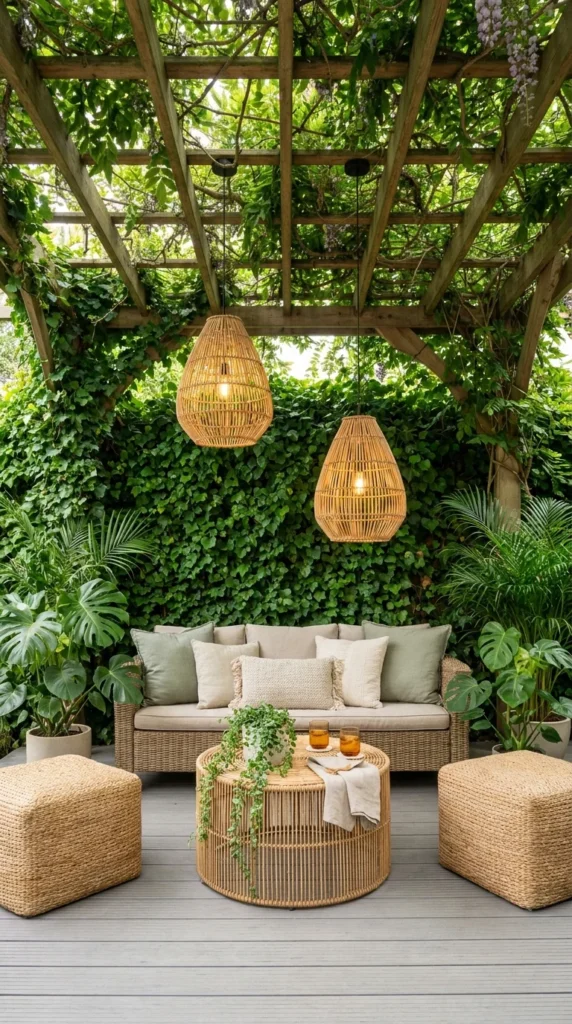
Wisteria and ivy have grown completely over this pergola’s wood frame, so the “roof” here is genuinely alive rather than built from fabric, slats, or glass—a distinction that sets this space apart from every other structure in this guide.
The idea worth taking from this room is patience: a living, grown-in canopy takes real years to establish, but it delivers a depth and texture that no manufactured shade structure can fully replicate. Dappled light filtering through actual leaves overhead changes the entire feeling of the seating below it, hour by hour.
It suits readers planning long-term, willing to plant and train a climbing vine over multiple seasons rather than achieve an instant finished look. It’s the wrong idea for someone who wants a patio transformed by next weekend—this one only works with real-time investment.
The lifestyle fit is a gardener at heart, someone who enjoys the process of growing a space as much as the finished result. Its strongest advantage is that a mature living canopy actually cools the seating area below it in a way no artificial shade structure can match, since living leaves transpire and lower the immediate air temperature.
The compromise is exactly that time investment, plus ongoing pruning to keep the growth from overtaking the pergola structure itself or blocking too much light. To simplify for a smaller budget and see results sooner, pair a young climbing vine with a temporary shade cloth or slatted cover while the plant establishes—you get shade immediately and a living canopy within a few seasons.
The most common mistake is choosing an aggressive climbing variety without a pruning plan, which can quickly overwhelm the pergola’s structural beams or spread beyond the intended coverage area.
One practical recommendation: confirm your climbing vine variety is appropriate for your specific climate zone before planting—some wisteria varieties are considered invasive in certain regions, so a native or well-behaved alternative may be the better long-term choice.
What a Living Roof Changes About the Space Below
The two rattan pendant lights hanging beneath the canopy provide the only artificial light this space really needs, since the living leaves overhead already filter and soften daylight during the day. The round rattan coffee table and woven cube poufs stay simple on purpose—with this much happening overhead, the furniture below is deliberately restrained.
Recommended Materials: Wisteria or climbing ivy (living canopy) · Rattan (pendant lights, sofa, coffee table) · Woven seagrass (cube poufs) · Composite decking
Main Colors: Deep Green · Warm Wood Tone · Soft Lavender (from wisteria blooms, seasonal)
Best Lighting: Two simple rattan pendants suffice for evening use—the living canopy already handles daytime light filtering, so avoid adding more fixtures than necessary.
Maintenance Note: A living pergola canopy needs seasonal pruning to control growth direction and density—left entirely unmanaged, most climbing vines will eventually block more light than intended.
Where This Idea Goes Wrong
- Choosing an aggressive or regionally invasive climbing variety without a management plan
- Expecting an instant finished look from a canopy that genuinely takes seasons to establish
- Skipping structural reinforcement on an older pergola before adding significant vine weight
- Under-watering a young climbing vine during its critical first growing season
A Glass Conservatory That Erases the Indoor-Outdoor Line
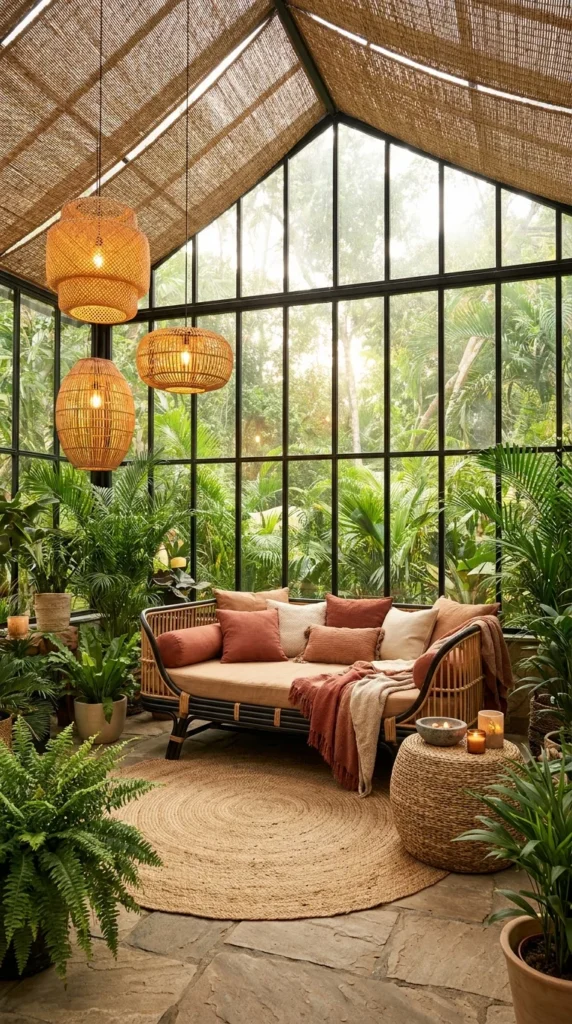
Floor-to-ceiling glass walls under a woven reed shade roof put this rattan daybed directly inside a wall of surrounding jungle—this is the most complete blurring of indoor and outdoor space in this entire guide, with more architectural commitment than any other room here.
The defining feature is the glass conservatory structure itself, paired with a reed or bamboo shade layer along the roofline that softens and filters the light coming through. Unlike a simple sliding door or window, this is a fully enclosed structure built specifically to put the person inside it in constant visual contact with dense greenery on every side.
It suits readers with the space and budget for a genuine architectural addition—a conservatory, greenhouse-style sunroom, or glass-walled garden room. It’s an aspirational idea for most readers rather than a weekend project, but it’s a useful north star for anyone planning a larger renovation around bringing the garden fully into daily living space.
The lifestyle fit is someone who wants their daily routine—morning coffee, evening unwinding—to happen surrounded by plants regardless of season or weather. Its strongest advantage is year-round usability: unlike an open pergola or patio, a glass conservatory extends the boho-garden feeling into cold or rainy months when an open-air space would be unusable.
The compromise is substantial cost and planning—glass structures need proper insulation and ventilation planning to avoid overheating in summer or losing all their warmth in winter, on top of the construction investment itself. To simplify for a smaller budget, recreate the feeling on a much smaller scale with a single large window wall and a dense arrangement of tall floor plants just outside it, rather than a full enclosed structure.
The most common mistake is under-planning ventilation for a glass structure like this, leading to serious summer overheating that makes the space unusable during exactly the season it should shine.
One practical recommendation: if pursuing a real conservatory addition, budget for operable vents or windows within the glass structure itself—passive ventilation is what actually keeps a glass-walled room comfortable through a full summer, not just the shade layer on the roof.
Is a Full Glass Conservatory Worth the Investment?
Here’s an honest take: a structure like this is a genuine architectural investment, not a decorating choice, and it’s not the right starting point for most readers building a boho garden space. But for a home with the budget and site conditions to support it, a glass conservatory delivers something no patio or pergola ever fully can—daily access to a garden-immersed space in every season, rain or shine. If the cost gives you pause, that’s a reasonable signal to start smaller: a single glass-walled reading nook or a modest sunroom addition captures a meaningful share of the same feeling at a fraction of the investment and can always be expanded later once you’ve confirmed how much you actually use the space.
Recommended Materials: Structural glass paneling · Reed or bamboo shade roofing · Rattan (daybed frame, pendant lights) · Jute (round rug) · Linen and cotton (cushions and throws)
Main Colors: Deep Jungle Green · Terracotta · Cream · Warm Amber (pendant glow)
Best Lighting: Layered rattan pendants at different heights supplement the daylight flooding through the glass walls, keeping the space usable well after sunset without overpowering the daytime brightness.
Maintenance Note: Dense tropical plantings just outside conservatory glass need regular trimming to prevent growth from blocking too much of the natural light the whole structure depends on.
Readers drawn to this fully immersive plant-and-light approach may also enjoy our sunroom guide built around rattan and natural light, which explores a closely related indoor-outdoor material palette.
Common Ways This Gets Misread
- Underestimating ventilation needs, leading to an unusable space during peak summer heat
- Choosing furniture not rated for the higher humidity and light exposure glass structures create
- Letting exterior plantings grow dense enough to block most of the interior daylight
- Skipping UV-protective glass, which accelerates fading on cushions and rattan alike
Keeping a Boho Garden Space Weather-Ready
- Bring cushions and throws indoors or into a storage box during heavy rain or the off-season—natural fibers like cotton and linen hold moisture and mildew far faster than synthetic outdoor fabrics
- Reseal rattan furniture every year or two with an outdoor-rated protectant, since UV exposure dries and eventually cracks untreated rattan
- Check hanging plant baskets and macramé pieces after storms for water pooling, which weakens both the cording and the basket’s structure over time
- Store or unplug string lights during extended wet weather unless they’re specifically rated for continuous outdoor exposure
Who Should Choose This Style?
- Best for readers with a covered patio, pergola, or sunroom who want texture and warmth without a full renovation
- Best for plant lovers who want their outdoor space to feel as intentional and layered as an interior room
- Not ideal for very exposed, unshaded patios where rattan and natural textiles would face constant harsh sun and rain with no protection
- Not ideal for anyone who wants a low-maintenance outdoor space, since natural materials and live plants both need seasonal attention
Budget Summary
| Budget | Expectation |
|---|---|
| Low | One macramé wall hanging, a few hardy potted plants, and a budget-friendly outdoor rug |
| Medium | Rattan seating set, patterned outdoor pillows, layered rattan pendant lighting |
| Premium | A trained living pergola canopy, a full glass conservatory addition, a curated textile gallery wall |
FAQ
Does rattan furniture actually survive outdoors? Natural rattan holds up reasonably well under a covered patio or pergola, but it needs regular resealing and protection from direct, prolonged rain exposure. For a fully open, unshaded space, a synthetic all-weather wicker is generally a more durable choice than natural rattan.
Can macramé and other textile wall art survive outside? Under a pergola or roofed patio, yes, for a good while—but full sun exposure will bleach undyed cotton cording over a season or two, and direct rain exposure speeds up mildew risk. Rotating pieces indoors during the harshest weather extends their life considerably.
Do I need a lot of space to pull off a boho garden look? No. Several of the ideas here—a single macramé piece, one hanging chair, a small cluster of potted plants—scale down easily to a balcony or small courtyard. The larger, more architectural ideas, like a full glass conservatory, are the exception, not the rule.
How do I keep this style from looking messy rather than intentionally relaxed? The spaces that read as “curated, not cluttered” in this guide tend to repeat a small, consistent material palette—rattan, jute, or one or two accent colors—even when they layer in a lot of texture. Picking a tight palette before adding pieces is usually the difference between boho and simply busy.
Conclusion
Nine spaces, nine different ways of getting to the same feeling—a wall dressed in flowers instead of tile, a pergola with a living roof instead of a built one, a bedroom corner that borrows the garden’s whole vocabulary without ever stepping outside. That’s the real thread running through good bohemian outdoor design: it’s built from a handful of honest, natural materials, arranged with more care than they let on. Whichever of these nine spoke to you, it’s probably because it matched something about how you actually want to spend time outside—and that’s the only real test that matters.
Explore More
You may also enjoy:
- Our Guide to Biophilic Living Room Design—the same plant-forward philosophy applied indoors, year-round
- Koi Pond Designs for Small Yards, Big Yards, and Everything Between—for readers ready to add a water feature to their garden plans
- Inside 10 Apartment Deck Designs—boho-friendly ideas scaled down for a small outdoor footprint
3 Responses