

Photos of bedrooms with LED strips tend to show the same thing: a bed floating on a glowing outline. It looks great for about five seconds. Then the practical questions start. Where does the strip actually go? Why does one room look expensive while another looks like an arcade? And will a bright color keep you awake?
The ten bedrooms below answer those questions through placement, color, and restraint, with notes on what to check before you buy. Some use a single warm amber line under the bed. Others split a room into color zones, follow a curve, or let a polished floor double the effect. Each section pulls out the one decision that makes the lighting work, so you can borrow the idea without copying the whole room.
One habit runs through all of them: the strips are hidden. You see glow on a surface, not a row of dots. That small detail separates a finished result from a kit-installed one, and it comes up again further down.
A Floating Bed Is Mostly a Lighting Decision
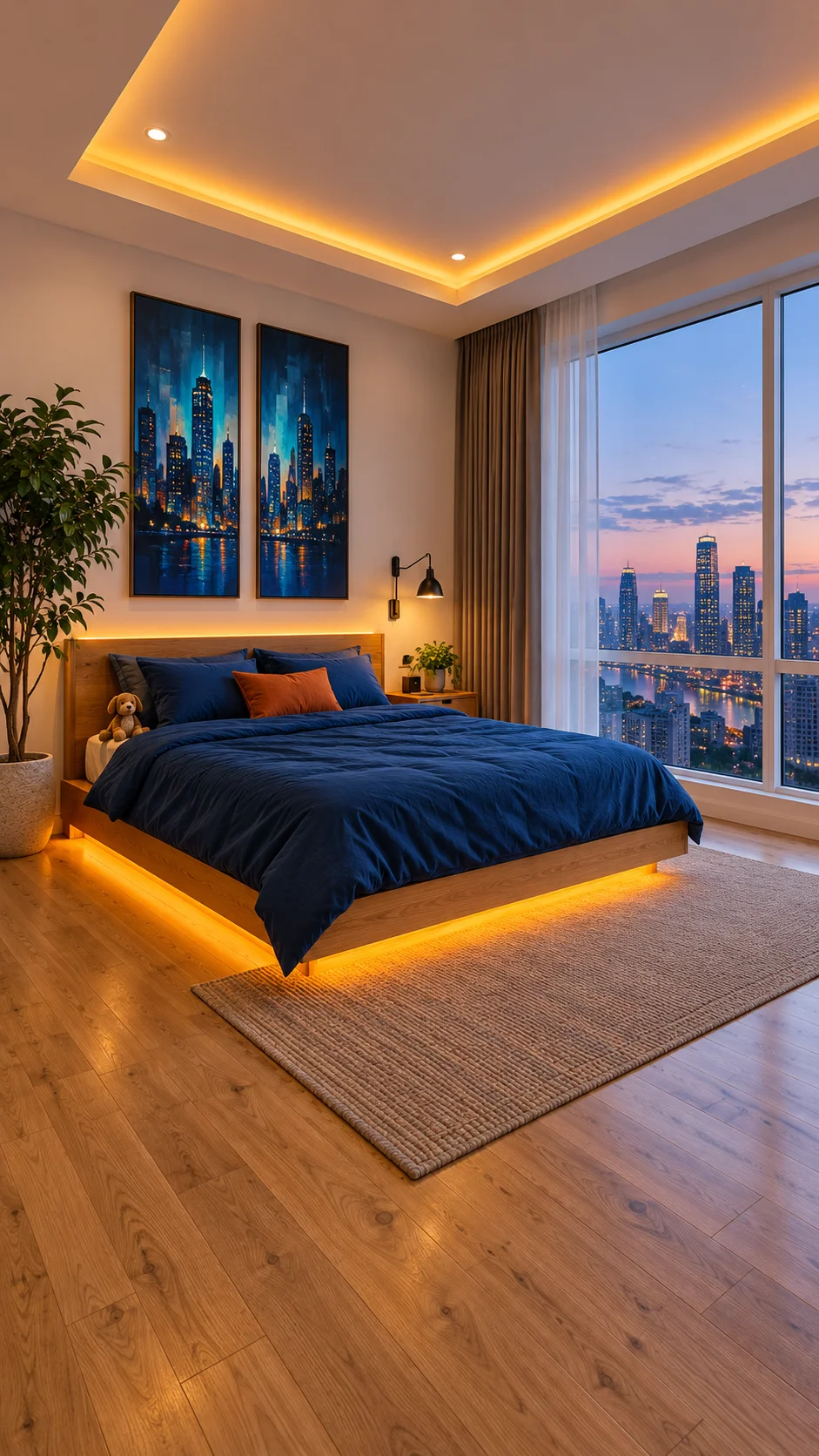
The oak platform frame in this room looks like it hovers because of what happens underneath it. The base appears to be set back from the rail, and a strip of amber light sits tucked away from the edge, so the glow lands on the floor instead of in your eyes. You read a soft pool of light, not a bulb. Remove the strip and the same bed would look like an ordinary frame resting on boards.
The navy duvet does real work here. Dark bedding gives the glowing edge something to contrast against, and amber sits almost opposite deep blue on the color wheel, which is why the rust pillow and warm oak floor feel connected to the bedding instead of fighting it. A second thin line washes the wall above the headboard, and the ceiling cove repeats the same warm tone. Three lines, one color temperature.
Check the frame before you buy any strip. The bed needs a visible gap or inset under the rail, because a frame sitting flush on the floor gives the light nowhere to go. The pair of tall skyline canvases over the headboard is a good size relationship to study, and our above-bed art ideas cover how to scale a pair like that without crowding the bed.
Let the Strip Follow the Curve, Not Fight It
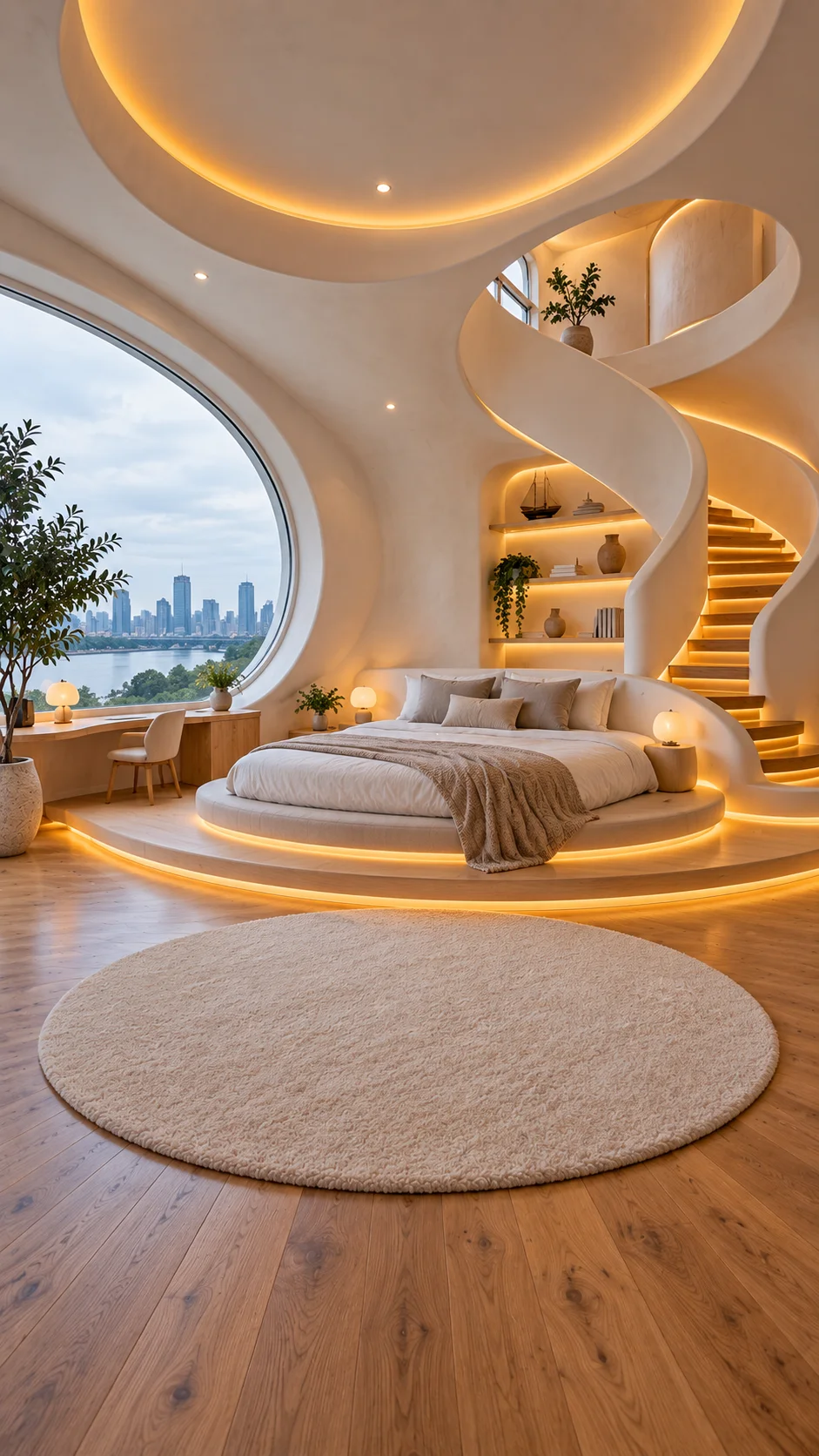
Curved rooms are hard to light with rigid fixtures and easy to light with flexible strip. In this cream-walled bedroom, the same warm line traces an oval ceiling recess, the edge of a round platform, the undersides of built-in shelves, and the treads of a spiral staircase. One product handles all of it.
The staircase is the clearest practical win. Lit steps give you a path at night without switching on an overhead light, which is a better reason to install strip lighting than decoration alone. The shelves work differently: light sits under each shelf edge and washes down over a few vases, books, and a trailing plant, so the display looks deliberate without a single lamp.
A couple of cautions if you try a smaller version. Flexible strips bend in broad arcs but can kink at tight turns, so a sharp corner usually needs a connector or a separate cut section. And the platform here has two glowing edges stacked one above the other. In a smaller room, one line is usually enough, and the second can wait until you’ve seen how the first looks at night. The soft palette of cream, oak, and linen suits that restraint, and it overlaps with the calm approach in these Japandi bedroom ideas.
Strips for Mood, Lamps for Reading
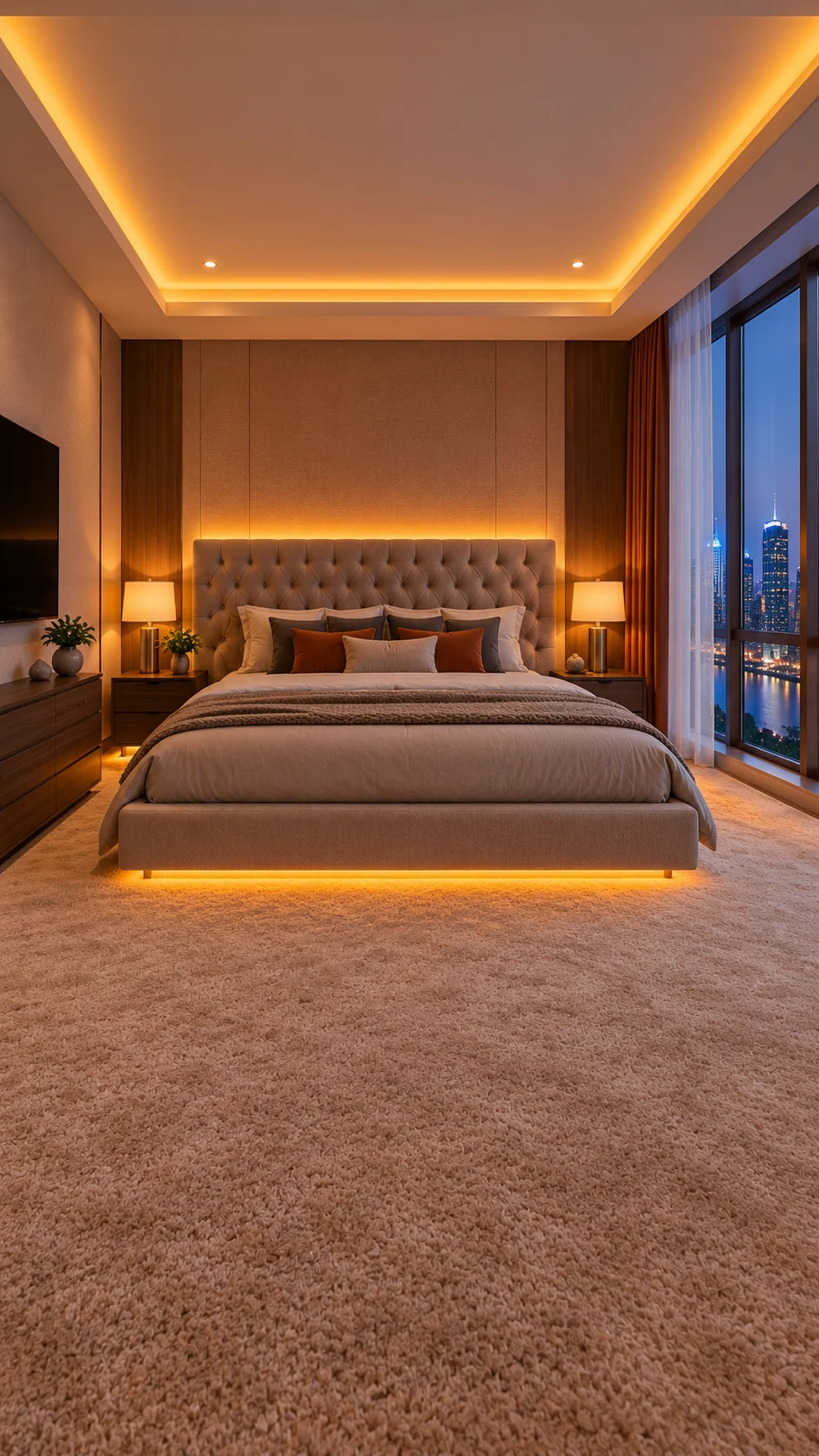
Two kinds of light share this room, and each has a separate job. Warm strips wash the wall above the tufted headboard and run along the underside of the bed base. Two shaded table lamps with brass bases sit on the nightstands. The strips set the ambient level. The lamps are where you actually read.
That split matters because a strip makes a poor reading light. Diffused glow is easy on the eyes and calms a room, but it rarely puts enough light on a page. Keeping lamps as the task layer means you can dim the strips to a low glow at night and still finish a chapter.
The symmetry helps too. Matching lamps, matching nightstands, a centered headboard, and a backlight that runs the headboard’s full width all point the same way. The walnut-toned side panels and rust curtain pick up the same warmth, much like the palettes in our earthy bedroom ideas. A thick beige carpet also swallows the under-bed glow, so here the strip reads as a thin line along the base instead of a floor-wide pool.
Why Dark Walls Make Modest Strips Look Strong
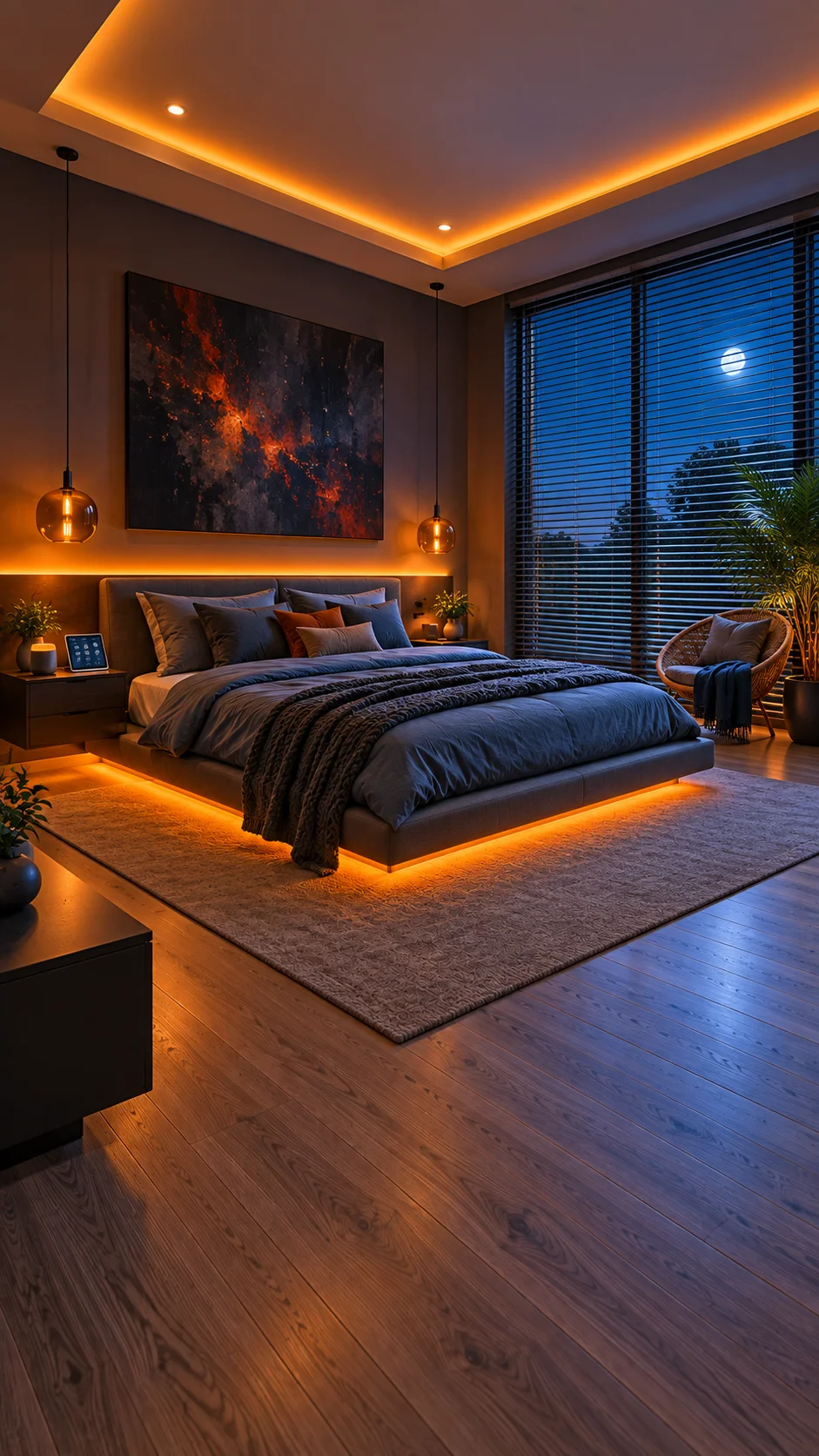
The walls in this bedroom are a deep taupe-brown, and the room still reads as glowing even though the strips are thin. Dark surfaces reflect less light, so each bright line looks more intense against its surroundings. If you mostly use the bedroom after dark, that’s a useful effect to know about.
The trade-off is bounce. Light from the under-bed strip stays low, near the floor, and the ceiling cove has to carry the rest. This room handles it by leaving the cove on and hanging two amber globe pendants beside the bed, so the light isn’t all at ankle height. Without them, a room this dark could start to feel heavy.
Near the left nightstand sits what looks like a small tablet or smart-home panel. Whatever it is, the idea behind it is sound: a controller that dims in steps matters more than a wide color range. Low-brightness orange is the setting to aim for in the last hour before sleep, and it also keeps the abstract painting’s deep reds from washing out. For more ways to keep a dark room from feeling closed in, see these black bedroom designs that balance drama and warmth.
Give Each Color a Job
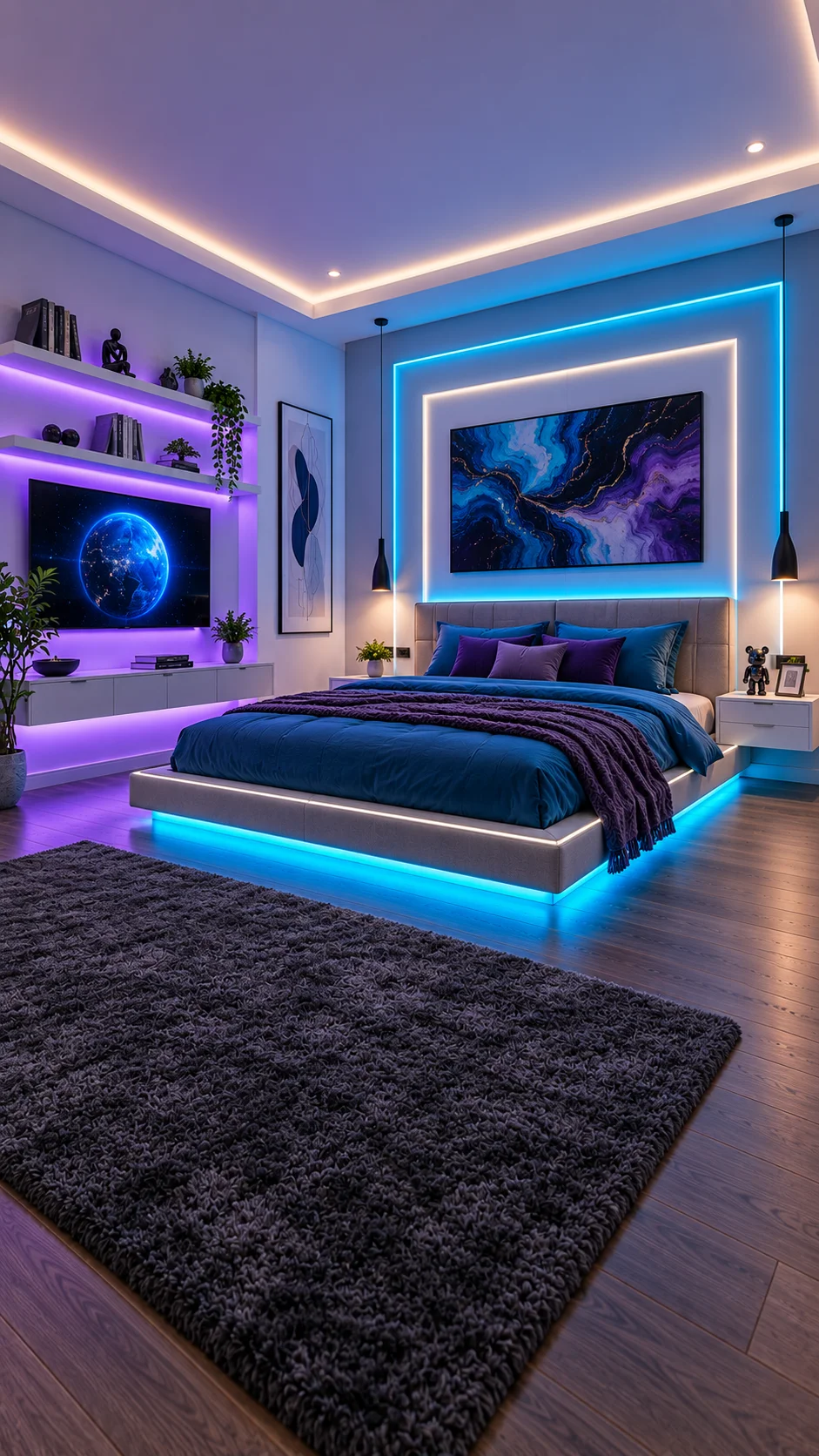
This is the busiest room in the set, and it holds together because every color has an assignment. Cool blue outlines the artwork wall and runs under the bed. Purple washes the floating shelves and the TV console on the left. A thin warm-white line sits inside the blue frame and follows the top edge of the bed base, while a warm cove runs across the ceiling.
The bedding repeats the lights: a blue duvet with purple pillows and a purple knit throw. That repetition is what stops the room from looking random. When LED colors match fabrics already in the room, the lighting looks planned. When they don’t, it looks like it came in the box.
For a smaller version, pick two hues, not four, and give each its own zone. One RGB strip on a single controller changes color all at once, so separate zones need either separate controllers or a strip with individually addressable segments, which the product listing will specify. A setup like this also suits a gaming-leaning room, and our gaming bedroom ideas show how to keep the screens and the lighting from competing.
One Cool Accent Inside a Warm Room
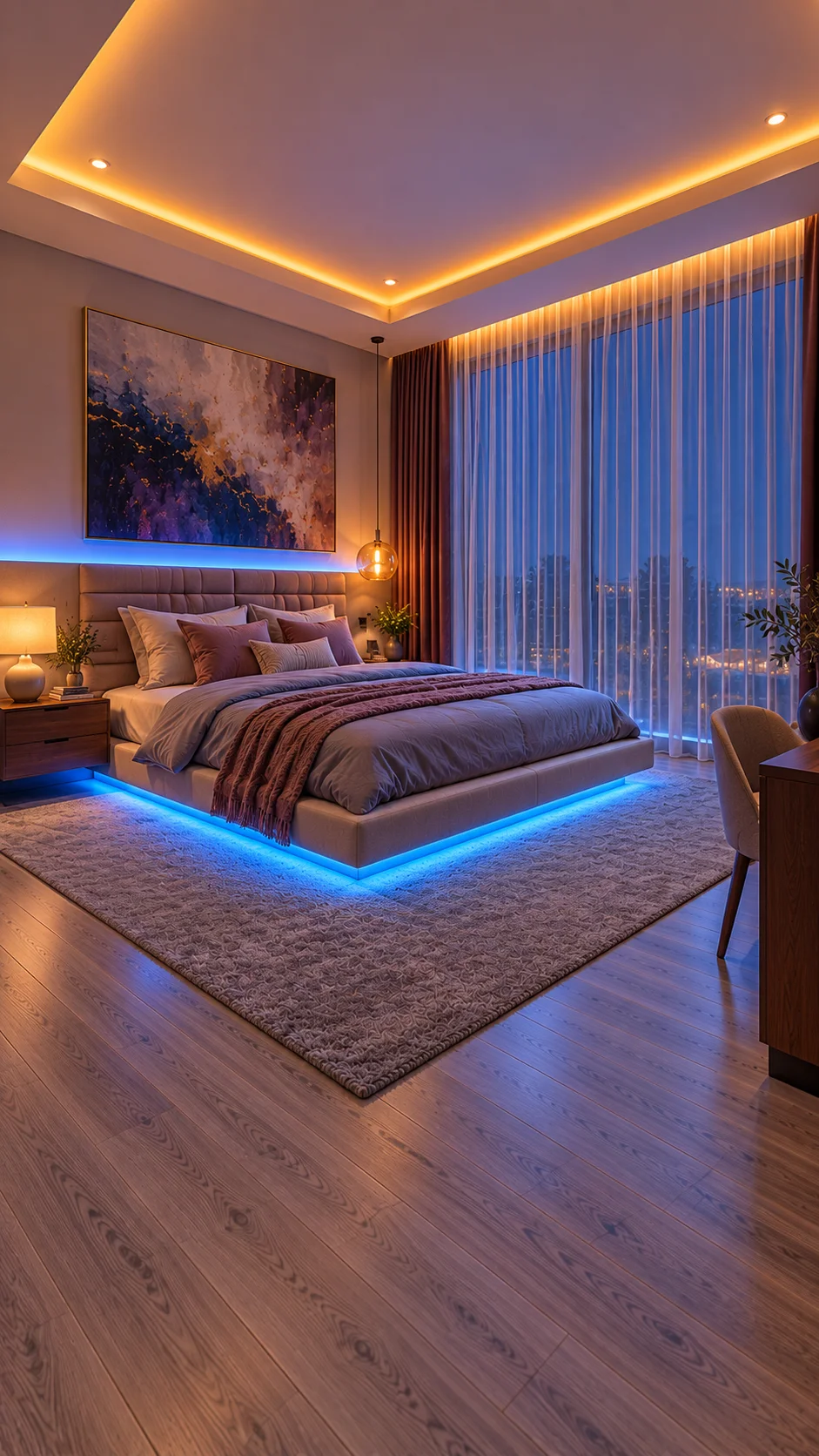
Warm amber does most of the work in this room. It lines the ceiling cove and appears to wash the sheer curtains from the top edge. Blue shows up in just two places: under the bed and in a thin band above the headboard. Because the cool color stays low and small, it reads as an accent instead of a second, competing light source. The contrast also gives the lilac-gray bedding and mauve throw a little more depth.
There’s a sleep angle to consider. Harvard Health reports that blue light at night suppresses melatonin more strongly than other colors, while red light is less likely to shift circadian rhythms. A blue underglow is fine for an evening scene, but it makes sense to keep it on its own preset, so that amber is what’s on by default at bedtime and the blue is something you choose.
If you copy the curtain detail, hide the strip above the track or behind a pelmet. The sheer fabric catches the light and glows like a lantern, and the effect holds up as long as the strip itself stays out of sight. A warm white strip also keeps the fabric looking soft instead of tinted, which matters if the curtains are meant to stay neutral by day.
Lighting the Seams Instead of the Surfaces
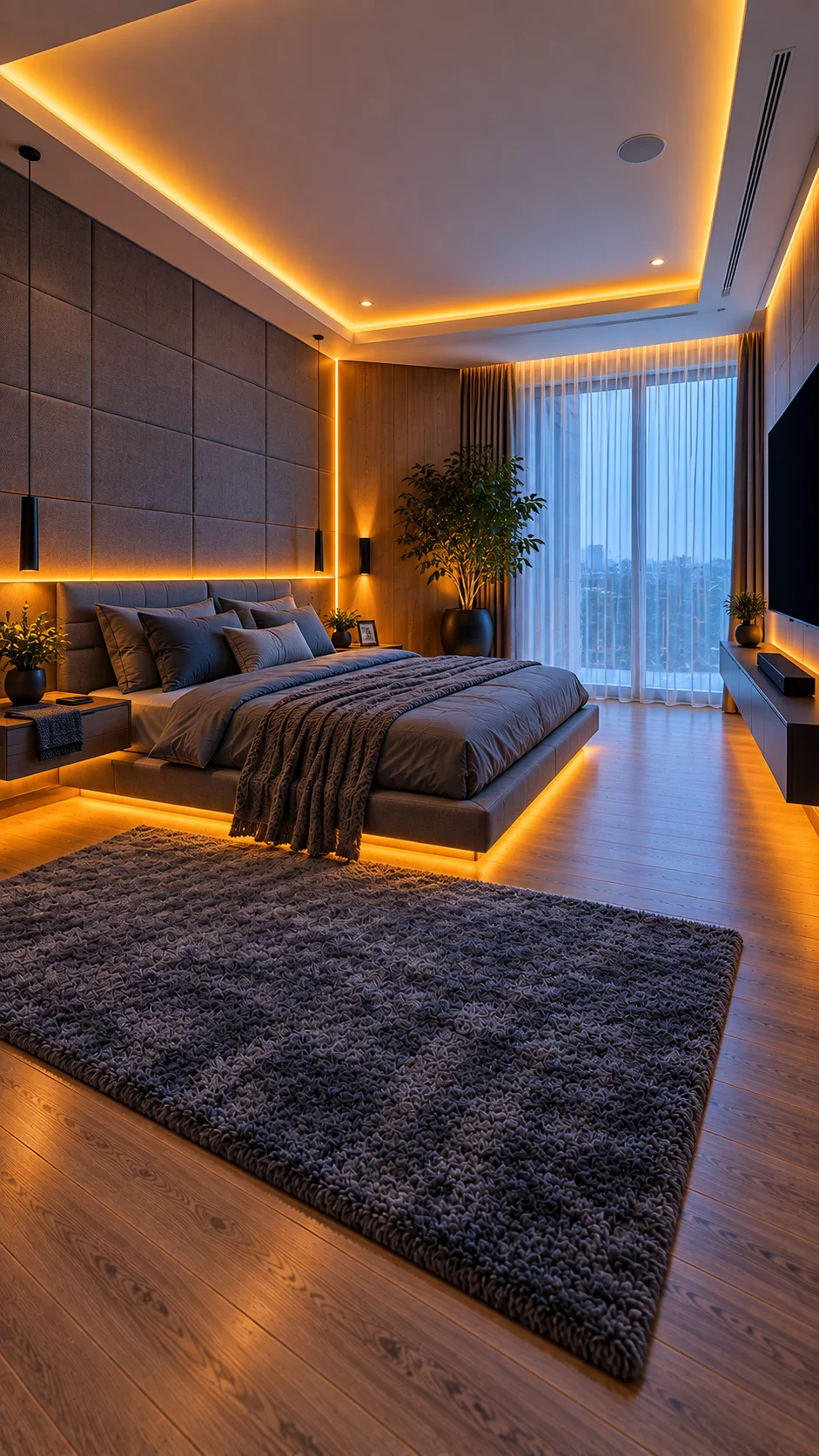
Look at where the strips sit in this room: along the ceiling edge, down the vertical corner where the gray padded panels meet the oak wall, at the base of the headboard wall, and behind the TV unit on the right. None of them lights a flat surface directly. They light joints.
Joints suit edge-glow because the shadow line hides the strip and gives the light a clean start and stop. Upholstered wall panels with deep seams are a natural host, and a vertical line at a corner draws the room’s height upward, which matters in a bedroom with a lower ceiling.
The TV wall adds a practical benefit. A soft glow around a screen reduces the contrast between a bright display and a dark wall, which is the common reason people install bias lighting in a dim room. The floating nightstand carries its own warm line underneath, so it looks as light as the bed beside it. If you’re planning the screen side of a room like this, our bedroom TV wall ideas cover placement and wall treatments.
When the Light Is the Artwork
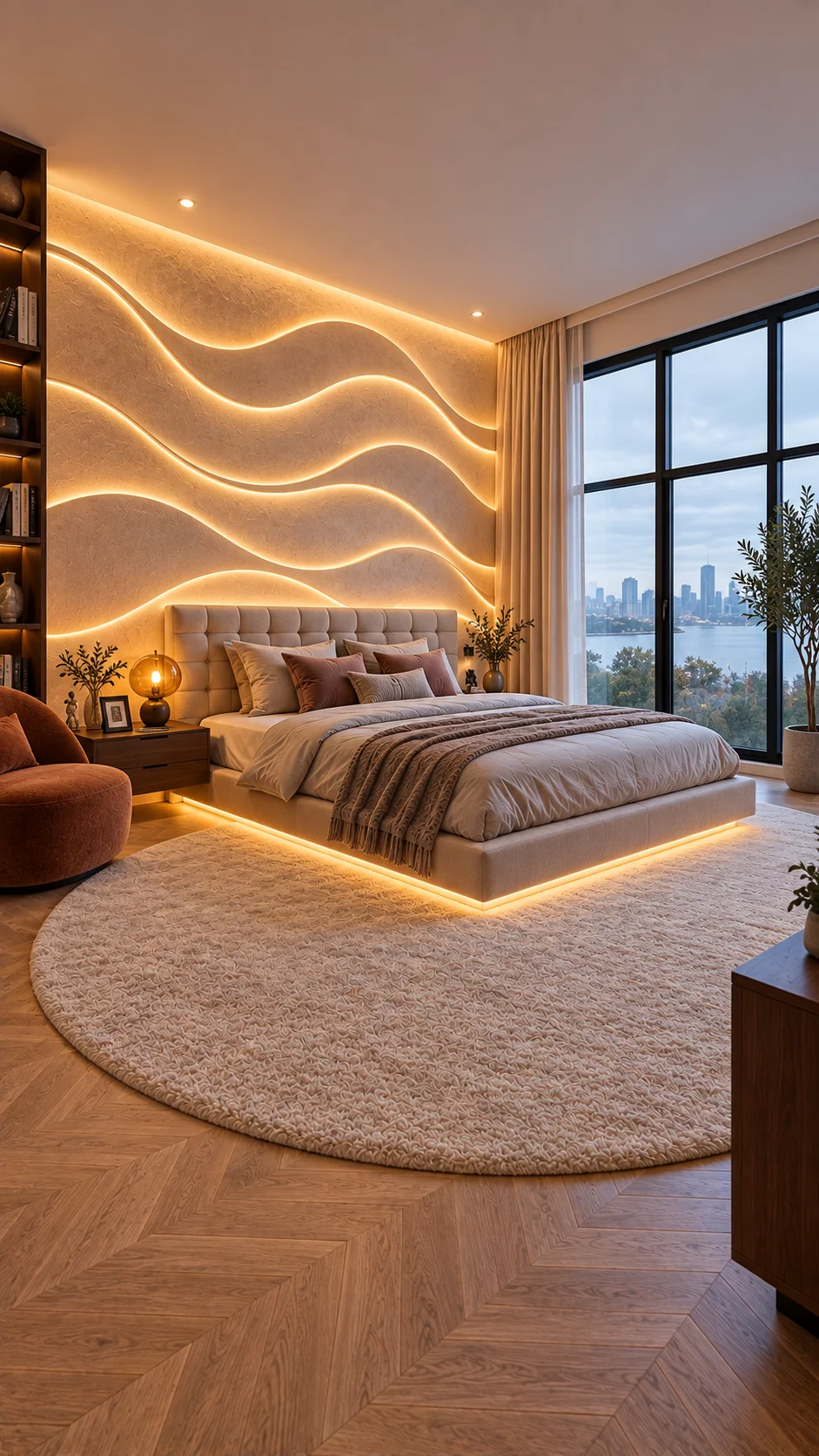
This room skips the framed art entirely. Instead, the wall behind the bed is sculpted into four soft waves, and a warm strip appears to sit along the edge of each one. At night the wall reads as a relief sculpture. In daylight it’s a quiet, textured plaster surface.
It’s also the biggest commitment in this list. The grooves would need to be formed into the wall during construction or a renovation, with an electrician planning the power supply and where the driver will live. Stick-on strips can’t reproduce it. For a rental or a lighter project, a wall-mounted wave panel with a strip behind it gets part of the way.
Everything else in the room repeats the curve: a round shag rug, a rounded rust armchair, a globe lamp on the nightstand. Curves in the lighting look intentional when the furniture shares them. If you’re choosing a rug for a room like this, our guide to bedroom rug styles is a useful place to compare shapes and pile heights.
Pull the LED Color From What’s Already There
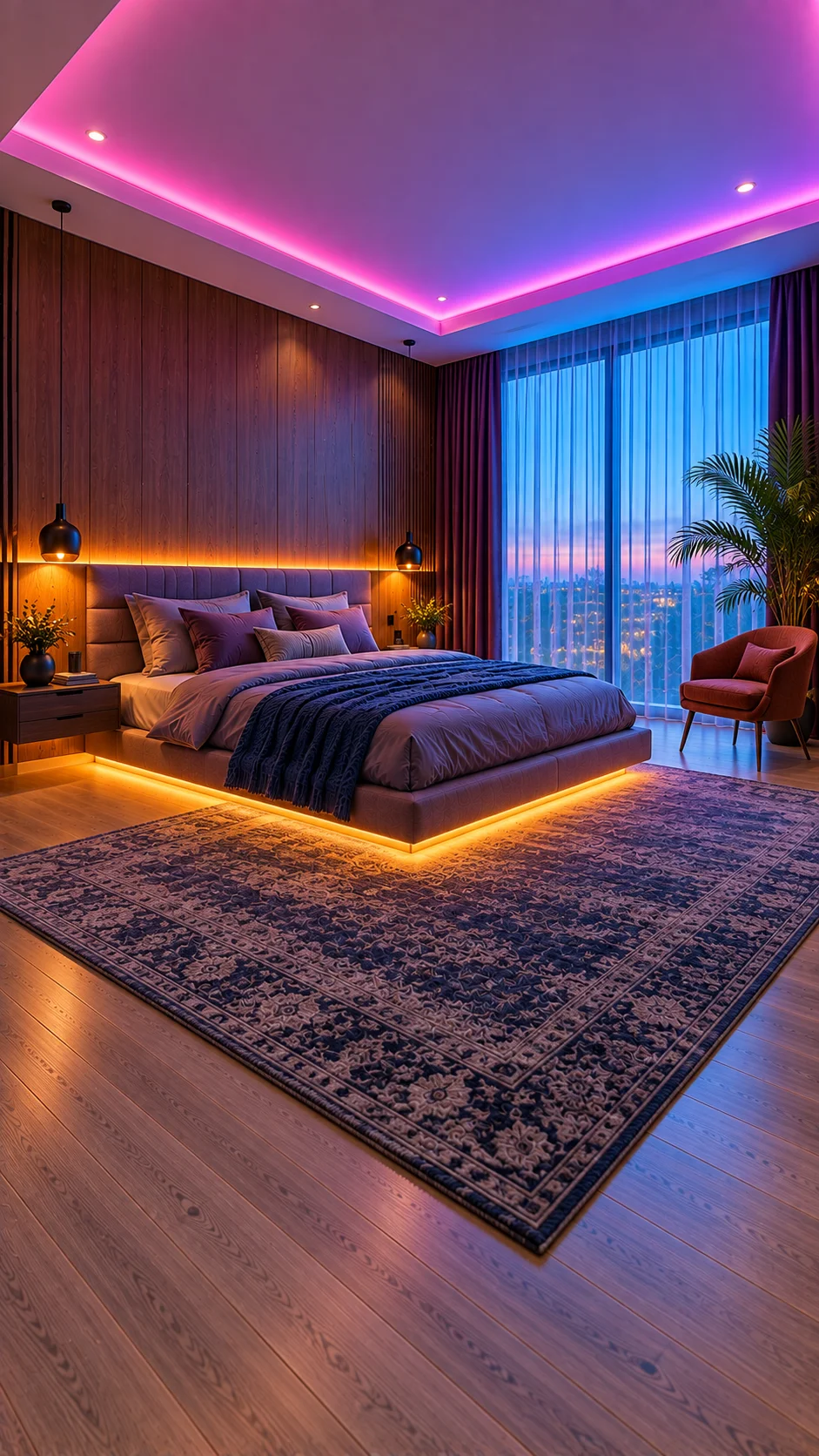
The ceiling cove in this room glows magenta and blue-violet, and the window shows a pink-purple dusk sky. That match is the detail to notice. The light echoes the view, the plum curtains, and the purple pillows, so the colored ceiling feels like part of the palette instead of an add-on.
Meanwhile, the under-bed and headboard strips stay amber, which keeps the vertical wood paneling looking like warm wood. The rule at work is color up high, amber down low. Colored light on a ceiling bounces softly around the whole room, while colored light near the bed tints sheets and faces, which is usually less flattering.
One limit worth knowing: a scheme like this leans on the evening sky. At midday, with bright daylight in the window, the ceiling color will look flatter and less connected. Rooms with a purple-leaning palette can use the same logic, as in these purple bedroom ideas.
A Polished Floor Gives You Every Light Line Twice
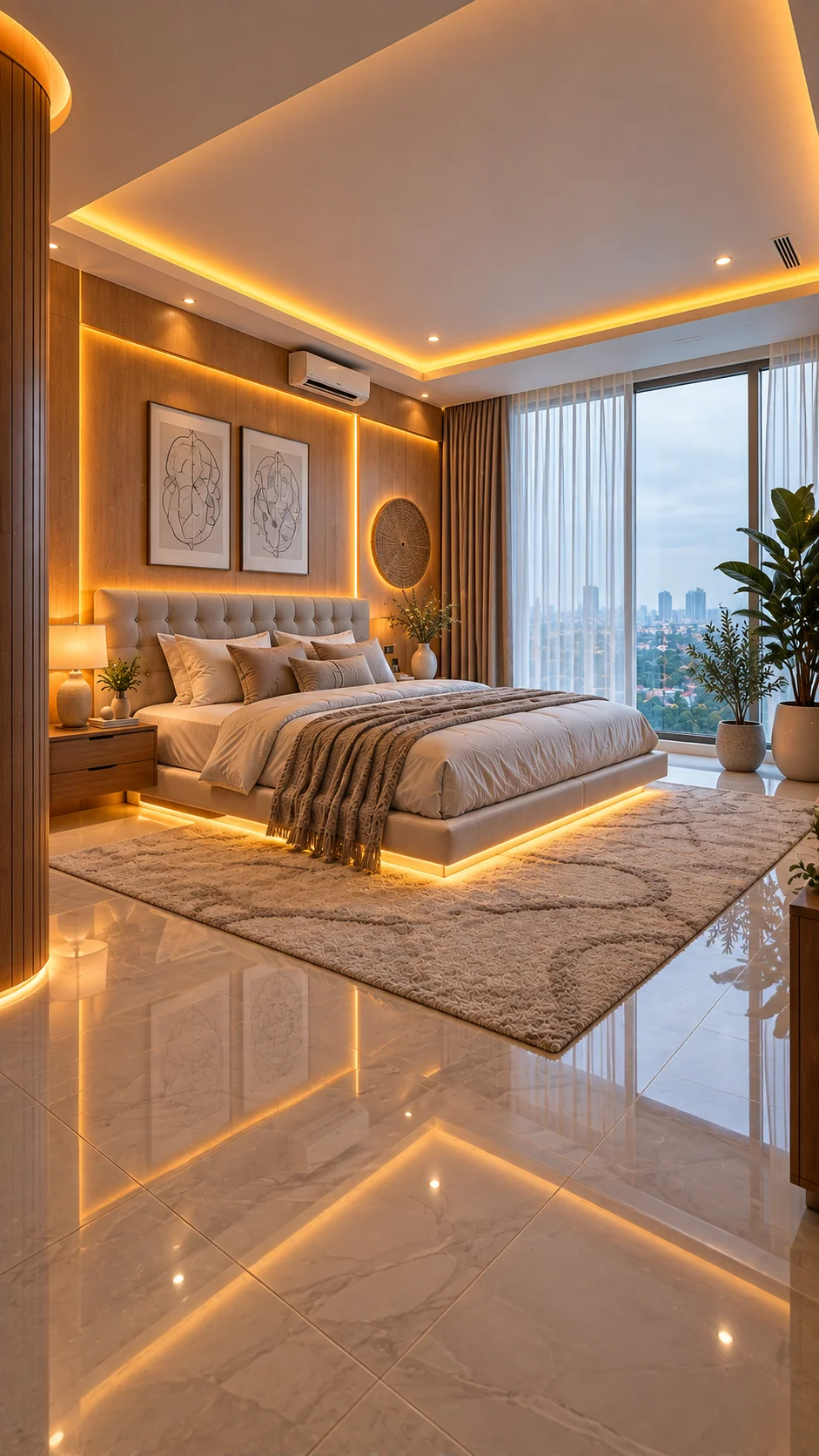
The glossy marble-look tile in this room mirrors the ceiling cove, the outlines around the wall panels, and the glow at the base of the curved wood column. Every line of light appears twice, once on its own surface and once in the floor. The room feels brighter without a single added fixture.
The catch is that reflection exposes flaws. A bare LED strip shows its individual dots, and a glossy floor would repeat each dot. The recessed downlights here already throw bright reflected spots onto the tile. Strips with a frosted diffuser or an aluminum channel keep the lines smooth, and they matter more on a reflective floor than on carpet or matte wood.
The bed area works the other way. The textured rug absorbs light, so the glow beneath the frame is soft there while the tile around it is bright, and that matte-against-gloss contrast is part of the look. The ribbed wood column at the left edge is a small-scale version of the slatted wood wall designs we’ve covered, and it holds the warm glow well.
FAQ
Should bedroom LED strips be warm white, RGB, or both?
For a light you’ll use every night, warm white (roughly 2700K to 3000K) or amber is the safer starting point, since it matches ordinary bedroom bulbs. RGB strips are fun for accents and zones, as in the blue and purple room above. If you want both, look for RGBW or tunable-white strips, which let you switch between a color scene and a clean warm white.
Where should the first strip go?
Under the bed frame or above the headboard, provided the frame has a gap or the wall has a ledge to hide the strip. Before sticking anything down, lay the strip along the route and switch it on, so you can see where the dots show and where the glow looks clean. Both spots are easy to reach, easy to reposition, and visible from most of the room. A ceiling cove is a bigger project because it needs a recess built into the ceiling.
Do LED strips need a dimmer?
In a bedroom, yes. A dimmable strip with a remote or app control lets you drop the glow low at night. Match the power supply to the total strip length too: long runs can look dimmer at the far end, and an undersized supply can shorten the strip’s life.
Can I install LED strips in a rental?
Often, yes. Most strips come with adhesive backing, and the back of a headboard, the underside of a bed rail, and the top of a curtain track are easy to hide and easy to remove. Test the adhesive on an inconspicuous spot first, since some adhesives can lift paint when peeled off.
Conclusion
The rooms that work well here follow the same short list of habits. They hide the strip, they give each line a reason to exist (a path on the stairs, a soft edge on the bed, a halo behind the TV), and they keep color to one or two hues that already appear in the bedding or the view.
If you’re starting from nothing, light one edge first: the underside of the bed or the wall behind the headboard, in warm white or amber. Live with it for a week, adjust the brightness until it feels right at 10 p.m., and then decide whether a second line or a color accent earns a spot.
About the Author: The Aesthetic Life Team writes about bedroom, living room, and outdoor design ideas, with a focus on how real rooms are put together and which ideas are worth borrowing. Learn more on the About the Author page.

