

A vanity does more heavy lifting in a bathroom than almost any other fixture. It’s the first thing seen walking in, the surface used every single morning, and often the one piece that decides whether the whole room reads as thrown-together or genuinely considered. Swap the sink, the mirror, or the cabinet finish, and the entire bathroom can shift from forgettable to something worth showing off—without touching the tile or the layout at all.
The ten vanities below range from quiet and functional to genuinely sculptural, but each one shows a different way to get more out of this single piece of furniture. Some solve a storage problem, others lean entirely into drama, and a few manage both at once.
A Backlit Wood Frame That Turns One Mirror Into a Focal Wall
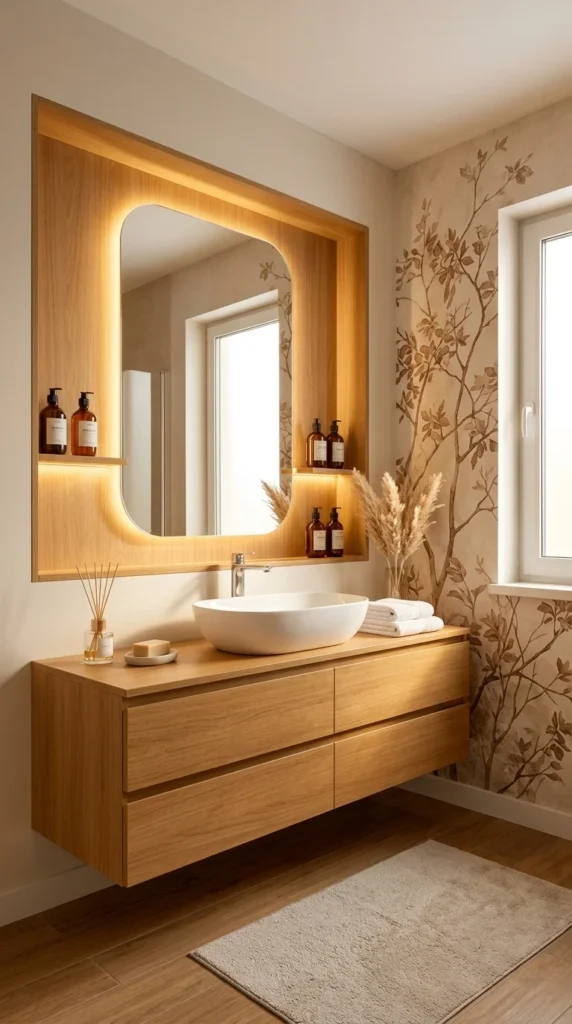
Recessed into a warm wood surround, this mirror sits inside its own lit niche, with narrow shelves tucked on either side for bottles and daily essentials. The soft glow tracing the frame’s edge means the mirror stays lit even with the room’s main light off, which matters most during early morning routines when a harsh overhead isn’t welcome.
💡 Pro Tip
Backlit mirrors are far more usable day to day if they’re wired on a separate dimmer switch from the room’s main lighting. A single bright setting works for grooming tasks, but a dimmer option makes the same mirror comfortable to use late at night without flipping on every light in the room.
The floating vanity below keeps a clean line along the floor, and the vessel sink sitting on top adds just enough height variation to keep the whole wall from reading as one flat surface.
Interlocking Circular Mirrors Over a Sculptural Wood Basin
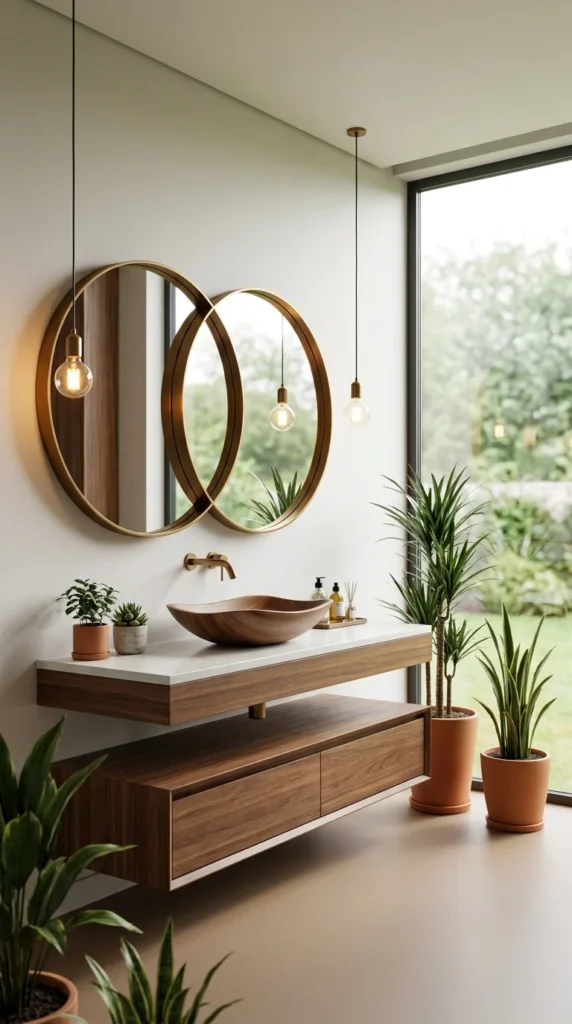
Two brass-ringed circular mirrors overlap slightly on this wall, paired with hanging pendant bulbs that swing just outside their frames rather than mounting flush against them. Below, a carved wood vessel basin sits on a floating walnut console, giving the whole setup a sculptural quality that a standard rectangular mirror-and-sink pairing wouldn’t have.
Overlapping mirror shapes like these work best when the room has enough plain wall space around them to let the geometry stand out—a busier backdrop would compete with the interlocking circles instead of showcasing them. The warm walnut tones running through both the vanity and the basin tie the whole wall together despite the mix of brass, wood, and glass.
Curved Oak Framing an Oval Mirror and a Full Storage Wall
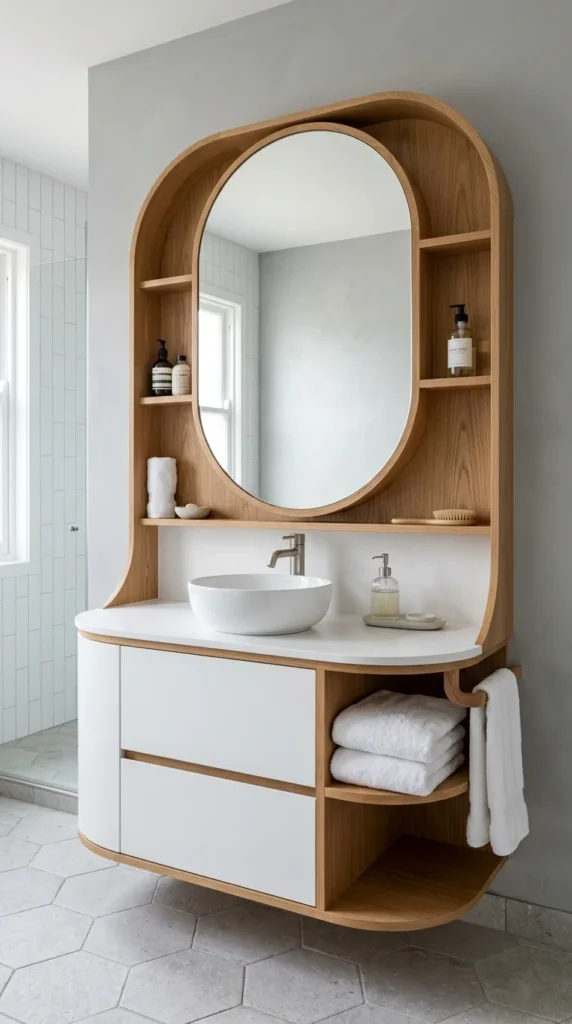
An oversized oval mirror sits nested inside a curved oak surround that wraps down into open shelving on both sides, then continues into the vanity cabinet itself. White drawer fronts contrast against the wood frame, while an open shelf beside the sink holds folded towels within easy reach.
📌 Important Note
Curved cabinetry like this needs slightly more floor clearance than a standard rectangular vanity, since the rounded edges extend the footprint in ways a straight-line cabinet wouldn’t. Measuring the widest point of the curve — not just the cabinet’s stated width — prevents an unpleasant surprise once it’s installed against a wall or beside a shower door.
Hexagonal floor tile underneath continues the room’s soft geometric theme, keeping the curved vanity from feeling like an isolated design choice in an otherwise straight-edged room.
Emerald Cabinetry Paired With Stacked Wood-Framed Mirrors
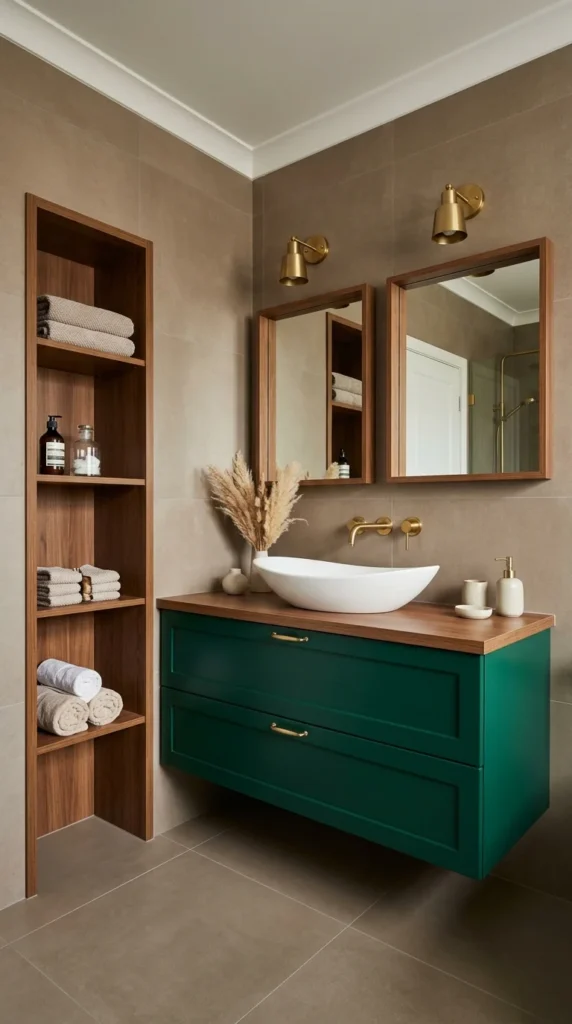
A deep emerald green vanity anchors this bathroom, topped with a warm wood countertop that carries through to two stacked wood-framed mirrors above it. Brass wall sconces flank the mirrors, and a tall wood shelving niche beside the vanity holds folded towels in place of a standard linen closet.
⚠️ Warning
Committing to a bold cabinet color like this emerald green is harder to reverse than choosing a neutral tone, since repainting or replacing a vanity is a bigger job than swapping out towels or a shower curtain. It’s worth living with a paint sample on the wall for at least a few days in different lighting before finalizing a saturated color for a piece this central to the room.
The warm wood tones running through the mirrors, countertop, and shelving keep the green from feeling isolated, tying the boldest element in the room back to something more neutral throughout.
Dark Marble and Brass: A Vanity Built for Drama
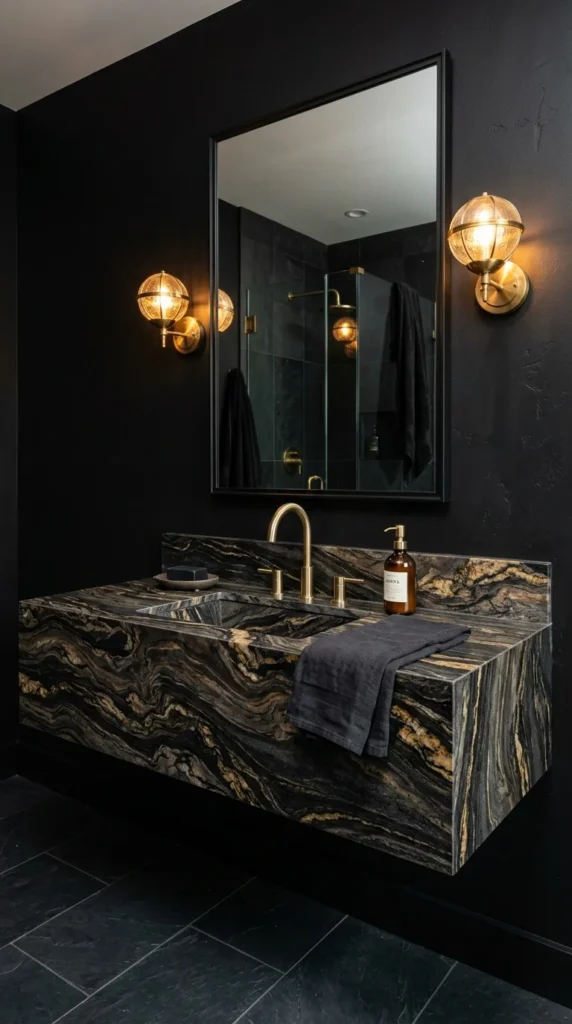
Nearly black walls surround this vanity, and the veined marble slab used for both the sink and the surrounding countertop reads almost like abstract art under the warm glow of brass globe sconces. A matching black-framed mirror keeps the entire wall in the same tonal family, letting the marble’s gold and grey veining provide the only real contrast.
Dark, dramatic vanities like this one tend to work best in secondary bathrooms or powder rooms rather than a primary bathroom used daily, since the mood suits an occasional statement space more than a room needing bright, functional morning light. The brass fixtures and integrated sink basin, carved directly from the same marble as the counter, keep the whole piece feeling like one continuous material rather than separate parts assembled together.
Double Vessel Sinks Sharing One Walnut Console
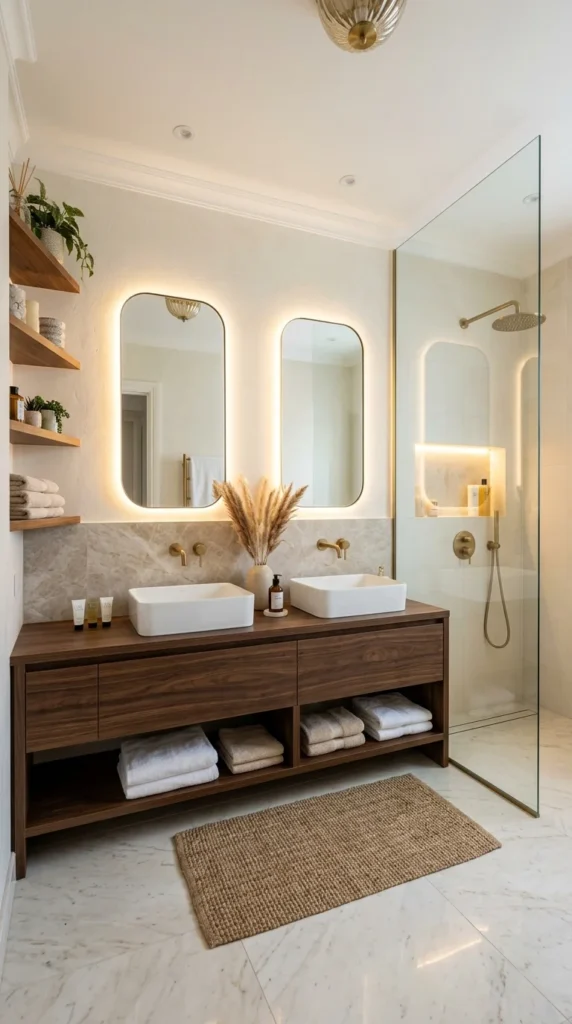
Two square vessel sinks sit side by side atop a single long walnut vanity, with open shelving below holding neatly folded towels instead of closed cabinet doors. Backlit arched mirrors above each sink echo the shower’s arched niche just beside them, tying the whole wet-room layout together.
What a Double-Sink Vanity Needs to Work
☐ Enough counter width that both sinks have separate elbow room ☐ Two full sets of plumbing, checked against existing wall connections ☐ Adequate storage split evenly, so neither side feels shortchanged ☐ Separate task lighting above each mirror, not just one shared fixture
Open shelving instead of closed cabinetry works particularly well in a shared vanity like this, since neatly folded towels stay visible and accessible from both sides without either person needing to open a door to find them.
Black Cabinetry Broken Up by a Warm Wood Center Column
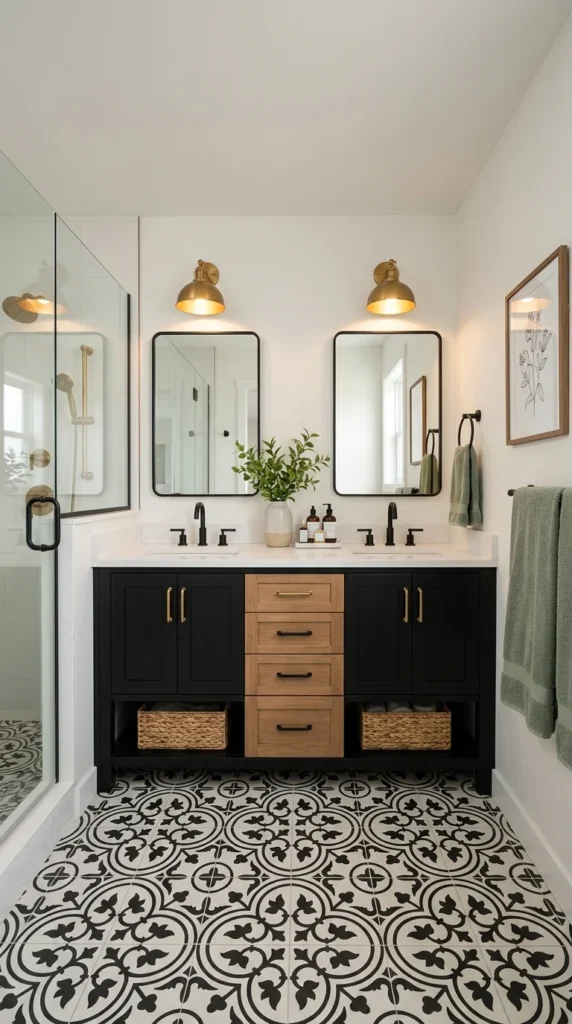
Matte black cabinets flank a narrow column of stacked wood drawers in the center of this vanity, breaking up what would otherwise be a long, uniform run of dark cabinetry. Brass hardware and matching brass sconces above each mirror pick up the same warm tone as the wood drawers, tying the two materials together.
⚠️ Warning
Mixing two distinct wood or cabinet tones in one vanity, as this design does with black and natural wood, only reads as intentional when the warm tone is repeated somewhere else in the room. Here, the brass hardware and light fixtures echo the wood drawers directly—without that repetition, the center column risks looking like a leftover piece rather than a deliberate design choice.
Patterned black-and-white floor tile underneath adds enough visual energy that the vanity’s more restrained black-and-wood palette doesn’t feel plain by comparison.
Reclaimed Stone and Timber for a Vanity That Feels Outdoors
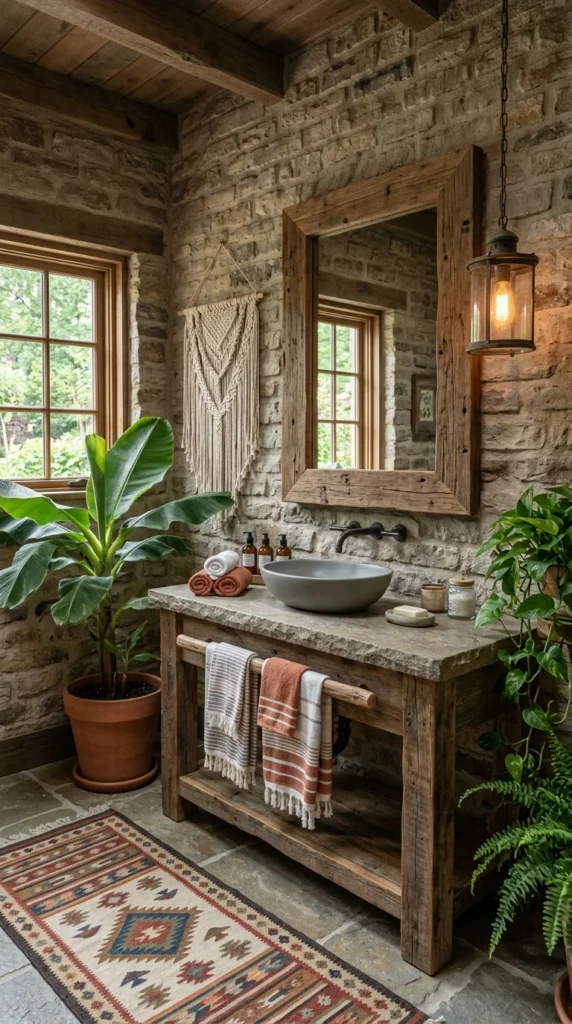
Built more like a piece of furniture than a fitted cabinet, this vanity uses a slab of rough stone as its countertop atop a simple reclaimed wood table frame, complete with a built-in towel bar running underneath. A stone vessel sink continues the same raw material used on the countertop, and a lantern-style pendant light hangs beside the mirror.
💡 Pro Tip
Natural stone vessel sinks like this one generally need periodic sealing to resist staining, since stone is more porous than standard ceramic or porcelain. Checking whether water beads on the surface or soaks in is a simple way to tell when it’s time to reseal, without needing to guess on a fixed schedule.
Surrounding stone walls, a macrame wall hanging, and generous greenery all lean into the same raw, unfinished material palette, making the vanity feel like part of the architecture rather than a piece dropped into the room afterward.
Floral Wallpaper Behind a Black-and-Brass Double Vanity
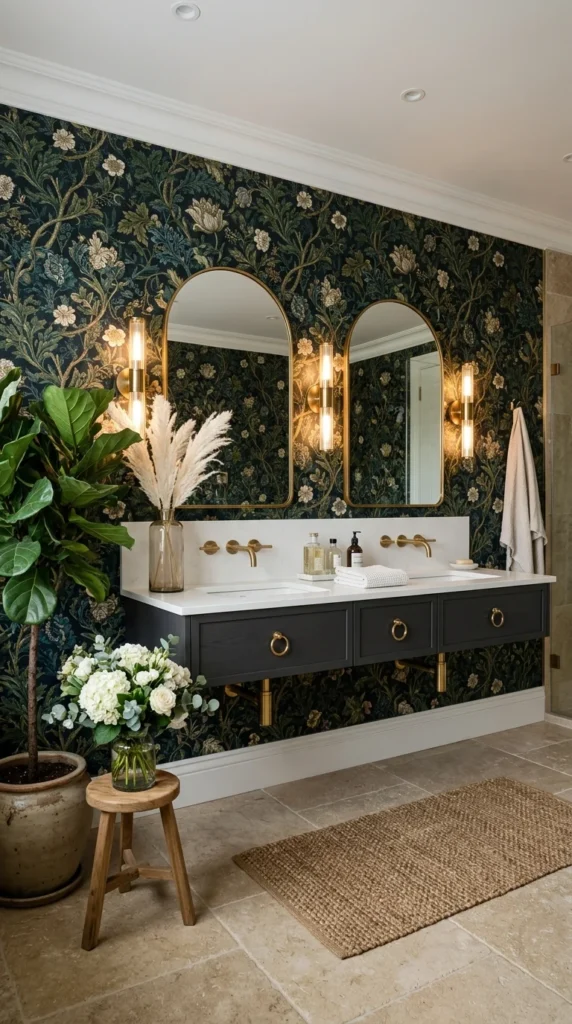
Dense botanical wallpaper covers the wall behind this matte black double vanity, with brass ring pulls and wall sconces standing out sharply against the dark pattern. Two arched brass-framed mirrors echo the wallpaper’s ornate quality without competing with it directly.
Wallpaper vs. Tile Behind a Vanity
| Factor | Wallpaper | Tile |
|---|---|---|
| Visual impact | Higher, more pattern options | More restrained, material-driven |
| Water resistance | Lower—needs distance from splashes | Higher, built for wet areas |
| Best placement | Well back from the sink, dry zones | Directly behind and around the sink |
| Replacement | Easier and cheaper | More involved, especially set-tile |
Choosing wallpaper for a vanity wall works best when the sink sits far enough forward, as it does here, that daily splashes stay well clear of the paper.
Sculptural Bronze Curves That Turn a Sink Into Art
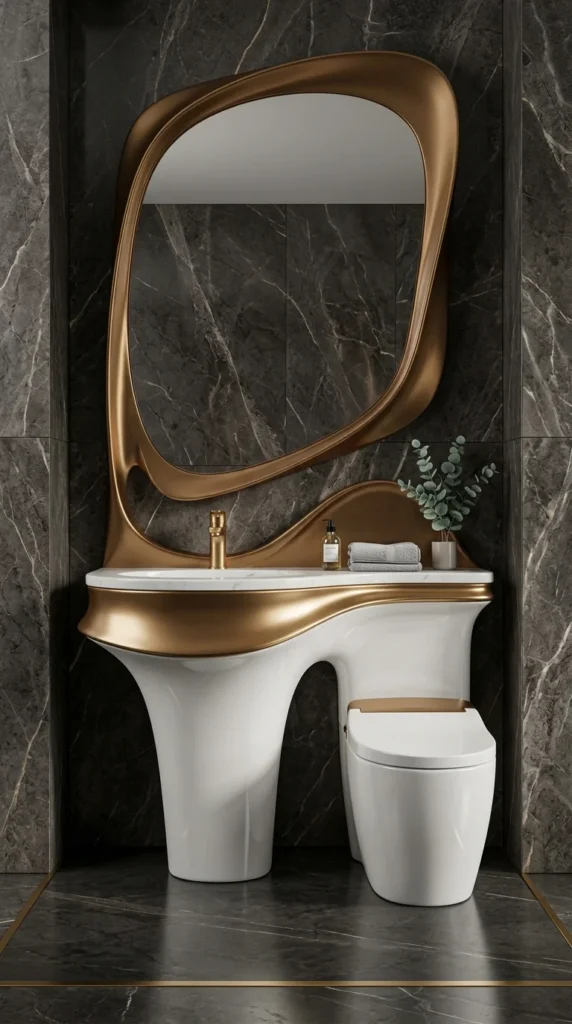
Flowing bronze metal wraps this vanity from the mirror frame down into the basin itself, curving into a shape that reads more like a sculpture than standard bathroom fixtures. A white ceramic pedestal base supports the whole piece, set against dark veined marble walls that let the bronze surface catch and reflect the room’s ambient light.
Recreating This Look: Budget Tiers
💚 Affordable: A curved brass mirror frame paired with a simple white vessel sink can borrow the same warm-metal, sculptural mood without a fully custom piece. 💛 Mid-Range: A semi-custom vanity with an integrated metal countertop edge, ordered from a specialty fabricator, gets closer to the seamless flow between mirror and basin. 💎 Investment: A fully bespoke, sculpted metal-and-ceramic vanity like this one, designed and cast as a single continuous form, is the only way to achieve this exact organic shape.
A piece of this sculptural work acts as the room’s single statement—everything else here, from the marble walls to the matching toilet, stays deliberately quiet so the vanity remains the only thing drawing the eye.
Final Thoughts
Across all ten vanities, the biggest differences come down to what each one is asked to do—some solve a storage problem for two people sharing one counter, others exist purely to make a bold visual statement in a room that will be seen daily. A vanity upgrade rarely needs to touch the rest of the bathroom to make an impact; choosing the right material, mirror shape, and storage setup for how the space actually gets used is usually enough to change how the whole room feels.
Frequently Asked Questions
How do I choose the right vanity size for my bathroom? Measuring the available wall width first, then leaving at least a few inches of clearance on either side for elbow room, is the most reliable way to avoid a vanity that feels cramped. For shared bathrooms, a double-sink vanity generally needs at least 60 inches of width to give both sinks comfortable spacing.
Is a floating vanity harder to install than a standard one? Floating vanities typically require more reinforcement inside the wall to support the weight without visible legs, which can make installation slightly more involved than a standard floor-mounted cabinet. The visual payoff—a lighter look and easier floor cleaning underneath—is usually why people choose the extra installation step.
What countertop material holds up best in a bathroom? Quartz and porcelain are both popular choices because they resist staining and don’t require regular sealing, unlike natural stone. Natural marble or granite offer more visual variation but generally need periodic sealing to stay protected from water and everyday products.
Should vanity hardware match the faucet finish? Matching isn’t strictly necessary, but keeping hardware and faucet finishes in the same general metal family—both warm tones or both cool tones—usually reads as more intentional than mixing brass hardware with chrome fixtures, for example. A slight tonal variation within the same metal family, like brushed brass with polished brass, still tends to look coordinated.
How much storage does a bathroom vanity actually need? That depends mostly on how many people share the bathroom and how much is stored versus kept elsewhere in a linen closet. A single vanity with two drawers and one cabinet is often enough for one person’s daily essentials, while a shared double vanity benefits from open shelving or extra drawers so both users have dedicated space rather than competing for the same storage.
2 Responses