
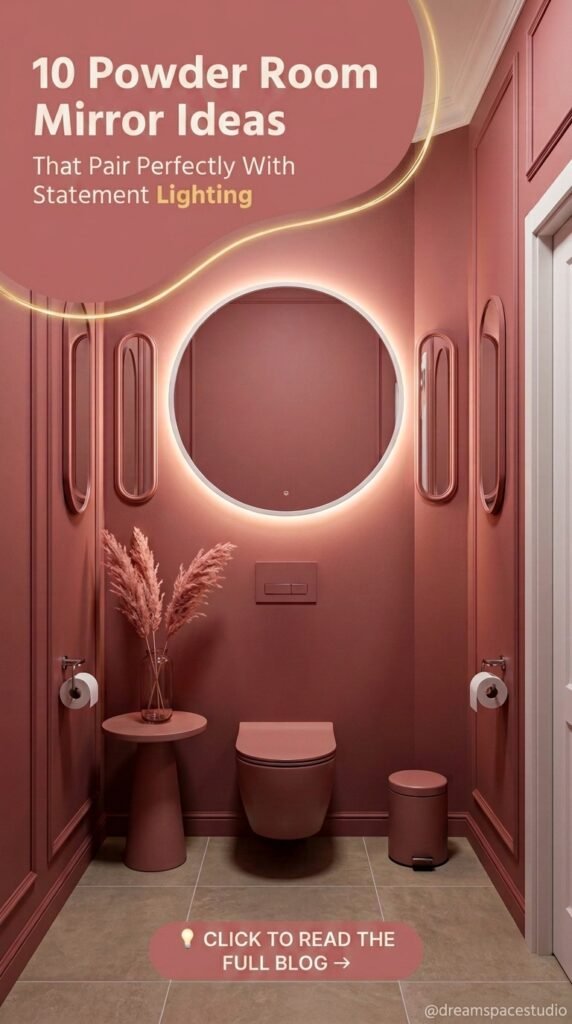
A powder room only gives a designer one wall to work with, and most of the time that wall belongs to the mirror. Because the room is small and guests only spend a minute or two in it, the mirror carries more design weight here than almost anywhere else in the house — it sets the tone before anyone even notices the tile or the faucet. The ten rooms below each build around a completely different mirror decision, from a backlit circle to a hand-carved gold frame, so the comparison is really about which visual weight, shape, and finish fit your own powder room’s size, light, and personality.
Quick Overview
| Style | Statement Mirror Powder Rooms |
|---|---|
| Best For | Small bathrooms, guest powder rooms |
| Budget | Low–High (mirror-dependent) |
| Difficulty | Easy swap to moderate full remodel |
| Maintenance Level | Low |
A Backlit Circle That Does the Lighting’s Job Too
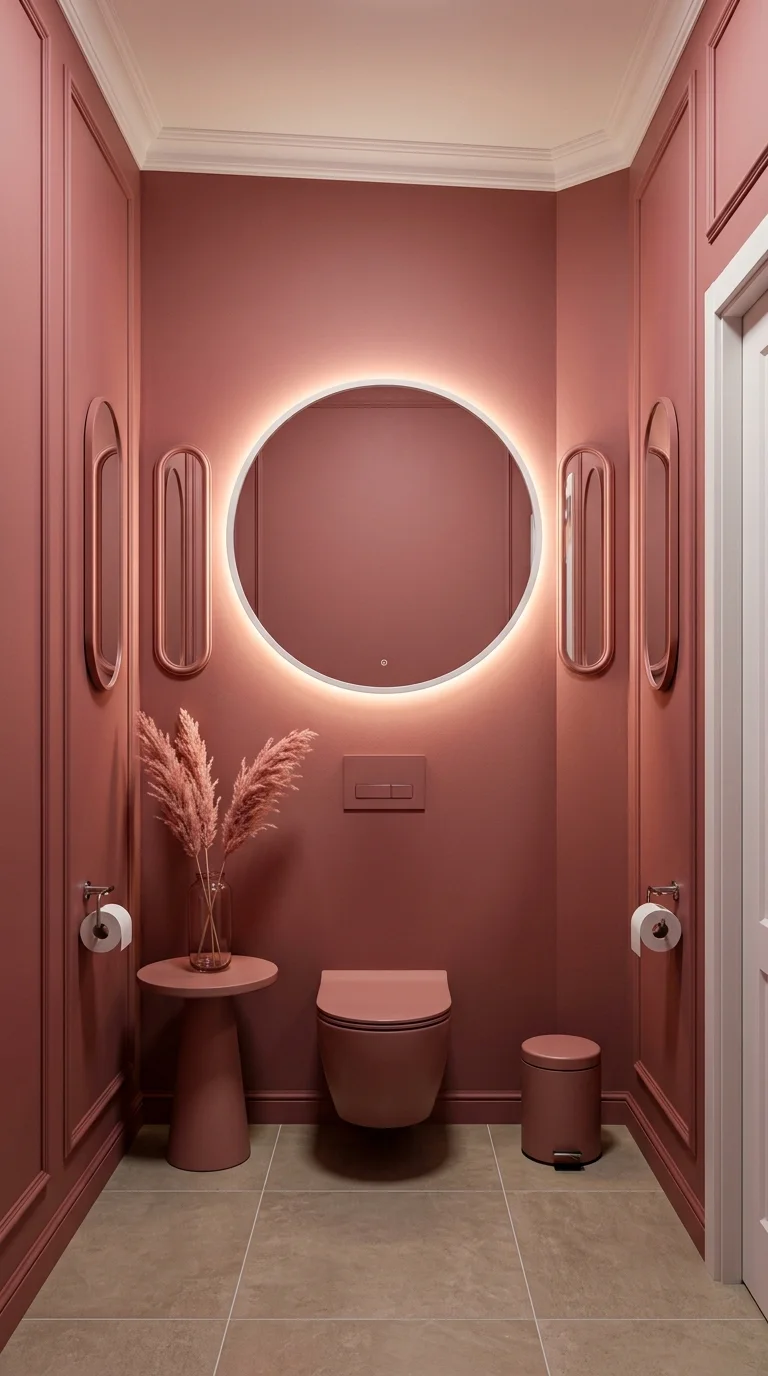
The backlit glow makes this powder room feel larger after sunset without extra fixtures.
The defining move in this room isn’t the wall color — it’s that the mirror is also the light source. A round LED-rimmed mirror sits dead-center on a monochrome dusty-rose wall, and because the glow wraps the whole circle evenly, it reads less like a fixture and more like the room’s own halo. That single decision solves two problems a small powder room usually has separately: even, shadow-free light at the sink, and a focal point strong enough to distract from the room’s actual footprint. The two slim oval mirrors flanking it aren’t there for extra reflection — they repeat the round mirror’s curve at a smaller scale, which is why the wall reads as composed rather than symmetrical for symmetry’s sake. Choose this if the room gets little to no natural light, since the backlighting does the work a window normally would. Skip it if you already have strong overhead lighting; a second glowing element in that case competes rather than helps.
💡 Quick Decision: If your powder room has no window, a backlit mirror can replace a separate vanity light fixture entirely — check the wall for existing wiring before committing to this swap.
Why the Glow Reads as Warmth, Not Cold Tech
Backlit LED mirrors can feel clinical in the wrong palette, but here the warm dusty-rose paint absorbs the light rather than bouncing it, so the effect softens instead of sterilizing the room. That interaction between light temperature and wall color is worth testing with a paint sample before buying a fixed-temperature mirror, since it can’t be adjusted after installation the way a bulb can.
Recreating It, Room by Room
A monochrome wall — same or nearly the same shade on walls, trim, and even the toilet — is what lets a single bold mirror hold the room’s attention. On a tight budget, this look can be approximated with a plug-in backlit mirror and a can of the same rosy paint used elsewhere on the wall, skipping the hardwired install entirely. For homeowners weighing whether wallpaper or paint carries a small room’s personality better, it’s worth comparing both approaches side by side — see this breakdown of powder room wallpaper ideas that make a small space unforgettable for the wallpaper side of that decision.
Recommended Materials: Matte-painted drywall, LED-rimmed glass mirror, ceramic wall-hung toilet, dried pampas grass, painted round side table
Main Colors: Dusty Rose, Warm Blush, Soft White
Best Lighting: Integrated LED ring, supplemented by any ambient overhead light already in the space
Where This Look Falls Apart
- Pairing the backlit mirror with a cool-white bulb elsewhere in the room, which clashes against its warm LED tone
- Choosing a wall color too dark to let the backlighting actually diffuse
- Skipping a dimmer, so the glow is either fully on or fully off with no in-between.
- Hanging the flanking oval mirrors off-center, which breaks the symmetry the whole wall depends on
A Rustic Pair That Looks Collected, Not Decorated
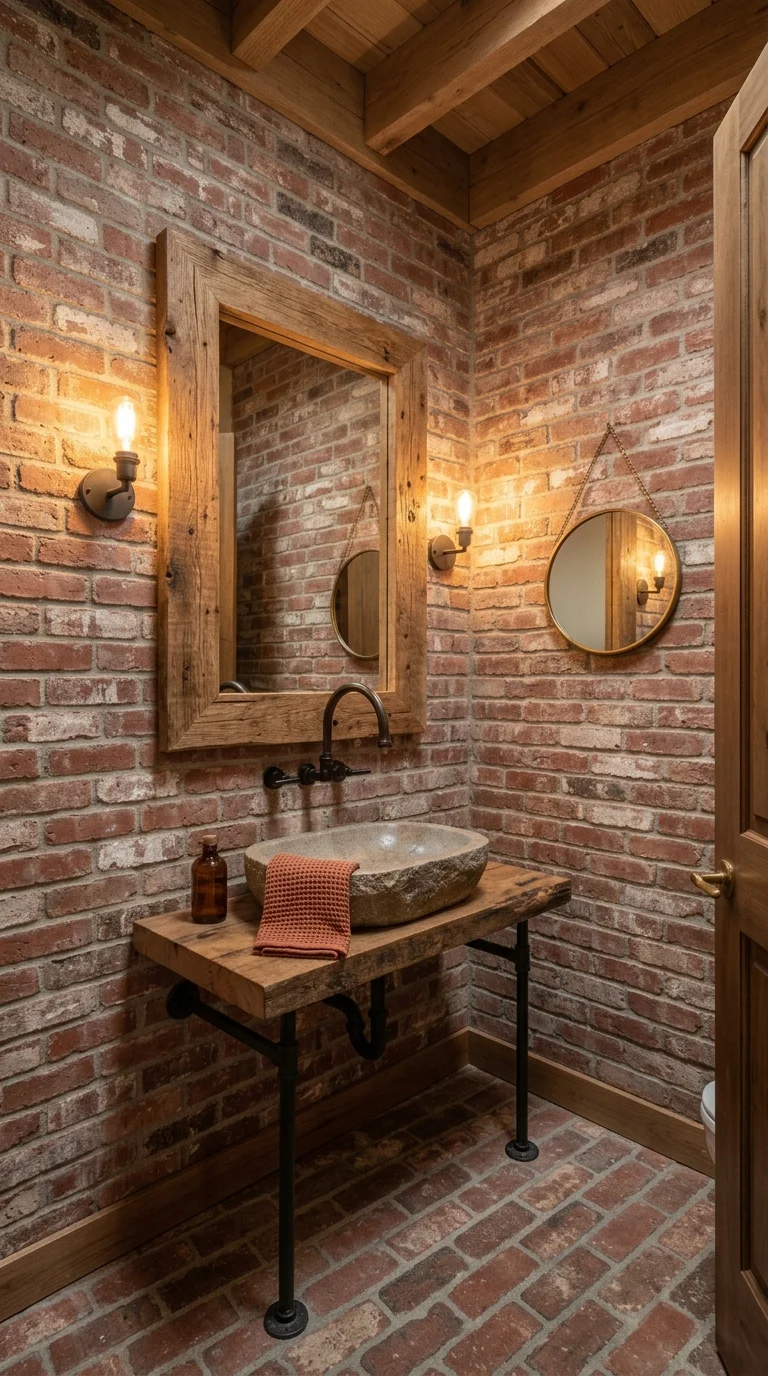
Mismatched mirror sizes give this brick wall a collected-over-time, not decorated, feeling.
Two mirrors of noticeably different sizes hang on the same reclaimed brick wall here — one a large rectangular wood frame, the other a small round mirror on a leather strap — and that mismatch is the entire point. A single large mirror on this wall would look like a store display; two mirrors of different scale, hung slightly apart, look like they were gathered over years rather than bought as a set. The stone vessel sink and exposed black pipe faucet lean into the same idea: nothing here is trying to look brand-new. Brick, wood, and raw stone all show natural texture and irregularity, which is exactly what keeps the room from reading like a themed rental cabin instead of a lived-in space. This works best in older homes where exposed brick or timber beams already exist structurally — retrofitting brick veneer purely for this look adds real cost and rarely fools the eye up close.
Material Behavior Worth Knowing
Reclaimed brick in a bathroom setting will absorb humidity slightly more than sealed drywall, and unsealed stone vessel sinks can stain if soap residue sits too long — both are manageable, but they’re a different maintenance rhythm than a standard tiled powder room, and worth knowing before committing to the material rather than discovering it after.
Simplifying for a Smaller Budget
Full reclaimed brick isn’t necessary to borrow this idea — a single accent wall of brick-look tile behind just the mirror grouping gets most of the visual effect at a fraction of the material cost, and it keeps the rest of the room easier to clean.
Recommended Materials: Reclaimed brick, live-edge wood mirror frame, natural stone vessel sink, blackened iron pipe fittings, waffle-weave cotton towel
Main Colors: Terracotta Red, Warm Walnut, Aged Brass
Best Lighting: Warm Edison-bulb wall sconces, positioned to avoid harsh shadow across the sink
Easy Ways to Get This Wrong
- Using a perfectly matched mirror pair instead of two genuinely different sizes
- Sealing the brick so heavily it loses its natural texture and starts to look like wallpaper.
- Choosing a bright white towel that fights the room’s warm, aged palette
- Hanging both mirrors at the exact same height, which removes the collected-over-time feeling
Brass Sconces That Keep an All-White Room From Feeling Cold
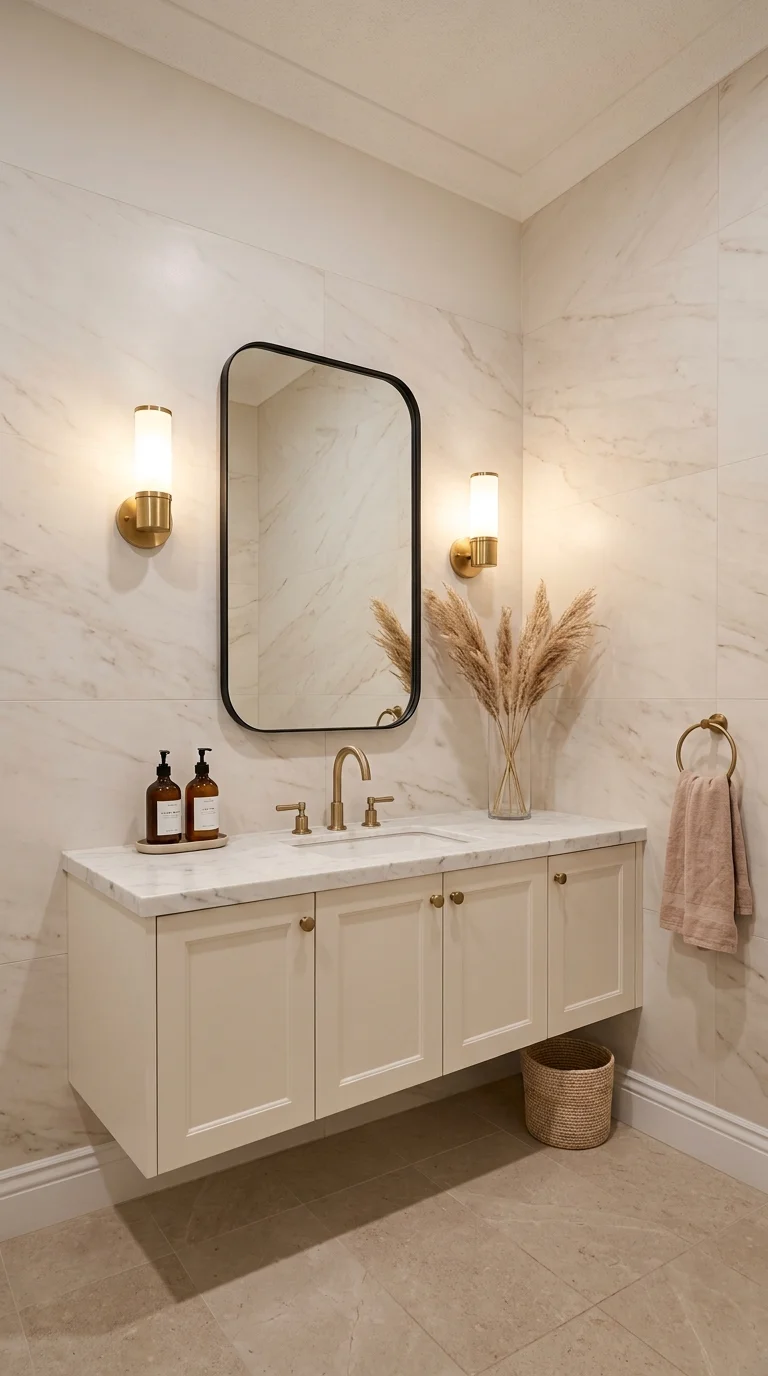
Warm brass sconces keep this all-white marble room from reading cold or clinical.
An all-marble powder room is a common instinct for anyone chasing a luxury look, but marble alone can read sterile without a second material to warm it up. Here, that job falls entirely to the brass — the mirror frame, the two sconces, and the faucet all repeat the same warm metal, which is what keeps the white marble from feeling like a hotel bathroom. The mirror itself is a simple black-framed rounded rectangle, deliberately restrained so it doesn’t compete with the sconces on either side of it; if the frame had been brass too, the wall would have three competing metal accents instead of one clear hierarchy. Choose this direction if you want a resale-friendly, broadly appealing look — marble and brass rarely date the way trend colors do. It’s a weaker choice for anyone wanting a distinctly personal or unusual room, since this combination is now common enough to feel safe rather than surprising.
Recommended Materials: Polished marble tile, black-framed mirror, brass wall sconces, floating cream vanity, woven rattan basket
Main Colors: Warm Marble White, Brass Gold, Cream
Best Lighting: Symmetrical brass sconces flanking the mirror at eye level, avoiding a single overhead source that would cast shadow under the chin
A Small Scale Risk That Pays Off
Rectangular mirrors with rounded corners are a slightly softer choice than a sharp-edged rectangle, and against all that hard marble geometry, that one rounded detail does more to soften the room than it might get credit for — it’s a subtle decision, but removing it would likely make the whole wall feel harder than intended.
For anyone deciding between sconces and an overhead fixture in a similarly tight footprint, this comparison of sconce placements that change how a bathroom feels is worth reading before finalizing electrical placement.
Where This Look Falls Apart
- Mixing brass with a second metal finish like brushed nickel, which breaks the room’s one consistent thread
- Choosing a mirror frame in a competing metal instead of a neutral black or white
- Over-polishing every surface, which can tip the room from “warm luxury” into “showroom”
- Skipping the woven basket or any soft texture, leaving every surface hard and reflective
A Sculptural Mirror That Replaces the Need for Other Décor
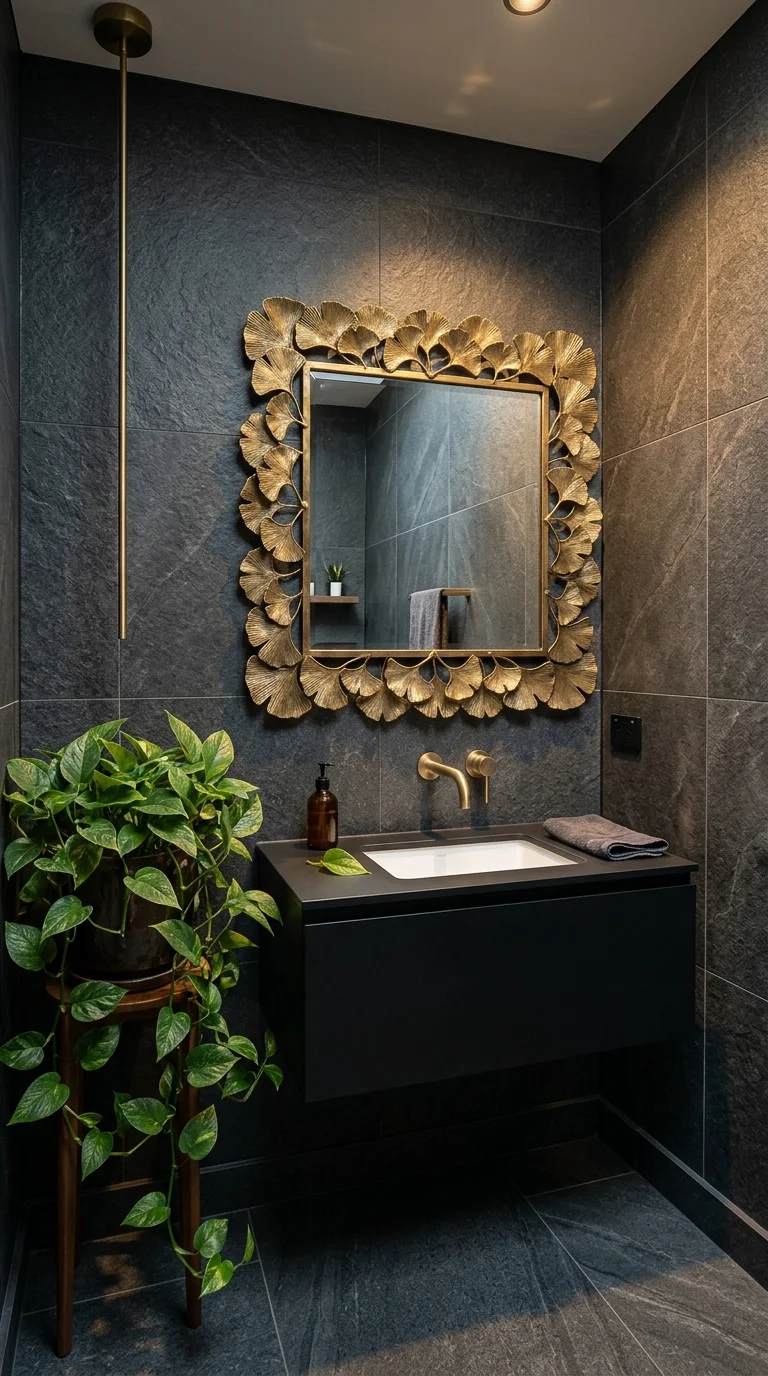
The sculptural frame turns the mirror into the room’s only necessary decoration.
This is the article’s clearest example of a single object doing all the design work. The gold ginkgo-leaf mirror frame is sculptural enough to function as wall art, not just a reflective surface, and because the surrounding stone-tiled walls are left completely bare otherwise, nothing dilutes its impact. Dark charcoal stone is a deliberately bold backdrop choice for a small room — it can make a space feel smaller in photos, but in person it makes the brass fixtures and the mirror’s gold leaves glow noticeably brighter by contrast. A trailing pothos plant on a wood stand is the only other element in the room, and it’s there specifically to soften an otherwise all-hard-surface space with something organic and slightly imperfect.
Is the Statement Mirror Worth It?
A hand-finished sculptural mirror like this typically costs meaningfully more than a plain framed one, and the honest answer is that it’s only worth the premium if the rest of the room is intentionally minimal. Pair it with a busy tile pattern or a lot of other décor and its impact gets lost; pair it with bare stone walls, as here, and it becomes the reason the whole room works. If your walls are already visually busy, that budget is better spent simplifying the walls first.
Recommended Materials: Dark slate wall tile, cast brass ginkgo-leaf mirror frame, matte black floating vanity, brass wall-mount faucet, potted pothos
Main Colors: Charcoal Black, Antique Brass, Deep Green
Best Lighting: A single pendant positioned to catch and reflect off the mirror’s textured brass leaves
Maintaining the Greenery: Pothos tolerates low bathroom light well but needs the soil to dry between waterings — a bathroom’s humidity alone isn’t enough moisture for it to thrive.
For homeowners drawn to this darker, moodier direction generally, it’s worth browsing a full room built the same way in these dark green bathroom ideas that feel moody, luxurious, and timeless.
What Trips People Up Recreating This
- Adding wall art or shelving that competes with the mirror’s sculptural shape
- Choosing a dull or matte gold instead of a finish with real reflective texture
- Skipping the plant, which leaves the room feeling stark rather than intentionally minimal
- Using cool-toned lighting that flattens the warmth the brass is meant to create
Three Mirrors That Read as One Composed Wall
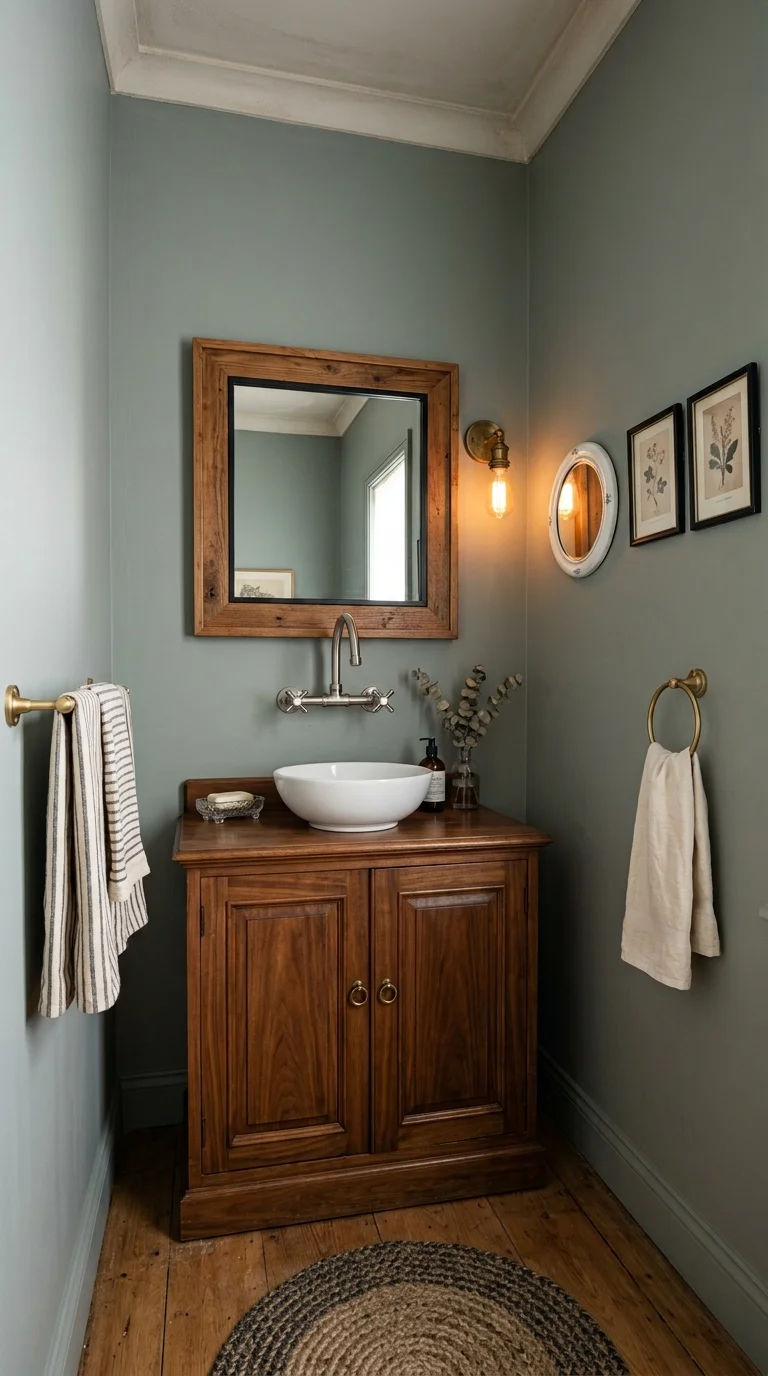
Three mirrors of different shapes work together instead of competing for attention.
Most powder rooms commit to a single mirror; this one uses three and still reads as calm rather than cluttered. The large square wood-framed mirror anchors the vanity, a small oval mirror sits just beside it, and two framed botanical prints continue the same gallery rhythm further down the wall. What keeps this from looking chaotic is that every frame shares the same wood tone and the same era of style, so the eye reads them as one grouping rather than three separate decisions. The sage green wall is muted enough to let that wood-toned cluster stand out without shouting. This is a strong option for anyone who already owns a few mismatched mirrors or frames and doesn’t want to buy one large statement piece — it turns “we didn’t commit to one mirror” into a deliberate design choice instead of an accident.
Recommended Materials: Painted plaster wall, walnut-framed square mirror, oval vanity mirror, framed botanical prints, wall-mount faucet, jute round rug
Main Colors: Sage Green, Walnut Brown, Antique Brass
Best Lighting: A single warm sconce beside the main mirror, since the grouping itself provides visual interest without needing multiple fixtures
One Reason This Wall Feels Resolved
Repetition is doing more work here than color choice — the same wood tone shows up in the mirror frame, the vanity, and the smaller frames, and that repeated material is one reason the wall reads as cohesive rather than assembled. Swapping just the small oval mirror for a metal-framed one would likely loosen that continuity more than it seems it should.
Where This Look Falls Apart
- Mixing frame woods of noticeably different tones within the same gallery grouping
- Hanging the prints too far from the mirror cluster, which breaks the visual grouping apart
- Overcrowding the wall with a fourth or fifth frame, tipping it from curated into busy
- Choosing a striped or patterned rug that competes with the wall’s own visual rhythm
Copper Piping That Solves a Storage Problem the Mirror Alone Couldn’t
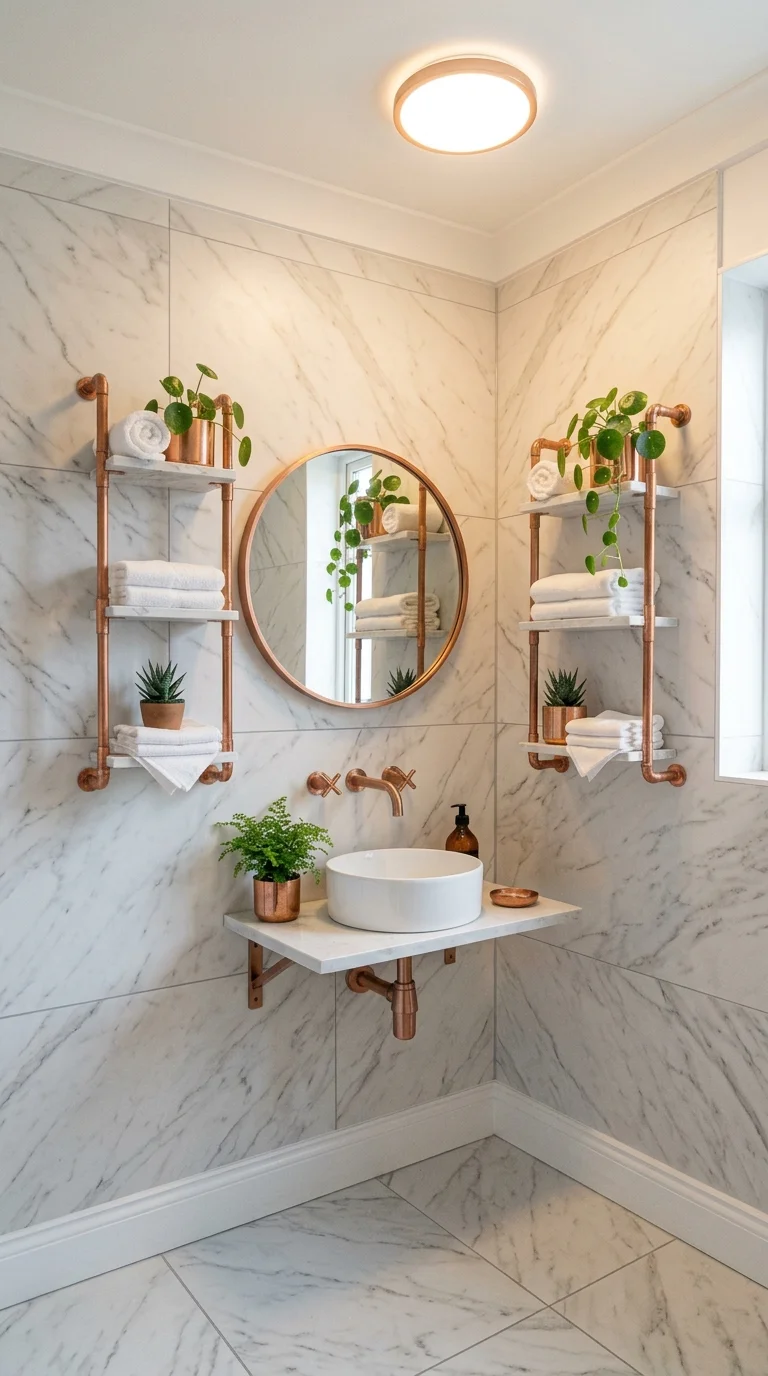
Exposed copper piping doubles as shelving, saving counter space in a narrow room.
A round copper-framed mirror is the centerpiece here, but the more useful decision in this room is what flanks it: two matching shelf units built from exposed copper pipe, holding towels and small potted plants. In a room this narrow, built-in storage isn’t always possible, and these shelves solve that without requiring any wall demolition — they mount directly to the tile like a fixture would. The white marble tile keeps the room bright despite having no window, and the warm copper tone throughout (mirror, shelving, faucet) keeps that brightness from feeling sterile- the same problem an all-white room risks without a second material.
Recommended Materials: Marble tile, copper pipe shelving, round copper-framed mirror, small potted ferns, rolled white towels.
Main Colors: Marble White, Copper, Soft Green
Best Lighting: A flush ceiling fixture positioned centrally, since wall space is already committed to shelving rather than sconces
Keeping the Greenery Alive: Small potted plants on open shelving dry out faster than those on a counter — check soil moisture weekly rather than on a fixed watering schedule.
This layered, minimal-but-warm approach borrows a lot from Japandi styling more broadly — see how the same balance of natural material and restraint plays out in the Japandi bathroom trend explained, room by room, for more of that logic applied elsewhere in the house.
What This Layout Solves in Daily Use
- Guest towels have a dedicated spot instead of piling on the vanity edge.
- Small plants get light without taking up counter space needed for soap and hand towels.
- The shelving doubles as a soft frame for the mirror, so the wall feels finished even before anything is hung on it.
- Everything mounted stays above splash height, keeping copper fittings away from standing water.
Easy Ways to Get This Wrong
- Overloading the shelves with too many objects, which turns a clean industrial look cluttered
- Mixing copper with a second metal tone on the faucet or mirror frame
- Skipping sealant on grout lines near the shelf mounting points, risking water damage over time.
- Choosing shelves too deep for the room, which will make the already-narrow space feel tighter
A Ribbed Arched Frame That Softens a Two-Tone Wall
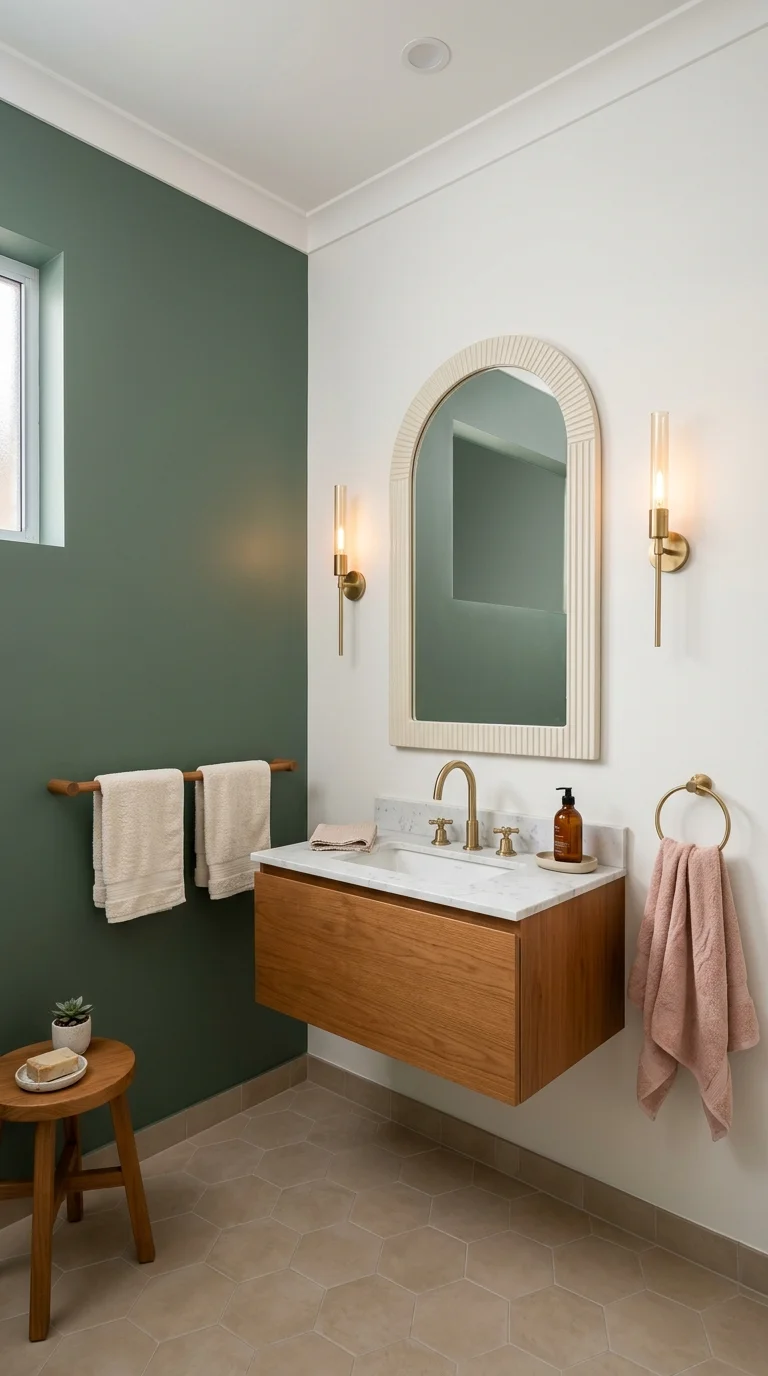
A two-tone wall lets the ribbed mirror frame read as texture, not just shape.
Splitting a wall between a broad green accent and plain white is a classic way to add color without repainting an entire small room, but the mirror choice here is what keeps the two-tone wall from feeling like two separate decisions. Its cream, ribbed, arched frame has enough texture and a soft enough shape to bridge both wall colors instead of matching either one directly. That arched top also echoes the vanity’s rounded vessel sink, which is a smaller repetition most visitors won’t consciously notice but will register as “put-together.” Brass sconces on either side add warmth without competing with the mirror’s own cream tone, and a warm wood vanity keeps the room from leaning too cool despite the green.
Recommended Materials: Painted plaster (two-tone), ribbed plaster mirror frame, brass wall sconces, oak floating vanity, terracotta hexagon-adjacent tile, cotton towels
Main Colors: Forest Green, Soft White, Warm Oak, Brass
Best Lighting: Brass sconces mounted at mirror height on the white portion of the wall, where they read clearly against the lighter backdrop
A Palette Built Around Restraint
Only three real colors appear in this entire room — green, white, and warm wood — and that restraint is what lets the pink towel work as a single accent pop rather than getting lost. Adding a fourth strong color anywhere else in the room would likely compete with that towel for attention.
Where This Look Falls Apart
- Choosing a mirror frame color that matches one wall exactly instead of bridging both
- Placing the accent wall color on the wrong wall, so it fights the vanity instead of framing it.
- Skipping the rounded vessel sink in favor of an undermount, losing the echo with the arched mirror
- Overloading the small wood stool with more than one or two objects
An Oval Mirror That Softens a Room Built From Straight Lines
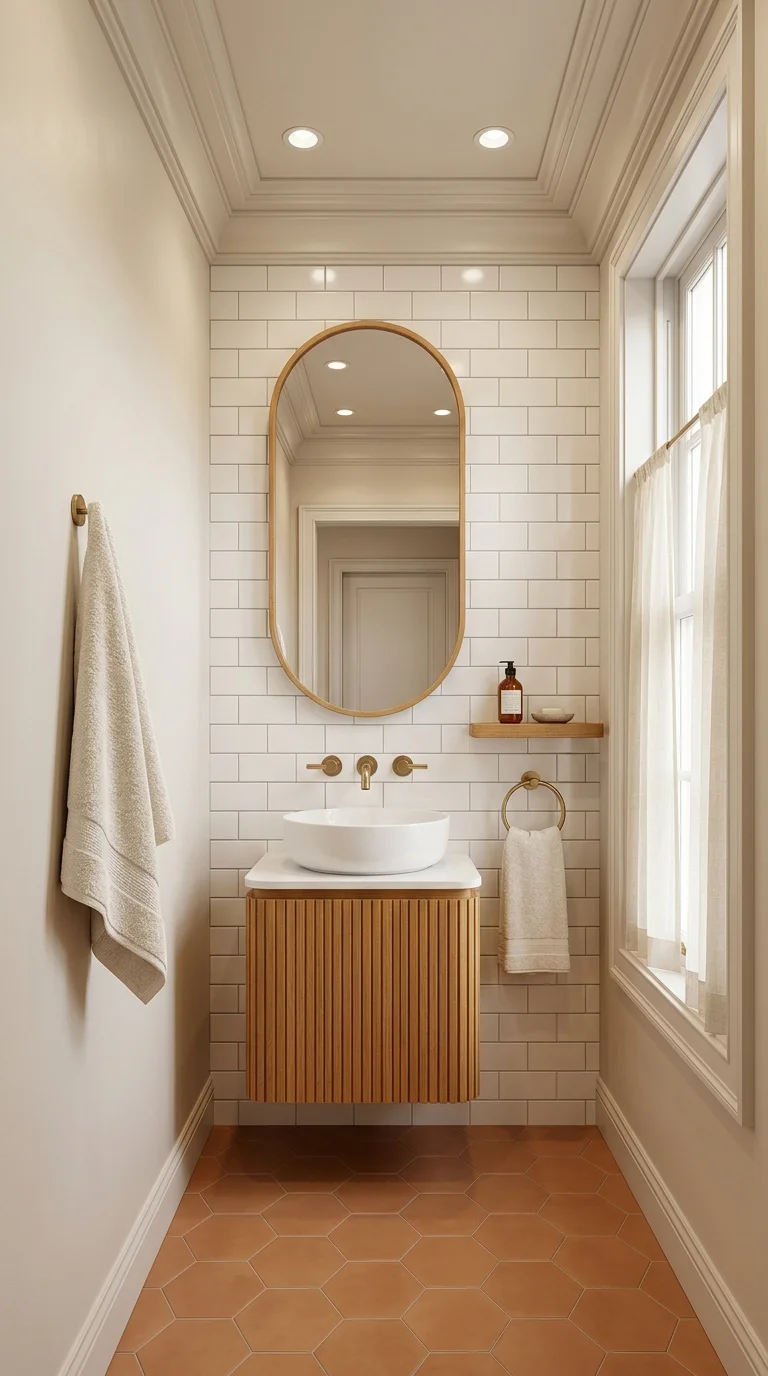
The oval shape softens all the straight lines already present in the subway tile.
Subway tile, a rectangular window, and a slatted wood vanity all bring hard, straight lines into this narrow room — the oval pill-shaped mirror is the one deliberately curved element, and it’s doing more visual work than its size suggests. Without it, the room would read as entirely geometric and slightly clinical; with it, there’s one soft shape for the eye to land on. The wood tone on both the mirror frame and the vanity slats ties the two together, while the terracotta hexagon floor introduces warmth from below in a room that’s otherwise mostly white. This is a strong template for narrow hallway-style powder rooms specifically, since the elongated mirror shape works well in a tight vertical space where a large round or square mirror might feel cramped.
Recommended Materials: White subway tile, oak-framed oval mirror, slatted oak vanity, terracotta hexagon floor tile, linen curtain
Main Colors: White, Warm Oak, Terracotta
Best Lighting: Recessed ceiling lights supplemented by a wall-mounted shelf light near the mirror, plus natural light from the window
Why the Proportions Work in a Narrow Room
The mirror’s height-to-width ratio is noticeably taller than wide, which matters more in a narrow room than most people account for — a wider mirror in this same footprint would visually shrink the already-tight wall space rather than opening it up.
Terracotta and warm wood floors like this pair naturally with vanity choices that lean traditional; for more on getting that vanity pairing right, this guide on upgrading a bathroom with the right vanity is a useful next read.
What Trips People Up Recreating This
- Choosing a perfectly round mirror instead of the taller oval, which changes the room’s proportions
- Grouting the subway tile in a dark color that overwhelms the terracotta floor’s warmth
- Skipping the wood tone repetition between mirror frame and vanity
- Hanging the mirror too high, breaking the sightline the oval shape is meant to create
An Octagon Mirror That Repeats the Tile’s Angles on Purpose
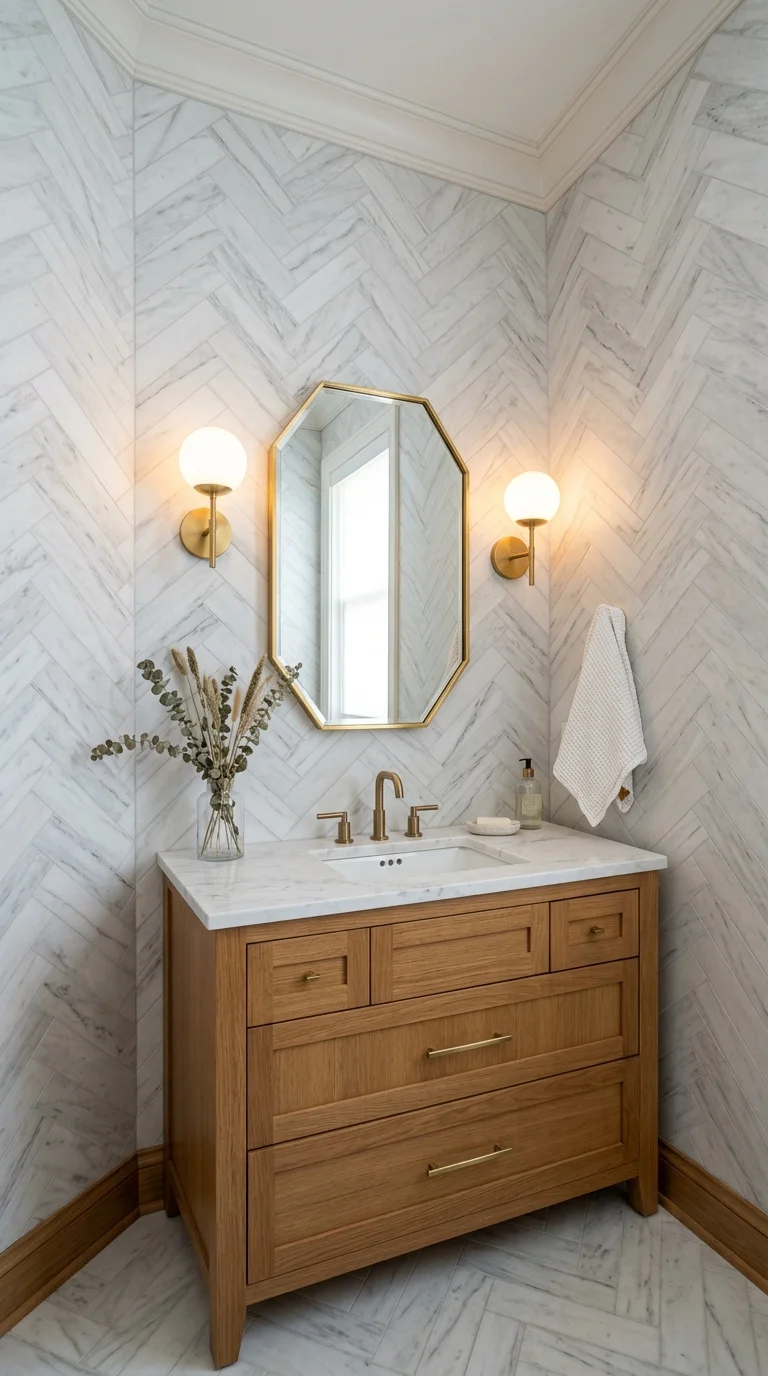
Herringbone tile and an octagon mirror repeat angles without ever feeling matched.
Herringbone-laid marble tile already fills this wall with diagonal lines, and instead of choosing a plain round or square mirror to contrast that pattern, this room doubles down with an octagonal brass-framed mirror that echoes the same angularity. That’s a riskier decision than it looks — pattern-on-pattern can easily become visually noisy — but it works here because the tile is a single neutral marble tone, so the “pattern” is texture rather than color, leaving room for one more geometric shape without overwhelming the wall. Twin brass globe sconces flank the mirror symmetrically, which grounds the more unusual mirror shape in a classic, familiar lighting arrangement.
Recommended Materials: Herringbone marble tile, brass octagonal mirror frame, brass globe sconces, oak vanity with brass hardware, waffle-weave towel
Main Colors: Marble White, Warm Oak, Brass Gold
Best Lighting: Matched brass globe sconces at eye level, chosen specifically for soft, even light rather than a directional beam
Why the Eye Goes to the Mirror First
Herringbone patterns naturally pull the eye along their diagonal lines, but the octagon’s straight-edged symmetry interrupts that movement and holds it — that’s the specific reason the mirror reads as the room’s focal point despite the tile pattern’s visual pull.
What Trips People Up Recreating This
- Choosing a round mirror instead of an angular one, which loses the intentional echo with the tile
- Running the herringbone pattern in more than one tile color, which turns texture into busy pattern
- Mismatching the sconces instead of using a symmetrical matched pair
- Selecting a mirror frame in a metal that doesn’t match the vanity hardware
An Ornate Frame as the Room’s One Maximalist Choice
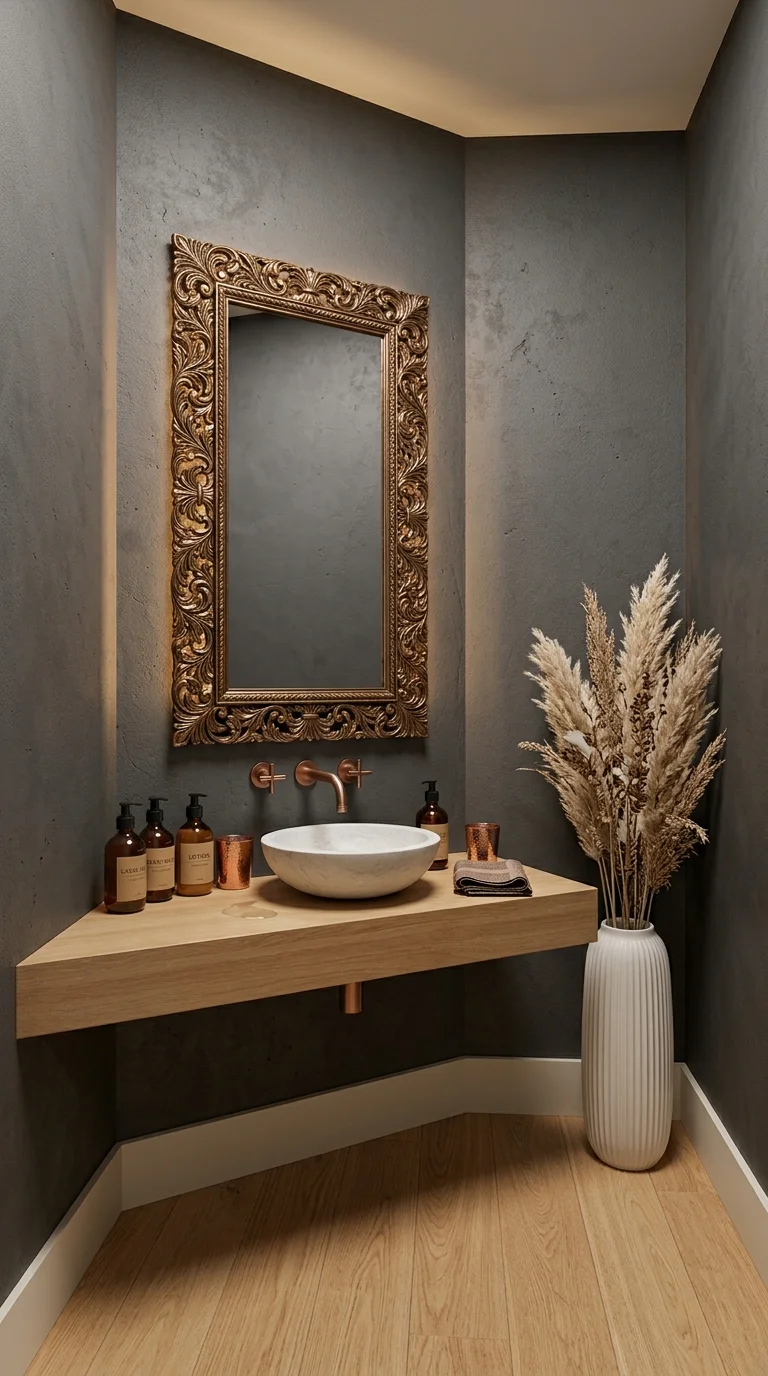
An heirloom-style frame is the one deliberately maximalist choice in an otherwise dark room.
Every other room in this article leans toward restraint somewhere; this one is the exception. Against dark charcoal plastered walls, a large ornate gold baroque-style mirror frame is allowed to be genuinely decorative — carved florals and scrollwork rather than a clean geometric edge. That’s a deliberate contrast strategy: the darker and more minimal the backdrop, the more a single ornamental piece can carry the whole room without looking excessive. A floating wood shelf serves as the vanity surface instead of a full cabinet, which keeps the room from feeling heavy despite the dark walls and elaborate mirror, and a tall vase of pampas grass adds height without adding visual weight.
Recommended Materials: Plastered dark walls, ornate gold-framed mirror, floating oak shelf, copper wall-mount faucet, ribbed ceramic vase, dried pampas grass
Main Colors: Charcoal Black, Antique Gold, Warm Oak
Best Lighting: Warm, low-positioned lighting that lets shadow pool slightly in the room’s corners, keeping the mirror as the brightest point by contrast
Who Should Skip This Style?
An ornate frame this decorative isn’t a fit for anyone who plans to resell soon or who already has strong personality elsewhere in the home’s décor — it’s a genuinely bold, opinionated choice, and it reads best in a house that’s comfortable with a little maximalism rather than one aiming for broad neutral appeal.
Readers drawn to this darker, more atmospheric direction across an entire bathroom rather than just a powder room may want to browse moody bathroom ideas that feel luxurious, not dark, for a fuller room-scale version of the same contrast strategy.
Easy Ways to Get This Wrong
- Pairing the ornate frame with an equally ornate vanity, which creates competing focal points
- Choosing a wall color too light to let the dark-and-gold contrast register
- Skipping a floating shelf for a boxy cabinet, adding visual weight the room doesn’t need
- Using cool white lighting that flattens the gold frame’s warmth and detail
Keeping These Mirror Finishes Fog-Free Between Guests
- Wipe brass, copper, and gold-leaf frames with a dry microfiber cloth rather than glass cleaner, which can dull metallic finishes over time.
- Run the exhaust fan for at least ten minutes after any shower elsewhere in the house shares ventilation with the powder room.
- Check stone vessel sinks and unsealed wood vanities monthly for water spotting, since powder rooms get quick, frequent use without much airflow.
- Keep a small squeegee near backlit or LED mirrors specifically, since moisture buildup around the light seal can shorten the fixture’s lifespan.
Who Should Choose This Style?
- Best for homeowners who want a small guest bathroom to make a strong first impression without a full remodel
- Best for renters or budget-conscious homeowners, since a mirror swap is one of the least expensive ways to change a room’s entire character
- Best for anyone with a windowless powder room, where a backlit or reflective mirror choice can meaningfully improve how bright the space feels
- Not ideal for households wanting a completely neutral, resale-focused bathroom — several of these mirror choices are intentionally bold and personal
Budget Summary
| Budget | Expectation |
|---|---|
| Low | A simple framed mirror swap, fresh paint, and a plug-in sconce or two |
| Medium | A backlit LED mirror, brass or copper hardware upgrades, and a floating vanity |
| Premium | A custom sculptural or hand-carved mirror frame, natural stone surfaces, and full electrical sconce work |
Frequently Asked Questions
How big should a mirror be in a small powder room?
As a general guide, the mirror should be roughly 70–80% of the vanity’s width, though several rooms above — particularly the sculptural and gallery-wall examples — intentionally break that rule to make the mirror the room’s focal point rather than a simple vanity accessory.
Does the mirror frame need to match the faucet finish?
Not always, but matching or closely coordinating them (as seen in nearly every room above) is what keeps a small space from feeling visually busy — in a room this size, three or more competing metal finishes tend to read as clutter rather than layered design.
Can a bold mirror replace the need for wallpaper or an accent wall?
Often, yes. Several rooms here use one sculptural or ornate mirror as the room’s entire personality statement instead of a patterned wall, which can be a lower-maintenance way to get a similar visual impact.
About StartechLife Team
StartechLife Team is a home décor and interior design publication written by a team who researches and curates real, achievable design ideas for everyday homes. For this piece, the focus stayed specifically on small-space powder rooms, where a single fixture decision carries more visual weight than in almost any other room. Every recommendation here is chosen for being realistic to recreate at different budget levels, not just aspirational to look at.
Conclusion
A powder room mirror rarely gets the same planning attention as a kitchen backsplash or a living room sofa, but as these ten rooms show, it’s often the one object doing the most design work in the entire space. Whether that means a backlit circle solving a lighting problem, an ornate gold frame carrying a dark room’s whole personality, or three smaller mirrors working together instead of one large one, the right choice comes down to how much visual weight your own small room can actually hold — and how much personality you want the first thing a guest sees to carry.

