

A laundry room usually gets whatever paint was left over from another project. Sage green has started changing that, and not by accident — it’s one of the few colors that reads calm under bright task lighting and still looks warm once the sun goes down. The ten rooms below use that same color in ten different ways: through cabinetry, tile, open shelving, wood, and even a single wall-mounted rod. Read them as ten separate decisions rather than ten pretty photos, and you’ll come away knowing which version actually fits your space, your budget, and how your household does laundry.
Quick Overview
| Style | Sage Green Farmhouse-to-Transitional |
|---|---|
| Best For | Multi-machine laundry rooms and renovators who want a calming, neutral-adjacent palette |
| Budget | Medium |
| Difficulty | Easy DIY paint-and-shelving projects up to full custom cabinetry builds |
| Maintenance Level | Low to medium |
Should Your Laundry Room Commit Fully to Farmhouse Style?
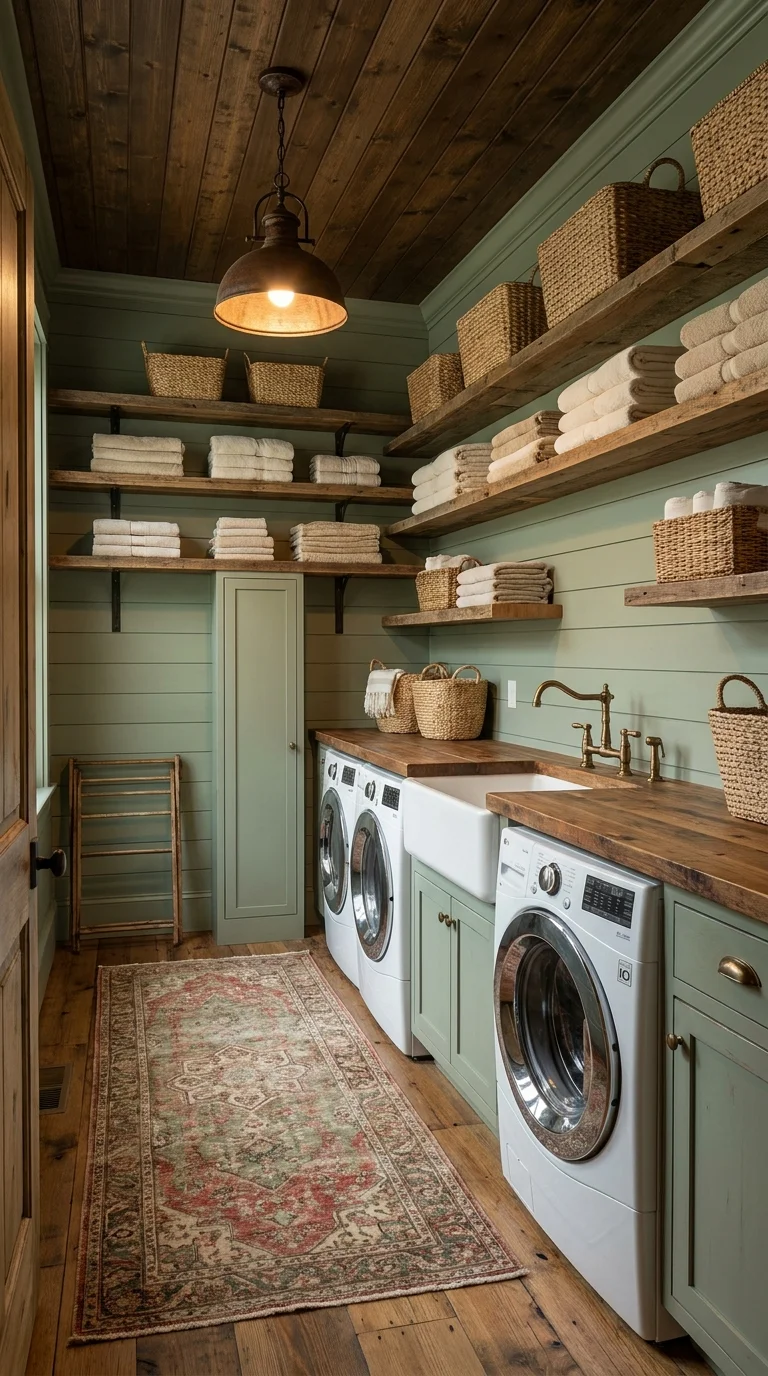
Three appliances sit in a row under one long reclaimed-wood counter here, with a farmhouse sink dropped into the middle and a stained wood ceiling overhead. That ceiling is doing more than it looks like at first — pale sage shiplap walls this pale need a darker anchor somewhere in the room, or the whole space starts to feel like a paint chip rather than a finished room. Swap the ceiling for white and the shiplap loses its contrast almost entirely.
Two shelves above the counter hold matching woven baskets, and the repetition matters more than any single basket does. A single mismatched basket would throw off the whole shelf; ten identical ones read as a system instead of leftover storage. An industrial pendant light and a faded vintage-style rug both lean warm, which keeps this much sage from tipping cold.
This look suits a household that already has farmhouse touches somewhere else in the house — a room committed this fully to one style can feel out of place if it’s the only one. It also needs real length to work, since three machines and a full counter run take up more floor space than most laundry closets have.
Recommended Materials: stained wood ceiling planks or peel-and-stick wood planks, painted shiplap, butcher block or reclaimed wood counter, farmhouse apron sink, woven seagrass baskets
Where This Goes Wrong
- Painting the ceiling the same sage as the walls, which erases the contrast holding the room together
- Choosing a light-toned counter that shows water spots near the sink
- Mixing basket sizes or materials instead of repeating one style
- Hanging a small, modern fixture that fights the room’s scale
Is Tall Cabinetry the Fix for a Narrow Laundry Nook?
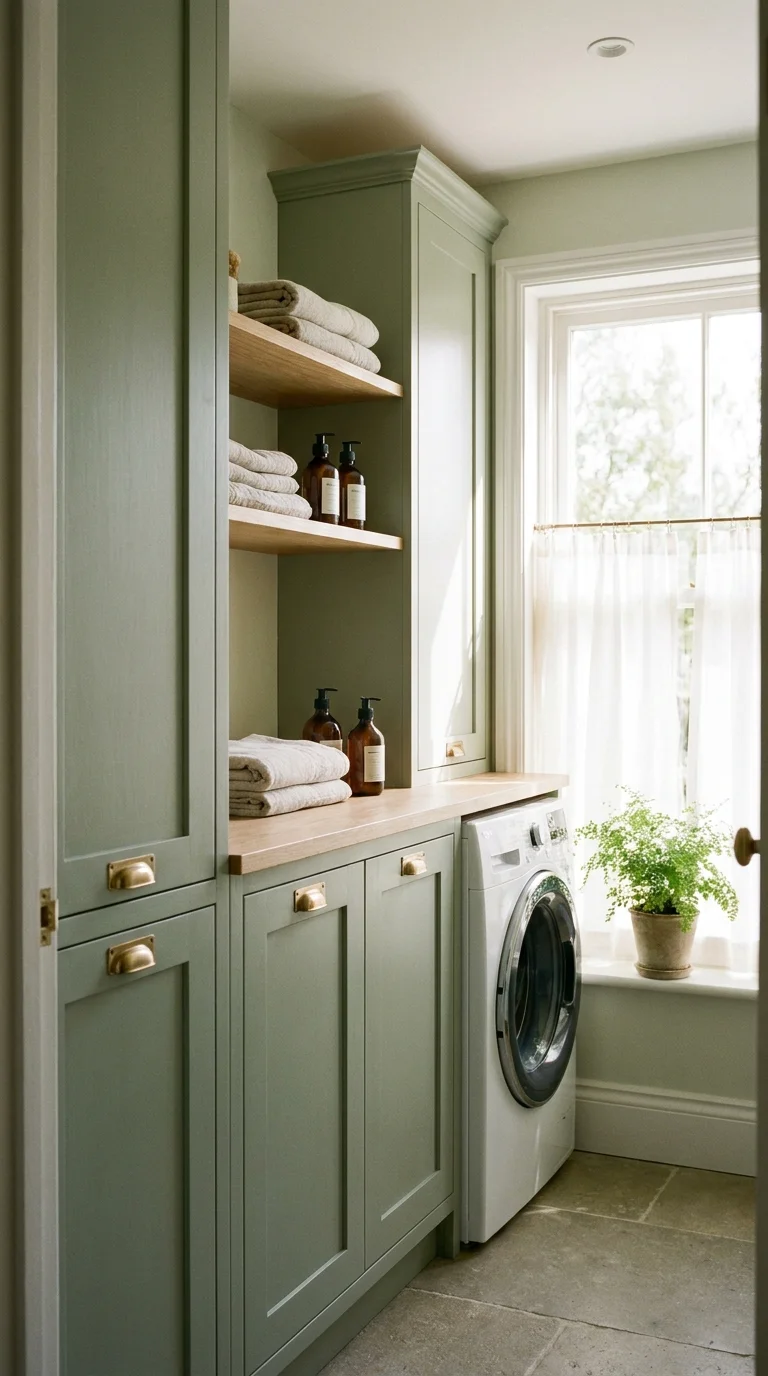
One washer, one window, and floor-to-ceiling sage green cabinetry — that’s the entire room, and it works because the cabinetry goes all the way up instead of stopping at a standard upper-cabinet height. In a footprint this narrow, vertical storage does what square footage can’t.
Brass cup pulls run down the full cabinet run, and a butcher block shelf holds amber apothecary bottles next to folded towels, arranged like they’re meant to be seen from the hallway, not just used. A sheer curtain filters the window light, which flatters sage more than direct sun does — harsh light tends to wash the color out, while filtered light lets it stay soft.
Apartment dwellers and anyone converting a closet or hallway alcove are the obvious fit. A two-machine household isn’t, since there’s no floor space left for a second appliance in this layout. The same reasoning that makes sage forgiving in a small sage green kitchen applies here too — a bolder color in a space this tight would feel like standing inside a paint can.
Getting This Look Without Custom Cabinetry
A tall, ready-to-assemble pantry cabinet, painted sage and topped with a butcher block cut to size, gets close to the same vertical effect for a fraction of a custom build’s cost.
Should You Put Statement Wallpaper in a Utility Room?
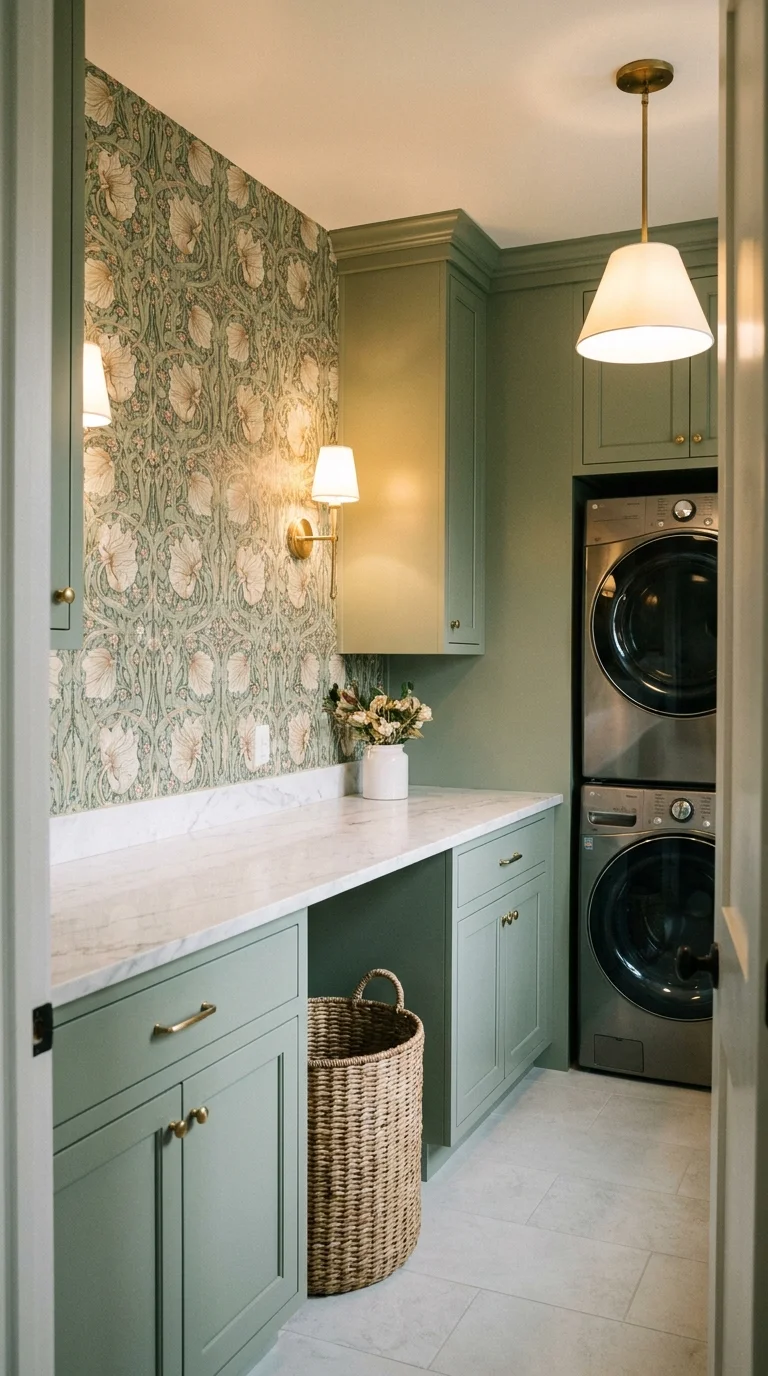
Sage green plays a supporting role here instead of the lead. A William Morris-style floral wallpaper covers one wall, and the plain sage cabinetry on either side gives the eye a quiet place to rest before and after taking in the pattern. Cover every wall in a print like this and it would compete with itself; confine it to one wall and it reads as intentional.
A stacked washer-dryer tower frees up counter space for genuine marble — a bigger cost jump from butcher block than it might look, and one that tells you this room was built to feel like an extension of the house’s living spaces rather than something tucked out of sight. Two brass sconces plus a fabric-shaded pendant put more light over this counter than laundry actually requires, but that extra light is what makes the wallpaper’s detail visible instead of flat.
Homeowners renovating a period or traditional-style home are the natural audience. A household that uses this room as a mudroom or drop zone probably isn’t, since wallpaper won’t hold up to daily foot traffic and dropped bags the way a washable painted wall would.
Can Lighting Alone Carry a Simple Laundry Room?
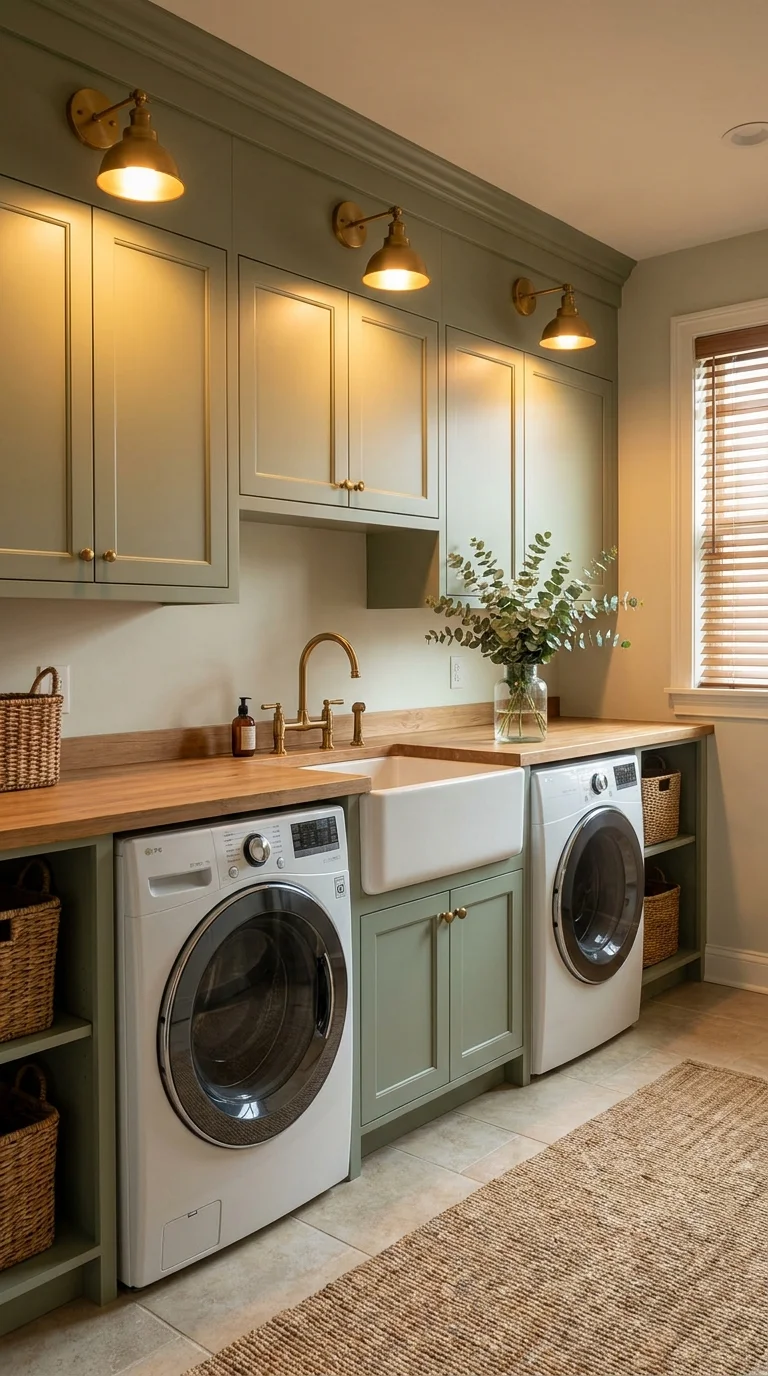
Two appliances, a wood counter, open shelving — on paper, an ordinary laundry room. Three brass sconces mounted right above the cabinets change that. They sit closer to counter height than any ceiling fixture could, and counter height is exactly where the actual work happens: sorting, folding, treating a stain.
A jute runner on the floor repeats the same warm tone as the brass, a small detail that ties the room together more than the shelving or appliances do. This is worth trying in a renovation that isn’t touching plumbing or walls, since wall sconces rarely need more than an electrician and a free afternoon.
A Few Ways This Gets Undercut
- Cool white LED bulbs instead of warm-toned ones, which cancels the sconces’ effect almost entirely
- Mounting the sconces too high, losing the intimate, task-lit feel they’re built for
- Brass fixtures paired with chrome or nickel faucet hardware instead of a matching warm metal
- A bright ceiling fixture layered on top, which competes with the sconces instead of supporting them
Is a Wall of Matching Baskets Worth Setting Up?
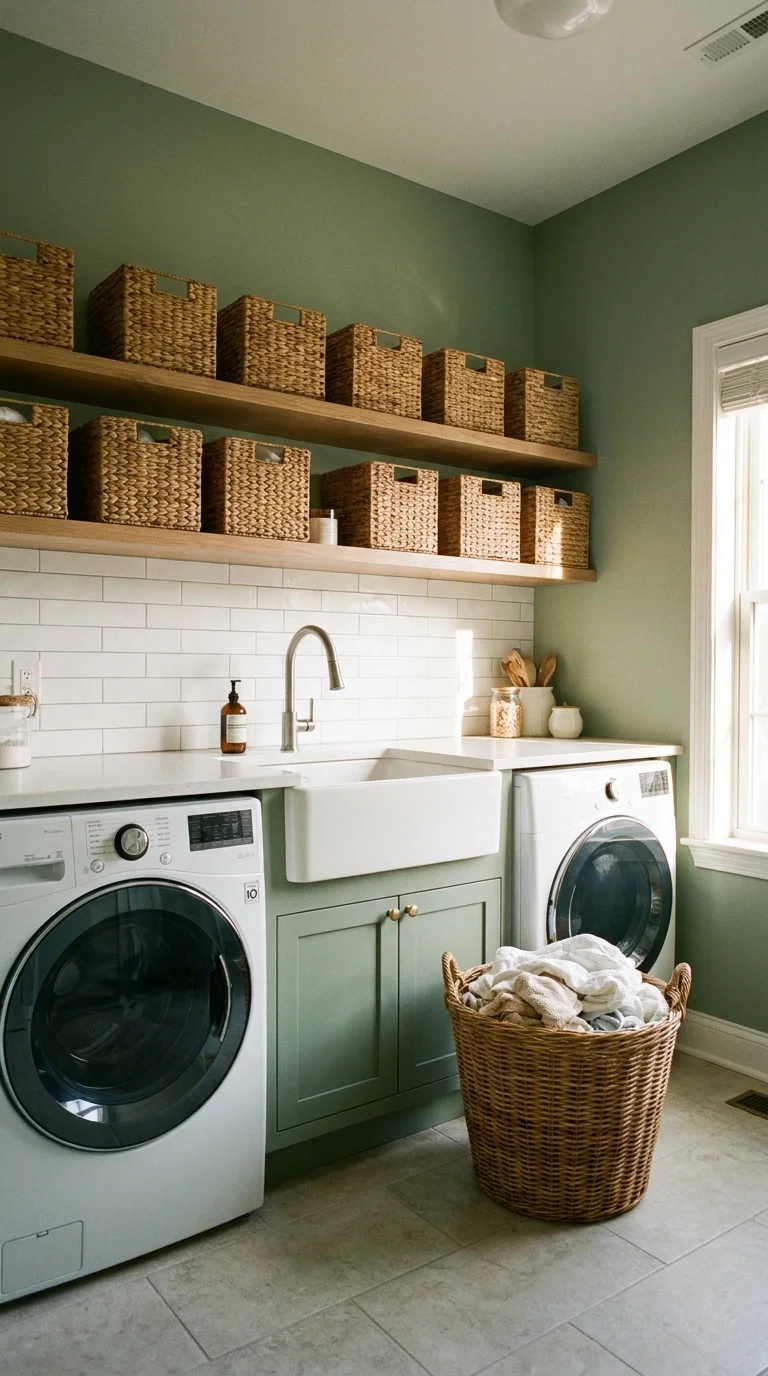
This sage leans more olive than the others in this list, which is why it sits against crisp white subway tile instead of a lighter backsplash — a darker green next to a darker surface would read muddy fast. Above the counter, identical woven baskets run the full length of two shelves, spaced with obvious intention. One basket in the wrong size would break that rhythm; the sameness is the whole point.
A farmhouse sink and a single washer sit below, and an oversized wicker hamper overflowing with towels sits on the floor as the one deliberately imperfect note in an otherwise ordered room.
This setup only holds up if the household actually sorts laundry into visible categories — towels, whites, delicates — since open baskets look intentional only when what’s inside them stays neat. Anyone who piles rather than sorts would likely do better with the closed-door approach used in a similarly toned sage kitchen, where the mess stays out of view.
Should the Windows Decide the Whole Design?
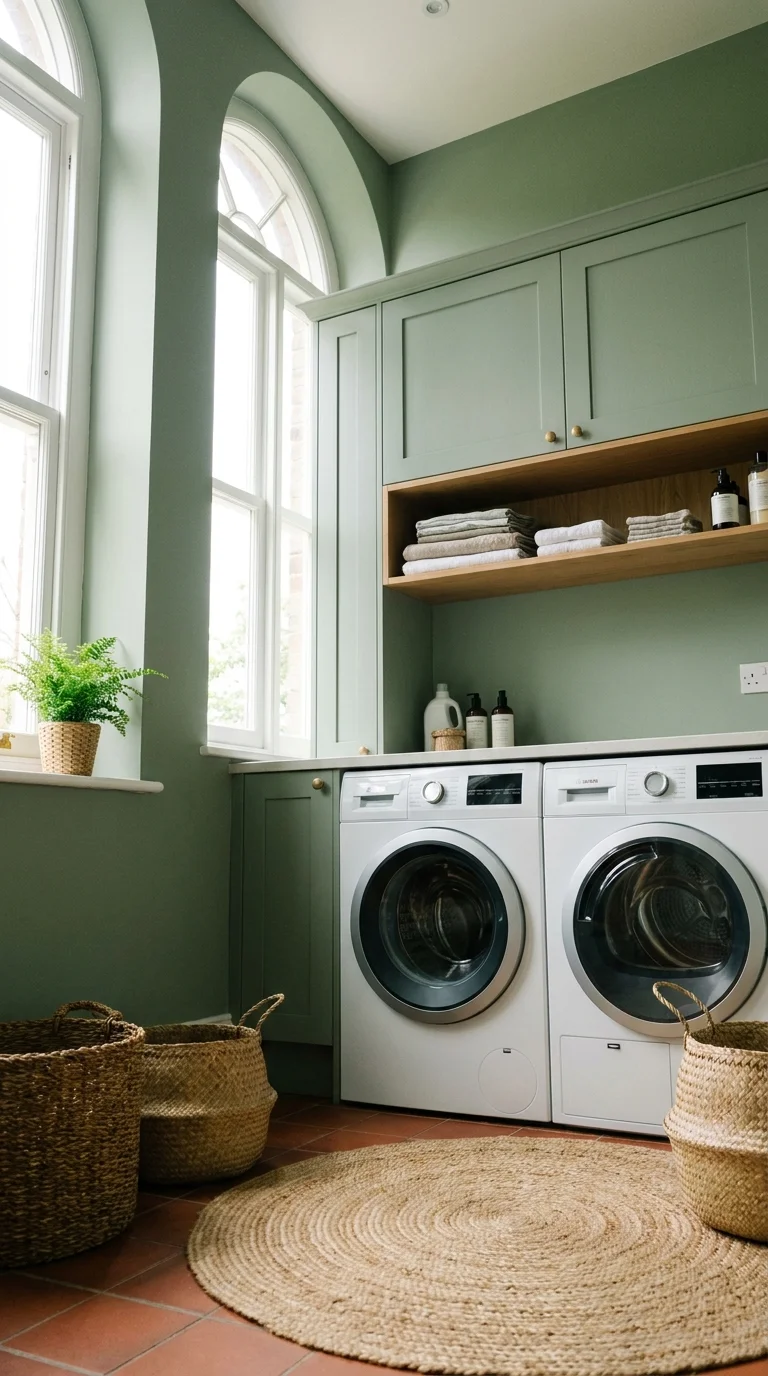
Two tall arched windows take up most of the visual space in this room, and everything else — terracotta tile, a round jute rug, pale sage walls — reads like it was chosen to stay out of their way. Heavy cabinetry or a busy tile pattern would have pulled attention from the one feature that can’t be added after the fact.
The terracotta floor does real color work, warming a palette that would otherwise lean cool given how much sage surrounds it. A simple built-in shelf nook above the machines holds folded towels without asking for attention, and floor baskets absorb whatever storage the shelf can’t.
This only makes sense in a home with genuine architectural bones — an older cottage, a converted period building, something with windows like this already in place. New construction rarely justifies arched windows purely for the look, given the cost. A newer build chasing the same palette without that architecture would get further with the ideas in a sage green living room, where the color carries the room instead of the windows.
Do Glass-Front Cabinets Make Sense Next to a Washing Machine?
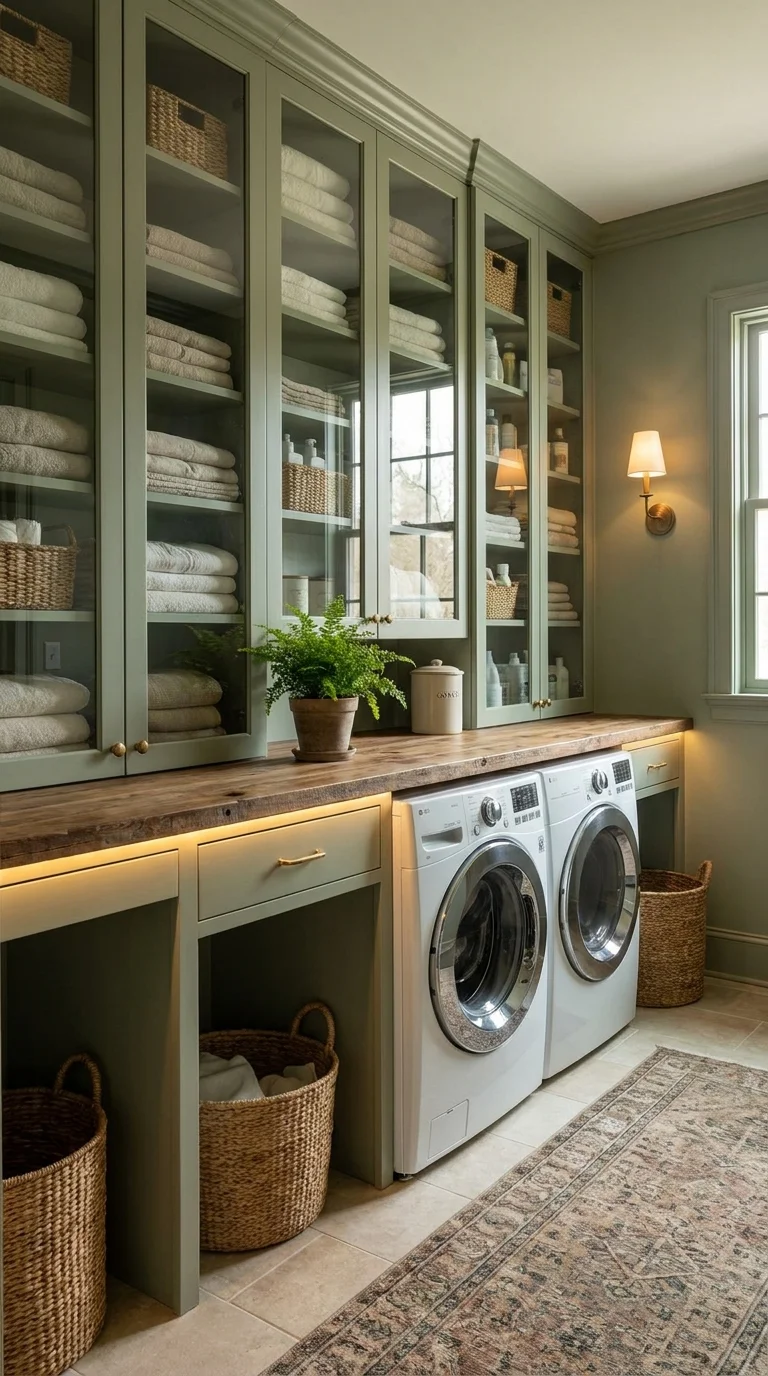
Most laundry rooms hide what’s inside their cabinets. This one puts folded towels and toiletries behind glass, arranged with the kind of care you’d expect in a dining room hutch. That choice only works if the contents actually stay tidy — a closed door forgives clutter; glass doesn’t.
Underneath, a dark reclaimed-wood counter has a hidden LED strip built in, and on either side of the machines, two open knee-hole stations function like small desks — a second use for the room beyond washing clothes. Brass hardware ties the cabinet pulls, the sconce, and the faucet into one consistent finish.
This suits a household that folds and puts laundry away promptly, or wants somewhere to wrap gifts or sort mail. It’s a mismatch for anyone who treats the laundry room as a drop zone for unsorted baskets, since there’s nowhere here to hide that kind of pile once the glass doors are in.
Is the Glass Worth the Extra Upkeep?
Glass fronts and hidden LED strips cost more than solid doors and a standard ceiling fixture, and neither one washes a single load of laundry. The upside only shows up in a household that already keeps its towels folded and its counters clear — for anyone whose routine is messier than that, the same money would likely go further on deep, closed storage instead.
Should a Laundry Room Open Straight to the Outdoors?
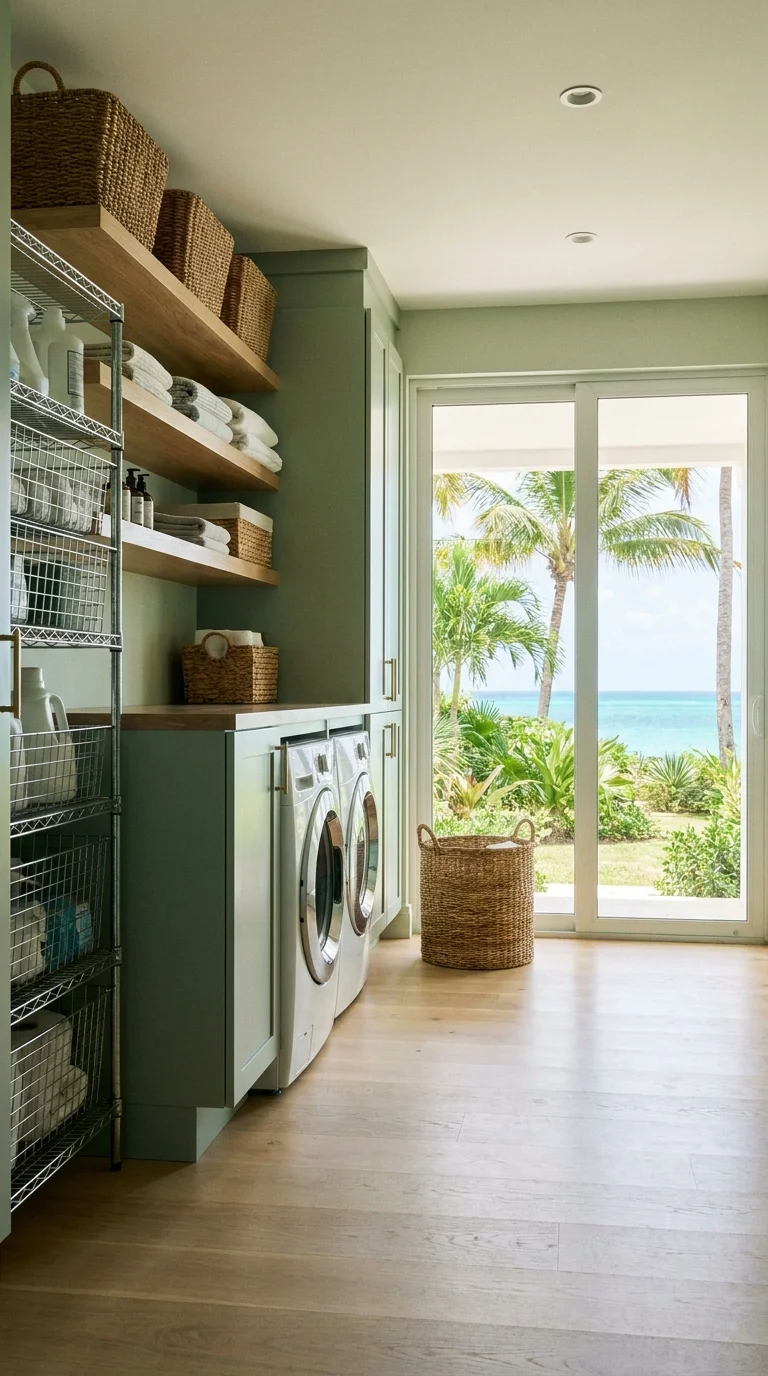
A sliding glass door connects this laundry room directly to palm trees and open water, and light oak flooring runs the full length of the space to carry that connection inside. Sage green cabinetry stays confined to one side wall so it never blocks the view.
A chrome wire shelving unit sits right next to the built-in cabinetry, and that pairing is more deliberate than it looks — an off-the-shelf industrial shelf next to custom millwork keeps the room from feeling too polished for a space that still does actual work. A woven basket parked just outside the door hints that laundry and outdoor living overlap here, which only makes sense in a warm, coastal climate where drying racks genuinely move between inside and out.
This is a layout worth admiring rather than copying directly, unless a home already has a similar indoor-outdoor threshold to build around. For most renovations, the more transferable idea is the mixed-metal shelving, not the ocean view behind it.
Is Matching Your Appliances to the Cabinets Worth the Cost?
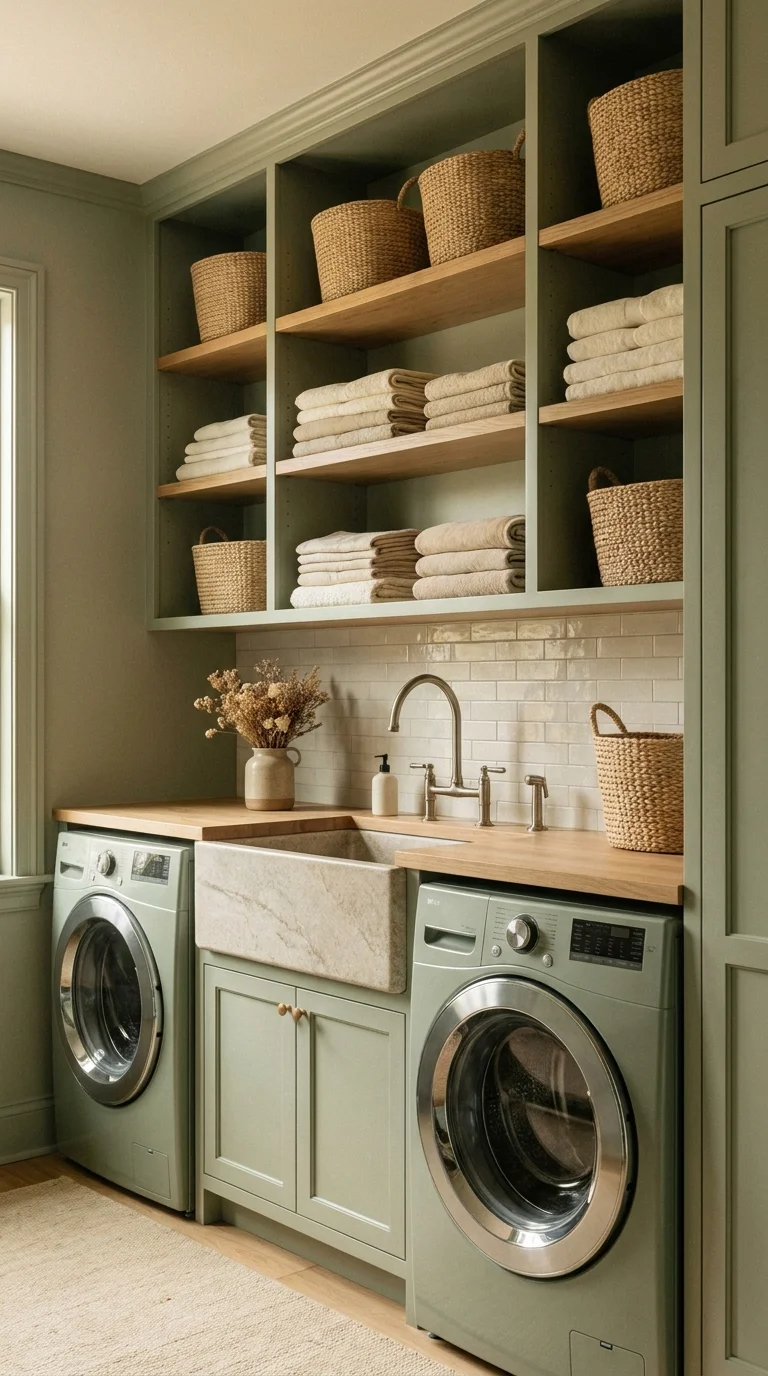
Panel fronts on the washer and dryer are painted to match the surrounding sage exactly, which is why this reads as one continuous wall of storage instead of a room with appliances shoved into it. Open cubbies above hold uniform baskets on top and folded towels below, with a stone-look farmhouse sink centered between the two color-matched machines.
That kind of integration only comes through custom or semi-custom appliance panels, and it’s a genuinely different price tier than a standard washer and dryer — an existing set can’t simply be repainted, since factory finishes won’t hold ordinary paint the way wood cabinetry does.
This fits a full gut renovation where appliance panels can be ordered alongside the rest of the cabinetry. It doesn’t fit a smaller update where the washer and dryer are staying put, since there’s no retrofit version of this look.
Where the Cost Adds Up Fast
- Assuming any washer or dryer can be painted, when only panel-ready models actually support it
- A cabinet paint sheen that doesn’t match the appliance panel manufacturer’s finish, creating a visible seam
- Skipping the open cubbies for flat-front doors, which flattens the whole wall into one surface
- Underestimating how much more panel-ready appliances cost over standard models
Can a Laundry Room Work Without Any Shelving at All?
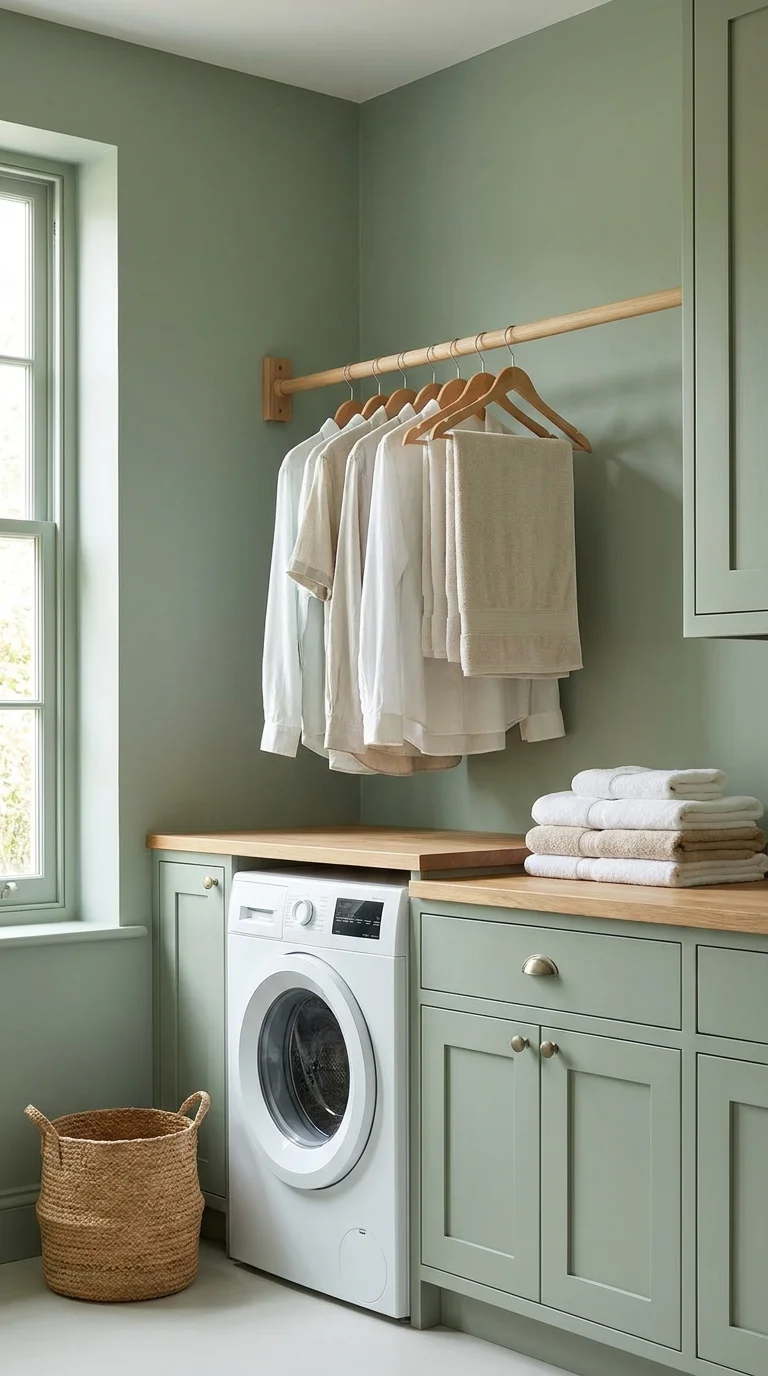
No shelving, no baskets stacked on a counter — just a stacked washer, sage paint on every wall, and a single wood rod mounted at an angle in the corner, holding hangers of shirts and one folded towel. The assumption behind this room is different from every other one on this list: clothes hang and dry in place instead of needing somewhere to be stored.
One small woven basket on the floor is the only nod to traditional storage. This fits a genuinely tight footprint — a hallway closet, an under-stair nook — where built-in shelving isn’t physically an option. It’s the wrong call for a household running regular loads of towels and sheets, since that volume needs more than a single rod can hold.
Getting Through Wash Day Without the Chaos
- Mount the rod high enough to clear hangers, but low enough to reach without a step stool for most heights
- Keep one basket dedicated to items waiting to be hung, so nothing piles on the floor between loads
- Match the rod’s finish to the room’s other hardware, since it’s one of the few fixtures actually on display
- Add a small hook strip beside the rod for the odd item a hanger won’t hold
Who Should Choose This Style?
- Best for homeowners who want a calming, neutral-adjacent palette that reads warmer than white or gray
- Best for farmhouse, cottage, and transitional homes with existing wood tones to set the green against
- Best for renovators willing to add open shelving or baskets, since sage relies on visible texture to avoid feeling flat
- Not a strong fit for a stark, ultra-modern laundry room, since sage tends to read warm and traditional even in its coolest shades
Budget Summary
| Budget | Expectation |
|---|---|
| Low | Sage paint, ready-made wire or wood shelving, store-bought woven baskets |
| Medium | Painted shaker cabinetry, a butcher block counter, a farmhouse-style sink, brass hardware |
| Premium | Custom cabinetry with matching appliance panels, natural stone counters, architectural windows |
Frequently Asked Questions
Does sage green work in a laundry room with no natural light?
It can, with some adjustment. A lighter, warmer sage paired with warm-toned bulbs holds up better without daylight — under harsh overhead lighting alone, sage can start to read gray rather than green.
Is a wood countertop practical near a laundry sink?
Yes, as long as it’s sealed properly. A well-sealed butcher block counter handles occasional splashes without trouble, though standing water should still get wiped up promptly to protect the seal.
What hardware finish pairs best with sage cabinetry?
Brass and aged brass tend to feel warmest against sage. Chrome and nickel work too, but they shift the room toward a cooler, more modern feel than the farmhouse direction most of these rooms lean into.
Do I need open shelving, or does closed cabinetry work with this color?
Either can work. Open shelving with baskets adds the texture that flat sage walls sometimes lack, while closed cabinetry gives a cleaner look for anyone who’d rather keep supplies out of sight.
Meet the Author
Aesthetic Life Team writes home design and renovation guides focused on turning ordinary, everyday rooms — laundry rooms included — into spaces people actually want to spend time in.
Conclusion
Sage green works in a laundry room because it doesn’t ask the room to be anything it isn’t — it’s calm enough for a working space and warm enough not to feel clinical. The real decision isn’t whether to use the color; it’s how much of the room you’re willing to build around it, from a full farmhouse remodel down to a single painted wall and a rod on a bracket.
Explore More
You may also enjoy:

