

Grey gets called “safe” more often than any other couch color, and that reputation isn’t entirely fair. A grey sofa doesn’t lock a room into one mood—it’s closer to a blank canvas that shifts depending on what surrounds it. Pair it with rust and it warms up instantly. Set it against dark walls and it turns moody. Add marble, wood, or a bold rug and it recedes just enough to let those materials lead.
That flexibility is exactly why grey remains one of the most-used sofa colors in modern living rooms, yet so many grey-couch rooms still end up looking flat or unfinished. The difference between a grey sofa that disappears into the background and one that anchors a genuinely well-designed room usually comes down to texture, contrast, and a handful of supporting choices. The ten rooms below show what that looks like in practice.
A Curved Two-Tone Sofa That Turns One Corner Into a Statement
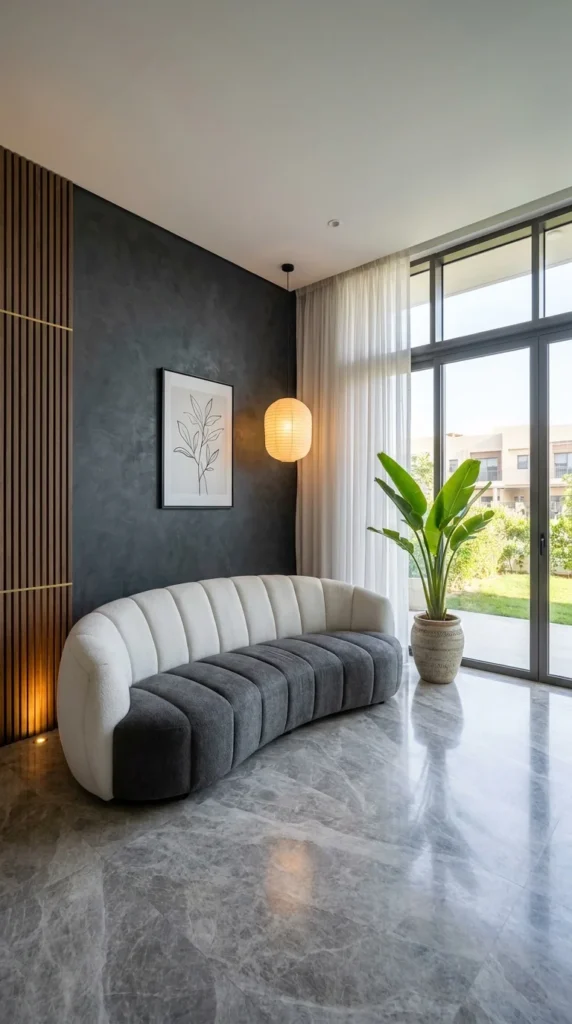
This sofa splits its upholstery into two shades—a soft cream backrest sitting above deep charcoal grey seating—and the channel-tufted shape gives both tones room to catch light differently. Set against a dark textured wall and warm wood slats, the piece reads more like sculpture than standard seating.
📌 Important Note
Curved sofas like this one need open floor space around them to actually register as curved. Pushed into a tight corner or boxed in by other furniture, the shape gets lost, and it starts to look like an oddly formed straight sofa instead. This layout works because the room gives it a full, uninterrupted sweep of marble floor to sit on.
The lesson for smaller rooms: a curved silhouette is worth the investment only if there’s enough clearance to walk around it and actually see the shape from more than one angle.
Rust and Charcoal: How Two Accent Colors Warm Up a Grey Sectional
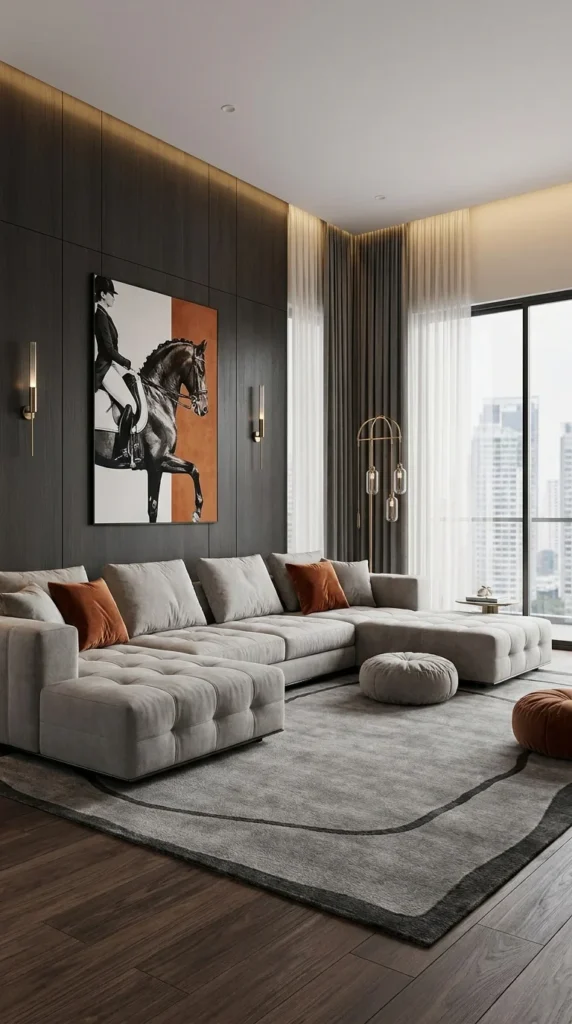
A deep grey tufted sectional fills most of this room, and on its own it would sit fairly neutrally against the dark wood-paneled wall behind it. What changes the temperature entirely is the small dose of burnt orange—two throw pillows and a velvet pouf—picked up again in the equestrian artwork above the sofa.
💡 Pro Tip
When adding a single accent color to a grey sofa, repeat it in at least two other spots in the room—a piece of art, a pouf, a vase—rather than using it once. One rust pillow can look accidental; the same color showing up three times reads as a deliberate palette.
The gold sconces and hanging pendant lights add a second layer of warmth, which matters here because the wall paneling and floor are both fairly dark. Without that warm lighting, the room would lean cold despite the orange accents.
Boucle Texture Doing the Work a Second Sofa Color Usually Would
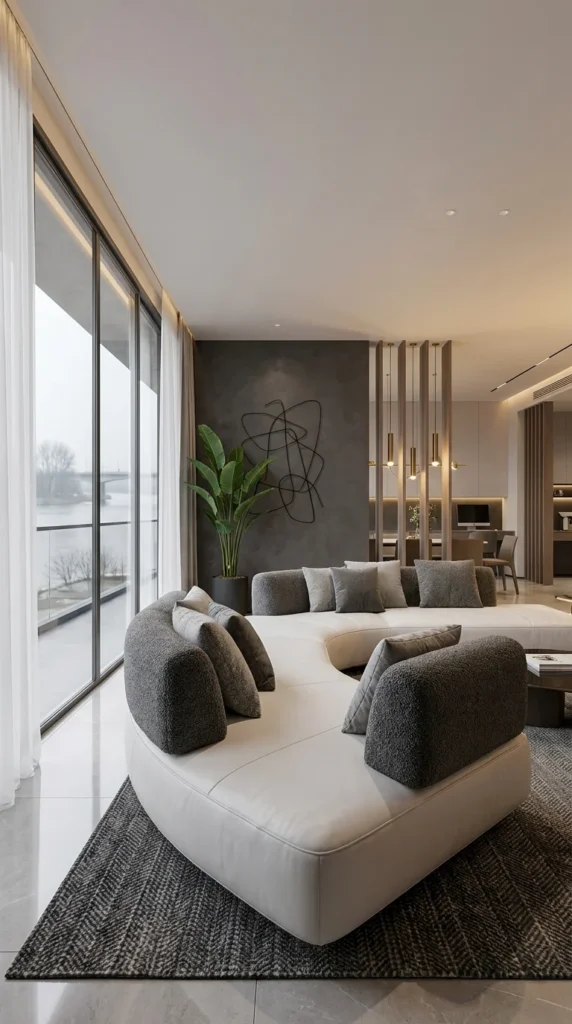
This curved sofa keeps its entire surface in a single soft cream, but the boucle-textured back cushions—set in a contrasting grey—create the visual break that a two-tone upholstery job usually provides. Against a charcoal accent wall and a herringbone rug, the texture does more to define the shape than color ever could.
⚠️ Warning
An all-neutral room like this one risks looking flat if every surface has the same smoothness. The reason this space avoids that trap is the deliberate texture mixing—boucle cushions, a woven herringbone rug, smooth marble flooring, and a raw wire sculpture on the wall. Skipping texture variation is the single most common reason all-grey and all-cream rooms end up looking unfinished in photos.
A river view through floor-to-ceiling glass gives the room natural light from one entire side, which is part of why the pale palette works instead of feeling washed out.
Grey Sectional, Forest View—Letting the Window Set the Mood
Facing a wall of glass that opens onto a mountain and forest view, this light grey sectional keeps its own styling deliberately quiet—simple bolster cushions in cream, grey, and a touch of black, with nothing competing for attention. The dark marble feature wall to the left is the only other bold material in the room.
Rooms with a view benefit this strongly from restraint elsewhere. A busier sofa or a heavily patterned rug would pull focus away from the window, which is clearly the room’s main event here. The low, round wood coffee table stays out of the sightline for the same reason—nothing in this layout sits tall enough to interrupt the view from the seating.
Burnt orange pillows and a scattering of books on the table add just enough personality to keep the space from feeling like a showroom, without introducing a second focal point.
Channel-Tufted Grey Against Warm Wood: A Study in Balance
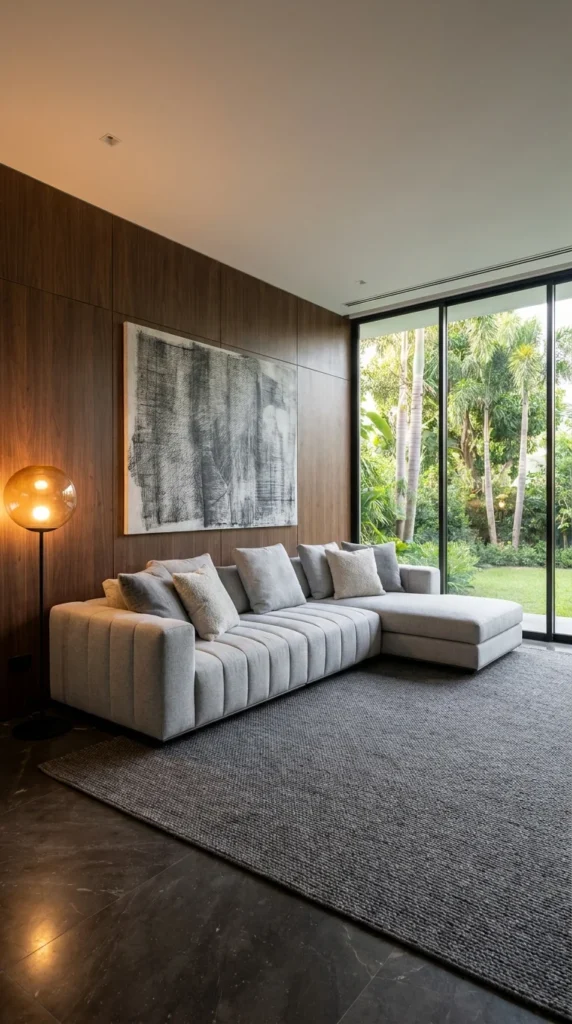
Vertical wood paneling wraps this entire wall, and the grey channel-tufted sectional in front of it picks up the same linear rhythm in its upholstery—ribbed vertical seams running the length of every cushion. It’s a quiet echo that ties the sofa to the wall without matching them exactly.
Two Ways to Pair Grey With Wood Paneling
| Approach | Best For | Effect |
|---|---|---|
| Matching linear texture (ribbed sofa + slatted wall) | Modern, minimal rooms | Cohesive, calm, slightly formal |
| Contrasting smooth sofa and textured wood | Rooms wanting more visual variety | Softer, less matched, more casual |
This room takes the first route, and it works because nothing else in the space competes with the pattern—the black-and-white abstract art, the round floor lamp, and the grey woven rug all stay quiet enough to let the wall-and-sofa pairing carry the room.
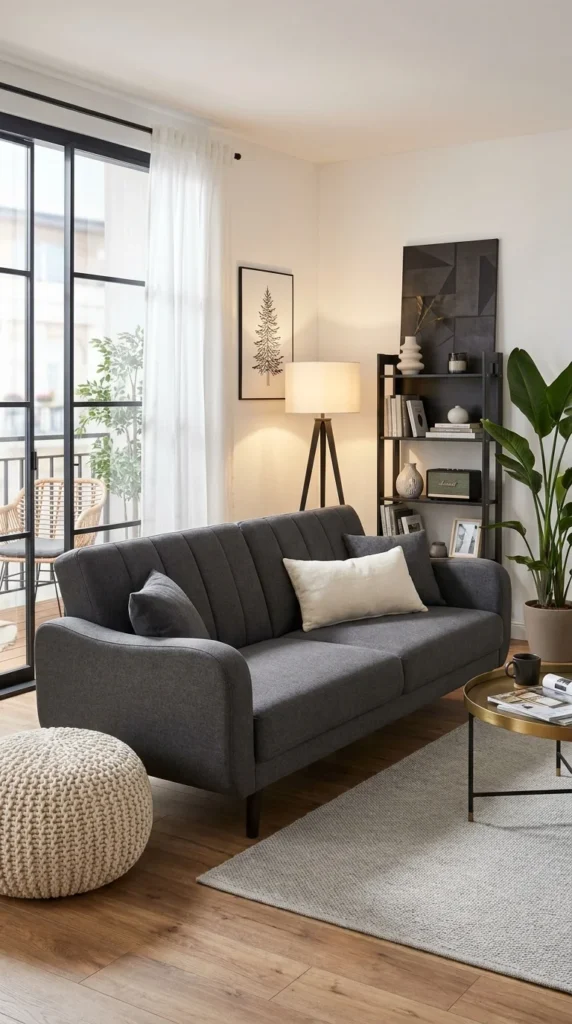
Small-Space Grey: Making a Compact Sofa Feel Fully Furnished
A single charcoal sofa with a distinctive fan-shaped back sits in a modestly sized room, proving a grey couch doesn’t need a large footprint to anchor a space. Cream walls, a wood floor, and a mix of small furniture pieces keep the room feeling complete rather than sparse.
What Fills Out a Small Grey-Sofa Room
☐ One tall floor lamp for ambient light ☐ A knit pouf or ottoman for extra, flexible seating ☐ Open shelving to add height without bulk ☐ A round coffee table—easier to move around in tight space ☐ At least one plant for a non-furniture layer of texture
Small rooms often go wrong by either overcrowding the space or leaving it too bare. This one lands in between: the sofa, shelf, lamp, and pouf are all modestly scaled, but there are enough of them that the room reads as finished rather than half-furnished.
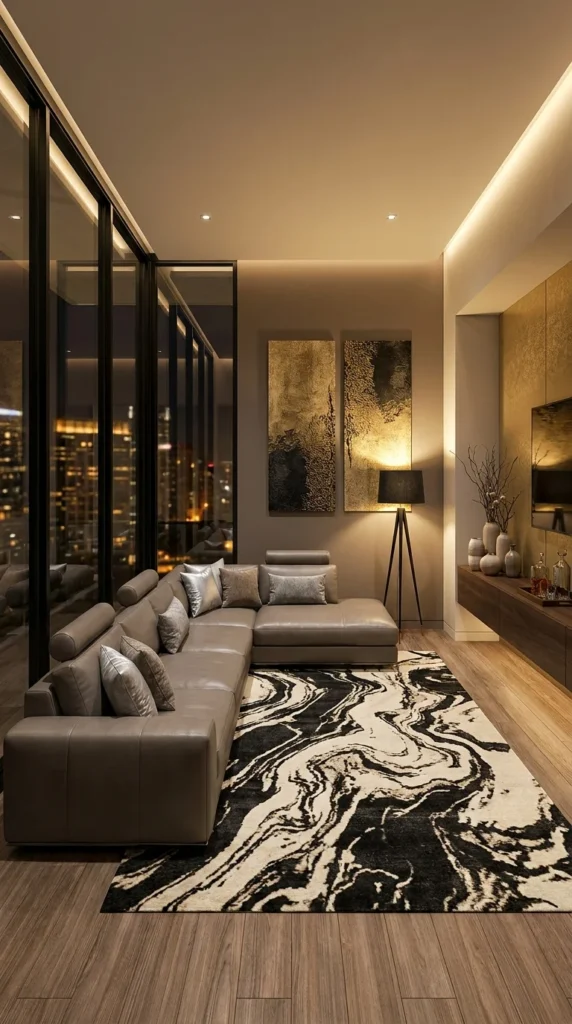
Leather Grey Meets a Marbled Rug for a Nighttime Look
A taupe-grey leather sectional stretches along a wall of glass overlooking a city skyline, and the room is clearly built for evening use—warm gold artwork, low lamp lighting, and a black-and-cream marbled rug that reads almost dramatically under the low light. Leather grey behaves differently from fabric grey; it holds a slight sheen that catches every light source in the room.
💡 Pro Tip
Leather sofas in a city-view living room benefit from being paired with a rug that has movement in its pattern—like the marbled swirl here—rather than a flat, solid color. Leather’s smooth surface can look stark against hard flooring alone, and a patterned rug gives the eye somewhere textured to land.
Metallic pillows in silver tones pick up the same cool undertone as the leather, keeping the whole seating area visually connected instead of scattered across different finishes.
Deep Charcoal Walls and a Grey Boucle Sofa Built for Evening Light
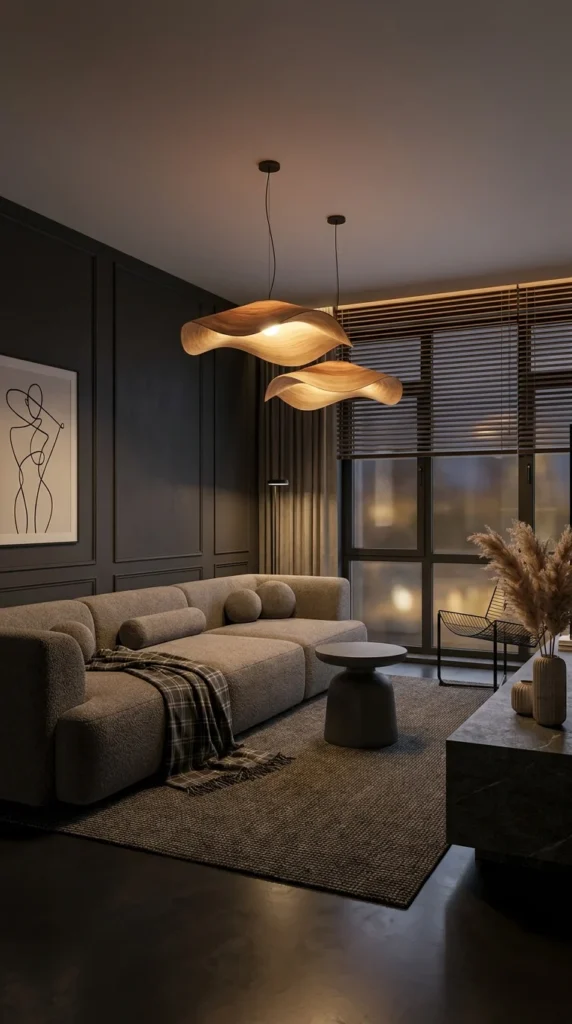
Nearly black paneled walls surround this room, and the taupe-grey boucle sofa is the lightest surface in the entire space aside from the artwork. Two sculptural wood pendant lights hang low over the coffee table, their warm glow doing most of the work to keep the room from feeling too dim.
⚠️ Warning
Rooms this dark rely almost entirely on layered lighting rather than a single overhead source. A single ceiling light in a space with charcoal walls this deep would leave most of the room in shadow. This layout uses at least three separate light sources—the pendants, a floor lamp, and a window light—specifically to avoid that problem.
A plaid throw and a jute rug bring in the only texture variation against the smooth walls, which keeps the moodiness from tipping into starkness.
One Circular Grey Sofa Replacing an Entire Seating Arrangement
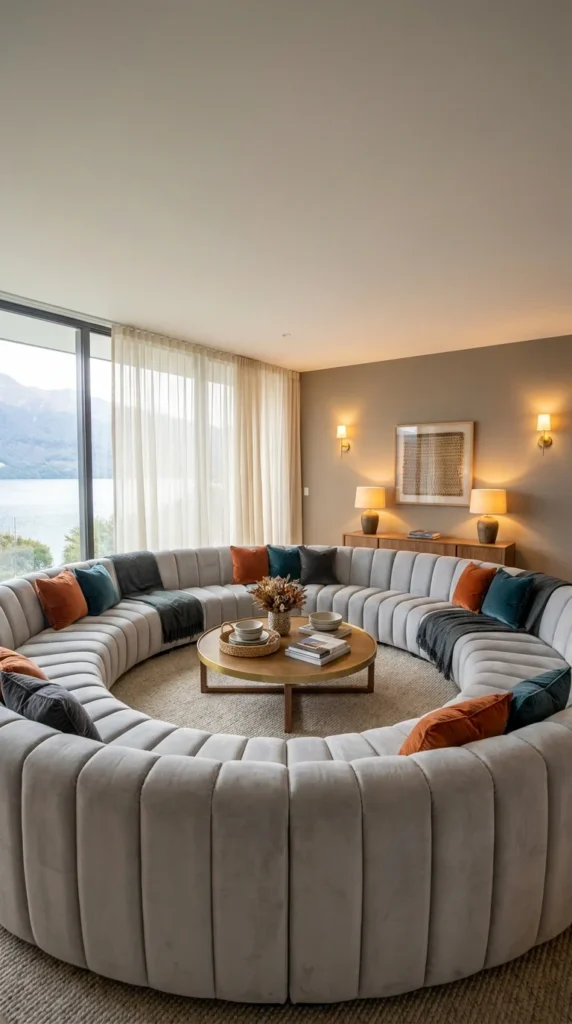
Instead of a standard sofa-plus-chairs setup, this room uses a single full-circle channel-tufted sectional to seat an entire group around a central coffee table. Rust, teal, and navy pillows scattered around the ring keep the grey from reading as one flat mass, while a lake-and-mountain view fills the window behind it.
Recreating This Look: Budget Tiers
💚 Affordable: A round jute rug plus mismatched colorful pillows on a standard sectional can mimic the layered-color effect without a custom circular frame. 💛 Mid-Range: Several modular grey ottomans arranged in a loose circle around a coffee table get close to the same seating flow. 💎 Investment: A fully custom curved or circular sectional, built to the room’s exact dimensions, is the only way to get this precise unbroken ring shape.
A round shape like this works best as the single largest piece in a room, since anything else competing for center stage would break the visual circle the sofa is built to create.
Warm Grey Against a Golden Marble Wall
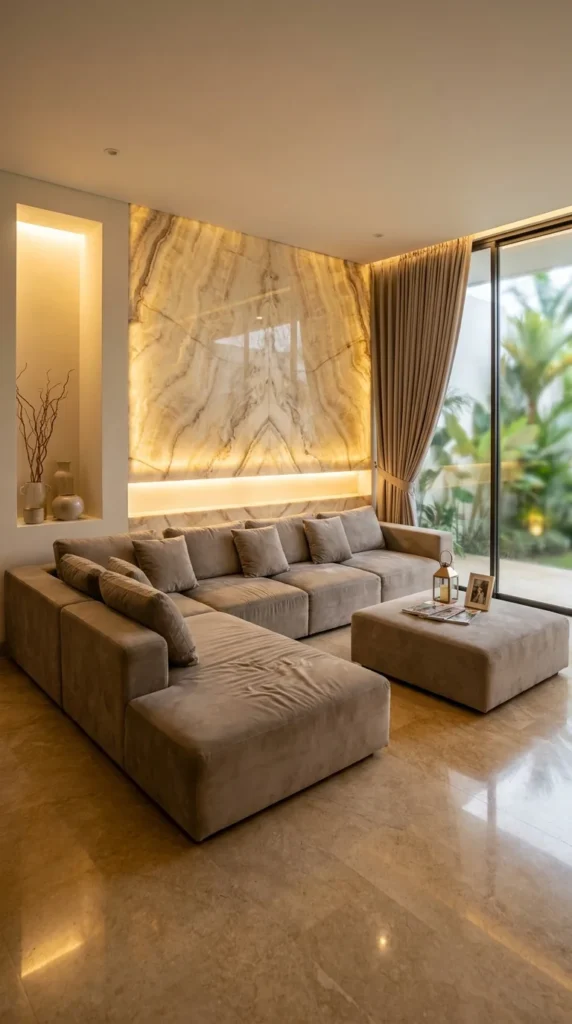
A taupe-grey modular sectional sits low and wide in this room, but the real focal point is the backlit golden onyx wall behind it—veined marble glowing from hidden lighting along its base. The sofa’s job here is almost entirely supportive: staying quiet enough that the wall gets full attention.
Before and After
❌ Before: A patterned or brightly colored sofa in front of a marble feature wall like this would create two competing focal points, and the room would lose the sense of calm the marble is meant to provide. ✅ After: Keeping the sofa in a plain, warm grey lets the veining and glow of the marble read as the room’s single statement, with the furniture acting purely as support.
This is a useful principle whenever a room includes one expensive or dramatic material—tile, stone, or a feature wall. The furniture around it generally benefits from staying simple rather than trying to match its intensity.
Final Thoughts
Across all ten rooms, grey never behaves the same way twice—it goes moody against charcoal walls, warm against rust accents, and almost architectural when paired with curved or channel-tufted shapes. What ties them together isn’t the color itself but the choices made around it: texture, lighting, and knowing when the sofa should lead the room and when it should simply support something else in it. A grey couch is rarely the boring option—it’s usually just the most adaptable one.
Frequently Asked Questions
Does a grey couch work with warm wood tones? Yes—grey and warm wood are one of the more reliable pairings in modern living rooms. Cooler grey tones create contrast against warm wood, while warmer, taupe-leaning greys blend more seamlessly, so the choice mostly comes down to how much contrast is wanted in the room.
What rug colors pair best with a grey sofa? Grey sofas are flexible enough to handle almost any rug color, but rugs with some warmth—rust, mustard, terracotta, or deep blue—tend to prevent the room from feeling cold. A rug in the same grey family can also work well if the goal is a more monochromatic, tonal look.
How do I keep an all-grey living room from looking boring? Mixing textures is usually the fastest fix—a boucle or velvet cushion against a flat-weave rug, a smooth leather sofa against a rough jute mat. Adding one or two accent colors repeated in at least two spots in the room also helps break up a purely monochrome palette.
Is a light grey or dark grey couch better for a small living room? Light grey sofas generally make a small room feel more open, since they reflect more light and blend more easily with pale walls and flooring. Dark grey can still work in a small space, but it benefits from strong lighting and lighter surrounding furniture to avoid making the room feel boxed in.
What throw pillow colors go with a charcoal grey couch? Charcoal grey pairs well with warm accent tones like rust, mustard, and terracotta, as well as cooler options like teal or navy for a more muted look. Cream or ivory pillows are a safer, more neutral choice when the goal is to keep the sofa as the room’s quietest element rather than a focal point.
One Response