

Disclaimer: The images used in this post are for illustrative purposes only, meant to represent design concepts and styling ideas rather than real photographed interiors.
Black and brown together sound like a risky combination on paper. One is the color designers warn beginners away from; the other gets dismissed as “too safe.” Put them in the same room, and most people expect either a cave or a hotel lobby that tries too hard.
That’s not what actually happens when it’s done right. The pairing works because brown carries the warmth black doesn’t have on its own, and black gives brown a structure it usually lacks. Small rooms don’t automatically feel smaller with this combination—it depends entirely on where the black lands and how much brown surrounds it. Large rooms don’t automatically feel more luxurious either — without the right balance, they just feel empty in a dark way instead of a bright one.
What follows isn’t a single formula. Some of these rooms lean rustic, some lean modern, some are working with a hundred square feet, and some aren’t. Each one solves the same basic problem—how much dark is too much and where does it need to stop—in a different way.
1. A Weathered Metal Wall That Turns a Bedroom Into a City-View Retreat
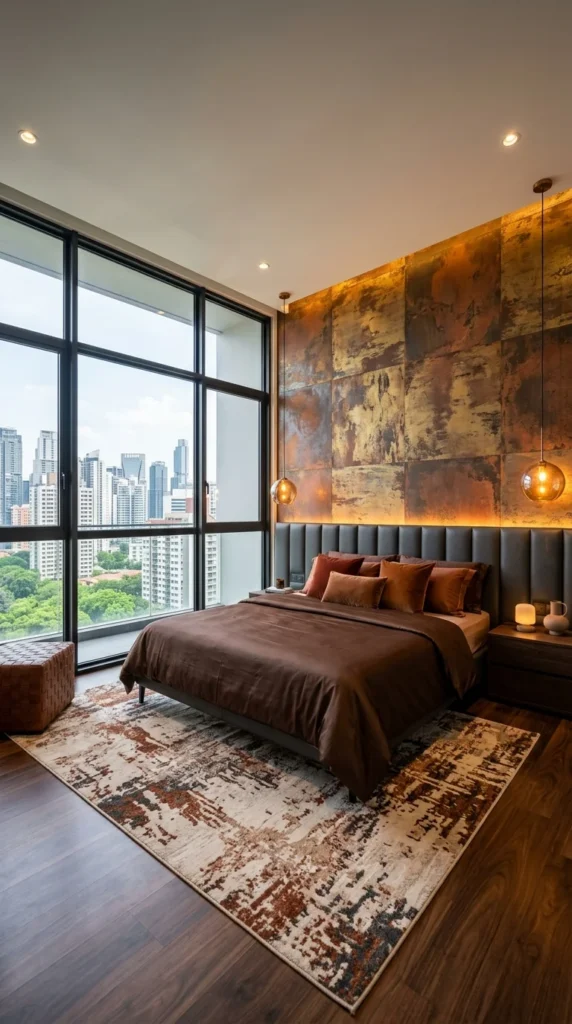
This room makes its case in the first three seconds — floor-to-ceiling glass on one side, a wall that looks like oxidized copper on the other. The black leather headboard sits between them almost like a hinge, pulling the cool skyline and the warm metal into the same visual conversation.
The wall itself is doing something most accent walls don’t attempt. It’s not flat color; it’s texture with variation built in—patches of amber, rust, and bronze that catch the pendant lighting differently depending on where you’re standing. That unevenness is exactly why it doesn’t read as a paint job. A single flat brown would go dead against all that glass; this one has enough movement to hold its own against a skyline view.
Black shows up in careful doses—the channel-tufted headboard, the bed frame, and the window mullions. Everything else is some version of brown: the rust-toned pillows, the chocolate bedding, the walnut floor, the warm-toned rug. It’s a room built on one dark anchor and a whole spectrum of warm tones around it, rather than an even split between the two colors.
💡 Pro Tip
If a full metal-panel wall isn’t realistic, this same amber-and-rust effect is available in peel-and-stick textured wallpaper. It won’t have the exact same shine under light, but it holds the color story without the installation cost.
📌 Important Note
This look depends on natural light during the day and warm-toned bulbs at night. Cool white LEDs would flatten the copper tones and make the wall look muddy instead of rich.
2. Matte Black Paneling With Rust Linen — A Study in Restraint
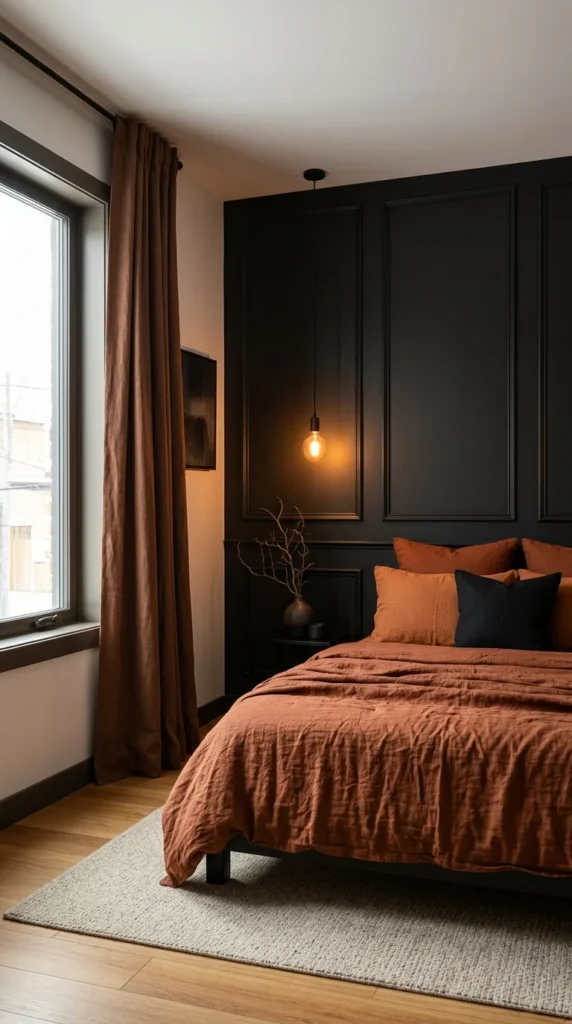
Where the first room used texture to soften black, this one uses geometry. The wall paneling is flat matte black, broken into rectangular panels with thin recessed lines—a classic architectural detail borrowed from formal dining rooms and dropped into a bedroom instead. It’s a quieter move than a textured accent wall, and it changes the whole mood of the space.
The single pendant bulb is doing more than lighting the nightstand area. Hung at that height, against that much dark wall, it becomes the one thing the eye has to focus on in an otherwise low-contrast room. Remove it and the black paneling would flatten into a backdrop with nothing to anchor it.
Rust-colored linen bedding is the actual hero here, not the wall. Linen has a rumpled, lived-in texture that keeps deep black from feeling formal or cold—this is not a hotel suite; it’s a room someone actually sleeps in. The curtains pick up a slightly muted version of the same rust-brown, which ties the window back into the color scheme instead of leaving it as an afterthought.
⚠️ Warning
Full matte black paneling absorbs almost all ambient light. Without a strong secondary light source—like this pendant or a floor lamp—the room can feel like a cave rather than cozy. Don’t attempt this look with only overhead lighting.
💚 Recreating This Look: Budget Tiers
Affordable Version: Black peel-and-stick wall panels or painted MDF strips over a flat black wall.
Investment Version: Custom millwork paneling, professionally painted in a true matte black finish for the deepest, most light-absorbing color.
3. A Coffered Ceiling With Wood Inlay Makes This the Most Architectural Room Yet
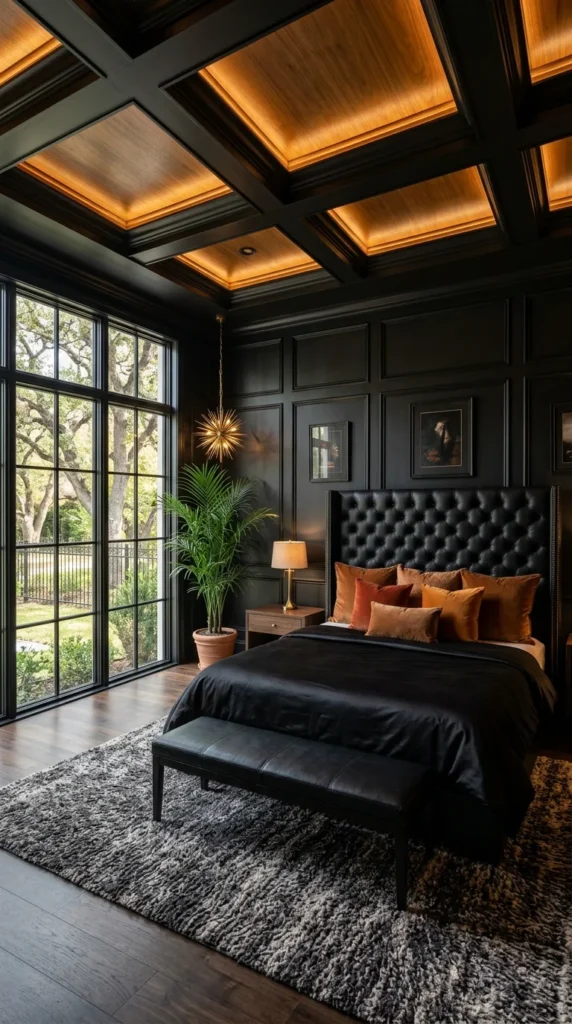
This is the largest room of the three so far, and it’s the one where the ceiling does more visual work than the bed. A black coffered grid crosses overhead, but instead of black paneling in each recessed square, warm wood glows from hidden lighting—turning what could have been a heavy, closed-in ceiling into something closer to a lit skylight grid.
That ceiling decision is what keeps a room this dark from feeling oppressive. Floor-to-ceiling black paneling, a black leather tufted headboard, black bedding, a black bench—on paper that’s an enormous amount of dark surface for one room. But warm light pours down from above and bounces off wood tones in the ceiling coffers, the picture frames, and the honey-colored throw pillows, so the darkness never sits flat.
The Starburst pendant light is an unexpected touch—a mid-century brass fixture in a room that otherwise reads formal and traditional. It’s the kind of detail that keeps a moody black room from feeling like a single decade or a single style, and it echoes the same warm metal tone found in the ceiling lighting.
📌 Important Note
A room this heavily black-paneled needs genuinely tall ceilings and strong architectural bones to avoid feeling cramped. In a standard 8-foot ceiling room, this same treatment would likely feel closed-in rather than dramatic.
✅ What Makes This Room Work
- Coffered ceiling with concealed warm LED strip lighting
- Full-height black wall paneling with picture-frame molding
- Tufted leather headboard in matching black
- Warm brass or gold accent lighting fixture
- Large potted plant to break up hard architectural lines
- Rust and amber throw pillows against black bedding
4. Slatted Black Wall Panels Give a Solid Wood Bed Somewhere to Stand Out
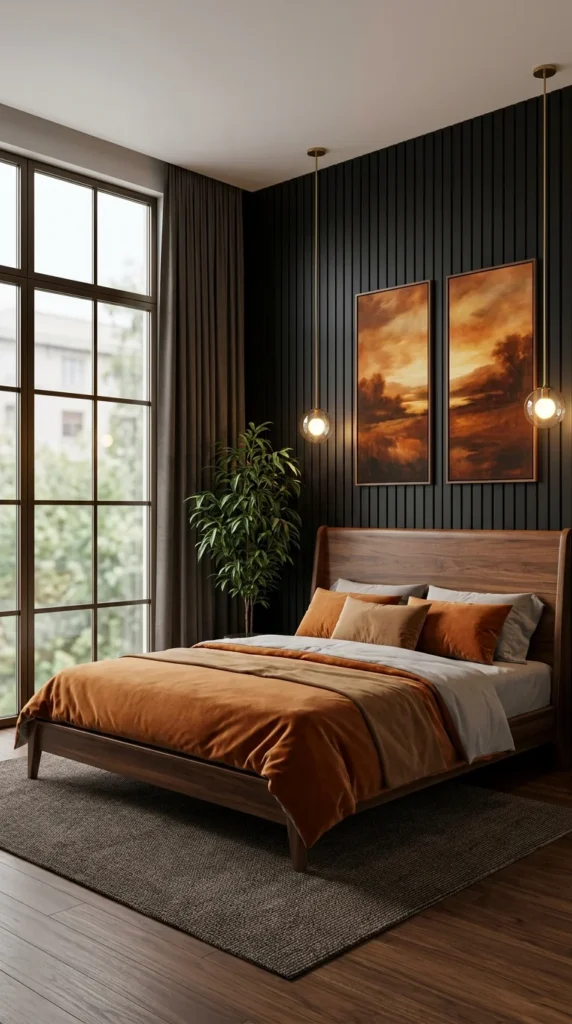
The vertical wood slats here change the wall’s whole personality before anything else in the room gets noticed. Painted black and installed with thin gaps between each strip, they trade the flat solidity of the earlier rooms for something with rhythm—narrow shadow lines running top to bottom that make the wall feel taller than it actually is.
The bed frame is the real departure from the rest of this list. It’s solid walnut, left in its natural wood tone rather than upholstered or painted black—a mid-century silhouette with a gently sloped headboard. Against slatted black paneling, that warm wood grain becomes the transition point between the cool dark wall and the burnt-orange velvet bedding piled on top of it.
Two framed landscape prints in matching amber and rust tones fill the space above the headboard almost like a diptych, and the twin pendant lights hung at slightly different heights keep the symmetry from feeling too rigid. It’s a small asymmetry, but it’s the kind of detail that stops a very organized wall from looking staged.
💡 Pro Tip
Vertical slat paneling is available in lightweight MDF strips that install with adhesive — no need for a full carpentry project. Spacing the slats slightly wider apart uses fewer boards and still gives the same shadow-line effect.
📌 Important Note
This look depends on the wood tone of the bed frame matching or complementing the flooring. A mismatched wood undertone would fight the cohesion this room relies on.
5. Backlit Wood Slats and String Lighting Make an All-Brown Room Feel Layered, Not Flat
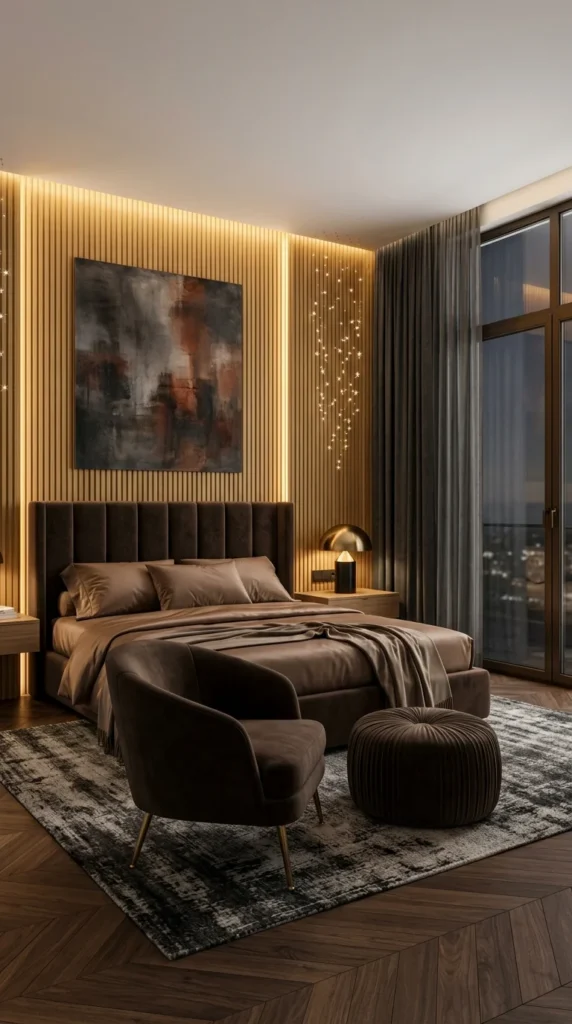
This room skips black almost entirely and still earns its place on this list—the depth comes from tone variation within brown itself, not from contrast with black. Chocolate velvet headboard, caramel bedding, warm honey wood paneling, and dark chevron flooring: four different shades of brown, each doing a different job in the room.
The backlighting behind the slatted wall is what keeps that much brown from collapsing into one flat block of color. A strip of hidden LED lighting runs along the panel edges, throwing a warm glow that separates the wall visually from the ceiling and gives the wood grain somewhere to catch light. Without it, this same wall in daylight would likely look far more monotone.
The hanging string lights next to the window are an unusual choice for a bedroom this polished—closer to something found in a lounge than a typical furniture catalog. They add a point of visual interest at eye level, so the eye has a reason to travel across that entire wall instead of stopping at the headboard.
📌 Important Note
An all-brown palette like this one relies heavily on texture contrast—velvet, wood grain, woven rug, brushed metal—to keep it from feeling flat. Matching every surface in the same smooth finish would erase the depth this room is built on.
✅ What Makes This Room Work
- Slatted wood wall with hidden LED backlighting
- Multiple brown tones—velvet, caramel, honey wood, espresso floor
- Dark abstract art as a contrast point against warm wood
- Decorative string lighting for texture and ambiance
- Chevron-pattern wood flooring for added visual movement
- Layered textiles — velvet bench, ribbed pouf, patterned rug
6. The Same Copper Wall Treatment, Styled Completely Differently
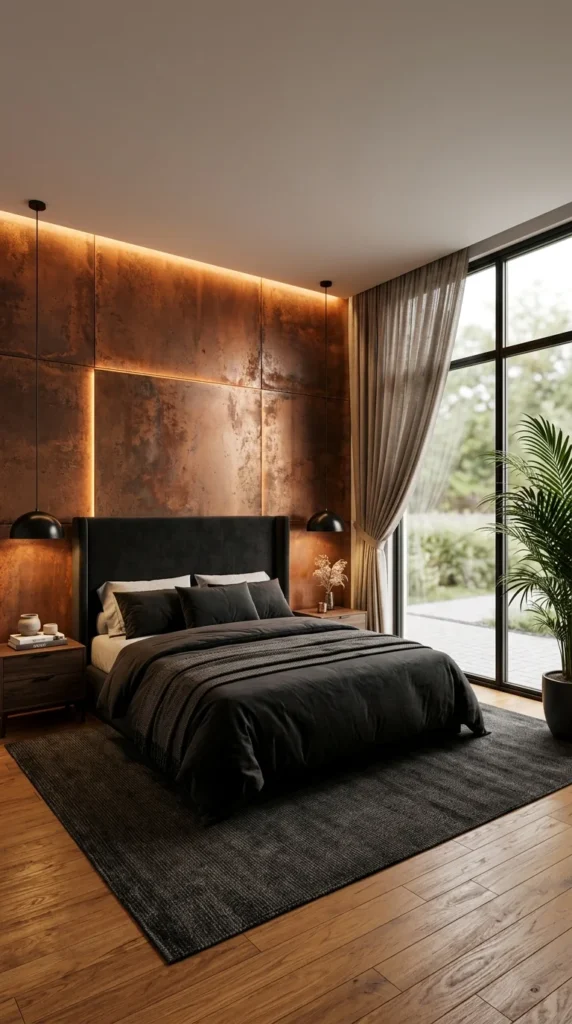
A weathered metal accent wall shows up again here, but the room around it takes a much darker, more minimal direction than the first version on this list. Where that room used chocolate and rust bedding to match the wall’s warmth, this one goes almost entirely black—bedding, headboard, pendant shades, all of it—and lets the wall carry every ounce of color in the space.
That contrast is the whole point. Black absorbs light and recedes; copper reflects it and advances, so putting them directly next to each other creates more depth than either would have alone. The two black dome pendants, hung low on either side of the bed, add a third texture—matte black metal against the wall’s high-shine patina—without introducing a new color into the mix.
The garden-level window changes what this room needs to do. Instead of skyline drama, there’s greenery and daylight streaming in from ground level, and the sheer curtain softens it rather than blocking it. A large potted palm in the corner picks up that outdoor green and pulls it into the room, which keeps all that black and copper from feeling closed off from the window entirely.
⚠️ Warning
An all-black bedding set against a warm metallic wall can tip into feeling cold if the room lacks a plant, warm wood tones, or warm-toned lighting elsewhere. This room avoids that by keeping the flooring light oak and adding greenery near the window.
💡 Pro Tip
If working with an existing rust or copper accent wall, black bedding is a lower-cost way to reset the room’s mood without touching the wall itself—swap the linens seasonally between black and warmer rust tones for two completely different looks from the same base room.
7. Built-In Shelving and a Fireplace Turn a Narrow Room Into a Full Living Space
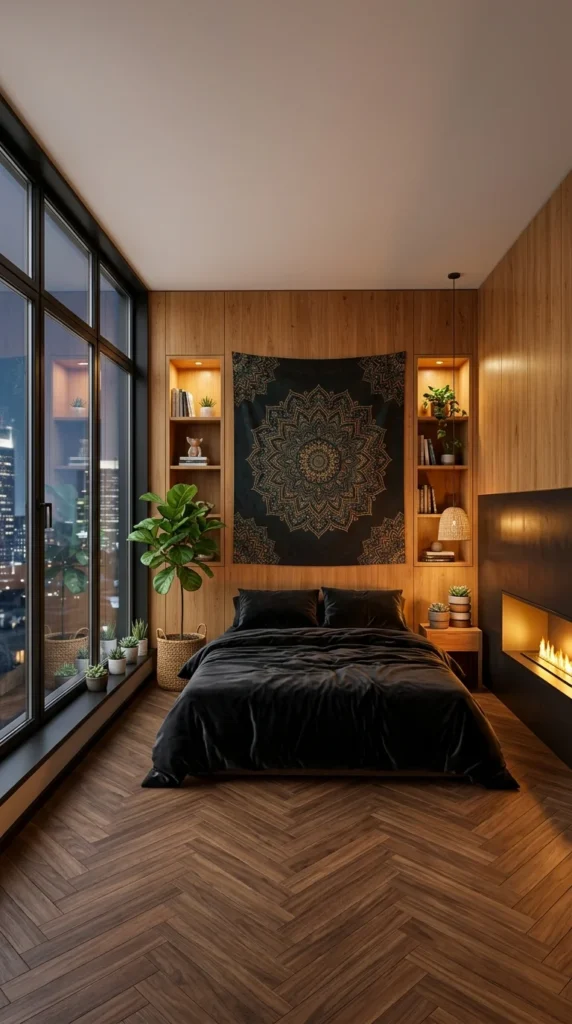
This is the most compact footprint on the list, and it’s also the one doing the most multitasking. A wall of light wood paneling houses two recessed bookshelf niches, a black linear fireplace sits at the foot of the bed instead of in a separate living room, and a wall of windows runs the entire length of the space. None of that is typical bedroom real estate—it’s borrowed from a studio apartment’s need to make one room work as several.
The wood paneling here is a different animal from the black slats and copper panels seen earlier—this one is pale, warm, straight-grain wood that opens the narrow room up rather than compressing it. Black only enters through the bedding and the mandala tapestry hung above the headboard, which keeps the dark tone from competing with a room that’s already working with limited width.
That tapestry is doing something specific: it fills the one blank stretch of wall between the two shelving niches with pattern and detail, so the eye has a focal point instead of a gap. Without it, the space between the shelves would just read as an unfinished wall.
📌 Important Note
This layout works because the fireplace, window ledge, and shelving all share the same wood tone. In a narrow room, mixing multiple wood finishes would fragment the space instead of letting it read as one continuous surface.
✅ What Makes This Room Work
- Recessed built-in shelving with warm accent lighting
- Wide-format herringbone wood flooring
- Linear fireplace integrated into the bedroom wall
- Patterned tapestry as the wall’s single focal point
- Deep windowsill styled with potted plants
- Black velvet bedding as the only dark element in the room
8. A Duplex Bedroom Where a Floating Staircase Becomes Part of the Décor
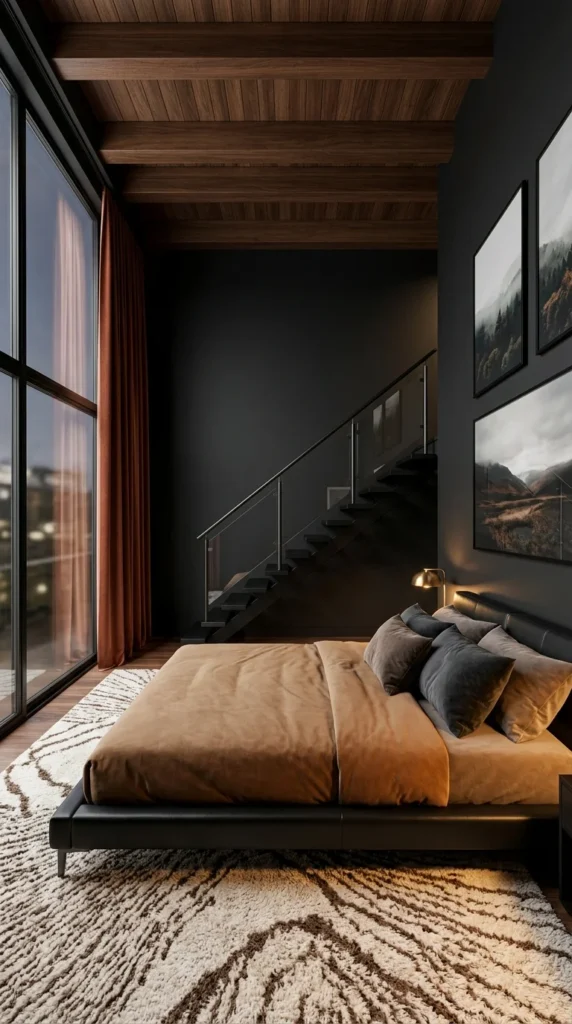
This is the only room on the list with a second floor built into it, and that staircase changes the entire scale of the space. Open steel treads and a glass railing climb along the black wall toward a loft level, and instead of hiding that structure, the room lets it sit in full view as the main visual event behind the bed.
The wood-beamed ceiling is doing something specific here—it’s the one warm element overhead in a room where the walls have gone almost entirely black. Exposed beams and wood ceiling planks bring the ceiling down into the same material language as the caramel bedding and the floor, so the eye has a warm path from the bed up and across, even with black surrounding it on three sides.
Three black-and-white landscape prints, stacked and clustered on the wall beside the bed, are the only spot of contrast against the dark paint. Rust-colored curtains at the window pick up the same tone as the bedding, so even with a staircase, a loft, and gallery walls all fighting for attention, the color story stays simple.
📌 Important Note
A visible interior staircase this close to a bed only works with genuinely high ceilings and enough floor area to keep the steps from feeling like they’re intruding on the sleeping space. This is a layout suited to duplex or loft-style units, not standard single-level bedrooms.
💡 Pro Tip
If a full staircase isn’t part of the space, the same effect can be recreated with faux wood ceiling planks and a matte black paint finish on the surrounding walls.
9. A Cognac Leather Headboard Warms Up a Wood-and-Charcoal Bedroom
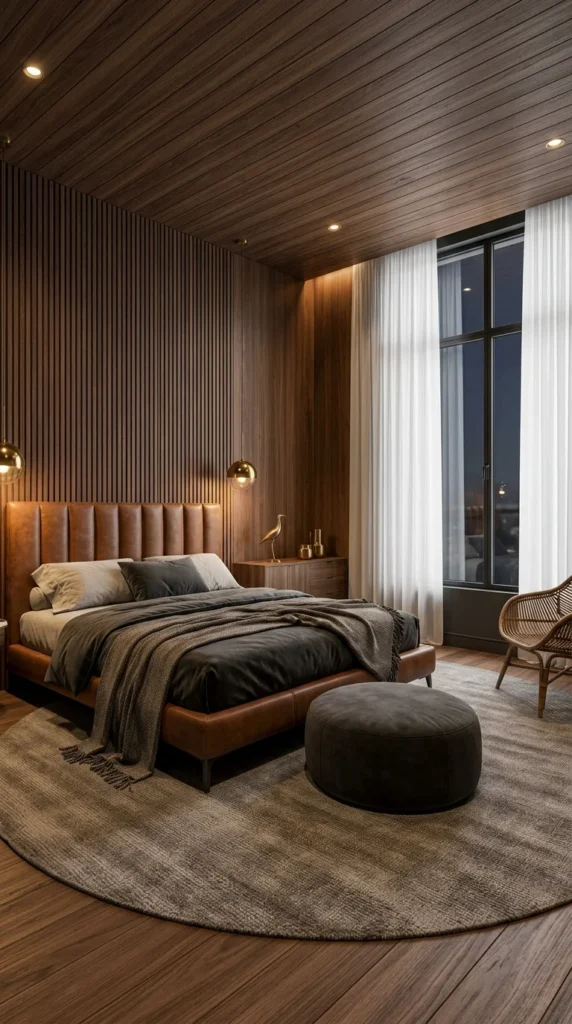
Wood covers nearly every surface in this room—slatted walls, angled plank ceiling, wide-board flooring—which puts it at risk of feeling like a sauna if nothing breaks up the tone. What saves it is the headboard: cognac-colored leather in vertical channels, warm enough to belong with the wood but different enough in texture and sheen to register as its own element rather than blending in.
Charcoal shows up instead of true black throughout the bedding, throw blanket, and round leather pouf—a softer, warmer version of dark that suits a room already this saturated with wood tone. True black against all that brown would likely have pushed the room toward heavy rather than rich; charcoal keeps enough warmth in it to sit comfortably next to cognac leather and honey-toned wood.
Sheer white curtains are doing something the other rooms on this list haven’t attempted — they let the blue evening light outside filter through as a cool contrast to all that warm interior wood. A woven rattan chair by the window picks up on that same natural-material thread without repeating the leather or wood already established.
💚 Recreating This Look: Budget Tiers
Affordable Version: Slatted wood wall panels in a peel-and-stick format, paired with a faux-leather channel-tufted headboard.
Mid-Range Version: Solid wood accent wall installed by a contractor, with a genuine leather headboard in a cognac or whiskey tone.
Investment Version: Full wood-paneled ceiling and walls with custom leather furniture pieces color-matched to the wood grain.
📌 Important Note
A room this wood-heavy needs at least one cool or neutral element—here, it’s the sheer white curtains and gray-toned rug—to keep the palette from tipping entirely into orange-brown monotony.
Conclusion
None of these nine rooms follow the same recipe, and that’s really the point. Some lean on texture — weathered metal, slatted wood, tufted leather — to keep dark colors from feeling flat. Others lean on light, hiding LED strips behind panels and ceiling coffers so black and brown never sit in total shadow. A few skip black almost entirely and prove that tonal layering within brown alone can do the same job.
What ties them together is restraint. Every room here treats black as a tool for contrast and structure, not as the whole plan. The brown—whether it’s rust linen, cognac leather, or a weathered copper wall—is what keeps the space feeling lived-in rather than staged. Whether the room is a hundred square feet or twice that, the same question decides whether it works: how much dark is enough, and where does the warmth need to step in?
Frequently Asked Questions
Does a black and brown bedroom make a small room feel smaller?
Not necessarily. A small room stays open if black is used in doses—a headboard, an accent wall, or bedding—rather than covering every surface. Pairing it with a lighter floor, a large window, or warm lighting keeps the room from closing in.
What shade of brown pairs best with black?
There’s no single correct shade. Rust, cognac, caramel, and chocolate all pair well with black, but the right one depends on the room’s lighting and wood tones. Warmer, more saturated browns tend to balance cooler black tones better than muted or grayish browns.
Is a black accent wall better than black bedding for a beginner?
Black bedding is the lower-risk starting point. It’s easy to change seasonally and doesn’t require repainting if the look doesn’t work out. A black wall
One Response