
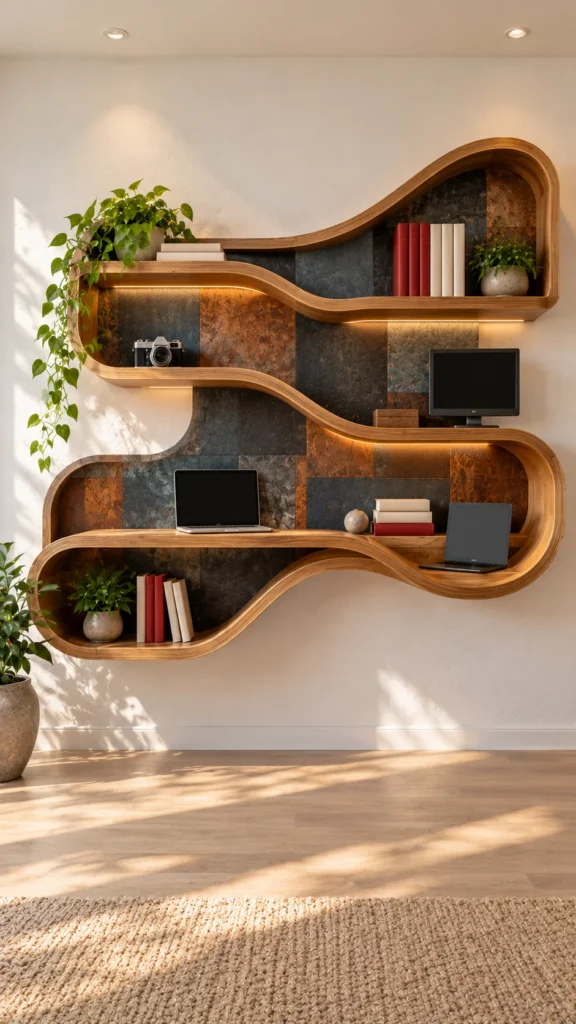
Most shelving is an afterthought — a flat board, some brackets, done. The ten pieces below refuse that fate. Each one treats the shelf as the room’s main event: sculptural wood, unexpected geometry, lighting built into the structure itself. And yet every one of them still has to do the unglamorous job of holding things.
That’s the tension worth paying attention to as you scroll. A shelf that only looks good usually holds little; a shelf that only holds a lot usually looks like a warehouse. The strongest pieces here negotiate between the two — they earn their wall space twice, once as storage and once as something worth looking at.
Notice what each design asks you to store, because the shape decides. Deep cubbies swallow books; shallow waves demand curation; a tree-shaped shelf basically insists on plants. Pick the shelf that matches what you actually own, not the one that photographs well with someone else’s things.
A Workspace Wall That Doubles as Display
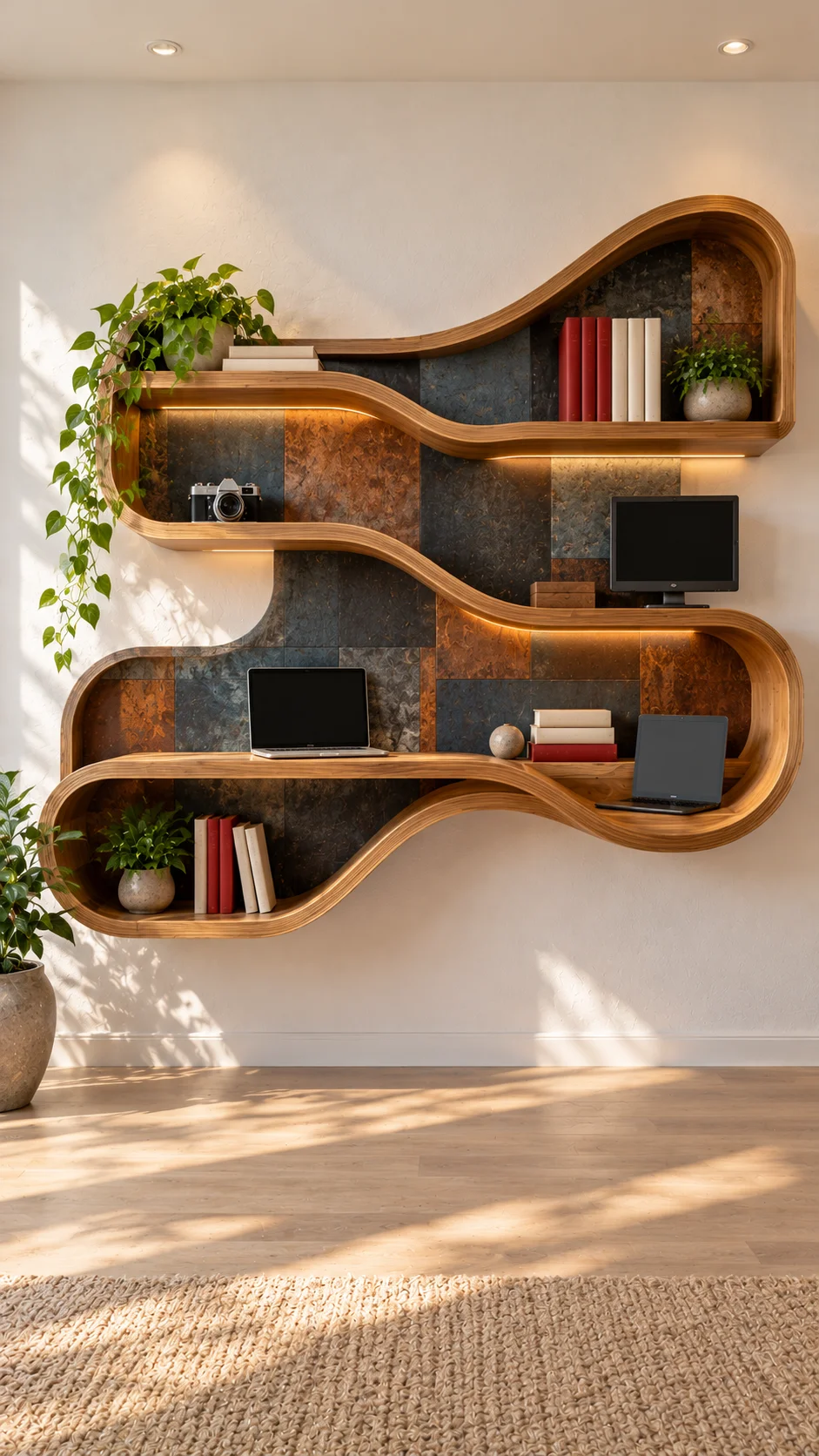
This wavy wooden shelf unit is doing two jobs that usually fight: it’s a working desk wall (two laptops live on its shelves) and a display piece, backed by slate-and-copper tile with warm LED strips under each wave. The tile backing is the move that makes it work — it turns open storage into a feature wall, so the laptops and books read as part of a composition instead of clutter on boards.
The wave shape isn’t just pretty; it creates shelf depths that vary along the wall, which is genuinely useful. Deep pockets hold the laptops, shallow curves hold the camera and small stacks of books. Straight shelves give you one depth everywhere; a sculptural shelf gives you zones. The LEDs matter more than they look, too — open workspace shelving goes murky without its own light, and the under-shelf strips keep every level readable after dark.
The honest requirement is cable discipline. Open tech storage only looks this good when chargers and cables are managed — a couple of adhesive cable channels behind the unit keep the illusion intact. If you’re planning a work-from-home corner, 10 attic office design ideas for a cozy, functional workspace cover the same small-space thinking in a different setting.
Honeycomb Shelves as Living-Room Art
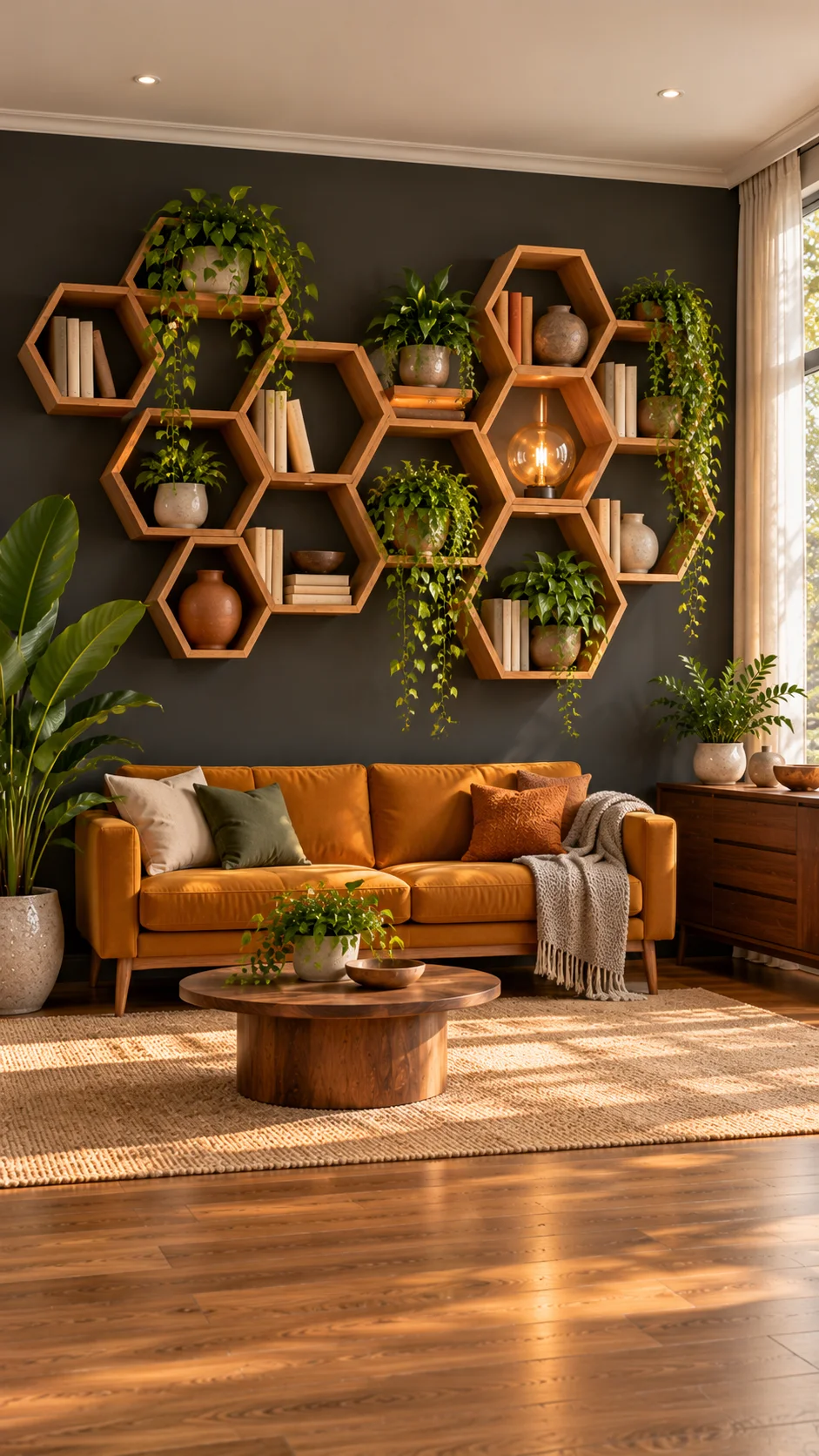
A dozen wooden hexagons climb the dark wall above an orange sofa, holding trailing plants, books, and pottery — and the repetition is the point. One hexagon shelf is a quirky accent; twelve of them become an installation. The geometry does what a gallery wall of frames does, with the added benefit of holding actual things.
The dark wall is doing heavy lifting here. Against white, honeycomb shelves can look busy and a little crafty; against charcoal, the wood pops like sculpture and each cubby reads as a framed vignette. The trailing pothos softening the hard geometry is not optional decoration — without something organic spilling over those sharp angles, the whole thing would feel mathematical.
Small cubbies enforce honesty: you can’t shove a stack of magazines into a hexagon and close the door, because there is no door. That’s the trade — this shelf keeps your display edited, which is either a feature or a chore depending on your temperament.
Live-Edge Shelves for the Plant Collector
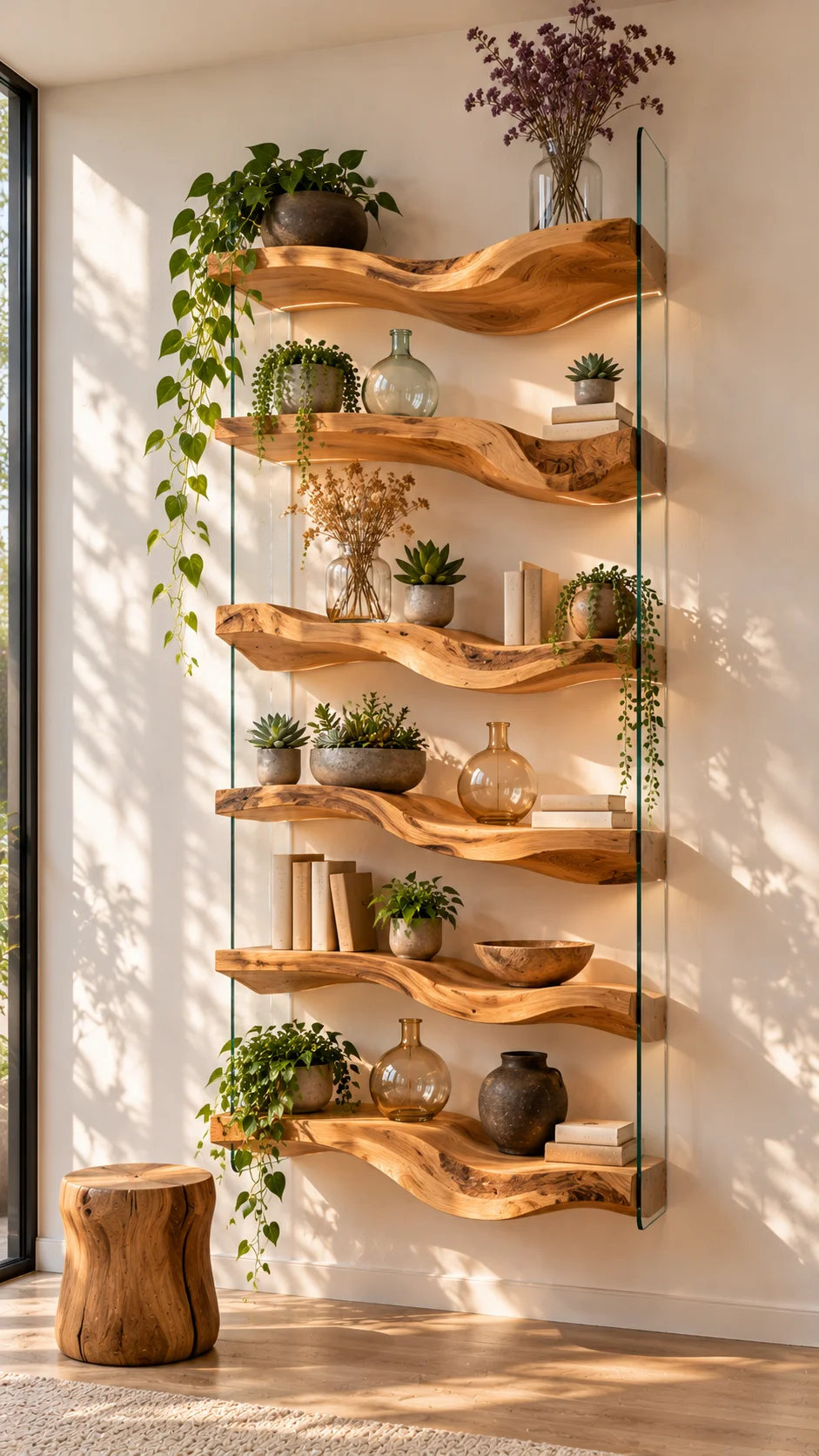
Six live-edge wood slabs held between near-invisible glass sides, styled almost entirely with plants in ceramic and glass — this is a plant gallery that happens to be shelving. The wavy natural edges keep every level from feeling like a retail display; no two shelves share the same line, so the eye moves instead of scanning.
The glass sides are the quiet engineering win. Traditional brackets would chop up the composition and fight the organic edges; glass disappears, letting the wood look like it’s floating. Styling follows one rule throughout: vary the heights. Trailing pothos up top, compact succulents mid-level, tall dried stems breaking the skyline — the plants are arranged like a skyline, and that variation is what makes six shelves of greenery feel composed rather than crowded.
If your shelves are really plant shelves in disguise, indoor plant ideas: the plant styling guide goes deeper on grouping, trailing versus upright habits, and which plants actually forgive shelf life.
One Practical Warning
Water and wood are old enemies. Every plant on these shelves should sit in a waterproof saucer, and the wood itself wants a wipeable finish — otherwise one overwatering leaves a ring you’ll see forever. Beautiful plant shelves are maintained plant shelves.
The Stepped Shelf That Gives Every Plant Light
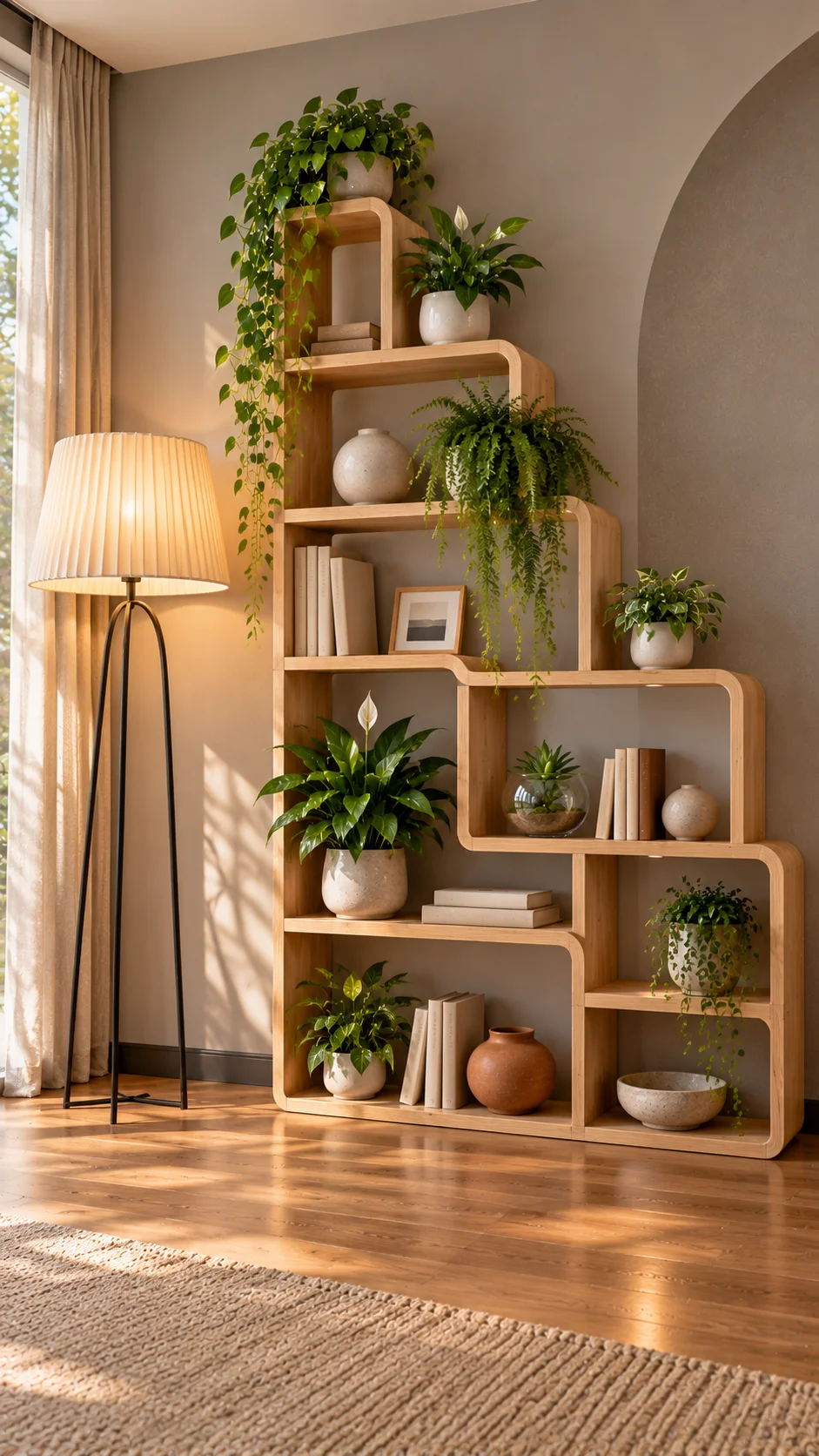
This light-wood unit climbs the wall in asymmetrical steps, and the asymmetry is functional: each step sits at a different height, so plants on lower levels still catch window light instead of living in the shadow of the shelf above. It’s a plant collector’s shelf designed by someone who has actually watched plants lean toward windows.
The pale wood keeps the whole thing airy — a dark-stained version of this silhouette would feel much heavier and more imposing. Styling stays in the same light register: white and terracotta pots, cream book spines, one small framed print. When the shelf itself has this much visual movement, the objects on it should stay calm; busy shelf plus busy objects equals noise.
Stepped shelving is also the friendliest of these designs to live with: no fixed cubbies means you can rearrange as plants grow, and the open sides make watering and dusting straightforward instead of a contortion act.
Geometry as Sculpture, Storage as Bonus
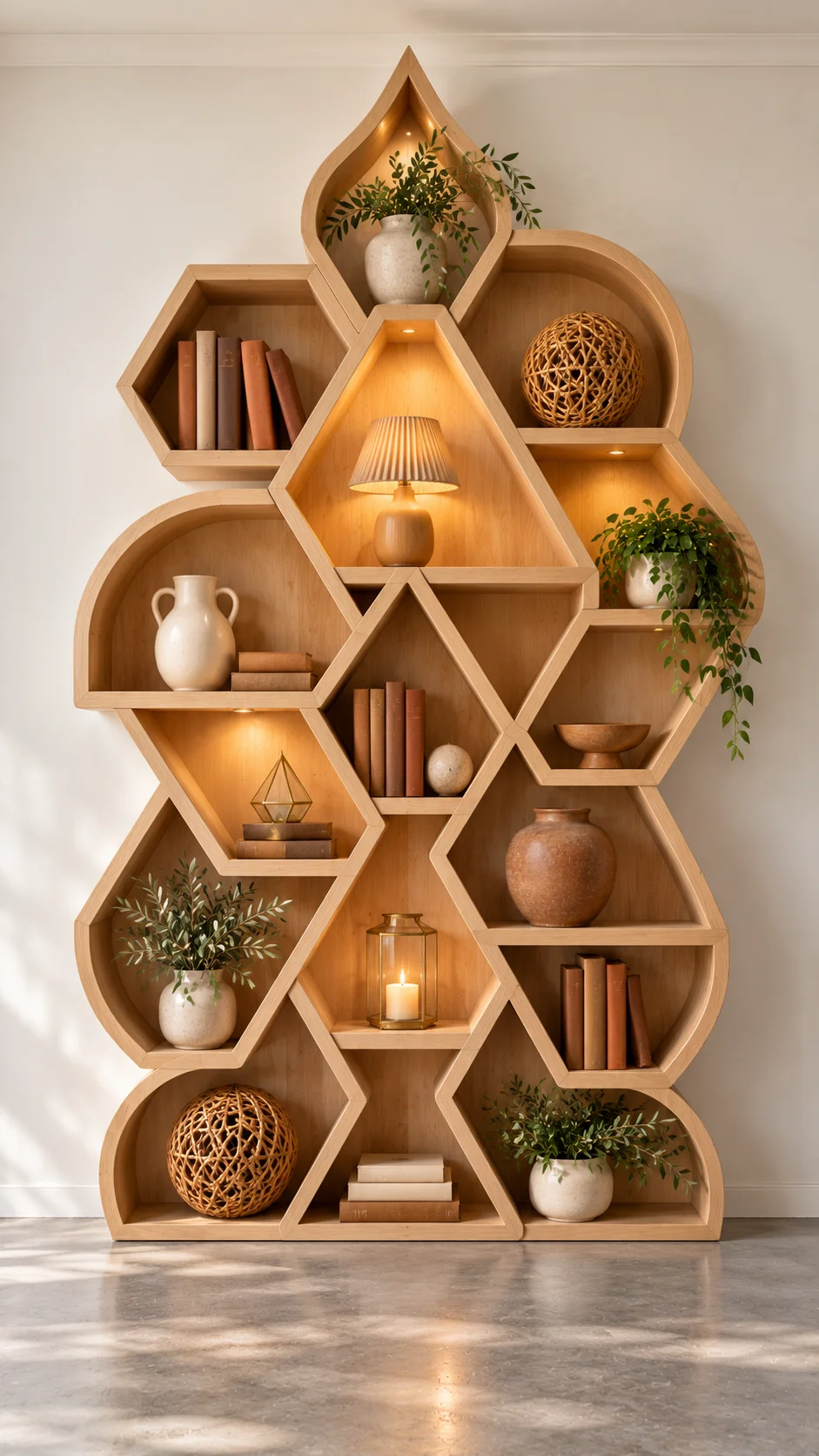
Hexagons, arches, and triangles interlock into one honey-colored wooden composition with tiny spotlights tucked into the joints — and honestly, the storage is secondary here. This piece exists to be looked at; the fact that it holds books, a lamp, and a candle is a pleasant bonus.
There’s a real lesson in the lamp placement: putting a small lamp inside one of the cubbies turns the shelf into a light source rather than a merely lit object. The warm pool of light in the center cubby gives the whole wall a hearth-like glow after dark. Integrated lighting like this is what separates statement shelving from expensive wall clutter — light tells the eye where to look.
Pieces this sculptural belong to the same family as furniture that earns its keep twice. Stylish shoe racks that double as entryway decor make the same argument at a smaller scale: storage should pull its visual weight as well as its practical one.
Know What You’re Buying
A shelf this specific dictates your styling forever — you will be arranging objects to fit triangles and arches, not the other way around. Buy it because you love the shape itself, empty, on the wall. If it doesn’t thrill you bare, it won’t thrill you full.
Soft White Waves on a Blue Wall
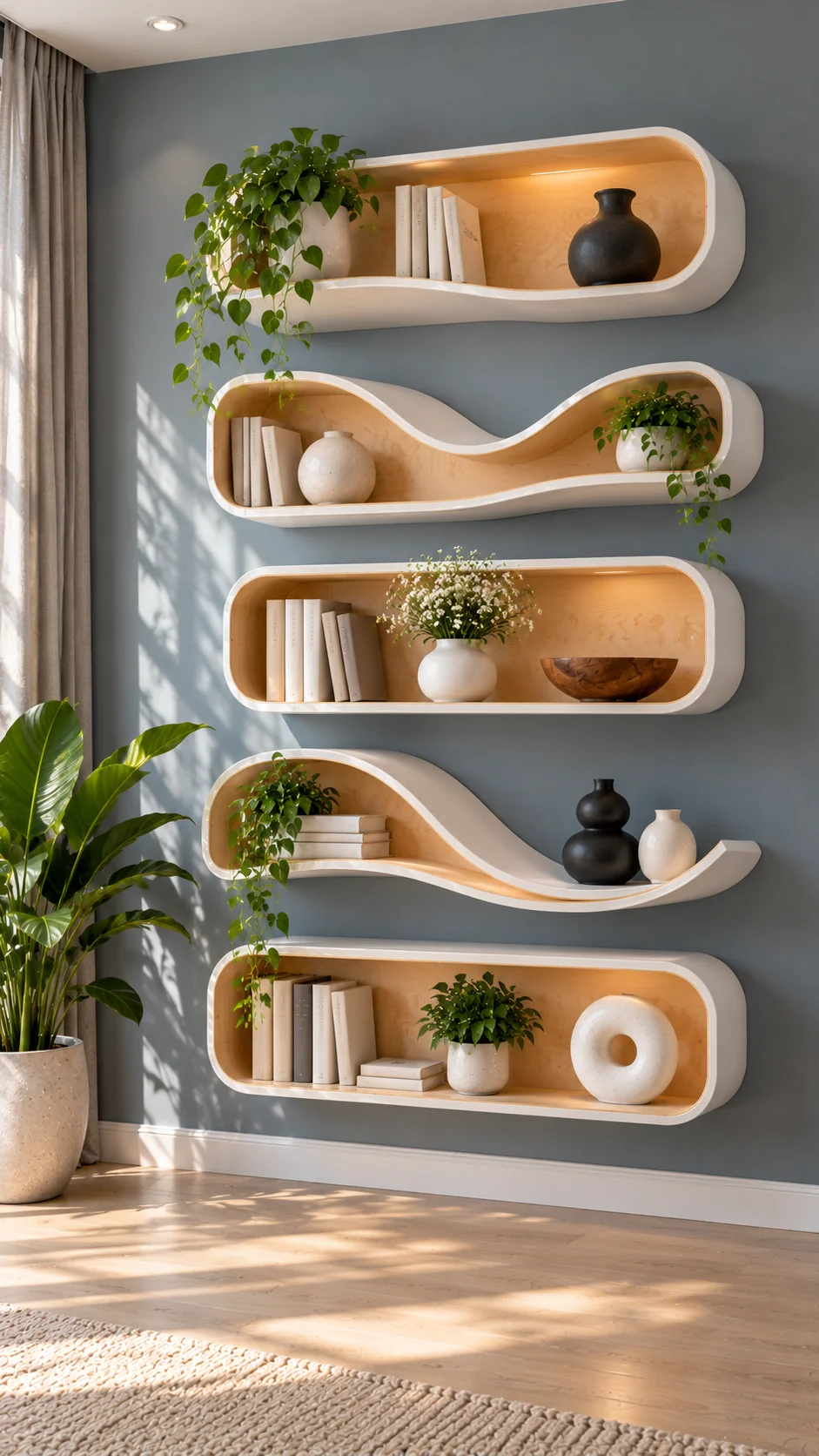
Five sculptural floating shelves in soft white ripple across a blue-gray wall, and the color contrast does half the work: white against blue reads crisp and calm, the visual equivalent of a deep breath. Each shelf has a gentle wave — some dip, some rise — creating natural display niches without any dividers.
Floating shelves live or die on their mounting, and these deep sculptural ones need serious wall anchoring — they’re holding books, which are deceptively heavy. The LED underlighting on each level isn’t just mood; it washes the blue wall with warm light that keeps the white shelves from looking stark. Styling stays minimal on purpose: a few books, one vase, one plant per shelf. When the shelf is the sculpture, the objects should be the quiet supporting cast.
This is the most renter-adjacent look in the set in spirit, if not in installation — the visual lightness comes from the floating mount and the pale palette, both of which make a wall feel bigger rather than more furnished.
The Corner Tower That Eats Dead Space
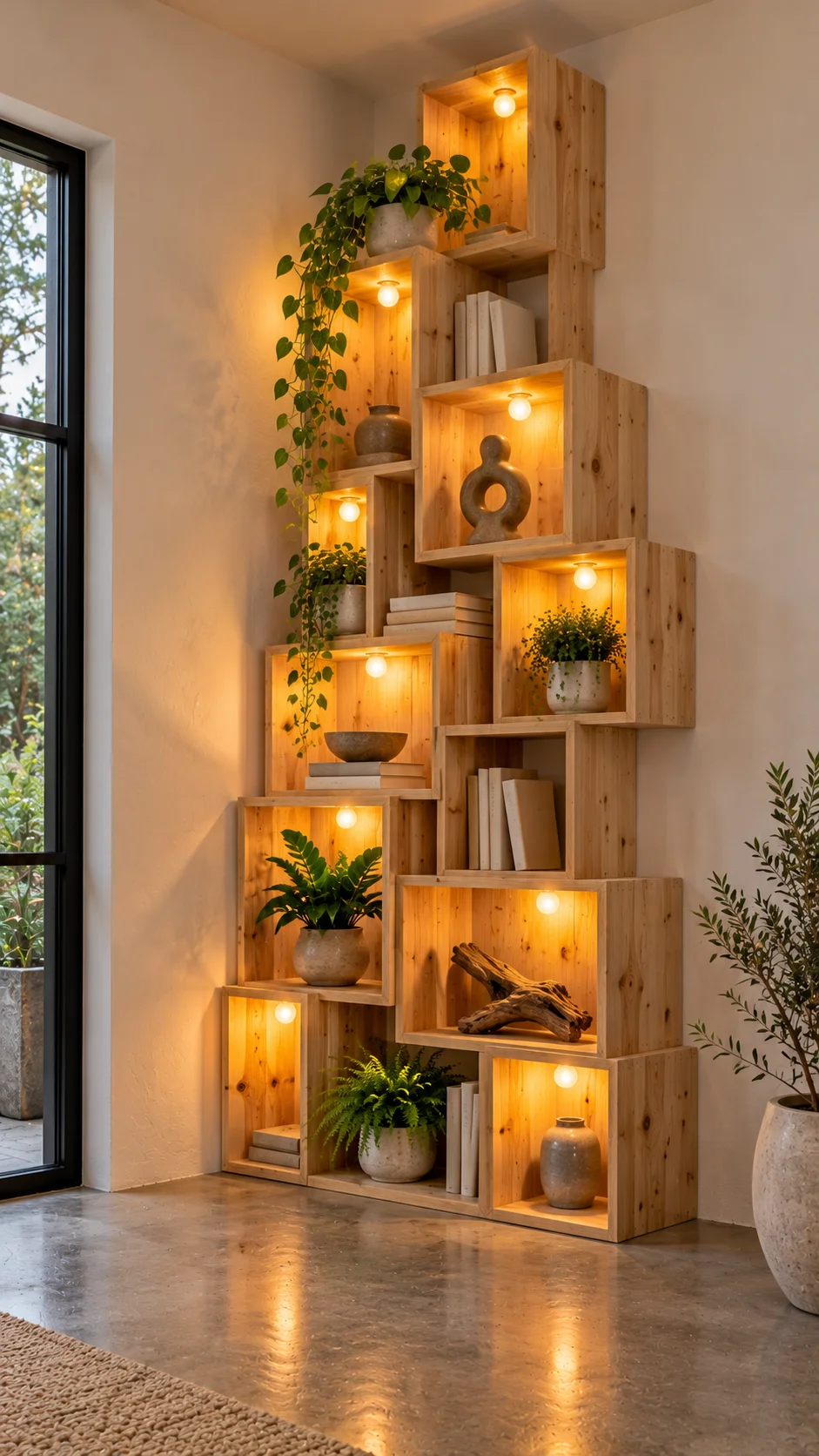
Corners are where floor plans go to waste — too tight for furniture, too visible to ignore. This tower of staggered wooden cubes climbs a corner floor-to-ceiling, each cube with its own small warm light, holding plants, books, and objects all the way up. It’s the most storage-dense piece in this set, and it occupies perhaps four square feet of floor.
The staggered arrangement matters: perfectly stacked cubes would read as a bookcase, but the offset rhythm makes it read as architecture. Each cube’s light turns it into a tiny display case after dark — the whole tower glows like a lantern, which is a lot of atmosphere from a corner that was doing nothing. Small cubes mean small objects, though; this is a tower for plants, vases, and curios, not for your hardcover collection.
Dead corners exist in every home — beside a fireplace, at the end of a hallway, next to a window. Home bar ideas that turn an empty corner into a stylish entertaining space show the same corner-claiming instinct pointed at entertaining instead of display.
Triangles Above, Drawers Below
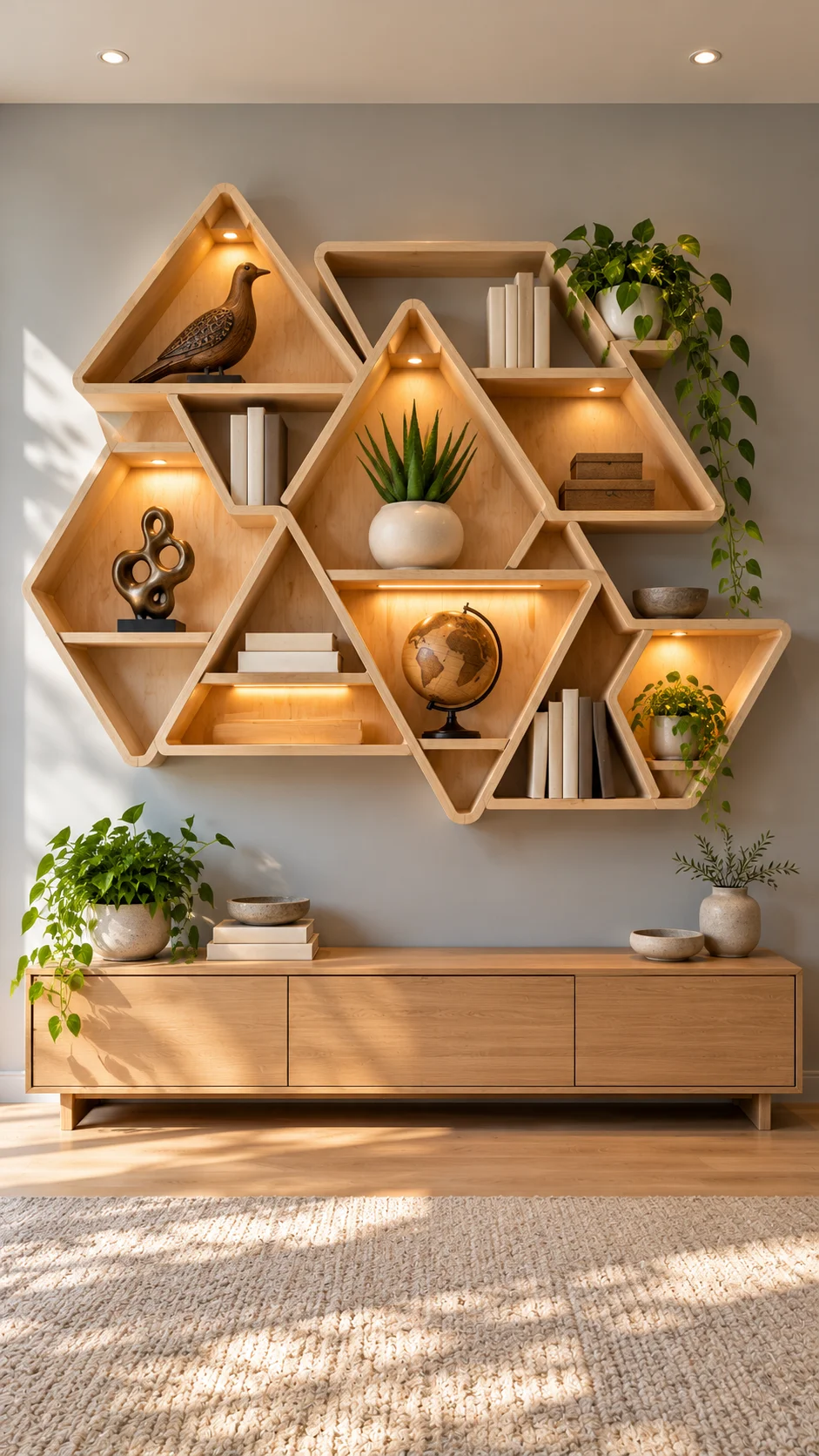
This is the most practical pairing in the set: a cluster of triangular shelves with integrated spotlights floating above a long, low credenza. The triangles hold the pretty things — a globe, a bird sculpture, small plants, a few books — while the credenza’s closed drawers swallow everything you don’t want to look at.
That open-above, closed-below formula is the whole secret of livable display shelving. Pure open shelving demands constant curation; pure closed storage is boring. Together, you get the gallery look with a place to hide the chargers, the paperwork, and the remote controls. The triangles themselves force small-scale styling — you physically cannot fit a cluttered stack into a triangle, which keeps the display honest without any willpower required.
Notice the restraint in the palette: pale wood, cream books, terracotta and bronze accents. Geometric shelving already has so much visual energy from its shape that the objects need to stay quiet — loud shelf plus loud objects is the fastest route to a wall that shouts.
The Wavy Bookcase for People Who Actually Read
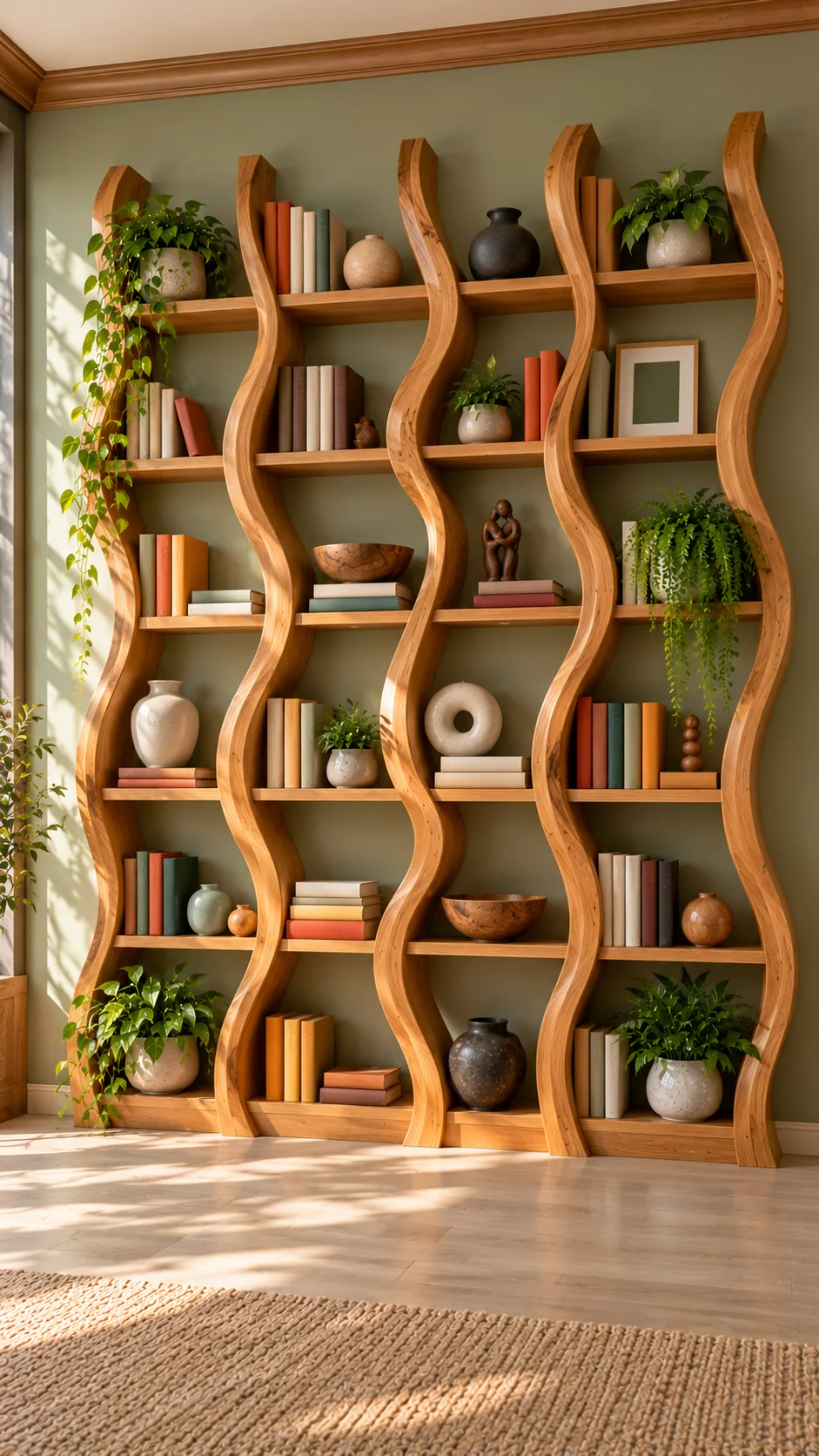
After all the display-first shelving, here’s one for the readers: a full-height bookcase with serpentine wooden uprights, holding what looks like a genuine book collection — hundreds of spines in warm earth tones — interspersed with plants, bowls, and small sculptures. This is storage at scale that still manages to be beautiful.
The wave of the uprights does something clever: it breaks the bookcase into bays without dividers, so each section feels like its own small shelf rather than one endless wall of spines. The styling rhythm is worth copying — roughly three parts books to one part objects, with the objects (a bowl, a trailing plant, a sculpture) placed where your eye needs a rest. Books grouped by tone rather than strict order keep the color story calm; rainbow-shelved books would fight the wood.
A bookcase this size is furniture, and it should be treated that way: anchored to the wall (a loaded bookcase can absolutely tip), with its back panel considered — here the sage wall behind shows through, which is half the beauty. If books are your thing, light, layers and comfort: 10 reading nook ideas that work show what to put next to the bookcase once it’s full.
The Tree Shelf That Starts Conversations
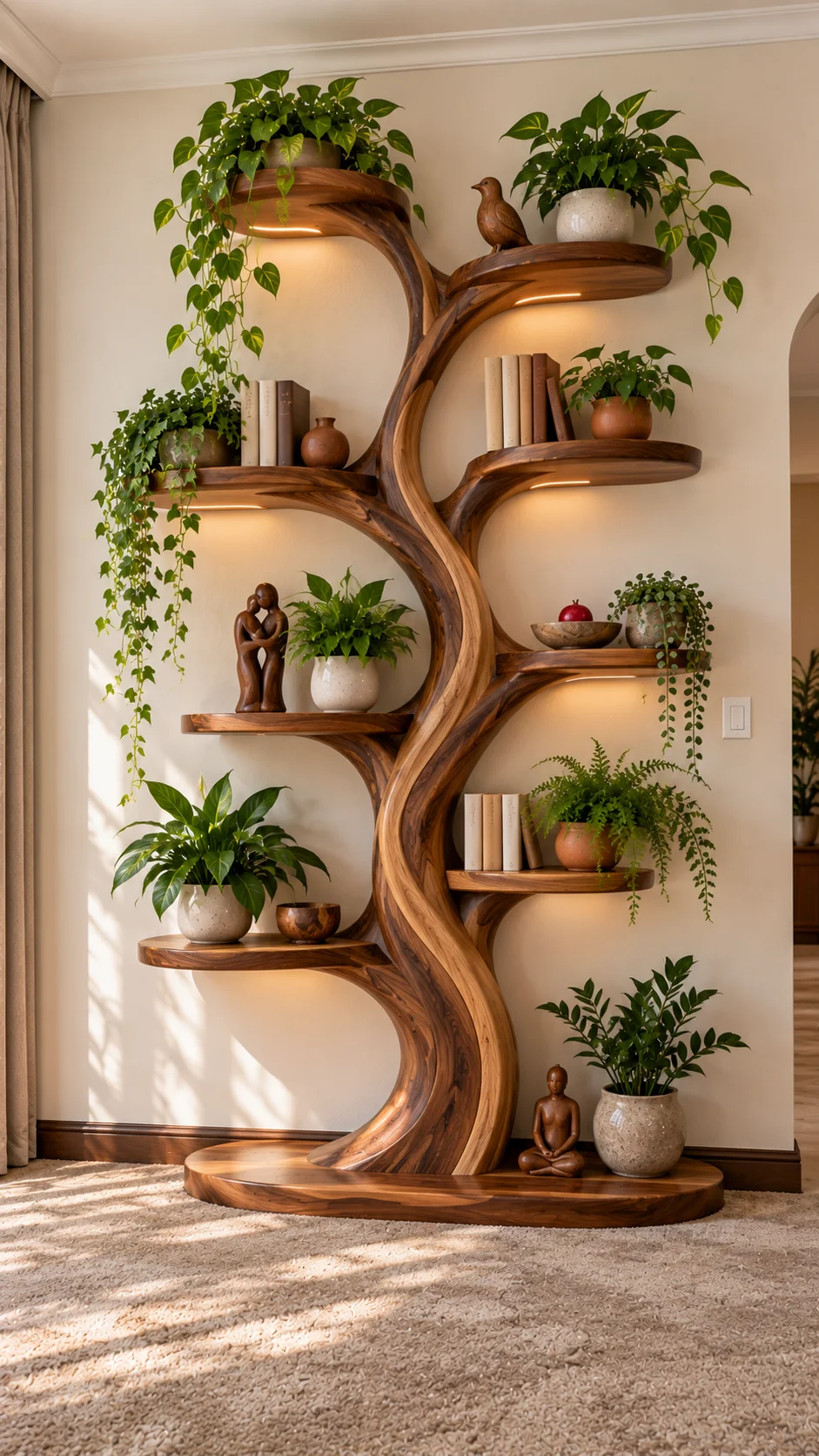
And then there’s the tree: a full-height wooden trunk with branch-shelves spiraling outward, holding plants, books, and small sculptures, with LED strips under several branches. It’s the least practical shelf in this set and the most delightful — nobody buys a tree shelf for optimal storage density.
That’s precisely its value. Some furniture exists to make a room memorable, and a tree shelf does that job better than almost anything at this price point. Guests will photograph it; kids will love it; it gives an otherwise plain corner an identity. The styling leans into the concept — mostly plants, a few books, small wooden objects — nothing that fights the arboreal joke.
The honest accounting: it holds less than a bookcase a third its visual size, dusting the branches is fiddly, and the novelty is the whole point — if you tire of the joke, you’re left with an awkward tree. But chosen with open eyes, for the right corner, it’s the kind of piece people remember your home by. Not every purchase needs to be sensible; some just need to be loved.
Frequently Asked Questions
How much weight can floating shelves actually hold?
It depends entirely on the mounting, not the shelf. Shelves on proper studs or heavy-duty wall anchors can hold books without complaint; shelves on drywall anchors alone cannot, no matter how solid they look. As a rule, if a shelf will hold books, it needs studs or a French cleat — and deep sculptural shelves like the wavy ones above need even more respect, because depth multiplies the pulling force on the mount.
How do I style open shelves without them looking cluttered?
Give every shelf a job and leave breathing room. The formula that works across all ten pieces above: group objects in odd numbers, vary heights, repeat one or two materials, and leave at least a third of each shelf empty. Empty space isn’t wasted — it’s what makes the objects read as chosen rather than stored.
Are open shelves practical in a dusty home?
They’re honest about dust, which is both the problem and the solution — you’ll see it, so you’ll deal with it. Fewer, larger objects dust faster than many small ones; closed storage below (like the credenza in the triangle-shelf room) hides the things you’d rather not dust at all. In very dusty environments, glass-front cabinets give you the display look with a fraction of the upkeep.
What’s the best wood for shelving?
For painted or light Scandinavian looks, maple and birch stay pale and take finish evenly. For warm rustic pieces, oak and walnut bring the grain. Live-edge slabs are usually cut from whatever the maker had — ask about the species if it matters to you, but for a decorative shelf, stability matters more than pedigree: kiln-dried, sealed on all sides, and thick enough not to sag under books.
Can I mix shelf styles in one room?
Yes, if they share a material language. A wavy oak shelf and a geometric oak shelf can coexist; a wavy oak shelf and a black metal industrial shelf will argue. Pick one wood tone (or one metal finish) and let the shapes vary — shared material is what makes eclectic shelving read as collected rather than random.
Conclusion
The shelf is the most honest furniture there is: it shows exactly what you own and how you think. The ten pieces above just refuse to be quiet about it — they wave, they glow, they climb corners and branch like trees. But the real lesson isn’t about buying sculptural wood. It’s about matching the shelf to the life: deep cubbies for the reader, lit niches for the collector, open waves for the plant keeper, closed drawers below for everyone.
So before you fall for the prettiest one, inventory your own things. Count the books, the plants, the objects that need a home — then pick the shelf whose shape wants exactly those things. Storage that fits your life doesn’t need to shout; but as these ten prove, there’s no rule that says it can’t.
About the Aesthetic Life Team
The Aesthetic Life Team writes practical home design guides — what looks good in photos, and what actually holds up once you live with it.

