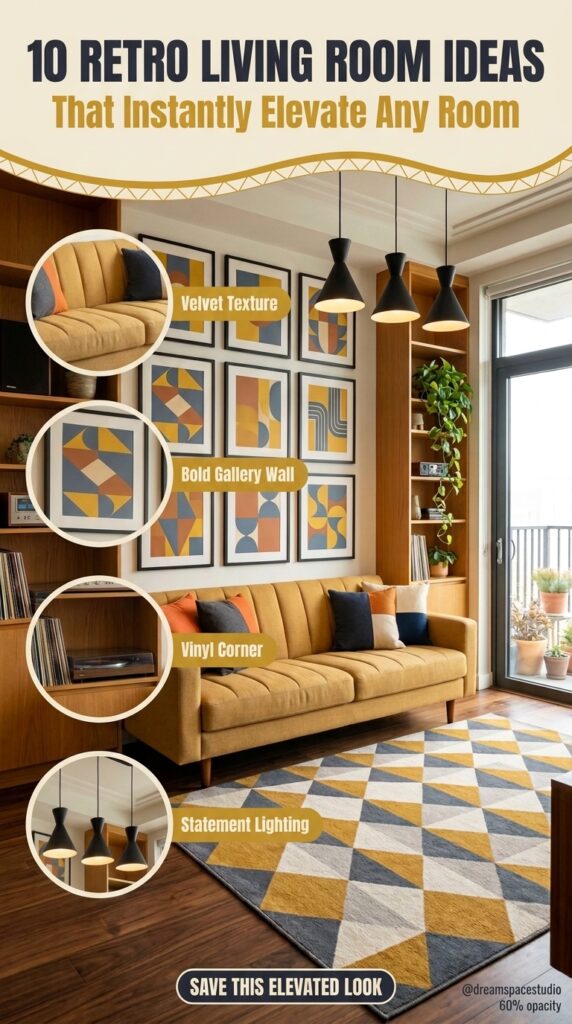
Retro design isn’t about recreating a decade exactly as it was—it’s about borrowing the parts that still work. Warm color, curved silhouettes, wood paneling, and a willingness to let pattern do more than a neutral palette ever could. These ten living rooms pull from that era without tipping into costume territory, each one built around its own specific combination of color, material, and shape.
Sunburst Clocks and Built-In Shelving Set the Retro Tone
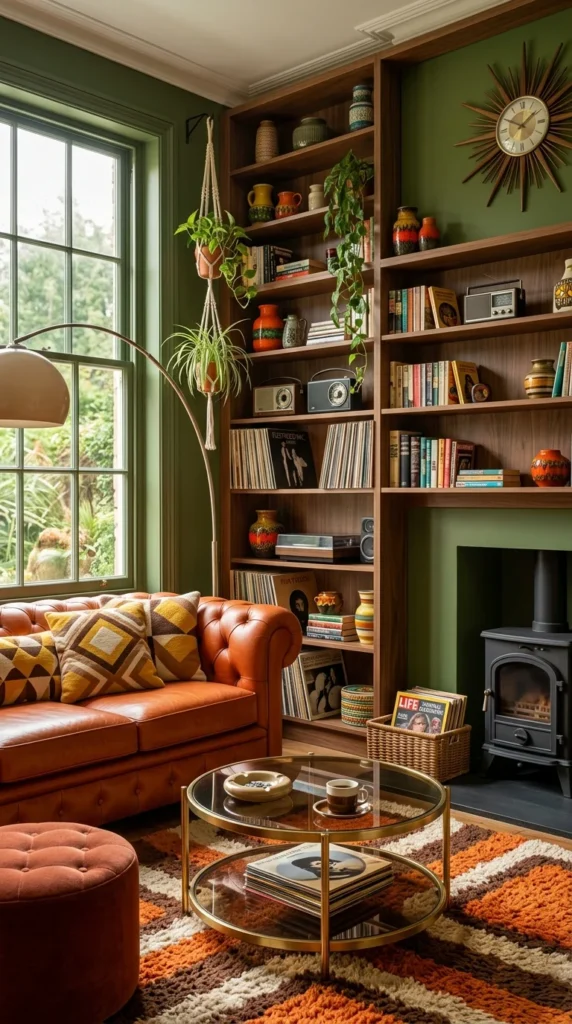
Olive green walls frame a wall of built-in wood shelving stacked with vinyl records, ceramic vases, and a vintage radio, while a brass sunburst clock fills the space where a piece of framed art might otherwise go. A burnt orange leather sofa anchors the seating area, styled with mustard and brown geometric pillows, and a macrame-hung plant softens the corner near the window. The shag rug underfoot—striped in cream, orange, and brown—is the one element that keeps the room from feeling too formal despite the leather and built-in cabinetry.
💡 Pro Tip: A sunburst clock works as a substitute for framed art on a wall that already has a lot of shelving detail—its shape and metal finish add visual interest without competing with the objects on the shelves themselves.
How a Geometric Gallery Wall Replaces a Single Piece of Art
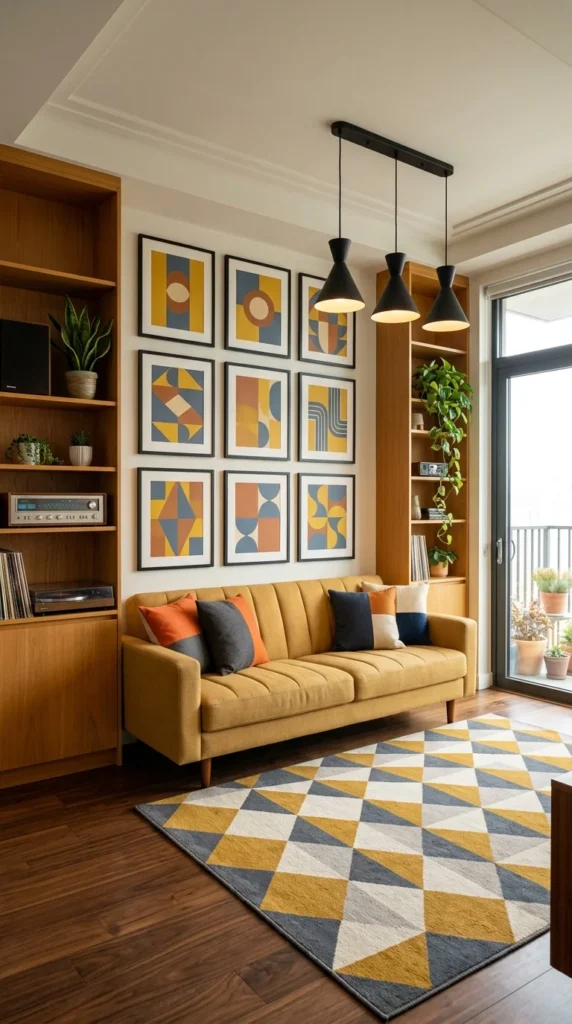
Nine framed geometric prints in mustard, navy, and rust are arranged in a tight three-by-three grid above a channel-tufted yellow sofa, functioning as one large art piece rather than nine separate ones. A matching triangle-patterned rug in the same three colors repeats the geometry at floor level, tying the wall and the seating area together without needing a third pattern in the room. Black pendant lights hang in a row above the sofa, and open wood shelving on either side holds plants and a working turntable, reinforcing the room’s commitment to shape over ornament.
✅ Checklist — Building a Geometric Gallery Grid
- Choose 3 colors maximum and repeat them across every print
- Use identical frame widths and matting for a clean grid line
- Match the grid’s color palette to one other element in the room, like a rug
- Space prints evenly with consistent gaps, not varied spacing
Wood-Paneling Grounds a Room Full of Psychedelic Patterns
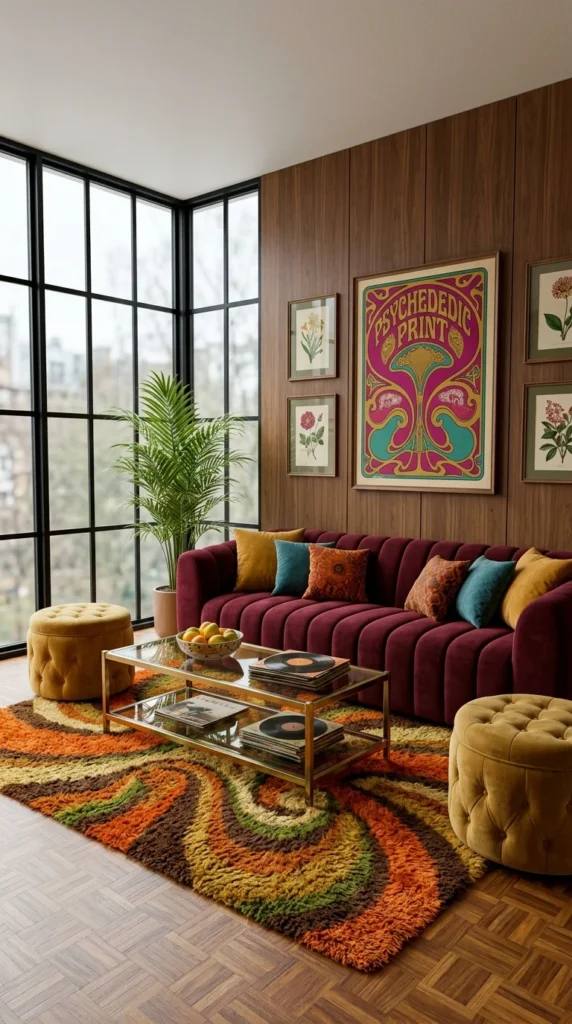
Warm wood paneling covers the wall behind a burgundy velvet channel sofa, providing a calm backdrop for a large psychedelic-style print in magenta, teal, and gold hung at the center. Smaller botanical prints flank it on either side, and a swirling shag rug in orange, olive, and brown picks up the same energy at floor level. Floor-to-ceiling windows on the opposite wall bring in enough daylight to keep the saturated colors from feeling heavy, while a glass-and-brass coffee table holds a stack of records without adding any competing material to the mix.
📝 Note: Wood paneling is one of the few backdrops that can hold a highly saturated statement print without a mat or a second neutral wall—the warmth of the wood grain does the same visual job a cream wall would.
Why Does an All-Olive Room Feel Warm Instead of Dark?
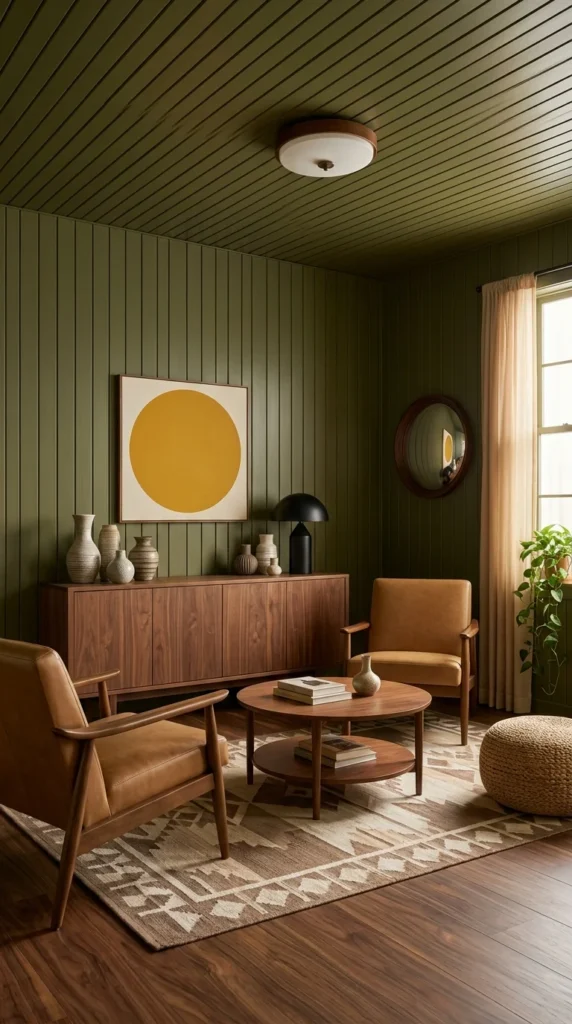
Because olive sits closer to a warm neutral than a true dark tone, and this room proves it by covering both the walls and the slatted ceiling in the same shade. Tan leather armchairs, a walnut credenza, and a round wood coffee table keep every surface in a matching warm wood-and-leather family, while a bold mustard circle print above the credenza becomes the room’s only graphic moment. A woven jute pouf and patterned area rug in cream and brown add texture without introducing a new color, which is part of why the room reads as cozy rather than closed-in.
📊 At-a-Glance: Why This Olive Room Doesn’t Feel Dark
- Wall and ceiling color: Same warm olive tone throughout
- Furniture finish: Warm wood and tan leather only
- Natural light Source: Tall window with sheer curtain
- Only graphic element: One mustard circle print
Curved Furniture Softens a Bold Color Palette
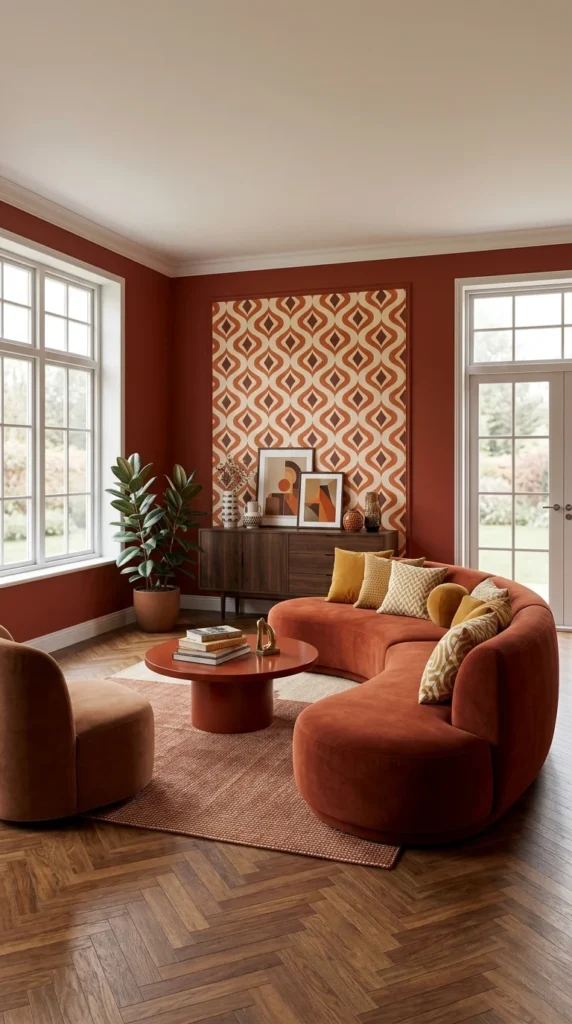
A rust-red sofa with a fully rounded, curved silhouette sits against walls painted the same deep red, broken up only by a large ogee-patterned accent panel in rust, cream, and brown behind it. The curve of the sofa removes every hard angle from the seating area, which matters in a room this saturated—sharp lines against this much color would read as more aggressive than the room intends. A herringbone wood floor and a low, curved coffee table in matching red continue the rounded, monochromatic approach, while mustard and patterned pillows introduce the only textile variation in the space.
🔄 Alternative Approach: For a similar effect without committing to curved upholstery, a traditional sofa paired with rounded side tables and a circular rug can soften a monochromatic red or rust room in a lower-cost, lower-commitment way.
Channel-Tufted Velvet Brings Texture Back Into a Neutral Room
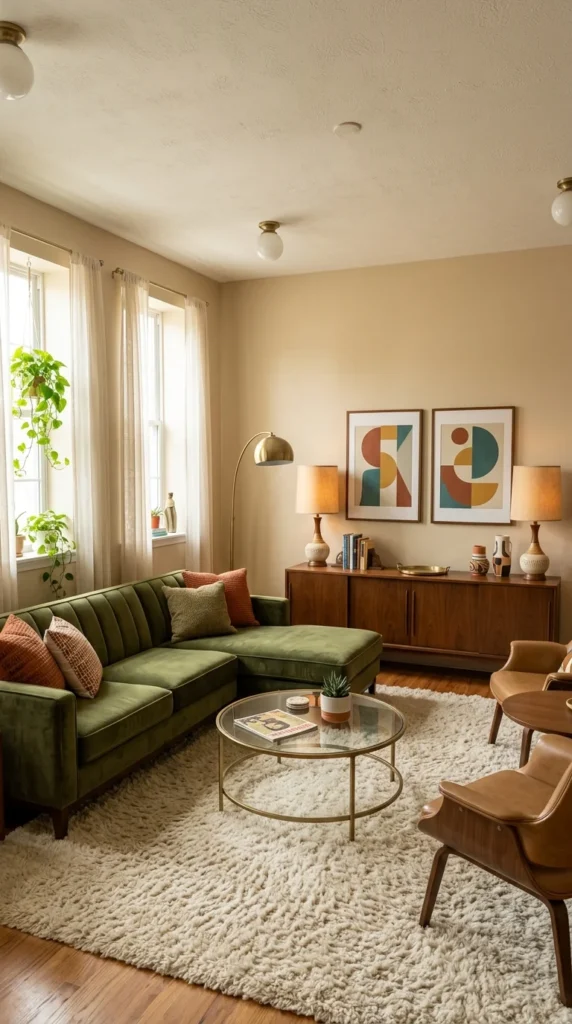
An olive-green channel-tufted sofa sits against warm beige walls, paired with a cream shag rug and a brass arc floor lamp that curves gently over the seating area. Two framed abstract prints in teal, mustard, and rust hang above a walnut credenza styled with ceramic lamps and small plants, giving the room its only concentrated dose of color against an otherwise soft, neutral backdrop. Rattan and leather accent chairs on the opposite side of the coffee table round out the material mix without adding another dominant color.
💰 Budget Box: Channel-tufted upholstery adds cost over a flat-panel sofa because of the additional fabric and stitching required, but a single channel-tufted piece—rather than a full sectional—can bring the same texture into a room at a lower overall price point.
Vinyl Storage Becomes the Room’s Main Architecture
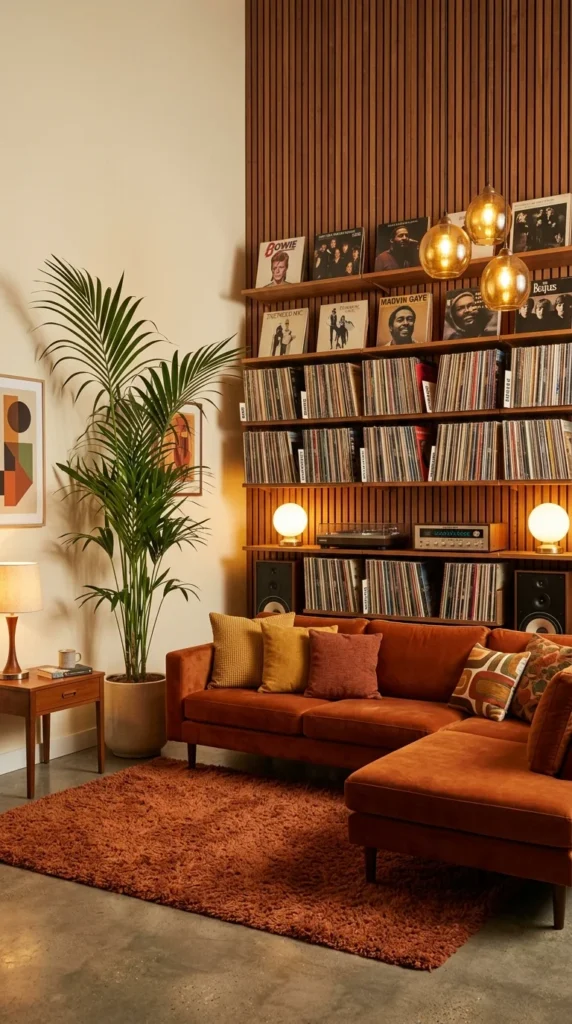
A wall of wood slat paneling rises from floor to ceiling, lined with shelves that hold a working turntable, stereo receiver, and a dense collection of vinyl records displayed spine-out and cover-forward. Amber glass globe pendant lights hang at staggered heights in front of the shelving, casting a warm glow that a ceiling fixture alone wouldn’t achieve. A rust velvet sectional and a matching shag rug in the same tone keep the seating area from competing with the wall, letting the record collection function as the room’s primary visual feature rather than a side detail.
⏱️ Time & Cost: A slatted wood accent wall built specifically for album storage requires more planning than a standard bookshelf—measuring record sleeve dimensions before building the shelf depth prevents an expensive redo.
What a Color-Blocked Rug Does for a Symmetrical Layout
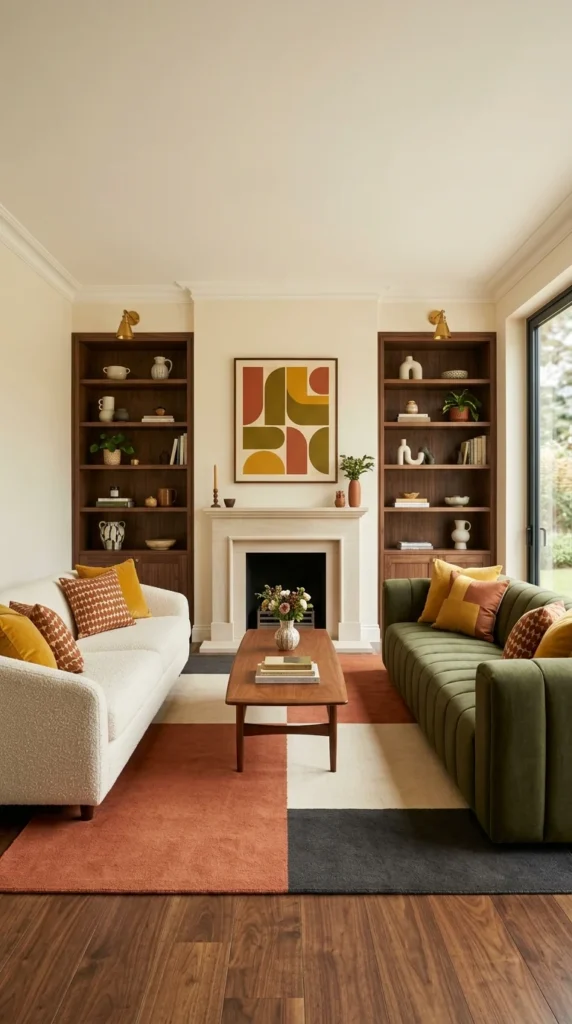
A rug divided into solid blocks of rust, charcoal, and cream sits between a cream boucle sofa and an olive green channel sofa, which face each other in a fully symmetrical arrangement centered on a fireplace. A single piece of geometric art in mustard, rust, and olive hangs above the mantel, and matching built-in bookshelves flank the fireplace on either side, reinforcing the symmetry down to the sconces mounted above each one. Because the furniture arrangement is so evenly balanced, the color-blocked rug is the one element allowed to introduce asymmetry, with each color block sized differently from the others.
⚠️ Warning: A fully symmetrical furniture layout can feel stiff without at least one intentionally uneven element—a color-blocked rug, an off-center light fixture, or an asymmetrical piece of art keeps the balance from tipping into rigidity.
Tropical Print Wallpaper Anchors a Warm-Toned Sectional
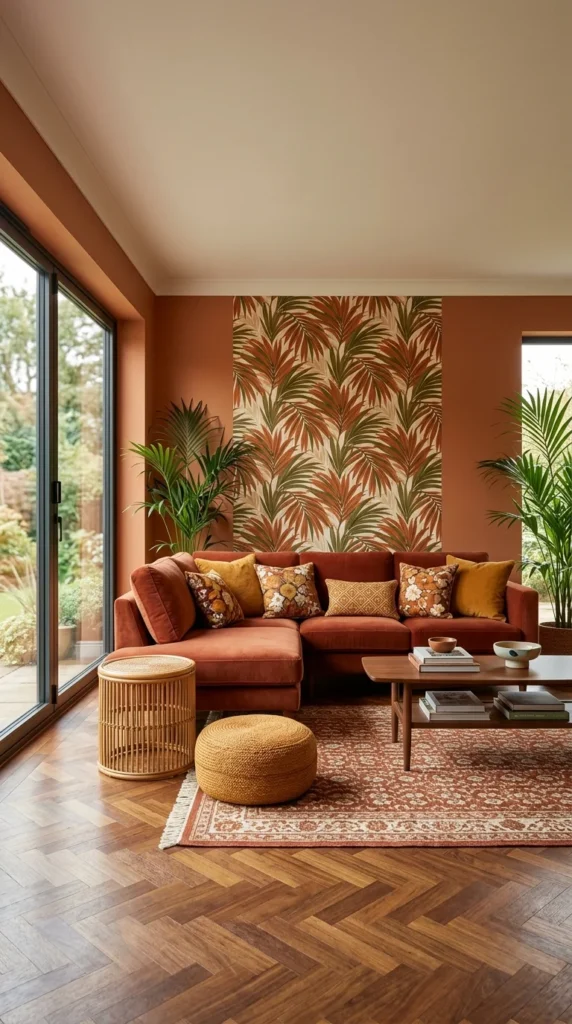
A tall panel of tropical leaf-print wallpaper in rust, olive, and cream breaks up an otherwise solid terracotta wall, sitting directly behind a rust velvet sectional dressed in mustard and floral pillows. A herringbone wood floor and a rattan side table echo the natural, botanical theme introduced by the wallpaper panel, while sliding glass doors on either side bring the room’s real plants into visual conversation with the printed ones. Keeping the wallpaper contained to a single panel, rather than covering every wall, allows the pattern to function as a focal point instead of a full backdrop.
❓ Reader Question: Do I need to wallpaper an entire wall to get this look? No—a single framed or panel-mounted section of wallpaper, sized to sit behind a sofa, delivers the same focal-point effect with a fraction of the material and labor.
A Built-In Nook Turns Seating Into Its Own Small Room
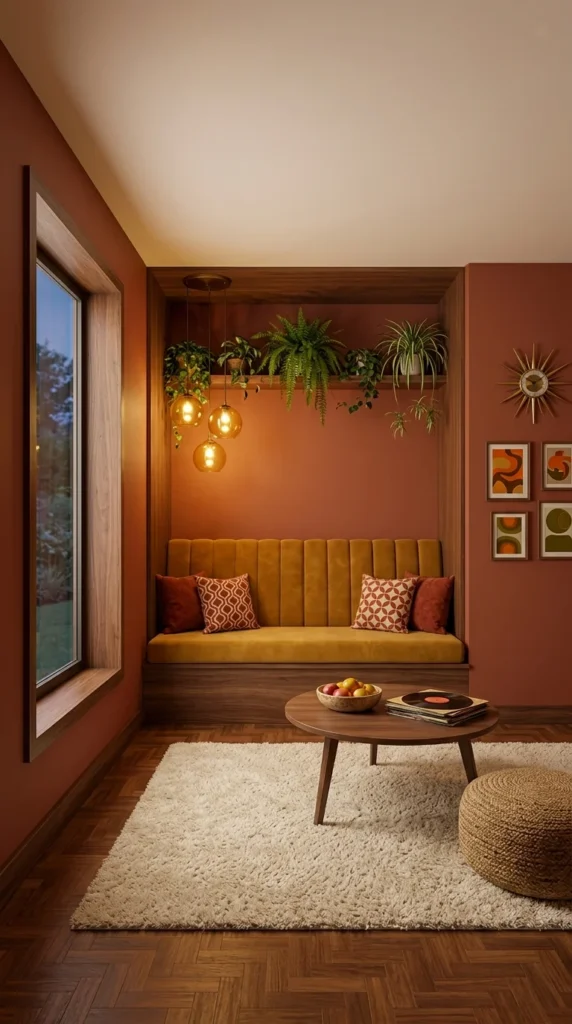
A mustard velvet banquette sits inside a built-in wood-framed alcove, with a shelf of trailing plants mounted just above it and three amber glass pendant lights hanging low over the seating area. Terracotta walls extend from the main room into the nook without a break, while a small sunburst clock and a set of graphic art prints on the adjacent wall keep the space visually connected to the room beyond it. A plush cream shag rug and a round wood coffee table with a woven jute pouf complete the seating area, giving the nook everything it needs to function as a self-contained reading or listening corner.
💡 Pro Tip: A built-in banquette reads as a distinct “room within a room” most successfully when the wall color continues unbroken from the main space into the alcove — a color change at the threshold tends to make the nook feel like an afterthought instead of a planned feature.
Frequently Asked Questions
Is retro living room design the same as mid-century modern?
They overlap but aren’t identical. Mid-century modern refers specifically to a design movement centered on clean lines and functional furniture, while retro design can pull from a wider range of decades and includes bolder, more pattern-heavy choices than classic mid-century style typically allows.
What colors define a retro living room?
Warm, earthy tones—olive, mustard, rust, and burgundy—show up most consistently, often paired with wood tones rather than white or gray, which keeps the palette from reading as a modern color scheme.
Do I need vintage furniture to get this look, or can I use new pieces?
New furniture works fine as long as the silhouette and material reference the era—curved sofas, channel tufting, tapered wood legs, and velvet or leather upholstery all read as retro regardless of manufacture date.
Is wood paneling outdated, or is it coming back?
It’s being used deliberately again, particularly as a backdrop for bold art or color rather than as the main event of a room, which is a different application than the wall-to-wall paneling of past decades.
How do I avoid making a retro room feel like a themed costume rather than a lived-in space?
Limiting the retro-specific elements—a shag rug, one statement print, and one piece of curved furniture—to a few intentional choices, rather than filling every surface with era-specific decor, keeps the room feeling designed rather than staged.
Conclusion
The rooms above share a formula worth noticing: one or two era-defining choices—a curved sofa, a slatted wood wall, a sunburst clock—supported by a warm, consistent color palette and enough restraint elsewhere to keep the room livable. Retro design works best as a set of specific decisions borrowed from the past, not a full recreation of it. Anyone drawn to this look can start small—a rug, a print, a single piece of curved furniture—and let the rest of the room stay grounded in the present.
One Response