

Dark academia borrows its mood from old libraries and older houses—deep wood tones, worn leather, brass that’s allowed to tarnish a little, and enough shadow that a room never feels fully lit. Translating that into a kitchen is a genuine design challenge, since kitchens are supposed to be bright, functional, and easy to clean. The rooms below prove it can be done without sacrificing either mood or usability.
None of these kitchens rely on a single dark cabinet color to get there. Stained glass, patterned tile, hanging copper, and shelves of real books all do as much work as the paint choice. Here’s how nine different kitchens build the same atmosphere in different ways.
A Gothic Arch and a Wall of Hanging Copper
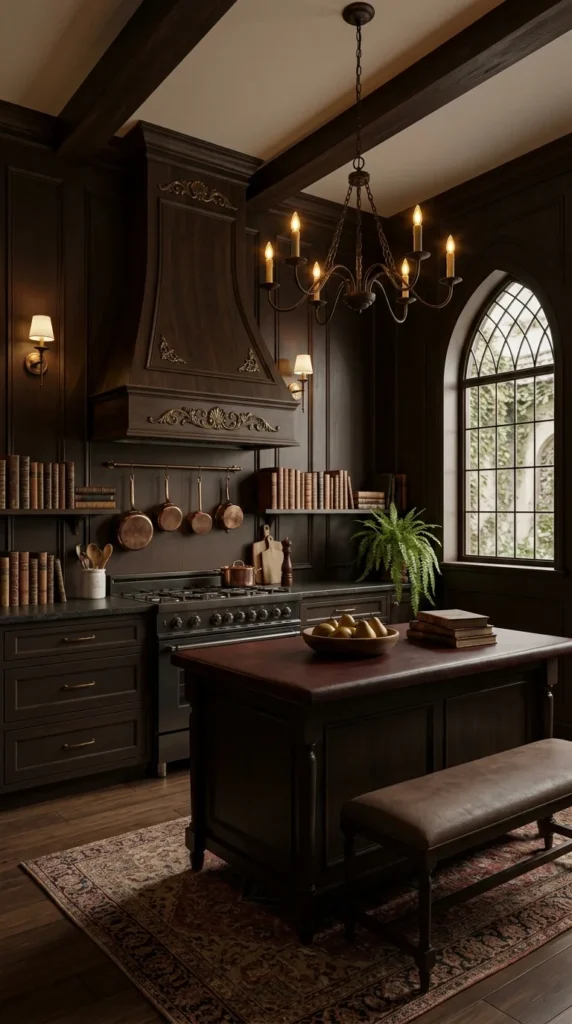
Deep brown wood paneling covers nearly every surface in this kitchen, from the carved range hood down to the drawer fronts, broken up only by a gothic arched window that lets in filtered daylight through climbing greenery outside. A row of copper pots hangs directly below open bookshelves, turning cookware storage into part of the room’s display.
A wrought iron chandelier with candle-style bulbs hangs above a wood island topped in deep oxblood leather, paired with a low leather bench and a faded Persian-style rug underneath. A small fern on the counter and a bowl of pears are the only unstyled, everyday touches in an otherwise formal room.
Pro Tip: Open shelving filled with real, worn hardcover books does more to establish a dark academia mood than almost any paint color—it’s worth sourcing secondhand books by the shelf foot before investing in cabinetry.
Oxblood Cabinetry Beneath a Coffered Black Ceiling
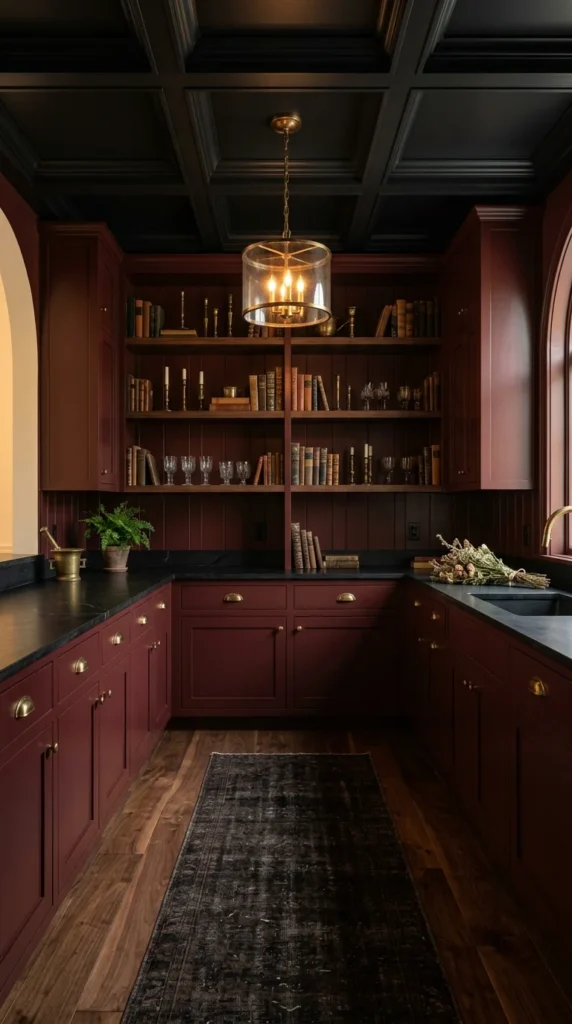
A deep coffered ceiling in matte black sets a dramatic upper boundary for this kitchen, while oxblood-red cabinets below carry the room’s main color statement. Open shelving between the cabinets holds a mix of old books, candlesticks, and stemmed glassware, arranged with enough irregularity to look collected rather than staged.
Black soapstone counters ground the red cabinetry in something cooler and more neutral, and a glass drum pendant with exposed candle-style bulbs hangs at the center of the room. A dark, worn runner rug underfoot and a small potted fern by the sink are the only textures that break up the room’s otherwise hard, flat surfaces.
Note: Coffered ceilings painted in the same dark tone as the walls make a room feel taller, not shorter, by removing the visual line where the wall meets the ceiling—a useful trick in a kitchen where deep color might otherwise feel closing in.
Stained Glass, Stone, and a Cat by the Rug
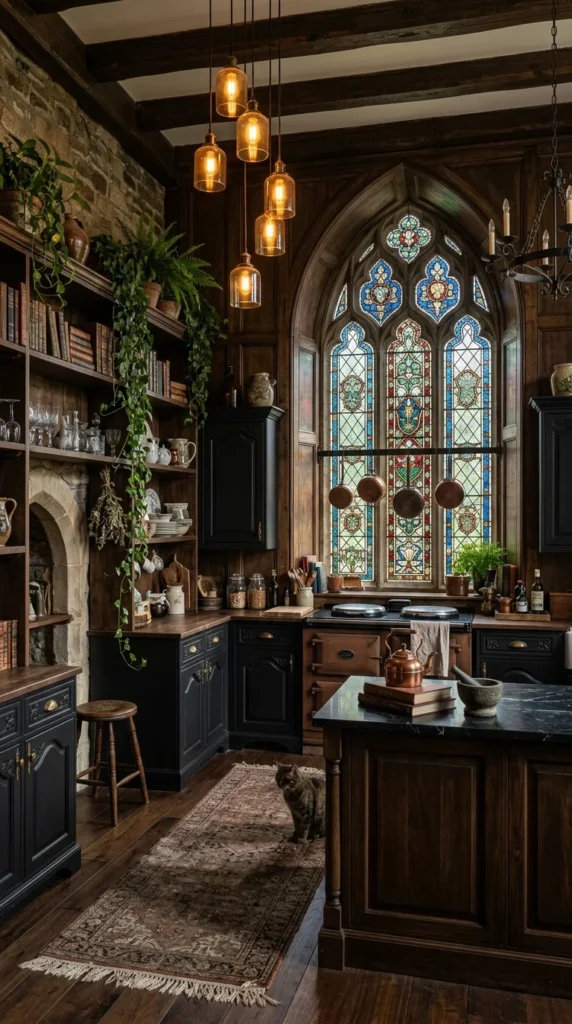
Exposed stone on one wall and a stained-glass-arched window at the far end give this kitchen the feel of a converted chapel or old manor pantry. A row of copper pots hangs directly across the lower portion of the window, catching the colored light passing through the glass above them.
Black cabinetry throughout stays deliberately plain, letting the window and stone wall carry the room’s visual interest, while a cluster of amber glass pendant lights adds warmth without competing with the stained glass. Trailing plants along the open shelving, a worn patterned rug, and a resident cat curled near the island leg complete a room that reads more lived-in than showroom-styled.
Warning: Stained glass this size is typically a custom or antique architectural salvage piece—if it’s the detail driving the whole design, expect it to be one of the more expensive single elements in the room, and plan the layout around it rather than trying to fit it in after the fact.
Black Marble and Walnut, lit by brass
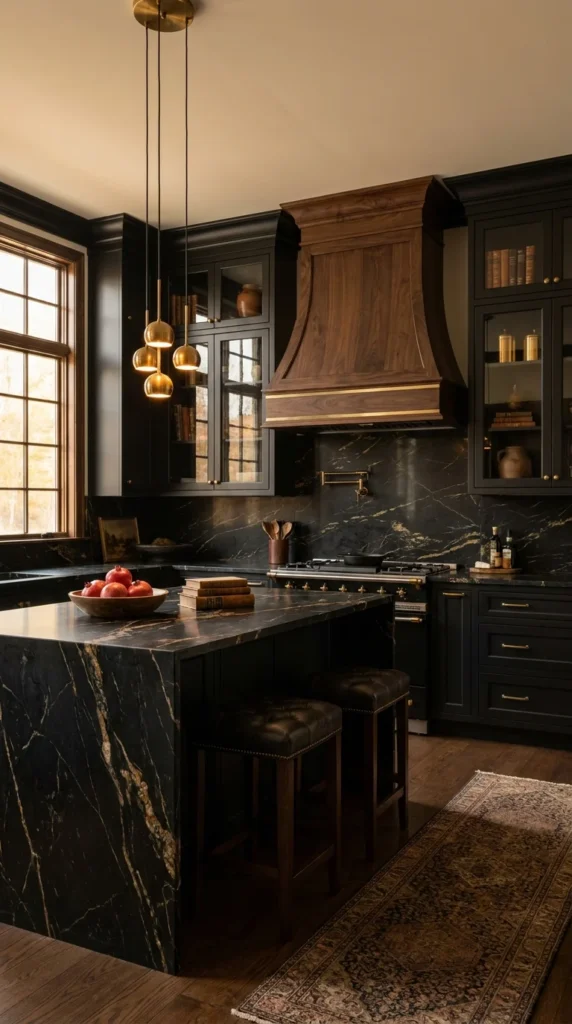
Dramatic black-and-gold veined marble covers both the island and the backsplash here, its pattern doing most of the visual work in a kitchen that otherwise keeps its palette restrained. A walnut wood range hood trimmed in brass breaks up the black cabinetry above the stove, warming what could otherwise read as a cold, all-black room.
A cluster of round brass pendants hangs low over the island, and glass-front cabinets on either side display leather-bound books alongside everyday glassware—a detail that keeps the room from feeling purely decorative. A bowl of pomegranates on the marble island adds the only saturated color in a room built mostly from black, brass, and warm wood.
Checklist for pairing marble with dark cabinetry:
- Choose a marble with warm veining (gold, brass, or cream) to offset cool black cabinets
- Keep hardware in a single warm metal tone throughout—brass, not mixed with chrome or nickel
- Reserve glass-front cabinets for the most visually interesting items, not everyday dishware
- Balance the marble’s high shine with at least one matte surface, like painted wood
A Forest Green Dining Corner Set for Tea
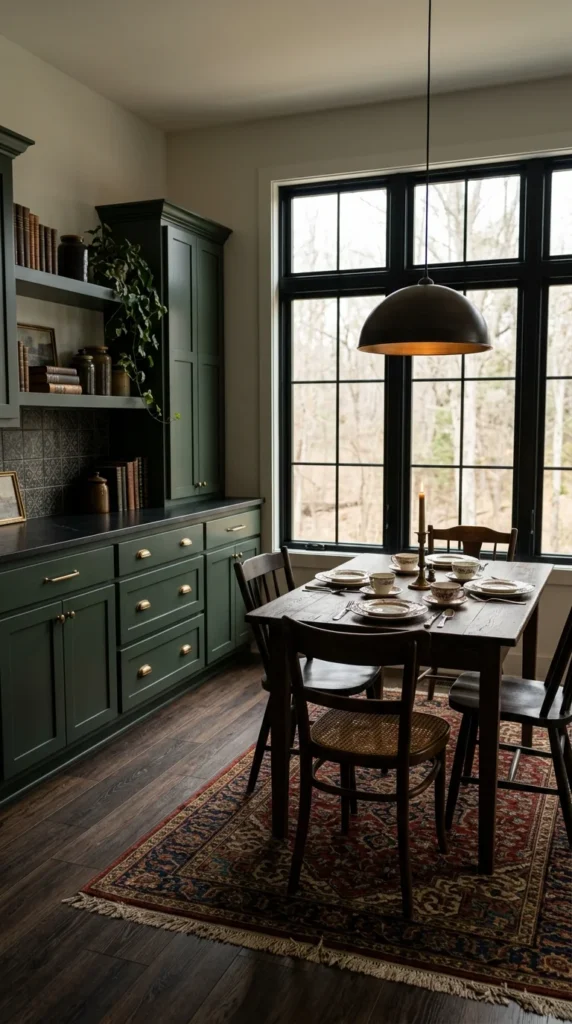
Deep forest green cabinets anchor this kitchen’s dining corner, paired with a patterned tile backsplash in a muted, antique palette rather than anything glossy or modern. Tall black-framed windows look directly out onto bare winter trees, keeping the room’s mood quiet rather than bright.
A worn wood farmhouse table is set with mismatched vintage china and a lit taper candle, more evocative of a study break than a casual breakfast. A black dome pendant hangs low over the table, and a runner rug in deep red and cream ties the dining area back to the cabinetry’s cooler green tone.
Reader Question: Does dark green work as well as black for a moody kitchen? Yes—dark green tends to feel slightly warmer and less severe than black, which makes it a good option for anyone who wants the dark academia mood without the starker contrast that full black cabinetry creates.
Black Hexagon Tile With Brass Grout Lines
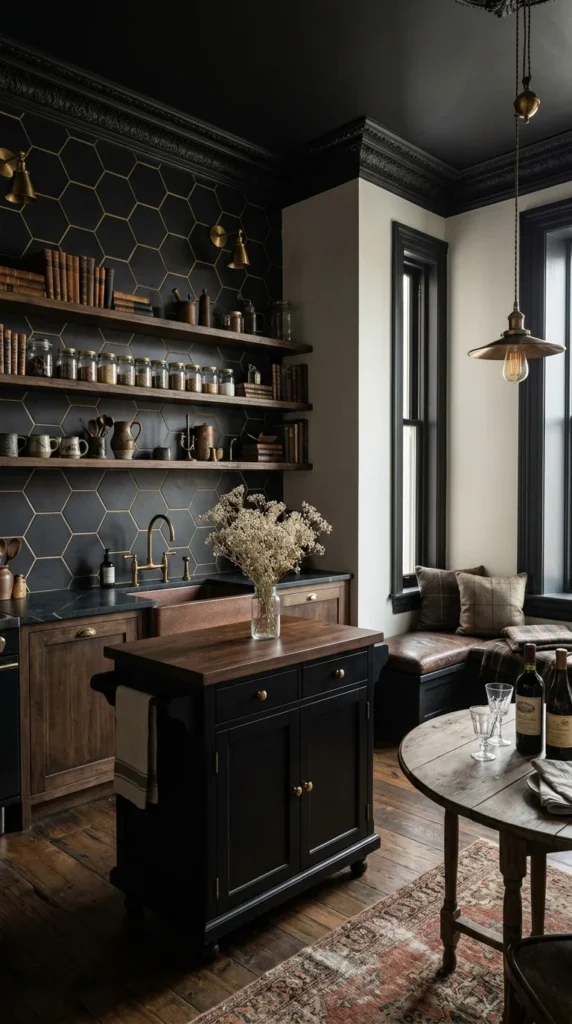
A hexagon tile backsplash in matte black, outlined in brass grout lines, gives this kitchen its most distinctive detail—a pattern that reads as jewelry-like rather than purely functional. The same black extends up to the ceiling and crown molding, while warm wood open shelving nearby holds labeled spice jars and stacked hardcover books.
A built-in leather banquette with a plaid throw pillow sits beside a tall window, offering a quieter seating nook away from the main workspace. A small kitchen cart in black and wood serves as a movable prep surface, and a round wood table set with wine bottles and glassware suggests the room doubles as a place to linger, not just cook.
Time & Cost: Hand-set hexagon tile with contrasting grout lines takes considerably longer to install than a standard subway tile pattern—budget extra time in the schedule if this level of detail is part of the plan.
Deep Green Walls With Oxblood Trim
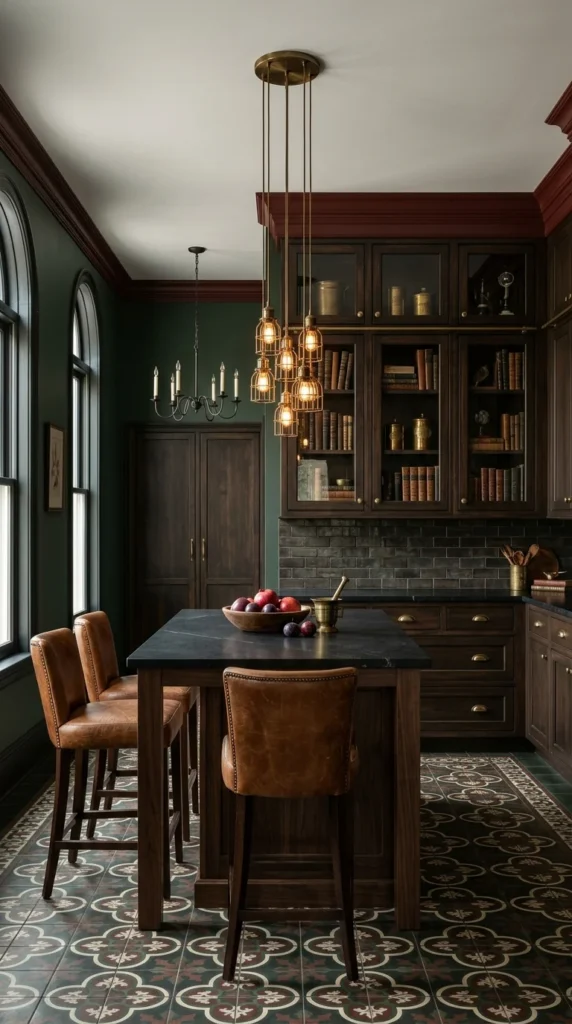
This kitchen pairs two saturated colors rather than one, with deep green walls meeting oxblood-red crown molding along the ceiling line. Arched windows framed in black bring in soft daylight without competing with the richly colored walls, and a patterned tile floor in muted green and burgundy ties the two tones together at ground level.
A cluster of cage-style pendant lights hangs above a black soapstone island, and glass-front cabinets nearby display stacked books alongside jars and small collectibles. Brown leather stools with nailhead trim pull up to the island, offering a casual counterpoint to the room’s otherwise formal color palette.
Alternative Approach: Pairing two dark colors on walls and trim is a bolder commitment than a single dark cabinet color. A safer entry point is painting just the ceiling or crown molding in a contrasting dark tone while keeping the walls a lighter neutral.
Oxidized Copper Paneling Beside a Garden Door
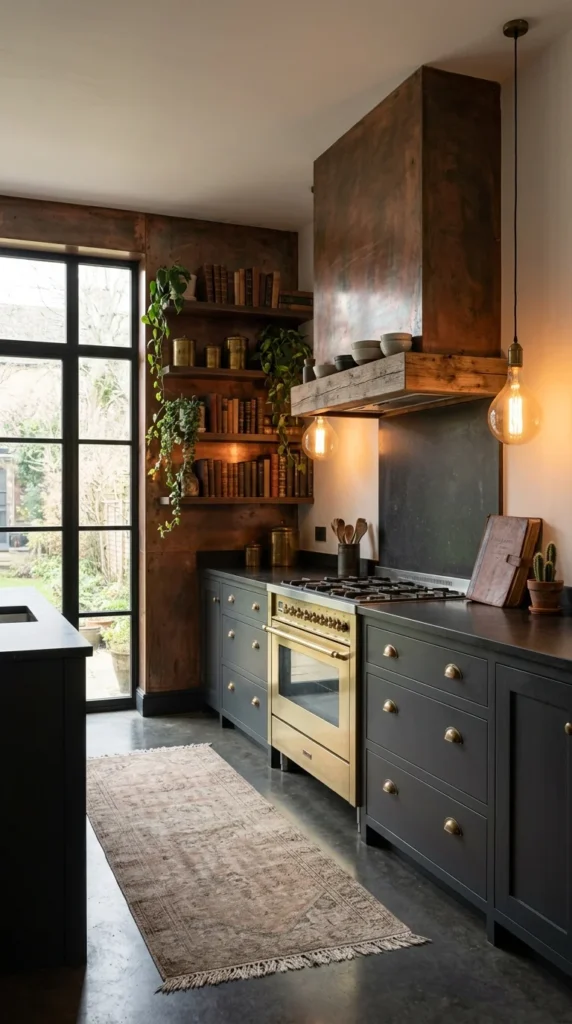
Weathered, oxidized copper paneling covers both the range hood and an adjacent wall in this kitchen, its uneven patina reading almost like a painted mural rather than a metal surface. Charcoal cabinetry throughout the rest of the room stays flat and matte, letting the copper’s texture stand out by contrast.
Open wood shelving beside a glass garden door holds stacked books and trailing plants, softening what could otherwise be a fairly industrial material palette. A single bare bulb pendant and a worn runner rug on a polished concrete floor keep the room grounded, while a small cactus and a leather-bound notebook on the counter suggest a kitchen used as much for reading as for cooking.
Budget Note: A genuine oxidized copper finish like this is achieved through a chemical patina process on real copper sheeting, which costs significantly more than a printed or painted faux finish—worth requesting a physical sample before committing to the material at scale.
Charcoal Cabinetry and a Cluster of Amber Glass
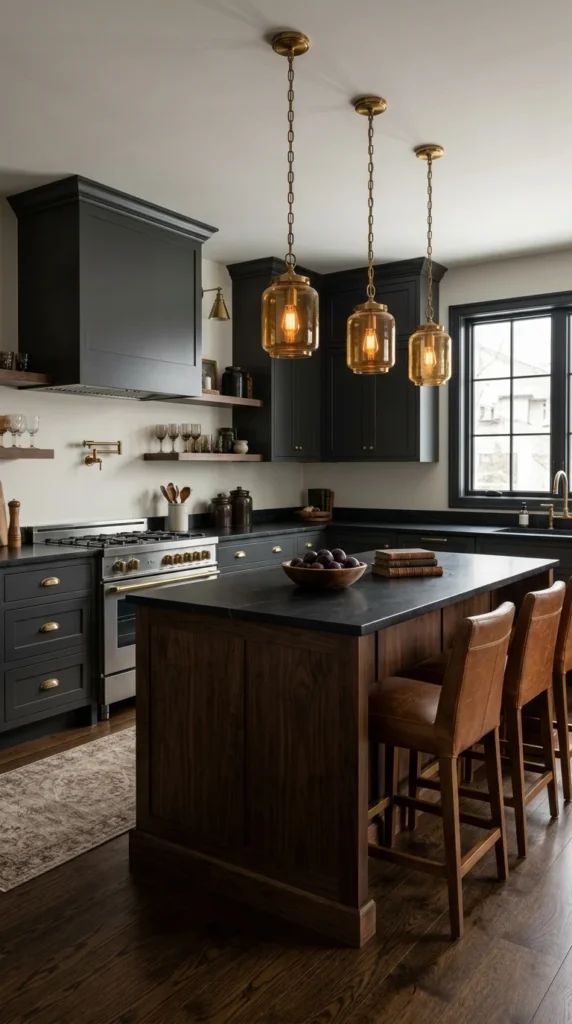
Charcoal-painted cabinetry sets a cool, even base throughout this kitchen, warmed considerably by a cluster of three amber glass pendants hanging above the island. Their honeyed glow is the room’s clearest nod to old library lighting, softening what could otherwise be a fairly stark, monochrome space.
A wood-toned island with a black soapstone top sits at the center, paired with brown leather stools that echo the amber tone of the pendants above. Open shelving nearby holds stemmed glassware and stacked books, and a bowl of dark plums on the island adds the room’s only strong color note.
Worth noting: Amber- or smoked-glass pendants tend to warm a room’s overall light temperature more effectively than clear-glass fixtures with a warm bulb alone—a detail worth testing with a single fixture before committing to a full cluster.
Frequently Asked Questions
Does a dark academia kitchen need black cabinets? No—as these examples show, deep green, oxblood, and stained or natural wood all achieve the same mood, and several of the rooms above use color rather than black as their main cabinet tone.
Is this style hard to keep looking clean? Dark surfaces show water spots and fingerprints more visibly than white ones in some finishes, particularly matte black, so a honed or leathered stone counter and a quick daily wipe-down tend to work better than a high-gloss finish.
What’s the fastest way to add the look without a renovation? Open shelving stocked with real books, brass or amber-glass pendant lighting, and a patterned vintage-style rug are the three details that show up across nearly every kitchen above and require no structural changes.
Can a small kitchen handle this much dark color? Yes, though it helps to keep at least one element—a window, a lighter countertop, or brass fixtures—reflecting light, so the room doesn’t lose all sense of depth in a tighter footprint.
Bringing It Together
The kitchens above rely on more than paint color to earn the dark academia label—stained glass, real books, aged copper, and patterned tile all carry as much weight as any wall tone. That layering is what keeps a dark kitchen from reading as simply dim: every room here gives the eye somewhere specific to land, whether that’s a hanging pot, a stack of spines, or a single glowing pendant against all that shadow.
One Response