
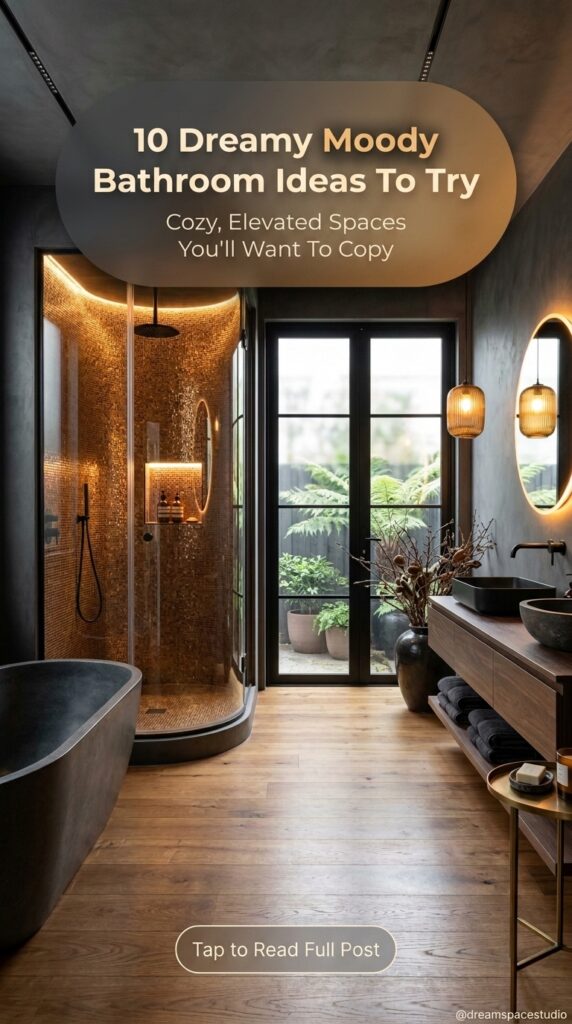
There’s a difference between a dark bathroom and a moody one, and most people only notice it once they’ve lived with the wrong version. A dark bathroom without a plan just feels like a cave—cold tile, one overhead bulb, and a room you want to leave as fast as possible. A moody bathroom, done right, does something else entirely. It uses shadow the way a good restaurant uses it: to make you slow down.
The ten spaces below all lean into black, charcoal, and deep brown palettes, but none of them read as gloomy. Warm brass fixtures, layered lighting, natural wood, and living plants keep every one of these rooms feeling inhabited rather than closed off. Here’s what makes each one work.
1. A Curved Shower That Turns Gold Under Its Own Light
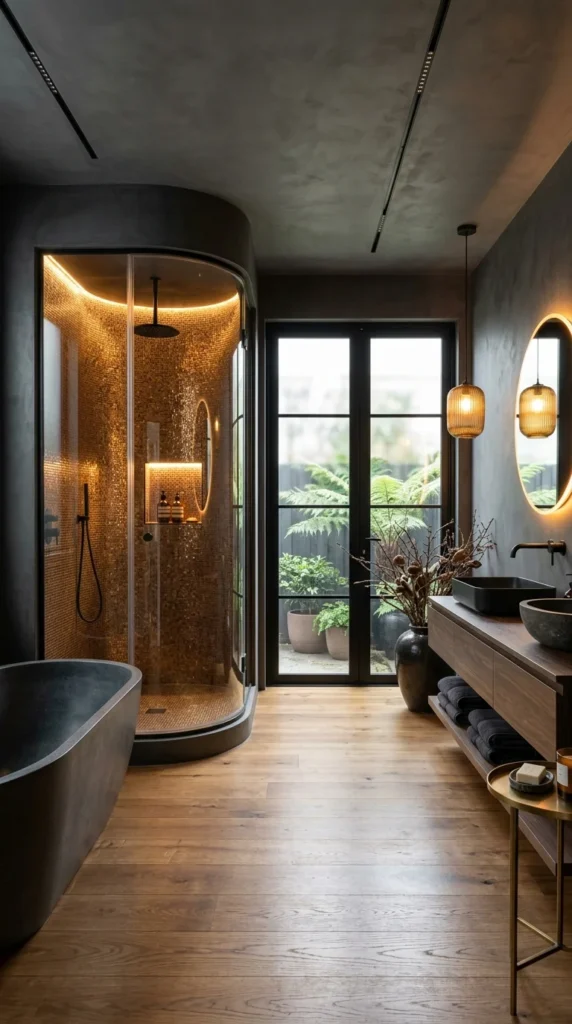
The rounded glass enclosure is the first thing that sets this bathroom apart from a standard rectangular layout. Curved walls are harder to build and more expensive to tile, which is exactly why they still feel like a splurge decades after they first appeared in high-end hotel design.
Inside, the shower is lined with small gold mosaic tile that catches the recessed lighting built into the curve of the ceiling. Outside the enclosure, the walls stay in flat matte charcoal—a deliberate move that keeps all the shine contained to one spot instead of scattering it across the whole room. Warm oak flooring and a pair of amber pendant lights soften the transition between the metallic shower and the black stone tub and vessel sinks nearby.
💡 Pro Tip
Mosaic tile inside a shower enclosure only reads as luxurious if the grout lines stay thin and consistent. Ask your installer for a rounded interior corner piece rather than mitered tile—it prevents the visible seam that makes curved showers look budget rather than bespoke.
2. Marble That Turns a Small Footprint Into a Spa
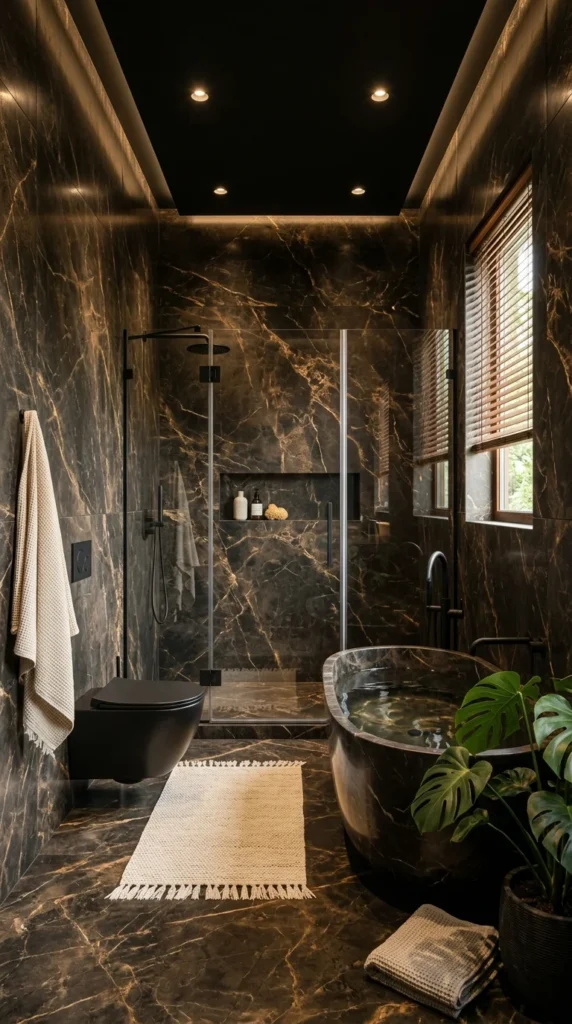
Every surface in this bathroom—floor, walls, ceiling trim—is wrapped in the same dark, gold-veined marble, and that continuity is what makes a fairly compact room feel expansive instead of boxed in. When a material doesn’t stop at a chair rail or a half-wall, the eye has nowhere to land and register the room’s actual size.
The matte black toilet and glass-walled shower disappear into the marble background rather than competing with it, while the deep soaking tub sits front and center, filled and ready. A woven cream runner and a monstera plant are the only elements that break from the stone, and they do it on purpose—without a soft, organic counterpoint, this much polished marble would tip into showroom territory instead of feeling lived-in.
📌 Important Note
Full-room marble like this depends entirely on consistent veining and slab-matching. Cheaper porcelain lookalikes can mimic the color convincingly, but the pattern usually repeats in an obvious grid—worth checking samples under the same lighting the bathroom will actually have before committing.
3. Stacked Stone Walls Built Around a Single Shaft of Light
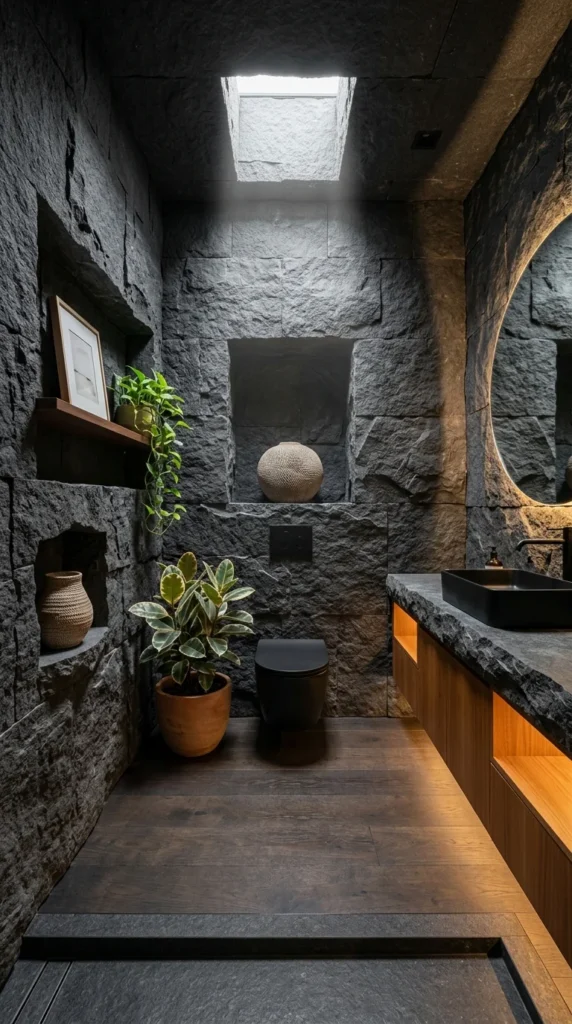
Raw, chunky stacked stone covers nearly every surface here, and it’s the kind of material that could easily feel like a cellar without the right lighting plan. The fix in this room is a single rectangular skylight positioned directly above the walkway, dropping one clean shaft of daylight into an otherwise enclosed space.
Small carved niches interrupt the stone at different heights, holding a framed print, a woven vase, and a scattering of trailing plants—details that keep the texture from feeling monolithic. A warm wood vanity with a black vessel sink and an amber-lit round mirror anchors the far end, giving the eye a soft landing point after all that rough stone.
⚠️ Warning
Stacked stone absorbs light instead of bouncing it back, which means a single overhead fixture usually isn’t enough. Skipping supplementary lighting — a skylight, wall sconces, or under-shelf LEDs — is the most common reason this look ends up feeling like alighting—ad of a retreat.
4. Exposed Brick PairedLEDs—isUnexpected Red
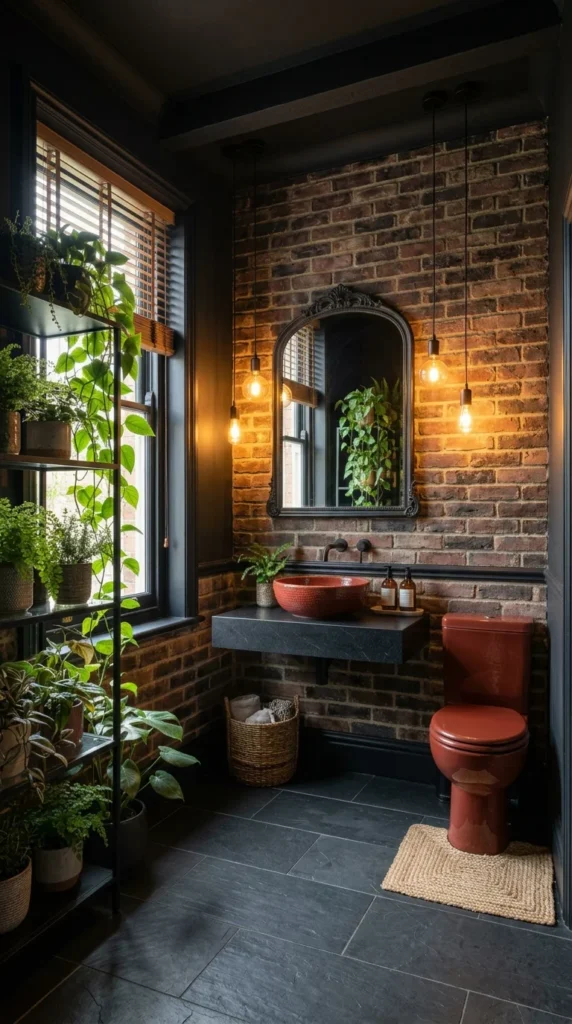
Brick is a material most people associate with kitchens and living rooms, but here it fills an entire bathroom wall and becomes the star of the room. Rather than softening the brick with a neutral fixture, this space commits to a deep brick-red vessel sink and a matching red toilet — a color choice bold enough that it could only work because the brick already set that warm, saturated tone.
An ornate black-framed mirror adtoilet—atly formal note against all that rough texture, while pendant bulbs on exposed cord hang at staggered heights for an unfussy, almost workshop feel. A dense wall of potted plants along the window does the real work of keeping the room from reading as too industrial or too cold.
Recreating This Look: Budget Tiers
💚 Affordable: Brick-effect peel-and-stick wallpaper behind a single vanity wall, paired with an inexpensive colored vessel sink. 💛 Mid-Range: Reclaimed brick veneer panels installed on one accent wall, with a mid-tier ceramic sink in a saturated color. 💎 Investment: Full structural brick exposure with custom mortar pointing and a hand-glazed vessel sink sourced from a specialty maker.
5. Slate Walls Cooled Down With String Lighting
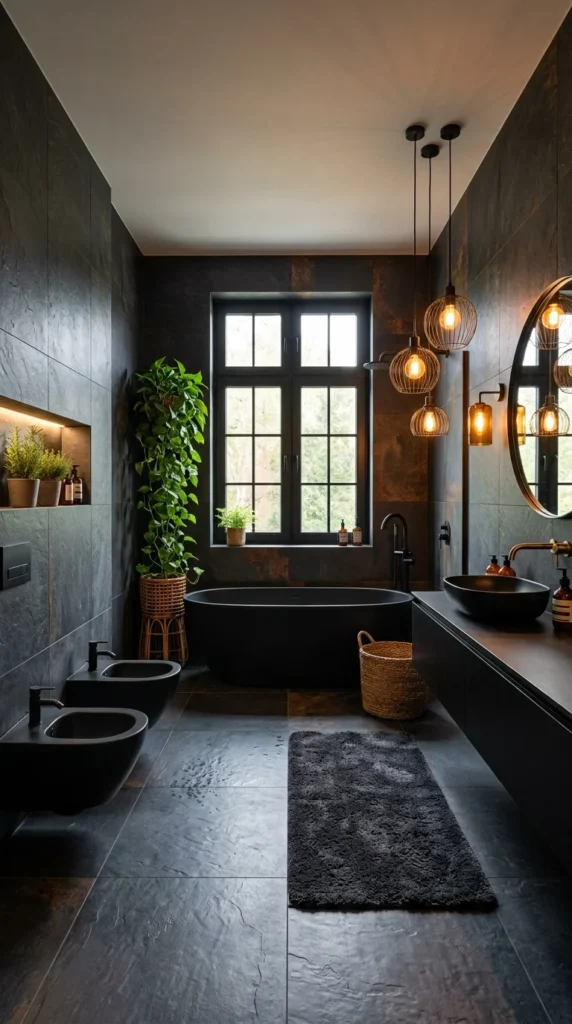
Slate tile covers the walls and floor of this bathroom in a uniform, almost architectural gray-black, and the room leans into that coolness rather than fighting it. A long, freestanding, black tub sits at the far end beneath a window, flanked by a matching pair of black bidet and toilet—a fully coordinated fixture suite that keeps the room from feeling patchwork.
Where this space avoids feeling severe is in the lighting: a cluster of wire-cage pendants hangs at staggered heights near the vanity, each one holding a warm amber bulb. That single cluster does more to soften the room than any amount of added color could, proving that warmth doesn’t always have to come from materials—sometimes it just comes from where the light sits.
Slate Bathroom Checklist
☐ Matte, not polished, slate—polished slate shows water spots almost immediately. ☐ At least one warm light source at eye level, not just overhead. ☐ A textured bath mat or rug to break up the uniform gray ☐ A tall plant for scale and a living contrast to the stone ☐ Matte black fixtures throughout to avoid visual competition with the slate’s natural sheen
6. A Chevron Wood Wall That Frames a Forest View
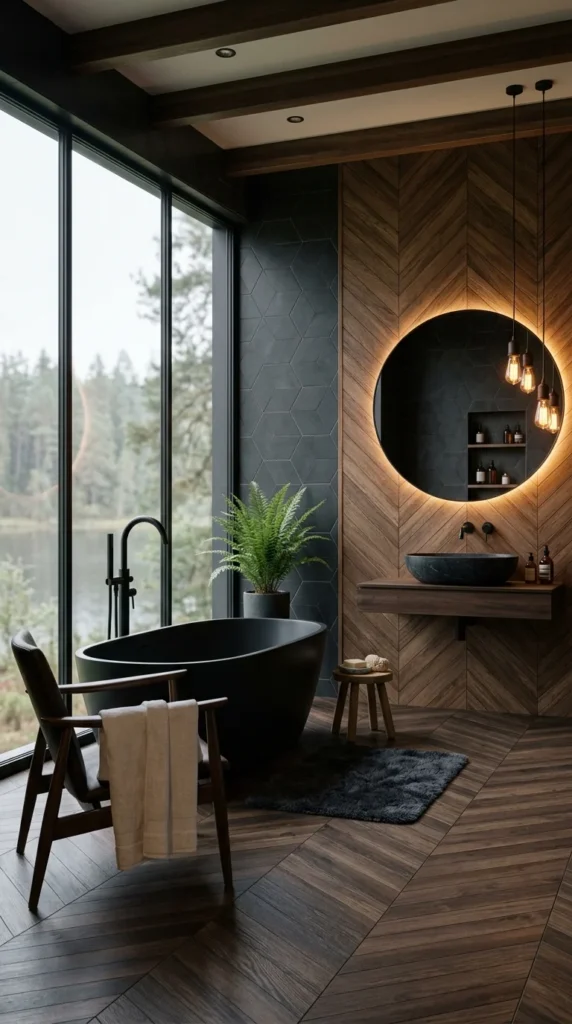
Floor-to-ceiling windows on one side of this bathroom open onto a lake and treeline, and the design around it is built to complement that view rather than distract from it. A wall of dark chevron-pattern wood tile runs behind the vanity, with a large round mirror set into it and backlit so it glows from the edges rather than glaring straight into the room.
A black oval tub sits directly in front of the glass, positioned so bathing becomes an outdoor experience without actually being outdoors. A leather-and-wood accent chair off to the side gives the room a furnished, lived-in quality that a lot of bathrooms skip entirely in favor of pure function.
💡 Pro Tip
Chevron and herringbone wood tile need a wall that’s genuinely flat before installation—any waviness in drywall becomes obvious once the angled pattern is laid, so this is one finish worth having professionally leveled first.
7. Art Deco Drama in Black, Marble, and Brass
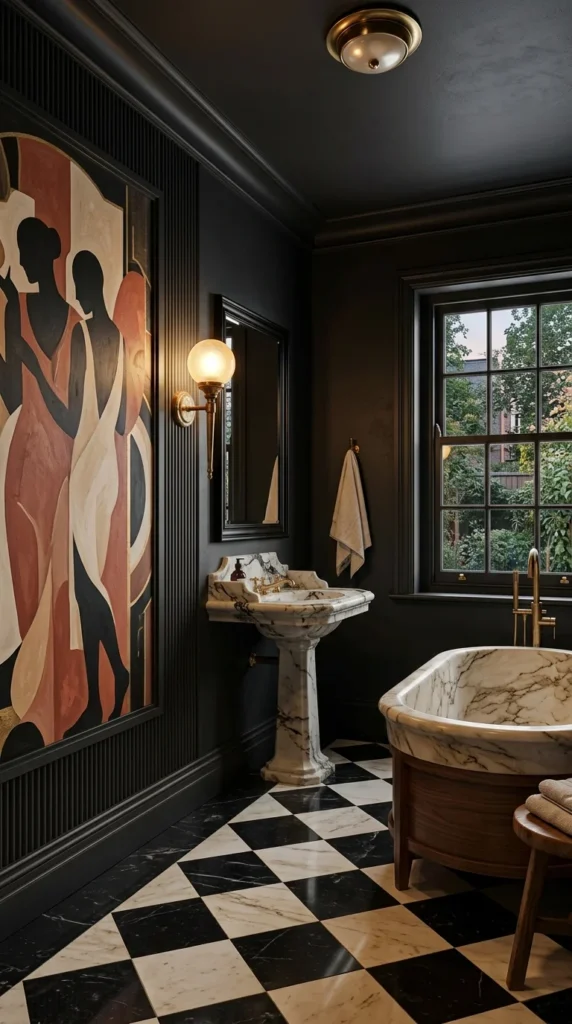
Where most moody bathrooms lean rustic or industrial, this one goes fully formal. Black-and-white checkerboard marble flooring anchors the room in a pattern that’s instantly recognizable as art deco, while matte black walls and crisp white trim keep the palette disciplined rather than busy.
A carved marble pedestal sink and a wood-clad marble tub bring old-world craftsmanship into the room, and a warm brass sconce beside the mirror ties the metal tones together without introducing a third competing finish. The real showstopper is the oversized figurative art panel on the far wall — its terracotta and cream tones are the only warm color in an otherwise black-and-white room, and that restraint is exactly why it commands attention.
Two Ways to Approach a Checkerboard Floor
| Factor | Classic Blawall—its | Modern Charcoal & Cream |
|---|---|---|
| Best suited for | Period homes, formal spaces | Contemporary or transitional homes |
| Visual effect | Bold, high-contrast, timeless | Softer contrast, easier to update later |
| Pairs well with | Brass fixtures, marble | Matte black fixtures, warm wood |
| Risk if overdone | Can feel like a stage set | Can read as slightly flat without texture |
8. Concrete Walls Opened Up to a Jungle
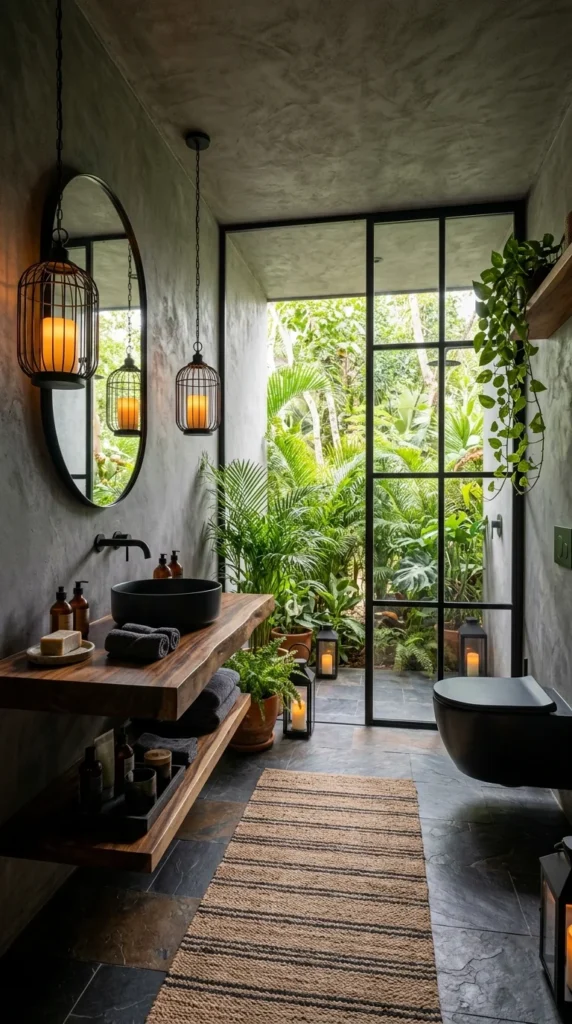
Smooth, pale concrete covers the walls and ceiling of this bathroom, and on its own that material could feel stark. What changes everything here is the wall of black steel-framed glass along one side, opening the room directly onto dense tropical greenery just outside.
A live-edge wood vanity with a round black vessel sink brings warmth into a space that would otherwise skew industrial, and a cluster of wire lantern pendants—each holding a real candle rather than a bulb—adds flickering, irregular light that no ceiling fixture could replicate. A striped jute runner grounds the concrete floor underfoot, and potted ferns tucked along the vanity blur the line between the indoor tile and the jungle just beyond the glass.
📌 Important Note
Real candles in pendant fixtures look extraordinary in photos, but they need genuine airflow and a non-flammable surrounding material to be safe day-to-day. In a fully enclosed bathroom, flameless LED candles with a flicker effect deliver nearly the same glow without the upkeep.
9. A Ladder Shelf That Turns Into a Living Wall
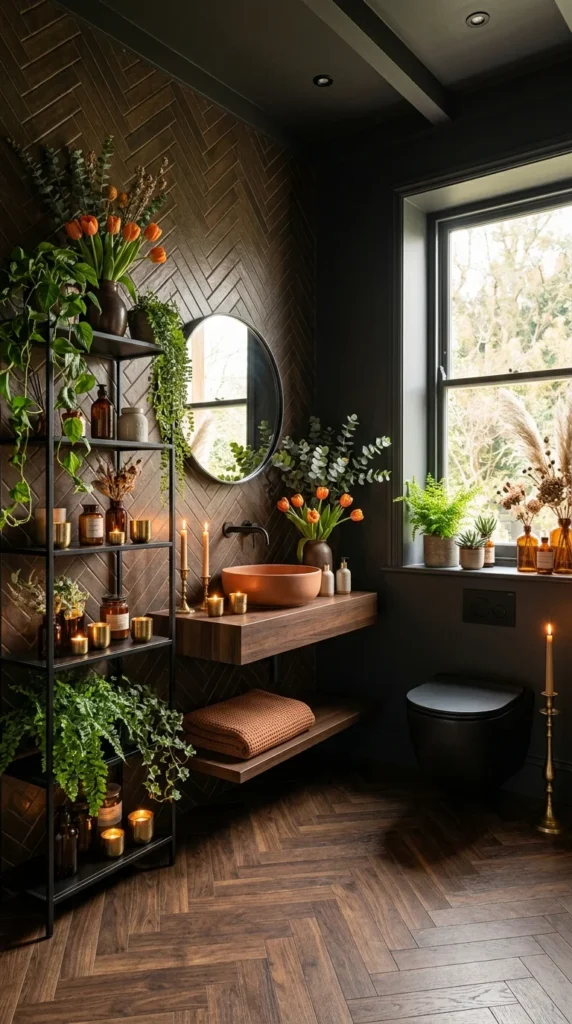
Herringbone-pattern wood tile covers the far wall of this powder room, but it’s almost secondary to the black metal ladder shelf standing in front of it, packed with trailing plants, amber candles, and small glass bottles. The shelf does more to define the room’s character than any single fixture does.
A terracotta vessel sink sits on a floating wood shelf below a round mirror, its warm clay tone picking up the orange tulips arranged nearby—a small, deliberate color echo that keeps the room from reading as purely dark. The black walls and ceiling recede into the background, letting the greenery and the warm terracotta take center stage instead.
⚠️ Warning
A densely styled shelf like this can tip into clutter fast if every item is roughly the same size. Vary the heights deliberately—tall trailing plants at the top, squat candles and bottles lower down—so the eye has a clear path through the arrangement instead of scanning a flat wall of stuff.
10. Textured Concrete With a Built-In Glow
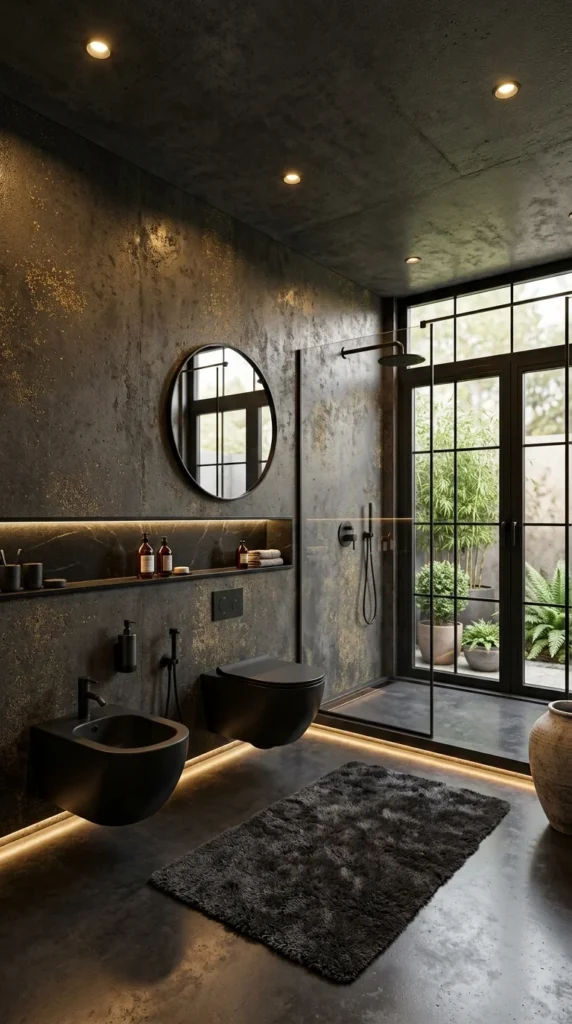
Rough, hand-troweled concrete walls with flecks of gold pigment give this bathroom a finish that looks almost geological—closer to weathered rock than a typical painted surface. That texture alone would carry most of the room’s visual interest, so the fixtures stay purposefully simple: a matte black wall-hung toilet and bidet, a round mirror, and a glass-walled shower with a garden view through black steel-framed doors.
The real signature move is the strip lighting hidden along the base of the walls and vanity, casting a soft amber glow upward across the textured surface rather than down onto the floor. That uplighting is what keeps a room this dark from ever feeling flat—shadows fall in the right places instead of everywhere at once, and the concrete’s texture only becomes fully visible because of how the light grazes across it.
💡 Pro Tip
Hidden LED strip lighting reads as expensive largely because of what you don’t see—the fixture itself. Recessed channels or a simple lip of trim to hide the strip make the difference between a glowing wall and a visible light bar running along the baseboard.
Final Thoughts
None of these ten bathrooms rely on black paint alone to create their mood. Every one of them pairs dark surfaces with something that pushes back against the darkness—a shaft of daylight, a cluster of warm bulbs, a wall of real plants, or a single saturated color. That balance is the actual formula behind a moody bathroom that feels luxurious rather than closed-in: pick one dominant dark material, then be deliberate about where the warmth and light come from. Skip that second half, and even the most expensive stone will just look like an unfinished basement.
Frequently Asked Questions
Will a dark bathroom make a small space feel smaller?
Not necessarily. A single continuous dark material — the samaterial—thent running floor to ceiling without a break — often makbreak—oftenthroom feel more expansive than a room chopped up by contrasting colors, because there’s no visual stopping point for the eye to measure the room against.
What’s the biggest mistake people make with moody bathrooms?
Relying entirely on a single overhead light. Dark surfaces absorb far more light than white ones, so a bathroom that would feel adequately lit in white tile can feel dim and flat in black or charcoal unless layered lighting — sconces, under-cabinet strips, or lighting—sconces, to compensate.
Do moody pendants—isk in homes without much natural light?
Yes, though the lighting plan matters more in that case. Warm-toned bulbs, layered fixtures at different heights, and reflective materials like polished brass or glass all help a windowless dark bathroom avoid feeling like an enclosed box.
Is matte black hardware harder to maintain than chrome or brushed nickel?
Matte black shows water spots and mineral buildup less than polished chrome, but it can show fingerprints and scratches more visibly over time. A quick wipe-down after use keeps it looking sharp, and most matte black fixtures are coated to resist the fading that happens with cheaper black finishes.
What plants actually survive in a low-light bathroom?
Pothos, snake plants, and ZZ plants tolerate low light and humidity well, making them reliable choices for bathrooms without much of a window. Ferns and monstera need brighter indirect light, so they’re better suited to bathrooms with a skylight or a larger window nearby.
How do I keep a dark bathroom from feeling cold?
Warmth in a dark bathroom almost always comes from three places: wood tones, amber-toned lighting, and texture. A room with black tile, warm oak flooring, and a couple of low-wattage warm bulbs will read as cozy, while the same black tile under a single cool-white overhead light will read as sterile.
2 Responses