
There is a specific kind of disappointment that comes with buying a rattan chair, a jute rug, and a few string lights, arranging them exactly like the photo, and still ending up with a patio that feels like leftover furniture instead of a finished space. That gap between the picture and the actual backyard is where most boho patio attempts quietly fall apart — not because the pieces were wrong, but because the reasoning behind the arrangement never made it into the caption.
This roundup looks at ten patios that get the boho approach right, and more importantly, explains why they work. Not just what to buy, but how texture, scale, and negative space are actually doing the job most people assume comes from the right throw pillow. Some of these setups are renter-friendly. Some need a bit more commitment. All of them are built around ideas that hold up once the photo shoot lighting is gone and it is just an ordinary Tuesday evening outside.
1. Peacock Chairs Do More Than Look Good Here
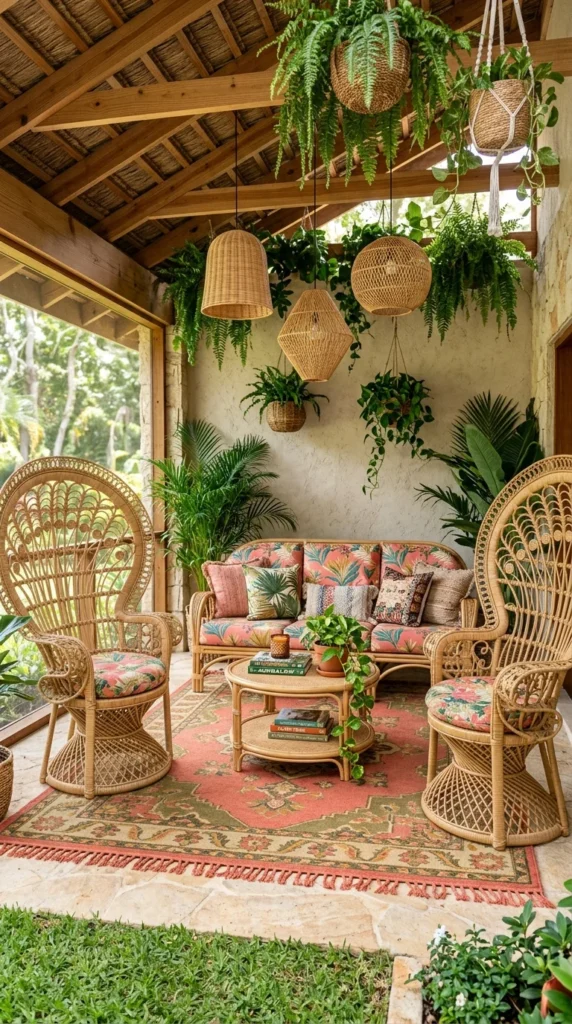
The two peacock chairs are the first thing the eye catches, and that is not an accident. Their fan-shaped backs sit taller than everything else in the room, which gives the seating area a natural frame before you even notice the sofa between them. That is visual weight balance at work — the heavier, more sculptural pieces anchor the corners, while the lighter rattan pendant lights overhead keep the ceiling from feeling heavy in return. What I find interesting is how the hanging plants are doing double duty. They soften the transition between the wood beams and the wall, but they also block direct light from hitting the cushions straight on, which matters more than it looks like in a covered patio this open to the yard. The layered rug underneath grounds the whole arrangement without competing for attention.
2. This Pergola Is Basically a Lighting Lesson
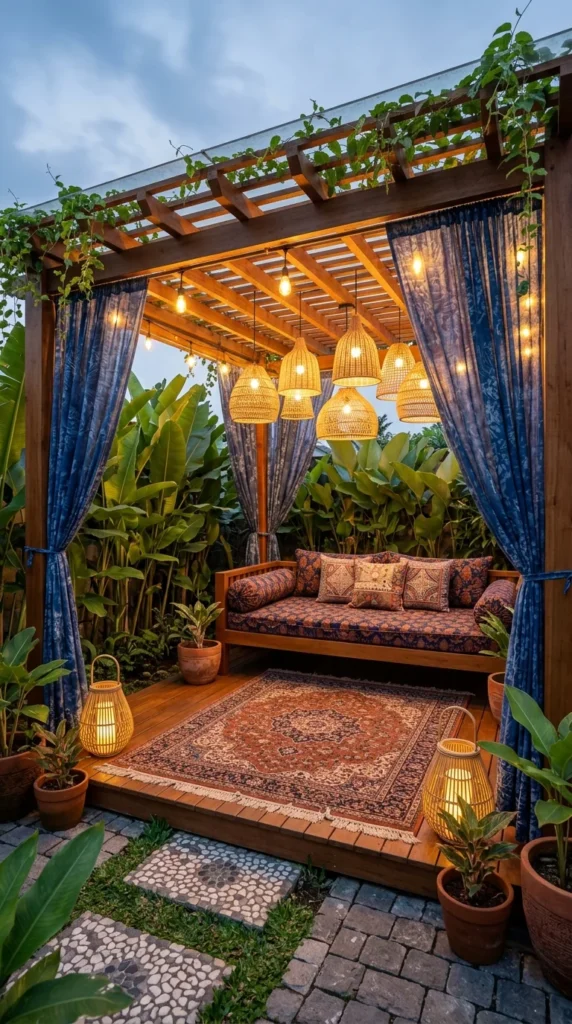
Honestly, the string lights and the cluster of woven pendants are doing the heavy lifting in this photo, and I would not blame anyone for missing why it works so well at dusk specifically. Warm bulb tones against indigo curtains create a contrast that daylight photos of the same space would not deliver — this is a setup built for evening, not for a noon Instagram shot. The batik-patterned curtains pull double duty as a privacy layer and a texture contrast against the plain wood beams above them. Underneath, the daybed and layered rug keep the seating low and grounded, which stops the tall banana leaves outside from making the whole nook feel closed in. It sounds like a lot of patterns in one small space. It somehow is not.
3. A Round Pod Like This Is Not for Every Backyard
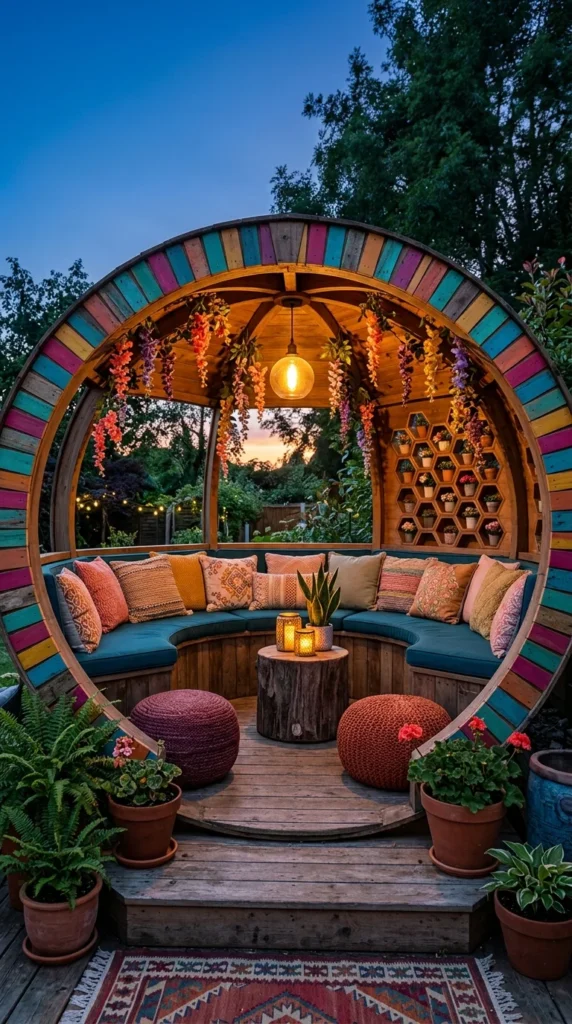
This one is a commitment, not a weekend project, and it is worth saying that upfront before getting into what makes it work. The rainbow-striped ring frame is a permanent structure, which means this idea skips right past the renter-friendly category most of this list lives in. What it gets in return is a genuinely rare kind of spatial tension — the circular opening frames the sunset like a porthole, so the eye is pulled outward even while the built-in bench pulls everyone’s attention inward toward the tree-stump table. The hexagonal planter wall on the right is a smart use of a surface that would otherwise sit empty. Faux wisteria garlands hang overhead, and I would guess most people replace them with something seasonal once the novelty wears off. Still, as a one-time backyard centrepiece, it earns its footprint.
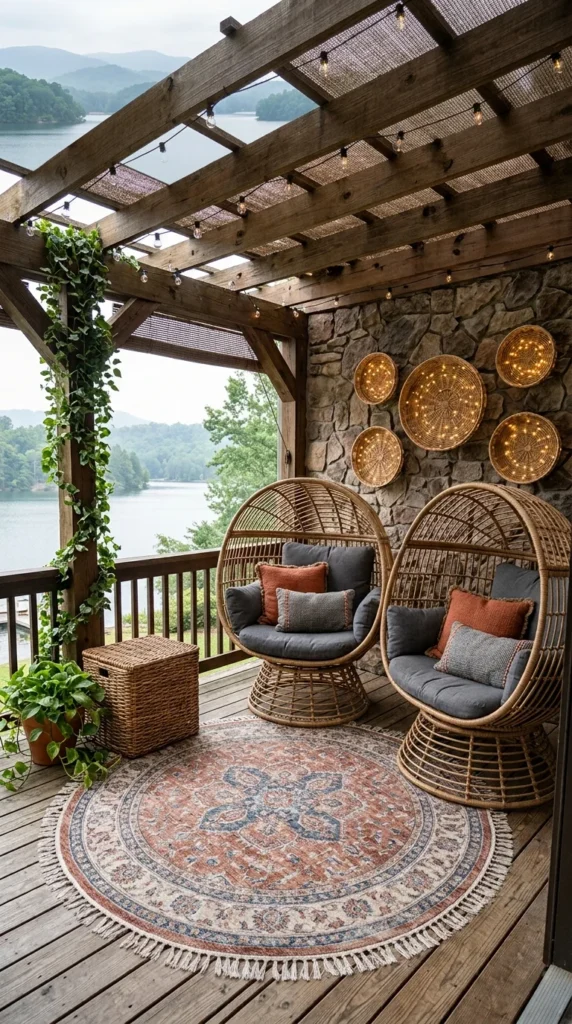
4. The Lake View Almost Steals the Show
Almost, but not quite — because the illuminated basket wall on the stone facade is working just as hard to hold attention once you look away from the water. Round rattan chairs replace the usual sofa-and-loveseat setup, and that decision fits this deck better than a bulkier piece would: two egg-shaped chairs leave clear sightlines to the mountains beyond the railing, where a full sectional would have blocked the view for anyone not sitting front and centre. The mesh-covered pergola roof filters direct light without going fully solid, which matters on a deck with this much open exposure. A round rug underfoot echoes the circular chairs above it, a small repetition that keeps the whole layout feeling deliberate rather than assembled piece by piece. Stone, rattan, and string lights share the space without competing for it.
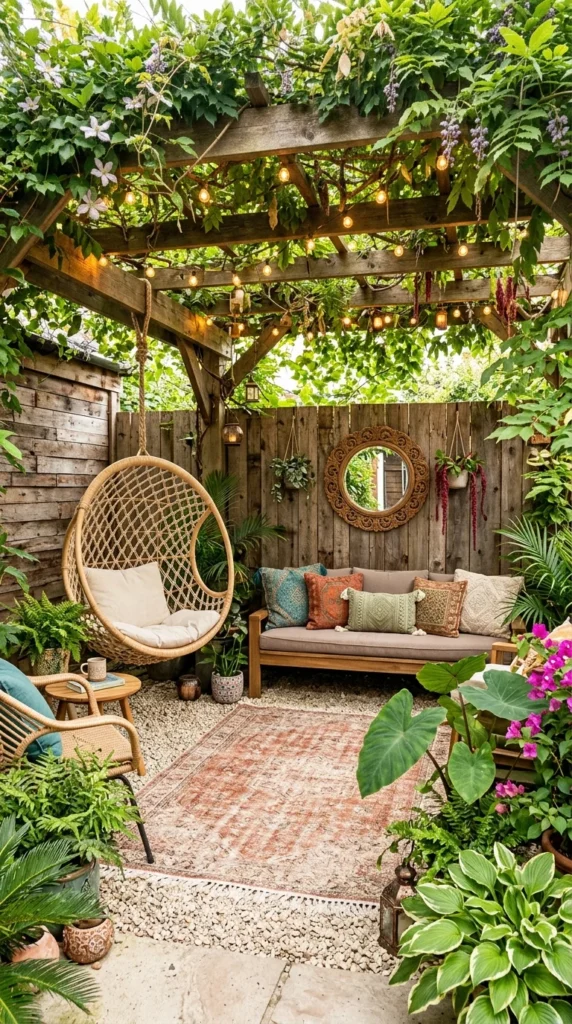
5. A Mirror Doing Quiet Work on a Wooden Fence
The round rattan mirror mounted on the fence is easy to walk past in a space this full of greenery, but it is solving a real problem. A patio boxed in by a solid wood fence on one side can start to feel closed off, and that mirror bounces back just enough light and reflected foliage to soften the wall without needing another plant. The hanging egg chair on the left is the clear focal point, its woven frame heavy enough to hold its own against the wisteria canopy overhead. Pea gravel underfoot is a practical, low-maintenance choice, and the layered rug on top gives the seating area a defined edge without needing a hard border. Wisteria vines threading through the pergola beams add seasonal colour that a fixed structure could not offer on its own.
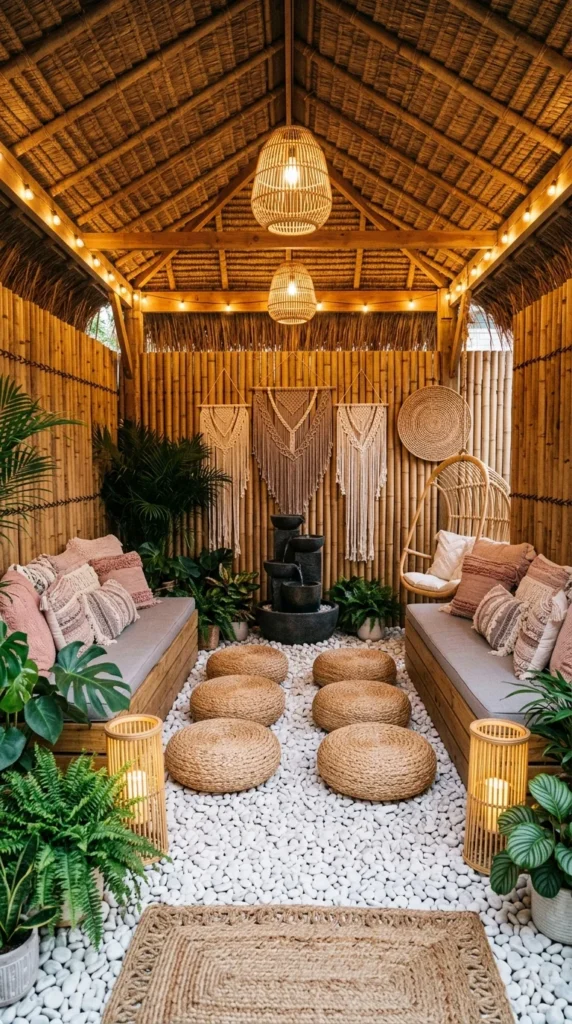
6. Six Woven Poufs and One Very Deliberate Sound
This is a straightforward space to describe, so I will not overcomplicate it: a bamboo-walled, thatch-roofed room built almost entirely from natural fibre, with a small tiered fountain doing something none of the other patios on this list attempt. Running water adds a sensory layer that a photo cannot fully capture — the sound fills the narrow room the way the macramé wall hangings fill the visual space above it. Six round jute pouffes sit in two loose rows across white pebble flooring, functioning as flexible extra seating that can be pulled toward either bench depending on the group size. The hanging egg chair tucked into the back corner is easy to overlook at first glance, positioned almost like a quiet reading nook rather than the room’s main event. Symmetry does a lot of the work here, more than colour or pattern.
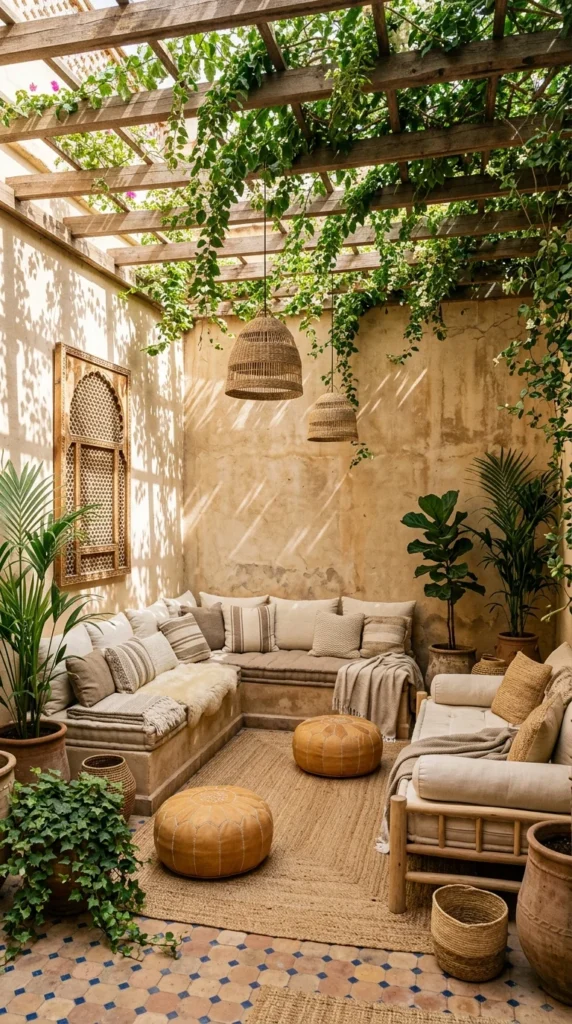
7. What the Pergola Slats Are Actually Doing to This Wall
Look at the plaster wall behind the sectional, and you will notice a pattern of light and shadow that is not painted on – it is the pergola slats overhead filtering direct sun into stripes across the surface. That is the kind of detail a photo captures better than a written description ever could, and it changes completely depending on the hour, which is worth knowing if this look is the goal. Two mustard leather pouffes sit low against a woven jute rug, their round shape breaking up what would otherwise be a room built entirely from rectangles and straight lines. The carved wooden wall panel on the left corner adds pattern without needing fabric or paint. Bougainvillaea spilling over the beams softens the transition between structure and sky, and the aged, sun-worn wall finish is doing more character work than any single piece of furniture in the room.
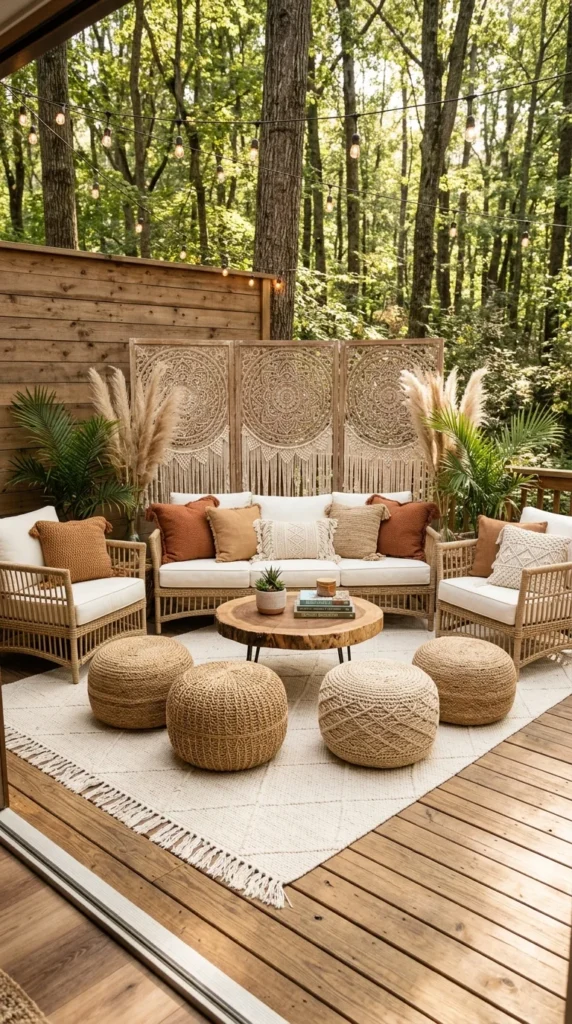
8. Personally, This Is the Setup I Would Take Home Tomorrow
Of everything covered so far, this is the one I would actually attempt in my own backyard, mostly because nothing here requires a fixed structure or a major renovation. The three-panel carved screen behind the sofa is doing the job a pergola or fence usually handles — creating a backdrop and a sense of enclosure — but it is freestanding, which means it works on a rented deck just as easily as an owned one. Pampas grass on either side softens the screen’s geometric pattern without hiding it completely. Four jute pouffes surround a live-edge wood coffee table, giving the layout flexible extra seating that a fixed bench could never offer. The string lights overhead are simple, almost an afterthought against the trees, and that restraint is exactly what keeps this space from feeling overdone. Sometimes the easiest idea to copy is also the smartest one.
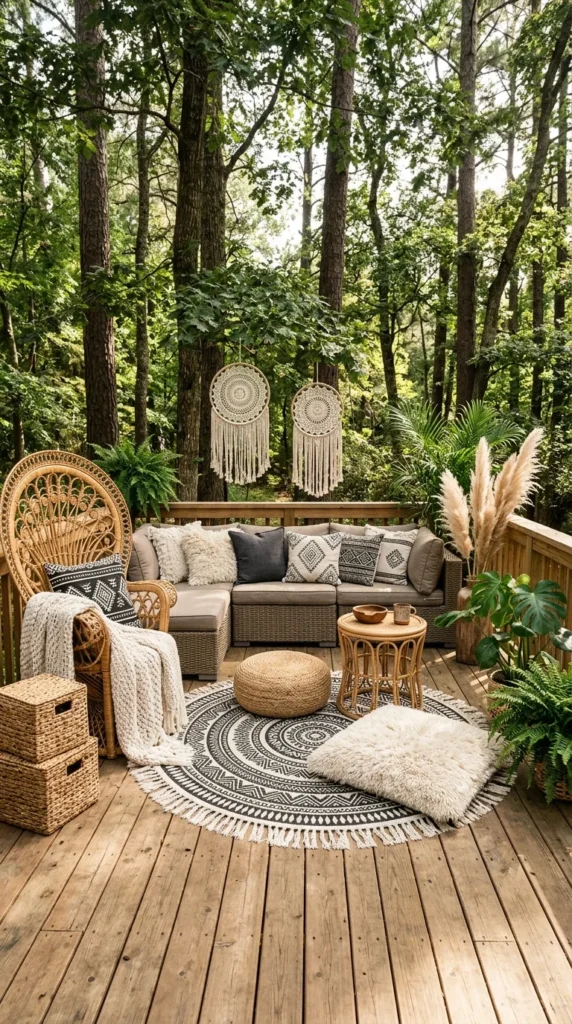
9. Two Dreamcatchers, One Woodland Backdrop
This is the most pared-back palette in the group — black, white, and natural wood, with the forest itself supplying all the green. The two macramé dreamcatchers hanging between the trees are simple, straightforward additions with no real function beyond visual anchoring, and that is fine. Not every element needs a job. The black-and-white geometric rug is the boldest pattern choice here, and it works because everything surrounding it, from the wicker sectional to the woven side table, stays neutral enough to let the rug read as the room’s statement piece rather than one voice in a crowd. A faux fur cushion tossed on the deck beside the rug adds a texture shift at floor level that most people forget to include. Pampas grass stands tall enough to hold its own against actual trees behind it, which is a taller order than it sounds.
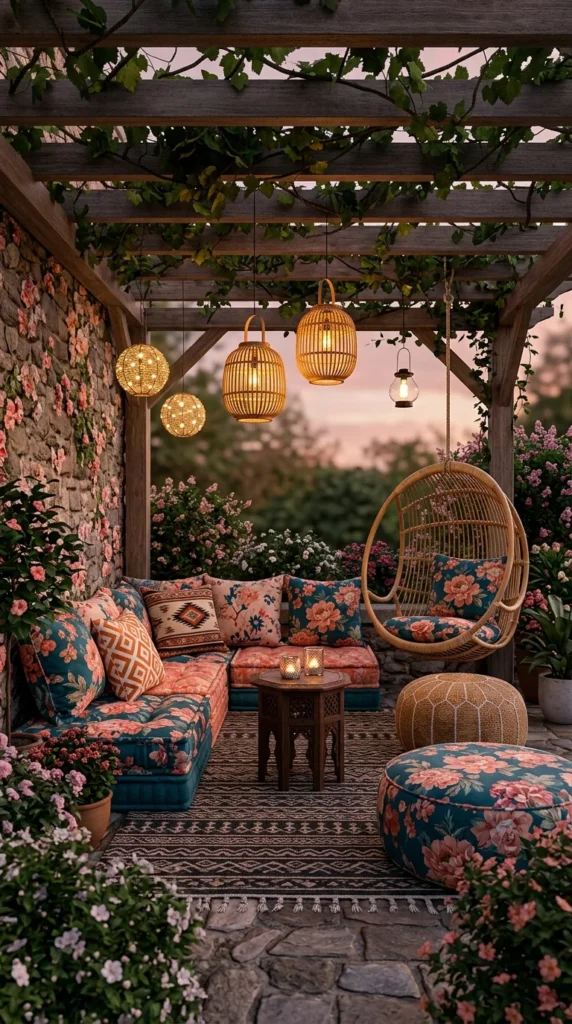
10. Where the First Rooftop Hidden Detail Trick Would Not Work Here
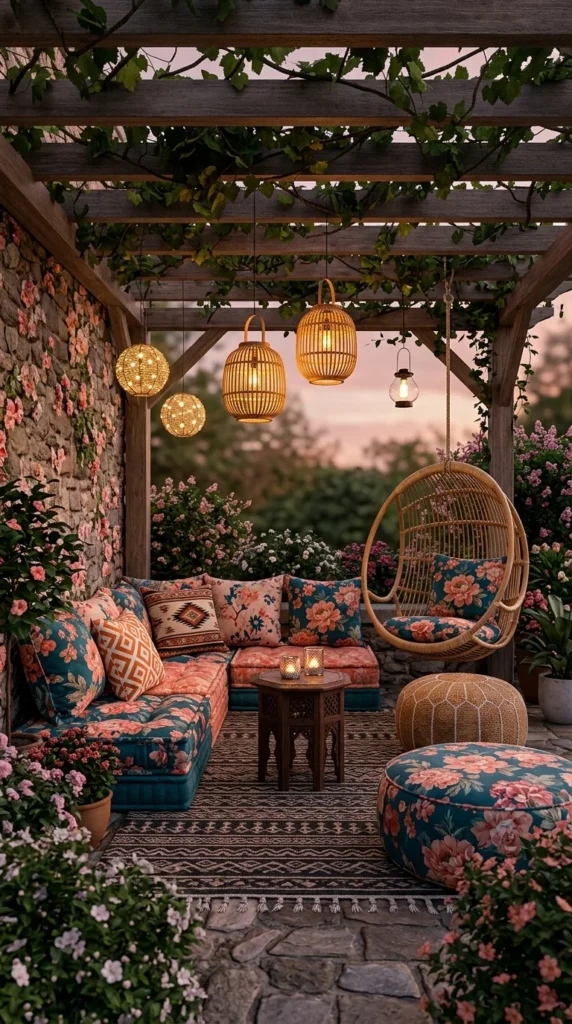
Unlike the neutral, restrained palette in the woodland deck a few sections back, this one goes fully in the opposite direction — florals, jewel-tone cushions, and a rose-covered stone wall all compete for attention at once, and somehow none of it clashes. What’s easy to miss is the small carved wooden side table between the sectional pieces; it is low enough to stay out of the sightline toward the hanging chair, which keeps the space feeling open despite how much pattern surrounds it. That hanging chair itself, with its floral cushion, is the one element repeating the sofa’s print rather than introducing something new, a small continuity choice that ties the whole seating area together. Warm lantern light against a dusk sky does a lot of the mood-setting work here, more than the furniture itself. This is a patio for someone who wants maximalism, not someone easing into boho for the first time.
Conclusion
After looking at ten very different takes on the same idea, one thing becomes clear: boho patio design is not a fixed look. It shows up as bamboo and running water in one backyard and as florals stacked on florals in another. What actually connects every space in this list is not a colour palette or a specific chair — it is the willingness to let texture, pattern, and greenery do more talking than perfectly matched furniture ever could. Some of these ideas need a weekend and a trip to a home store. Others need a carpenter and a lot more patience. Neither approach is more “correct” than the other. The real takeaway is smaller than it sounds: pick one structural idea — a hanging chair, a woven wall, or a cluster of pouffes — and build outward from there, instead of trying to recreate an entire photo at once. That is usually where these spaces start to feel real instead of staged.
FAQs
1. Do I need a permanent structure to create a boho patio? No. Several spaces in this list, like the freestanding carved screen or the round rug and pouffe arrangement, use movable, renter-friendly pieces instead of built-in pergolas or fixed walls. A permanent structure adds impact, but it is not a requirement for the style to work.
2. What is the easiest way to start a boho patio on a budget? Layering is usually more affordable than buying statement furniture first. A textured rug, a few patterned cushions, and one hanging plant can shift a plain patio toward boho without a large upfront cost, and pieces can be added gradually.
3. Does boho patio furniture require a lot of maintenance? It depends on the materials. Natural fibre pieces like jute, rattan, and untreated wood tend to need more upkeep in humid or rainy climates than synthetic wicker or treated outdoor fabric, so it is worth checking material care before committing to an all-natural look.
2 Responses